
The root-finding problem is one of the most important problems in Numerical Analyis. It arises in a wide variety of practical applications in physics, chemistry, biosciences, engineering, etc. As a matter of fact, determination of any unknown appearing implicitly led to the evolution of root-finding problem. Therefore, this paper focuses on the modification and analysis of a high order derivative-free iteration methods for finding roots of nonlinear algebraic equations of the form f (x) = 0. The methods require only one initial approximation. The proposed method is seen as an extension of the second-order Steffensen’s scheme, which is an Iterative method for approximating roots of non-linear equations which often breaks down when the derivative of the function value is zero or near zero at the point of iteration. This work therefore, seeks to introduce a method that overcomes such breakdown. The method herein is a combination of forward difference formula with Simpson’s quadrature in spirit of Steffensen. The idea is to modify the Steffensen’s method, which were recently developed to obtain derivative-free methods. The modified methods are shown to converge. We also describe how to obtain derivative-free methods to find solutions to multiple roots. Several numerical examples are provided to validate the theoretical order of convergence for nonlinear functions with simple roots and results obtained show the comparative advantage the proposed method has over well-known methods.
| Published in | Applied and Computational Mathematics (Volume 15, Issue 3) |
| DOI | 10.11648/j.acm.20261503.12 |
| Page(s) | 75-88 |
| Creative Commons |
This is an Open Access article, distributed under the terms of the Creative Commons Attribution 4.0 International License (http://creativecommons.org/licenses/by/4.0/), which permits unrestricted use, distribution and reproduction in any medium or format, provided the original work is properly cited. |
| Copyright |
Copyright © The Author(s), 2026. Published by Science Publishing Group |
Nonlinear Equations, Steffensen, Convergence
 . The derivative
  at the point
  is given by the forward difference operator as:
 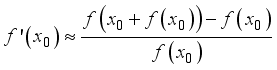 (2)
(2) 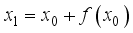
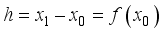 (3)
(3) 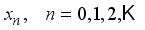 , the derivative of in Newton Raphson’s method is replaced by the forward approximation.
 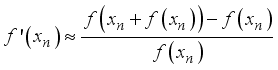 (4)
(4) 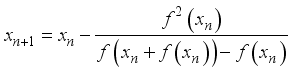 (5)
(5)  -process for quadratic convergence, with higher-order variants achieving super-quadratic (e.g., fourth-order) or even super-cubic convergence (e.g., order ~3.383) using more function evaluations per step, often via interpolating polynomials or parameter estimation, all while maintaining efficiency by avoiding costly derivative calculations, making them popular for complex problems.
 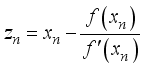 (6)
(6) 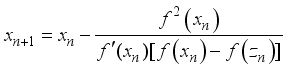 (7)
(7)  with
with 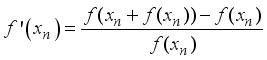 . For each step, the method requires two evaluations of the function and single evaluation of the derivative.
  (8)
(8) 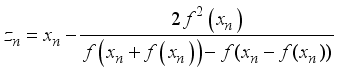 (9)
(9)  (10)
(10) 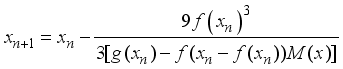 (11)
(11)  (12)
(12)  (13)
(13)  be a simple zero of sufficiently differentiable function
  for an open interval I. If
  is sufficiently close to
  , then the modified Steffensen method free from derivative has order of convergence three and satisfies the error equation.
  . We can write
  With
With 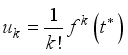 , k = 1, 2,... and
  be the error in
  . after n iterations i.e.
  .
. 
 (16)
(16)  in the equation (26), we obtain
 (17)
(17)  around the root by taking into consideration (17). Accordingly, we have
 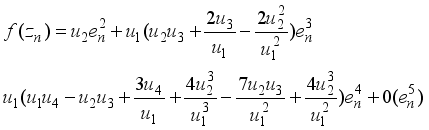 (18)
(18) 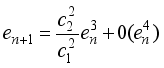 (19)
(19)  be a simple zero of sufficiently differentiable function
  for an open interval I. If
  is sufficiently close to
  , then the order of convergence m of the methods is of order m=2.
 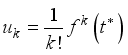 , and
, and  .
.  is sufficiently differentiable, first Taylor expand
  about
about  to obtain
  (20)
(20)  is
is  (21)
(21)  (22)
(22)  about α, first expand
 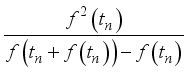 about
about  to obtain
 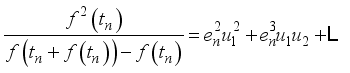 (23)
(23)  (24)
(24) 
 (25)
(25)  (26)
(26)  (27)
(27)  become
 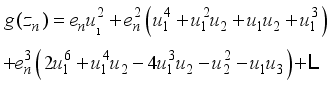 (28)
(28) 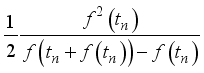 gives
gives  (29)
(29)  (30)
(30) 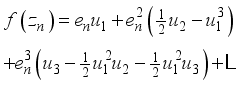 (31)
(31)  (32)
(32) 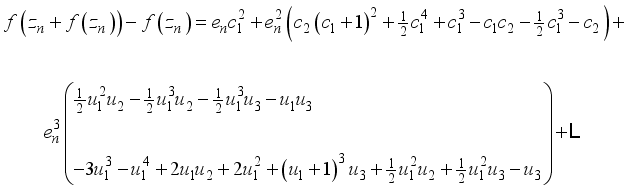 (33)
(33)  is given as
  (34)
(34)  (35)
(35) 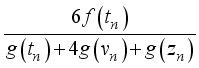 about
about  is
is  (36)
(36) 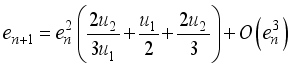 (37)
(37) s/n | Nonlinear Equations | Simple Root | Initial point |
|---|---|---|---|
1 |
|
|
|
2 |
|
|
|
3 |
|
|
|
4 |
|
|
|
5 |
|
|
|
6 |
|
|
|
7 |
|
|
|
Iterates (i) | Root (MSTM) | Root (NR) | Root (SM) | Root (NIM) |
|---|---|---|---|---|
1 | -0.613394 | 0.734536 | 7.91330 | 3.98861 |
2 | 0.376528 | 0.7390892 | 0.874395 | -4.47739 |
3 | 0.713909 | 0.739085 | 0.736226 | 0.520357 |
4 | 0.738968 | - | 0.739084 | 0.728841 |
5 | 0.739085 | - | 0.739085 | 0.739058 |
6 | - | - | - | 0.739085 |
Iterates (i) | Root (MSTM) | Root NR) | Root SM) | Root (NIM) |
|---|---|---|---|---|
1 | 0.498677 | 0.453698 | 0.265172 | 0.548969 |
2 | 0.510955 | 0.51058 | 0.50270 | 0.511279 |
3 | 0.510973 | 0.510973 | 0.510948 | 0.510973 |
4 | - | - | 0.510973 | - |
Iterates (i) | Root (MSTM) | Root (NR) | Root (SM) | Root (NIM) |
|---|---|---|---|---|
1 | 0.816451 | 0.5 | 0.553574 | Diverges |
2 | 0.638342 | 0.61006 | 0.619727 | |
3 | 0.619234 | 0.618997 | 0.619061 | |
4 | 0.619061 | 0.619061 | - |
Iterates (i) | Root (MSTM) | Root (NR) | Root (SM) | Root (NIM) |
|---|---|---|---|---|
1 | 0.796016 | 0.666667 | 0.8 | 0.790698 |
2 | 0.730373 | 0.730159 | 0.73857 | 0.743282 |
3 | 0.732071 | 0.732049 | 0.732122 | 0.732721 |
4 | 0.732051 | 0.732051 | 0.732051 | 0.732054 |
5 | - | - | - | 0.732051 |
Iterates (i) | Root (MSTM) | Root (NR) | Root (SM) | Root (NIM) |
|---|---|---|---|---|
1 | -0.223119 | Diverges | -0.233333 | Diverges |
2 | -0.53067 | -0.536487 | ||
3 | -0.817694 | -0.809952 | ||
4 | -1.07353 | -1.04799 | ||
5 | -1.27705 | -1.23887 | ||
6 | -1.39654 | -1.36606 | ||
7 | -1.42901 | -1.42127 | ||
8 | -1.43079 | -1.43056 | ||
9 | -1.4308 | -1.43079 | ||
10 | - | -1.4308 |
Iterates (i) | Root (NR) | Root (SM) | Root (NIM) | Root (MSTM) |
|---|---|---|---|---|
1 | 2.77558 | 2.53062 | 2.64056 | 2.33474 |
2 | 2.79838 | 2.6102 | 2.77668 | 2.71079 |
3 | 2.79839 | 2.73879 | 2.79832 | 2.79672 |
4 | - | 2.79680 | 2.79839 | 2.79839 |
5 | - | 2.79839 | - | - |
Iterates (i) | Root (NR) | Root (SM) | Root (NIM) | Root (MSTM) |
|---|---|---|---|---|
1 | 2.0769 | 0.852556 | -2.68597 | 1.07413 |
2 | 1.91056 | 3.4634 | 1.78590 | 1.58535 |
3 | 1.89562 | 1.26769 | 1.65651 | 1.85322 |
4 | 1.89549 | 1.88755 | 1.87742 | 1.89466 |
5 | - | 1.89547 | 1.89529 | 1.89549 |
6 | - | 1.89549 | 1.89549 | - |
 .
. MSTM | Modified Steffensen’s Type Method |
SM | Secant Method |
NIM | New Iterative Method |
NR | Newton-Raphson’s Method |
| [1] | Abdul_Hassan, N. Y. (2016). New Predictor-Corrector Iterative Methods with Twelfth-Order Convergence for Solving Nonlinear Equations. American Journal of Applied Mathematics, 4(4), 175-180. |
| [2] | Aboamemah, A. H., Gorgey, A., Razali, N., & Ibrahim, M. A. H. (2021). Secant Method Superiority Over Newton’s Method in Solving Scalar Nonlinear Equations. Turkish Journal of Computer and Mathematics Education (TURCOMAT), 12(3), 681–689. |
| [3] | Akinnukawe, B. F. and Muka, K. O., (2020). “L-stable Block Hybrid Numerical Algorithm for first order Ordinary Differential Equations”. Journal of Nigerian Society of Physical Sciences. Vol. 2, pp 160-165. |
| [4] | Alicia Cordero, Jose L. Hueso, Eulalia Martinez, Juan R. Torregrosa (2012). Steffensen Type Methods for Solving Nonlinear Equations. Journal of Computational and Applied Mathematics, Vol. 236 pp 3058-3064. |
| [5] | Alicia. Cordero, Juan R. Torregrosa (2007). Variants of Newton’s Method using fifth-order quadrature formulas. Applied Mathematics and Computation, Vol. 190 pp 686–698. |
| [6] | Alicia Cordero, José L. Hueso, Eulalia Martínez, Juan R. Torregrosa (2010), A modified Newton-Jarratt’s composition. Numerical Algorithm, Vol. 55 pp 87–99. |
| [7] | Amat S, Busquier S. (2006), On a Steffensen’s type method and its behavior for semismooth equations, Applied Mathematics and Computation 819–823. |
| [8] | Alarcón V, Amat S, Busquier S, López D. J (2008) A Steffensen’s type method in Banach spaces with applications on boundary-value problems, Journal of Computational and Applied Mathematics 243–250. |
| [9] | Amat S., S. Busquier S and Candela V (2002): A class of quasi-Newton generalized Steffensen methods on Banach spaces. Journal of Computational and Applied Mathematics, vol. 149, no. 2, pp. 397–406. |
| [10] | Azure, I., Aloliga, G., & Doabil, L. (2019). Comparative Study of Numerical Methods for Solving Non-linear Equations Using Manual Computation. Mathematics Letters, 5(4), 41–46. |
| [11] | Azure Isaac, Twum Boakye Stephen, Baba (2021): A New Trapezoidal-Simpson 3/8 Method for Solving Systems of Nonlinear Equations. American Journal of Mathematical and Computer Modelling; 6(1): 1-8. |
| [12] | Badr, E., Almotairi, S., & Ghamry, A. El. (2021). A comparative study among new hybrid root finding algorithms and traditional methods. Mathematics, 9(11), 1–15. |
| [13] | Badr, H.; Attiya, S.; Ghamry, A. E. (2022): Novel hybrid algorithms for root determining using advantages of open methods and bracketing methods. Alex. Eng. J. 61, 11579–11588. |
| [14] | Bazuaye, F. E. Nwachukwu, U. K (2024): Numerical Methods for Scientists and Engineers. |
| [15] | Burden, R. L., & Faires, J. D. (2011). Numerical Analysis (9th ed.). Brooks/Cole. |
| [16] | Chapra, S. C., & Canale, R. P., (2015). Numerical methods for engineers (7th ed.). McGraw-Hill. |
| [17] | Chen D (1989): On the convergence of a class of generalized Steffensens iterative procedures and error analysis,” International Journal of Computer Mathematics, vol. 31, pp. 195–203. |
| [18] | ChenJ. and ShenZ (2007) “Convergence analysis of the secant type methods,” Applied Mathematics and Computation, vol. 188, no. 1, pp. 514–524. |
| [19] | Chun C (2007): Some second derivative free variants of Chebyshev–Halley methods, Applied Mathematics and Computation 191 (2007) 410–414. |
| [20] | Chun, C., & Ham, Y. (2008): Some second-derivative-free variants of super-Halley method with fourth-order convergence, Applied Mathematics and Computation 195 (2008) 537–541. |
| [21] | Cowell, W. (1984): Sources and Development of Mathematical Software, Prentice-Hall Inc. |
| [22] | Dehghan M, H. (2010): Some derivative free quadratic and cubic convergence iterative formulas for solving nonlinear equations, Journal of Computational and Applied Mathematics 29: 19–30. |
| [23] | Dekker, T. J. (1969) Finding a zero by means of successive linear interpolation. |
| [24] | Ebelechukwu, C. O., Johnson, B. O., Michael, A. I., & Fidelis, A. T. (2018). Comparison of Some Iterative Methods of Solving Nonlinear Equations. International Journal of Theoretical and Applied Mathematics, 4(2), 22–28. |
| [25] | Ehiwario, J. C., & Aghamie, S. O. (2014). Comparative Study of Bisection, Newton-Raphson and Secant Methods of Root-Finding Problems. IOSR Journal of Engineering, 04(04), 1–7. |
| [26] | Gemechu, T. (2016). Root Finding With Some Engineering Applications. IJISET-International Journal of Innovative Science, Engineering & Technology, 3(6), 80–85. |
| [27] | Ezquerro J. A., Hernandez M. A. and Salanova M. A. (2000): A discretization scheme for some conservative problems. Journal of Computational and Applied Mathematics, vol. 115, no. 1-2, pp. 181–192, 2000. |
| [28] | Feng X, He, Y. (2007): High order iterative methods without derivatives for solving nonlinear equations, Applied Mathematics and Computation 186 (2007) 1617–1623. |
| [29] | Fernandez-Torres, G. A (2015). A novel geometric modification of the Newton-secant method to achieve convergence of order 1+ √ and its dynamics, Mod. Sim. Eng., art. ID 502854. |
| [30] | Gerald, C. F. and Wheatley, P. O. (1994) Applied numerical analysis. Fifth Edition, 40-75. |
| [31] | Grau M, Díaz-BarreroJ. J, (2006): An improvement to Ostrowski root-finding method, Applied Mathematics and Computation 173 (2006) 450–456. |
| [32] | Han D & Wang, X (1998): Convergence on a deformed Newton method,” Applied Mathematics and Computation, vol. 94, no. 1, pp. 65–72. |
| [33] | Han D & Zhu, J (2006) “Convergence and error estimate of a deformed Newton method,” Applied Mathematics and Computation, vol. 173, no. 2, pp. 1115–1123. |
| [34] | Hilout S. (2008): Convergence analysis of a family of Steffensen-type methods for generalized equations. Journal of Mathematical Analysis and Applications, vol. 339, no. 2, pp. 753–761. |
| [35] | Hui, Z., De-Sheng, L., & Yu-Zhong, L. (2009). A new method of secant-like for nonlinear equations. Communications in Nonlinear Science and Numerical Simulation, 14(7), 2923–2927. |
| [36] | Intep, S. (2018). A review of bracketing methods for finding zeros of nonlinear functions. Applied Mathematical Sciences, 12(3), 137–146. |
| [37] | Israel Abdulrahman, (2022). A Method to Avoid the Division-by-Zero, Near-Zero, Divergence, and Oscillation in Newton’s Method. Researchgate. |
| [38] | Jain, M. K., Iyengar, S. R., & Jain, R. K. (2012): Numerical methods for scientific and engineering computation (6th ed.). New Age International. |
| [39] | Kasturiarachi, A. B. (2002) A Leapfrogging Newton's method, International Journal of Mathematical Education in Science and Technology, 33(4), 521-527. |
| [40] | Kou, J. and Wang, X (2007): Sixth-order variants of Chebyshev- Halley methods for solving non-linear equations, Appl. Math. Comput., 190, 1839-1843. |
| [41] | Kou, J. (2007): On Chebyshev-Halley methods with sixth-order convergence for solving non-linear equations, Appl. Math. Comput., 190, 126-131. |
| [42] | Kou J., and Li, Y. (2007): An improvement of Jarratt method, Appl. Math. Comput. 189, 1816-1821. |
| [43] | Kou, J. Li, Y. and Wang, X. (2009) Some modifications of Newton’s method with fifth order convergence, Journal of Computational and Applied Mathematics, 209, 146-152. |
| [44] | solving nonlinear equations. Applied Mathematics Letters, 25(11), 1755–1760. |
| [45] | Tasiu, A. R., Abbas, A., Alhassan, M. N., & Umar, A. N. (2020). Comparative Study on some Methods of Handling Nonlinear Equations. InRosli et al., Malaysian Journal of Computing, 8(1): 1349-1362, 2023. |
| [46] | Thota, S. (2019). A new root-finding algorithm using exponential series. Ural MathematicalJournal, 5(1), 83–90. |
| [47] | Thota, S., & Srivastav, V. (2014). Interpolation based Hybrid Algorithm for Computing Real Root of Non-Linear Transcendental Functions. 2(11), 729–735. |
| [48] | Thukral R. (2018): A New Secant-type Method for Solving Nonlinear Equations. American Journal of Computational and Applied Mathematics. 8(2): 32-36. |
| [49] | Thukral R, (2019), Further Improvement of Simpson - type Methods for Solving Nonlinear Equations. American Journal of Computational and Applied Mathematics, Vol. 9(3), pp 57-61. |
| [50] | Thukral, R. (2020). New Three-Point Secant-Type Methods for Solving Nonlinear Equations. |
| [51] | American Journal of Computational and Applied Mathematics, 10(1), 15–20. |
| [52] | Thukral, R. (2018a). A New Secant-type method for solving nonlinear equations. American Journal of Computational and Applied Mathematics, 8(2): 32-36. |
| [53] | Thukral, R. (2018b) Further development of secant-type methods for solving nonlinear equations. International Journal of Advances in Mathematics, 38(5), 45-53. |
| [54] | Thukral R. (2024): Application of Multipoint Secant-Type Method For Finding Roots of Nonlinear Equations. Journal of Advances in Mathematics Vol 23 (2024). |
| [55] | Tiruneh, A. T., Ndlela W. N. and Nkambule S. J. (2013) A two-point Newton method suitable for non-convergent cases and with super-quadratic convergence, Adv. Numer. Anal. art. ID687382. |
| [56] | Tiruneh, A. T., Debessai, T. Y., Bwembya, G. C., & Nkambule, S. J. (2019). A modified three-point Secant method with improved rate and characteristics of convergence. International Journal of Advances in Mathematics, 2019(4), 69–83. |
| [57] | Traub, J. F. (1982) Iterative methods for the solution of equations, Prentice-Hall, Englewood. |
APA Style
Nnedinma, C. A., Etin-Osa, B. F. (2026). Solution of Nonlinear Equations Using the Modified Steffensen’s Type Method. Applied and Computational Mathematics, 15(3), 75-88. https://doi.org/10.11648/j.acm.20261503.12
ACS Style
Nnedinma, C. A.; Etin-Osa, B. F. Solution of Nonlinear Equations Using the Modified Steffensen’s Type Method. Appl. Comput. Math. 2026, 15(3), 75-88. doi: 10.11648/j.acm.20261503.12
@article{10.11648/j.acm.20261503.12,
  author = {Clement Adaku Nnedinma and Bazuaye Frank Etin-Osa},
  title = {Solution of Nonlinear Equations Using the Modified Steffensen’s Type Method},
  journal = {Applied and Computational Mathematics},
  volume = {15},
  number = {3},
  pages = {75-88},
  doi = {10.11648/j.acm.20261503.12},
  url = {https://doi.org/10.11648/j.acm.20261503.12},
  eprint = {https://article.sciencepublishinggroup.com/pdf/10.11648.j.acm.20261503.12},
  abstract = {The root-finding problem is one of the most important problems in Numerical Analyis. It arises in a wide variety of practical applications in physics, chemistry, biosciences, engineering, etc. As a matter of fact, determination of any unknown appearing implicitly led to the evolution of root-finding problem. Therefore, this paper focuses on the modification and analysis of a high order derivative-free iteration methods for finding roots of nonlinear algebraic equations of the form f (x) = 0. The methods require only one initial approximation. The proposed method is seen as an extension of the second-order Steffensen’s scheme, which is an Iterative method for approximating roots of non-linear equations which often breaks down when the derivative of the function value is zero or near zero at the point of iteration. This work therefore, seeks to introduce a method that overcomes such breakdown. The method herein is a combination of forward difference formula with Simpson’s quadrature in spirit of Steffensen. The idea is to modify the Steffensen’s method, which were recently developed to obtain derivative-free methods. The modified methods are shown to converge. We also describe how to obtain derivative-free methods to find solutions to multiple roots. Several numerical examples are provided to validate the theoretical order of convergence for nonlinear functions with simple roots and results obtained show the comparative advantage the proposed method has over well-known methods.},
 year = {2026}
}
TY  - JOUR
T1  - Solution of Nonlinear Equations Using the Modified Steffensen’s Type Method
AU  - Clement Adaku Nnedinma
AU  - Bazuaye Frank Etin-Osa
Y1  - 2026/05/16
PY  - 2026
N1  - https://doi.org/10.11648/j.acm.20261503.12
DO  - 10.11648/j.acm.20261503.12
T2  - Applied and Computational Mathematics
JF  - Applied and Computational Mathematics
JO  - Applied and Computational Mathematics
SP  - 75
EP  - 88
PB  - Science Publishing Group
SN  - 2328-5613
UR  - https://doi.org/10.11648/j.acm.20261503.12
AB  - The root-finding problem is one of the most important problems in Numerical Analyis. It arises in a wide variety of practical applications in physics, chemistry, biosciences, engineering, etc. As a matter of fact, determination of any unknown appearing implicitly led to the evolution of root-finding problem. Therefore, this paper focuses on the modification and analysis of a high order derivative-free iteration methods for finding roots of nonlinear algebraic equations of the form f (x) = 0. The methods require only one initial approximation. The proposed method is seen as an extension of the second-order Steffensen’s scheme, which is an Iterative method for approximating roots of non-linear equations which often breaks down when the derivative of the function value is zero or near zero at the point of iteration. This work therefore, seeks to introduce a method that overcomes such breakdown. The method herein is a combination of forward difference formula with Simpson’s quadrature in spirit of Steffensen. The idea is to modify the Steffensen’s method, which were recently developed to obtain derivative-free methods. The modified methods are shown to converge. We also describe how to obtain derivative-free methods to find solutions to multiple roots. Several numerical examples are provided to validate the theoretical order of convergence for nonlinear functions with simple roots and results obtained show the comparative advantage the proposed method has over well-known methods.
VL  - 15
IS  - 3
ER  -
Department of Mathematics and Statistics, University of Port Harcourt, Port Harcourt, Nigeria
Department of Mathematics and Statistics, University of Port Harcourt, Port Harcourt, Nigeria
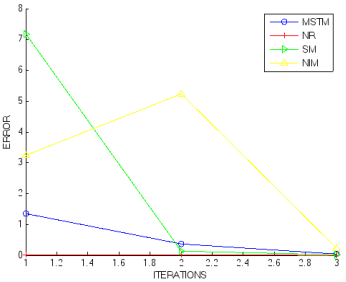
Figure 1. The graph of error versus iterations for problem 1.
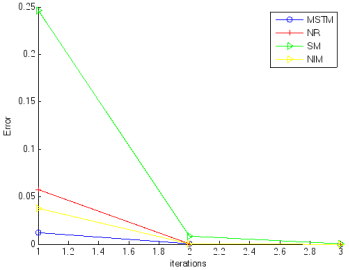
Figure 2. The graph of error versus iterations for problem 2.
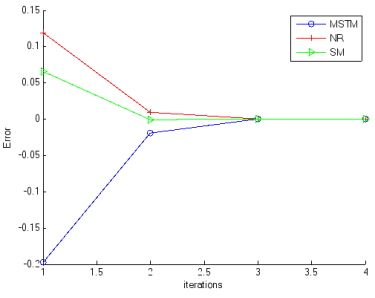
Figure 3. The graph of error versus iterations for problem 3.
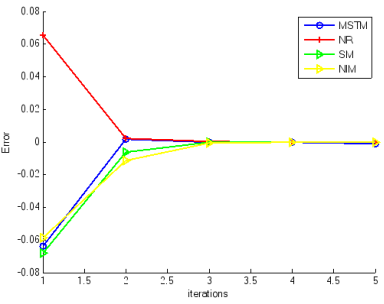
Figure 4. The graph of error versus iterations for problem 4.
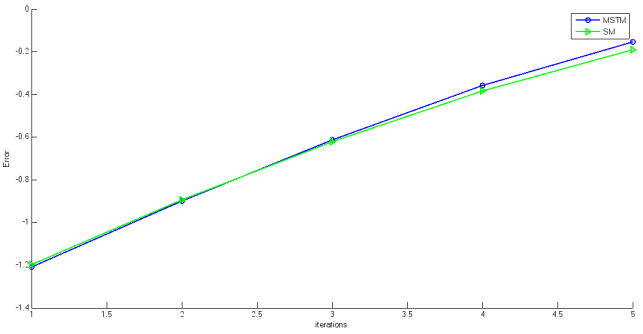
Figure 5. The graph of error versus iterations for problem 5.
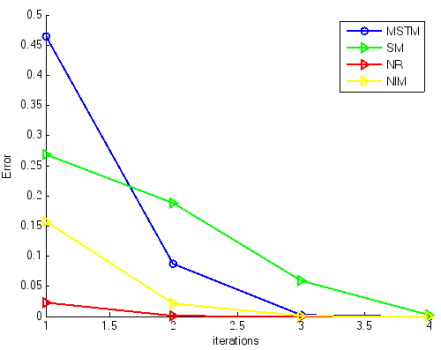
Figure 6. The graph of error versus iterations for problem 6.
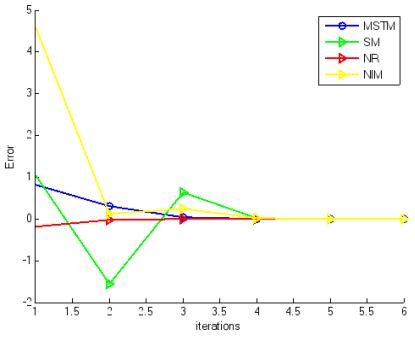
Figure 7. The graph of error versus iterations for problem 7.

Information



 Share This Article
 Twitter
 Linked In
 Facebook


 Copy
Copy Download