Research Article | | Peer-Reviewed

Development of Oryza sativa L. Hybrid Seeds from 60 Hybrids as Compared with 6 Different Nationally Checked Hybrid Seeds in the Rabi Season

Received: 25 February 2026     Accepted: 23 April 2026     Published: 16 May 2026
Views:       Downloads:
Abstract

The Design of worldwide rice production is linked to the development of hybrid rice. Total rice growing land will be reduced due to the production of hybrid rice which has helped to feed people worldwide. The present study was initiated to select the few hybrid seeds of rice as compared with Nationally selected 6 number of check hybrid seeds or control. The field experiment was conducted at Nuziveedu Seeds Limited, Regional Research Station, Barrackpore, 24 Parganas North (22º 7’48” and 88º 30’ 0’’ E), Kolkata-700121, West Bengal, India, during the Rabi season in the year of 2021-2022. Altogether, sixty-six (66) treatments were carried out in a Randomised Complete Block Design (RCBD) with four replications in the Regional Research Station. The obtained data exhibited the higher yielding capacity only 12 No. of hybrids and the occurrence of a 5% extra yield deviation from the control hybrids' yielding capacity. The tallest height (cm) of variety (T58= NPHK-2), maximum length (cm) of panicle (T40=TCH-54), highest Days of Flowering (50%) (T57=NPHK-14 and T27=NPHK-3), highest of Ear Bearing Tiller number (T13=NPHK-28), highest Grain panicle-1 number (T51=TCH-44)), maximum Chaffs panicle-1 number (T19=TCH-100), highest Plant yield (gm) (T54=TCH-94), maximum 1000 Grain weight (gm) (T49=TCH-97), maximum Plot yield (Kg) (T49=TCH-97) and maximum Yield production tons ha-1 (T49=TCH-97) were observed all morphological parameters in compares with control treatments. Out of the 60 hybrids, only 12 numbers promising hybrids T49= TCH-97, T50= NPHK-17, T51= TCH-44, T52= NPHK-18, T53=TCH-38, T54=TCH-94, T55=TCH-106, T56=TCH-42, T57=NPHK-14, T58= NPHK-2, T59= NPHK-8, and T60=TCH-86 in yielding capacity have been selected for large scale seed production. Henceforth, the above-mentioned hybrid seeds are available for undertaking large-scale farming by farmers.

Published in American Journal of Agriculture and Forestry (Volume 14, Issue 3)
DOI 10.11648/j.ajaf.20261403.11
Page(s) 133-148
Creative Commons

This is an Open Access article, distributed under the terms of the Creative Commons Attribution 4.0 International License (http://creativecommons.org/licenses/by/4.0/), which permits unrestricted use, distribution and reproduction in any medium or format, provided the original work is properly cited.

Copyright

Copyright © The Author(s), 2026. Published by Science Publishing Group

Keywords

Hybrid Rice, Rabi Season, Morphological Characters, Check Hybrids, Seed Production

1. Introduction
Sustainable agricultural development and Food security are vital resources for the well-being of all countries and their people. The increasing world population, environmental changes, urban development, creating the loss of land, and increasing demand for animal feed are reasons for the threat to food security. Rice (Oryza sativa L., 2n=2x=24) is the second most widely grown cereal in the world and accounts for over 20% of global caloric intake . In India rice is one of the most important staple foods required for more than 70% of people. The area basis rice production in India is the 1st position as China harvests the largest-scale rice production in the world. Rice is not India's only staple food; more than half of the world's population depends on rice . It plays a vital role in the socioeconomic conditions in East and Southeast Asian countries . The National Food Security Mission (NFSM) in India 2007 was launched hybrid rice seed technology playing a vital role in the higher rate of rice production. Heterosis or hybrid vigour of rice was first reported by Jones in 1926 . Hybrid rice production is a completely different breeding procedure from those used for breeding inbred rice varieties. Accumulate productivity genes that execute healthily under homozygous conditions in an inbred line breeding program, whereas hybrid breeding collects genes under heterozygous conditions in hybrids from two different parents. The presence of dissimilar genes expresses dominant, epistatic, and additive effects; their adverse effects, if any, due to repulsion-phase linkage occurring in parental lines, are overcome by their co-existence in hybrids. Rice breeders in China started hybrid rice development in 1964 through a three-line system but in 1976, the same procedure was used for commercially large-scale production of hybrid rice. In 1983 the successful commercialization of hybrid rice yield was 5 tonnes ha-1, but through the modern hybrid rice technology process (three-line system) in 1995 induced the yielding of rice nationwide more or less 6 tonnes ha-1 in the republic of China . The continuously increasing large population led to the initiation in the next year 1996 the Ministry of Agriculture of China decided to meet the food demand of the Chinese people in the 21st century not only by introducing the probability of increasing the yielding capacity through a super rice breeding program along with the utilization of the arable land. It was made into four stages with the target of the particular quantity through advanced science and technology: 1st stage from 1996 - 2000 with the production of 10.5 tons ha -1, 2nd stage from 2001- 2005 with the production of 12 tons ha -1, 3rd stage from 2006- 2015 with the production 13.5 tons ha-1, 4th stage from 2016-2020 with the production 15 tons ha-1 . The improved agronomic packages, such as appropriate seed rates, optimum seedling density, spacing, balanced and optimum fertilizer, etc. enhanced the production of hybrid rice . Three major steps are involved in this procedure i.e., 1st Parental lines development, 2nd seed production through experimental hybrid combination, and 3rd hybrid combination seeds evaluation. Breeding efficiency for improvement in hybrid rice can be made through different modern biotechnological tools.
1.1. Principle of Hybrid Rice Seed Production
The use of hybrid seeds started in the 1970s but the grain's achievements have shown in current times . Cross-fertilization between dissimilar strains of rice is induced to form hybrids for increased vigorous form to compare with both parents . Rice is principally a self-pollinating plant, so naturally, it is impossible to achieve heterosis among the plants. Two approaches are being used for the formation of heterosis plants. One of the approaches that are important for the use of cytoplasmic genetic male sterile (CGMS) line in the development of hybrid rice is a three-line system that is well known to rice breeders in the world. The studies of pollen which is exclusively regulated by cytoplasmic genes or plasma genes is known as Cytoplasmic Male Sterility (CMS).
1.2. Process of Hybrid Rice Seed Production
1.2.1. Three-line System
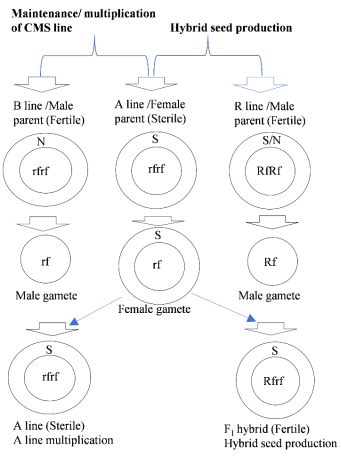
This system consists of three lines (a) Cytoplasmic Male Sterile / A-line, (b) Maintainer / B-line or male fertile, and (c) Restorer / R-line. The CMS is maintained by crossing the A-line with B-Cytoplasmic Genetic Male Sterility (CGMS). In the CGMS system, sterility or fertility occurs due to the interaction of cytoplasm with the nuclear gene. In the A-line, the sterility including cytoplasm has been incorporated from the related wild species and the nucleus contains normal cytoplasm and recessive fertility restorer gene, so, it is fertile. The A and B-lines are exactly similar genetically except for the fact that they differ only in the content of cytoplasm. A-line / CMS line possesses sterility including cytoplasm, whereas the B-line/Maintainer line has normal cytoplasm hence B-line is self-fertile. R-line / Restorer line possess fertility restoring genes in the dominant condition thus they are self-fertile.
In CMS seed multiplication, the crossing takes place between the A-line and B-line. Since both possess fertility genes in recessive conditions and cytoplasm contributed by a line is the sterility including one, the resultant progeny is sterile i.e., it is nothing but the A-line. Production of hybrid seeds occurs between the A-line and R-line. Since the R-line contains fertility restoring gene in the dominant homozygous condition the resulting F1 fertile seed will be used for commercial seed production (Figure 1).
Figure 1. Cytoplasmic Genetic Male Sterility (CGMS) system.
1.2.2. The Parent and Steps Involved in CGMS or Three-line Systems
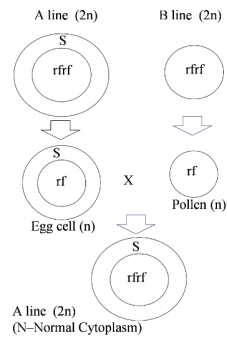
a) A-line: The CMS line cannot produce viable pollen grains resulting from an interaction between the cytoplasmic and nuclear genes. It is used as a female parent in the production of hybrid seeds. So, multiplication of the A-line population can be made by crossing with the B-line (maintainer line) which is the sister line of the A-line containing the ability to produce viable pollens. The B-line is isogenic having homozygous recessive genes for fertility restoration. Then F1 progeny of A x B crosses will be male sterile production (Figure 2).
Figure 2. Seeds of A line is produced by making a cross with the B line.
(i). Desirable Characteristics of the CMS Line
1) Male sterility of CMS lines should not be affected by environmental conditions such as temperature and photoperiod, The plants with spikelet’s should be 100% sterile.
2) Acceptable quality of grain
3) Resistance to disease as well as insect pests
4) Good general and specific combining abilities
5) Good panicle exertion
6) High number of spikelets per panicle
7) Longer heading duration
8) Wider and longer duration of opening of glumes
9) Larger and feathery stigma with greater exertion
10) Longer stigma receptivity
11) Longer pistil length and large stigmatic area
12) Shrivelled and white anthers
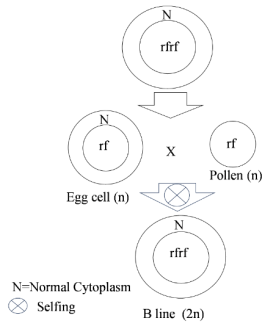
b) B-line: It is isogenic to the A-line and used as a pollen parent to maintain male sterility in the A-line. As the B-line is male fertile, the population can be raised or multiplied by self-pollination in isolation using physical, time, and distance at least 5 meters away from any variety (Figure 3).
(ii). Desirable Characters of B-line
1) Multiple resistance to disease and insect pests
2) Good panicle exertion
3) High number of spikelets per panicle
4) Longer heading duration
5) Wider and longer duration of opening of glumes
6) Longer pollen viability period
7) Plumy and yellow anthers
8) A high amount of residual pollen
Figure 3. Seeds of the B line are produced by self-pollination.
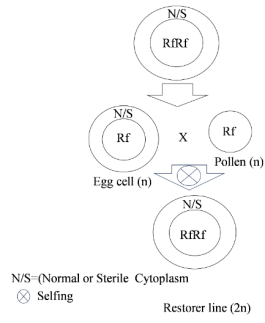
c) R-line: The R-line is called the restorer or pollinator line which restores the fertility of the A-line. R-line has the nuclear homozygous dominant gene that suppresses cytoplasmic male sterility of A-line. The population of the R-line can be raised by self-pollination as that of the B-line. Proper isolation (Physical, time, and distance around 5 meters away from any variety of rice) should be maintained for its seed production (Figure 4).
Figure 4. Seeds of the R line are produced by self-pollination.
(iii). Desirable Characteristics of R-line
1) Strong and stable fertility restoration for different CMS lines
2) Good general and specific combining ability
3) Erect plant type with short flag leaf
4) Profuse tillering ability
5) Multiple resistance to major pests and diseases
6) Desirable gain characters
7) Complete exertion of the panicle
8) Big size, long and broad anthers
9) Long filament
10) Good amount of pollen grains per anther
11) High amount of residual pollen
12) Longer pollen viability schedule
The present research work was carried out to investigate the better hybrid rice varieties from the 60 varieties of hybrid rice compared with 6 numbers of control or check hybrid rice through assessment of different morphological characters during the Rabi season in 2021 to 2022.
2. Materials and Methods
2.1. Study Site
The field Trial was carried out in the Regional Research Station, Nuziveedu Seeds Limited, Barrackpore (22º 45’ 36” N, 88º 22’ 12” E and 7 meters above MSL=Mean Sea Level), 24 Parganas (North), West Bengal, India during the Ravi seasons from November 2021 to May 2022. An Experimental site was in a dry rain region with a subtropical environment in a wet summer.
2.2. Weather Condition
The overall meteorological weather of the Regional Research Station is as follows,
1) Daily main temperature ranges from 28º - 32º C during seed production.
2) Relative Humidity (RH) varies from 60% to 70%.
3) Night and Day time temperature variation is 5º to 8º C.
4) Optimum wind velocity 10 km h-1.
5) Annual precipitation is 1250 mm to 1500 mm
2.3. The Following Procedures Are Used for the Production of Test Cross-hybrids
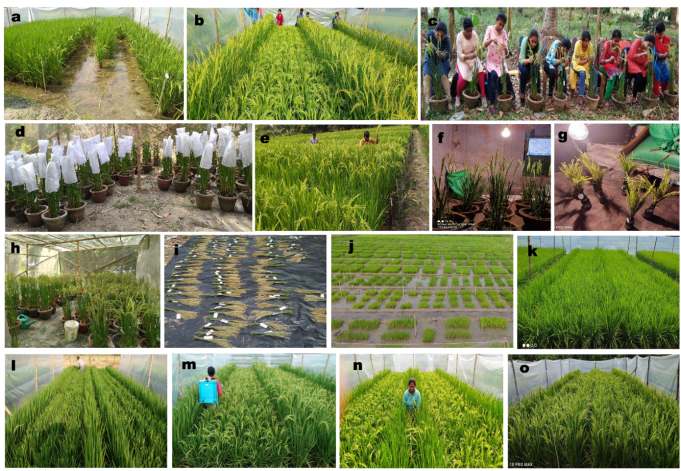
Step 1: A-line and B-line were grown (Table 1, 2) separately in the presence of standard agronomic practices (Figure 5a-b). In our experiment, we used a total 6 numbers of cytoplasmic male sterile lines for the development of test cross hybrids.
Table 1. Maintenance / Multiplication of Cytoplasmic Male Sterile (CMS) line under field condition (100 Sqm. area).

Sl. No.

CMS Lines

Cross Combinations

Date of Sowing

Date of Transplanting

Date of Flowering (50%)

Plot yield (Kg)

Yield (Q. ha-1)

1

NP 1A

NP1A x NP 1B

13.12.21/14.12.21

24.01.22/25.01.22

21.04.22/22.04.22

10.200/27.450

10.20/27.45

2

NP 5A

NP 5A x NP 5B

13.12.21/14.12.21

24.01.22/25.01.22

12.04.22/13.04.22

17.415/26.250

17.41/26.25

3

NP 7A

NP7A x NP 7B

13.12.21/14.12.21

24.01.22/25.01.22

03.04.22/04.04.22

22.050/28.600

22.05/28.60

4

NP BA

NP BA x NP BB

13.12.21/14.12.21

24.01.22/25.01.22

17.04.22/18.04.22

20.040/31.300

20.04/31.30

5

NP GA

NPGA x NP GB

13.12.21/14.12.21

24.01.22/25.01.22

13.04.22/14.04.22

19.110/25.910

19.11/25.91

6

NP SPA

NPSPA x NPSPB

13.12.21/14.12.21

24.01.22/25.01.22

10.04.22/11.04.22

24.750/30.900

24.75/30.90

There were 6 maintainers i.e., B-line used to maintain A-line.
Figure 5. (a, b) Maintenance of the CMS or A-line and B-line. (c) Clipping of spikelets (1/3) of the CMS line to enhance the possibility of a higher seed set. (d) All panicles of the CMS line were covered with butter paper and labelled properly. (e) All selected R-lines were collected and kept in the glass bottles. (f, g) Panicles of both A-line and R-line were kept separately under artificial light before pollination. (h) CMS line in the net house during the seed setting. (i) Panicles collected from CMS lines just after 21 days of pollination for F1 hybrid seeds. (j) Nursery beds showing seedlings of test cross hybrids. (k) Spacing of A and R lines in the main field, (l) Clipping of the flag leaf of CMS line to remove the physical obstruction of pollen dispersal. (m). Spraying of GA3 on the CMS lines to enhance the production of rice hybrid seeds. (n) Shaking the maintainer line (R) for uniform pollen dispersal on the CMS line for large-scale production, o. Hybrid seed production plot.
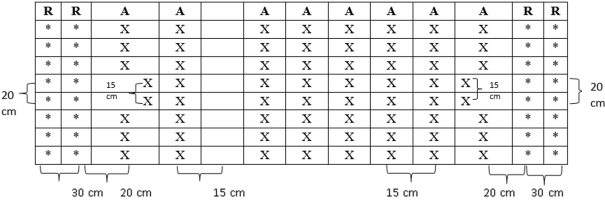
Table 2. Maintenance/Multiplication of Maintainer Lines (B) under field condition (100 Sqm. area).

Sl. No.

B Lines

Date of Sowing

Date of Transplanting

Date of Flowering (50%)

Plot yield (Kg)

Yield (ton ha-1)

1

NP 1B

14.12.21

25.01.22

22.04.22

54.650

5.40

2

NP 5B

14.12.21

25.01.22

13.04.22

52.540

5.18

3

NP 7B

14.12.21

25.01.22

04.04.22

56.400

5.55

4

NP BB

14.12.21

25.01.22

18.04.22

62.150

6.11

5

NP GB

14.12.21

25.01.22

14.04.22

50.850

5.00

6

NP SPB

14.12.21

25.01.22

11.04.22

60.710

5.97

Step 2: CMS lines were collected from the field in the earthen pots. Clipping (Figure 5c) of the 1/3rd part of the spikelet’s was done in the afternoon which was then followed by spraying of GA3. All panicles of the CMS line were covered with butter paper and labelled properly (Figure 5d).
Step 3: On the next day around 8: 00 AM, all panicles of the selected R-lines were collected in the glass bottles (Figure 5e). We utilized 36 superior or promising restorer lines within 15 days to develop 60 test cross hybrids in combination with the 6 numbers mentioned above the CMS line.
Table 3. Maintenance/Multiplication of Restorer lines (R) under Field condition (25 Sq. m area).

Sl. No.

R-lines

Date of Sowing

Date of Transplanting

Date of Flowering (50%))

Plot yield (Kg)

Yield (ton ha-1)

1

NP 87-10R

26.11.2021

13.01.2022

03.04.22

20.110

7.91

2

NP 72-10R

26.11.2021

13.01.2022

04.04.22

19.650

7.73

3

NP 35-3R

26.11.2021

13.01.2022

05.04.22

20.310

8.00

4

NP 31-4R

26.11.2021

13.01.2022

06.04.22

18.560

7.30

5

NP 90-6R

26.11.2021

13.01.2022

04.04.22

16.350

6.44

6

NP 31-12-2R

26.11.2021

13.01.2022

04.04.22

18.750

7.38

7

NPSP 2R

26.11.2021

13.01.2022

09.04.22

19.250

7.60

8

NP 1902R

26.11.2021

13.01.2022

04.04.22

15.340

6.04

9

NP 89-7R

26.11.2021

13.01.2022

04.04.22

17.260

6.80

10

NP 1925R

26.11.2021

13.01.2022

09.04.22

21.115

8.31

Step 4: Panicles of the A-line (Figure 5f) and R-line (Figure 5g) were kept separately under artificial light before pollination.
Step 5: Each selected CMS plant in the earthen pot was pollinated by selected panicles of the R line in the isolation room followed by bagging properly. In this way a total number of 60 hybrids were produced in 15 days and just after 21 days of pollination all panicles were collected from the CMS line for the F1 hybrid seed production (Figure 5h-i).
2.4. Treatments
The experiment comprised of 60 treatments such as T1= TCH-8, T2= NPHK-24, T3= TCH-77, T4=TCH-96, T5=TCH-10, T6= TCH-19, T7= SPRH-2, T8= TCH-4, T9= TCH-26, T10= NPHK-27, T11= NPHK-10, T12= NPHK-4, T13= NPHK-28, T14= NPHK-7, T15= NPHK-26, T16= TCH-24, T17= TCH-16, T18= TCH-79, T19= TCH-100, T20= TCH-91, T21= TCH-33, T22= TCH-34, T23= TCH-89, T24= TCH-49, T25= TCH-85, T26= TCH-101, T27= NPHK-3, T28= TCH-30, T29= TCH-13, T30= TCH-110, T31= NPHK-29, T32= TCH-56, T33= TCH-92, T34= TCH-58, T35= TCH-70, T36= TCH-90, T37=TCH-35, T38= TCH-71, T39= TCH-45, T40= TCH-54, T41= TCH-99, T42= TCH-32, T43= TCH-66, T44= TCH-62, T45= TCH-61, T46= TCH-40, T47= TCH-31, T48= TCH-47, T49= TCH-97, T50= NPHK-17, T51= TCH-44, T52= NPHK-18, T53= TCH-38, T54= TCH-94, T55= TCH-106, T56=TCH-42, T57= NPHK-14, T58= NPHK-2, T59= NPHK-8, and T60=TCH-86 belong to different hybrid varieties of rice and 6 Nos. of check or control treatments such as T61=PAN 802 (C-3), T62= PA-6444 (C-6), T63= K-468 (C-5), T64=PA6129 (C-2), T65=Champion (C-1) and T66=MC-13 (C-7)) varieties of hybrid rice were used.
2.5. Evaluation of Hybrid Rice with Check or Control Hybrids in the Field
2.5.1. The Following Steps Are Used for the Evaluation
Step 1: Seedlings of the 60 hybrids (Figure 5j) and 6 check hybrids are raised in the nursery beds.
Step 2: Standard agronomic practices are used for land preparation.
Step 3: Transplant the seedlings in the field at 20 x 15 cm spacing with check hybrids. The length of the lines was 5 meters. No. of replication was 4 and plot size 10 Sqm.
Step 4: F1 hybrids were grown in the field and during the growing time it was protected from any pest.
Step 5: Data collection: The Agro morphological traits such as Plant height (cm.), Days to flowering (50% DFF), Number of Ear Bearing Tiller (EBT), Panicle length (cm.), Field Grain panicle-1 (No.), Chaffs panicle-1 (No.), Grain types, Plant yield (gm), 1000 grains weight (gm), Plot yield (kg.) and Yield (ton ha-1) were collected from the experimental field station at Barrackpore.
Table 4. List of check hybrids with sources.

Sl. No.

Name of the check Hybrids

Source

1

T61=PAN 802 (C-3)

PAN Seeds Ltd.

2

T62= PA-6444 (C-6)

Pioneer Hybrid International

3

T63= K-468 (C-5)

Kaveri Seeds Company Ltd.

4

T64=PA6129 (C-2)

Pioneer Hybrid International

5

T65= Champion (C-1)

Nuziveedu Seeds Ltd.

6

T66= MC-13 (C-7)

Maharashtra Hybrid Seeds Company Pvt. Ltd.

2.5.2. Selection of Field
The selected field was not used in the previous year's paddy crop production. Our field experiment possessed good fertility with controlled irrigation and proper drainage facilities to enhance the commercial production of hybrid seeds.
(i). Preparation of Nursery Bed
The soil of the experimental field was prepared by repeatedly ploughing and cross ploughings in both directions. The nursery bed was flooded with water, puddled, and left as such for ten days for the decomposition of unwanted weeds. The prepared bed was 6.0 metres in length and 1.0 metres in breadth.
(ii). Seed Rate
The 15 kg ha -1 seeds were used for the female parent or A-line as 5kg ha -1 for the male parent i.e., R-line.
(iii). Manuring Nursery Bed
The healthy and strong growth of seedlings with 1 to 3 tillers is essential for transplantation in the experimental field. To get a healthy seedling around 50gm of DAP and 25gm of urea were applied in each 1 square metre seedbed area (Figure 5j).
2.5.3. Layout for Transplanting
There are many commonly used transplanting layouts for hybrid rice seed production, but we used a 2:8 male (R): female (A) row ratio for hybrid seed production in our experiment. Keep in mind that planting of seed and pollen parent rows always should be in the direction across the prevailing wind and supplementary pollination may be made with a rope or stick when velocity is below 2.5 metres second-1. In our study area, the available wind was from South to North direction. So, in both lines directions of A and R were east to west. The R-line was transplanted with the spacing of 20 cm from plant to plant 30 cm from one row of restore to another and 30 cm from the A-line. A-line was transplanted with the spacing of 15 x 15 cm one seedling/hill of the A-line and two seedlings/hill of the B-lines and R-lines were transplanted (Figure 5k).
(i). Layout
Figure 6. Male: Female = 2: 8, Hybrid rice seed production row ratio and spacing of A and R-lines in the main field.
(ii). Conditions
Space between two R-lines: 30 cm.
Space between two plants in R-line: 20 cm.
Space between two A-lines: 15 cm.
Space between two plants in A-line: 15 cm.
(iii). Roughing
Roughing was done three times at the maximum tillering stage. Any plant outside the row, which was considerably shorter and taller than the real seed with the pollen parent was removed. Those were off types regarding size, shape, leaf blade, the colour of the sheath, and leaf colour also removed.
At the heading stage, all plants that headed very early and off-types concerning leaf angle, body size, panicle size, and shape were removed. In the male sterile line, plants with plumy anther yellow in colour and those that shed viable pollen were removed. Even those plants that show fully exerted panicle were removed from the seed production plots.
The plants with normal seed sets were rogued out from A-line rows before the harvesting schedule and off-type plants having different shapes of grains or the presence/absence of awns on spikelets were also rouged out.
(iv). Synchronization of Heading
The yield of hybrid seeds depends on the degree of synchronization in the heading (flowering) of the CMS female flower and pollinator parents’ flower (R-line). To lengthen the duration of the pollen supply around 5-7 days intervals, the male parent (R-line) is seeded twice, called staggered seed sowing.
1) Prediction and adjustment of Heading date
Harmony of flowering may not be attained eventually due to variations in field management and temperature. Therefore, it is most important to predict the heading date so that necessary precautions are taken to adjust it by examining the primordial initiation of the panicle.
2) Prediction of heading date
In all rice cultivars, the maximum tillering stage begins at the panicle initiation, by which the heading date can be predicted. Heading usually takes place after 30 days of panicle initiation. The magnifying glass is used to check the growth of panicle primordium i.e., the young panicle. The longest-growing tiller joining part of the culm and root junction is used for the panicle initiation. The culm was split openly longitudinally from the lower part up to the top of the tiller. The incision was opened immediately at the above of the nodal portion. With the help of a magnifying lens, a newly developed panicle can be seen.
Table 5. Different development stages from panicle initiation to the heading.

Sl. No.

Designation of development stages

Days before heading

Panicle length (mm) (Approx.)

1

Panicle Primordium

30

0.2

2

Primary branch primordium

27

0.4

3

Secondary branch primordium

24

1.5

4

Stamen and Pistil primordium

20

2.0

5

Pollen mother cell

17

10-25

6

Meiotic division

12

80

7

Mature pollen

6

190-250

8

The ripening stage of pollen

4

260

9

Completed spikelet

21

270

3) Determining heading date from panicle development
To get complete flowering synchronization, the male parent needed to be one stage earlier than the female parent at the time of panicle development stages I, II, and III. During the middle stages i.e., IV, V, VI, VII both parent lines were in the same stages. During the last three stages of panicle development i.e., VIII, IX, and X the female parent was earlier than the male parent.
4) Adjustment of the heading date of parental lines
It was observed that the synchronization of the flowering not be achieved during the early stages of panicle development, during the first three stages, the parent plant which is developing faster should be applied with quick releasing N fertilizer, and the parent plant with delayed development, should be sprayed 2% solution of di-ammonium phosphate {(NH4)2HPO4} as a resulting adjustment in synchronization difference may be led to 4-5 days.
If the above condition persists during the later stages of panicle development, another way drainage or irrigation can help to adjust the differences of 3-4 days. The A-lines are less sensitive to water in comparison to the R-line. Suppose the R-line develops earlier; the development of the panicle can be delayed by draining out water from the field. Another way is if the R-line is observed to be late, faster growth development of the panicle can be facilitated by higher standing water.
If both parental lines differ in heading period by more than 10 days, then removal of the panicles from the main tiller of the early developing parent is necessary. In addition, Nitrogen fertilizer and spraying 2% urea can make unproductive late tiller bear productive panicle and thus show synchronous flowering. Advancement of the heading date of the late flowering parent can be done by spraying the 1% solution of the phosphatic fertilizer immediately after the observation of the panicle development stage in the late flowering parent plants. It can be adjusted by allowing standing water to persist in the field. All the methods of synchronization are used for the production of hybrid rice.
2.5.4. Promoting Outcrossing in the Seed Production Plot
The following processes are required.
(i). Clipping of the Flag Leaf
The flag leaves taller than panicles became the main obstacles to outcrossing and therefore, was removed. Clipping of the flag leaf enhances uniform pollen movement and widespread dispersal of the pollen grains resulting in a higher seed set.
These leaves were clipped when the primary tiller was at the booting stage. More than half of the blades of flag leaves were cut back from the top (Figure 5l).
Flag leaf clipping is not recommended in plots infected with bacterial leaf blight, bacterial leaf streak, or sheath blight disease. The cut leaves may infect other plants or the infection may spread by contaminated tool used for flag leaf clipping. In this situation, where there is already infection in the seed production plot, the flag leaf clipping of the healthy plants in the plots is done first followed by leaf clipping of the infected area.
(ii). Application of Gibberellin (GA3)
Gibberellin (GA3) plays a vital role in the production of hybrid seeds of rice. Some of the major advantages of GA3 applications are as follows:
In the seed parent, its application enhances panicle exertion from the flag leaf, increases the duration of spikelet opening increases the rate of stigma exertion, and lengthens the duration of stigma receptivity.
To bear panicles, the growth rate of secondary and tertiary tillers was to be increased.
Timing of application: Two sprays were done. 1st spray of the GA3 was done when 15-20% of the tillers had started their heading. Just after two days of the 1st spraying, the next spraying of GA3 was conducted in the afternoon on a sunny day. At the rate of 150-180 gm ha-1 with the help of a knapsack sprayer was used but now a days to reduce the cost of GA3 the Ultra Low Volume (ULV) sprayer is used at the rate of 25 gm ha-1. In our experiment first dose, we applied GA3 (90 gm ha-1) at the 5% heading stage (Figure 5m) whereas 2nd dose was used after the gap of 48 hours from the 1st dose.
(iii). Supplementary Pollination
The pollen parent’s (R-line) canopy is shaken artificially with the help of a long stick (Figure 5n) at the heading for increasing outcrossing called supplementary pollination. It helps uniform dispersion of all pollen on the top of the stigma of the second parent (A-line). Mostly it was carried out in the morning around 9.30 to 11.30 AM because the CMS line started maximum heading. The plant canopy was stirred at 30-minute intervals till all bloomed spikelet’s in the pollen parents (A-line) were closed, the exerted stigma still had receptivity to pollen so it was continued even after the closing of the seed parent.
2.5.5. Harvesting
The R-line was harvested first followed by the A-line. All harvested A and R-line seeds were kept separately from each other during subsequent threshing, proper drying (around 12% moisture content), and bagging operations (Figure 5o).
(i). Design
The Randomised Complete Block Design (RCBD) with four replications was used for the measuring development of superior hybrids.
(ii). Statistical Analysis
A statistical tool mean ± standard error (SEM) was used for the expression of the different Agro morphological experimental data. Gomez K. A. & Gomez A. A. to observe the significant difference among the different hybrid rice varieties. Employing the F-test a two-way ANOVA was performed for the significance test at the level of p=0.05 (5%).
3. Result
3.1. Result of Mean Performance of Rice Traits
The experiment was carried out for the development of better hybrids of rice (Oryza sativa L.) from 60 hybrids as compared with different 6 check hybrids (Table 6) in Rabi seasons (2021-2022) through the process of diverse morphological characters.
3.1.1. Plant Height
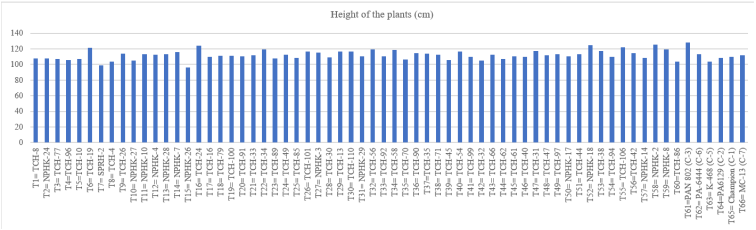
Statistical analysis of variance noticed a highly significance difference (p < 0.05) in the hybrid plant's height between the 66 treatments including check treatments. We observed the overall mean of the 66 hybrids was 112.19 ± 1.56 cm. Hybrid plant height was maximum in T58=NPHK-2 (125.38 ± 2.60 cm) and minimum in T15=NPHK-26 (96.45 ±7.61 cm) compared with control hybrid treatments from T61 to T66 was observed (Figure 7 and Table 7).
3.1.2 EBT (No. of Ear Bearing Tiller)
There was significant (p < 0.05) Ear Bearing Tiller No. difference found in the 60 No. of treatments compared with control or check of 6 Nos of hybrids. EBT No. was higher in T13=NPHK-28 (16.83±7.48) hybrid than that in all-check hybrids from T61 to T66 treatments (Table 7).
Table 6. Treatment details for the Experiment in the Rabi season.

Treatment with the name of Hybrid

Cross combinations/ Parentage

Treatment with the name of Hybrid

Cross combinations/ Parentage

T1= TCH-8

NP 7A x NP 87-10R

T34= TCH-58

NP 1A x NP 76-8

T2= NPHK-24

NP 7A x NP 72-10R

T35= TCH-70

NP BA x NP 31-10R

T3= TCH-77

NP BA x NP 35-3R

T36= TCH-90

NP BA x NP 72-6-2R

T4=TCH-96

NP BA x NP 31-4R

T37=TCH-35

NP 1A x NP 31-4R

T5=TCH-10

NP 7A x NP 90-6R

T38= TCH-71

NP BA x NP 90-6R

T6= TCH-19

NP 5A x NP 31-12-2R

T39= TCH-45

NP 1A x NP 31-5R

T7= SPRH-2

NP SA x NPSP 2R

T40= TCH-54

NP 1A x NP 75-5R

T8= TCH-4

NP 7A x NP 89-7R

T41= TCH-99

NP 5A x NP 27R

T9= TCH-26

NP 5A x NP 35-3R

T42= TCH-32

NP 5A x NP 45-5R

T10= NPHK-27

NP 7A x NP 31-11R

T43= TCH-66

NP BA x NP 40-4R

T11= NPHK-10

NP 5A x NP 1933R

T44= TCH-62

NP 1A x NP 89-7R

T12= NPHK-4

NP 5A x NP 40-5R

T45= TCH-61

NP 1A x NP 87-4R

T13= NPHK-28

NP 7A x NP 1902R

T46= TCH-40

NP 1A x NP 38-1R

T14= NPHK-7

NP 5A x NP 31-5R

T47= TCH-31

NP 5A x NP 90-6

T15= NPHK-26

NP 7A x NP 40-5R

T48= TCH-47

NP 1A x NP 31-14-1R

T16= TCH-24

NP 5A x NP 40-4R

T49= TCH-97

NP BA x NP 75-5R

T17= TCH-16

NP 5A x NP 72-6-2R

T50= NPHK-17

NP 1A x NP 1925R

T18= TCH-79

NP BA x NP 31-14-1R

T51= TCH-44

NP 1A x NP 72-6-2R

T19= TCH-100

NP 5A x NP BLUR

T52= NPHK-18

NP 1A x NP 72-10R

T20= TCH-91

NP BA x NP 88-4R

T53= TCH-38

NP 1A x NP 72-3

T21= TCH-33

NP 5A x NP 87-10R

T54= TCH-94

NP BA x NP 19-3R

T22= TCH-34

NP 5A x NP 87-4R

T55= TCH-106

NP GA x NP 75-4R

T23= TCH-89

NP BA x NP 87-3R

T56=TCH-42

NP 1A x NP 40-3R

T24= TCH-49

NP 1A x NP 90-10R

T57= NPHK-14

NP 1A x NP 1917R

T25= TCH-85

NP BA x NP 1917R

T58= NPHK-2

NP 5A x NP 72-10R

T26= TCH-101

NP GA x NP 72-3R

T59= NPHK-8

NP 5A x NP 31-7R

T27= NPHK-3

NP 5A x NP 19-5R

T60=TCH-86

NP BA x NP 31-14-2R

T28= TCH-30

NP 5A x NP 87-3R

T61=PAN 802 (C-3)

Control

T29= TCH-13

NP 5A x NP 31-4R

T62= PA-6444 (C-6)

Control

T30= TCH-110

NP GA x NP 72-6-2R

T63= K-468 (C-5)

Control

T31= NPHK-29

NP 5A x NP 27R

T64=PA6129 (C-2)

Control

T32= TCH-56

NP 1A x NP 40-4R

T65= Champion (C-1)

Control

T33= TCH-92

NP BA x NP 75-4R

T66= MC-13 (C-7)

Control

Figure 7. Height (cm) of the 66 hybrids (T1-T66) rice cultivars grown in the Regional Research Station of Nuziveedu Seeds Limited, Barrackpore, West Bengal, India.

Table 7. Analysis of various traits (11 Nos.) among 66 hybrids Mean ± SE & ANOVA in all hybrids of rice.

Treatment and Name of Rice hybrids

DFF (Days)

Plant height (cm)

EBT (No.)

Panicle length (cm)

Grains/Panicle (No.)

Chaffs/panicle (No.)

Grain type

Plant yield (gm)

1000 grains weight (gm)

Plot yield (Kg)

Yield (Ton /ha)

Remarks

T1= TCH-8

118

108.13± 11.48

13.40±4.52

24.53±

2.20

176.00 ± 39.54

63.53±

8.59

MB

45.56± 5.40

18.55±0.9

7.196±0.91

7.08±0.65

T2= NPHK-24

117

107.60± 3.47

12.33±2.42

25.28± 1.83

109.00±

17.06

69.55±

13.36

LS

32.45± 10.23

24.80±0.61

8.090±0.49

7.96±0.54

T3= TCH-77

121

107.13± 4.67

12.08±1.18

23.93± 0.30

130.21± 39.9

24.30± 5.02

MB

43.81± 3.13

23.53±0.45

7.836±0.45

7.71±0.56

T4=TCH-96

124

105.68± 4.88

13.04± 2.39

24.55± 0.93

110.85± 19.54

27.40±

4.09

MB

49.50± 9.92

25.30±0.54

7.972±0.55

7.84±0.67

T5=TCH-10

120

107.23± 7.8

14.00± 1.95

24.88±

0.87

156.43±

29.89

84.75± 16.53

MB

49.64± 10.90

23.33±0.45

7.916±0.65

7.80±0.49

T6= TCH-19

125

121.45± 13.64

11.03± 2.64

27.33±

0.46

171.19±

32.9

47.21±

4.10

MB

40.03±14.74

23.08±0.48

8.352±0.61

8.22±0.43

T7= SPRH-2

124

99.23± 2.97

13.08± 1.81

24.55±

1.04

182.75± 27.88

17.75±

9.87

LS

50.23±50.23

22.45±0.58

7.944±0.78

7.81±0.34

T8= TCH-4

120

103.55± 1.89

12.90± 2.59

24.85±

0.43

151.13±

11.67

49.9±

19.57

MB

45.63±7.68

24.68±0.60

7.228±0.45

7.11±0.35

T9= TCH-26

121

113.83± 3.26

11.68± 1.67

25.90±

1.01

156.63±

3.03

38.83±

2.51

MB

44.24±8.04

26.23±0.49

8.000±0.63

7.88±0.45

T10= NPHK-27

118

105.05± 3.77

13.13± 2.37

24.70±

1.60

170.47±

51.18

44.45±

11.01

MB

37.78±8.78

20.20±0.61

7.475±0.45

7.36±0.60

T11= NPHK-10

125

113.13± 3.50

10.33± 3.96

28.28±

1.41

158.33± 14.45

45.20± 8.51

MB

32.95±12.31

23.45±0.43

8.628±0.56

8.50±0.45

T12= NPHK-4

125

112.78± 6.60

13.00± 3.68

27.18±

1.58

160.10±

21.14

63.65±

18.26

LS

40.93±5.04

23.23±0.34

8.665±0.56

8.52±0.42

T13= NPHK-28

119

113.13± 4.13

16.83± 7.48

23.89±

2.21

124.30±

26.31

61.63±

6.03

MB

41.86±23.68

21.68±1.34

7.950±0.75

7.82±0.38

T14= NPHK-7

125

115.65± 2.21

14.35±2.37

26.75±

2.29

140.58±

15.11

55.55±

17.49

LS

27.45±16.92

21.33±0.48

8.273±0.59

8.14±0.43

T15= NPHK-26

118

96.45± 7.61

11.95± 8.80

25.11±

1.35

134.46±

18.41

59.14±

14.44

LS

40.41±35.76

24.95±0.68

8.098±0.29

8.00±0.65

T16= TCH-24

125

124.08± 5.83

12.93±1.51

28.04±

0.77

165.43±

21.99

40.73± 8.22

LS

43.43±3.84

24.68±0.61

7.964±0.69

7.83±0.62

T17= TCH-16

125

109.95± 8.08

13.15± 5.65

26.24±

0.21

170.98±

22.38

63.03±

15.65

MB

47.99±19.89

21.43±0.52

7.464±0.67

7.34±0.56

T18= TCH-79

126

111.35± 7.07

13.28± 3.34

26.13±

0.98

157.97±

10.66

60.28±

3.95

MB

42.57±8.85

22.25±0.61

8.624±0.56

8.49±0.45

T19= TCH-100

128

110.9± 5.25

10.7± 2.01

27.95±

1.53

164.78±

41.61

87.95±

40.25

MB

43.96±9.96

26.28±0.48

7.248±0.49

7.13±0.68

T20= TCH-91

125

110.48± 4.87

14.95± 1.60

27.00±

0.61

138.25±

13.65

30.80±

11.03

MB

51.78±14.18

27.70±0.49

7.268±0.65

7.15±0.49

T21= TCH-33

124

111.88± 2.44

13.25± 2.11

27.30±

0.18

158.03±

33.65

70.46±

12.49

MB

49.92±11.54

23.38±0.41

6.720±0.56

6.61±0.56

T22= TCH-34

125

119.63± 4.21

10.35± 0.80

28.05±

1.76

186.58±

19.97

85.20±

24.57

MB

41.48±6.29

23.25±0.53

6.964±0.48

6.85±0.76

T23= TCH-89

129

108.10± 1.92

10.18± 2.13

26.00± 1.06

168.28±

21.77

47.85± 6.44

MB

40.03±10.66

26.28±0.45

7.768±0.56

7.64±0.49

T24= TCH-49

126

112.70± 3.89

11.78± 3.16

27.10±

0.67

159.28± 30.43

67.83±

13.06

LS

48.07±10.83

21.43±0.47

7.748±0.56

7.62±0.67

T25= TCH-85

129

108.40± 3.49

8.95± 1.77

26.65±

1.09

203.43±

56.53

47.15±

17.40

MB

37.76±12.88

23.98±0.24

7.740±0.76

7.61±0.71

T26= TCH-101

128

116.38± 2.56

13.28± 2.23

26.68±

1.61

171.73±

61.93

43.73±

12.83

MB

47.74±5.02

20.33±0.38

7.396±0.47

7.20±0.81

T27= NPHK-3

130

115.63± 6.10

15.20± 2.01

27.18±

0.41

109.10±

6.77

60.50±

14.16

MB

40.11±5.76

23.45±0.47

8.660±0.76

8.52±0.59

T28= TCH-30

123

109.23± 2.78

13.63± 2.96

28.78±

1.92

147.20±

36.44

71.33±

15.22

MB

37.95±6.34

22.30±1.22

7.796±0.89

7.70±0.71

T29= TCH-13

124

116.80± 2.77

11.65± 1.98

28.68±

1.05

139.18±

17.01

43.43±

11.19

LS

36.99± 5.91

24.45±0.58

7.760±0.76

7.63±0.67

T30= TCH-110

128

116.73± 3.01

9.90±

1.33

26.63±

0.085

206.85±

35.35

54.35±

9.58

MB

43.71±12.05

21.53±0.48

7.716±0.56

7.60±0.56

T31= NPHK-29

128

110.63± 2.26

13.95± 3.98

26.38±

1.09

121.18±

26.67

69.75±

17.92

LB

39.28±9.76

24.33±0.66

8.252±0.45

8.12±0.59

T32= TCH-56

129

119.55± 3.34

16.28±3.28

26.08±

0.45

162.65±

45.65

28.78±

2.43

LS

46.89±13.75

15.63±0.47

7.408±0.56

7.30±0.60

T33= TCH-92

129

110.48± 8.22

12.88± 1.28

26.04±

1.66

129.23±

18.58

32.17±

4.98

MB

43.97±8.38

29.18±0.90

7.876±0.76

7.75±0.39

T34= TCH-58

125

118.50±

3.31

13.33± 5.53

27.36±

1.94

165.05±

22.71

70.19±

31.18

MB

41.21±13.60

18.65±0.58

8.704±0.63

8.57±0.56

T35= TCH-70

129

106.68± 3.85

14.15± 2.90

26.30± 0.37

159.34±

3.77

49.02±

10.49

MB

42.27±10.61

20.43±0.59

7.916±0.86

7.80±0.49

T36= TCH-90

129

114.50± 1.04

9.08± 2.61

26.65±

0.61

175.85±

21.26

39.30±

8.53

MB

37.90±8.37

25.35±0.36

8.068±0.49

7.94±0.61

T37=TCH-35

125

113.63± 1.72

11.68± 3.23

26.75±

0.53

175.83±

7.85

40.75±

7.75

LS

37.64±9.30

21.35±0.62

7.784±0.54

7.70±0.57

T38= TCH-71

128

112.55± 5.69

11.83± 1.41

25.45±

1.36

137.93±

47.34

64.85±

33.10

MB

40.69±9.03

25.13±0.56

8.040±0.49

7.91±0.99

T39= TCH-45

125

105.90± 1.4

12.98± 2.26

27.30±

0.19

123.83±

11.50

19.75±

4.95

MB

42.93±12.42

25.43±0.59

8.620±0.56

8.50±0.67

T40= TCH-54

132

116.38± 3.01

14.25± 3.49

29.50±

1.05

110.20±

3.25

38.40±

2.05

LS

46.84±16.77

20.08±0.92

7.584±0.67

7.46±0.49

T41= TCH-99

128

109.70± 2.75

12.98± 3.50

27.03±

0.99

132.03±

30.29

73.53±

10.14

LB

41.51±5.41

24.60±0.46

7.828±0.56

7.70±0.78

T42= TCH-32

123

105.40± 3.38

13.28± 0.90

26.00±

1.29

128.35±

15.98

79.95±

22.68

LS

36.23±4.99

22.40±0.61

6.628±0.67

6.52±0.38

T43= TCH-66

128

112.33± 1.97

13.95± 0.86

24.47±

0.78

171.14±

26.94

17.90±

6.68

MB

44.29±4.99

16.38±0.34

7.520±0.56

8.39±0.49

T44= TCH-62

128

107.30± 2.99

12.35± 2.30

26.87±

0.72

197.99±

11.21

50.80±

8.45

MB

45.99±7.75

21.10±0.54

8.520±0.67

8.39±0.8

T45= TCH-61

128

110.88± 3.05

9.00± 1.22

27.78±

0.21

145.45±

14.50

58.30±

6.86

MB

34.86±4.94

22.45±0.64

8.408±0.72

8.28±0.64

T46= TCH-40

126

109.95± 2.22

13.68± 2.7

29.35±

0.96

157.33±

22.18

63.18±

17.10

LS

48.93±10.38

23.03±0.31

7.840±0.39

7.71±0.56

T47= TCH-31

126

117.38± 5.53

10.63± 3.44

27.35±

0.47

219.53±

72.07

82.58±

21.07

MB

42.57±12.19

22.22±0.34

7.168±0.68

7.05±0.57

T48= TCH-47

126

111.70± 4.84

11.73± 0.66

26.98±

0.40

111.63±

6.85

60.65±

6.23

LS

29.34±4.98

25.25±0.61

8.364±0.64

8.23±0.56

T49= TCH-97

129

113.45± 3.45

12.63± 3.73

26.16±

1.53

113.01±

18.26

28.83±

7.90

MB

41.76±13.29

31.85±0.58

10.56±0.61

10.4±1.22

Promising

T50= NPHK-17

124

110.70± 4.14

15.18± 3.40

25.58±

0.84

166.53±

20.16

30.78± 2.83

MB

43.48±9.32

19.35±0.46

10.07±0.99

9.91±1.01

Promising

T51= TCH-44

126

113.18± 3.47

12.98± 3.25

26.85±

0.70

219.73± 11.95

56.73±

7.53

MB

47.93±13.84

17.25±0.36

9.640±0.96

9.49±1.12

Promising

T52= NPHK-18

129

124.85± 5.51

14.68± 2.06

27.17±

0.71

135.16± 12.07

52.13±

18.33

LS

49.16±14.08

25.30±0.46

9.457±0.56

9.30±1.10

Promising

T53= TCH-38

129

117.25± 4.04

15.63± 5.95

26.24±

0.67

146.62±

37.86

56.05±

7.38

MB

47.72±15.57

23.63±0.53

9.180±0.58

9.03±0.98

Promising

T54= TCH-94

125

109.90± 4.60

15.10± 1.39

26.80±

1.16

137.98± 11.82

67.30±

28.94

MB

54.11±5.46

27.05±0.58

9.052±0.56

8.90±0.65

Promising

T55= TCH-106

126

122.30± 6.71

12.53± 2.78

26.13±

0.92

170.37±

43.97

55.76±

20.02

MB

43.33±10.37

22.65±0.68

9.044±0.78

8.90±0.65

Promising

T56=TCH-42

126

114.35± 4.95

14.08± 0.38

28.60±

8.45

160.08±

21.07

54.73±

21.09

MB

47.35±16.85

21.73±0.49

9.036±0.73

8.90±0.87

Promising

T57= NPHK-14

130

108.38± 9.03

13.95± 0.86

26.18±

2.10

205.02±

59.56

40.73±

8.22

MB

49.71±11.26

22.58±0.45

9.035±0.45

8.90±0.46

Promising

T58= NPHK-2

128

125.38± 2.60

16.00± 2.40

27.93±

2.40

147.18±

26.27

55.90±17.47

LS

49.31±12.29

23.70±0.44

8.815±0.56

8.68±0.54

Promising

T59= NPHK-8

128

119.101± 2.72

15.05± 4.67

28.00±

1.37

160.70±

39.91

76.10±

21.13

MB

41.07±11.46

20.53±0.64

8.790±0.39

8.65±0.78

Promising

T60=TCH-86

127

103.95± 3.24

12.05± 2.04

24.96±

1.40

180.39±

18.41

22.47± 4.7

MB

41.59±10.73

23.48±0.56

8.776±0.56

8.63±0.49

Promising

T61=PAN 802 (C-3)

129

128.55 ±

2.9

13.75± 3.18

29.53±

0.34

140.81±

15.69

78.23±

13.03

ELS

41.93±10.71

24.25±0.43

8.336±0.67

8.20±0.99

Best check

T62= PA-6444 (C-6)

127

113.60± 4.5

13.25± 2.40

26.45±

1.67

162.58±

10.70

40.73±

8.22

MB

40.18±8.85

21.43±0.48

8.224±0.46

8.09±0.56

T63= K-468 (C-5)

125

103.48± 10.11

12.88 ± 3.05

25.17±

1.04

161.91±

16.49

68.10± 45.69

MB

39.51±13.21

27.13±0.53

8.216±0.67

8.08±0.53

T64=PA6129 (C-2)

125

108.50± 3.82

14.98± 3.63

25.78±

2.19

198.15±

29.09

52.45±

3.55

MB

50.84±4.30

22.60±0.68

7.968±0.56

7.84±0.39

T65= Champion (C-1)

123

109.73± 11.38

15.18± 1.85

24.11±

0.69

90.58±

16.59

47.89±

16.39

LS

43.56±7.23

24.18±0.6

7.568±0.48

7.44±0.56

T66= MC-13 (C-7)

129

111.73± 8.01

12.08± 5.25

27.53±

2.39

119.38±

30.74

45.64±

10.31

MB

40.77±10.18

31.73±0.72

7.264±0.63

7.14±0.56

ANOVA

-

*

*

*

*

*

-

*

NS

*

*

Analysis of variance (ANOVA): Significant effects are indicated by as * = p < 0.05 (5%); and non-significant effects are indicated by NS

3.1.3. Panicle Length (PL)
Statistically significant variation was recorded to the Panicle Length (cm) in the different treatments of the hybrid rice. The highest PL was noticed 29.50 ± 1.05 (cm) from T40=TCH-54 which was statistically more or less identical (29.53 ± 0.34) to the best control treatment T61=PAN-802 (C3) (Table 7).
3.1.4. Grain Panicle-1 (No.)
There was a significant difference among the 66 hybrids of the rice varieties. The overall mean was found to be 154.851 grain panicle-1. The highest Grain panicle-1 was 219.73±11.95 noticed in the promising hybrid rice treatment T51=TCH-44 followed by control treatment 198.15±29.09 in the T64=PA-6129 (C-2) while the lowest Grain panicle-1 (No.) was found in control treatment 90.58 ± 16.59, T65=Champion (C-1) (Table 7).
3.2. Days of Flowering (50%)
Flowering in hybrid rice progressively varied due to the varietal effect. The earliest 50% flowering at 117 days was recorded in T2=NPHK-24 while the maximum delaying flowering at 130 days was noticed in the two-hybrid rice which is one of the promising hybrids T57=NPHK-14 and another one belonging to T27=NPHK-3 hybrid rice (Table 7).
3.3. Chaffs Panicle -1 (No.)
A statistically significant difference was recorded as the lowest number (17.75 ± 9.87) of chaff panicle-1 in treating the T7 =SPRH-2 among the 66 hybrids. Whereas the maximum number (87.95 ± 40.25) of chaff panicle -1 was found in the T19 =TCH-100 hybrid but in the best check was produced 78.23 ± 13.03 chaff panicle -1. One of the best characteristics of the rice varieties is the smaller number of chaffs per panicle may be led to the best recognition of the rice variety. Among the 12 promising hybrids T60=TCH-86, the lowest number of chaff panicle -1 was 22.47 ± 4.7 (Table 7).
3.4. Plant Yield (gm)
Statistically significant differentiation was reported in the promising treatment of T54=TCH-94 for Plant yield (gm) 54.11± 5.46, whereas the lowest 27.45±16.92 was observed from T14=NPHK 7 (Table 7).
3.4.1. 1000 Grain Weight (gm)
Statistically significant variation was noticed for the weight of 1000 seeds among the 66 hybrid rice varieties (Table 7). The highest weight of 1000 seeds 31.85 ± 0.58 gm was recorded from one of the promising hybrid rice’s T49=TCH-97 whereas the lowest weight was 31.73 ± 0.72 in the check treatment of T66=MC-13 (C-7).
3.4.2. Plot Yield (Kg)
Plot yield varied significantly for different hybrid rice varieties (Table 7). The highest plot yield of 10.564 ± 0.61 kg and 10.072 ± 0.99 kg were observed in T49=TCH-49 and T50=NPHK-17 respectively of the promising rice hybrids whereas the lowest plot yield was observed in the hybrid rice treatment of T42= TCH-32 (6.628±0.67).
3.5. Yield (ton)
The ANOVA elucidated the significant effects of treatments on grain yields of hybrid rice at 0.05 (5%) level of significance. The highest grain yield capacity of 10.4 ±1.22 t ha-1 was recorded in T49=TCH-97 followed by 9.91 ± 1.01 t ha-1 in T50=NPHK-17 as compared with 8.20 ± 0.99 t ha-1 in the T61=PAN802 (C-3) check hybrid rice (Table 7).
4. Discussion
With the fast growth of population not only in India but even in the world, there is an urgent need to be implemented the ways of three-line system to assist in the production of hybrid seeds for higher quantity level which may help to provide food each and every people. In our neighbouring country China’s rice breeder initially started hybrid rice development using a three-line system in 1964 .
4.1. Combined Grain Yield Analysis
In 1996, the Ministry of Agriculture of China initiated a super rice breeding program to meet the Chinese people's food demand in the 21st century . Hybrid seed demand in large-scale cultivation is one of the highly laborious practices every year for producing, packaging, and tagging fresh seeds of hybrid rice. Technically hybrid seed production is completely different from inbreed rice seed production. Generally Cytoplasmic male sterility happens naturally in advanced plants and has been employed since the 1970s in hybrid rice production . CMS due to nuclear mitochondria incompatibility, typically from backcrossing distantly related species . This material inheritance is controlled by mitochondrial genes that can rapidly rearrange to form toxic chimeric open reading frames, causing male sterility . However, this sterility causing effect of open reading frames can be counteracted by the nuclear restore fertility gene, which restores male fertility despite the presence of CMS associated genes in the mitochondria . In our experiment out of 66 different types of hybrid seeds, only 12 number hybrid seeds were produced promisingly through the technique of CMS. Currently, the most popular male sterility system i.e., the CMS (Cytoplasmic Male Sterile) line is popularly known as a three-line system commonly used in China and India among the private firms . In our trial, it was found that in the three-line system with different combinations of crossing out of the 60 hybrids only 12 hybrids exhibit high-yielding production (5% extra yields than the check hybrids) as compared to 6 numbers control or check hybrids. The T49 =TCH-97 hybrid crossed with NP BA x NP 75-5R possesses a mean grain yield of 10.4 tons h-1 followed by T50=NPHK-17 crossed with NP 1A x NP 1925R yielding 9.91 tons h-1 compared with one of the best control hybrids T61=PAN-802 (C-3) production capacity 8.20 tons h-1. Conversely, there are also studies revealing that irrigated conditions also does not help to produce higher quantity from too low a yield of 4.2 tons h-1 in India whereas compared with 6.1 tons h-1 in China and 9.3 tons h-1 in Egypt . In China, a new record of rice yield was created in Gejiu, Yunnan with an average of 16 tons h-1 in the years of 2015, 2016, and 2017 whereas 17 tons h-1 seeds of hybrid rice were produced commercially in 2018, 2019, and 2020 . It was reported that genetic approaches with proper crop management practices induced in the plant breeders of the Government organization and private sectors have evolved some hybrids for different states of India. The large-scale hybrid seed productions (more than 7 tons h-1) were released for commercial cultivation by Central Variety Release Committee (CVRC) in different parts of India after 1994-1998 such as APHR-1 cross IR58025A/Vajram yielded 7.14 tons h-1, APHR-2 cross IR62829A/MTU9992 yielded 7.52 tons h-1, CNRH-3 cross IR62829A/Ajaya yielded 7.49 tons h-1, DRRH-1cross IR58025A/IR40750 yielded 7.30 tons h-1, KRH-2 cross IR58025A/KMR-3 yielded 7.40 tons h-1, ADTRH-1 cross IR58025A/IR66 yielded 7.10 tons h-1, PHB-71 yielded 7.86 tons h-1 (on-farm trials) over check along with in the world some of the hybrid rice seeds were released at Philippines (IR6-1616H, IR68284H) and Vietnam (IR64615H, IR64616H, IR69690H).
Our experiment revealed that two effective approaches such as morphological improvement and heterosis approaches regulate the increased yield potential in rice breeding as verified by a long-term crop improvement program .
4.2. Production Induced by the Environmental Condition
Our experimental environment shows favourable conditions for good outcrossing in rice have been identified as daily temperature, relative humidity, and sunny days with a breeze. The researchers reported more or less similar conditions induced the production of hybrid seeds. The healthy environment influences the flowering behaviour such as the number of blooming days, time of blooming, duration of the blooming, and duration of the floret opening traits for outcrossing reported in hybrid rice.
4.3. Imported Role of Hormones
The GA3 application plays an important role on the parental lines to overcome those showing poor panicle exertion. At the rate of 150-300 gm ha-1 GA3 induced high seed yielding of rice in China . In our experiment, we noticed 150-180 gm ha-1 GA3 have been achieved (10.4 tons ha-1) lower than the yield per hectare compared to the production in China. Ultra Low Volume (ULV) sprayer may help for spreading the liquid of GA3 in the rice growing field. It helps to reduce the high cost of GA3 in many countries.
4.4. Production Through Field Trial
The researchers in 2000 revealed that the occurrence of 48% of labour cost accounted for the total cost of hybrid seeds production in the Indian states of Andhra Pradesh, Karnataka, and West Bengal where our experiments also show the utilization of modern technology triggered the downward movement of the present cost of production around 30% of the total cost.
4.5. Heterosis
Different types of hybrid rice are formed by variable plant height based on their inter-subspecific heterosis characters . Improved varieties are the first and foremost requirement for initiation and accelerated production. The growth of the rice is strongly influenced by genotype as well as environmental factors .
5. Conclusion
The seed industry of newly produced hybrid rice is very labour-intensive in terms of cultivation, production of seeds, packaging, and labelling of the seed of different rice hybrids. These mechanisms will be adopted regularly as required by farmers every year for large-scale cultivation of fresh hybrid seeds.
Abbreviations

TCH

Test Cross Hybrids

NP

Nuziveedu Paddy

NPHK

Nuziveedu Paddy Hybrids Kolkata

LS

Long Slender

LB

Long Bold

MS

Medium Slender

MB

Medium Bold

ELS

Extra Long Slender

NFSM

National Food Security Mission

CGMS

Cytoplasmic Genetic Male Sterile

CMS

Cytoplasmic Male Sterility

MSL

Mean Sea Level

RH

Relative Humidity

DAP

Di-Ammonium Phosphate

GA3

Gibberellic Acid

ULV

Ultra Low Volume

RCBD

Randomized Complete Block Design

ANOVA

Analysis of Variance

Acknowledgments
Nuziveedu Seeds Limited, Regional Research Station, Barrackpore, 24 Parganas North (2207’48” and 880 30’ 0 E), Kolkata-700121, West Bengal, India was provided all facilities in the field from land preparation to harvesting for our experiments.
Author Contributions
Anup Kumar Sarkar: Conceptualization, Data curation, Formal Analysis, Investigation, Software, Supervision, Validation, Writing – original draft, Writing – review & editing
Raima Dutta: Data curation, Formal Analysis, Software, Validation, Visualization
Debasmita Goswami: Data curation, Formal Analysis, Software, Validation, Visualization
Anindita Das: Data curation, Formal Analysis, Software, Validation, Visualization
Sarmistha Das: Data curation, Formal Analysis, Software, Validation, Visualization
Indrakshi Chakraborty: Data curation, Formal Analysis, Software, Validation, Visualization
Arpita Das: Data curation, Formal Analysis, Software, Validation, Visualization
Papiya Bala: Data curation, Formal Analysis, Software, Validation, Visualization
Sreetama Ray: Data curation, Formal Analysis, Software, Validation, Visualization
Ankita Das: Data curation, Visualization, Formal Analysis, Software, Validation
Conflicts of Interest
All authors declare that there is no conflict of interest.
References
[1] Khan M. H., Dar Z. A. & Dar S. A. (2015). Breeding Strategies for Improving Rice Yield-A Review. Agricultural Sciences, 6: 467-478.
[2] Wailes E. J. (2003). Rice: Global Trade, Protectionist Policies, and the Impact of Trade Liberation. Draft Chapter. World Bank. Dec. 1-33.
[3] Fischer K. S. (1998). Challenges for rice research in Asia. In: Dowling NG, Greenfield SM and Fischer KS (Eds.), Sustainability of Rice in the Global Food System, Manila (Philippines). IRRI 95-98.
[4] Singha K. & Mishra S. (2015). Sustainability of rice cultivation: A study of Manipur. Journal of Rice Research 4(1): 1- 4.
[5] Jones J. W. (1926). Hybrid Vigor in Rice. Agronomy journal. 18: 423-428.
[6] Jiming Li., Yeyun Xin. & Longping Yuan. (2009). Hybrid Rice Technology Development, Ensuring China Food Security. International Food Policy Research Institute 1-28.
[7] Yuan L. P. (2015). Developing super hybrid rice for the food security of China. Hybrid rice. 30(3): 1-2.
[8] Wanjari R. H., Mandal K. G., Ghosh P. K., Adhikari T. & Rao N. H. (2006). Rice in India: Present Status and Strategies to Boost Its Production Through Hybrids. Journal of Sustainable Agriculture. 28(1): 19-39.
[9] Qian Q., Longbiao G., Steven S. M. & Jiayang Li. (2016). Breeding high-yield superior quality hybrid super rice by rational design. National Science Review. 3(3): 283-294.
[10] Shull G. H. (1948). What is Heterosis? Genetics. 33: 439-446.
[11] Gomez K. A. & Gomez A. A. (1984). Statistical procedures for agricultural research. Willey, New York.
[12] Yuan L. (2017). Progress in super-hybrid rice breeding. The Crop Journal 1-3.
[13] Yuan L. (2019). Strategic vision for hybrid rice. Crop Breed Genetetics and Genomics. 1 e190020•
[14] Huang J. Z., Zhi-Guo E., Zhang Hua-L. & Shu Q. Y. (2014). Workable male sterility systems for hybrid rice: Genetics biochemistry, molecular biology and utilization. Rice 7 (1): 13.
[15] Tanaka Y., Tsuda M., Yasumoto K., Yamagishi H. & Terachi T. (2012). A complete mitochondrial genome sequence of Ogura-type male-sterile cytoplasm and its comparative analysis with that of normal cytoplasm in radish (Raphanus sativus L.). BMC Genomics 13(352): 1-11.
[16] Li M., Chen L., Tang D., Liao X., Kong X., Li B. You J. & Zhou R. (2020). Discovery of Four Novel ORFs Responsible for Cytoplasmic Male Sterility (CMS) in Cotton (Gossypium hirsutum L.) through Comparative Analysis of the Mitochondrial Genomes of Four Isoplasmic Lines. Agronomy 10 (765): 1-17
[17] Toriyama K. (2021). Molecular basis of cytoplasmic male sterility and fertility restora tion in rice. Plant Biotechnology 38: 285-295.
[18] Qian Q., Zhang F. & Xin Y. (2021). Yuan Longping and Hybrid Rice Research. Rice. 14(101): 1-3.
[19] Ma G. H. & Yuan L. P. (2015). Hybrid rice achievements, development and prospect in China. J. Intregr. Agric. 197-205.
[20] Xu S. J. & Li B. (1988). Managing hybrid rice seed production. Proceedings of the 1st International Symposium on Hybrid Rice, Oct. 6-10, Inte. Rice Res. Ins., Manila, Philippines, Pp 157-163.
[21] Malik T. H. and Baba A. Y. (2018). Techniques hybrid seed production in rice. J. Phar. Phyto. 7(3): 962-967.
[22] Janaiah A. & Hossain M. (2000). Hybrid rice for food security in the tropics: An evaluation of farm-level experiences in India. In: The 3rd International Crop Sciences Congress. August 17-22, Hamburg, Germany.
[23] BBRI (2008). Annual Internal Review Report for 2007-08. Bangladesh Rice Res. Ins. Gazipur.
Cite This Article
  • APA Style

    Sarkar, A. K., Dutta, R., Goswami, D., Das, A., Das, S., et al. (2026). Development of Oryza sativa L. Hybrid Seeds from 60 Hybrids as Compared with 6 Different Nationally Checked Hybrid Seeds in the Rabi Season. American Journal of Agriculture and Forestry, 14(3), 133-148. https://doi.org/10.11648/j.ajaf.20261403.11

    Copy | Download

    ACS Style

    Sarkar, A. K.; Dutta, R.; Goswami, D.; Das, A.; Das, S., et al. Development of Oryza sativa L. Hybrid Seeds from 60 Hybrids as Compared with 6 Different Nationally Checked Hybrid Seeds in the Rabi Season. Am. J. Agric. For. 2026, 14(3), 133-148. doi: 10.11648/j.ajaf.20261403.11

    Copy | Download

    AMA Style

    Sarkar AK, Dutta R, Goswami D, Das A, Das S, et al. Development of Oryza sativa L. Hybrid Seeds from 60 Hybrids as Compared with 6 Different Nationally Checked Hybrid Seeds in the Rabi Season. Am J Agric For. 2026;14(3):133-148. doi: 10.11648/j.ajaf.20261403.11

    Copy | Download

  • @article{10.11648/j.ajaf.20261403.11,
      author = {Anup Kumar Sarkar and Raima Dutta and Debasmita Goswami and Anindita Das and Sarmistha Das and Indrakshi Chakraborty and Arpita Das and Papiya Bala and Sreetama Ray and Ankita Das},
      title = {Development of Oryza sativa L. Hybrid Seeds from 60 Hybrids as Compared with 6 Different Nationally Checked Hybrid Seeds in the Rabi Season},
      journal = {American Journal of Agriculture and Forestry},
      volume = {14},
      number = {3},
      pages = {133-148},
      doi = {10.11648/j.ajaf.20261403.11},
      url = {https://doi.org/10.11648/j.ajaf.20261403.11},
      eprint = {https://article.sciencepublishinggroup.com/pdf/10.11648.j.ajaf.20261403.11},
      abstract = {The Design of worldwide rice production is linked to the development of hybrid rice. Total rice growing land will be reduced due to the production of hybrid rice which has helped to feed people worldwide. The present study was initiated to select the few hybrid seeds of rice as compared with Nationally selected 6 number of check hybrid seeds or control. The field experiment was conducted at Nuziveedu Seeds Limited, Regional Research Station, Barrackpore, 24 Parganas North (22º 7’48” and 88º 30’ 0’’ E), Kolkata-700121, West Bengal, India, during the Rabi season in the year of 2021-2022. Altogether, sixty-six (66) treatments were carried out in a Randomised Complete Block Design (RCBD) with four replications in the Regional Research Station. The obtained data exhibited the higher yielding capacity only 12 No. of hybrids and the occurrence of a 5% extra yield deviation from the control hybrids' yielding capacity. The tallest height (cm) of variety (T58= NPHK-2), maximum length (cm) of panicle (T40=TCH-54), highest Days of Flowering (50%) (T57=NPHK-14 and T27=NPHK-3), highest of Ear Bearing Tiller number (T13=NPHK-28), highest Grain panicle-1 number (T51=TCH-44)), maximum Chaffs panicle-1 number (T19=TCH-100), highest Plant yield (gm) (T54=TCH-94), maximum 1000 Grain weight (gm) (T49=TCH-97), maximum Plot yield (Kg) (T49=TCH-97) and maximum Yield production tons ha-1 (T49=TCH-97) were observed all morphological parameters in compares with control treatments. Out of the 60 hybrids, only 12 numbers promising hybrids T49= TCH-97, T50= NPHK-17, T51= TCH-44, T52= NPHK-18, T53=TCH-38, T54=TCH-94, T55=TCH-106, T56=TCH-42, T57=NPHK-14, T58= NPHK-2, T59= NPHK-8, and T60=TCH-86 in yielding capacity have been selected for large scale seed production. Henceforth, the above-mentioned hybrid seeds are available for undertaking large-scale farming by farmers.},
     year = {2026}
    }
    

    Copy | Download

  • TY  - JOUR
    T1  - Development of Oryza sativa L. Hybrid Seeds from 60 Hybrids as Compared with 6 Different Nationally Checked Hybrid Seeds in the Rabi Season
    AU  - Anup Kumar Sarkar
    AU  - Raima Dutta
    AU  - Debasmita Goswami
    AU  - Anindita Das
    AU  - Sarmistha Das
    AU  - Indrakshi Chakraborty
    AU  - Arpita Das
    AU  - Papiya Bala
    AU  - Sreetama Ray
    AU  - Ankita Das
    Y1  - 2026/05/16
    PY  - 2026
    N1  - https://doi.org/10.11648/j.ajaf.20261403.11
    DO  - 10.11648/j.ajaf.20261403.11
    T2  - American Journal of Agriculture and Forestry
    JF  - American Journal of Agriculture and Forestry
    JO  - American Journal of Agriculture and Forestry
    SP  - 133
    EP  - 148
    PB  - Science Publishing Group
    SN  - 2330-8591
    UR  - https://doi.org/10.11648/j.ajaf.20261403.11
    AB  - The Design of worldwide rice production is linked to the development of hybrid rice. Total rice growing land will be reduced due to the production of hybrid rice which has helped to feed people worldwide. The present study was initiated to select the few hybrid seeds of rice as compared with Nationally selected 6 number of check hybrid seeds or control. The field experiment was conducted at Nuziveedu Seeds Limited, Regional Research Station, Barrackpore, 24 Parganas North (22º 7’48” and 88º 30’ 0’’ E), Kolkata-700121, West Bengal, India, during the Rabi season in the year of 2021-2022. Altogether, sixty-six (66) treatments were carried out in a Randomised Complete Block Design (RCBD) with four replications in the Regional Research Station. The obtained data exhibited the higher yielding capacity only 12 No. of hybrids and the occurrence of a 5% extra yield deviation from the control hybrids' yielding capacity. The tallest height (cm) of variety (T58= NPHK-2), maximum length (cm) of panicle (T40=TCH-54), highest Days of Flowering (50%) (T57=NPHK-14 and T27=NPHK-3), highest of Ear Bearing Tiller number (T13=NPHK-28), highest Grain panicle-1 number (T51=TCH-44)), maximum Chaffs panicle-1 number (T19=TCH-100), highest Plant yield (gm) (T54=TCH-94), maximum 1000 Grain weight (gm) (T49=TCH-97), maximum Plot yield (Kg) (T49=TCH-97) and maximum Yield production tons ha-1 (T49=TCH-97) were observed all morphological parameters in compares with control treatments. Out of the 60 hybrids, only 12 numbers promising hybrids T49= TCH-97, T50= NPHK-17, T51= TCH-44, T52= NPHK-18, T53=TCH-38, T54=TCH-94, T55=TCH-106, T56=TCH-42, T57=NPHK-14, T58= NPHK-2, T59= NPHK-8, and T60=TCH-86 in yielding capacity have been selected for large scale seed production. Henceforth, the above-mentioned hybrid seeds are available for undertaking large-scale farming by farmers.
    VL  - 14
    IS  - 3
    ER  - 

    Copy | Download

Author Information
  • Abstract
  • Keywords
  • Document Sections

    1. 1. Introduction
    2. 2. Materials and Methods
    3. 3. Result
    4. 4. Discussion
    5. 5. Conclusion
    Show Full Outline
  • Abbreviations
  • Acknowledgments
  • Author Contributions
  • Conflicts of Interest
  • References
  • Cite This Article
  • Author Information