
Silica sand/quartz and feldspar are strategic industrial minerals that play a vital role in glass, ceramic, foundry, construction, filtration, and chemical industries. Ethiopia has abundant occurrences of these minerals across diverse geological settings, yet their industrial potential remains underutilized due to limited systematic characterization and beneficiation studies. This review provides a comprehensive assessment of the geological occurrence, distribution, physicochemical characteristics, and industrial suitability of major silica sand and feldspar deposits in Ethiopia. Representative deposits including Mugher, Lemi, Fetra, Atsbi, Dire Dawa (Belewa), and Blue Nile Gorge for silica sand, and Kenticha, Shebelle, Negelle Borena, and Hamariesa for feldspar were evaluated using compiled physical parameters (grain size, shape, sorting, weathering, and bulk density) and chemical compositions (major oxides). The results indicate that Mugher, Fetra, and Lemi silica sand deposits exhibit high SiO2 contents (>95%), favorable grain morphology, and low impurity levels, making them suitable for foundry applications, water filtration, construction, and amber and green glass production, with limited beneficiation. However, none of the studied deposits meet the stringent requirements for optical or float glass without advanced processing to reduce Fe2O3 and Al2O3. Feldspar deposits, particularly Shebelle and Kenticha, show promising alkali and alumina contents suitable for ceramic and glass industries, though iron removal is required to meet high-grade industrial specifications. Overall, Ethiopia possesses substantial potential to substitute imported industrial minerals and develop value-added mineral industries, provided that targeted beneficiation, infrastructure development, and systematic resource evaluation are implemented.
| Published in | American Journal of Applied and Industrial Chemistry (Volume 10, Issue 2) |
| DOI | 10.11648/j.ajaic.20261002.11 |
| Page(s) | 30-49 |
| Creative Commons |
This is an Open Access article, distributed under the terms of the Creative Commons Attribution 4.0 International License (http://creativecommons.org/licenses/by/4.0/), which permits unrestricted use, distribution and reproduction in any medium or format, provided the original work is properly cited. |
| Copyright |
Copyright © The Author(s), 2026. Published by Science Publishing Group |
Silica Sand, Quartz, Feldspar, Physiochemical, Beneficiation, Industrial Use, Ethiopia
Deposit type | Exploration status | Reserve (tons) | Geological setting | mineralogy & physicochemical characteristics | Industrial Applications | Reference |
|---|---|---|---|---|---|---|
Lemisilica sand | Detailed | 6.94 × 10⁹ | Mesozoic sandstone and Quaternary alluvial | Dominated by quartz, minor feldspar, clay minerals with Fe2O3 (<0.1%), Al2O3 ~1%, hard, angular to sub-rounded grains; specific gravity ~2.65 g/cm3 | Manufacturing of container glass, fiberglass, and foundry casting. For the highest grades of glass, such as clear float glass or optical glass, the alumina (Al2O3) and potassium oxide (K2O) levels might require further beneficiation or blending. | [13] |
Fetra silica sand | Detailed | 5 × 10⁶ | Mesozoic sandstone and Quaternary alluvial specifically hosted by Debire libanos sand stone (DLS) | Quartz-rich sandstone, minor feldspar and clay, sub-rounded grains, moderate purity | all glass types except the high grade one and ceramic production, foundry sands, construction materials | [14] |
Mugher silica sand | Detailed | 3.4 × 10⁶ | Mesozoic sandstone and Quaternary alluvial | Quartz (96-98%), feldspar (4%), muscovite (1-3%) and accessory minerals like magnetite, ilmenite, graphite and garnet | It is well-suited for the manufacturing of High quality glass (including clear sheet/float glass, container glass, and tableware) Fiberglass Specialty glass (e.g., for lighting, laboratory ware) Other high-purity applications in ceramics and chemicals | [15] |
Enticho silica sand | Detailed | - | Paleozoic-Mesozoic sandstone and Quaternary alluvial | Extremely pure α-quartz, negligible impurities, fine-grained, chemically stable | Specialty glass, laboratory-grade silica, electronics, high-purity industrial applications | - |
Atsbi/Sasada silica sand | Detailed (1: 5000) | 5.95 × 10⁸ | Mesozoic sandstone and Quaternary alluvial | Quartz-dominated sand, minor feldspar and clay, with fine to medium grain and rounded to sub rounded grains, with white to yellowish and reddish color and bulk density of | Construction applications (concrete, mortar) Foundry sandformetal casting Medium-grade glass production and Water filtration media and others | [16] |
Dire Dawa (Belewa) silica sand | Detailed | 3.1 × 10⁷ | High grade metamorphic rocks and intrusive (granite and pegmatite) Mesozoic sediment and Quaternary alluvial | Dominantly Quartz and minor feldspar rich sand with moderate iron content (~1-2%), mixed grain sizes | Used for Construction materials, and all typesfiber glass industries, not suitable for high grade glass production and foundry industries unless its impurities (iron, titanium and alumina) are removed by advanced processing methods like floatation and acid leaching | [17] |
BlueNile gorge (Amenti. A, 1973) | Detailed | - | Pre-Adigrant sand stone, | dominantly quartz and minor feldspar with lithic fragments | Unsuitable for flint glass due to high Fe2O3, Cr2O3 and Al2O3 in both chip and core samples but the SiO2 is 96.1 and 89.5% respectively. | [18] |
Harare - Jijiga (Somali region) | Reconnaissance | - | Paleozoic-Mesozoic sandstone and Quaternary alluvial | Quartz with variable purity, minor feldspar and clay, iron oxides | Construction aggregate, potential for industrial processing after beneficiation | - |
Deposit Type | Bulk Density (g/cm3) | Degree of Weathering & Alteration | Grain Size | Grain Shape | %Fines (<0.075 mm) | Color | Remark |
|---|---|---|---|---|---|---|---|
Atsbi Silica Sand | 2.65 | Moderate surface weathering: 0.5-0.7 m of iron-stained, brownish overburden. Minimal alteration at depth, becoming pure white. | Fine to medium (0.5 to 0.1 mm) | Sub rounded to rounded | White-yellowish and brownish | Massive, weakly cemented deposits; easily excavatable after removing thin overburden. | |
Lemi Silica Sand | 1.9 | Moderate to intensive weathering: loosely consolidated, suggesting chemical weathering has weakened cement. | 0.34 - 0.50mm Sand (97.18%), gravel (1.93%), and Mud-sized (1.21%) | Dominantly rounded to well round, high to medium sphericity | 1.18 | Whitish | Well-sorted and unconsolidated; ideal for minimal processing. |
Mugher Silica Sand | 1.6 | Low weathering: derived from weakly cemented sandstone; retains high purity and rounded grains. | 0.5 - 0.1 sand size (85.5%), >0.5 (0.66%) and <0.1 clay sized (14.82) | Rounded | White | High sphericity and roundness; excellent for proppants and filtration. | |
Fetra Silica Sand | 1.8 | Low weathering: similar to Mugher, with loose consolidation indicating minimal chemical alteration. | sand-size grains are predominant with (97.24%) 92.3% are found (0.60-0.15 mm, Gravel (0.99) and mud (1.17%) with D50 (0.34 - 0.50) with aver D50=041mm medium sizeSand grains. | Predominantly rounded with less spherical sand grain Cu=1.3>0.1- 0.9, Cc=2.18 | 1 | Whitish | Well-graded and uniform, suggesting for foundary, water treatment and filtration and proponants in oil and gas industry |
Blue Nile Gorge Silica Sand | - | - | - | - | - | It requires investigation | |
Gelemso (Kulubi) Silica Sand | - | - | - | - | - | - | |
Sidamo Silica Sand | - | Unknown: not characterized; weathering profile unconfirmed. | - | - | - | It requires investigation | |
Dire Dawa (Belewa) Silica Sand | 1.47-2.35 | High weathering and alteration: surface is clay-rich and stained; high Al2O3 and LOI suggest significant alteration and impurity concentration. | Characterized by medium to fine grained size with 16.23% granule, 35.43% sand and 6.5% silt size | Sub rounded to sub angular | 6.5 | White (at depth) | Variable grain sizes and poor sorting due to weathering; requires significant washing. |
Pure Feldspar | - | Low weathering (fresh rock): hosted in hard pegmatite; slight surface discoloration possible but largely unweathered. | Coarse (in pegmatite) | Crystalline / Anhedral | White, Pink | Hard, competent rock; requires blasting and crushing. | |
Feldspar-Quartz | - | Low weathering (fresh rock): crystalline rock, largely unweathered; quality variation is primary, not due to alteration. | Coarse (in pegmatite) | Crystalline / Anhedral | White, Mixed | Hard rock; “mixed” nature is primary feature, not due to weathering. | |
Shebale Feldspar | - | Low weathering (fresh rock): high-quality unweathered pegmatite; low Fe2O3 indicates minimal oxidative weathering. | Coarse (in pegmatite) | Crystalline / Euhedral | White, Pink | Coarse-grained with well-formed crystals; hard and competent. | |
Negelle Borena Feldspar | - | Low weathering (fresh rock): high iron content is primary (from biotite), not a result of surface weathering. | Coarse (in pegmatite) | Crystalline / Anhedral | White, Brownish | Hard rock; biotite content intrinsic, making it susceptible to iron staining when crushed and exposed. |
Deposit type | SiO2 | Al2O3 | Fe2O3 | TiO2 | K2O | Na2O | CaO | MgO | MnO | P2O5 | Cr2O5 | LOI |
|---|---|---|---|---|---|---|---|---|---|---|---|---|
Atsbi Silica Sand | 95.45 | 2.75 | 0.44 | 0.03 | 0.04 | 0.09 | 0.39 | 0.06 | <0.01 | <0.01 | - | 1.14 |
Lemi silica sand | 95.66 | 1.94 | 0.95 | 0.17 | 0.49 | 0.02 | 0.02 | 0.03 | 0.01 | 0.01 | <0.01 | 0.4 |
Mugher Silica Sand | 96.48 | 1.46 | 0.19 | 0.1 | 0.5 | 0.06 | - | - | - | - | <0.01 | 0.1 |
Fetra silica sand | 96.65 | 1.35 | 0.85 | 0.13 | 0.06 | 0.04 | 0.06 | 0.03 | - | - | <0.01 | 0.39 |
Blue Nile gorge silica sand | 95.7 | 1.91 | 0.3 | 0.1 | 1.02 | 0.1 | 0.1 | 0.1 | - | - | - | - |
Gelemso (Kulubi) silica sand | 93 | - | - | - | - | - | - | - | - | - | - | - |
Sidamo silica sand | 95 | - | - | - | - | - | - | - | - | - | - | - |
Dire Dawa (Belewa) silica sand | 91.1 | 6.25 | 0.18 | 0.06 | 0.08 | <0.01 | 1.63 | 0.09 | 0.01 | <0.01 | 2.55 | |
Pure feldspar | 65.7 | 18.6 | 0.5 | - | 4.9 | 7 | 0.2 | 0.1 | - | - | - | 0.7 |
Feldspar-quartz | 70.5 | 16.3 | 0.7 | - | 4.8 | 5.4 | 0.6 | 0.2 | - | - | - | 2.7 |
Shebale Feldspar | 70.96 | 18.04 | 0.24 | 0.002 | 9.45 | 1.41 | 0.56 | 0.15 | - | - | 0.018 | - |
Negelle Borena Feldspar | 66.0 | 18.5 | 0.58 | 0.04 | 10.0 | 2.75 | 0.45 | 0.3 | - | - | - | 0.65 |
Glass Type | SiO2 (min%) | Al2O3 (max%) | Fe2O3 (max%) | Mugher (95.46, 1.46, 0.44) | Lemi (96.13, 1.95, 0.96) | Fetra (96.65, 1.35, 0.85) | Atsbi (95.45, 2.24, 0.75) | Belewa-Dire Dawa (91.10, 6.25, 0.18) | Suitability |
|---|---|---|---|---|---|---|---|---|---|
Optical glass | 99.8 | 0.10 | 0.02 | ✗ | ✗ | ✗ | ✗ | ✗ | Not suitable - Fe2O3 too high |
Flint containers | 98.5 | 0.50 | 0.035 | ✗ | ✗ | ✗ | ✗ | ✗ | Not suitable - Fe2O3 exceeds limit |
Flint glass | 95.0 | 4.00 | 0.035 | ✓ (partially) | ✓ (partially) | ✓ (partially) | ✓ (partially) | ✗ | Suitable after Fe2O3 reduction |
Sheet /Float glass | 98.5 | 0.50 | 0.06 | ✗ | ✗ | ✗ | ✗ | ✗ | Requires beneficiation; Fe2O3 too high |
Green glass containers | 98.0 | 0.50 | 0.30 | ✗ | ✗ | ✗ | ✗ | ✗ | SiO2 below requirement; Fe2O3 too high |
Green glass | 95.0 | 4.00 | 0.30 | ✓ (partially) | ✓ (partially) | ✓ | ✓ | ✗ | Suitable after minimal beneficiation |
Amber glass containers | 98.0 | 0.50 | 1.00 | ✓ | ✓ | ✓ | ✓ | ✓ | Suitable for amber glass with high Fe2O3 tolerance |
Amber glass | 95.0 | 4.00 | 1.00 | ✓✓ | ✓✓ | ✓✓ | ✓✓ | ✓ | Fully meets specification |
Deposit Type | SiO2 (%) | Al2O3 (%) | Fe2O3 (%) | CaO (%) | MgO (%) | Na2O+K2O (%) | LOI (%) | Grain Size (mm) | % Grains Retained (3 sieves) | % Grains Retained (5 sieves) | % Fines <0.075 mm | IS/Brown Standard | Compliance | Suitability |
|---|---|---|---|---|---|---|---|---|---|---|---|---|---|---|
Lemi Silica Sand | 95.66 | 1.94 | 0.95 | 0.02 | 0.03 | 0.51 | 0.40 | 0.34-0.50 | 74.1 | 94.0 | 1.18 | SiO2 ≥ 95%, Fe2O3 ≤1%, LOI ≤0.5%, fines <2%, 3-5 sieve retention >70% | ✔ | High-quality foundry sand |
Fetra Silica Sand | 96.65 | 1.35 | 0.85 | 0.06 | 0.03 | 0.10 | 0.39 | 0.30-0.48 | 72 | 92 | 1.0 | Same as above | ✔ | Suitable |
Mugher Silica Sand | 96.48 | 1.46 | 0.19 | - | - | 0.56 | 0.10 | - | - | - | - | Same as above | ✔ | Excellent |
Atsbi Silica Sand | 95.45 | 2.75 | 0.44 | 0.39 | 0.06 | 0.13 | 1.14 | - | - | - | - | Same as above | ⚠ | Acceptable (LOI slightly high) |
Dire Dawa (Belewa) | 91.10 | 6.25 | 0.18 | 1.63 | 0.09 | 0.09 | 2.55 | - | - | - | - | Same as above | ✗ | Not suitable |
Deposit Type | SiO2 (%) | Al2O3 (%) | Fe2O3 (%) | Na2O+K2O (%) | Grain shape and uniformity | LOI (%) | D10 | Cu | Grain size & uniformity (Chatterjee, 2009)) | BS EN 12904 (2005): D10 >0.15 mm, Cu ≤3 | BIS 8419 (1977): SiO2 ≥90%, LOI ≤0.7% | Compliance | Suitability |
|---|---|---|---|---|---|---|---|---|---|---|---|---|---|
Lemi Silica Sand | 95.66 | 1.94 | 0.95 | 0.51 | Rounded and well sorted | 0.40 | 0.19 mm | 2.25 | Same as above | Same as above | Same as above | ✔ | suitable |
Fetra Silica Sand | 96.65 | 1.35 | 0.85 | 0.10 | Rounded and well sorted | 0.39 | 0.20 mm | Cu = 2.18 | Same as above | Same as above | Same as above | ✔ | Suitable |
Mugher Silica Sand | 96.48 | 1.46 | 0.19 | 0.56 | Rounded and well sorted | 0.10 | - | - | Same as above | Same as above | Same as above | ✔ | suitable |
Atsbi Silica Sand | 95.45 | 2.75 | 0.44 | 0.13 | Rounded and well sorted | 1.14 | - | - | Same as above | Same as above | Same as above | ⚠ | Acceptable (LOI slightly high) |
Dire Dawa (Belewa) | 91.10 | 6.25 | 0.18 | 0.09 | Sub rounded to rounded and | 2.55 | - | - | Same as above | Same as above | Same as above | ✗ | Not suitable |
Industry type | Specification / Standard | Fetra Silica Sand | Lemi Silica Sand | Mugher Silica Sand | Atsbi Silica Sand | Dire Dawa (Belewa) | Suitability / Remarks |
|---|---|---|---|---|---|---|---|
Foundry Industry | Brown (2000): ≥95% on 4-5 consecutive screens | 95.3% retained on 5 sieves | 94.0% retained on 5 sieves | - | - | - | Both Fetra, and Lemi, suitable |
BIS 1987-2002: SiO2 ≥95%, Fe2O3 ≤1.5% | SiO2 = 96.65%, Fe2O3 = 0.85% | SiO2 = 95.66%, Fe2O3 = 0.95% | SiO2 = 96.48%, Fe2O3 = 0.19% | SiO2 = 95.45%, Fe2O3 = 0.44% | SiO2 = 91.10%, Fe2O3 = 0.18% | Fetra, Lemi, Mugher fully meet criteria; Atsbi slightly high LOI; Dire Dawa below SiO2 standard | |
Grain shape: Rounded preferred (Chatterjee, 2009) | Predominantly rounded | Moderately rounded | Rounded | Sub-rounded | Angular | Grain shape favors Fetra, Lemi, Mugher; Atsbi marginal; Dire Dawa less suitable | |
Water treatment and Filtration | BIS 8419 (1977): SiO2≥90%, LOI ≤0.7% | SiO2 = 96.65%, LOI = 0.39% | SiO2 = 95.66%, LOI = 0.40% | SiO2 = 96.48%, LOI = 0.10% | SiO2 = 95.45%, LOI = 1.14% | SiO2 = 91.10%, LOI = 2.55% | Fetra, Lemi, Mugher suitable; Atsbi marginal; Dire Dawa not suitable |
BS EN 12904 (2005): D10 >0.15 mm, Cu ≤3 | D10 = 0.20 mm, Cu = 2.18 | D10 ≈ 0.19 mm, Cu ≈ 2.25 | - | - | - | Both Fetra, and Lemi, ideal for slow filtration; | |
Grain size & uniformity (Chatterjee, 2009) | Medium, well-graded | Medium, fairly uniform | Medium, uniform | Medium, slightly variable | Fine to medium, poorly sorted | Fetra, Lemi, Mugher best for controlled filtration; Atsbi marginal; Dire Dawa less suitable | |
Glass, Tiles And Ceramics | For glass: Norton (1957) SiO2 (min): 95%, Al2O3 (max): 4%&Fe2O3 (max): 1% | SiO2 = 96.65%, Fe2O3 = 0.85% | SiO2 = 95.66%, Fe2O3 = 0.95% | SiO2 = 96.48%, Fe2O3 = 0.19% | SiO2 = 95.45%, Fe2O3 = 0.44% | SiO2 = 91.10%, Fe2O3 = 0.18% | None ideal for high-grade glass/ceramics; Mugher best due to lowest Fe2O3 |
Paints, Plastics, and Rubber | ISO 3262-19 / ASTM D6051): SiO2>97%Fe2O3< 0.3%, Al2O3<2%, K2O + Na2O<0.5%, CaO+MgO<0.5%, TiO2<0.1, LOI<1%, grain size 10-100 micron | SiO2 = 96.65%, Fe2O3 = 0.85% | SiO2 = 95.66%, Fe2O3 = 0.95% | SiO2 = 96.48%, Fe2O3 = 0.19% | SiO2 = 95.45%, Fe2O3 = 0.44% | SiO2 = 91.10%, Fe2O3 = 0.18% | All deposits are generally suitable except Belewa silica sand |
Oil And Gas | API RP 19 C: CR>6,000 psi, SP&rRD≥0.6, AS≤2.0%, TR<100 FTU, BD=1.55-1.7 g/cm3, MS: 40/70, 30/50 | Not determined | Not determined | Not determined | Not determined | Not determined | |
ISO1350-2: SiO2:>95 | SiO2 = 96.65%, | SiO2 = 95.66%, | SiO2 = 96.48%, | SiO2 = 95.45%, | SiO2 = 91.10% | All deposits are suitable except Belewa silica sand | |
Paper and Packaging | ISO 3262-19 / ASTM D1534 / TAPPI T437, SiO2>96%Fe2O3< 0.3%, Al2O3<2%, K2O + Na2O<0.5%, CaO+MgO<0.5%, TiO2<0.1, LOI<1%, grain size <50 micronBrightness (TAPPIT437) ≥ 85%, Opacity (TAPPI T524) ≥ 80%Ash Content (TAPPI T524) 10-20% | SiO2 = 96.65% Fe2O3 = 0.85% | SiO2 = 95.66% Fe2O3 = 0.95% | SiO2 = 96.48% Fe2O3 = 0.19% | SiO2 = 95.45%, Fe2O3 = 0.44% | SiO2 = 91.10%, Fe2O3 = 0.18% | Mugher, Fetra, Are Best Suitable While Lemi And Atsbi Moderately Suitable |
Construction and Cement | Concrete Aggregate (ASTM C33 / EN 12620): SiO2>90%, Fe2O3< 1-5%, Al2O3<5%, K2O + Na2O<1%, MgO<1%, TiO2<0.5, LOI<3% | SiO2 = 96.65%, Fe2O3 =0.85% | SiO2 = 95.66%, Fe2O3 = 0.95% | SiO2 = 96.48%, Fe2O3 = 0.19% | SiO2 = 95.45%, Fe2O3 = 0.44% | SiO2 = 91.10%, Fe2O3 = 0.18% | Mugher, Fetra, Lemi, and Atsbi are highly suitable, while Dire Dawa (Belewa) is suitable but less preferred due to its comparatively lower SiO₂ content |
Cement Raw Material (ASTM C114 / ISO 29581-1 / EN 196-2): SiO2>80%, Fe2O3<4%, Al2O3<2-8%, K2O + Na2O<0.5-5%, MgO<5%, TiO2<0.5, LOI<5% | SiO2 = 96.65%, Fe2O3 =0.85 | SiO2 = 95.66%, Fe2O3 = 0.95% | SiO2 = 96.48%, Fe2O3 = 0.19% | SiO2 = 95.45%, Fe2O3 = 0.44% | SiO2 = 91.10%, Fe2O3 = 0.18% | Mugher is the most suitable owing to its high SiO₂ and low Fe₂O₃ contents, followed by Fetra, Lemi, and Atsbi. Dire Dawa (Belewa) is suitable for general cement applications | |
Mortar / Plaster Sand (ASTM C144 / EN 13139): SiO2>85%, Fe2O3<3%, Al2O3<5%, K2O + Na2O<1%, MgO<1%, TiO2<0.5, LOI<3% | SiO2 = 96.65%, Fe2O3 =0.85 | SiO2 = 95.66%, Fe2O3 = 0.95% | SiO2 = 96.48%, Fe2O3 = 0.19% | SiO2 = 95.45%, Fe2O3 = 0.44% | SiO2 = 91.10%, Fe2O3 = 0.18% | Fetra, Lemi, Mugher, and Atsbi are highly suitable, whereas Dire Dawa (Belewa) is suitable for generalconstruction applications but less preferred for high-quality products |
Deposit Type | K2O + Na2O (%) | Requirement (> 10%) | Fe2O3 (%) | Requirement (< 0.2%) | Al2O3 (%) | Requirement (16 - 19%) | Compliance Status |
|---|---|---|---|---|---|---|---|
Pure Feldspar | 11.9 | Meets | 0.50 | Above limit | 18.6 | Meets | Partial - Requires Fe reduction |
Feldspar-Quartz | 10.2 | Meets | 0.70 | Above limit | 16.3 | Meets | Partial - Requires Fe reduction |
Shebale Feldspar | 10.86 | Meets | 0.24 | Slightly above limit | 18.04 | Meets | Near compliance - Minor Fe treatment needed |
Negelle Borena | 12.75 | Excellent | 0.58 | Above limit | 18.5 | Meets | Requires significant Fe beneficiation |
Deposit Type | K2O + Na2O (%) | Requirement (≥ 10%) | Fe2O3 (%) | Requirement (≤ 0.3%) | Al2O3 (%) | Requirement (15 - 19%) | Compliance Status (ISO 3262 Based) |
|---|---|---|---|---|---|---|---|
Pure Feldspar | 11.9 | Meets | 0.50 | Above limit | 18.6 | Meets | Partial - Fe reduction required for ISO grade |
Feldspar-Quartz | 10.2 | Meets | 0.70 | Above limit | 16.3 | Meets | Partial - Fe reduction needed |
Shebale Feldspar | 10.86 | Meets | 0.24 | Acceptable (near limit) | 18.04 | Meets | Near-compliant - Minor Fe polishing needed |
Negelle Borena | 12.75 | Meets | 0.58 | Above limit | 18.5 | Meets | Requires Fe beneficiation - for ISO use |
Filler Application | ISO 3262 Requirements | Shebale Feldspar | Pure Feldspar | Negelle Borena | Feldspar-Quartz |
|---|---|---|---|---|---|
Paints & Coatings | Fe2O3<0.5%, Whiteness >85%, LOI <1.0% | Excellent | Good | Limited | Poor |
Plastics & Polymers | Low moisture, chemical inertness, Fe2O3<0.8% | Excellent | Good | Good | Limited |
Rubber Compounds | LOI <1.0%, Consistent particle size, Fe2O3<0.6% | Excellent | Good | Good | Poor |
Adhesives & Sealants | Brightness >75%, Fe2O3<0.5% | Excellent | Good | Moderate | Poor |
Construction Fillers | LOI <2.0%, Fe2O3<1.0%, consistent grading | Excellent | Excellent | Good | Fair |
Impurity type | Deposit types | Recommended Beneficiation Method | Reason for Selection |
|---|---|---|---|
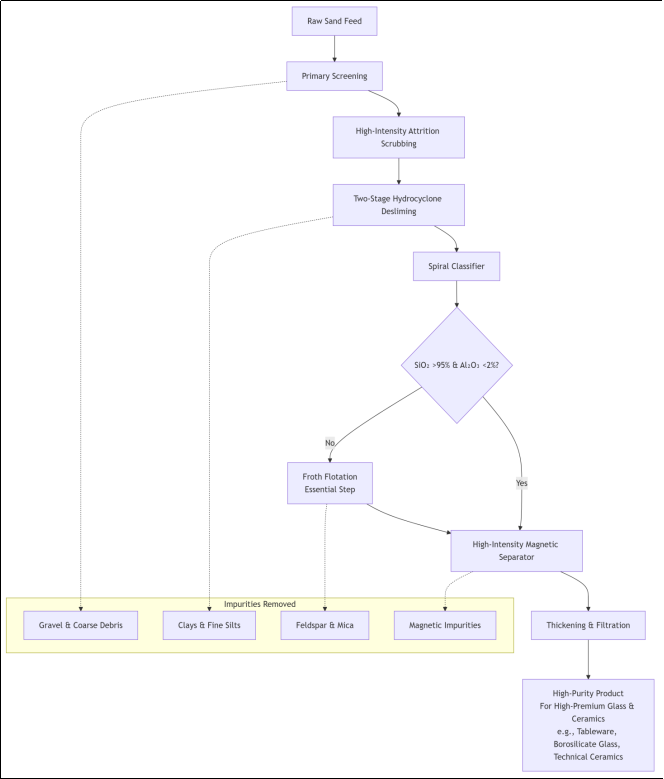
Clays & coatings | All Silica Sands, especially Dire Dawa | Attrition Scrubbing & Desliming | Liberates and physically removes fine coatings that increase LOI and Al2O3. |
Magnetic Minerals (Magnetite, Ilmenite, Garnet) | Mugher, Lemi, Fetra, Atsbi, Feldspar deposits | High-Intensity Magnetic Separation | Highly efficient for removing Fe and Ti oxides that cause discoloration in glass. |
Feldspar & Mica | Lemi, Fetra, Dire Dawa, Feldspar ores | Froth Flotation | Effective for separating minerals with similar density (e.g., quartz and feldspar). |
Quartz | Kenticha, Shebelle Feldspar | Froth Flotation | Separates valuable feldspar concentrate from quartz gangue. |
High Iron/Biotite Content | Negelle Borena Feldspar | Multi-Stage Magnetic Separation + Flotation acid leaching | Essential for this low grade deposit; requires advanced processing to achieve marketable grade. |
API | American Petroleum Institute |
ASTM | American Society for Testing and Materials |
BIS | Bureau of Indian Standards |
BS EN | British Standard European Norm |
Cc | Coefficient of Curvature |
Cu | Coefficient of Uniformity |
D10 | Effective Grain Size |
DLS | Debre Libanos Sandstone |
GSE | Geological Survey of Ethiopia |
ISO | International Organization for Standardization |
LOI | Loss on Ignition |
TAPPI | Technical Association of the Pulp and Paper Industry |
| [1] | Harben, P. W., Kuzvart, M. Industrial Minerals: A Global Geology. Cham: Springer; 1997, pp. 1-500. |
| [2] | Deer, W. A., Howie, R. A., Zussman, J. An Introduction to the Rock-Forming Minerals. 3rd ed. London: Mineralogical Society; 2013, pp. 1-500. |
| [3] | Ibrahim, K., Al-Masri, M., Abdel-Mohsen, A., Al-Hwaiti, M. Characterization of the Jordanian Feldspar Raw Materials for Application in the Ceramic and Glass Industries. International Journal of Mineralogy. 2020, 2020, 8816823. |
| [4] | Kirk-Othmer Encyclopedia of Chemical Technology. Silica and Silicates. Hoboken, NJ: John Wiley & Sons; 2014, pp. 1-500. |
| [5] | Wilson, J. R. Ceramic Raw Materials: Industrial Minerals and Their Processing. Amsterdam: Elsevier; 2019, pp. 1-400. |
| [6] | Ministry of Mines. Ethiopian Industrial Minerals Development Strategy 2019-2030. Addis Ababa; 2019. |
| [7] | Mitchell, C., Morgan, D., editors. Industrial Mineral Occurrence Map of Ethiopia [map]. 1:2,000,000. Addis Ababa: Geological Survey of Ethiopia; 2007. Available from: |
| [8] | Tadesse, S., Milesi, J.-P., Deschamps, Y. Geology and Mineral Potential of Ethiopia: A Note on Geology and Mineral Map of Ethiopia. Journal of African Earth Sciences. 2003, 36(4), 273-313. |
| [9] | Mohammedyasin, M. S. Geology, Geochemistry and Geochronology of the Kenticha Rare Metal Granite Pegmatite, Adola Belt, Southern Ethiopia: A Review. International Journal of Geosciences. 2017, 8(1), 12-33. |
| [10] | Teklewold, B., Yihunie, A., Alemayehu, M. Preliminary Report on Prospecting Results of the Kenticha Rare Metal Deposit [Unpublished internal report]. Addis Ababa: Ethiopian Mineral Resource Development Corp, Ministry of Mines and Energy; 2023. |
| [11] | Geological Survey of Ethiopia. Industrial Minerals of Ethiopia: Occurrence and Utilization. Addis Ababa: Ministry of Mines; 2018. |
| [12] | Gezahegn, G., Amsalu, A., Teku, M., Ejeta, N. Evaluation and Delineation of Lemi Silica Sand, Baso and Seladingay Kaolin in Amhara Regional State, North Shewa. Addis Ababa: Geological Survey of Ethiopia; 2020. |
| [13] | Wuletaw, A., Mihret, B. Physicochemical and Mineralogical Characterization of Silica Sand from the Lemi Region, Blue Nile Basin, Central Ethiopia: Evaluating Industrial Applications and Resource Potential. Heliyon. 2024, 10(14), e34426. |
| [14] | Ashenafi, N., Demisse, T., Getaneh, W. Industrial Properties and Uses of Silica Sand from Blue Nile Basin, Central Ethiopia. Arabian Journal of Geosciences. 2023, 16(3), 11302. |
| [15] | Mengistu, T., Lavrinenko, L., Esuyawkal, T., Tadele, H., Mamo, W. Evaluation of Sheet Glass Raw Materials (Silica Sand, Dolomite and Calcite Marble, Feldspar) at North Shoa, West Hararghe and Sidamo (Note No. 321). Addis Ababa: Ethiopian Institute of Geological Surveys, Mineral Exploration Department; 1989. |
| [16] | Bulto, D., Amsalu, A., Redae, M., Mitiku, M. Silica Sand Exploration and Evaluation in Atsbi Wonberta and Sasete Saedamba Woredas in Tigray National Regional State. Addis Ababa: Geological Survey of Ethiopia, Mineral Exploration and Evaluation Directorate; 2016. |
| [17] | Mitiku, M., Amsalu, A., Redae, M., Hunegnaw, Y. Exploration and Evaluation of Limestone and Silica Sand Resources in the Dire Dawa Administrative Council. Addis Ababa, Ethiopia: Geological Survey of Ethiopia, Mineral Exploration and Evaluation Directorate; 2017. |
| [18] | Amenti, A. Examination of Blue Nile Gorge Quartz Sandstones: Final Report (Report 1973/6). Addis Ababa: Imperial Ethiopian Government, Ministry of Mines, Geological Survey of Ethiopia; 1973. |
| [19] | Assefa, A., Tadele, H., Knoth, W. Geological Research and Evaluations for Sheet Glass Raw Materials (Silica Sand, Vein Quartz, Dolomite, Limestone and Feldspar), Shoa, Hararghe, Wollega, and Sidamo Administrative Regions (EIGS Note No. 238). Addis Ababa: Ethiopian Institute of Geological Surveys; 1985. |
| [20] | Bekele, W. Preliminary Geological Report of Delga Chebsi and Hakim Gara Limestone (Marble) and Hamaresia Granite Deposits. Addis Ababa: Ethio-Libyan Joint Mining Company (ELMICO); 1983. |
| [21] | Geological Survey of Ethiopia. Geological Map of Ethiopia (1:2,000,000). Addis Ababa: Ministry of Mines; 1972. |
| [22] | Platais, S., Vatalis, K. I., Charalampides, G. Suitability of Quartz Sands for Different Industrial Applications. Procedia Economics and Finance. 2014, 14, 491-498. |
| [23] | McLaws, I. Uses and Specifications of Silica Sand. Edmonton, AB: Research Council of Alberta; 1971. |
| [24] | Norton, F. Elements of Ceramics. Reading, MA: Addison-Wesley; 1957, pp. 1-300. |
| [25] | BS EN 12904. Products Used for Treatment of Water Intended for Human Consumption: Silica Sand and Silica Gravel. London: British Standards Institution; 2005. |
| [26] | Bureau of Indian Standards. Indian Specification (IS: 488-1988) for Glass Making Sand. New Delhi: Indian Standard Institution; 1980. |
| [27] | Indian Bureau of Mines. Quartz and Silica Sand. Nagpur, India: Ministry of Mines; 1993. |
| [28] | Kogel, J. E., Society for Mining, Metallurgy, and Exploration (U.S.). Industrial Minerals & Rocks: Commodities, Markets, and Uses. 7th ed. Littleton, CO: Society for Mining, Metallurgy, and Exploration; 2006, pp. 1-1500. |
| [29] | Brown, J., Ed. Foseco Ferrous Foundry Man's Handbook. Oxford: Butterworth-Heinemann; 2000, pp. 1-400. |
| [30] | Bureau of Indian Standards. Indian Specification (IS: 1988-1974) for High Silica Sand Use in Foundries. New Delhi: Indian Standard Institution; 1987. |
| [31] | Sundeen, S. Geologic Study of Sand Deposits in the State of Michigan Phase 2. Lansing, MI: Michigan Department of Environmental Quality, Geological Survey Division; 2001. |
| [32] | Chatterjee, K. Uses of Industrial Minerals, Rocks and Freshwater. New York: Nova Science Publishers; 2009, pp. 1-300. |
| [33] | Huisman, L., Wood, E. Slow Sand Filtration. Geneva: World Health Organization; 1974, pp. 1-200. |
| [34] | Bureau of Indian Standards. Indian Standard Specification (IS: 8419) for Filter Sand and Gravel Sand Used in Water Filtration. New Delhi: Indian Standard Institution; 1977. |
| [35] | Klein, C., Dutrow, B. Manual of Mineral Science. 23rd ed. Hoboken, NJ: John Wiley & Sons; 2007, pp. 1-700. |
| [36] |
Edem, C. A., Malu, S. P., Ita, B. I. Characterization and Beneficiation of the Glass Making Potentials of Silica Sand Deposit from River Benue North Central Nigeria. Journal of Natural Sciences Research. 2014, 4(19), 49-58. Available from:
https://www.iiste.org (accessed 1 August 2026). |
| [37] | Grbes, A. A Life Cycle Assessment of Silica Sand: Comparing the Beneficiation Processes. Sustainability. 2015, 8(1), 11. |
APA Style
Sheferaw, Y. B., Belachew, G. (2026). Silica Sand and Feldspar Resources in Ethiopia: A Review of Their Occurrence, Characteristics, Industrial Applications, and Beneficiation. American Journal of Applied and Industrial Chemistry, 10(2), 30-49. https://doi.org/10.11648/j.ajaic.20261002.11
ACS Style
Sheferaw, Y. B.; Belachew, G. Silica Sand and Feldspar Resources in Ethiopia: A Review of Their Occurrence, Characteristics, Industrial Applications, and Beneficiation. Am. J. Appl. Ind. Chem. 2026, 10(2), 30-49. doi: 10.11648/j.ajaic.20261002.11
@article{10.11648/j.ajaic.20261002.11,
  author = {Yohanes Belachew Sheferaw and Getnet Belachew},
  title = {Silica Sand and Feldspar Resources in Ethiopia: A Review of Their Occurrence, Characteristics, Industrial Applications, and Beneficiation},
  journal = {American Journal of Applied and Industrial Chemistry},
  volume = {10},
  number = {2},
  pages = {30-49},
  doi = {10.11648/j.ajaic.20261002.11},
  url = {https://doi.org/10.11648/j.ajaic.20261002.11},
  eprint = {https://article.sciencepublishinggroup.com/pdf/10.11648.j.ajaic.20261002.11},
  abstract = {Silica sand/quartz and feldspar are strategic industrial minerals that play a vital role in glass, ceramic, foundry, construction, filtration, and chemical industries. Ethiopia has abundant occurrences of these minerals across diverse geological settings, yet their industrial potential remains underutilized due to limited systematic characterization and beneficiation studies. This review provides a comprehensive assessment of the geological occurrence, distribution, physicochemical characteristics, and industrial suitability of major silica sand and feldspar deposits in Ethiopia. Representative deposits including Mugher, Lemi, Fetra, Atsbi, Dire Dawa (Belewa), and Blue Nile Gorge for silica sand, and Kenticha, Shebelle, Negelle Borena, and Hamariesa for feldspar were evaluated using compiled physical parameters (grain size, shape, sorting, weathering, and bulk density) and chemical compositions (major oxides). The results indicate that Mugher, Fetra, and Lemi silica sand deposits exhibit high SiO2 contents (>95%), favorable grain morphology, and low impurity levels, making them suitable for foundry applications, water filtration, construction, and amber and green glass production, with limited beneficiation. However, none of the studied deposits meet the stringent requirements for optical or float glass without advanced processing to reduce Fe2O3 and Al2O3. Feldspar deposits, particularly Shebelle and Kenticha, show promising alkali and alumina contents suitable for ceramic and glass industries, though iron removal is required to meet high-grade industrial specifications. Overall, Ethiopia possesses substantial potential to substitute imported industrial minerals and develop value-added mineral industries, provided that targeted beneficiation, infrastructure development, and systematic resource evaluation are implemented.},
 year = {2026}
}
TY  - JOUR
T1  - Silica Sand and Feldspar Resources in Ethiopia: A Review of Their Occurrence, Characteristics, Industrial Applications, and Beneficiation
AU  - Yohanes Belachew Sheferaw
AU  - Getnet Belachew
Y1  - 2026/08/22
PY  - 2026
N1  - https://doi.org/10.11648/j.ajaic.20261002.11
DO  - 10.11648/j.ajaic.20261002.11
T2  - American Journal of Applied and Industrial Chemistry
JF  - American Journal of Applied and Industrial Chemistry
JO  - American Journal of Applied and Industrial Chemistry
SP  - 30
EP  - 49
PB  - Science Publishing Group
SN  - 2994-7294
UR  - https://doi.org/10.11648/j.ajaic.20261002.11
AB  - Silica sand/quartz and feldspar are strategic industrial minerals that play a vital role in glass, ceramic, foundry, construction, filtration, and chemical industries. Ethiopia has abundant occurrences of these minerals across diverse geological settings, yet their industrial potential remains underutilized due to limited systematic characterization and beneficiation studies. This review provides a comprehensive assessment of the geological occurrence, distribution, physicochemical characteristics, and industrial suitability of major silica sand and feldspar deposits in Ethiopia. Representative deposits including Mugher, Lemi, Fetra, Atsbi, Dire Dawa (Belewa), and Blue Nile Gorge for silica sand, and Kenticha, Shebelle, Negelle Borena, and Hamariesa for feldspar were evaluated using compiled physical parameters (grain size, shape, sorting, weathering, and bulk density) and chemical compositions (major oxides). The results indicate that Mugher, Fetra, and Lemi silica sand deposits exhibit high SiO2 contents (>95%), favorable grain morphology, and low impurity levels, making them suitable for foundry applications, water filtration, construction, and amber and green glass production, with limited beneficiation. However, none of the studied deposits meet the stringent requirements for optical or float glass without advanced processing to reduce Fe2O3 and Al2O3. Feldspar deposits, particularly Shebelle and Kenticha, show promising alkali and alumina contents suitable for ceramic and glass industries, though iron removal is required to meet high-grade industrial specifications. Overall, Ethiopia possesses substantial potential to substitute imported industrial minerals and develop value-added mineral industries, provided that targeted beneficiation, infrastructure development, and systematic resource evaluation are implemented.
VL  - 10
IS  - 2
ER  -
Geological Institute of Ethiopia, Addis Ababa, Ethiopia
Geological Institute of Ethiopia, Addis Ababa, Ethiopia
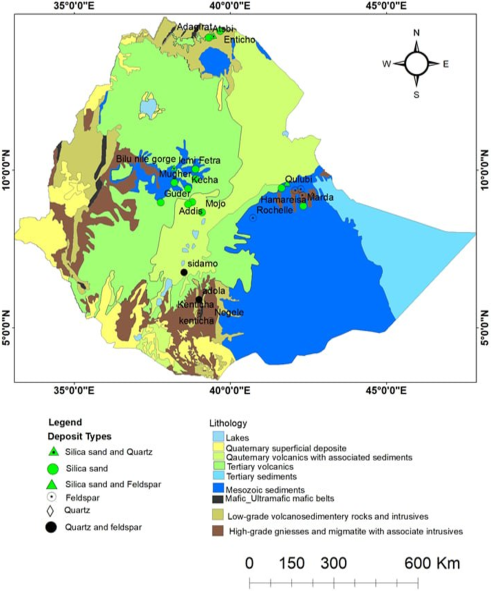
Figure 1. Geological map showing the occurrences of silica sand, quartz and feldspar deposits in Ethiopia [21].
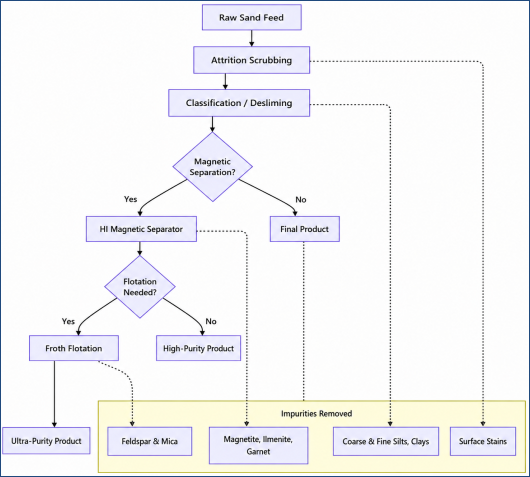
Figure 2. Beneficiation flowsheet for high-grade silica sand deposit (Mugher and Fetra).
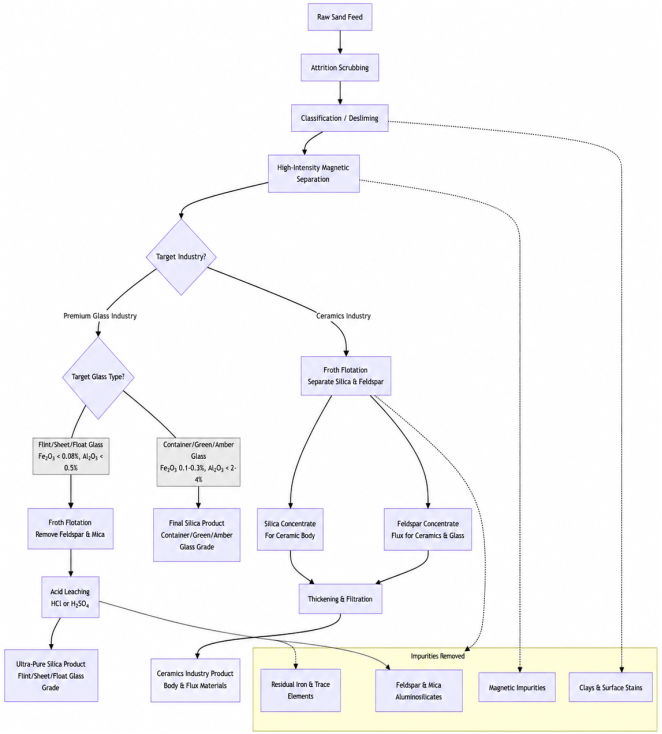
Figure 3. Beneficiation flowsheet for medium-grade silica sand deposit (Atsbi and Lemi).
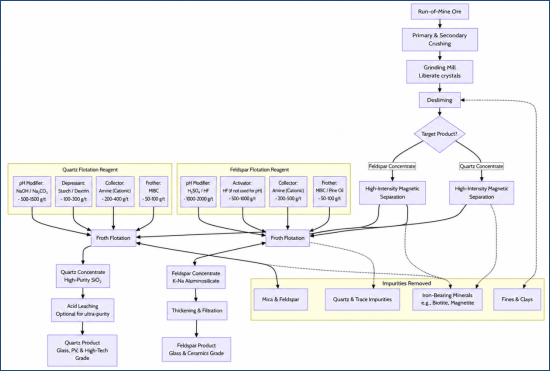
Figure 5. Beneficiation flowsheet for the Kenticha feldspar deposit.
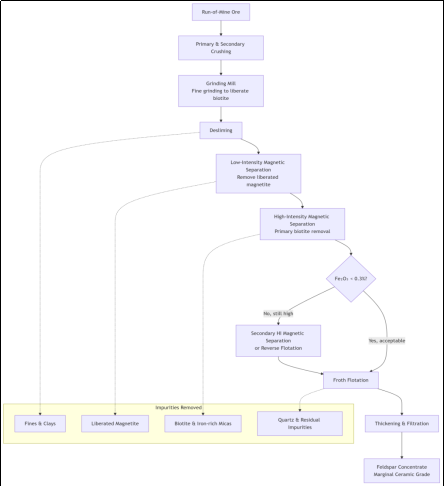
Figure 6. Beneficiation flow sheet for theNegelle -Borena feldspar deposit.

Information



 Share This Article
 Twitter
 Linked In
 Facebook
 Copy
Copy Download