
This paper presents a semi-analytical solution for one-dimensional advection-diffusion equation coupled with a linear partial differential equation with constant coefficients. The mathematical model describes a grain-fumigant-air system during fumigation processes, where fumigant gas transports through a storage silo. The coupled system considers both diffusion and advection mechanisms with constant velocity and diffusivity parameters. The solution methodology employs the Laplace transformation technique to convert the partial differential equations into ordinary differential equations in the Laplace domain. The Stehfest numerical algorithm is subsequently applied to invert the Laplace transforms and obtain the time-domain solution. Numerical computations are performed using MATLAB software to simulate the fumigant concentration distributions. Graphical results illustrate the fumigant gas concentration in air versus vertical height within the silo for different time intervals. Additional plots demonstrate the fumigant concentration absorbed by grain particles over time. The analysis examines effects of varying initial gas concentration and flow velocity on the transport process. Results indicate that higher initial concentrations and increased velocities accelerate the fumigation process, requiring less time to fill the silo completely. The proposed solution provides a mathematical framework for optimizing fumigation parameters in agricultural storage applications.
| Published in | American Journal of Applied Mathematics (Volume 14, Issue 2) |
| DOI | 10.11648/j.ajam.20261402.11 |
| Page(s) | 39-45 |
| Creative Commons |
This is an Open Access article, distributed under the terms of the Creative Commons Attribution 4.0 International License (http://creativecommons.org/licenses/by/4.0/), which permits unrestricted use, distribution and reproduction in any medium or format, provided the original work is properly cited. |
| Copyright |
Copyright © The Author(s), 2026. Published by Science Publishing Group |
Advection, Advection-diffusion, Coupled Equation, Laplace Transformation Method, Linear Partial Differential Equations
 (1)
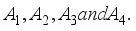
(1) 
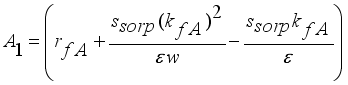
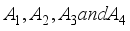 are given by: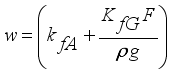
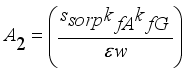
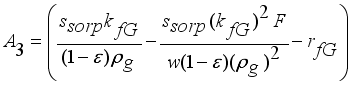
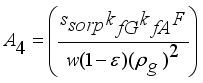
 : The mass transfer coefficient of gaseous fumigant from air to grain.
  : The mass transfer coefficient of adsorbed fumigant in grain.
  : The rate of the first-order reaction of adsorbed fumigant in the grain.
  : Rate of first order “reaction” of gaseous fumigant in air.
  : Specific surface area for sorption.
  : partition factor.
  : The true density of the grain kernels.
  : porosity of the bulk grain.
  : The diffusivity of fumigant into grain.
  (3)
(3)  , ,
, ,  (5)
(5)  (6)
(6)  (7)
(7) 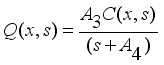 (8)
(8)  (9)
(9)  Thereforethegeneralsolutioncanbewrittenas:
 Applying the boundary conditions, we find: A=0 Hence B
  . Thus:
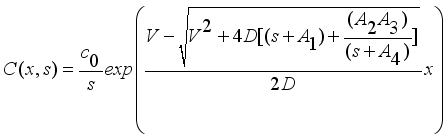

| [1] | Kumar, A., Jaiswal, D. K. and Kumar, N. (2009). Analytical solutions of one-dimensional advection-diffusion equation with variable coefficients in a finite domain. Journal of Earth System Science, 118(5), 539-549. |
| [2] | Kumar, A., Jaiswal, D. K. and Kumar, N. (2010). Analytical solutions to one-dimensional advection-diffusion equation with variable coefficients in semi-infinite media. Journal of Hydrology, 380(3-4), 330-337. |
| [3] | Jaiswal, D. K., Kumar, A. and Yadav, R. R. (2011). Analytical solution to the one-dimensional advection-diffusion equation with temporally dependent coefficients. Journal of Water Resource and Protection, 3(1), 76-84. |
| [4] | Jaiswal, D. K. and Kumar, A. (2011). Analytical solution of advection-dispersion equation for varying pulse type input point source in one-dimension. International Journal of Engineering, Science and Technology, 3(1), 22-29. |
| [5] | Kumar, A., Jaiswal, D. K. and Kumar, N. (2012). One-dimensional solute dispersion along unsteady flow through a heterogeneous medium, dispersion being proportional to the square of velocity. Hydrological Sciences Journal, 57(6), 1218-1232. |
| [6] | Kumar, A., Jaiswal, D. K. and Yadav, R. R. (2012). Analytical solutions of one-dimensional temporally dependent advection-diffusion equation along longitudinal semi-infinite homogeneous porous domain for uniform flow. IOSR Journal of Mathematics, 2(1), 1-11. |
| [7] | Chen, J. S. and Liu, C. W. (2011). Generalized analytical solution for advection-dispersion equation in finite spatial domain with arbitrary time-dependent inlet boundary condition. Hydrology and Earth System Sciences, 15(8), 2471-2479. |
| [8] | Daga, A. and Pradhan, V. H. (2013). Analytical solution of advection-diffusion equation in homogeneous medium. International Journal of Science, Spirituality, Business and Technology (IJSSBT), 2(1), 1-8. |
| [9] | Mazaheri, M., Samani, J. M. V. and Samani, H. M. V. (2013). Analytical solution to one-dimensional advection-diffusion equation with several point sources through arbitrary time-dependent emission rate patterns. Journal of Agricultural Science and Technology, 15(6), 1231-1245. |
| [10] | Kumar, A. and Yadav, R. R. (2014). One-dimensional solute transport for uniform and varying pulse type input point source through heterogeneous medium. Environmental Technology, 36(4), 487-495. |
| [11] | Wadi, A. S., Dimian, M. F. and Ibrahim, F. N. (2014). Analytical solutions for one-dimensional advection–dispersion equation of the pollutant concentration. Journal of Earth System Science, 123(6), 1317-1324. |
| [12] | Sanskrityayn, A. and Kumar, N. (2016). Analytical solution of advection diffusion equation in heterogeneous infinite medium using Green’s function method. Journal of Earth System Science, 125(8), 1713-1723. |
| [13] | Kumar, L. K. (2017). An analytical approach for one-dimensional advection diffusion equation with temporally dependent variable coefficients of hyperbolic function in semi-infinite porous domain. International Research Journal of Engineering and Technology, 4(9), 1587-1592. |
| [14] | Yadav, R. R. and Kumar, L. K. (2017). One-dimensional spatially dependent solute transport in semi-infinite porous media: an analytical solution. International Journal of Engineering, Science and Technology, 9(4), 20-27. |
| [15] | Chaudhary, M., Thakur, C. K. and Singh, M. K. (2020). Analysis of 1-D pollutant transport in semi-infinite groundwater reservoir. Environmental Earth Sciences, 79(1), 24. |
| [16] | Yadav, R. R. and Roy, J. (2022). Analytical solutions of one-dimensional scale dependent advection-dispersion equations for finite domain solute transport. Groundwater for Sustainable Development, 16, 100712. |
| [17] | Jaiswal, D. K., Kumar, N. and Yadav, R. R. (2022). Analytical solution for transport of pollutant from time-dependent locations along groundwater. Journal of Hydrology, 610, 127826. |
| [18] | Yadav, R. R., Kushwaha, S., Roy, J. and Kumar, L. K. (2023). Analytical solutions for scale and time dependent solute transport in heterogeneous porous medium. Journal of Water Resources and Ocean Science, 12(1), 1-11. |
| [19] | Kumar, R., Chatterjee, A., Singh, M. K. and Singh, V. P. (2019). Study of solute dispersion with source/sink impact in semi-infinite porous medium. Pollution, 6(1), 87-98. |
| [20] | Paudel, K., Bahandari, P. S. and Kafe, J. (2021). Analytical solution for advection-dispersion equation of the pollutant concentration using Laplace transformation. Journal of Nepal Mathematical Society (JNMS), 4(1), 1-12. |
| [21] | Sanskrityayn, A., Suk, H., Chen, J. S. and Park, E. (2021). Generalized analytical solutions of the advection dispersion equation with variable flow and transport coefficients. Sustainability, 13(14), 7796. |
| [22] | Yadav, R. R., Kushwaha, S., Kumar, L. K. and Roy, J. (2023). An analytical approach to contaminant transport with spatially and temporally dependent dispersion in a heterogeneous porous medium. Cumhuriyet Science Journal, 44(3), 538-546. |
| [23] | Yadav, R. R., Kumar, L. K. and Kushwaha, S. (2020). Analytical solution for two-dimensional advection diffusion equation in semi-infinite homogeneous porous media by Laplace transformation method. Pollution, 6(4), 901-915. |
| [24] | Mckaa, S., Dougall, E. A. and Mottram, N. J. (2016). Analytical solutions of a simple advection-diffusion model of an oxygen transfer device. Journal of Mathematics in Industry, 6(1), 3. |
| [25] | Chatterjee, A. and Singh, M. K. (2018). Two-dimensional advection-dispersion equation with depth-dependent variable source concentration. Pollution, 4(1), 1-8. |
| [26] | Thakur, C. K., Chaudhary, M., van der Zee, S. E. A. T. M. and Singh, M. K. (2019). Two-dimensional solute transport with exponential concentration distribution and varying flow velocity. Pollution, 5(4), 721-737. |
| [27] | Yadav, R. R. and Kumar, L. K. (2019). Solute transport for pulse type input point source along temporally and spatially dependent flow. Pollution, 5(1), 53-70. |
| [28] | Essa, K. S. M., Mosallem, A. M. and Shalaby, A. S. (2021). Evaluation of analytical solution of advection diffusion equation in three dimensions. Atmospheric Science Letters, 22(11), e1043. |
| [29] | Ibrahim, F., Saleh, A., Wadi, A. and Hadhouda, M. (2022). Remediation of pollution in a river by releasing clean water using the solution of advection-diffusion equation in two-dimension. Information Sciences Letters, 11(5), 1385-1392. |
| [30] | Chaudhary, M. and Singh, M. K. (2020). Study of multispecies convection-dispersion transport equation with variable parameters. Journal of Hydrology, 591, 125562. |
| [31] | Chen, J. S., Ho, Y. C., Liang, C. P., Wang, S. W. and Liu, C. W. (2019). Semi-analytical model for coupled multispecies advective-dispersive transport subject to rate-limited sorption. Journal of Hydrology, 579, 124164. |
| [32] | Buske, D., Bodmann, B. and Vilhena, M. T. (2015). On the solution of the coupled advection-diffusion and Navier-Stokes equations. American Journal of Environmental Engineering, 5(1A), 1-8. |
| [33] | De Athayde, A. S., Piovesan, L. R., Bodmann, B. E. J. and De Vilhena, M. T. M. B. (2018). Analytical solution of the coupled advection diffusion and Navier-Stokes equation for air pollutant emission simulation. American Journal of Environmental Engineering, 8(4), 150-153. |
| [34] | Stehfest, H. (1970). Algorithm 368: Numerical inversion of Laplace transform [D5]. Communications of the ACM, 13(1), 47-49. |
| [35] | Darby, J., Willis, T. and Damcevski, K. (2009). Modelling the kinetics of ethyl formate sorption by wheat using batch experiments. Pest Management Science, 65(9), 982-990. |
APA Style
Qasimi, M. J., Alias, N. (2026). Semi-analytical Solution of One-dimension Advection Diffusion Equation Coupled with Linear Partial Differential Equation with Constant Coefficient. American Journal of Applied Mathematics, 14(2), 39-45. https://doi.org/10.11648/j.ajam.20261402.11
ACS Style
Qasimi, M. J.; Alias, N. Semi-analytical Solution of One-dimension Advection Diffusion Equation Coupled with Linear Partial Differential Equation with Constant Coefficient. Am. J. Appl. Math. 2026, 14(2), 39-45. doi: 10.11648/j.ajam.20261402.11
AMA Style
Qasimi MJ, Alias N. Semi-analytical Solution of One-dimension Advection Diffusion Equation Coupled with Linear Partial Differential Equation with Constant Coefficient. Am J Appl Math. 2026;14(2):39-45. doi: 10.11648/j.ajam.20261402.11
@article{10.11648/j.ajam.20261402.11,
  author = {Mohammad Jawad Qasimi and Norma Alias},
  title = {Semi-analytical Solution of One-dimension Advection Diffusion Equation Coupled with Linear Partial Differential Equation with Constant Coefficient},
  journal = {American Journal of Applied Mathematics},
  volume = {14},
  number = {2},
  pages = {39-45},
  doi = {10.11648/j.ajam.20261402.11},
  url = {https://doi.org/10.11648/j.ajam.20261402.11},
  eprint = {https://article.sciencepublishinggroup.com/pdf/10.11648.j.ajam.20261402.11},
  abstract = {This paper presents a semi-analytical solution for one-dimensional advection-diffusion equation coupled with a linear partial differential equation with constant coefficients. The mathematical model describes a grain-fumigant-air system during fumigation processes, where fumigant gas transports through a storage silo. The coupled system considers both diffusion and advection mechanisms with constant velocity and diffusivity parameters. The solution methodology employs the Laplace transformation technique to convert the partial differential equations into ordinary differential equations in the Laplace domain. The Stehfest numerical algorithm is subsequently applied to invert the Laplace transforms and obtain the time-domain solution. Numerical computations are performed using MATLAB software to simulate the fumigant concentration distributions. Graphical results illustrate the fumigant gas concentration in air versus vertical height within the silo for different time intervals. Additional plots demonstrate the fumigant concentration absorbed by grain particles over time. The analysis examines effects of varying initial gas concentration and flow velocity on the transport process. Results indicate that higher initial concentrations and increased velocities accelerate the fumigation process, requiring less time to fill the silo completely. The proposed solution provides a mathematical framework for optimizing fumigation parameters in agricultural storage applications.},
 year = {2026}
}
TY  - JOUR
T1  - Semi-analytical Solution of One-dimension Advection Diffusion Equation Coupled with Linear Partial Differential Equation with Constant Coefficient
AU  - Mohammad Jawad Qasimi
AU  - Norma Alias
Y1  - 2026/03/05
PY  - 2026
N1  - https://doi.org/10.11648/j.ajam.20261402.11
DO  - 10.11648/j.ajam.20261402.11
T2  - American Journal of Applied Mathematics
JF  - American Journal of Applied Mathematics
JO  - American Journal of Applied Mathematics
SP  - 39
EP  - 45
PB  - Science Publishing Group
SN  - 2330-006X
UR  - https://doi.org/10.11648/j.ajam.20261402.11
AB  - This paper presents a semi-analytical solution for one-dimensional advection-diffusion equation coupled with a linear partial differential equation with constant coefficients. The mathematical model describes a grain-fumigant-air system during fumigation processes, where fumigant gas transports through a storage silo. The coupled system considers both diffusion and advection mechanisms with constant velocity and diffusivity parameters. The solution methodology employs the Laplace transformation technique to convert the partial differential equations into ordinary differential equations in the Laplace domain. The Stehfest numerical algorithm is subsequently applied to invert the Laplace transforms and obtain the time-domain solution. Numerical computations are performed using MATLAB software to simulate the fumigant concentration distributions. Graphical results illustrate the fumigant gas concentration in air versus vertical height within the silo for different time intervals. Additional plots demonstrate the fumigant concentration absorbed by grain particles over time. The analysis examines effects of varying initial gas concentration and flow velocity on the transport process. Results indicate that higher initial concentrations and increased velocities accelerate the fumigation process, requiring less time to fill the silo completely. The proposed solution provides a mathematical framework for optimizing fumigation parameters in agricultural storage applications.
VL  - 14
IS  - 2
ER  -
Independent Scholar, Kabul, Afghanistan
Department of Mathematical Science, University Technology Malaysia, Johor Bahru, Malaysia
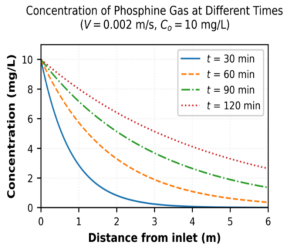
Figure 1. Concentration of fumigant gas in air vs. height for V=0.002 m/s, C0=10 mg/L.
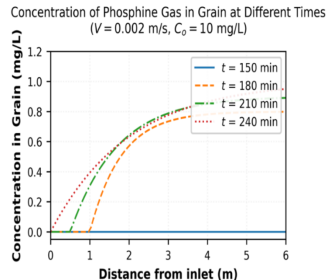
Figure 2. Concentration of fumigant gas in grain vs. height for V=0.002 m/s, C0=10 mg/L.
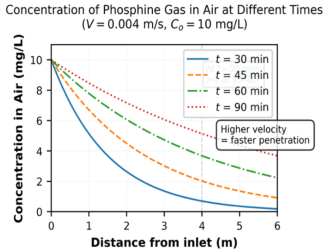
Figure 3. Concentration of fumigant gas in air vs. height for V=0.004 m/s, C0=10 mg/L.
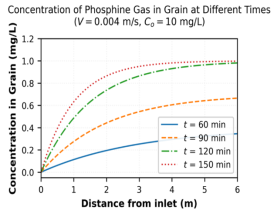
Figure 4. Concentration of fumigant gas in grain vs. height for V=0.004 m/s, C0=10 mg/L.
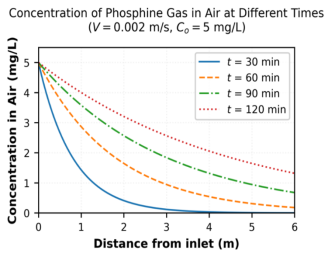
Figure 5. Concentration of fumigant gas in air vs. height for V=0.002 m/s, C0=5 mg/L.
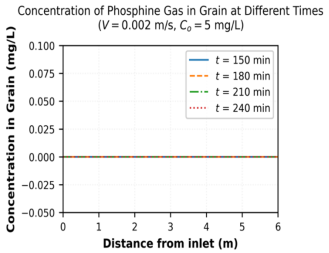
Figure 6. Concentration of fumigant gas in grain vs. height for V=0.002 m/s, C0=5 mg/L.
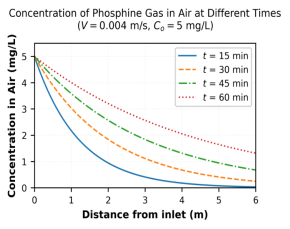
Figure 7. Concentration of fumigant gas in air vs. height for V=0.004 m/s, C0=5mg/L.

Information



 Share This Article
 Twitter
 Linked In
 Facebook
 Copy
Copy Download