In Côte d'Ivoire, potatoes have become a key component of the local diet. To meet the rising demand, the government invests over 22 billion FCFA annually to ensure sufficient supply for the population. Despite its favorable climate, Côte d'Ivoire produces very little potatoes. The main constraint to potato cultivation is the lack of seed availability at the right time for producers. This study aims to develop a protocol for producing potato in vitro plantlets in Côte d'Ivoire. Nodal segments from 21-day-old in vitro plantlets were placed onto four basal media containing different combinations of growth regulators (MS0: MS + Morel and Wetmore vitamins; M1: MS + Morel and Wetmore vitamins + 0.25 mg/L BAP; M2: MS + Morel and Wetmore vitamins + 0.25 mg/L BAP+ 0.01 mg/L IAA; M3: MS + Morel and Wetmore vitamins + 0.25 mg/L BAP+ 0.01 mg/L IAA + 0.25mg/L GA3). A series of subcultures was carried out on the medium expressing the best responses. The MS0 medium, lacking growth regulators, supported the highest seedling growth (11.33 cm) and healthy leaf development in all varieties. The Charlotte variety, during its fourth subculture, demonstrated the greatest multiplication capacity, producing plants with an average height of 9.21 cm, 12.1 nodes per leafy shoot, and 3.21 leafy shoots per explant. Beyond this stage, multiplication performance decreases sharply. These results will contribute to the development of a protocol for mass production of potato seeds in the form of in vitro plantlets.
This is an Open Access article, distributed under the terms of the Creative Commons Attribution 4.0 International License (http://creativecommons.org/licenses/by/4.0/), which permits unrestricted use, distribution and reproduction in any medium or format, provided the original work is properly cited.
. It is world’s third most important food crop after rice and wheat. It stands out for its efficiency, offering superior yields and nutritional value more fiber, protein, and micronutrients
[2]
Sharde R, Tripathi MK, Bhatt D, Tiwari S, Sharma M, Tomar YS, Tripathi N. Influence of plant growth regulators on invitro morphogenesis in sprout culture of potato (Solanumtuberosum L.). PotatoResearch. 2024; 67(2): 399-420.
. Its consumption is now part of the culinary habits of the Ivorian population. To satisfy the population's need for this tuber, the State of Côte d'Ivoire spends nearly 22 billion FCFA a year
[3]
N’cho YP. Potato in Côte d’Ivoire. World: Presentation of the potato value chain. LaCôted’IvoireAgricole. 2023.
[3]
. To cope with this external dependence, several attempts were made to introduce its cultivation in Côte d'Ivoire through research programs in the Touba area in the north-west of the country
[4]
Goore-Bi GG, Carlos MB, Francis A, Lanceni K, Alberto S, Foncho PAF, Tetevi K, Ifenkwe OP. Potatoproduction:ReportoftheworkshopheldatBamenda,Cameroon,September25-30,1988. 1988.
[4]
. All these initiatives ended in failure, mainly due to the unavailability of seeds at the right time for farmers. Also, the availability of quality seed to smallholder farmers for most crops in sub-Saharan Africa is a problem
[5]
Tessema L, Negash W, Kakuhenzire R, Belay G, Seid E, Enyew M. Seed health trade-offs in adopting quality declared seed in potato farming systems. CropScience. 2024; 64(3): 1340-1348.
. Yet it has been shown that seed is the most important agricultural input
[6]
Beauval V, Grandval F. Les semences, un intrant stratégique concentrant beaucoup d’enjeux. GraindeSel. 2011; 52-53: 12-14.
[7]
FAO. TheStateofFoodSecurityandNutritionintheWorld2023. Rome: Food and Agriculture Organization of the United Nations; 2023.
[6, 7]
. According to Vanesse
[8]
Vanesse L. Evaluation of an innovative practice: The use and production of seeds of root and tuber crops for distribution and the creation of allelic diversity. PhD Thesis, Montpellier SupAgro; 2009.
[8]
, the unavailability and cost of imported seeds force smallholders to use their harvests as seeds. This reduces tuber quality, encouraging the establishment and resurgence of diseases and lower yields from one season to the next.
Potato seedd is essentially made up of in vitro plantlets from developed countries
[9]
Thomas-Sharma S, Abdurahman A, Ali S, Andrade-Piedra JL, Bao S, Charkowski AO, Crook D, Kadian M, Kromann P, Struik PC, Torrance L, Garrett KA, Forbes GA. Seed degeneration in potato: The need for an integrated seed health strategy to mitigate the problem in developing countries. PlantPathology. 2016; 65(1): 3-16.
. The technology for producing this type of seed is difficult to adopt due to the technical skills required and the large investments to be made. Despite the difficulties of implementing this technology, it could solve the potato seed problem in sub-Saharan countries. Indeed, this technology makes it possible to rapidly obtain large numbers of sanitary-quality plants in a limited space, independently of the seasons, and genetically in line with the starting plant material
[10]
Hajare ST, Chauhan NM, Kassa G. Effect of growth regulators on in vitro micropropagation of potato (Solanumtuberosum L.) Gudiene and Belete varieties from Ethiopia. TheScientificWorldJournal. 2021; 2021: 5928769.
. Given the multiplication potential of this technique, it has been widely used to study potato seed production in technologically advanced agricultural countries. The literature review showed that the success of micropropagation depends on the composition of the environment and varies according to variety and species
[11]
Grishchenko OV, Subbotin EP, Gafitskaya IV, Vereshchagina YV, Burkovskaya EV, Khrolenko YA, Kulchin YN. Growth of micropropagated Solanumtuberosum L. plantlets under artificial solar spectrum and different mono- and polychromatic LED lights. HorticulturalPlantJournal. 2022; 8(2): 205-214.
Bruno F, Ledbetter M, Davies B, Sturrock K, McNamara G, Montague G, Fiore A. Effect of post-harvest anti-sprouting treatment with spearmint essential oil on acrylamide formation in potato crisps. LWT. 2023; 183: 114896.
Shafique I, Mehmood K, Shah SH, Baig RM, Hasnain Z. Influence of plant growth regulators on in vitro micropropagation of potato varieties. JournalofAgriculturalResearch(JAR). 2025; 63(1): 87-93.
Mubeen A, Mustafa G, Akhtar S, Nadeem Z. Impact assessment of growth regulators on in vitro tuberization in S.tuberosum. UnwanSciencesSociety. 2024; 2(2): 109-114.
would produce well-developed in vitro plants, while Zerbo et al.
[16]
Zerbo A, Some K, Tiama D, Soro M, Ouedraogo WIC, Traore RE. Evaluation of four growth mediums effect on potato (Solanumtuberosum L.) plantlet production in Burkina Faso. ResearchSquare. 2024.
found that a medium containing the salts of Murashige and Skoog supplemented with 0.5 mg/L IBA is better for the production of potato in vitro plants. However, multiplication potential is linked to the number of subcultures performed, which is unfortunately a source of somaclonal variation in the clones produced. The number of subcultures required to avoid somaclonal variation has yet to be determined.
The aim of this study is to develop a multiplication protocol to determine the number of subcultures required for efficient production of potato vitroplants under our growing conditions. The development of such a protocol will make it possible to provide local producers with potato seed in the form of vitroplants.
2. Materials and Methods
2.1. Plant Material
The plant material consisted of 21-day-old potato in vitro plantlets of the Charlotte and Roseval varieties. These seedlings were produced at the Laboratory of Biology and Improvement of Plant Production (LBAPV) of Nangui ABROGOUA University.
2.2. Media Composition and Culture Conditions
The basal medium used is that of Murashige and Skoog
[15]
Murashige T, Skoog F. A revised medium for rapid growth and bio assays with tobacco tissue cultures. PhysiologiaPlantarum. 1962; 15(3): 473-497.
and various growth regulators (BAP, IAA and GA3). The pH of the medium was adjusted to 5.8 with NaOH (0.1 N) or HCl (0.1 N) after the addition of sucrose (3%) as a carbon source and gelrite (0.25%) as a gelling agent. The mixture was boiled to promote distribution into test tubes (10 ml) or jars (30 ml), then sterilized for 20 min in an autoclave, at a pressure of 1 bar and a temperature of 121°C. The four media formulated were as follows:
1) M0: MS + Morel and Wetmore vitamins;
2) M1: MS + Morel and Wetmore vitamins + 0.25 mg/L BAP;
3) M2: MS + Morel and Wetmore vitamins + 0.25 mg/L BAP+ 0.01 mg/L IAA;
4) M3: MS + Morel and Wetmore vitamins + 0.25 mg/L BAP+ 0.01 mg/L IAA + 0.25mg/L GA3.
Cultures were incubated in a culture chamber at 25±2°C with humidity fluctuating between 70 and 80% and a 16/8-hour photoperiod for 30 days.
2.3. In Vitro Plant Subculture Cycles
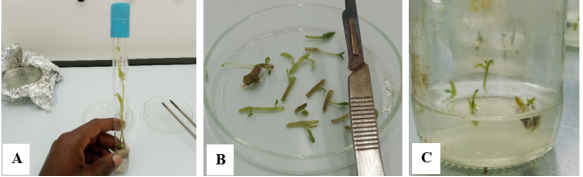
The in vitro plantlets obtained after each 30-day subculture cycle were used as explant sources for the following cycle. Under a laminar flow hood, 2 cm-long nodal segments bearing 1 or 2 nodes were harvested from the in vitro plantlets obtained. The explants thus obtained were transplanted onto a medium and transferred to a culture chamber.
Figure 1. transplanting process. A: 21 days-old seedlings, B: cuttings of nodal axes and C: transfer of cuttings on culture medium.
2.4. Parameters Measured
Parameters were measured on 30 in vitro plantlets after 30 days of incubation. On each explant, the number of leafy shoots, the rooting rate and the number of roots were counted. The parameters taken from the leafy shoots were height, number of leaves and number of nodes.
2.5. Statistical Analysis
R software version 4.3.3 was used for data analysis. Analysis of variance tests (parametric or non-parametric) were performed to determine the responses of explants subjected to the different experiments. In the event of a significant difference, a Turkey test at the 5% threshold was performed to classify the means into homogeneous groups.
3. Results
3.1. Morphology of in Vitro Plantlets as a Function of Medium Composition
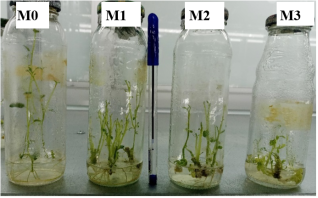
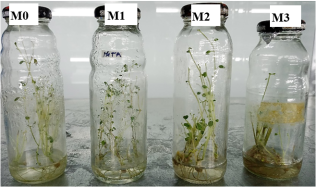
Generally speaking, whatever the variety, the leafy shoots obtained on M0 medium were morphologically the best, with green, full-blown leaves. These leafy shoots are more robust and have a greater number of nodes (Figures 2 and 3). On media M1, M2 and M3, the leafy shoots were small and slightly whitish, with signs of hyperhydricity.
Figure 3. Charlotte in vitro plantlets at 1st subculture on M0, M1, M2 and M3 media.
3.2. Interaction of Variety Factors and Growing Medium Composition on the Growth of Potato in Vitro Plantlets
Table 1. significance of factors according to parameters studied.
Parameters
Variety (p)
Media (p)
Interaction Variety*Media (p)
Plantlet height
<0.001
<0.001
0.47
Number of nodes
0.017
<0.001
<0.001
Number of leafy shoots
0.014
<0.001
0.006
p: critical probability
Table 1 shows that the height of in vitro plantlets was very significantly influenced by variety (P<0.001) and growing medium composition (P<0.001). However, the interaction of these two factors had no effect on height. Number of nodes and number of leafy shoots were influenced by variety, growing medium and the interaction of these two factors.
3.3. Influence of Variety and Medium Composition on in Vitro Plant Height
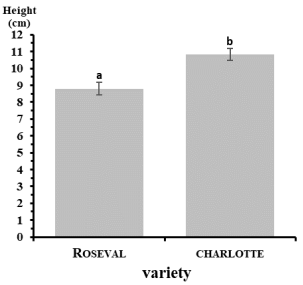
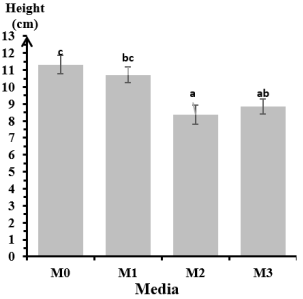
The tallest in vitro plantlets were obtained with the Charlotte variety (10.82 cm). The Roseval variety (8.79 cm) produced small in vitro plantlets (Figure 4). With regard to culture media (Figure 5), the M0 medium produced large-sized in vitro plants (11.32 cm), while the lowest values were obtained with the M2 medium (8.37 cm).
Figure 4. Height of potato variety in vitro plantlets under in vitro culture conditions. Bars topped with the same letters indicate statistically identical values at the 5% threshold.
Figure 5. Height of potato in vitro plantlets as a function of culture medium composition. Bars topped with the same letters indicate statistically identical values at the 5% threshold.
3.4. Combined Effect of Variety and Medium Composition on the Number of Leafy Shoots and Knots in in Vitro Plantlets
Charlotte in vitro plantlets grown on M1 medium produced a high number of nodes, while a low number was obtained with Charlotte in vitro plantlets grown on M2 and M3 media (Table 2). In terms of the number of leafy shoots, the highest values were obtained with the Roseval variety on M2 and M2 media. The lowest values were observed with the Charlotte variety on medium M2.
Table 2. number of nodes and leafy shoots depending on variety and media.
Variety
Media
Number of nodes
Number of leafy shoots
Roseval
M0
19.67±1.47bc
1.80±0.18ab
Roseval
M1
17.43±1.30abc
2.87±0.28bc
Roseval
M2
14.97±1.61ab
3.37±0.47c
Roseval
M3
19±1.23bc
3.83±0.43c
Charlotte
M0
15±1.14ab
2.03±0.25ab
Charlotte
M1
22.10±1.43c
2.63±0.28abc
Charlotte
M2
11.97±0.99a
1.53±0.10a
Charlotte
M3
12.47±1.07a
3.07±0.30bc
P
<0.001
0.006
In the same column, means followed by the same letter are statistically identical at the 5% threshold. Mean ± standard error, p: critical probability
3.5. Interaction of Variety and Subculture Factors on the Growth of Potato in Vitro Plantlets
The effect of the interaction of variety and subculture factors was studied on in vitro plantlets height, number of nodes, number of roots and number of leafy shoots. The significance of the analysis of variance for these parameters is shown in Table 3. The variety*subculture interaction was highly significant (P<0.01) for number of leaves and significant (P<0.05) for in vitro plantlets height and number of roots. The interaction of these factors had no effect on the number of nodes and the number of leafy shoots (P>0.05).
Table 3. significance of the analysis of variances for the factors and parameters studied.
Parameters
Variety (p)
Subculture (p)
Interaction Variety* Subculture (p)
Number of leaves
0,366
<0,001
0,005
Number of roots
<0,001
<0,001
0,036
Number of leafy shoots
0,228
<0,001
0,079
Plantlet height
<0,001
<0,001
0,016
Number of nodes
0,965
<0,001
0,052
p: critical probability
3.6. Effect of Subcultures on the Number of Leafy Shoots and Nodes
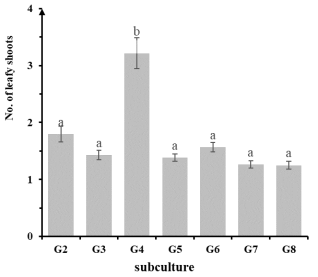
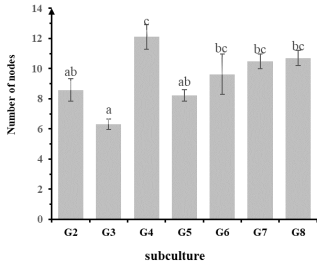
The highest number of leafy shoots and nodes was obtained in the 4th subculture (G4) with an average of 3.21 leafy shoots and 12.10 nodes (Figures 6 and 7). All other subcultures gave statistically significantly lower values the number of leafy shoots, while the lowest number of nodes (6.30) was obtained in the 3rd subculture (G3).
Figure 6. number of leafy shoots according to subcultures. Bars topped with the same letters indicate statistically identical values at the 5% threshold.
Figure 7. number of nodes according to subcultures. Bars topped with the same letters indicate statistically identical values at the 5% threshold.
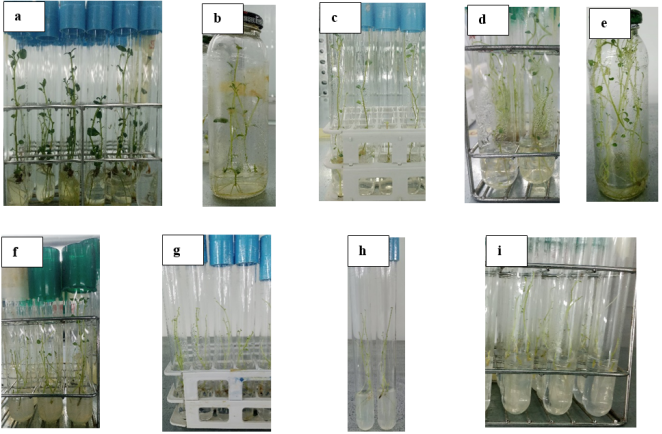
Generally speaking, during subcultures, a progressive loss of green stem coloration and a reduction in in vitro plantlets leaves were observed. At initiation (G0), the in vitro plantlets showed robust stems with good green pigmentation and broad, well-spreading green leaves. (Figure 8a). From the first to the fifth subculture (G1-G5), the in in vitro plantlets showed less robust stems, reduced leaves and poor green stem pigmentation (Figures 8b to 8f). Finally, from the sixth to eighth subcultures (G6-G8), the in vitro plantlets showed fragile stems, very small leaves and stem pigmentation that turned from green to white (Figures 8g to 8i).
A high number of leaves was obtained with the Roseval variety in the 4th subculture (Table 4). As for the number of roots, the Charlotte variety gave a high number of roots at the 7th subculture. The highest heights were observed at 4th subculture with the Charlotte variety. Whatever the growth parameter studied, the lowest values were obtained with the Roseval variety at 3rd subculture.
Table 4. growth parameters of in vitro plantlets of varieties during subcultures.
Variety
Subculture
Number of leaves
Number of Roots
Height (cm)
Roseval
G2
12.63±1.57 bcde
3.60±0.59 ab
8.18±0.77de
Roseval
G3
7.70±0.60 a
1.87±0.42a
5.40±0.32a
Roseval
G4
16.20±1.52e
4.30±0.51bc
6.31±0.30abcd
Roseval
G5
10.87±0.60abcd
4.5±0.44bc
5.85±0.29abc
Roseval
G6
10.47±0.72abcd
3.30±0.36ab
5.51±0.14ab
Roseval
G7
11.27±0.61abcd
3.73±0.42ab
6.19±0.34abcd
Roseval
G8
11.80±0.85abcd
4.60±0.31bc
7.60±0.31bcde
Charlotte
G2
8.79±0.70ab
4.86±0.57bc
7.86±0.95cde
Charlotte
G3
9.13±0.60abc
4±0.36abc
6.37±0.41abcd
Charlotte
G4
13.40±1.06de
5.03±0.64bc
9.21±0.59e
Charlotte
G5
9.83±0.61abcd
4.13±0.41bc
6.95±0.37abcd
Charlotte
G6
10.19±0.59abcd
5.07±0.32bc
7.39±0.40abcde
Charlotte
G7
13.30±0.86cde
6.10±0.45c
7±0.29abcd
Charlotte
G8
13.03±0.79bcde
5.10±0.48 bc
8.33±0.27de
In the same column, means followed by the same letter are statistically identical at the 5% threshold. Mean ± standard error.
4. Discussion
The results of this study highlight significant differential responses of potato in vitro plantlets according to variety, culture medium composition and number of subcultures. These observations confirm the complex, multifactorial nature of in vitro micropropagation, largely influenced by genotype, hormonal conditions and transplanting cycles. The height of Charlotte in vitro plantlets was higher than that of Roseval. This behavior can be explained by Charlotte's specific genetic vigor and greater tolerance to in vitro environmental stress. Many authors confirm the inter-varietal variability in response to micropropagation
[18]
Gopal J. Challenges and way-forward in selection of superior parents, crosses and clones in potato breeding. PotatoResearch. 2015; 58(2): 165-188.
Zakaria M, Hossain MM, Mian MK, Hossain T. Performance of different protocols on in vitro tuberization in potato (Solanumtuberosum). BangladeshJournalofAgriculturalResearch. 2014; 39(1): 59-66.
observed distinct in vitro salt stress responses across potato genotypes, attributing these to hormonal and genetic factors. This diversity is thought to result from differential expression of genes linked to potato growth or tuberization
[21]
Nhut DT, Ngan HTM, Mai NTN, Tung HT. In vitro hydroponic culture system in plant micropropagation. In: Nhut DT, Tung HT, Yeung ECT, editors. PlantTissueCulture:NewTechniquesandApplicationinHorticulturalSpeciesofTropicalRegion. Springer Singapore; 2022. p. 191-206.
. The observed responses could be specific to each of these varieties. Hajare et al.
[10]
Hajare ST, Chauhan NM, Kassa G. Effect of growth regulators on in vitro micropropagation of potato (Solanumtuberosum L.) Gudiene and Belete varieties from Ethiopia. TheScientificWorldJournal. 2021; 2021: 5928769.
also showed that the potato varieties Gudiene and Belete have variety-specific responses. They concluded that this could be due to a genotypic difference between the two varieties. These findings align with those of Bairu et al.
[22]
Bairu MW, Aremu AO, Van Staden J. Somaclonal variation in plants: Causes and detection methods. PlantGrowthRegulation. 2011; 63(2): 147-173.
, who discussed the role of somaclonal and genotypic variation in tissue culture-based propagation systems, further supporting the necessity of variety-tailored micropropagation protocols.
Concerning the effect of media on morphogenesis and growth, the M0 medium containing Murashige and Skoog salts and the vitamins of Morel and Wetmore, without any exogenous hormone supply, enabled optimum growth of in vitro plantlets. These in vitro plantlets have well-developed leaves, a robust stem and a high number of nodes. The results reported here suggests sufficient autotrophy of the explants, probably linked to a prior accumulation of sufficient endogenous hormones to support early cell division and tissue differentiation. This finding corroborates the observations reported by Mubeen et al.
[14]
Mubeen A, Mustafa G, Akhtar S, Nadeem Z. Impact assessment of growth regulators on in vitro tuberization in S.tuberosum. UnwanSciencesSociety. 2024; 2(2): 109-114.
, who demonstrated the efficacy of basal Murashige and Skoog medium without growth regulators on the development of in vitro plantlets. These data support the idea that varieties such as Roseval and Charlotte may possess a higher intrinsic morphogenetic potential under aseptic culture conditions. In contrast, the work of Badoni and Chauhan
[23]
Badoni A, Chauhan JS. Effect of growth regulators on meristem-tip development and in vitro multiplication of potato cultivar ‘Kufri Himalini’. NatureandScience. 2009; 7(9): 31-34.
[23]
reported a low node number (9.4 nodes) in the cultivar Kufri Himalini.
The M1, M2 and M3 media, presumably containing additive phytohormones, induced signs of hyperhydricity (whitish leaves, watery appearance), suggesting a hormonal imbalance. This phenomenon could be accentuated by overconcentration of cytokinins or poor aeration of the agar medium
[24]
Kevers C, Franck T, Strasser RJ, Dommes J, Gaspar T. Hyperhydricity of micropropagated shoots: A typically stress-induced change of physiological state. PlantCell,TissueandOrganCulture. 2004; 77(2): 181-191.
Wang Y, Rashid MAR, Li X, Yao C, Lu L, Bai J, Li Y, Xu N, Yang Q, Zhang L. Collection and evaluation of genetic diversity and population structure of potato landraces and varieties in China. FrontiersinPlantScience. 2019; 10: 139.
Singh P, Arif Y, Siddiqui H, Upadhyaya CP, Pichtel J, Hayat S. Critical factors responsible for potato tuberization. TheBotanicalReview. 2023; 89(4): 421-437.
Yasmin A, Jalbani AA, Raza S. Effect of growth regulators on meristem tip culture of local potato cvs. Desiree and Patrones. PakistanJournalofAgriculture,AgriculturalEngineeringandVeterinarySciences. 2011; 27(2): 143-149.
[27]
. The M0 medium containing salts of Murashige and Skoog and vitamins of Morel and Wetmore, without exogenous hormones, was selected to determine the effect of subcultures on the growth and development of in vitro plantlets.
Repeated subcultures (from G0 to G8) enabled us to monitor the morphological evolution of in vitro plantlets. It is interesting to note that maximum performance (number of shoots, nodes, leaves and height) was recorded at the 4th subculture (G4), with stability relatively maintained until G5-G6, before a qualitative decline beyond G6. The number of shoots (3.21) and nodes (12.10) were highest in the 4th subculture. For each variety, the highest number of leaves was obtained during 4th subculture. Generally speaking, the highest values were obtained from 4th to 8th subculture, but the morphological quality of the in vitro plantlets decreased with the number of subcultures. This could be explained by the fact that the plants tend to adapt to their new lifestyles. Also, epigenetic factors linked to subculture cycles play a role in this progressive degeneration. Hundayehu et al.
[28]
Hundayehu MC, Du Toit E, Laurie SM, Steyn M, Greyling R, Myeza N. Effect of long-term in vitro subculturing on quality degeneration of sweetpotato varieties: Morpho-anatomic assessment and simple sequence repeat (SSR) analysis. In: Low J, Nyongesa M, Quinn S, Parker M, editors. PotatoandSweetpotatoinAfrica:TransformingtheValueChainsforFoodandNutritionSecurity. CABI; 2015. p. 311-321.
have shown that stresses linked to artificial environments (medium, light,..) can induce epigenetic modifications responsible for morphological variation. Similar observations have also been reported by Astarini et al.
[29]
Astarini IA, Margareth D, Febryanti NPK, Defiani MR, Temaja IGRM. Production of quality early-generation seed potatoes in Bali, Indonesia. IOPConferenceSeries:EarthandEnvironmentalScience. 2023; 1133(1): 012013.
with four potato genotypes. They concluded that in vitro development depends on the explants and their interaction with the environment. They therefore stressed the importance of developing specific protocols for each genotype, as each responds differently to the environment.
5. Conclusion
The aim of the present study was to investigate the influence of subcultures on in vitro plantlets growth and development, and to develop a protocol for in vitro plant multiplication. The study showed that the hormone-free medium allowed production of in vitro plantlets displaying best growth and development. The 4th subculture gave the best values for multiplication rate. Beyond this rank of subculture, the in vitro plantlets showed a different aspect (fragile stems, very small leaves and stem pigmentation that turned from green to white) from those produced by previous subcultures. This implies that it will be necessary to limit subculturing to four subcultures in the conduct of the micropropagation protocol of the two varieties tested.
Abbreviations
BAP
6-Benzylaminopurine
GA3
Gibberellic Acid
HCl
Hydrochloric Acid
IAA
Indole-3-acetic Acid
IBA
Indole-3-butyric Acid
LBAPV
Laboratory of Biology and Improvement of Plant Production
MS
Murashige and Skoog
MS0
Murashige and Skoog Basal Medium Without Vitamins
NaOH
Sodium Hydroxide
NLS
Number of Leafy Shoots
NN
Number of Nodes
p
Critical Probability
Acknowledgments
The authors express their sincere gratitude to the Head of the Laboratory of Biology and Plant Production Improvement (LBAPV), within the Training and Research Unit of Natural Sciences (UFR-SN) at Nangui ABROGOUA University, for providing technical support and research facilities.
Author Contributions
Pyminnan Traoré: Conceptualization, Data curation, Formal Analysis, Investigation, Methodology, Writing – original draft
N’cho YP. Potato in Côte d’Ivoire. World: Presentation of the potato value chain. LaCôted’IvoireAgricole. 2023.
[4]
Goore-Bi GG, Carlos MB, Francis A, Lanceni K, Alberto S, Foncho PAF, Tetevi K, Ifenkwe OP. Potatoproduction:ReportoftheworkshopheldatBamenda,Cameroon,September25-30,1988. 1988.
[5]
Tessema L, Negash W, Kakuhenzire R, Belay G, Seid E, Enyew M. Seed health trade-offs in adopting quality declared seed in potato farming systems. CropScience. 2024; 64(3): 1340-1348.
Beauval V, Grandval F. Les semences, un intrant stratégique concentrant beaucoup d’enjeux. GraindeSel. 2011; 52-53: 12-14.
[7]
FAO. TheStateofFoodSecurityandNutritionintheWorld2023. Rome: Food and Agriculture Organization of the United Nations; 2023.
[8]
Vanesse L. Evaluation of an innovative practice: The use and production of seeds of root and tuber crops for distribution and the creation of allelic diversity. PhD Thesis, Montpellier SupAgro; 2009.
[9]
Thomas-Sharma S, Abdurahman A, Ali S, Andrade-Piedra JL, Bao S, Charkowski AO, Crook D, Kadian M, Kromann P, Struik PC, Torrance L, Garrett KA, Forbes GA. Seed degeneration in potato: The need for an integrated seed health strategy to mitigate the problem in developing countries. PlantPathology. 2016; 65(1): 3-16.
Hajare ST, Chauhan NM, Kassa G. Effect of growth regulators on in vitro micropropagation of potato (Solanumtuberosum L.) Gudiene and Belete varieties from Ethiopia. TheScientificWorldJournal. 2021; 2021: 5928769.
Grishchenko OV, Subbotin EP, Gafitskaya IV, Vereshchagina YV, Burkovskaya EV, Khrolenko YA, Kulchin YN. Growth of micropropagated Solanumtuberosum L. plantlets under artificial solar spectrum and different mono- and polychromatic LED lights. HorticulturalPlantJournal. 2022; 8(2): 205-214.
Bruno F, Ledbetter M, Davies B, Sturrock K, McNamara G, Montague G, Fiore A. Effect of post-harvest anti-sprouting treatment with spearmint essential oil on acrylamide formation in potato crisps. LWT. 2023; 183: 114896.
Shafique I, Mehmood K, Shah SH, Baig RM, Hasnain Z. Influence of plant growth regulators on in vitro micropropagation of potato varieties. JournalofAgriculturalResearch(JAR). 2025; 63(1): 87-93.
Mubeen A, Mustafa G, Akhtar S, Nadeem Z. Impact assessment of growth regulators on in vitro tuberization in S.tuberosum. UnwanSciencesSociety. 2024; 2(2): 109-114.
Zerbo A, Some K, Tiama D, Soro M, Ouedraogo WIC, Traore RE. Evaluation of four growth mediums effect on potato (Solanumtuberosum L.) plantlet production in Burkina Faso. ResearchSquare. 2024.
Zakaria M, Hossain MM, Mian MK, Hossain T. Performance of different protocols on in vitro tuberization in potato (Solanumtuberosum). BangladeshJournalofAgriculturalResearch. 2014; 39(1): 59-66.
Nhut DT, Ngan HTM, Mai NTN, Tung HT. In vitro hydroponic culture system in plant micropropagation. In: Nhut DT, Tung HT, Yeung ECT, editors. PlantTissueCulture:NewTechniquesandApplicationinHorticulturalSpeciesofTropicalRegion. Springer Singapore; 2022. p. 191-206.
Badoni A, Chauhan JS. Effect of growth regulators on meristem-tip development and in vitro multiplication of potato cultivar ‘Kufri Himalini’. NatureandScience. 2009; 7(9): 31-34.
[24]
Kevers C, Franck T, Strasser RJ, Dommes J, Gaspar T. Hyperhydricity of micropropagated shoots: A typically stress-induced change of physiological state. PlantCell,TissueandOrganCulture. 2004; 77(2): 181-191.
Wang Y, Rashid MAR, Li X, Yao C, Lu L, Bai J, Li Y, Xu N, Yang Q, Zhang L. Collection and evaluation of genetic diversity and population structure of potato landraces and varieties in China. FrontiersinPlantScience. 2019; 10: 139.
Singh P, Arif Y, Siddiqui H, Upadhyaya CP, Pichtel J, Hayat S. Critical factors responsible for potato tuberization. TheBotanicalReview. 2023; 89(4): 421-437.
Yasmin A, Jalbani AA, Raza S. Effect of growth regulators on meristem tip culture of local potato cvs. Desiree and Patrones. PakistanJournalofAgriculture,AgriculturalEngineeringandVeterinarySciences. 2011; 27(2): 143-149.
[28]
Hundayehu MC, Du Toit E, Laurie SM, Steyn M, Greyling R, Myeza N. Effect of long-term in vitro subculturing on quality degeneration of sweetpotato varieties: Morpho-anatomic assessment and simple sequence repeat (SSR) analysis. In: Low J, Nyongesa M, Quinn S, Parker M, editors. PotatoandSweetpotatoinAfrica:TransformingtheValueChainsforFoodandNutritionSecurity. CABI; 2015. p. 311-321.
Traoré, P., Touré, Y., Ouattara, B., Togbo, P. E., Koné, T., et al. (2026). Micropropagation Potential of Roseval and Charlotte Varieties of Potato (Solanum Tuberosum L) from Nodal Segments During Subcultures. American Journal of BioScience, 14(4), 96-104. https://doi.org/10.11648/j.ajbio.20261404.12
Traoré, P.; Touré, Y.; Ouattara, B.; Togbo, P. E.; Koné, T., et al. Micropropagation Potential of Roseval and Charlotte Varieties of Potato (Solanum Tuberosum L) from Nodal Segments During Subcultures. Am. J. BioScience2026, 14(4), 96-104. doi: 10.11648/j.ajbio.20261404.12
Traoré P, Touré Y, Ouattara B, Togbo PE, Koné T, et al. Micropropagation Potential of Roseval and Charlotte Varieties of Potato (Solanum Tuberosum L) from Nodal Segments During Subcultures. Am J BioScience. 2026;14(4):96-104. doi: 10.11648/j.ajbio.20261404.12
@article{10.11648/j.ajbio.20261404.12,
  author = {Pyminnan Traoré and Yaya Touré and Brahima Ouattara and Pauleroux Elodie Togbo and Tchoa Koné and Mongomaké Koné},
  title = {Micropropagation Potential of Roseval and Charlotte Varieties of Potato (Solanum Tuberosum L) from Nodal Segments During Subcultures},
  journal = {American Journal of BioScience},
  volume = {14},
  number = {4},
  pages = {96-104},
  doi = {10.11648/j.ajbio.20261404.12},
  url = {https://doi.org/10.11648/j.ajbio.20261404.12},
  eprint = {https://article.sciencepublishinggroup.com/pdf/10.11648.j.ajbio.20261404.12},
  abstract = {In Côte d'Ivoire, potatoes have become a key component of the local diet. To meet the rising demand, the government invests over 22 billion FCFA annually to ensure sufficient supply for the population. Despite its favorable climate, Côte d'Ivoire produces very little potatoes. The main constraint to potato cultivation is the lack of seed availability at the right time for producers. This study aims to develop a protocol for producing potato in vitro plantlets in Côte d'Ivoire. Nodal segments from 21-day-old in vitro plantlets were placed onto four basal media containing different combinations of growth regulators (MS0: MS + Morel and Wetmore vitamins; M1: MS + Morel and Wetmore vitamins + 0.25 mg/L BAP; M2: MS + Morel and Wetmore vitamins + 0.25 mg/L BAP+ 0.01 mg/L IAA; M3: MS + Morel and Wetmore vitamins + 0.25 mg/L BAP+ 0.01 mg/L IAA + 0.25mg/L GA3). A series of subcultures was carried out on the medium expressing the best responses. The MS0 medium, lacking growth regulators, supported the highest seedling growth (11.33 cm) and healthy leaf development in all varieties. The Charlotte variety, during its fourth subculture, demonstrated the greatest multiplication capacity, producing plants with an average height of 9.21 cm, 12.1 nodes per leafy shoot, and 3.21 leafy shoots per explant. Beyond this stage, multiplication performance decreases sharply. These results will contribute to the development of a protocol for mass production of potato seeds in the form of in vitro plantlets.},
 year = {2026}
}
TY  - JOUR
T1  - Micropropagation Potential of Roseval and Charlotte Varieties of Potato (Solanum Tuberosum L) from Nodal Segments During Subcultures
AU  - Pyminnan Traoré
AU  - Yaya Touré
AU  - Brahima Ouattara
AU  - Pauleroux Elodie Togbo
AU  - Tchoa Koné
AU  - Mongomaké Koné
Y1  - 2026/09/20
PY  - 2026
N1  - https://doi.org/10.11648/j.ajbio.20261404.12
DO  - 10.11648/j.ajbio.20261404.12
T2  - American Journal of BioScience
JF  - American Journal of BioScience
JO  - American Journal of BioScience
SP  - 96
EP  - 104
PB  - Science Publishing Group
SN  - 2330-0167
UR  - https://doi.org/10.11648/j.ajbio.20261404.12
AB  - In Côte d'Ivoire, potatoes have become a key component of the local diet. To meet the rising demand, the government invests over 22 billion FCFA annually to ensure sufficient supply for the population. Despite its favorable climate, Côte d'Ivoire produces very little potatoes. The main constraint to potato cultivation is the lack of seed availability at the right time for producers. This study aims to develop a protocol for producing potato in vitro plantlets in Côte d'Ivoire. Nodal segments from 21-day-old in vitro plantlets were placed onto four basal media containing different combinations of growth regulators (MS0: MS + Morel and Wetmore vitamins; M1: MS + Morel and Wetmore vitamins + 0.25 mg/L BAP; M2: MS + Morel and Wetmore vitamins + 0.25 mg/L BAP+ 0.01 mg/L IAA; M3: MS + Morel and Wetmore vitamins + 0.25 mg/L BAP+ 0.01 mg/L IAA + 0.25mg/L GA3). A series of subcultures was carried out on the medium expressing the best responses. The MS0 medium, lacking growth regulators, supported the highest seedling growth (11.33 cm) and healthy leaf development in all varieties. The Charlotte variety, during its fourth subculture, demonstrated the greatest multiplication capacity, producing plants with an average height of 9.21 cm, 12.1 nodes per leafy shoot, and 3.21 leafy shoots per explant. Beyond this stage, multiplication performance decreases sharply. These results will contribute to the development of a protocol for mass production of potato seeds in the form of in vitro plantlets.
VL  - 14
IS  - 4
ER  -
Traoré, P., Touré, Y., Ouattara, B., Togbo, P. E., Koné, T., et al. (2026). Micropropagation Potential of Roseval and Charlotte Varieties of Potato (Solanum Tuberosum L) from Nodal Segments During Subcultures. American Journal of BioScience, 14(4), 96-104. https://doi.org/10.11648/j.ajbio.20261404.12
Traoré, P.; Touré, Y.; Ouattara, B.; Togbo, P. E.; Koné, T., et al. Micropropagation Potential of Roseval and Charlotte Varieties of Potato (Solanum Tuberosum L) from Nodal Segments During Subcultures. Am. J. BioScience2026, 14(4), 96-104. doi: 10.11648/j.ajbio.20261404.12
Traoré P, Touré Y, Ouattara B, Togbo PE, Koné T, et al. Micropropagation Potential of Roseval and Charlotte Varieties of Potato (Solanum Tuberosum L) from Nodal Segments During Subcultures. Am J BioScience. 2026;14(4):96-104. doi: 10.11648/j.ajbio.20261404.12
@article{10.11648/j.ajbio.20261404.12,
  author = {Pyminnan Traoré and Yaya Touré and Brahima Ouattara and Pauleroux Elodie Togbo and Tchoa Koné and Mongomaké Koné},
  title = {Micropropagation Potential of Roseval and Charlotte Varieties of Potato (Solanum Tuberosum L) from Nodal Segments During Subcultures},
  journal = {American Journal of BioScience},
  volume = {14},
  number = {4},
  pages = {96-104},
  doi = {10.11648/j.ajbio.20261404.12},
  url = {https://doi.org/10.11648/j.ajbio.20261404.12},
  eprint = {https://article.sciencepublishinggroup.com/pdf/10.11648.j.ajbio.20261404.12},
  abstract = {In Côte d'Ivoire, potatoes have become a key component of the local diet. To meet the rising demand, the government invests over 22 billion FCFA annually to ensure sufficient supply for the population. Despite its favorable climate, Côte d'Ivoire produces very little potatoes. The main constraint to potato cultivation is the lack of seed availability at the right time for producers. This study aims to develop a protocol for producing potato in vitro plantlets in Côte d'Ivoire. Nodal segments from 21-day-old in vitro plantlets were placed onto four basal media containing different combinations of growth regulators (MS0: MS + Morel and Wetmore vitamins; M1: MS + Morel and Wetmore vitamins + 0.25 mg/L BAP; M2: MS + Morel and Wetmore vitamins + 0.25 mg/L BAP+ 0.01 mg/L IAA; M3: MS + Morel and Wetmore vitamins + 0.25 mg/L BAP+ 0.01 mg/L IAA + 0.25mg/L GA3). A series of subcultures was carried out on the medium expressing the best responses. The MS0 medium, lacking growth regulators, supported the highest seedling growth (11.33 cm) and healthy leaf development in all varieties. The Charlotte variety, during its fourth subculture, demonstrated the greatest multiplication capacity, producing plants with an average height of 9.21 cm, 12.1 nodes per leafy shoot, and 3.21 leafy shoots per explant. Beyond this stage, multiplication performance decreases sharply. These results will contribute to the development of a protocol for mass production of potato seeds in the form of in vitro plantlets.},
 year = {2026}
}
TY  - JOUR
T1  - Micropropagation Potential of Roseval and Charlotte Varieties of Potato (Solanum Tuberosum L) from Nodal Segments During Subcultures
AU  - Pyminnan Traoré
AU  - Yaya Touré
AU  - Brahima Ouattara
AU  - Pauleroux Elodie Togbo
AU  - Tchoa Koné
AU  - Mongomaké Koné
Y1  - 2026/09/20
PY  - 2026
N1  - https://doi.org/10.11648/j.ajbio.20261404.12
DO  - 10.11648/j.ajbio.20261404.12
T2  - American Journal of BioScience
JF  - American Journal of BioScience
JO  - American Journal of BioScience
SP  - 96
EP  - 104
PB  - Science Publishing Group
SN  - 2330-0167
UR  - https://doi.org/10.11648/j.ajbio.20261404.12
AB  - In Côte d'Ivoire, potatoes have become a key component of the local diet. To meet the rising demand, the government invests over 22 billion FCFA annually to ensure sufficient supply for the population. Despite its favorable climate, Côte d'Ivoire produces very little potatoes. The main constraint to potato cultivation is the lack of seed availability at the right time for producers. This study aims to develop a protocol for producing potato in vitro plantlets in Côte d'Ivoire. Nodal segments from 21-day-old in vitro plantlets were placed onto four basal media containing different combinations of growth regulators (MS0: MS + Morel and Wetmore vitamins; M1: MS + Morel and Wetmore vitamins + 0.25 mg/L BAP; M2: MS + Morel and Wetmore vitamins + 0.25 mg/L BAP+ 0.01 mg/L IAA; M3: MS + Morel and Wetmore vitamins + 0.25 mg/L BAP+ 0.01 mg/L IAA + 0.25mg/L GA3). A series of subcultures was carried out on the medium expressing the best responses. The MS0 medium, lacking growth regulators, supported the highest seedling growth (11.33 cm) and healthy leaf development in all varieties. The Charlotte variety, during its fourth subculture, demonstrated the greatest multiplication capacity, producing plants with an average height of 9.21 cm, 12.1 nodes per leafy shoot, and 3.21 leafy shoots per explant. Beyond this stage, multiplication performance decreases sharply. These results will contribute to the development of a protocol for mass production of potato seeds in the form of in vitro plantlets.
VL  - 14
IS  - 4
ER  -





 Share This Article
 Twitter
 Linked In
 Facebook
 Copy
Copy Download