Research Article | | Peer-Reviewed

Improved Driving Training-Based Optimization Algorithm Using Levy Flight and Crowding Distance Techniques for Solving Optimal Power Flow Problem

Received: 20 April 2026     Accepted: 3 May 2026     Published: 14 May 2026
Views:       Downloads:
Abstract

Driving Training-Based Optimization (DTBO) algorithm is a metaheuristic algorithm based on the simulation of driving training process. Improved version of the DTBO is proposed in this paper for solving Optimal Power Flow (OPF) problem. The Improved Driving Training-Based Optimization (IDTBO) algorithm includes the Crowding Distance Technique for more diverse driver and learner selection and incorporates the Levy Flight distribution for better exploration and local optima avoidance. OPF is considered as one of the most difficult optimization problems and is very important for the control of electrical network. The objective of this study is finding the best control variables while minimizing the total generation fuel cost and considering equality and inequality constraints of the system. The standard IEEE 30-bus network is used for evaluating the performance of the IDTBO algorithm for solving OPF problem. For solving conventional power flow equation, Newton Raphson algorithm is considered. Compared to Modified Driving Training-Based Optimization (MDTBO), Teaching Learning-Based Optimization (TLBO) and Particle Swarm Optimization (PSO) algorithms, the proposed method is more accurate and is better in convergence speed. The performance of the IDTBO is very useful for finding the most secure operating point of any electric power system and its convergence speed contributes to improving the dynamic management of a smart electricity grid.

Published in American Journal of Engineering and Technology Management (Volume 11, Issue 3)
DOI 10.11648/j.ajetm.20261103.11
Page(s) 31-41
Creative Commons

This is an Open Access article, distributed under the terms of the Creative Commons Attribution 4.0 International License (http://creativecommons.org/licenses/by/4.0/), which permits unrestricted use, distribution and reproduction in any medium or format, provided the original work is properly cited.

Copyright

Copyright © The Author(s), 2026. Published by Science Publishing Group

Keywords

Electrical Network, Optimal Power Flow, Improved Driving Training-Based Optimization, Levy Flight, Crowding Distance, Fuel Cost, Newton Raphson Method

1. Introduction
Power flow study consists of measuring the active and reactive power at each bus of the network, while the goal of OPF problem is to optimize an objective function such as generation fuel cost by adjusting power system control variables which are the generator real powers, the generator bus voltages, the transformer tap settings and the reactive power of switchable VAR sources. The ideal power flow becomes a large-scale, highly constrained nonlinear and nonconvex optimization problem since each control variable has a limit.
In the literature, there are several methods for calculating power flow such as Newton Raphson (1960), Gauss Seidel (1874), Brown (1971), Tensor (1972), Fast-decoupled (1974), Iwamoto (1978), quadratic Newton (1980), Integral State Estimation (1983), Runge-Kutta (1986), Generalized Minimal Residual (1993), continuous version of Newton (1997), Newton with partial regularization using Singular Value Decomposition (2007) and Levenberg Marquardt (2008) . For the OPF problem, Mohamed Ebeed and al. (2018) identified 5 conventional optimization methods including linear programming, nonlinear programming, quadratic programming, Newton’s Method and interior point method, and 89 recent optimization methods including 27 nature inspired algorithms, 11 human inspired algorithms, 6 physics inspired algorithms, 25 evolutionary inspired algorithms, 13 hybrid inspired algorithms and 7 artificial neural networks and fuzzy logic approach . Emmanuel and al. (2021) also identified 39 swarm and bio-inspired optimization techniques, 11 human-inspired optimization techniques, 4 physic-inspired optimization techniques, 6 evolutionary-inspired optimization techniques, 5 artificial neural networks and fuzzy logic approach, and 12 hybrid optimization techniques . PSO is proposed by M. Abido (2002) for solving OPF in IEEE 30-bus with as objective functions: fuel cost minimization, piecewise cost, voltage profile improvement and voltage stability enhancement . Arul Ponnusamy and al. (2014) used Cuckoo Search Algorithm (CSA) for OPF solution in IEEE 62-Indian utility system with minimization of fuel cost function . Bouchekara et al. (2014) present TLBO for IEEE 30-bus and 118-bus with quadratic fuel cost, piecewise quadratic cost, voltage stability, voltage profile, and active power transmission losses as objective functions in the OPF issue . Recently, O. M. Ranarison (2025) proposed a Modified Driving Training Based Opitmization algorithm for solving OPF problem with five objective functions: minimization of fuel cost, voltage profile improvement, voltage stability enhancement, minimization of active and reactive power losses, applied in IEEE 30-bus system . According to the survey of Levy Flight-Based Metaheuristics for Optimization by Juan Li and al. (2022), thirteen thousand Levy flight-related studies have been published in journals/dissertations/conferences up to 23 April 2022 since Levy flight was proposed in 1981. 13% of these relate to the field of engineering, but no precision for Electrical engineering . However, the state of the art proves that there are some metaheuristic algorithms using Levy Flight for OPF solution. Edmond and al. (2017) proposed OPF by Cuckoo Search via Levy Flight algorithm on a standard IEEE 30-bus with fuel costs minimization, voltage profiles improvement and piecewise quadratic cost curve; results are compared to PSO and Differential Evolution (DE) algorithms . An improved TLBO algorithm (ITLBO) using Levy mutation strategy for non-smooth OPF is also proposed by Ghasemi and al. (2015), tested on IEEE 30-bus and 57-bus systems with voltage stability, emission minimization, generation cost, quadratic cost with valve-point effect and piecewise quadratic cost, as objective functions . K. Lenin (2018) used crowding distance based particle swarm optimization algorithm (CDPSO) for solving optimal reactive power dispatch problem with minimization of real power loss and minimization of voltage deviation, tested in IEEE 30-bus network .
In this paper, Improved version of Driving Training-Based Optimization algorithm is proposed, using Levy Flight and Crowding Distance techniques. Objective function is to minimize fuel cost generation while considering constraints of the IEEE 30-bus system. For the numerical calculation of power flow, the Newton-Raphson method is considered.
2. Power Flow
2.1. Mathematical Modeling of Power Flow
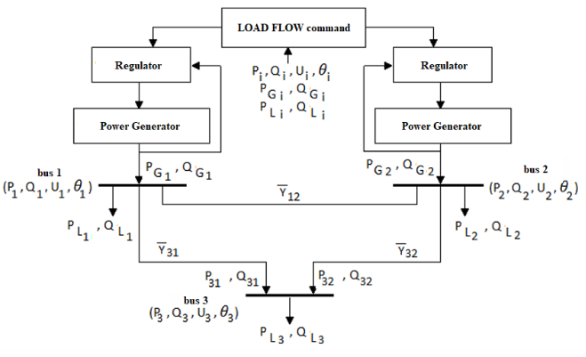
As shown in Figure 1, each bus of electrical network is characterized by 4 variables which are: Pi (active power injected), Qi (reactive power injected), Vi (magnitude voltage), θi (voltage angle), “i” is the bus number. The powers generated at the bus i are denoted by PG i and QG i, and powers load by PL i and QL i. The active and reactive powers injected at the bus i are given by:
Pi=PG i-PL i +jPij(1)
Qi=QG i-QL i +jQij(2)
Pij and Qij are power transmitted in the line ij and given by:
Pij=RealS¯ij(3)
Qij=-ImagS¯ij(4)
Apparent power of line ij is:
S¯ij=V¯i I¯ij*(5)
With:
I¯ij=-V¯i-V¯jYbus¯ik(6)
Ybus¯ik is the bus admittance of branch i and k.
Depending on the case, a bus can be of type PQ bus, PV bus or Slack bus. There is at least one slack bus per network where the most powerful power plant is associated. The description of each type of bus is given in Table 1. The general power equations of bus i are then given by:
Pi=RealS¯i*(7)
Qi=-ImagS¯i*(8)
Where S¯i* is the conjugate apparent power of bus i, given by:
S¯i*=Pi-jQi=V¯i* I¯i=V¯i*k=1nYbus¯ikV¯k (9)
Figure 1. Power control in an electrical network.
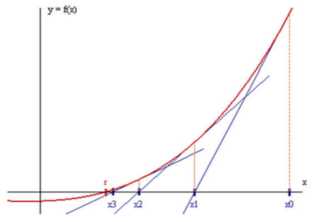
Table 1. Bus classification.

Bus Type

Specified variables

Desired variables

PQ bus

P, Q

V, θ

PV bus

P, V

Q, θ

Slack bus

V, θ

P, Q

2.2. Newton-Raphson’s Method
Newton-Raphson’s method is iterative and consists, at each step, of using the intersection between the x-axis and the tangent to the curve at the previous point (Figure 2).
xk+1=xk-fxkf'xk(10)
For n the total number of bus in the network, the power equations are:
Pi=Pi(V1,V2,,Vn,θ1,θ2,,θn)Qi=Qi(V1,V2,,Vn,θ1,θ2,,θn)withi=1,, n(11)
The power residuals obtained according to Newton-Raphson’s method are:
Pik=j=1nPikθjθjk+PikVjVjkQik=j=1nQikθjθjk+QikVjVjk(12)
Pik=Pik+1-Pik=Piplan-PikQik=Qik+1-Qik=Qiplan-Qikθjk=θjk+1-θjkVjk=Vjk+1-Vjk(13)
With Piplan, Qiplan are the planned values, and Pik,Qik are the calculated values.
Hence the following matrix equation:
PkQk= JkθkVk(14)
θkVk=Jk-1 PkQk(15)
With Jk is the Jacobian given by:
Jk=P1kθ1P1kθnPnkθ1PnkθnP1kV1P1kVnPnkV1PnkVnQ1kθ1Q1kθnQnkθ1QnkθnQ1kV1Q1kVnQnkV1QnkVn(16)
Finally, results are obtained by:
θik+1=θik+θikVik+1=Vik+Vik i=1,, n(17)
Figure 2. Iterative method of Newton-Raphson.

3. Optimal Power Flow
3.1. Mathematical Modeling of Optimal Power Flow
Let x be a vector of dependent variables and u a vector of control variables:
x=PG1,VL1VL,NPQ,QG1QG,NG,STL,1STL,NTL(18)
u=PG,2PG,NG,VG,1VG,NG,QC,1QC,NC,T1TNT(19)
PG1: active power output at slack bus;
VL: voltage magnitude at PQ buses;
QG: reactive power output of all generator units;
STL: transmission line loading;
NPQ: number of load buses;
NG: number of generator units;
NTL: number of transmission lines
PG: active power generation at the PV buses except at the slack bus;
VG: voltage magnitude at PV buses;
QC: shunt VAR compensation;
T: tap settings of transformer;
NC: number of VAR compensators;
NT: number of regulating transformers
By minimizing an objective function F made up of x and u, the OPF problem can be modeled as:
Min F(x,u)(20)
The objective function for minimizing the total generation fuel cost can be expressed as:
F1= i=1NGFiPGi=i=1NG(ai+biPGi+ciPGi2)(21)
Where ai, bi, ci are the cost coefficients of ith generator.
The equilibrium between generated and load powers is represented by the equality constraints:
PGi-PLi=0(22)
QGi-QLi=0(23)
Inequality constraints are security constraints that are closely related to system limitations.
PGiminPGiPGimax i=1,2,, NG(24)
VGiminVGiVGimax i=1,2,, NG(25)
QGiminQGiQGimax i=1,2,, NG(26)
TiminTiTimax i=1,2,, NT(27)
QCiminQCiQCimax i=1,2,, NC(28)
SLiSLimin i=1,2,, NTL(29)
VLiminVLiVLimax i=1,2,, NPQ(30)
3.2. Driving Training-Based Optimization Algorithm
DTBO is a human-based metaheuristic algorithm, for solving optimization problems on the base of simulation of driving training process, developed by Mohammad Dehghani and al. (2022) . Main idea is presented in Figure 3 and explained as follow: “Driving training is an intelligent process in which a learner driver is trained and acquires driving skills. Learner driver can choose from several instructors when attending driving school. The instructor then teaches the learner driver the instructions and skills. The learner driver tries to learn driving skills from the instructor and drive following the instructor. In addition, personal practice can improve the driver’s skills of the learner. These interactions and activities have extraordinary potential for designing an optimizer”.
Figure 3. Main idea of DTBO.
Driving students and instructors make up the DTBO population, where size N is manually chosen. The population matrix models the OPF problem, and DTBO members represent potential solutions:
X=X1XiXNN×1= x11x1jx1mxi1xijximxN1xNjxNmN×m(31)
m is the number of problem variables, Xi is the ith candidate solution, xij is the value of the jth variable determined by the ith candidate solution and is randomly initialized using following equation:
xij=lbj+rubj-lbj,
i=1,2,,N, j=1,2,,m(32)
lbj and ubj are respectively the lower and upper bounds of the jth variable; r is a random number from [0, 1].
Every candidate is put into the objective function, and the population's best member is the one with the best value (Xbest).
F=F1FiFNN×1=F(X1)F(Xi)F(XN)N×1(33)
DTBO is modelled in three different phases:
Phase 1: Training by the driving instructor (exploration)
The learner driver selects the driving teacher in the first step, and the chosen instructor then instructs the learner driver in driving. It can be stated as:
DI= DI11DI1jDI1mDIi1DIijDIimDINDI1DINDIjDINDImNDI×m(34)
The top participants are regarded as driving teachers in each iteration t, while the remaining members are classified as trainee drivers. Using the following formula, the number of driving instructors NDI decreases with each iteration:
NDI=0.1N(1-t/T)(35)
T is the maximum number of iterations.
The following formula is used to determine each member's new position:
xi,jP1=xi,j+rDIki,j-Ixi,j, FDIki<Fi xi,j+rxi,j-DIki,j, otherwise. (36)
I is a number randomly selected from the set [1, 2], r is a random number in the interval [0, 1].
If this new position increases the objective function's value, it replaces the old one.
Xi=XiP1, si FiP1<Fi Xi, otherwise(37)
Phase 2: Patterning of the instructor skills of the student driver (exploration)
The learner driver mimics the instructor in the second phase. The DTBO's exploration power is increased by this process, which shifts the population to various locations throughout the search space.
xi,jP2=Pxi,j+(1-P)DIki,j (38)
Xi=XiP2, si FiP2<FiXi, otherwise (39)
P is the patterning index given by:
P=0.001+0.9(1-t/T) (40)
Phase 3: Personal practice (exploitation)
This third stage is built on each student driver's individual practice to develop and strengthen their driving abilities.
xi,jP3=xi,j+(1-2r)R(1-t/T) xi,j (41)
Xi=XiP3, si FiP3<Fi Xi, otherwise(42)
r is a random real number of the interval [0, 1], R is the constant set to 0.05.
3.3. Improved Driving Training-Based Optimization Algorithm
IDTBO algorithm using Levy Flight and Crowding Distance Techniques are recently proposed by Daniel Kwegyir and al. (2024) : “The choice of learners and drivers in the original DTBO process can significantly impact the algorithm’s accuracy. In the DTBO algorithm, drivers are the members used to produce new solutions in each iteration. If they are poorly chosen, the DTBO algorithm’s chances of finding optimal solutions are minimal. Furthermore, if the learners are well chosen, there is a higher chance that the algorithm will converge to a reasonable solution within the search space”.
Implementation of Crowding Distance Technique:
A solution's similarity to its neighbors is measured by its crowding distance . The number of drivers chosen in equation (35) is always 10% of the entire population or less. Because many candidate members are left as learners and only a small number of the solution's fit members are chosen as drivers, this makes it difficult for the algorithm to produce high-quality solutions and avoid becoming trapped in local optima. The drivers and learners are chosen in crowding distance selection in order to maximize the average crowding distance of the chosen solutions.
First, arrange everyone in the population in order of best to worst solution. Fmax and Fmin are respectively the objective value of the best and worst solution.
F=F(Xbest)F(Xi)F(Xworst)N×1=FmaxFiFminN×1(43)
Next, determine each member's crowding distance:
di=Fi+1 - Fi-1Fmax - Fmin (44)
In the subsequent algorithmic iteration, choose the top half of the population with the greatest crowding distance to be drivers and the other half to be learners.
Implementation of Levy Flight distribution:
Equation (32) defines the random distribution that was frequently utilized to initiate the population in the original DTBO. However, the method can search outside the immediate search space of initial solutions and possibly uncover superior solutions if Levy Flight is used to initialize the solution . Additionally, by avoiding local optima, Levy Flight prevents the algorithm from prematurely converging to subpar answers. The formula to produce an initial random solution is as follows, where A and D represent the number of search agents and the problem's dimension, respectively:
xij=lbj+ubj-lbjrand(A,D)(45)
Next, determine the Levy distribution's step size using:
step size= 1D(46)
Next, create a Cauchy number at random using the Cauchy distribution. The typical probability distribution function is applied, using scale value 1 and location parameter 0:
fx= 1π1+x2(47)
Levy number is given by:
levy number=step size ×Cauchy number(48)
Lastly, the answer is scaled down using the Levy flight:
Xij=xij+rand(A,D)levy(A)(49)
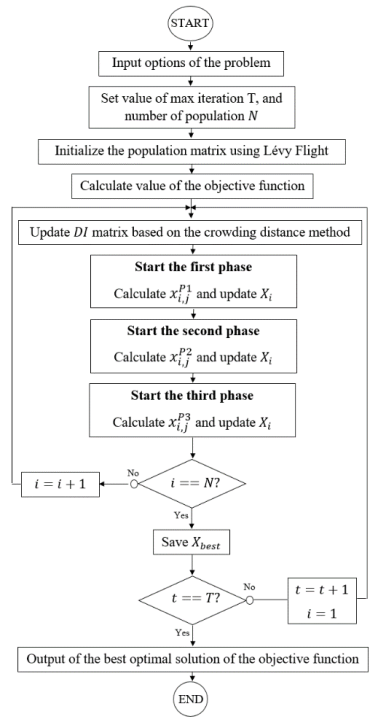
Flowchart of IDTBO is presented in Figure 4.
Figure 4. Flowchart of IDTBO.
4. IEEE 30 Bus Network
Figure 5. IEEE 30-bus system.
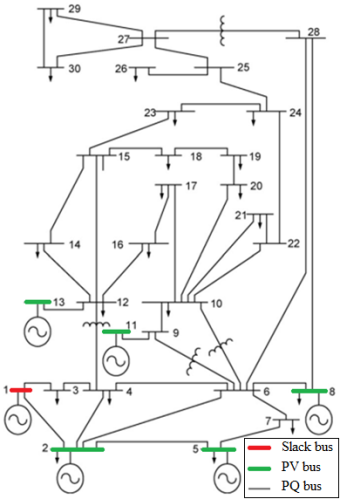
Six power generators (buses 1, 2, 5, 8, 11, and 13), four transformers with an off-nominal tap ratio (lines 6-9, 6-10, 4-12, and 28-27), and nine shunt VAR compensation buses (buses 10, 12, 15, 17, 20, 21, 23, 24, and 29) make up the IEEE 30-bus system (Figure 5). Cost coefficients, bus data, generator data, and line data are provided in . The control variable and line power transmission minimum and maximum limits are provided in .
Solution of OPF with IDTBO algorithm for minimizing fuel cost is given in Table 2. Results are compared with Particle Swarm Optimization (PSO), Teaching Learning-Based Optimization (TLBO) and Modified Driving Training-Based Optimization (MDTBO) algorithms.
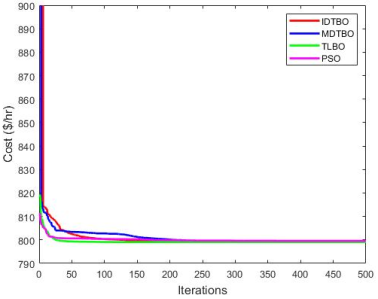
The MATLAB code for IDTBO is executed with the same machine as the three others algorithms, with more interesting elapsed time which is equal to 149s (15% improved compared to 177s with MDTBO, and 50.9% improved compared to 305s with TLBO). The PSO’s convergence speed remains the best, but with a less optimized result (799.5823$/h) compared to that obtained with IDTBO (799.2659$/h). Furthermore, compared to MDTBO (799.5753$/h), the cost is more attractive with the new method. In Figure 6, IDTBO also represents an interesting fuel cost variation.
Table 2. Optimal settings of control variables with PSO, TLBO, MDTBO and IDTBO.

Variables

Min

Max

Initial case

PSO

TLBO

MDTBO

IDTBO

P1

50

200

99.2225

177.3006

177.0567

176.9336

176.6836

P2

20

80

80

48.7654

48.6972

48.6810

48.7035

P5

15

50

50

21.3155

21.3043

21.2255

21.2130

P8

10

35

20

20.8126

21.0814

20.9396

20.9662

P11

10

30

20

11.8358

11.8842

11.7209

12.0235

P13

12

40

20

12.1574

12.000

12.6520

12.4609

V1

0.95

1.1

1.0500

1.1000

1.1000

1.1000

1.1000

V2

0.95

1.1

1.0400

1.0873

1.0879

1.0876

1.0882

V5

0.95

1.1

1.0100

1.0613

1.0617

1.0608

1.0614

V8

0.95

1.1

1.0100

1.0695

1.0694

1.0689

1.0701

V11

0.95

1.1

1.0500

1.0999

1.1000

1.1000

1.0995

V13

0.95

1.1

1.0500

1.0999

1.1000

1.1000

1.0998

T11

0.9

1.1

1.0780

0.9902

1.0447

0.9497

0.9595

T12

0.9

1.1

1.0690

1.0436

0.9000

1.0125

1.0261

T15

0.9

1.1

1.0320

1.0999

0.9863

1.0177

1.0104

T36

0.9

1.1

1.0680

1.0123

0.9657

0.9717

0.9733

Q10

0.0

5.0

0

0.0018

5.000

2.2939

3.1194

Q12

0.0

5.0

0

4.8882

5.000

1.5445

2.3485

Q15

0.0

5.0

0

1.4461

5.000

2.1016

1.6498

Q17

0.0

5.0

0

4.9987

5.000

2.4704

4.9998

Q20

0.0

5.0

0

1.8570

5.000

0.8641

4.4746

Q21

0.0

5.0

0

0.0004

5.000

3.6410

4.9998

Q23

0.0

5.0

0

4.9983

3.8490

1.7289

4.8488

Q24

0.0

5.0

0

3.1354

5.000

0.77854

2.3917

Q29

0.0

5.0

0

4.9907

2.7434

1.0707

1.9906

Cost ($/h)

901.9501

799.5823

799.0680

799.5753

799.2659

Ploss(MW)

5.8225

8.7880

8.6245

8.7532

8.6514

Qloss(MVAR)

-4.6063

3.2444

4.1827

5.0820

4.4967

VD

1.1496

1.0757

1.8583

1.4079

1.5887

Lmax

0.1723

0.1270

0.1164

0.1268

0.1214

Elapsed time

107.9159

305.0494

177.6250

149.7006

Figure 6. Fuel cost variation with IDTBO, MDTBO, TLBO and PSO.
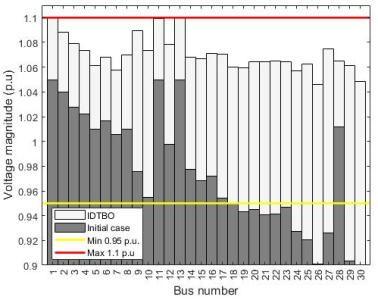
In the first instance, there were some voltage breaches at buses 19 through 30 (below the minimum 0.95 p.u.), but the IDTBO results show that there are no longer any violations (Figure 7).
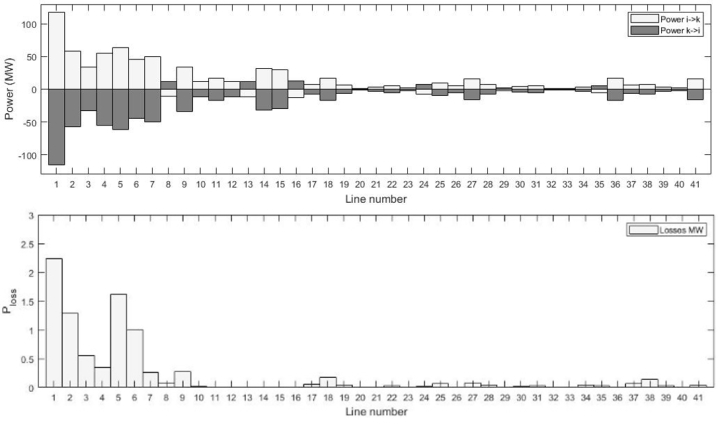
Active power flow and losses through transmission line is given in Figure 8. Active power losses are more interesting with IDTBO (a total of 8.6514 MW) compared to MDTBO (a total of 8.7532 MW). Similarly, the reactive power losses is greatly improved with IDTBO (a total of 4.4967 MVAR) compared to MDTBO (5.0820 MVAR). Reactive power flow and losses through transmission line is given in Figure 9.
Considering the imposed inequality constraints, including the limit on the power transmitted through the lines, solving OPF with IDTBO represents no violation with the considered objective function. As shown is Figure 10, there is still a significant margin before the power limits are reached.
Figure 7. System voltage profiles for initial case and IDTBO.
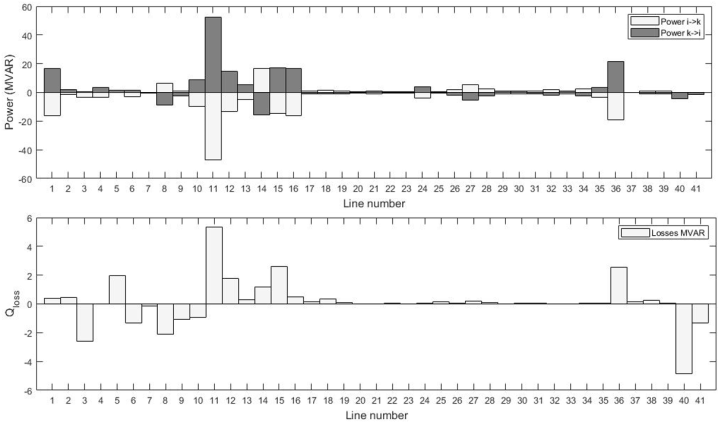
Figure 9. Reactive power flow and losses through transmission lines with IDTBO.
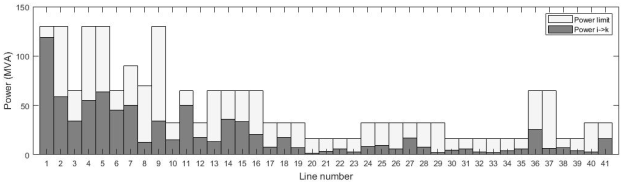
Figure 10. Apparent power flow through transmission lines with IDTBO.

5. Conclusions
In this paper, an enhanced version of the DTBO algorithm has been proposed for solving OPF problem. IDTBO introduces two critical enhancing in the original DTBO: first, drivers and learners are chosen using the crowding distance technique, second, initialization phase incorporates the Levy Flight distribution. These improved the algorithm’s convergence speed, diversity, accuracy and aid in escaping local optima entrapment. With minimization of fuel cost as objective function, application’s results of IDTBO in IEEE 30-bus network are compared to three metaheuristic algorithm: MDTBO, TLBO and PSO. The results show that IDTBO is more interesting with the best optimized value and the best convergence speed.
Abbreviations

OPF

Optimal Power Flow

DTBO

Driving Training-Based Optimization

MDTBO

Modified Driving Training-Based Optimization

IDTBO

Improved Driving Training-Based Optimization

TLBO

Teaching Learning-Based Optimization

PSO

Particle Swarm Optimization

CSA

Cuckoo Search Algorithm

IEEE

Institute of Electrical and Electronics Engineers

DE

Differential Evolution

ITLBO

Improved Teaching Learning-Based Optimization

CDPSO

Crowding Distance Based Particle Swarm Optimization

Author Contributions
Edmond Randriamora: Conceptualization, Methodology, Supervision, Writing – review & editing
Olivier Mickael Ranarison: Software, Writing – original draft
Rivo Mahandrisoa Randriamaroson: Supervision
Conflicts of Interest
The authors declare no conflicts of interest.
References
[1] Wael AMOR, Power flow for large and poorly conditioned networks, E. T. S., University of Quebec, 2018, pp. 43.
[2] Ebeed M., Kame S., Jurado F., Optimal Power Flow Using Recent Optimization Techniques, Classical and Recent Aspects of Power System Optimization, Elsevier Inc., 2018, pp. 157-183.
[3] Emmanuel A. Nyiekaa, Ikenna Onyegbadue, Optimal Power Flow Methods – A survey, International Journal of Advances in Engineering and Manangement, vol. 3, issue 2, feb 2021, pp. 20-32.
[4] M. Abido, Optimal Power Flow Using Particle Swarm Optimization, International Journal of Electrical Power Energy System, 24, 2002, pp. 563-571.
[5] Arul Ponnusamy, Rengarajan N., Optimal Power Flow Solution using Cuckoo Search Algorithm, ARPN Journal of Engineering and Applied Sciences, vol. 9, no. 12, December 2014, pp. 2687-2691.
[6] Bouchekara H., Abido M., Boucherma M., Optimal power flow using teaching-learning based optimization technique, Electr. Power Syst. Res., 114, 2014, pp. 49-59.
[7] O. M. Ranarison, E. Randriamora, H. Andriatsihoarana, Optimal Power Flow Using Modified Driving-Training Based Optimization algorithm, International Journal of Advances in Engineering and Management, vol. 7, Issue 02 Feb. 2025, pp. 846-860.
[8] Juan Li, Qing An, Hong Lei, Qian Deng, Gai-Ge Wang, Survey of Levy Flight-Based Metaheuristic for Optimization, Mathematics 10, no. 15: 2785, 2022.
[9] Edmond Randriamora, Faly Ramahatana, Yvon Andrianaharison, Optimal Power Flow by Cuckoo Search Via Levy Flight Algorithm, International Journal of Engineering Research & Technology, vol. 6, Issue 12, December 2017, pp. 32-37.
[10] Ghasemi M., Ghavidel S., Gitizadeh M., Akbari E., An improved teaching learning based optimization algorithm using Levy mutation strategy for non-smooth optimal power flow, Int. J. Electr. Power Energy Syst. 65, 2015, pp. 375-384.
[11] Dr. K. Lenin, Crowding Distance Based Particle Swarm Optimization Algorithm for Solving Optimal Reactive Power Dispatch Problem, International Journal of Research Granthaalayah, vol. 6, Issue 6, June 2018, pp. 226-237.
[12] Mohammad Dehghani, Eva Trojovská, Pavel Trojovský, A new human-based metaheuristic algorithm for solving optimization problems on the base of simulation of driving training process, Scientific reports, 2022.
[13] Daniel Kwegyir, Michael Dugbartey Terkper, Francis Boafo Effah, Emmanuel Kwaku Antoh, Stacy Gyamfuah Lumor, Improved Driving Training-Based Optimization Algorithm Using Levy Flight and Crowding Distance Techniques, Research Reports on Computer Science, vol. 3, Issue 1, April 2024, pp. 12-28.
[14] Deb K., Pratap A., Agarwal S., Meyarivan T., A fast and elitist multiobjective genetic algorithm: NSGA-II, IEEE Trans. Evol. Comput., 2002, 6, pp. 182-197.
[15] Bechikh S., Kessentini M., Said L. B., Ghédira K., Preference incorporation in evolutionary multiobjective optimization: A survey of the state-of-the-art, Adv. Comput., 2015, 98, pp. 141-207.
[16] Gao Y., Zhang H., Duan Y., A novel hybrid PSO based on levy flight and wavelet mutation for global optimization, PLOS ONE, 18, e0279572, 2023.
[17] Kamaruzaman A. F., Zain A. M., Yusuf S. M., Udin A., Levy Flight Algorithm for Optimization Problems – A Literature Review, Appl. Mech. Mater, 421, 2013, pp. 496-501.
[18] Chawla M., Duhan M., Levy Flights in Metaheuristics Optimization Algorithms – A Review, Appl. Artif. Intell., 32, 2018, pp. 802-821.
[19] Abou El Ela A. A, Abido M. A, Optimal power flow using differential evolution algorithm, Electr. Power Syst. Res., 80(7), 2010, pp. 878-885.
[20] Alsac O., Stot B., Optimal load flow with steady-state security, IEEE Trans. Power App. Syst., PAS-93 (3), 1974, pp. 745-751.
Cite This Article
  • APA Style

    Randriamora, E., Ranarison, O. M., Randriamaroson, R. M. (2026). Improved Driving Training-Based Optimization Algorithm Using Levy Flight and Crowding Distance Techniques for Solving Optimal Power Flow Problem. American Journal of Engineering and Technology Management, 11(3), 31-41. https://doi.org/10.11648/j.ajetm.20261103.11

    Copy | Download

    ACS Style

    Randriamora, E.; Ranarison, O. M.; Randriamaroson, R. M. Improved Driving Training-Based Optimization Algorithm Using Levy Flight and Crowding Distance Techniques for Solving Optimal Power Flow Problem. Am. J. Eng. Technol. Manag. 2026, 11(3), 31-41. doi: 10.11648/j.ajetm.20261103.11

    Copy | Download

    AMA Style

    Randriamora E, Ranarison OM, Randriamaroson RM. Improved Driving Training-Based Optimization Algorithm Using Levy Flight and Crowding Distance Techniques for Solving Optimal Power Flow Problem. Am J Eng Technol Manag. 2026;11(3):31-41. doi: 10.11648/j.ajetm.20261103.11

    Copy | Download

  • @article{10.11648/j.ajetm.20261103.11,
      author = {Edmond Randriamora and Olivier Mickael Ranarison and Rivo Mahandrisoa Randriamaroson},
      title = {Improved Driving Training-Based Optimization Algorithm Using Levy Flight and Crowding Distance Techniques for Solving Optimal Power Flow Problem},
      journal = {American Journal of Engineering and Technology Management},
      volume = {11},
      number = {3},
      pages = {31-41},
      doi = {10.11648/j.ajetm.20261103.11},
      url = {https://doi.org/10.11648/j.ajetm.20261103.11},
      eprint = {https://article.sciencepublishinggroup.com/pdf/10.11648.j.ajetm.20261103.11},
      abstract = {Driving Training-Based Optimization (DTBO) algorithm is a metaheuristic algorithm based on the simulation of driving training process. Improved version of the DTBO is proposed in this paper for solving Optimal Power Flow (OPF) problem. The Improved Driving Training-Based Optimization (IDTBO) algorithm includes the Crowding Distance Technique for more diverse driver and learner selection and incorporates the Levy Flight distribution for better exploration and local optima avoidance. OPF is considered as one of the most difficult optimization problems and is very important for the control of electrical network. The objective of this study is finding the best control variables while minimizing the total generation fuel cost and considering equality and inequality constraints of the system. The standard IEEE 30-bus network is used for evaluating the performance of the IDTBO algorithm for solving OPF problem. For solving conventional power flow equation, Newton Raphson algorithm is considered. Compared to Modified Driving Training-Based Optimization (MDTBO), Teaching Learning-Based Optimization (TLBO) and Particle Swarm Optimization (PSO) algorithms, the proposed method is more accurate and is better in convergence speed. The performance of the IDTBO is very useful for finding the most secure operating point of any electric power system and its convergence speed contributes to improving the dynamic management of a smart electricity grid.},
     year = {2026}
    }
    

    Copy | Download

  • TY  - JOUR
    T1  - Improved Driving Training-Based Optimization Algorithm Using Levy Flight and Crowding Distance Techniques for Solving Optimal Power Flow Problem
    AU  - Edmond Randriamora
    AU  - Olivier Mickael Ranarison
    AU  - Rivo Mahandrisoa Randriamaroson
    Y1  - 2026/05/14
    PY  - 2026
    N1  - https://doi.org/10.11648/j.ajetm.20261103.11
    DO  - 10.11648/j.ajetm.20261103.11
    T2  - American Journal of Engineering and Technology Management
    JF  - American Journal of Engineering and Technology Management
    JO  - American Journal of Engineering and Technology Management
    SP  - 31
    EP  - 41
    PB  - Science Publishing Group
    SN  - 2575-1441
    UR  - https://doi.org/10.11648/j.ajetm.20261103.11
    AB  - Driving Training-Based Optimization (DTBO) algorithm is a metaheuristic algorithm based on the simulation of driving training process. Improved version of the DTBO is proposed in this paper for solving Optimal Power Flow (OPF) problem. The Improved Driving Training-Based Optimization (IDTBO) algorithm includes the Crowding Distance Technique for more diverse driver and learner selection and incorporates the Levy Flight distribution for better exploration and local optima avoidance. OPF is considered as one of the most difficult optimization problems and is very important for the control of electrical network. The objective of this study is finding the best control variables while minimizing the total generation fuel cost and considering equality and inequality constraints of the system. The standard IEEE 30-bus network is used for evaluating the performance of the IDTBO algorithm for solving OPF problem. For solving conventional power flow equation, Newton Raphson algorithm is considered. Compared to Modified Driving Training-Based Optimization (MDTBO), Teaching Learning-Based Optimization (TLBO) and Particle Swarm Optimization (PSO) algorithms, the proposed method is more accurate and is better in convergence speed. The performance of the IDTBO is very useful for finding the most secure operating point of any electric power system and its convergence speed contributes to improving the dynamic management of a smart electricity grid.
    VL  - 11
    IS  - 3
    ER  - 

    Copy | Download

Author Information