
 ,
Erna Laeticia Tchinda Ngounou,
Bertrand Sitamtze Youmbi,
Georges Collince Fouokeng*,
Aurelien Kenfack Jiotsa,
Nirina Randrianantoandro
,
Erna Laeticia Tchinda Ngounou,
Bertrand Sitamtze Youmbi,
Georges Collince Fouokeng*,
Aurelien Kenfack Jiotsa,
Nirina Randrianantoandro
In the present work, we report on a theoretical investigation of the magnetoelectric parameters of the helical Heisenberg multiferroic spin chain model. The spin-wave approximation in the bosonization process is used to evaluate the energy spectrum of the quadratic form of the model as that of regular quantum gases. The quantized form of the model is conveniently treated using the canonical ensemble in terms of the free energy developed by the use of Landau theory. Following the Fermi-Dirac statistics of quantum gases, the joint effect of Dzyaloshinskii -Mriya (DM) and Kaplan-Shekhtman-Entin-Wohlman-Aharony (KSEA) interactions on the magnetoelectric properties of the helical multiferroic spin structure controlled by a static electric field in the y-direction and a magnetic field in the z-direction is quantified. The magnetization, susceptibility, and electric polarization are used as measurable parameters. The work convincingly establishes that the juxtaposition of KSEA interactions to DM interactions is worthy since, on the one hand, it amplifies the magnetic property of the system, and on the other hand makes it possible to control the phase transition dynamics induced in such materials by the symmetric inversion due to the DM interactions. At low temperature, the measurable parameters are closely related to ferroelectricity and ferromagnetism in multiferroic materials, where all effects favor the symmetrization mechanism and hence magnetoelectric properties. These properties are critical in spintronics and information storage control.
| Published in | American Journal of Modern Physics (Volume 15, Issue 2) |
| DOI | 10.11648/j.ajmp.20261502.11 |
| Page(s) | 13-23 |
| Creative Commons |
This is an Open Access article, distributed under the terms of the Creative Commons Attribution 4.0 International License (http://creativecommons.org/licenses/by/4.0/), which permits unrestricted use, distribution and reproduction in any medium or format, provided the original work is properly cited. |
| Copyright |
Copyright © The Author(s), 2026. Published by Science Publishing Group |
Helical Spin, Isotropic Spin, Magnetoelectric, DM Interaction, KSEA Interaction, Quantum Phase Transition, Spin-orbit Coupling

 can also be obtained. However, Moriya

 (1)
(1) 

 (2)
(2) 

 ,
, 

 , and,

 ,
, 

 are the interaction parameters in the x- and y- directions, respectively, i.e., the intrachain Heisenberg interaction parameter with nearest and NNN responsible for the helical structure in the spin system,

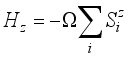 (3)
(3) 

 the transverse magnetic field,

 (4)
(4) 

 , and,

 being the magnetocrystalline anisotropy constants

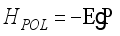 (5)
(5) 

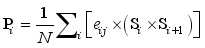 a net electric polarization well described by the spin-current model and found under spiral and conical spin structures

 is the propagation direction of the spin spiral and

 the moments on neighboring spins.

 is the external electric field. The sum is over the sites

 , with

 the number of spins per unit volume,

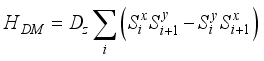 (6)
(6) 
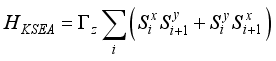
 , the DM factor taken along the z-direction),

 (7)
(7) 

 .
. 
 ) in charge of SU (2) symmetry breaking on its own, which includes NN spins and NNN, has been shown to be suitable to explain meta-magnetoelectric excitations due to its significant polarization in the ferroelectric phase and strong ME coupling

 (
( 

 the Pauli matrix defined at site i in the three space directions

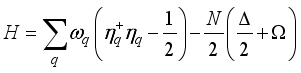
 ) into the solvable model, the spin wave theory, based successively on the Jordan-Wigner (JW) transformations, Fourier transformations and thus Bogoliubov transformations, in the adiabatic limit, is used in this work as a diagonalization procedure. The NNN interactions, represented by a set of four fermions in JW representations, can result in 2l-fermions vertices for spin exchanges between NN of rank 1. The system deals with non-vanishing four-fermion order terms implying that the NNN term turns the model into deep paramagnetic phase for all positive value of

 where all spins are oriented in the direction of the transverse field such that

 .
. 

 (8)
(8) 

 (9)
(9) 

 is the Bogoliubov quasiparticle expressed in terms of the Fourier transform operator

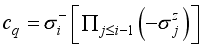 and be the wave numbers in the range

 .
. 
 and magnetization
 are related to the electric
 and magnetic fields
 by the following relations
 (10)
(10) 
 (11)
(11) 
 and
and 
 are the spontaneous polarization and magnetization components, respectively,
 and
and 
 are the electrical permittivity and magnetic permeability constants in the vacuum,
 and
and 
 are the second-order tensors of electric and magnetic susceptibilities of the substance.
 and
and 
 are the electric field and magnetic field components in the medium.
 are the tensors used to determine the magnitude of the linear ME effect in the material.
 of the system with applied fields (magnetic and electric), can be expressed in Landau theory as
 (12)
(12) 
 is the ground state free energy.

 (13)
(13) 

 (14)
(14) 

 (
( 

 is the absolute temperature and

 is the Boltzmann constant).

 (15)
(15) 

 (16)
(16) 

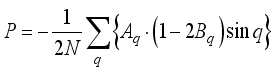 (17)
(17) 

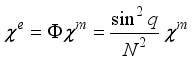 (18)
(18) 

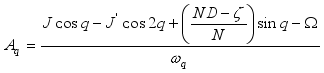 and
and 

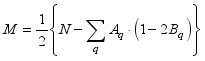
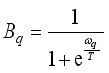 are respectively a dimensionless energy and the number of particles with energy

 defined according to Fermi-Dirac statistics at thermal equilibrium.
 the phase factor linking
 to
to 
 . The coefficients
 ,
, 
 ,
, 
 , and
, and 
 are respectively the magnetization, magnetic susceptibility, electric polarization and the electric susceptibility of the system.

 and
and 

 .
.  measured under the joint effect of DM and KSEA interaction, with
  in (M1a) and
  in (M1b). The other parameters are
 and
and  .
. measured under the joint effect of DM and KSEA interaction, with in (M2a) and in (M2b). The other parameters are
  and .
and .
 and electric polarization
 are comparable concepts used to quantify magnetic
 and electric field
 responses, respectively, indicating magnetic dipole moment density and electric dipole moment density, both of which align spin moment. Magnetic/electric susceptibility are characteristic parameters that indicate how a quantum system reacts to external fields, resulting in quantum/dynamical quantum phase transitions. In ME multiferroics, ME coupling is a direct result of applied magnetic and electric fields. It is the signature that controls the ME parameters by the action of applied external fields. All influences on the ME coupling, such as spin-orbit interactions investigated in this study, are critical for creating and understanding novel material states devices. Modifying the ME coupling factor affects the electric structure and thus the energy levels, spin dynamics, and even the material's topology

 ,
, 

 and in Figures 5 and 6 the polarization behavior at

 (for M1a, M2a, P1a and P2.a) and

 (for M1b, M2b, P1.b and P2.b) alongside fits obtained under different values of

 and
and 

 .
.  measured under the joint effect of DM and KSEA interaction, with
  in (S1a) and
  in (S1b). The other parameters are
  and .
and . measured under the joint effect of DM and KSEA interaction, with in (S2a) and in (S2b). The other parameters are:
  and .
and . measured under the joint effect of DM and KSEA interaction, with in (P1a) and in (P1b). The other parameters are and .
 measured under the joint effect of DM and KSEA interaction, with in (P2a) and in (P2b). The other parameters areand .
 , which is responsible for symmetry breaking, preserves the observed behavior in the evolution of magnetization and polarization with respect to the magnetic field (Figures 1 and 5), while breaking the symmetric behavior observed in their evolution when they depend on the electric field (Figures 2 and 6). However, the factor
 tends to resist the action needed by the interaction parameters
 , diminishing its influence and providing greater control over the magnetic and electric domains.
  measured under joint effect of DM and KSEA interaction, with in (Se1a) and in (Se1b). The other parameters are: and .
 measured under joint effect of DM and KSEA interaction, with in (Se2a) and in (Se2b). The other parameters are: and .

 shows a sudden change in concavity at the critical values of the applied field (Figures 3 and 4). These points correspond to the phase transition points. There are several such points depending on the electric field (Figure 4). In contrast, the electric susceptibility

 exhibits progression with a number of positive transitions at the critical points of the applied field (Figures 7 and 8). The multiplicity of critical points as a function of the electric field refers to the variation of the action of the transverse electric field with respect to that of the anisotropy
 and that of the magnetic field applied along the z-axis. The variation of the DM interaction generates quantum transition dynamics phase diagram.
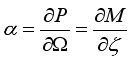


 et
et 
 . With reference to the result obtained in Eq. (18), we can read the possibility of coupling the two susceptibilities by a non-linear factor whose profile is represented in Figure 9.
 DM | Dzyaloshinskii Moriya |
KSEA | Kaplan-Shekhtman-Entin-Wohlman-Aharony |
NN | Nearest Neighbor |
NNN | Next Nearest Neighbor |
ME | Magnetoelectric |
JW | Jordan-Wigner |
| [1] | Dzyaloshinskii, I., (1958). A thermodynamic theory of weak ferromagnetism of antiferromagnetics. Journal of Physics and Chemistry of Solids, 4(4): 241-255. |
| [2] | Moriya, T., (1960). Anisotropic super-exchange interaction and weak ferromagnetism. Physical review, 120(1): 91-98. |
| [3] | George Rado, T., (1961). Mechanism of the Magnetoelectric Effect in an Antiferromagnet. Phys. Rev. Lett, 6(11): 609-610. |
| [4] | Dong, S., Liu, J. M., Cheong, S. W., and Ren, Z., (2015). Multiferroic materials and magnetoelectric physics: symmetry, entanglement, excitation, and topology. Advances in Physics, 64(5-6), 519-626. |
| [5] | Salje, E. K., (2020). Ferroelastic domain walls as templates for multiferroic devices, Journal of Applied Physics, 128(16): 164104. |
| [6] | Spaldin, N. A., Fiebig, M., and Mostovoy, M., (2008). The toroidal moment in condensed matter physics and its relation to the magnetoelectric effect, Journal of Physics: Condensed Matter. 20(43): 434203. |
| [7] | Kopyl, S., Surmenev, R., Surmeneva, M., Fetisov, Y., Kholkin, A., (2021). Magnetoelectric effect: principles and applications in biology and medicine- a review. Materials Today Bio, 12, 100149. |
| [8] | Fodouop, F. K., fouokeng, G. C., Tchoffo, M., Fai, L. C., Randrianantoandro, N., (2018). Thermodynamics of metamagnetoelectric effect in multiferroics. journal of magnetism and Magnetic Materials, 474: 456-461. |
| [9] | Glazer, A. M., (1972). The classification of tilted octahedra in perovskites. Acta Crystallographica Section B: Structural Crystallography and Crystal Chemistry, 28(11): 3384-3392. |
| [10] | Cho, Y., Hashimoto, S., Odagawa, N., Tanaka, K., Hiranaga, Y., 2006. Nanodomain manipulation for ultrahigh density ferroelectric data storage. Nanotechnology, 17(7): 137-141. |
| [11] | Dzyaloshinskii, I. E., (1960). On the magneto-electrical effects in antiferromagnets. Soviet Physics, JETP, 10: 628-629. |
| [12] | Shekhtman, L., Entin-Wohlman, O., and Amnon Aharony, (1992). Moriya’s anisotropic superexchange interaction, frustration, and Dzyaloshinsky’s weak ferromagnetism. Physical review letters, 69(5): 836-839. |
| [13] | Shekhtman, L., Entin-Wohlman, O., and Amnon Aharony, (1993). Shekhtman, EntinWohlman, and Aharony reply. Physical Review Letters, 71(3): 468-468. |
| [14] | Fouokeng, G. C., et al., (2025). Entanglement dynamics of two-qubit and two-qutrit systems coupled to an XY-spin-chain environment: Simultaneous effects of Dzyaloshinskii-Moriya and Kaplan-Shekhtman-Entin-Wohlman-Aharony interactions. Physica B: Condensed Matter, 697: 416691. |
| [15] | Schmid, H., (1994). Multi-ferroic magnetoelectrics, Ferroelectrics, 162(1): 317-338. |
| [16] | Kimura, T., Kawamoto, S., Yamada, I., Azuma, M., Takano, M., and Tokura, Y., (2003). Magnetocapacitance effect in multiferroic BiMnO3. Physical Review B, 67(18): 180401. |
| [17] | Landau, L. D., (1958). On the theory of the Fermi liquid. J. Exp. Theor. Phys, 35(97): 752-760. |
| [18] | Chaix, L., (2014). Couplage magnéto-électrique dynamique dans les composés multiferroïques: langasites de fer et manganites hexagonaux [Dynamic magneto-electric coupling in multiferroic compounds: iron langasites and hexagonal manganites] (Doctoral dissertation, University of Grenoble). |
| [19] | Hohenberg, P., and Kohn, W., (1964). Inhomogeneous electron gas. Physical review, 136(3B): B864- B871. |
| [20] | Bibes, M., and Barthlmy, A., (2008). Towards a magnetoelectric memory. Nature materials, 7(6): 425-426. |
| [21] | Choi, T., Horibe, Y., Yi, H. T., Choi, Y. J., Wu, W., and Cheong, S. W., (2010). Insulating interlocked ferroelectric and structural antiphase domain walls in multiferroic YMnO3. Nature materials, 9(3): 253-258. |
| [22] | Fujimura, N., Azuma, S. I., Aoki, N., Yoshimura, T., and Ito, T., (1996). Growth mechanism of YMnO3 film as a new candidate for nonvolatile memory devices, Journal of applied physics, 80(12): 7084-7088. |
| [23] | Pabst, G. W., Martin, L. W., Chu, Y. H., and Ramesh, R., (2007). Leakage mechanisms in BiFeO3 thin films. Applied Physics Letters, 90(7): 072902. |
| [24] | Sergienko, I. A., and Dagotto, E., (2006). Role of the Dzyaloshinskii-Moriya interaction in multiferroic perovskites. Physical Review B-Condensed Matter and Materials Physics, 73(9): 094434. |
| [25] | Dong, S., et al., (2009). Exchange Bias Driven by the Dzyaloshinskii-Moriya Interaction and Ferroelectric Polarization at G-Type Antiferromagnetic Perovskite Interfaces. Physical review letters, 103(12): 127201. |
| [26] | Dong, S., Zhang, Q., Yunoki, S., Liu, J. M., and Dagotto, E., (2011). Ab initio study of the intrinsic exchange bias at the SrRuO3/SrMnO3 interface. Physical Review B-Condensed Matter and Materials Physics, 84(22): 224437. |
| [27] | Kaplan, T. A., (1983). Single-band Hubbard model with spin-orbit coupling, Zeitschrift fr Physik B Condensed Matter, 49(4): 313-317. |
| [28] | Zheludev, A., et al., (1998). Experimental Evidence for Kaplan-Shekhtman-Entin-Wohlman-Aharony Interactions in Ba2CuGe2O7. Physical review letters, 81, (24): 5410- 5413. |
| [29] | Kurilovich, P. D., Kurilovich, V. D., and Burmistrov, I. S., (2016). Indirect exchange interaction between magnetic impurities in the two-dimensional topological insulator based on CdTe/HgTe/CdTe quantum wells. Physical Review B, 94(15): 155408. |
| [30] | Liu, T., Ren, J., and Tong, P., (2018). Synthesizing and controlling helical indirect exchange interactions out of equilibrium, Physical Review B, 98(18): 184426. |
| [31] | Lumsden, M. D., Sales, B. C., Mandrus, D., Nagler, S. E., Thompson, J. R., (2001). Weak Ferromagnetism and Field-Induced Spin Reorientation in K2V3O8, Phys. Rev. Lett., 86(1): 159-162. |
| [32] | Masłowski, T., et al., (2024). Fisher zeroes and dynamical quantum phase transitions for two-and three-dimensional models, Physical Review B, 110(22): 224302. |
| [33] | Fiebig, M., Lottermoser, T., Frhlich, D., Goltsev, A. V., and Pisarev, R. V., (2002). Observation of coupled magnetic and electric domains, Nature, 419(6909): 818- 820. |
| [34] | Hai-Lian, L., Zhi-Guo, W., Cheng-Quan, Y., Xian-Shan, H., and Yun-Long, S., (2007). The symmetric and antisymmetric superexchange interactions in spin-Peierls system. Chinese Physics, 16(12): 3858-3862. |
| [35] | Kimura, T., Goto, T., Shintani, H., Ishizaka, K., Arima, T. H., and Tokura, Y., (2003). Magnetic control of ferroelectric polarization”, nature, 426(6962): 55-58. |
| [36] | Jia, C., Onoda, S., Nagaosa, N., and Han, J. H., (2007) Microscopic theory of spin polarization coupling in multiferroic transition metal oxides, Physical Review B Condensed Matter and Materials Physics, 76(14): 144424. |
| [37] | Yang, Z., Wang, Z., and Chen, H., (2002). The Dzyaloshinskii-Moriya interaction in spin Peierls systems, Journal of Physics: Condensed Matter, 14(8) L199. |
| [38] | Liu, H. L., Huang, X. S., Wang, Z. G., and Shi, Y. L., (2010). Influence of Dzyaloshinskii Moriya and Kaplan-Shekhtman-Entinwohlman-Aharony superexchange interactions on ground state properties of the one-dimensional spin-Peilers model in open chain, Chinese Physics B, 19(11): 117502. |
| [39] | Xiao-Gang, Wen., (2007). Quantum Field Theory of Many-Body Systems: From the Origin of Sound to an Origin of Light and Electrons. Oxford Graduate Texts (Oxford; online edn, Oxford Academic, 1 Feb. 2010). |
| [40] | Levin, M., and Gu, Z.-C., (2012). Braiding statistics approach to symmetry-protected topological phases. Phys. Rev. B, 86(11): 115109. |
| [41] | Swingle, B., (2014). Interplay between short- and long-range entanglement in symmetry-protected phases. Phys. Rev. B, 90, (11): 035451. |
| [42] | Barkeshli, M., Bonderson, P., Cheng, M., and Wang, Z., (2019). Symmetry fractionalization, defects, and gauging of topological phases. Phys. Rev. B, 100(11) 115147. |
| [43] | Gaidi, S., Slaoui, A., Mohamed, A-B A., Falaki, EL. M., and Laamara, Ahl. R., (2024). Effects of DM and KSEA interactions on entanglement, Fisher and Wigner-Yanase information correlations of two XYZ-Heisenberg-qubit states under a magnetic field. Phys. Scr, 99: 115115. |
| [44] | Prelovsek, P., Gomilsek, M., Arh, T., and Zorko, A., (2021). Dynamical spin correlations of the kagome antiferromagnet. Phys. Rev. B, 103(1) 014431. |
APA Style
Ndakom, B., Ngounou, E. L. T., Youmbi, B. S., Nadjitonon, N., Fouokeng, G. C., et al. (2026). Magnetic Properties of One-dimensional Helical Spin System with Isotropic Spin Exchanges Under the Effect of DM and KSEA. American Journal of Modern Physics, 15(2), 13-23. https://doi.org/10.11648/j.ajmp.20261502.11
ACS Style
Ndakom, B.; Ngounou, E. L. T.; Youmbi, B. S.; Nadjitonon, N.; Fouokeng, G. C., et al. Magnetic Properties of One-dimensional Helical Spin System with Isotropic Spin Exchanges Under the Effect of DM and KSEA. Am. J. Mod. Phys. 2026, 15(2), 13-23. doi: 10.11648/j.ajmp.20261502.11
AMA Style
Ndakom B, Ngounou ELT, Youmbi BS, Nadjitonon N, Fouokeng GC, et al. Magnetic Properties of One-dimensional Helical Spin System with Isotropic Spin Exchanges Under the Effect of DM and KSEA. Am J Mod Phys. 2026;15(2):13-23. doi: 10.11648/j.ajmp.20261502.11
@article{10.11648/j.ajmp.20261502.11,
  author = {Blaise Ndakom and Erna Laeticia Tchinda Ngounou and Bertrand Sitamtze Youmbi and Ngarmaim Nadjitonon and Georges Collince Fouokeng and Aurelien Kenfack Jiotsa and Nirina Randrianantoandro},
  title = {Magnetic Properties of One-dimensional Helical Spin System with Isotropic Spin Exchanges Under the Effect of DM and KSEA},
  journal = {American Journal of Modern Physics},
  volume = {15},
  number = {2},
  pages = {13-23},
  doi = {10.11648/j.ajmp.20261502.11},
  url = {https://doi.org/10.11648/j.ajmp.20261502.11},
  eprint = {https://article.sciencepublishinggroup.com/pdf/10.11648.j.ajmp.20261502.11},
  abstract = {In the present work, we report on a theoretical investigation of the magnetoelectric parameters of the helical Heisenberg multiferroic spin chain model. The spin-wave approximation in the bosonization process is used to evaluate the energy spectrum of the quadratic form of the model as that of regular quantum gases. The quantized form of the model is conveniently treated using the canonical ensemble in terms of the free energy developed by the use of Landau theory. Following the Fermi-Dirac statistics of quantum gases, the joint effect of Dzyaloshinskii -Mriya (DM) and Kaplan-Shekhtman-Entin-Wohlman-Aharony (KSEA) interactions on the magnetoelectric properties of the helical multiferroic spin structure controlled by a static electric field in the y-direction and a magnetic field in the z-direction is quantified. The magnetization, susceptibility, and electric polarization are used as measurable parameters. The work convincingly establishes that the juxtaposition of KSEA interactions to DM interactions is worthy since, on the one hand, it amplifies the magnetic property of the system, and on the other hand makes it possible to control the phase transition dynamics induced in such materials by the symmetric inversion due to the DM interactions. At low temperature, the measurable parameters are closely related to ferroelectricity and ferromagnetism in multiferroic materials, where all effects favor the symmetrization mechanism and hence magnetoelectric properties. These properties are critical in spintronics and information storage control.},
 year = {2026}
}
TY  - JOUR
T1  - Magnetic Properties of One-dimensional Helical Spin System with Isotropic Spin Exchanges Under the Effect of DM and KSEA
AU  - Blaise Ndakom
AU  - Erna Laeticia Tchinda Ngounou
AU  - Bertrand Sitamtze Youmbi
AU  - Ngarmaim Nadjitonon
AU  - Georges Collince Fouokeng
AU  - Aurelien Kenfack Jiotsa
AU  - Nirina Randrianantoandro
Y1  - 2026/03/05
PY  - 2026
N1  - https://doi.org/10.11648/j.ajmp.20261502.11
DO  - 10.11648/j.ajmp.20261502.11
T2  - American Journal of Modern Physics
JF  - American Journal of Modern Physics
JO  - American Journal of Modern Physics
SP  - 13
EP  - 23
PB  - Science Publishing Group
SN  - 2326-8891
UR  - https://doi.org/10.11648/j.ajmp.20261502.11
AB  - In the present work, we report on a theoretical investigation of the magnetoelectric parameters of the helical Heisenberg multiferroic spin chain model. The spin-wave approximation in the bosonization process is used to evaluate the energy spectrum of the quadratic form of the model as that of regular quantum gases. The quantized form of the model is conveniently treated using the canonical ensemble in terms of the free energy developed by the use of Landau theory. Following the Fermi-Dirac statistics of quantum gases, the joint effect of Dzyaloshinskii -Mriya (DM) and Kaplan-Shekhtman-Entin-Wohlman-Aharony (KSEA) interactions on the magnetoelectric properties of the helical multiferroic spin structure controlled by a static electric field in the y-direction and a magnetic field in the z-direction is quantified. The magnetization, susceptibility, and electric polarization are used as measurable parameters. The work convincingly establishes that the juxtaposition of KSEA interactions to DM interactions is worthy since, on the one hand, it amplifies the magnetic property of the system, and on the other hand makes it possible to control the phase transition dynamics induced in such materials by the symmetric inversion due to the DM interactions. At low temperature, the measurable parameters are closely related to ferroelectricity and ferromagnetism in multiferroic materials, where all effects favor the symmetrization mechanism and hence magnetoelectric properties. These properties are critical in spintronics and information storage control.
VL  - 15
IS  - 2
ER  -
Department of Physics and Engineering Sciences, University of N’Djamena, N’Djamena, Chad
Department of Physics, University of Yaounde 1, Yaounde, Cameroon
Faculty of Engineering and Technology, University of Buea, Buea, Cameroon
Department of Physics, University of Dschang, Dschang, Cameroon
Department of Physics, University of Yaounde 1, Yaounde, Cameroon
Institute of Molecules and Materials of Le Mans, Le Mans University, Le Mans, France
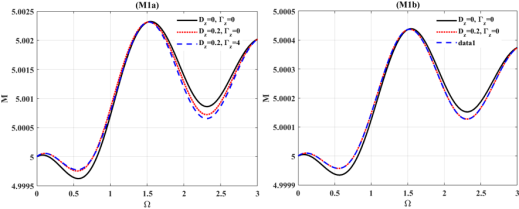
Figure 1. Magnetic field-dependent magnetizationmeasured under the joint effect of DM and KSEA interaction, with in (M1a) and in (M1b). The other parameters are and .
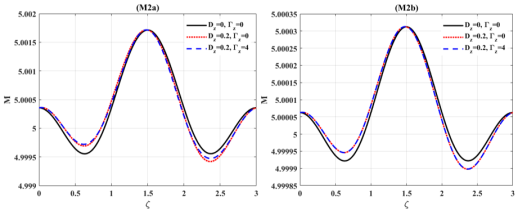
Figure 2. Electric field-dependent magnetizationmeasured under the joint effect of DM and KSEA interaction, with in (M2a) and in (M2b). The other parameters are and .
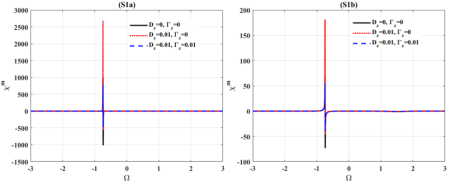
Figure 3. Magnetic field-dependent magnetic susceptibility measured under the joint effect of DM and KSEA interaction, with in (S1a) and in (S1b). The other parameters are and .
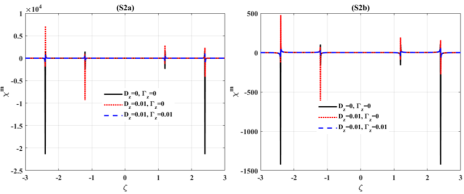
Figure 4. Electric field-dependent magnetic susceptibility measured under the joint effect of DM and KSEA interaction, with in (S2a) and in (S2b). The other parameters are: and .
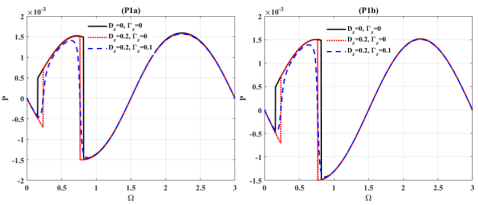
Figure 5. Magnetic field-dependent electric polarization measured under the joint effect of DM and KSEA interaction, with in (P1a) and in (P1b). The other parameters are and .
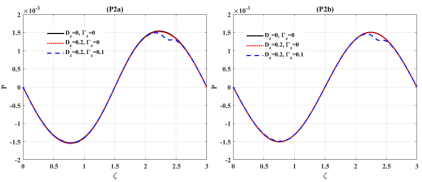
Figure 6. Electric field-dependent electric polarization measured under the joint effect of DM and KSEA interaction, with in (P2a) and in (P2b). The other parameters areand .
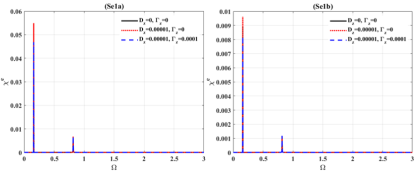
Figure 7. Magnetic field -dependent electric susceptibility measured under joint effect of DM and KSEA interaction, with in (Se1a) and in (Se1b). The other parameters are: and .
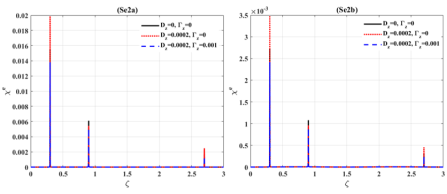
Figure 8. Electric field -dependent electric susceptibility measured under joint effect of DM and KSEA interaction, with in (Se2a) and in (Se2b). The other parameters are: and .
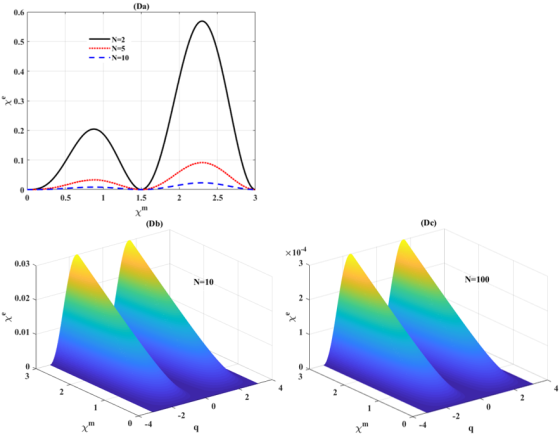
Figure 9. Magnetic susceptibility-dependent electric susceptibility phase diagram.

Information


 Share This Article
 Twitter
 Linked In
 Facebook
 Copy
Copy Download