2. Literature
This section critically reviews existing scholarship relevant to supervisory intensity and owner driven management in private sector organisations. It examines seven interconnected strands of research. These literatures provide valuable insights into managerial behaviour and organisational outcomes. However, they also reveal conceptual gaps, particularly in explaining why owners persist in exerting excessive pressure even when employees are competent.
2.1. Abusive Supervision
Abusive supervision has been widely recognised as one of the most destructive forms of leadership in organisational behaviour. According to Tepper
, it is defined as sustained hostile verbal and nonverbal behaviours by supervisors, excluding physical contact. This conceptualisation has guided decades of research, and scholars consistently demonstrate that abusive supervision undermines both employee well‑being and organisational performance. Li et al.
| [9] | Li, J., & Xu, G. (2025). The impact of abusive supervision on employee counterproductive work behaviour: A moderated mediation analysis. Frontiers in Organizational Psychology. |
[9]
argue that its most immediate consequence is emotional exhaustion, leaving employees psychologically depleted and dissatisfied with their jobs. Sridadi et al.
| [10] | Sridadi, A. R., Admojo, R. T. C. (2022). Himmawan, M. F. and Fuciu, M. The effect of abusive supervision on employee silence with the mediation role of emotional exhaustion and moderate leader-member exchange. BISMA (Bisnis dan Manajemen), 15(1), pp. 78–95.
https://doi.org/10.26740/bisma.v15n1.p78-95 |
[10]
add that employees often respond with silence and withdrawal, behaviours that weaken organisational learning and resilience. Studies also make it clear that abusive supervision reshapes the organisational climate in profound ways. A meta‑analysis by Shengmin & Zhenyu
| [11] | Shengmin, L., & Zhenyu, L. (2025). How does authoritarian leadership and abusive supervision suppress employee voice? A meta-analysis based on cognitive and resource perspectives. Baltic Journal of Management, 20(2), 248–265. |
[11]
shows that it dismantles psychological safety, eroding the trust that teams require to innovate and collaborate effectively. In a similar vein, Qiu et al.
| [12] | Qiu, A., Li, Z., Choi, M., & Kim, H. E. (2025). Abusive supervision and counterproductive work behaviours under generational differences: A chain mediation model between perception of organizational politics and defensive silence. Frontiers in Psychology. |
[12]
show that supervisory hostility provokes counterproductive behaviours such as retaliation and disengagement, which directly undermine organisational performance. Even those assumed to be resilient are not spared. Tepper
demonstrate that high performing employees also suffer long term stress and reduced commitment when exposed to abusive supervisory practices. This argument is reinforced by Mayuran and Thasika
| [14] | Mayuran, L., & Thasika, T. (2025). The moderating role of power distance orientation on the relationship between abusive supervision and coworker-directed knowledge hiding in the Sri Lankan information technology sector. In Proceedings of the 14th International Conference on Management and Economics (ICME) (pp. 703–716). University of Ruhuna.
http://ir.lib.ruh.ac.lk/handle/iruor/19961 |
[14]
, who illustrate how employees conceal knowledge and reduce proactive contributions, thereby weakening adaptability in dynamic environments. Previous studies have demonstrated that abusive supervision is not simply a matter of strained interpersonal relations but a systemic organisational phenomenon that reshapes the psychological and behavioural foundations of work
.
2.2. Micromanagement and Control in SMEs
Vu
suggest that micromanagement is described as a managerial style characterised by excessive oversight and control over employees' tasks, often leaving little room for autonomy. According to Tsolaki
, micromanagement in SMEs frequently emerges from owners' desire to safeguard quality and minimise risk, yet this behaviour paradoxically undermines employee morale and productivity. Her study demonstrates that constant monitoring creates insecurity among workers, discouraging initiative and innovation. Literature also situates micromanagement within the broader discourse on management control systems. Safae and Aziz
argue that management control mechanisms are indispensable for SMEs, where informal structures and limited resources demand accountability. They contend that while micromanagement represents an extreme form of control, structured management control systems can provide balance by ensuring compliance without suffocating autonomy. This distinction is critical, as micromanagement narrows employee discretion, whereas constructive control systems channel effort toward organisational goals
| [18] | Sohail, K., Belitski, M., & Christiansen, L. C. (2025). Multi-level entrepreneurial ecosystem framework: Founder, incubator, and country characteristics for start-up performance. Journal of Small Business Management.
https://doi.org/10.1080/00472778.2025.2581669 |
[18]
. Contextual studies further highlight the persistence of micromanagement despite advances in decentralised work practices. Vu
notes that micromanagement remains a global concern, consistently linked to stress, disengagement, and reduced creativity. At the same time, she observes that in industries requiring precision, such as healthcare or manufacturing, micromanagement can align with organisational objectives by enforcing strict compliance. This duality illustrates that micromanagement is not universally destructive; its impact depends on context, intensity, and the balance between oversight and autonomy
.
2.3. Founder Centrality in SMEs
According to Sohail et al.
| [18] | Sohail, K., Belitski, M., & Christiansen, L. C. (2025). Multi-level entrepreneurial ecosystem framework: Founder, incubator, and country characteristics for start-up performance. Journal of Small Business Management.
https://doi.org/10.1080/00472778.2025.2581669 |
[18]
, founder influence enhances management team congruence by aligning culture, vision, and goals, which strengthens cohesion and ultimately improves firm performance. This argument is reinforced by Liu et al.
| [19] | Liu, G., Zhang, S. X., Ko, W. W., & Jahanshahi, A. A. (2024). Causation processes and innovation strategy in small- and medium-sized firms in emerging countries: The moderating role of founder-CEOs’ human capital. Technological Forecasting and Social Change, 212, 123954.
https://doi.org/10.1016/j.techfore.2024.123954 |
[19]
, who demonstrate that SMEs frequently rely on founder‑driven decision making to overcome resource constraints and strategic ambiguity. According to Lanivich et al.
| [20] | Lanivich, S. E., Adomako, S., Vardaman, J. M., Donbesuur, F., & Tang, J. (2025). Founder regulatory focus: Effects on entrepreneurial orientation and venture performance. Strategic Entrepreneurship Journal. https://doi.org/10.1002/sej.1535 |
[20]
, founder‑led firms often benefit from long‑term orientation and stewardship, but this concentration of authority can also limit adaptability. Similarly, Kraiczy et al.
| [21] | Kraiczy, N. D., Bock, C., & Hack, A. (2025). The two faces of hierarchy: CEO power and TMT learning diversity in technology venture innovation. Small Business Economics, 64, 93–112. https://doi.org/10.1007/s11187-024-00893-4 |
[21]
argue that founder dominance in decision making provides clarity and speed, yet it risks suppressing diverse perspectives within management teams. In this sense, founder centrality is both a source of resilience and a potential bottleneck for innovation. Sohail et al.
| [18] | Sohail, K., Belitski, M., & Christiansen, L. C. (2025). Multi-level entrepreneurial ecosystem framework: Founder, incubator, and country characteristics for start-up performance. Journal of Small Business Management.
https://doi.org/10.1080/00472778.2025.2581669 |
[18]
show in a global study that founder influence fosters cohesion in top management teams, while Lanivich et al.
| [20] | Lanivich, S. E., Adomako, S., Vardaman, J. M., Donbesuur, F., & Tang, J. (2025). Founder regulatory focus: Effects on entrepreneurial orientation and venture performance. Strategic Entrepreneurship Journal. https://doi.org/10.1002/sej.1535 |
[20]
add that founder‑driven strategic choices shape entrepreneurial orientation and innovation capacity in SMEs. These findings illustrate that founder centrality is not merely a leadership style but a structural phenomenon embedded in the identity of SMEs.
2.4. Psychological Ownership in SMEs
Psychological ownership is a powerful driver of employee attitudes and behaviours, capturing the sense that individuals feel the organisation or its outcomes belong to them
| [22] | Pierce, J. L., Kostova, T., & Dirks, K. T. (2001). Toward a theory of psychological ownership in organizations. Academy of Management Review, 26(2), 298–310.
https://doi.org/10.5465/amr.2001.4378028 |
[22]
. According to Bai et al.
| [23] | Bai, T., Jia, D., Liu, S., et al. (2024). Psychological ownership and ambidexterity influence the innovative work behavior and job performance of SME employees: A mediating role of job embeddedness. Current Psychology, 43, 14304–14323.
https://doi.org/10.1007/s12144-023-05399-y |
[23]
, this feeling of possession is cultivated when employees are given autonomy and involvement in decision making. This, in turn, strengthens their commitment and encourages them to go beyond their basic job duties. A study by Dey and Fasbender
| [24] | Dey, C., & Fasbender, U. (2024). Exploring the role of psychological ownership toward organizational innovation in family businesses. Journal of Entrepreneurship in Emerging Economies, 17(3), 725–743.
https://doi.org/10.1108/JEEE-02-2024-0057 |
[24]
argues that psychological ownership is rooted in responsibility and self-identity, motivating employees to protect and enhance the organisation. Scholars consistently add that psychological ownership is not only about attachment but also about performance outcomes. Scuotto et al.
| [25] | Scuotto, V., Chaudhary, S., Gupta, P., & Tripathi, P. M. (2025). Mediating role of knowledge management for emotional ownership in technological innovations: An overview of Italian family SMEs. Journal of Knowledge Management, 29(6), 2046–2065. https://doi.org/10.1108/JKM-06-2024-0707 |
[25]
show that it helps explain how emotions and knowledge sharing lead to innovation, reinforcing its role as a mechanism through which attitudes translate into action. According to a study by Feldermann and Hiebl
| [26] | Feldermann, S. K., & Hiebl, M. R. W. (2025). Strategies to evoke entrepreneurial behavior in middle managers: Involvement in strategy development and the creation of psychological ownership. International Journal of Entrepreneurial Behavior & Research, 31(11), 235–253.
https://doi.org/10.1108/IJEBR-10-2024-1071 |
[26]
, employees with strong psychological ownership are more likely to engage in proactive behaviours such as creative problem solving and spotting new business opportunities, which are critical for SMEs competing in dynamic markets. Similarly, Pinna et al.
| [27] | Pinelli, M., Debellis, F., & De Massis, A. (2024). Long-term orientation, family-intensive governance arrangements, and firm performance: An institutional economics perspective. Small Business Economics, 63(2), 731–754.
https://doi.org/10.1007/s11187-024-00877-4 |
[27]
demonstrates that psychological ownership enhances commitment to change and reduces turnover intentions, stabilising the workforce in resource constrained firms. Studies further reinforce the argument that psychological ownership is a structural resource for SMEs. According to Melander et al.
| [28] | Melander, A., Brunninge, O., Andersson, D., Elgh, F., & Löfving, M. (2024). Management innovation in SMEs – taking psychological ownership of Hoshin Kanri. Production Planning & Control, 35(14), 1687–1705.
https://doi.org/10.1080/09537287.2023.2214517 |
[28]
, psychological ownership acts as a driver for successfully implementing new management ideas in small companies. Dey and Fasbender
| [24] | Dey, C., & Fasbender, U. (2024). Exploring the role of psychological ownership toward organizational innovation in family businesses. Journal of Entrepreneurship in Emerging Economies, 17(3), 725–743.
https://doi.org/10.1108/JEEE-02-2024-0057 |
[24]
add that it strengthens innovation through knowledge transfer, while Scuotto et al.
| [26] | Feldermann, S. K., & Hiebl, M. R. W. (2025). Strategies to evoke entrepreneurial behavior in middle managers: Involvement in strategy development and the creation of psychological ownership. International Journal of Entrepreneurial Behavior & Research, 31(11), 235–253.
https://doi.org/10.1108/IJEBR-10-2024-1071 |
[26]
argue that it directly supports technological innovation, and the Bai et al.
| [23] | Bai, T., Jia, D., Liu, S., et al. (2024). Psychological ownership and ambidexterity influence the innovative work behavior and job performance of SME employees: A mediating role of job embeddedness. Current Psychology, 43, 14304–14323.
https://doi.org/10.1007/s12144-023-05399-y |
[23]
study shows its role in helping employees feel more embedded in their jobs. These contributions present a compelling narrative: psychological ownership is not merely an individual attitude but a collective asset that sustains engagement, innovation, and resilience in SMEs
| [23] | Bai, T., Jia, D., Liu, S., et al. (2024). Psychological ownership and ambidexterity influence the innovative work behavior and job performance of SME employees: A mediating role of job embeddedness. Current Psychology, 43, 14304–14323.
https://doi.org/10.1007/s12144-023-05399-y |
| [24] | Dey, C., & Fasbender, U. (2024). Exploring the role of psychological ownership toward organizational innovation in family businesses. Journal of Entrepreneurship in Emerging Economies, 17(3), 725–743.
https://doi.org/10.1108/JEEE-02-2024-0057 |
| [25] | Scuotto, V., Chaudhary, S., Gupta, P., & Tripathi, P. M. (2025). Mediating role of knowledge management for emotional ownership in technological innovations: An overview of Italian family SMEs. Journal of Knowledge Management, 29(6), 2046–2065. https://doi.org/10.1108/JKM-06-2024-0707 |
| [26] | Feldermann, S. K., & Hiebl, M. R. W. (2025). Strategies to evoke entrepreneurial behavior in middle managers: Involvement in strategy development and the creation of psychological ownership. International Journal of Entrepreneurial Behavior & Research, 31(11), 235–253.
https://doi.org/10.1108/IJEBR-10-2024-1071 |
| [27] | Pinelli, M., Debellis, F., & De Massis, A. (2024). Long-term orientation, family-intensive governance arrangements, and firm performance: An institutional economics perspective. Small Business Economics, 63(2), 731–754.
https://doi.org/10.1007/s11187-024-00877-4 |
| [28] | Melander, A., Brunninge, O., Andersson, D., Elgh, F., & Löfving, M. (2024). Management innovation in SMEs – taking psychological ownership of Hoshin Kanri. Production Planning & Control, 35(14), 1687–1705.
https://doi.org/10.1080/09537287.2023.2214517 |
| [29] | Terstriep, J., David, A., & Rosenberger, T. (2025). Too robust to fail: International entrepreneurial resilience as coping mechanisms in crisis for SMEs. European Journal of International Management. https://doi.org/10.1504/EJIM.2025.144621 |
[23-29]
.
2.5. Entrepreneurial Stress and Loss Aversion in SMEs
Entrepreneurial stress has been consistently identified as a central challenge in small and medium sized enterprises (SMEs), where founders and owners often carry disproportionate responsibility for survival and growth
| [30] | Neneh, B. N. (2024). Why peer support matters: Entrepreneurial stressors, emotional exhaustion, and growth intentions of women entrepreneurs. International Journal of Entrepreneurial Behavior & Research.
https://doi.org/10.1108/IJEBR-ERJ-14-3-0501 |
[30]
. According to Neneh
| [30] | Neneh, B. N. (2024). Why peer support matters: Entrepreneurial stressors, emotional exhaustion, and growth intentions of women entrepreneurs. International Journal of Entrepreneurial Behavior & Research.
https://doi.org/10.1108/IJEBR-ERJ-14-3-0501 |
[30]
, entrepreneurs experience stress not only from workload and uncertainty but also from the emotional investment tied to their ventures. This stress is amplified in SMEs, where limited resources and high personal stakes make the boundary between personal and organisational well-being particularly fragile
| [29] | Terstriep, J., David, A., & Rosenberger, T. (2025). Too robust to fail: International entrepreneurial resilience as coping mechanisms in crisis for SMEs. European Journal of International Management. https://doi.org/10.1504/EJIM.2025.144621 |
[29]
. Scholars argue that entrepreneurial stress is closely linked to cognitive biases, especially loss aversion. Kahneman and Tversky's
prospect theory established that individuals weigh losses more heavily than equivalent gains, and subsequent research has shown that entrepreneurs are no exception. A study by Sohail et al.
| [18] | Sohail, K., Belitski, M., & Christiansen, L. C. (2025). Multi-level entrepreneurial ecosystem framework: Founder, incubator, and country characteristics for start-up performance. Journal of Small Business Management.
https://doi.org/10.1080/00472778.2025.2581669 |
[18]
contends that loss aversion intensifies stress because entrepreneurs perceive setbacks as disproportionately threatening to their identity and survival. In SMEs, this bias often leads to risk averse decision making, even when innovation or expansion might be necessary for long term competitiveness
| [32] | Jathanna, A., Prasanna, P. N. N., Raphel, G., Nebhani, S., & Hunswadkar, R. (2025). Emotional appeals and financial decision-making among MSME entrepreneurs: A behavioural finance perspective. International Journal of Advanced and Professional Technology. https://doi.org/10.52783/ijept.68 |
[32]
. Recent studies add that entrepreneurial stress and loss aversion interact to shape strategic behaviour. According to Feldermann and Hiebl
| [26] | Feldermann, S. K., & Hiebl, M. R. W. (2025). Strategies to evoke entrepreneurial behavior in middle managers: Involvement in strategy development and the creation of psychological ownership. International Journal of Entrepreneurial Behavior & Research, 31(11), 235–253.
https://doi.org/10.1108/IJEBR-10-2024-1071 |
[26]
, stress influences how entrepreneurs evaluate opportunities, often narrowing their focus and reinforcing conservative choices. A study by Enăchescu et al.
| [33] | Enăchescu, V.-A. (2025). The psychological determinants of financial decision-making in SMEs: An empirical analysis of cognitive biases and risk perception. Revista de Studii Financiare, 10(19), 126–138.
https://doi.org/10.55654/jfs.2025.10.19.07 |
[33]
on emotional appeals and financial decision-making argues that fear of failure, a manifestation of loss aversion, can both motivate persistence and constrain experimentation. This duality illustrates that stress and loss aversion are not purely destructive; under certain conditions, they can foster resilience and cautious stewardship, though at the cost of reduced adaptability.
2.6. Employee Autonomy and Empowerment in SMEs
Eng et al.
| [34] | Eng, I., Aboagye, E., Bergsten, E. L., & Strömberg, A. (2025). Balancing employee flexibility and organizational performance: Implications for innovation, productivity, and company attractiveness in SMEs. Frontiers in Psychology, 16, 1518284.
https://doi.org/10.3389/fpsyg.2025.1518284 |
[34]
assert that employee autonomy and empowerment central drivers of organisational performance, particularly in small and medium sized enterprises (SMEs) where flexibility and innovation are critical. Beltrán-Martín
| [35] | Beltrán-Martín, I., Bou-Llusar, J. C., García-Juan, B., & Salvador-Gómez, A. (2025). Does psychological empowerment mediate the HPWS–affective commitment relationship? International Journal of Manpower, 46(1), 1–17.
https://doi.org/10.1108/IJM-05-2023-0253 |
[35]
highlight that empowerment reflects employees' sense of meaning, competence, self-determination, and impact, which collectively enhance motivation and engagement. Autonomy, as a core dimension of empowerment, allows employees to make decisions and exercise discretion, thereby fostering creativity and responsibility
| [36] | Meurs, D., Born, M., Grift, Y., Lycklama à Nijeholt, M., & Schippers, J. (2024). Informal human resource management and innovation: Insights from European SMEs. International Small Business Journal: Researching Entrepreneurship, 43(2). https://doi.org/10.1177/02662426241288719 |
[36]
. Jabid et al.
| [37] | Jabid, A. W., Amarullah, D., Soleman, M. M., Sabuhari, R., & Zulkifli. (2025). From empowering leaders to innovative work behavior of SME employees: The mediating role of psychological well-being and psychological capital. Cogent Business & Management, 12(1), 2492401.
https://doi.org/10.1080/23311975.2025.2492401 |
[37]
contends that empowered employees are more likely to adapt to change and contribute proactively to problem solving. In SMEs, where resources are limited, this adaptability becomes a strategic advantage
| [37] | Jabid, A. W., Amarullah, D., Soleman, M. M., Sabuhari, R., & Zulkifli. (2025). From empowering leaders to innovative work behavior of SME employees: The mediating role of psychological well-being and psychological capital. Cogent Business & Management, 12(1), 2492401.
https://doi.org/10.1080/23311975.2025.2492401 |
[37]
. Similarly, Beltrán-Martín
| [35] | Beltrán-Martín, I., Bou-Llusar, J. C., García-Juan, B., & Salvador-Gómez, A. (2025). Does psychological empowerment mediate the HPWS–affective commitment relationship? International Journal of Manpower, 46(1), 1–17.
https://doi.org/10.1108/IJM-05-2023-0253 |
[35]
adds that empowerment strengthens psychological safety and collaboration, enabling employees to take initiative without fear of reprisal. Recent studies reinforce the argument that autonomy and empowerment are essential for innovation. According to Jabid
| [37] | Jabid, A. W., Amarullah, D., Soleman, M. M., Sabuhari, R., & Zulkifli. (2025). From empowering leaders to innovative work behavior of SME employees: The mediating role of psychological well-being and psychological capital. Cogent Business & Management, 12(1), 2492401.
https://doi.org/10.1080/23311975.2025.2492401 |
[37]
, empowering leadership enhances employees' intrinsic motivation, which in turn drives creative performance. Eng et al.
| [34] | Eng, I., Aboagye, E., Bergsten, E. L., & Strömberg, A. (2025). Balancing employee flexibility and organizational performance: Implications for innovation, productivity, and company attractiveness in SMEs. Frontiers in Psychology, 16, 1518284.
https://doi.org/10.3389/fpsyg.2025.1518284 |
[34]
demonstrates that empowered teams show higher productivity and commitment, outcomes particularly valuable in SMEs where collective effort compensates for resource constraints. Moreover, Eng et al.
| [34] | Eng, I., Aboagye, E., Bergsten, E. L., & Strömberg, A. (2025). Balancing employee flexibility and organizational performance: Implications for innovation, productivity, and company attractiveness in SMEs. Frontiers in Psychology, 16, 1518284.
https://doi.org/10.3389/fpsyg.2025.1518284 |
[34]
argues that empowerment is not only a motivational tool but also a governance mechanism, distributing responsibility and reducing dependence on centralised authority.
2.7. Governance in Owner Managed Firms
Freixanet et al.
| [38] | Freixanet, J., Renart Vicens, G., & Marquès Gou, P. (2024). Family firms’ survival in an economic downturn: The role of ownership concentration and collaborative intensity. Journal of Small Business Management, 62(6), 3087–3118.
https://doi.org/10.1080/00472778.2023.2293905 |
[38]
, this concentration of authority reduces the usual problems between owners and managers but simultaneously raises concerns about managers becoming too powerful and facing limited outside checks. In SMEs, governance structures are often informal, reflecting the founder's personal values and priorities rather than written rules and systems
| [39] | Coffie, I. S., Müller, R., Marfo, M., Ocloo, E. C., & de Klerk, N. (2025). Succession planning practices and succession success in family-owned businesses: The role of leadership style as internal branding mechanism. Journal of Family Business Management, 15(3), 684–704.
https://doi.org/10.1108/JFBM-09-2024-0207 |
[39]
. A study by Pinelli et al.
| [27] | Pinelli, M., Debellis, F., & De Massis, A. (2024). Long-term orientation, family-intensive governance arrangements, and firm performance: An institutional economics perspective. Small Business Economics, 63(2), 731–754.
https://doi.org/10.1007/s11187-024-00877-4 |
[27]
highlights that family ownership can enhance long term thinking and responsible stewardship, yet it may also limit how flexibly a business can respond to changes. Similarly, Coffie et al.
| [39] | Coffie, I. S., Müller, R., Marfo, M., Ocloo, E. C., & de Klerk, N. (2025). Succession planning practices and succession success in family-owned businesses: The role of leadership style as internal branding mechanism. Journal of Family Business Management, 15(3), 684–704.
https://doi.org/10.1108/JFBM-09-2024-0207 |
[39]
add that succession decisions in owner managed firms often prioritise family connections over actual skills, which can weaken how well the firm is governed. According to Amerongen
| [40] | Amerongen, N. V. N. (2025). LCE auditor’s management override-oversight dilemma: A descriptive analysis. International Journal of Critical Accounting, 14(4), 101–120.
https://doi.org/10.1504/IJCA.2025.149497 |
[40]
, effective governance structures provide strategic oversight and legitimacy, even in small firms. Pinelli et al.
| [38] | Freixanet, J., Renart Vicens, G., & Marquès Gou, P. (2024). Family firms’ survival in an economic downturn: The role of ownership concentration and collaborative intensity. Journal of Small Business Management, 62(6), 3087–3118.
https://doi.org/10.1080/00472778.2023.2293905 |
[38]
argues that boards in family owned SMEs often serve advisory rather than monitoring roles, reflecting the strong influence of owner managers in making decisions. While this model reduces the costs of monitoring managers and encourages long term commitment, it also risks managers becoming too powerful and limits how easily the firm can adapt to new challenges.
The preceding review highlights that abusive supervision, micromanagement, and governance challenges are well documented in SMEs, yet existing theories fail to explain why owners persistently exert pressure even when employees perform adequately. Traditional frameworks such as Theory X and Theory Y position employees as the source of organisational problems, overlooking the psychological insecurities of owners. To address this gap, the authors propose Theory O (Ownership Insecurity Theory), which explains supervisory intensity as a product of owner psychology. Theory O identifies three interrelated constructs: Investment Fear, Satisfaction Threshold, and Knowledge Dominance that collectively drive excessive supervision and organisational vulnerability. By reframing supervision as owner driven, the theory provides a novel lens for understanding managerial pressure in privately held enterprises, particularly SMEs where founder dependence is high.
Table 1. Comparison of Theory O with Theory X, Y, and Z.
Theory | Focus of Explanation | Source of Pressure/Control | View of Employees | Distinctive Contribution |
Theory X | Employees are lazy, require supervision. | Employee inadequacy | Negative | Explains managerial control as rational response to laziness. |
Theory Y | Employees are self-motivated, seek responsibility. | Employee potential | Positive | Explains empowerment and autonomy as effective management. |
Theory Z | Long-term commitment, trust, collective culture. | Organisational culture | Neutral/positive | Explains stability through trust and shared values. |
Theory O | Owner psychology drives supervision. | Owner insecurity (fear, dissatisfaction, dominance) | Employees competent but pressured | Explains excessive supervision as owner-driven, not employee-driven. |
2.8. Conceptual Method / Theory-Building Rigor
2.8.1. Problem Identification
The problem addressed in this study was identified through a critical review of existing managerial theories and empirical research on supervision in SMEs. Traditional frameworks such as Theory X, Theory Y, and Theory Z
provide important evidence on managerial assumptions about employee motivation but implicitly position employees as the source of organisational problems. They do not explain why owners exert disproportionate levels of control even when employees are competent and performing adequately. Empirical studies on abusive supervision, micromanagement, and founder centrality
| [12] | Qiu, A., Li, Z., Choi, M., & Kim, H. E. (2025). Abusive supervision and counterproductive work behaviours under generational differences: A chain mediation model between perception of organizational politics and defensive silence. Frontiers in Psychology. |
| [13] | Tepper, B. J. (2000). Consequences of abusive supervision. Academy of Management Journal, 43(2), 178–190. https://doi.org/10.2307/1556375 |
| [14] | Mayuran, L., & Thasika, T. (2025). The moderating role of power distance orientation on the relationship between abusive supervision and coworker-directed knowledge hiding in the Sri Lankan information technology sector. In Proceedings of the 14th International Conference on Management and Economics (ICME) (pp. 703–716). University of Ruhuna.
http://ir.lib.ruh.ac.lk/handle/iruor/19961 |
| [15] | Vu, T. T. (2025). Micromanagement: A systematic literature review and future research agenda. SAGE Open, 15(4).
https://doi.org/10.1177/21582440251383211 |
| [16] | Tsolaki, C. (2025). The cost of control: A case study on micromanagement and organizational dysfunction. International Journal of Research in Management, 7(2), 313–323. https://doi.org/10.33545/26648792.2025.v7.i2d.467 |
| [17] | Safae, S., & Aziz, H. (2025). Mastering management control to optimize SME performance: A bibliometric review. International Journal of Innovative Science and Research Technology, 10(2), 149–155.
https://eprint.innovativepublication.org/id/eprint/225/ |
| [18] | Sohail, K., Belitski, M., & Christiansen, L. C. (2025). Multi-level entrepreneurial ecosystem framework: Founder, incubator, and country characteristics for start-up performance. Journal of Small Business Management.
https://doi.org/10.1080/00472778.2025.2581669 |
| [19] | Liu, G., Zhang, S. X., Ko, W. W., & Jahanshahi, A. A. (2024). Causation processes and innovation strategy in small- and medium-sized firms in emerging countries: The moderating role of founder-CEOs’ human capital. Technological Forecasting and Social Change, 212, 123954.
https://doi.org/10.1016/j.techfore.2024.123954 |
| [20] | Lanivich, S. E., Adomako, S., Vardaman, J. M., Donbesuur, F., & Tang, J. (2025). Founder regulatory focus: Effects on entrepreneurial orientation and venture performance. Strategic Entrepreneurship Journal. https://doi.org/10.1002/sej.1535 |
[12-20]
revealed a recurring pattern of persistent supervision in privately owned firms. This contradiction between employee competence and continued owner driven pressure highlighted a conceptual gap: the absence of a framework that explains supervision as rooted in owner psychology rather than employee inadequacy. Addressing this gap provided the foundation for Theory O.
2.8.2. Selection of Constructs and Key Concepts
The three constructs thus Investment Fear, Satisfaction Threshold, and Knowledge Dominance were selected through abductive reasoning, combining insights from prior literature with observed organisational practices.
(i). Investment Fear Level
Investment Fear was derived from research on entrepreneurial stress and loss aversion
, which consistently shows that entrepreneurs experience heightened anxiety about losing personal and financial investments. Investment Fear Level refers to the profound anxiety and concern owners feel regarding the potential loss of their personal, financial, and temporal investment in the organisation. Private business owners often perceive the organisation as an extension of themselves; it embodies the resources, time, and sacrifices they have committed to building it. Any perceived underperformance, inefficiency, or lack of initiative by employees is interpreted as a direct threat to the security of that investment. Owners may fear that, without constant monitoring, employees could become lazy, neglect their responsibilities, or make mistakes that jeopardise organisational goals. This fear drives a pattern of intense supervision, micromanagement, frequent reporting requirements, and continuous intervention in employee tasks. In real-world settings, Investment Fear is observed in owners who demand daily progress updates, review minor operational decisions, or correct work that is already acceptable. The concept illustrates that managerial pressure is not necessarily driven by objective performance deficiencies but by the owner’s psychological perception of vulnerability.
(ii). Satisfaction Threshold Level
Satisfaction Threshold emerged from studies on founder expectations and employee performance
| [42] | Kelly, L. M & Athanassiou, N & William F. Crittenden, W. F (2000). Founder centrality and strategic behavior in the family-owned firm," Entrepreneurship Theory and Practice, 25(2), pages 27-42, December.
https://doi.org/10.1177/104225870002500202 |
[42]
, highlighting how owners compare employee contributions against their own sacrifices, often setting unrealistic benchmarks. Satisfaction Threshold Level represents the internal benchmark owners set for employee performance, which is often unrealistic and rooted in the owner’s personal experiences and sacrifices. Owners compare employees' efforts and outcomes with the extraordinary effort they themselves invested in establishing the organisation. Even when employees demonstrate competence and achieve measurable results, their work is often perceived as insufficient because it does not match the owner’s internal standards. This persistent sense of dissatisfaction perpetuates high-pressure management and continual oversight. This manifests as owners refusing to acknowledge achievements, frequently requesting revisions, or setting increasingly higher expectations over time. Satisfaction Threshold explains why employees in private enterprises often experience ongoing stress, feel undervalued, and may leave the organisation, creating vulnerability when skilled personnel depart. It also highlights why, even at peak performance, employees rarely satisfy the owner, reinforcing a cycle of pressure and oversight.
(iii). Knowledge Dominance Level
Knowledge Dominance was informed by literature on founder centrality and governance in SMEs
| [43] | Uhlaner, L., Wright, M. and Huse, M. (2007) Private Firms and Corporate Governance: An Integrated Economic and Management Perspective. Small Business Economics, 29, 225-241. http://dx.doi.org/10.1007/s11187-006-9032-z |
[43]
, which demonstrates that owners often perceive themselves as the primary source of organisational expertise. Knowledge Dominance Level refers to the owner’s perception that they are the primary or sole source of essential organisational knowledge, expertise, and legitimacy. Owners with high Knowledge Dominance believe that employees depend on them for guidance, decision-making, and managerial direction. This belief justifies restricted delegation, continuous intervention, and minimal employee autonomy. Knowledge Dominance is observed when owners dictate minor operational details, override employees' decisions, or disregard input from even highly competent staff. It reinforces the notion that the organisation would struggle or fail without the owner’s constant involvement, which legitimises intense supervision. Knowledge Dominance also contributes to a hierarchical culture in which employees’ contributions are undervalued and independent problem-solving is discouraged.
These constructs were chosen because they consistently appeared across diverse contexts and provided explanatory power for the persistence of owner-driven supervision. Understanding these core concepts is essential to explainizg owner-driven behaviour, employee experience, and the structural fragility that can result from highly centralised private-sector management.
(iv). Distinctiveness of Constructs
Although interrelated, the constructs are conceptually distinct. Investment Fear is anchored in risk perception, reflecting the owner’s anxiety about losing resources. Satisfaction Threshold is rooted in subjective evaluation, capturing the internal benchmarks owners set for employee performance relative to their own sacrifices. Knowledge Dominance is based on authority and expertise, representing the belief that owners possess superior organisational knowledge. Each construct addresses a different psychological dimension — fear, dissatisfaction, and authority ensuring that the theory does not collapse into a single explanatory factor. Their distinctiveness allows for precise theoretical propositions and empirical testing, while their interrelatedness ensures coherence in explaining supervisory behaviour.
(v). Interrelatedness of Constructs
The constructs belong together because they collectively explain the persistence of owner-driven pressure. Investment Fear motivates vigilance and control, Satisfaction Threshold sustains chronic dissatisfaction with employee performance, and Knowledge Dominance legitimises intervention and micromanagement. When combined, these constructs create a reinforcing cycle: fear triggers oversight, dissatisfaction perpetuates pressure, and dominance justifies intervention. This dynamic interaction explains why supervision remains intense even when employees are competent. The constructs therefore form a coherent triad that captures the psychological drivers of owner behaviour in SMEs, offering a holistic explanation that single constructs cannot provide.
Table 2. Definitions of Constructs in Theory O.
Construct | Definition | Antecedents | Classification (State/Trait/Reaction) | Distinctiveness |
Investment Fear | Anxiety about losing personal, financial, and temporal investment in the firm. | High personal risk, emotional attachment, lack of safeguards | Situational reaction (risk perception) | Rooted in vulnerability and risk |
Satisfaction Threshold | Unrealistic internal benchmark for employee performance based on owner’s sacrifices. | Founder identity, personal effort, comparison with employees | Perceptual state (evaluation bias) | Rooted in dissatisfaction and expectations |
Knowledge Dominance | Belief that the owner is the primary source of organisational expertise and legitimacy. | Founder centrality, prior experience, weak governance systems | Stable trait (authority belief) | Rooted in authority and expertise |
2.9. Derivation of Propositions
The propositions were derived through logical deduction and abductive reasoning, linking each construct to observable organisational outcomes.
2.9.1. Proposition 1: Investment Fear and Supervisory Pressure
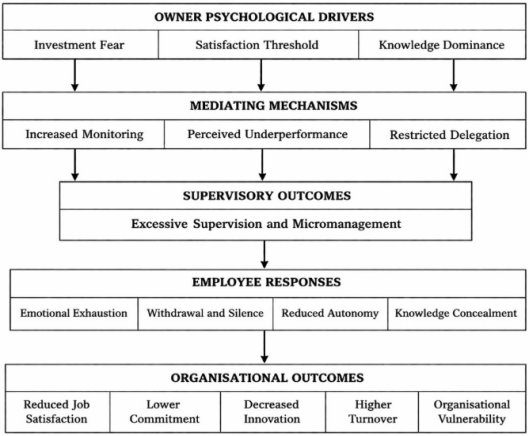
Investment Fear and Supervisory Pressure was hypothesised to predict supervisory pressure because heightened anxiety logically increases monitoring and control. Owners who perceive a greater risk of losing personal and financial investment are more likely to closely monitor work, intervene frequently, and impose strict performance expectations. Because the organisation represents both a professional achievement and a personal stake, owners perceive any potential loss as a direct threat to their resources, time, and effort. This insecurity motivates them to closely monitor employees, implement strict controls, and frequently intervene in daily operations, even when the employees are competent and performing effectively. The intensity of this behaviour is proportional to the owner’s perceived vulnerability, making ownership insecurity a primary driver of excessive supervision. This proposition highlights the causal link between perceived personal risk and the intensity of oversight, suggesting that protective behaviours are driven primarily by psychological concerns rather than by objective measures of employee performance.
2.9.2. Proposition 2: Satisfaction Threshold and Perceived Employee Underperformance
Satisfaction Threshold was linked to perceived underperformance, as unrealistic benchmarks inevitably produce dissatisfaction regardless of actual employee output. Unrealistic Satisfaction Thresholds increase the likelihood that owners perceive employees as underperforming, even when actual performance is adequate. Owners who measure employee output against their own past effort and sacrifice are more likely to experience dissatisfaction, which in turn prompts additional demands and corrective interventions. This proposition emphasises that managerial pressure in private enterprises is often rooted in subjective benchmarks rather than measurable deficiencies. Consequently, even optimal employee performance may fail to meet the owner’s internal expectations. This assumption highlights that managerial pressure is often a product of subjective perception rather than objective measures of employee capability, which helps explain why supervision remains high despite actual performance.
2.9.3. Proposition 3: Knowledge Dominance and Employee Autonomy
Knowledge Dominance was connected to reduced autonomy, since owners who believe they hold superior knowledge are less likely to delegate. Owners who consider themselves the primary source of organisational knowledge are more likely to restrict delegation, intervene frequently, and undervalue employee contributions. This proposition explains why capable employees may experience micromanagement and constrained decision-making opportunities in private sector workplaces.
Figure 1. A flow chart illustrating these relationships.
2.9.4. Proposition 4: Combined Effect on Organisational Vulnerability
The combined effect of all three constructs was theorised to predict organisational vulnerability, as persistent high pressure management undermines employee morale, increases turnover, and reduces resilience. The interaction of these three concepts results in persistent high-pressure management, excessive supervision, and limited employee empowerment, which can lead to stress, burnout, turnover, and reduced organisational resilience. This proposition illustrates how owner-driven behaviours may inadvertently undermine organisational stability even when employees are competent and committed. These propositions were grounded in prior empirical findings on stress, governance, and supervision in SMEs
| [10] | Sridadi, A. R., Admojo, R. T. C. (2022). Himmawan, M. F. and Fuciu, M. The effect of abusive supervision on employee silence with the mediation role of emotional exhaustion and moderate leader-member exchange. BISMA (Bisnis dan Manajemen), 15(1), pp. 78–95.
https://doi.org/10.26740/bisma.v15n1.p78-95 |
| [12] | Qiu, A., Li, Z., Choi, M., & Kim, H. E. (2025). Abusive supervision and counterproductive work behaviours under generational differences: A chain mediation model between perception of organizational politics and defensive silence. Frontiers in Psychology. |
| [30] | Neneh, B. N. (2024). Why peer support matters: Entrepreneurial stressors, emotional exhaustion, and growth intentions of women entrepreneurs. International Journal of Entrepreneurial Behavior & Research.
https://doi.org/10.1108/IJEBR-ERJ-14-3-0501 |
| [33] | Enăchescu, V.-A. (2025). The psychological determinants of financial decision-making in SMEs: An empirical analysis of cognitive biases and risk perception. Revista de Studii Financiare, 10(19), 126–138.
https://doi.org/10.55654/jfs.2025.10.19.07 |
| [41] | Uy, M. A. & Foo, M-D & Song, Z. (2013). Joint effects of prior start-up experience and coping strategies on entrepreneurs’ psychological well-being," Journal of Business Venturing, 28(5), 583-597 https://doi.org/10.1016/j.jbusvent.2012.04.003 |
[10, 12, 30, 33, 41]
, ensuring that the theory is both conceptually rigorous and empirically plausible. Theory O translates the relationships between Investment Fear, Satisfaction Threshold, and Knowledge Dominance into testable theoretical propositions. These propositions provide a framework for empirically examining how owner psychology drives supervisory behaviour and affects organisational outcomes in private-sector workplaces. Unlike public sector organisations, which have broader financial backing, formal procedures, and distributed accountability, private enterprises rely heavily on the owner’s investment, decisions, and personal effort.
2.10. Boundary Conditions
2.10.1. Applicable Contexts
Theory O is most relevant to privately owned firms, particularly those established and led by a single individual or a small group of founders. It is particularly applicable to small- and medium-sized enterprises (SMEs) in which the organisation’s survival and success depend heavily on the owner’s personal investment, decisions, and effort. Founder-led businesses in sectors such as education, healthcare, and corporate services are prime examples, as these contexts often exhibit intense supervisory behaviours and high owner-driven pressure. In these settings, employees are critical to achieving organisational goals, yet the owner’s perceptions of risk, satisfaction, and knowledge dominance strongly influence management style and workplace dynamics.
2.10.2. Non-Applicable Contexts
Theory O does not fully apply to public or government organisations, where supervision is structured, standardised, and supported by institutional procedures rather than the personal investment of individual leaders. Similarly, large corporations with dispersed ownership or strong corporate governance mechanisms are less likely to exhibit patterns of intense owner-driven oversight, as decision-making is distributed and accountability is formalised. Firms with robust institutional governance, including internal controls, performance evaluation systems, and employee empowerment policies, are also less susceptible to the psychological drivers outlined in Theory O. In these contexts, supervision and pressure are generally guided by organisational rules and objective performance metrics rather than the owner’s perceptions and insecurities. Theory O clarifies that its explanatory power is strongest in private enterprises where owner psychology dominates managerial behaviour.





 Share This Article
 Twitter
 Linked In
 Facebook
 Copy
Copy Download