
 ,
Albert Yemba Baruani Ahuka*,
Mathieu Masudi Saburi,
Richard Kabuyanga Kabuseba
,
Albert Yemba Baruani Ahuka*,
Mathieu Masudi Saburi,
Richard Kabuyanga Kabuseba
Background: Imperforate hymen is a rare congenital anomaly of the female genital tract. It is often diagnosed in adolescence due to symptoms related to hematocolpos. However, it can present in the neonatal period with significant hydrocolpos, which can lead to abdominal distension and other complications. Case Presentation: We report a case of a newborn female presenting with significant hydrocolpos due to an imperforate hymen. The infant was born at term through vaginal delivery with no complications during pregnancy. On physical examination shortly after birth, the infant exhibited marked abdominal distension. Ultrasound examination revealed a large cystic mass in the pelvic region consistent with hydrocolpos. Diagnosis and Management: The diagnosis of imperforate hymen was confirmed through a thorough physical examination. A small bulging membrane was observed at the introitus, and subsequent imaging supported the diagnosis. A hymenotomy was performed under general anesthesia, and approximately 50mL of milky fluid was drained from the vaginal canal. The infant's recovery was uneventful, and follow-up examinations showed no recurrence of symptoms. Discussion: This case underscores the importance of considering imperforate hymen in the differential diagnosis of a newborn with abdominal distension. Early recognition and prompt surgical intervention are crucial to prevent complications such as urinary obstruction, infection, and potential damage to the reproductive organs. Neonatal hydrocolpos due to imperforate hymen is rare but should be recognized as a possible etiology in similar presentations. Conclusion: Imperforate hymen with significant hydrocolpos can present in the neonatal period. Early diagnosis and surgical management are essential for a favorable outcome. This case highlights the need for awareness among clinicians regarding this rare but treatable condition.
| Published in | American Journal of Medical Science and Technology (Volume 1, Issue 1) |
| DOI | 10.11648/j.ajmst.20250101.13 |
| Page(s) | 14-17 |
| Creative Commons |
This is an Open Access article, distributed under the terms of the Creative Commons Attribution 4.0 International License (http://creativecommons.org/licenses/by/4.0/), which permits unrestricted use, distribution and reproduction in any medium or format, provided the original work is properly cited. |
| Copyright |
Copyright © The Author(s), 2025. Published by Science Publishing Group |
Hydrocolpos, Goma, DRC
CIMAK | Clinique Internationale de Médecine Avancée au Kivu |
DRC | Democratic Republic of Congo |
| [1] | Lausten-Thomsen MJ, Mogensen H. Hymen imperforatus with atypical symptom presentation. Ugeskrift for laeger. 2007; 169(6): 523-524. |
| [2] | Lardenoije C, Aardenburg R, Mertens H. Imperforate hymen: a cause of abdominal pain in female adolescents. Case Reports. 2009; 2009: bcr0820080722. |
| [3] | Basaran M, Usal D, Aydemir C. Hymen sparing surgery for imperforate hymen: case reports and review of literature. Journal of pediatric and adolescent gynecology. 2009; 22(4): e61-4. |
| [4] | Ayaz UY, Dilli A, Api A. Ultrasonographic diagnosis of congenital hydrometrocolpos in prenatal and newborn period: a case report. Medical ultrasonography. 2011; 13(3): 234-6. |
| [5] | Murthy V, Costalez J, Weiner J, Voos K. Two neonates with congenital hydrocolpos. Case reports in pediatrics. 2013; 2013. |
| [6] | Shah NT, Gandhi M, Valia P. A case report of large hydrometrocolpos in neonate. |
| [7] | Lui CT, Chan TWT, Fung HT, Tang SYH. A retrospective study on imperforate hymen and haematometrocolpos in a regional hospital. Hong Kong Journal of Emergency Medicine. 2010; 17(5): 435-40. |
| [8] | Vitale V, Cigliano B, Vallone G. Imperforate hymen causing congenital hydrometrocolpos. Journal of ultrasound. 2013; 16(1): 37-9. |
| [9] | Bhoil R, Ahluwalia A, Chauhan N. Herlyn werner wunderlich syndrome with hematocolpos: an unusual case report of full diagnostic approach and treatment. International Journal of Fertility & Sterility. 2016; 10(1): 136. |
| [10] | El-Messidi A, Fleming NA. Congenital imperforate hymen and its life-threatening consequences in the neonatal period. Journal of pediatric and adolescent gynecology. 2006; 19(2): 99-103. |
| [11] | Sakalkale R, Samarakkody U. Familial occurrence of imperforate hymen. Journal of pediatric and adolescent gynecology. 2005; 18(6): 427-9. |
| [12] | JASON M, Capelle X, Raquet J, Kridelka F. Le cas clinique du mois hématocolpos: Un diagnostic méconnu d’imperforation hyménéale. Revue Médicale de Liège. 2017; 72(11): 478-80. |
| [13] | Ramphul M, Perry L, Bhatia C. Neonatal imperforate hymen with hydrocolpos. BMJ case reports. 2016; 2016. |
| [14] | Kurdoglu Z, Kurdoglu M, Kucukaydin Z. Spontaneous rupture of the imperforate hymen in an adolescent girl with hematocolpometra. International Scholarly Research Notices. 2011; 2011. |
| [15] | Ramsiss H, Harrak H, Amrani S, Elyoussfi M, Benyahya, Bargach S. Hematocolpos sur Imperforation hyménéale à propos de 3 cas. Global Journal of Medical Research. Volume XV, issue IV, Version I, 2015. |
| [16] | Sidatt M, Ould Sidi Mohamed Wedih A, Ould Boubaccar A, Ould Ely Litime A, Feil A, Ould Moussa A. Hydrocolpos and hydrometrocolpos in newborns. Arch Pediatr 2013; 20: 176-80. |
APA Style
Mulyumba, M. K., Ahuka, A. Y. B., Saburi, M. M., Kabuseba, R. K. (2025). Hymeneal Imperforation with Significant Hydrocolpos at Birth: A Case Report. American Journal of Medical Science and Technology, 1(1), 14-17. https://doi.org/10.11648/j.ajmst.20250101.13
ACS Style
Mulyumba, M. K.; Ahuka, A. Y. B.; Saburi, M. M.; Kabuseba, R. K. Hymeneal Imperforation with Significant Hydrocolpos at Birth: A Case Report. Am. J. Med. Sci. Technol. 2025, 1(1), 14-17. doi: 10.11648/j.ajmst.20250101.13
@article{10.11648/j.ajmst.20250101.13,
  author = {Michel Kyembwa Mulyumba and Albert Yemba Baruani Ahuka and Mathieu Masudi Saburi and Richard Kabuyanga Kabuseba},
  title = {Hymeneal Imperforation with Significant Hydrocolpos at Birth: A Case Report },
  journal = {American Journal of Medical Science and Technology},
  volume = {1},
  number = {1},
  pages = {14-17},
  doi = {10.11648/j.ajmst.20250101.13},
  url = {https://doi.org/10.11648/j.ajmst.20250101.13},
  eprint = {https://article.sciencepublishinggroup.com/pdf/10.11648.j.ajmst.20250101.13},
  abstract = {Background: Imperforate hymen is a rare congenital anomaly of the female genital tract. It is often diagnosed in adolescence due to symptoms related to hematocolpos. However, it can present in the neonatal period with significant hydrocolpos, which can lead to abdominal distension and other complications. Case Presentation: We report a case of a newborn female presenting with significant hydrocolpos due to an imperforate hymen. The infant was born at term through vaginal delivery with no complications during pregnancy. On physical examination shortly after birth, the infant exhibited marked abdominal distension. Ultrasound examination revealed a large cystic mass in the pelvic region consistent with hydrocolpos. Diagnosis and Management: The diagnosis of imperforate hymen was confirmed through a thorough physical examination. A small bulging membrane was observed at the introitus, and subsequent imaging supported the diagnosis. A hymenotomy was performed under general anesthesia, and approximately 50mL of milky fluid was drained from the vaginal canal. The infant's recovery was uneventful, and follow-up examinations showed no recurrence of symptoms. Discussion: This case underscores the importance of considering imperforate hymen in the differential diagnosis of a newborn with abdominal distension. Early recognition and prompt surgical intervention are crucial to prevent complications such as urinary obstruction, infection, and potential damage to the reproductive organs. Neonatal hydrocolpos due to imperforate hymen is rare but should be recognized as a possible etiology in similar presentations. Conclusion: Imperforate hymen with significant hydrocolpos can present in the neonatal period. Early diagnosis and surgical management are essential for a favorable outcome. This case highlights the need for awareness among clinicians regarding this rare but treatable condition.},
 year = {2025}
}
TY  - JOUR
T1  - Hymeneal Imperforation with Significant Hydrocolpos at Birth: A Case Report
AU  - Michel Kyembwa Mulyumba
AU  - Albert Yemba Baruani Ahuka
AU  - Mathieu Masudi Saburi
AU  - Richard Kabuyanga Kabuseba
Y1  - 2025/12/24
PY  - 2025
N1  - https://doi.org/10.11648/j.ajmst.20250101.13
DO  - 10.11648/j.ajmst.20250101.13
T2  - American Journal of Medical Science and Technology
JF  - American Journal of Medical Science and Technology
JO  - American Journal of Medical Science and Technology
SP  - 14
EP  - 17
PB  - Science Publishing Group
UR  - https://doi.org/10.11648/j.ajmst.20250101.13
AB  - Background: Imperforate hymen is a rare congenital anomaly of the female genital tract. It is often diagnosed in adolescence due to symptoms related to hematocolpos. However, it can present in the neonatal period with significant hydrocolpos, which can lead to abdominal distension and other complications. Case Presentation: We report a case of a newborn female presenting with significant hydrocolpos due to an imperforate hymen. The infant was born at term through vaginal delivery with no complications during pregnancy. On physical examination shortly after birth, the infant exhibited marked abdominal distension. Ultrasound examination revealed a large cystic mass in the pelvic region consistent with hydrocolpos. Diagnosis and Management: The diagnosis of imperforate hymen was confirmed through a thorough physical examination. A small bulging membrane was observed at the introitus, and subsequent imaging supported the diagnosis. A hymenotomy was performed under general anesthesia, and approximately 50mL of milky fluid was drained from the vaginal canal. The infant's recovery was uneventful, and follow-up examinations showed no recurrence of symptoms. Discussion: This case underscores the importance of considering imperforate hymen in the differential diagnosis of a newborn with abdominal distension. Early recognition and prompt surgical intervention are crucial to prevent complications such as urinary obstruction, infection, and potential damage to the reproductive organs. Neonatal hydrocolpos due to imperforate hymen is rare but should be recognized as a possible etiology in similar presentations. Conclusion: Imperforate hymen with significant hydrocolpos can present in the neonatal period. Early diagnosis and surgical management are essential for a favorable outcome. This case highlights the need for awareness among clinicians regarding this rare but treatable condition.
VL  - 1
IS  - 1
ER  -
Department of Obstetrics and Gynecology, University of Goma, Goma, Democratic Republic of Congo;Department of Obstetrics and Gynecology, North Kivu General Hospital, Goma, Democratic Republic of Congo
Department of Obstetrics and Gynecology, University of Goma, Goma, Democratic Republic of Congo;Department of Obstetrics and Gynecology, Clinique Internationale de Medecine Avancee au Kivu (CIMAK), Goma, Democratic Republic of Congo
Department of Obstetrics and Gynecology, University of Goma, Goma, Democratic Republic of Congo;Department of Obstetrics and Gynecology, North Kivu General Hospital, Goma, Democratic Republic of Congo
Department of Obstetrics and Gynecology, University of Goma, Goma, Democratic Republic of Congo;Department of Obstetrics and Gynecology, North Kivu General Hospital, Goma, Democratic Republic of Congo
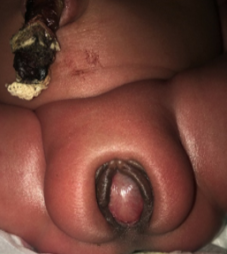
Figure 1. Preoperative appearance of imperforate hymen and vulvar edema (Preoperative aspect).
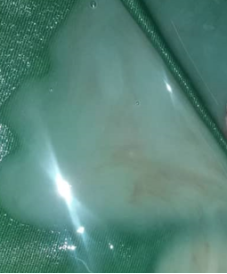
Figure 2. Drained fluid with a milky appearance (per operative appearance).
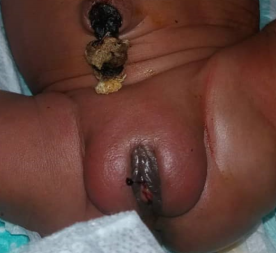
Figure 3. Vulva after hymenotomy and drainage (Immediate postoperative appearance).
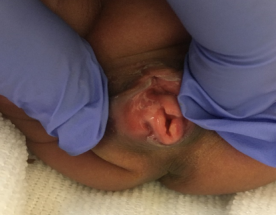
Figure 4. Vaginal orifice one-month post-operation.

Information


 Share This Article
 Twitter
 Linked In
 Facebook
 Copy
Copy Download