Abstract
Low pasture productivity and poor forage quality remain major constraints to smallholder dairy production in Tanzania, particularly during the dry season, when feed shortages reduce milk yield and animal performance. Although farmer training is widely promoted to improve pasture management, empirical evidence linking training to measurable improvements in pasture productivity and forage quality under field conditions remains limited. This study evaluated the effects of structured pasture management training on pasture productivity and forage nutritive value among smallholder dairy farmers in Muheza District, Tanzania. A comparative cross-sectional design was employed, using eighteen representative pasture plots selected from trained (n=9) and untrained (n=9) farmers. Forage samples were collected during the dry and wet seasons and analysed for biomass yield, dry matter, crude protein, crude fibre, ether extract, ash, neutral detergent fibre, acid detergent fibre, and total digestible nutrients using proximate analysis and ANKOM technology. Data were analysed using descriptive statistics, independent sample t-tests, and multivariate analysis of variance (MANOVA). The results showed that trained farmers produced significantly higher forage biomass (7.28 vs 6.32 t DM ha-1; p < 0.001) and recorded significantly greater crude protein, total digestible nutrients, ether extract, and ash contents than untrained farmers. Training, season, and farm size were identified as significant factors influencing pasture productivity and forage nutritive value, whereas sex had no significant effect. The findings demonstrate that structured farmer training promotes the adoption of improved pasture management practices, resulting in higher forage yield and enhanced nutritional quality. The study concludes that strengthening pasture-focused training and extension programmes can substantially improve feed availability, livestock productivity, and the sustainability of smallholder dairy production systems in Tanzania and similar tropical environments.
|
Published in
|
Animal and Veterinary Sciences (Volume 14, Issue 4)
|
|
DOI
|
10.11648/j.avs.20261404.14
|
|
Page(s)
|
120-128 |
|
Creative Commons
|

This is an Open Access article, distributed under the terms of the Creative Commons Attribution 4.0 International License (http://creativecommons.org/licenses/by/4.0/), which permits unrestricted use, distribution and reproduction in any medium or format, provided the original work is properly cited.
|
|
Copyright
|
Copyright © The Author(s), 2026. Published by Science Publishing Group
|
Keywords
Training, Pasture Management, Smallholder Dairy Production Systems, Forage Quality, Biomass, Farmer Training
1. Introduction
Dairy farming plays a fundamental role in improving food security, nutrition, employment, and household income across sub-Saharan Africa. In Tanzania, Smallholder dairy farmers contribute substantially to national milk production and to rural livelihoods; however, productivity remains constrained by inadequate feed resources, poor pasture management, and seasonal feed shortages
| [1] | Ndah, H. T., Schuler, J., Nkwain, V. N., Nzogela, B., Mangesho, W., Mollel, R., Loina, R., Zander, P., & Paul, B. K. (2022). Determinants for smallholder farmers' adoption of improved forages in dairy production systems: The case of Tanga Region, Tanzania. Agronomy, 12(2), 305.
https://doi.org/10.3390/agronomy12020305 |
[1]
. Feed shortages and low-quality forage are major limits on dairy production in smallholder systems across East Africa. During the dry season, natural pastures often produce little biomass and contain too little crude protein, which leads to lower milk output, poor reproduction, and reduced farm profits
| [2] | Mukasafari, M. A., Mpatswenumugabo, J. P., Mutimura, M., Ndahetuye, J. B., et al. (2026). Feed resources, feeding practices, and milk production at smallholder dairy farms in East African countries: A systematic review. Scientific African, 31, e03283. https://doi.org/10.1016/j.sciaf.2026.e03283 |
[2]
.
Recent studies have demonstrated that improved pasture management practices, including rotational grazing, improved forage establishment, fertiliser application, forage conservation, and proper grazing management, significantly increase forage biomass, crude protein concentration, and livestock productivity while improving environmental sustainability
| [3] | Mteta, S. K., Maleko, D. D., & Massawe, B. H. (2022). Selected soil properties and small-holder dairy farmers' perceptions on improved forage varieties in the Southern Highlands of Tanzania. African Journal of Agricultural Research, 18(10), 887–897. https://doi.org/10.5897/AJAR2022.16147 |
[3]
.
Farmer training has become an important strategy for promoting the adoption of improved pasture technologies. Training enhances farmers’ technical knowledge, decision-making capacity, and confidence to adopt innovations such as improved forage species, rotational grazing, forage conservation, and integrated soil fertility management. Nevertheless, adoption remains constrained by institutional, socioeconomic, and market-related factors
| [1] | Ndah, H. T., Schuler, J., Nkwain, V. N., Nzogela, B., Mangesho, W., Mollel, R., Loina, R., Zander, P., & Paul, B. K. (2022). Determinants for smallholder farmers' adoption of improved forages in dairy production systems: The case of Tanga Region, Tanzania. Agronomy, 12(2), 305.
https://doi.org/10.3390/agronomy12020305 |
[1]
.
Although several studies have investigated the adoption of improved forage technologies in Tanzania and East Africa, relatively few have quantified the direct effects of structured farmer training on pasture biomass production and forage nutritive value under field conditions. Most previous studies have focused on technology adoption, farmer perceptions, or socioeconomic determinants rather than objective measurements of pasture productivity and nutritional quality. Consequently, empirical evidence linking farmer training with measurable improvements in forage quantity and quality remains limited, particularly within smallholder dairy production systems in northeastern Tanzania
| [4] | Nyawira, S. S., Mwendia, S. W., Mwema, E., Gonzalez-Quintero, R., Nzogela, B., Sila, A., Mwilawa, A., Kizima, J., Paul, B. K., & Notenbaert, A. (2025). Forage crops boost the productivity and environmental sustainability of dairy farmers in southern Tanzania. Agriculture, Ecosystems & Environment, 389, 109649. https://doi.org/10.1016/j.agee.2025.109649 |
[4]
.
Evaluating the effectiveness of pasture management training is essential for guiding extension programs, informing livestock development policies, and supporting investments aimed at improving feed security and dairy productivity. Evidence generated from evaluations can assist policymakers and development partners in designing sustainable interventions that enhance livestock productivity while strengthening farmers’ resilience to climate variability
| [5] | Mugizi, F. M. P. (2025). Extension advice, agricultural productivity, and food security in Tanzania. Food and Energy Security, 14(1), e70047. https://doi.org/10.1002/fes3.70047 |
| [6] | Kitole, F. A. (2025). Impact of dairy farming extension programs on smallholder livestock keepers' welfare among Maasai communities in Arusha, Tanzania. Preventive Veterinary Medicine, 239, 106511.
https://doi.org/10.1016/j.prevetmed.2025.106511 |
[5, 6]
.
Smallholder dairy farmers in Muheza District have received structured training through the Maziwa Faida Project, an initiative funded by the Irish Embassy in Tanzania and jointly implemented by the Tanzania Livestock Research Institute (TALIRI) and the Livestock Training Agency (LITA). The project aims to improve the livelihoods of smallholder dairy farmers by addressing key production constraints, particularly the limited availability of quality livestock feeds. As a part of this initiative, pasture management training is delivered through classroom instruction, practical field demonstrations, and on-farm follow-up support provided by LITA instructors and livestock extension officers. Training covers land preparation, selection of improved forage species, pasture establishment, fertiliser and manure application, irrigation, weed control, rotational grazing, forage harvesting, hay and silage making, forage storage, and efficient forage utilisation.
Since the project’s inception, 1263 smallholder dairy farmers have completed the structured pasture management and forage conservation training program. In the present study, trained farmers were defined as those who had completed this structured training program, whereas untrained farmers were those who had not received any formal training in pasture production, management, or forage conservation practices.
Therefore, this study aimed to evaluate the impact of farmer training on pasture productivity and forage nutritive value among smallholder dairy farmers in Muheza District, Tanzania. In this study, pasture productivity refers to the quantity of usable forage biomass produced per unit area, expressed as tonnes of dry matter per hectare (tDMha
-1). Pasture quality refers to the nutritional value of forage and was assessed using crude protein (CP), crude fibre (CF), neutral detergent fibre (NDF), Acid detergent fibre (ADF), and total digestible nutrients (TDN)
| [7] | Boval, M., & Dixon, R. M. (2023). The importance of fibre measurements in tropical forages for ruminant nutrition: A review. Animals, 13, 1488.
https://doi.org/10.3390/ani13091488 |
| [8] | Islam, M. R., Garcia, S. C., Islam, M. A., Bashar, M. K., Roy, A., Roy, B. K., Sarker, N. R., & Clark, C. E. F. (2024). Ruminant production from Napier grass (Pennisetum purpureum Schum): A review. Animals, 14(3), 467.
https://doi.org/10.3390/ani14030467 |
[7, 8]
. The central research question that guided the study was: How does the training in pasture management and forage conservation impact pasture productivity and quality (nutritive value)? Therefore, understanding the context in which training influences these parameters is critical for guiding agricultural development policies and programs, especially in areas affected by feed scarcity and pasture degradation.
1.1. Theoretical Framework
The study was guided by “Diffusion of Innovations Theory (DIT)” by
. The DIT explains, step by step, how innovations (defined here as new or improved ideas, methods, or practices adopted to improve outcomes, in this case, sustainable forage production) are adopted over time by individuals within a social system
| [10] | Hoffmann, V. (2011). Knowledge and Innovation Management A 7020. 1–168. |
[10]
. According to the theory, five factors influence adoption: relative advantage, compatibility, complexity, trialability, and observability. Therefore, training enables farmers to recognize the relative advantage of improved practices, such as increased biomass yield and forage quality, making them more appealing than traditional methods.
Furthermore, the pasture management practices on which smallholder dairy farmers were be trained are compatible with their goals of enhancing livestock productivity and income, hence, the likelihood of increasing their acceptability. Moreover, training reduces the complexity of new techniques by providing clear practical guidance, which builds farmers’ confidence to adopt them. In addition, through trialability, farmers can experiment on a small scale, testing practices like rotational grazing or fertilization before full adoption. Lastly, the observability of results as visibly healthier pastures and higher milk yield among trained farmers, motivates others in the community to follow suit. Together, these factors explain the positive influence of training on the adoption of pasture innovations in Muheza District, boosting productivity and forage quality. In contrast, untrained farmers may lack both the knowledge and confidence to implement such innovations effectively.
1.2. Conceptual Framework
The Study’s conceptual framework (
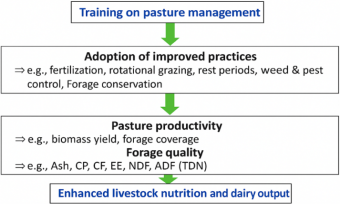
Figure 1) illustrates the relationship between training and pasture productivity among smallholder dairy farmers. Generally, training acts as the main independent variable, influencing the adoption of improved pasture management practices such as fertilizer application, rotational grazing, and weed control. These practices in turn, affect key dependent variables: forage biomass and nutritive quality indicators such as crude protein (CP), total digestible nutrients (TDN), ether extract (EE), neutral detergent fiber (NDF), acid detergent fiber (ADF), and ash content. The framework presents linear flow where training leads to better practices, which in turn improve pasture productivity and quality.
Figure 1. Conceptual framework for the effects of training on smallholder pasture productivity.
2. Material and Methodology
2.1. Description of the Study Area
The study was conducted in Muheza District, in Tanga Region, Tanzania. 5°12′25.56″S 38°44′12.48″E. The district was purposefully selected for the study because it was the primary implementation area of the Maziwa Faida (Milk for Profit) Project, where a large number of smallholder dairy farmers had received structured training on pasture management and forage conservation through the Livestock Training Agency (LITA) and the Tanzania Livestock Research Institute (TALIRI). Focusing on a single district ensured that trained and untrained farmers were exposed to similar agroecological and socioeconomic conditions, thereby reducing agroecological variability and potential confounding factors, enabling a more reliable assessment of the effects of the training programme.
2.2. Research Design
The study adopted a cross-sectional design because it enabled the comparison of pasture productivity and forage quality between trained and untrained farmers at a single point in time under comparable field conditions
| [11] | Hunziker, S., Blankenagel, M., & Wiesbaden, S. F. (2021). Research Design in Business and Management: A Practical Guide for Students and Researchers. Springer Fachmedien Wiesbaden GmbH. https://books.google.co.tz/books?id=mztszgEACAAJ |
| [12] | Kopechek, K., Langston, D. M., Kleinguetl, C., Posid, T., & Knudsen, B. E. (2024). Cross-sectional study: Design, measures, and classic examples. In Translational Urology: Handbook for Designing and Conducting Clinical and Translational Research (pp. 153–157). Elsevier.
https://doi.org/10.1016/B978-0-323-90186-4.00014-6 |
[11, 12].
2.3. Sampling Technique and Sample Size
Although the MaziwaFaida project targeted 3,000 smallholder dairy farmers in the district, only 210 were selected as the accessible study population due to their prior involvement in the structured survey. Nassiuma’s sampling (2000) formula (
1) was then applied to this relevant subset to ensure statistically reliable sample size selection within a manageable logistical constraint
.
Where: n= sample size, N= population size (210 farmers), C= Coefficient of variation (0.22, within the recommended range of 21-30%) and =standard error (0.05) as suggested by
| [14] | Cholo, W., Thiga, Mumbi, L., & Wilberforce, C. (2017). An assessment of open defecation among residents of Thika East Sub-County, Kiambu County, Kenya. International Journal of Medicine Research, 2(3), 2455–7404.
https://www.researchgate.net/publication/329443467 |
[14]
.
Substituting into the formula:
Eighteen pasture plots (one representative plot per farmer) were randomly selected for the laboratory component of the study from the accessible population of 210 farmers. The selection enabled detailed analyses of biomass and forage quality while ensuring representation of both trained and untrained farmer groups under comparable management conditions. Three forage species, which are commonly used in Muheza District: Elephant grass (Pennisetum purpureum), Guatemala grass (Tripsacum laxum), and Congo grass (Brachiaria ruziziensis) were studied across these plots, with samples taken from 9 trained and 9 untrained farmer groups. Five subsamples per plot were collected using 0.25 m2 quadrants to ensure reliability.
2.4. Data Collection
To assess forage biomass and nutritive value, pasture samples were collected from nine trained and untrained smallholder dairy farmers’ plots. Sample collection and laboratory analysis of forage nutritive value were done twice, i.e., at the end of the short dry season (February) and long wet season (May). During sample collection, a single linear transect was allocated to each pasture plot, and five (5) times 0.25 m
2 quadrant was randomly thrown behind to minimise bias. All the forage within a quadrant was cut at a height of 4 cm and collected in paper bags, and then the fresh weight of each was measured in the plot using a scale. Forage samples were transported to the laboratory at the Tanzania Livestock Research Institute (TALIRI)-Tanga Centre for analysis of nutritional values such as biomass, mineral content (ash), crude protein (CP), dietary crude fiber (CF), ether extract (EE), neutral detergent fiber (NDF), acid detergent fiber (ADF), and total digestible nutrients (TDN) as per
| [8] | Islam, M. R., Garcia, S. C., Islam, M. A., Bashar, M. K., Roy, A., Roy, B. K., Sarker, N. R., & Clark, C. E. F. (2024). Ruminant production from Napier grass (Pennisetum purpureum Schum): A review. Animals, 14(3), 467.
https://doi.org/10.3390/ani14030467 |
| [15] | Jayasinghe, P., Ramilan, T., Donaghy, D. J., Pembleton, K. G., & Barber, D. G. (2022). Comparison of nutritive values of tropical pasture species grown in different environments, and implications for livestock methane production: A meta-analysis. Animals, 12(14), 1806. https://doi.org/10.3390/ani12141806 |
[8, 15]
using Proximate analysis and ANKOM technology.
2.5. Methodology for Data Analysis
Before analysis, data were checked for normality using the Shapiro-Wilk test and homogeneity of variances using Levene’s test. MANOVA assumptions, including multivariate normality and equality of covariance matrices, were assessed using Box’s M test. Although the laboratory component involved only 18 pasture plots, MANOVA was considered appropriate because multiple correlated pasture productivity and nutritive quality variables were analysed simultaneously. In addition, the assumptions of multivariate normality, homogeneity of variances, and equality of covariance matrices were assessed and satisfied before the analysis, supporting the validity of the statistical approach.
Data analysis was performed using R software, version 4.5.0, to compare pasture productivity between trained and untrained smallholder dairy farmers in Muheza district across the dry and wet seasons. Key parameters analysed included dry matter, biomass, mineral contents (Ash), digestible crude protein (CP), digestible ether extract (EE), digestible crude fibre (CF), total digestible nutrients (TDN), neutral detergent fibre (NDF), and acid detergent fibre (ADF). Descriptive statistics were computed to determine the minimum, maximum, mean, median, and standard deviation for each parameter. Independent sample t-tests were conducted to assess the significant differences in mean values of related pasture productivity parameters between the two groups and across seasons. Furthermore, Multivariate Analysis of Variance (MANOVA) was used to determine the combined influence of training and sociodemographic factors on various dependent variables related to pasture productivity and quality.
Model equations used:
For an independent sample t-test
Model:t=-÷(s12/n +s22/n).(2)
Where: and were the mean values of two groups (trained and untrained), s1 and s2 were the variances of two groups (trained and untrained), and n is the sample size of the two groups.
For General MANOVA
Where: Y = Matrix of dependent variables (e.g., biomass, ash, CP, TDN, etc.),
X = matrix of independent variables (e.g., training status, sex, season, household size, farm size, income. B = matrix of coefficients of independent variables and ε = the error term.
3. Result and Discussion
3.1. Comparison of Pasture Productivity and Quality Between Trained and Untrained Smallholder Dairy Farmers
Table 1 presents a comparative overview (including descriptive statistics and t-tests) of pasture performance between trained and untrained smallholder dairy farmers in Muheza District. Trained farmers achieved significantly higher biomass yield (7.28±0.4 t DM ha
-1) compared to untrained farmers (6.32±0.43 t DM ha
-1), with these differences being statistically significant (p<0.001, t-value= 6.99). In terms of dry matter (DM) content, untrained farmers had higher (30.07±3.4%) than trained farmers (26.6±3.6%), with these differences statistically significant (p<0.01), possibly due to improved irrigation or timely harvesting practices among trained farmers.
Regarding nutritional quality, trained farmers’ forages had significantly higher crude protein (CP) content (8.08% against 5.84%; p<0.001, t-value= 7.89), total digestible nutrients (TDN) (78.88% against 75.38%; p<0.001), ether extract (EE) (1.69% against 1.54%; p<0.001), and ash (mineral) content (7.28% against 6.32%%; p<0.001). These parameters indicate a superior nutrient profile in pasture managed by trained farmers.
No statistical significance was found in crude fibre (CF), neutral detergent fibre (NDF), or acid detergent fibre (ADF) (p0.05), suggesting that structural fibre composition remained relatively unaffected by training.
Table 1. Comparison of pasture productivity and quality by training status.
Variable | Trained | Untrained | Trained | Untrained | t-value | p-value | Significance |
min | max | min | max | (Mean ± Sd) | (Mean ± Sd) |
Biomass (tDM ha-1) | 6.86 | 8.2 | 5.6 | 7.3 | 7.28 ± 0.4 | 6.32 ± 0.43 | 6.99 | < 0.001 | *** |
%DM (As fed) | 21 | 33 | 26 | 33 | 26.6 ± 3.6 | 30.07 ± 3.4 | -2.98 | 0.0052 | ** |
Ash (%) | 6.86 | 8.2 | 5.6 | 7.3 | 7.28 ± 0.4 | 6.32 ± 0.43 | 6.99 | < 0.001 | *** |
CP (%) | 6.83 | 8.99 | 4.7 | 8.4 | 8.08 ± 0.6 | 5.84 ± 1.05 | 7.89 | < 0.001 | *** |
EE (%) | 1.61 | 2.06 | 1.4 | 1.7 | 1.69 ± 0.1 | 1.54 ± 0.06 | 4.82 | < 0.001 | *** |
TDN (%) | 76.4 | 81.1 | 71 | 80 | 78.8 ± 1.4 | 75.38 ± 2.6 | 4.99 | < 0.001 | *** |
CF (%) | 30.9 | 36.6 | 30 | 38 | 32.8 ± 1.6 | 32.11 ± 2.1 | 1.14 | 0.2612 | |
NDF (%) | 49 | 69.9 | 51 | 71 | 58.1 ± 8.8 | 59.54 ± 7.2 | -0.55 | 0.5841 | |
ADF (%) | 24.2 | 37.9 | 27 | 40 | 30.4 ± 4.6 | 32.79 ± 4.5 | -1.59 | 0.1213 | |
3.2. Comparison of Forage Species Between Trained and Untrained Smallholder Dairy Farmers
The study’s results, in
Table 2, show that all three forage species: Guatemala, Elephant and Congo grasses recorded significantly higher biomass yields under trained farmers compared to their untrained counterparts. For instance, Congo grass had yields of 7.38 t DM ha
-1 under trained management versus 6.05 t DM ha
-1 for untrained farms (P<0.001). Elephant grass and Guatemala grass also showed significant yield differences (p<0.01) and (p<0.001), respectively, indicating a positive influence on biomass accumulation.
In terms of nutritional quality, trained farmers’ forage consistently had higher crude protein (CP) content. For example, Elephant grass showed 8.15% CP versus 5.25% CP for untrained farmers (p<0.001), while Congo and Guatemala grasses also recorded significantly higher CP under trained farmers (p<0.001 and p<0.01, respectively).
Acid detergent fibre (ADF) was significantly lower in Elephant grass managed by trained farmers (29.21% against 34.00%; p<0.05), indicating better digestibility. However, no significant differences were found in neutral detergent fiber across all species (p values >0.4). Lastly, ash content, representing mineral availability, was significantly higher across all three forage species on trained plots (p <0.01 to p<0.001), reflecting better soil management practices.
Table 2. Comparison by forage species between trained and untrained smallholder dairy farmers.
Variables | Grass | Mean | df | t-value | p-value | Sig. |
Trained | Untrained |
Biomass | Guatemala | 6.97 | 6.40 | 6.09 | 4.96 | < 0.001 | *** |
| Elephant | 7.48 | 6.52 | 9.85 | 3.95 | < 0.01 | ** |
| Congo | 7.38 | 6.05 | 9.97 | 5.22 | < 0.001 | *** |
ADF | Guatemala | 31.67 | 32.90 | 10 | -0.37 | 0.7215 | |
| Elephant | 29.21 | 34.00 | 6.17 | -2.49 | < 0.05 | * |
| Congo | 30.30 | 31.46 | 8.80 | -0.44 | 0.6703 | |
NDF | Guatemala | 60.46 | 60.78 | -0.06 | 10 | 0.9542 | |
| Elephant | 59.69 | 61.04 | 8.07 | -0.27 | 0.7910 | |
| Congo | 54.03 | 56.80 | 9.97 | -0.81 | 0.4352 | |
Minerals | Guatemala | 6.97 | 6.40 | 6.09 | 4.96 | < 0.01 | ** |
| Elephant | 7.48 | 6.52 | 9.85 | 3.95 | < 0.01 | ** |
| Congo | 7.38 | 6.05 | 9.97 | 5.22 | < 0.001 | *** |
Crude protein | Guatemala | 8.44 | 7.16 | 9.83 | 3.53 | < 0.01 | ** |
| Elephant | 8.15 | 5.25 | 7.99 | 11.31 | < 0.001 | *** |
| Congo | 7.65 | 5.11 | 6.51 | 13.21 | < 0.001 | *** |
3.3. Multivariate Analysis of Pasture Productivity and Quality
Multivariate analysis of variance (MANOVA) (
Table 3) revealed that training, season, and farm size significantly affected pasture productivity and nutritive quality. Training and season both were highly significant (p <0.001), while farm size had a significant but lesser effect (p<0.01). Household size and income levels showed marginal significance (p <0.1), and sex had no statistically significant influence.
These findings indicate that training and seasonal dynamics play a dominant role in shaping pasture outcomes, with landholding size also influencing the level of benefit realised.
Table 3. Multivariate tests on biomass, digestible crude protein, total digestible nutrients, mineral contents, and DM as fed.
Characteristic | Df | Test stat | F-value | Num Df | Den Df | Pr(>F) | |
Training | 1 | 0.7773 | 15.3559 | 5 | 22 | < 0.001 | *** |
Season | 1 | 0.8720 | 29.9666 | 5 | 22 | < 0.001 | *** |
Sex | 1 | 0.1485 | 0.7672 | 5 | 22 | 0.5833 | |
Household size | 2 | 0.5606 | 1.7917 | 10 | 46 | 0.0891 | . |
Farm size levels | 2 | 0.8217 | 3.2076 | 10 | 46 | < 0.01 | ** |
Income levels | 2 | 0.5783 | 1.8712 | 10 | 46 | 0.0744 | . |
4. Discussion
This study demonstrates that structured pasture management training substantially improved forage biomass production and nutritive value among smallholder dairy farmers in Muheza District. Rather than simply increasing farmers’ knowledge, the training appears to have enhanced the implementation of improved agronomic practices such as timely planting and harvesting, appropriate fertiliser and manure application, rotational grazing, weed control and improved forage management. These practices collectively improve pasture establishment, nutrient uptake, and herbage accumulation, resulting in greater biomass production. Similar findings were reported by Ndah
| [1] | Ndah, H. T., Schuler, J., Nkwain, V. N., Nzogela, B., Mangesho, W., Mollel, R., Loina, R., Zander, P., & Paul, B. K. (2022). Determinants for smallholder farmers' adoption of improved forages in dairy production systems: The case of Tanga Region, Tanzania. Agronomy, 12(2), 305.
https://doi.org/10.3390/agronomy12020305 |
[1]
, who showed that farmer training, institutional support, and access to extension services significantly increased adoption of improved forage technologies among smallholder dairy farmers in Tanga Region, Tanzania, leading to better forage productivity.
The significantly higher crude protein, ether extract, total digestible nutrients, and ash contents observed in forage from trained farmers indicate improved nutritional quality resulting from better pasture management. Adequate crude protein is essential for maintaining rumen microbial activity, feed intake, and milk production, while higher mineral concentrations reflect improved soil fertility management and nutrient cycling. Comparable observations were reported by Mteta
| [3] | Mteta, S. K., Maleko, D. D., & Massawe, B. H. (2022). Selected soil properties and small-holder dairy farmers' perceptions on improved forage varieties in the Southern Highlands of Tanzania. African Journal of Agricultural Research, 18(10), 887–897. https://doi.org/10.5897/AJAR2022.16147 |
[3]
, who found that improved
Pennisetum purpureum cultivars managed under recommended agronomic practices produced higher biomass together with superior nutritional composition suitable for dairy cattle production under Tanzanian conditions.
The consistently higher ash content across all forage species suggests that training encouraged improved soil fertility management through appropriate manure application and other soil improvement practices. Improved soil fertility enhances plant nutrient uptake, resulting in increased mineral accumulation within forage tissues. Similar conclusions were reached by Hays
| [16] | Hays, K. N., Muir, J. P., Kan, E., DeLaune, P. B., Brady, J. A., Obayomi, O., & Mitchell, A. B. (2023). Tillage, manure, and biochar short-term effects on soil characteristics in forage systems. Agronomy, 13(9), 2224.
https://doi.org/10.3390/agronomy13092224 |
[16]
, who demonstrated that manure and biochar amendments significantly improved soil chemical properties and promoted forage growth and quality by enhancing nutrient availability.
Although untrained farmers recorded higher dry matter percentages, this likely reflects more mature forage at harvest rather than better forage quality. As forage plants mature, moisture contents decline while structural carbohydrates increase, reducing digestibility and feeding value. In contrast, trained farmers were more likely to harvest forage at the recommended growth stage, thereby maintaining higher concentrations of digestible nutrients despite lower dry matter content.
The absence of significant differences in neutral detergent fibre and acid detergent fibre for most forage species suggests that structural fibre composition is influenced more strongly by species characteristics and physiological maturity than management alone. Nevertheless, the lower acid detergent fibre observed in elephant grass under trained management indicates improved digestibility resulting from better harvesting practices and plant growth management. Similar conclusions were reported by Chand
| [17] | Chand, S., Indu, Singhal, R. K., & Govindasamy, P. (2022). Agronomical and breeding approaches to improve the nutritional status of forage crops for better livestock productivity. Grass and Forage Science, 77(1), 11–32.
https://doi.org/10.1111/gfs.12557 |
[17]
, who emphasised that improvements in forage nutritive value are achieved through integrating forage genetics with appropriate agronomic management rather than management practices alone.
The multivariate analysis further demonstrated that training, season, and farm size significantly influenced pasture productivity and nutritive quality. Season effects were expected because rainfall, temperature, and soil moisture directly influence forage growth, nutrient accumulation, and biomass production. Comparable findings were reported by Gobena
| [18] | Gobena, G., Urgeb, M., Hundie, D., & Kumsa, D. (2022). Identification and evaluation of agro-ecological variation in dry matter yield and nutritional values of local grasses used as livestock feed in Adola Reedde, Guji Zone, Ethiopia. Journal of Applied Animal Research, 50(1), 369–379.
https://doi.org/10.1080/09712119.2022.2080212 |
[18]
, who observed considerable season and agroecological variation in dry matter yield, crude protein concentration, digestibility, and fibre fractions among indigenous forage grasses. These results reinforce the importance of season-specific pasture management strategies for maintaining forage availability throughout the year.
Farm size also significantly influenced pasture productivity, suggesting that farmers with larger landholdings have greater opportunities to establish improved forage plots, practice rotational grazing, and allocate land for forage conservation. Such management flexibility enhances the effectiveness of training interventions because farmers possess sufficient land resources to implement recommended practices. Similar observations were made by Rogers and Halvorson
, who emphasised that effective rangeland management depends not only on technical knowledge but also on access to land resources and supportive institutional environments that enable sustainable pasture management.
The marginal effects of household income and household size indicate that, although socioeconomic conditions influence technology adoption, structured training can partially reduce these constraints by improving farmers’ technical capacity and decision-making. Furthermore, the absence of significant sex differences suggests that both male and female farmers can benefit equally from well-designed training programmes when they receive comparable access to extension services and technical support.
Overall, these findings strongly support the Diffusion of Innovation Theory, which proposes that innovations are more readily adopted when users perceive clear relative advantages, comparability with existing farming systems, ease of implementation, opportunities for experimentation, and observable benefits. The superior biomass production and improved forage quality achieved by trained farmers provide visible evidence of these advantages, thereby encouraging wider adoption of improved pasture management practices among neighbouring farmers. The study therefore demonstrates that structured farmer training represents an effective pathway for improving pasture productivity, forage quality, and ultimately the sustainability of smallholder dairy production systems in Tanzania.
5. Limitations of the Study
This study has several limitations. First, the forage analysis was based on a relatively small sample of 18 pasture plots, which may limit the statistical power to detect small differences among groups. Second, the cross-sectional study design allows assessment of associations but does not establish causal relationships between training and pasture productivity. Third, the study was conducted only in Muheza District; therefore, the findings should be generalized to other regions with caution. Finally, farm-specific management factors, including soil fertility, pasture age, grazing intensity, fertilizer application, and irrigation practices, were not fully controlled and may have influenced the observed differences in pasture productivity and nutritive value. Future studies should employ larger sample sizes, longitudinal designs, and include multiple agroecological zones to validate and extend these findings.
6. Conclusion
The study evaluated the impact of farmer training on pasture productivity and nutritional value among smallholder dairy farmers in Muheza District, Tanzania. It examined differences in biomass yield and forage quality between trained and untrained farmers, and how training status, seasonality, and socioeconomic characteristics influence pasture outcomes.
The findings show that structured training significantly improves pasture productivity and forage quality. Trained farmers consistently recorded higher biomass yields and better nutritional parameters, including crude protein, total digestible nutrients, ether extract, and mineral content, compared with untrained farmers. The study also concludes that training is crucial in enabling farmers to adopt improved pasture management practices such as timely harvesting, fertilizer application, and weed control, which are essential for sustainable livestock production. Seasonal variation and land size further influence forage performance, underscoring the need for adaptive pasture management and land-use planning.
Finally, the study supports Diffusion of Innovation Theory (DIT), confirming that knowledge transfer through structured training promotes the adoption of innovations. This, in turn, leads to measurable improvements in pasture productivity and quality, thereby enhancing the livelihoods of smallholder dairy farmers.
7. Recommendations
Based on the findings of this study, it is recommended that agricultural extension services and development partners in Tanzania should prioritise scaling up structured training programmes on improved pasture management, given their proven impact on forage biomass and nutritive value. These initiatives should be expanded beyond Muheza District, with curricula emphasising practical, season-specific strategies to mitigate dry-season feed gaps. Crucially, training must be supported by robust institutional frameworks that facilitate access to inputs, technical follow-up, and favourable policies incentivising the adoption of improved forage species. Continued research is also vital to monitor long-term impacts and adapt training to evolving climatic challenges, ultimately enhancing the resilience and profitability of smallholder dairy farmers nationwide.
Abbreviations
ADF | Acid Detergent Fiber |
CF | Crude Fiber |
CP | Crude Protein |
DIT | Diffusion of Innovation Theory |
EE | Ether Extract |
LITA | Livestock Training Agency |
SUA | Sokoine University of Agriculture |
TALIRI | Tanzania Livestock Research Institute |
Acknowledgments
The authors thank the Livestock Training Agency (LITA), the Tanzania Livestock Research Institute (TALIRI), and Teagasac, Ireland, for supporting the Maziwa Faida Project. We also appreciate the help from Livestock Field Officers in Muheza District and staff from LITA, TALIRI and SUA during data collection and manuscript refinement.
Author Contributions
Calvin Aron James: Conceptualization, Data curation, Methodology, Writing – original draft
Dorice Leonard Lutatenekwa: Conceptualization, Methodology, Writing – review & editing
Zabron Nziku Zabron Cuthibert Nziku: Data curation, Funding acquisition
Justin Kalisti Urassa: Conceptualization, Data curation, Methodology, Supervision, Writing – review & editing
Funding
This research was funded by the Embassy of Ireland through the Maziwa Faida project.
Conflicts of Interest
The authors declare no conflicts of interest.
References
| [1] |
Ndah, H. T., Schuler, J., Nkwain, V. N., Nzogela, B., Mangesho, W., Mollel, R., Loina, R., Zander, P., & Paul, B. K. (2022). Determinants for smallholder farmers' adoption of improved forages in dairy production systems: The case of Tanga Region, Tanzania. Agronomy, 12(2), 305.
https://doi.org/10.3390/agronomy12020305
|
| [2] |
Mukasafari, M. A., Mpatswenumugabo, J. P., Mutimura, M., Ndahetuye, J. B., et al. (2026). Feed resources, feeding practices, and milk production at smallholder dairy farms in East African countries: A systematic review. Scientific African, 31, e03283.
https://doi.org/10.1016/j.sciaf.2026.e03283
|
| [3] |
Mteta, S. K., Maleko, D. D., & Massawe, B. H. (2022). Selected soil properties and small-holder dairy farmers' perceptions on improved forage varieties in the Southern Highlands of Tanzania. African Journal of Agricultural Research, 18(10), 887–897.
https://doi.org/10.5897/AJAR2022.16147
|
| [4] |
Nyawira, S. S., Mwendia, S. W., Mwema, E., Gonzalez-Quintero, R., Nzogela, B., Sila, A., Mwilawa, A., Kizima, J., Paul, B. K., & Notenbaert, A. (2025). Forage crops boost the productivity and environmental sustainability of dairy farmers in southern Tanzania. Agriculture, Ecosystems & Environment, 389, 109649.
https://doi.org/10.1016/j.agee.2025.109649
|
| [5] |
Mugizi, F. M. P. (2025). Extension advice, agricultural productivity, and food security in Tanzania. Food and Energy Security, 14(1), e70047.
https://doi.org/10.1002/fes3.70047
|
| [6] |
Kitole, F. A. (2025). Impact of dairy farming extension programs on smallholder livestock keepers' welfare among Maasai communities in Arusha, Tanzania. Preventive Veterinary Medicine, 239, 106511.
https://doi.org/10.1016/j.prevetmed.2025.106511
|
| [7] |
Boval, M., & Dixon, R. M. (2023). The importance of fibre measurements in tropical forages for ruminant nutrition: A review. Animals, 13, 1488.
https://doi.org/10.3390/ani13091488
|
| [8] |
Islam, M. R., Garcia, S. C., Islam, M. A., Bashar, M. K., Roy, A., Roy, B. K., Sarker, N. R., & Clark, C. E. F. (2024). Ruminant production from Napier grass (Pennisetum purpureum Schum): A review. Animals, 14(3), 467.
https://doi.org/10.3390/ani14030467
|
| [9] |
Rogers, E. M. (1983). The change agent. In Diffusion of Innovations (3rd ed.).
https://doi.org/10.4324/9781315263434-16
|
| [10] |
Hoffmann, V. (2011). Knowledge and Innovation Management A 7020. 1–168.
|
| [11] |
Hunziker, S., Blankenagel, M., & Wiesbaden, S. F. (2021). Research Design in Business and Management: A Practical Guide for Students and Researchers. Springer Fachmedien Wiesbaden GmbH.
https://books.google.co.tz/books?id=mztszgEACAAJ
|
| [12] |
Kopechek, K., Langston, D. M., Kleinguetl, C., Posid, T., & Knudsen, B. E. (2024). Cross-sectional study: Design, measures, and classic examples. In Translational Urology: Handbook for Designing and Conducting Clinical and Translational Research (pp. 153–157). Elsevier.
https://doi.org/10.1016/B978-0-323-90186-4.00014-6
|
| [13] |
Nassiuma, D. K. (2000). Survey sampling. Theory and Methods. Egerton University Press, 1, 302.
https://www.scirp.org/reference/referencespapers?referenceid=2616171
|
| [14] |
Cholo, W., Thiga, Mumbi, L., & Wilberforce, C. (2017). An assessment of open defecation among residents of Thika East Sub-County, Kiambu County, Kenya. International Journal of Medicine Research, 2(3), 2455–7404.
https://www.researchgate.net/publication/329443467
|
| [15] |
Jayasinghe, P., Ramilan, T., Donaghy, D. J., Pembleton, K. G., & Barber, D. G. (2022). Comparison of nutritive values of tropical pasture species grown in different environments, and implications for livestock methane production: A meta-analysis. Animals, 12(14), 1806.
https://doi.org/10.3390/ani12141806
|
| [16] |
Hays, K. N., Muir, J. P., Kan, E., DeLaune, P. B., Brady, J. A., Obayomi, O., & Mitchell, A. B. (2023). Tillage, manure, and biochar short-term effects on soil characteristics in forage systems. Agronomy, 13(9), 2224.
https://doi.org/10.3390/agronomy13092224
|
| [17] |
Chand, S., Indu, Singhal, R. K., & Govindasamy, P. (2022). Agronomical and breeding approaches to improve the nutritional status of forage crops for better livestock productivity. Grass and Forage Science, 77(1), 11–32.
https://doi.org/10.1111/gfs.12557
|
| [18] |
Gobena, G., Urgeb, M., Hundie, D., & Kumsa, D. (2022). Identification and evaluation of agro-ecological variation in dry matter yield and nutritional values of local grasses used as livestock feed in Adola Reedde, Guji Zone, Ethiopia. Journal of Applied Animal Research, 50(1), 369–379.
https://doi.org/10.1080/09712119.2022.2080212
|
| [19] |
Rogers, K. E., & Halvorson, S. J. (2025). Pastoral women and their rangelands in Tanzania: A feminist critical discourse reframing. Gender, Place & Culture, 32(5), 727–751.
https://doi.org/10.1080/0966369X.2024.2433431
|
Cite This Article
-
APA Style
James, C. A., Lutatenekwa, D. L., Nziku, Z. C., Urassa, J. K. (2026). Comparative Analysis of Pasture Productivity and Nutritive Value Among Smallholder Dairy Farmers in Muheza District, Tanzania. Animal and Veterinary Sciences, 14(4), 120-128. https://doi.org/10.11648/j.avs.20261404.14
 Copy
|
Copy
|
 Download
ACS Style
James, C. A.; Lutatenekwa, D. L.; Nziku, Z. C.; Urassa, J. K. Comparative Analysis of Pasture Productivity and Nutritive Value Among Smallholder Dairy Farmers in Muheza District, Tanzania. Anim. Vet. Sci. 2026, 14(4), 120-128. doi: 10.11648/j.avs.20261404.14
Copy
|
Download
AMA Style
James CA, Lutatenekwa DL, Nziku ZC, Urassa JK. Comparative Analysis of Pasture Productivity and Nutritive Value Among Smallholder Dairy Farmers in Muheza District, Tanzania. Anim Vet Sci. 2026;14(4):120-128. doi: 10.11648/j.avs.20261404.14
Copy
|
Download
-
@article{10.11648/j.avs.20261404.14,
  author = {Calvin Aron James and Dorice Leonard Lutatenekwa and Zabron Cuthibert Nziku and Justin Kalisti Urassa},
  title = {Comparative Analysis of Pasture Productivity and Nutritive Value Among Smallholder Dairy Farmers in Muheza District, Tanzania},
  journal = {Animal and Veterinary Sciences},
  volume = {14},
  number = {4},
  pages = {120-128},
  doi = {10.11648/j.avs.20261404.14},
  url = {https://doi.org/10.11648/j.avs.20261404.14},
  eprint = {https://article.sciencepublishinggroup.com/pdf/10.11648.j.avs.20261404.14},
  abstract = {Low pasture productivity and poor forage quality remain major constraints to smallholder dairy production in Tanzania, particularly during the dry season, when feed shortages reduce milk yield and animal performance. Although farmer training is widely promoted to improve pasture management, empirical evidence linking training to measurable improvements in pasture productivity and forage quality under field conditions remains limited. This study evaluated the effects of structured pasture management training on pasture productivity and forage nutritive value among smallholder dairy farmers in Muheza District, Tanzania. A comparative cross-sectional design was employed, using eighteen representative pasture plots selected from trained (n=9) and untrained (n=9) farmers. Forage samples were collected during the dry and wet seasons and analysed for biomass yield, dry matter, crude protein, crude fibre, ether extract, ash, neutral detergent fibre, acid detergent fibre, and total digestible nutrients using proximate analysis and ANKOM technology. Data were analysed using descriptive statistics, independent sample t-tests, and multivariate analysis of variance (MANOVA). The results showed that trained farmers produced significantly higher forage biomass (7.28 vs 6.32 t DM ha-1; p < 0.001) and recorded significantly greater crude protein, total digestible nutrients, ether extract, and ash contents than untrained farmers. Training, season, and farm size were identified as significant factors influencing pasture productivity and forage nutritive value, whereas sex had no significant effect. The findings demonstrate that structured farmer training promotes the adoption of improved pasture management practices, resulting in higher forage yield and enhanced nutritional quality. The study concludes that strengthening pasture-focused training and extension programmes can substantially improve feed availability, livestock productivity, and the sustainability of smallholder dairy production systems in Tanzania and similar tropical environments.},
 year = {2026}
}
Copy
|
Download
-
TY  - JOUR
T1  - Comparative Analysis of Pasture Productivity and Nutritive Value Among Smallholder Dairy Farmers in Muheza District, Tanzania
AU  - Calvin Aron James
AU  - Dorice Leonard Lutatenekwa
AU  - Zabron Cuthibert Nziku
AU  - Justin Kalisti Urassa
Y1  - 2026/08/17
PY  - 2026
N1  - https://doi.org/10.11648/j.avs.20261404.14
DO  - 10.11648/j.avs.20261404.14
T2  - Animal and Veterinary Sciences
JF  - Animal and Veterinary Sciences
JO  - Animal and Veterinary Sciences
SP  - 120
EP  - 128
PB  - Science Publishing Group
SN  - 2328-5850
UR  - https://doi.org/10.11648/j.avs.20261404.14
AB  - Low pasture productivity and poor forage quality remain major constraints to smallholder dairy production in Tanzania, particularly during the dry season, when feed shortages reduce milk yield and animal performance. Although farmer training is widely promoted to improve pasture management, empirical evidence linking training to measurable improvements in pasture productivity and forage quality under field conditions remains limited. This study evaluated the effects of structured pasture management training on pasture productivity and forage nutritive value among smallholder dairy farmers in Muheza District, Tanzania. A comparative cross-sectional design was employed, using eighteen representative pasture plots selected from trained (n=9) and untrained (n=9) farmers. Forage samples were collected during the dry and wet seasons and analysed for biomass yield, dry matter, crude protein, crude fibre, ether extract, ash, neutral detergent fibre, acid detergent fibre, and total digestible nutrients using proximate analysis and ANKOM technology. Data were analysed using descriptive statistics, independent sample t-tests, and multivariate analysis of variance (MANOVA). The results showed that trained farmers produced significantly higher forage biomass (7.28 vs 6.32 t DM ha-1; p < 0.001) and recorded significantly greater crude protein, total digestible nutrients, ether extract, and ash contents than untrained farmers. Training, season, and farm size were identified as significant factors influencing pasture productivity and forage nutritive value, whereas sex had no significant effect. The findings demonstrate that structured farmer training promotes the adoption of improved pasture management practices, resulting in higher forage yield and enhanced nutritional quality. The study concludes that strengthening pasture-focused training and extension programmes can substantially improve feed availability, livestock productivity, and the sustainability of smallholder dairy production systems in Tanzania and similar tropical environments.
VL  - 14
IS  - 4
ER  -
Copy
|
Download





 Share This Article
 Twitter
 Linked In
 Facebook