
This study investigates the Nabardo area, northeastern Nigeria for the economical potentials of the migmatites. Field evidence suggests that the study area has undergone an episode of metamorphism and deformations as depicted by the structural features like preferred orientation of the mineralogical and lithologic units. At least two deformational episodes (D1 and D2) which produced S1 and S2 planar fabrics. It was also observed from the field measurements, that the main structural trend within the study area is NNE/SSW. Representative rock samples were divides into several groups. From these groups, selected samples were studied under thin section and analyzed for XRF geochemistry. The petrographic study under thin section reveals the presence of felsic magma with identification of mineral suites of K- feldspar, biotite, quartz and accessory minerals like Zircon and garnet, indicating high grade of metamorphism. Geochemistry data plotted on major tectonic discrimination diagrams gives tholeiite and calc alkaline nature for the protolith of the selected samples. Based on the geochemical plots and REE signatures, fractional crystallization alone cannot account for these migmatites but rather partial melting and metamorphic differentiation are the major source of these migmatites. They are formed by partial melting of mafic rich protolith that were formed during the Pan-African orogeny. Using the first and second order classification of Sawyer, as a guide for morphological classification of the migmatites in the study area, the migmatites are grouped into metatexites, diatexites and nebulites. Results obtained from the geochemistry using concentration map inferred mineralization potential of Nickel (Ni), Chromium (Cr), Zinc (Zn) and industrial minerals.
| Published in | Earth Sciences (Volume 15, Issue 4) |
| DOI | 10.11648/j.earth.20261504.13 |
| Page(s) | 180-192 |
| Creative Commons |
This is an Open Access article, distributed under the terms of the Creative Commons Attribution 4.0 International License (http://creativecommons.org/licenses/by/4.0/), which permits unrestricted use, distribution and reproduction in any medium or format, provided the original work is properly cited. |
| Copyright |
Copyright © The Author(s), 2026. Published by Science Publishing Group |
Nabardo, Migmatites, Nickel (Ni), Chromium (Cr), Zinc (Zn)
Elements (ppm) | Zn | Ni | Cr | Co | Mn | V |
|---|---|---|---|---|---|---|
Min | 6.42 | 8.85 | 10.26 | 2.43 | 42.01 | 23.134 |
Max | 132.2301 | 654.45 | 601.46 | 26.6 | 878.49 | 130.4056 |
N | 30 | 30 | 30 | 30 | 30 | 30 |
Average | 55.92217 | 62.80874 | 96.26926 | 13.715 | 496.484 | 69.534 |
median | 74.39 | 33.477 | 92.30 | 12.98 | 472.65 | 68.255 |
Std dev | 45.5167 | 125.3678 | 116.0681 | 7.41076 | 273.3736 | 32.60255 |
Average Crustal Abundance | 70 | 84 | 102 | 25 | 950 | 120 |
D1, D2 | Deformation Events |
S1 and S2 | Planar Structural Fabrics |
| [1] | Ajibade A. C. and Wright. J. B (1988). Structural relationships in the Schist Belt of Northwestern Nigerian. Precambian Geology of Nigeria, Geological Survey of Nigeria, Kaduna. 103-110. |
| [2] | Krishnarao. J. S. R. (1964) Native nickel-iron alloy, its mode of occurrence, distribution and origin. Economic Geology, 59, 443-448. |
| [3] | Mucke. A. and Woakes. M. (1986). Pyrophanite: a typical mineral in the Pan African Province of Western and Central Nigeria. Journal of African Earth Sciences 5: 675-689. |
| [4] | Ogezi, A. E. O. 1977, Geochemistry and geochronology of the basement rocks from northwestern Nigeria. UNpubl. Ph. D thesis, Univ. of Leeds, England. 295pp. |
| [5] | Olobaniyi, S. B and Mucke. A. (2011). Chemical composition of chromite and intergrown chlorite in metamorphosed ultramafic rocks (serpentine and talc schist) in the Egbe-Isanlu Schist Belt, southwest Nigeria: genetic implication. Journal of Mining and Geology 47(2), 115-134. |
| [6] | Onyeagocha. A. C. (1979): The Mallanm Tanko serpentine: Petrology and and economic implications. Journal of Mining and Geology 16(1): 37-40. |
| [7] | Oyawoye, M. O. 1965. Bauchite: a new variety in the quartz monzonic series. Nature, 205, 689. |
| [8] | Oyawoye. M. O, (1970) The Basement Complex of Nigeria. In Dessauvagie. T. F. L. & Whiteman, A. J. (Eds), African Geology (pp. 67-99), University of Ibadan press. |
| [9] | Rahaman, M. A. (1988): Recent Advances in the Study of the Precambrian of Nigeria. First Symposium on Precambrian Geology of Nigeria. |
| [10] | Tubosun, I. A., (1983), Geochronology U/Pb of Precambrian rocks in Nigeria. Doctorate thesis. 14. University of science and technology Languedoc, Montpellier. |
| [11] | Mehnert, K. R., (1971). Migmatites and the Origin of Granitic Rocks. Elsevier, Amsterda. |
| [12] | Hasalová, P., Schulmann, K., Lexa, O., Štípská, P., Hrouda, F., Ulrich, S., Haloda, J., Týcová, P., in press-a. Origin of migmatites by deformation enhanced melt infiltration of orthogneiss: a new model based on quantitative microstructural analysis. Journal of Metamorphic Geology. |
| [13] | Wright, J. B. and Ogezi, E. A. (1977): Sepentine in the basement of northern Nigeria. Journal of Mining and Geology 14(1): 34-37. |
| [14] | Ferre, E., & Caby, F. (2006). Granulite Facies Metamorphism & Charnockite Plutonism: Examples from the Neoprotorozoic Belt of Northern Nigeria. Proceedings of the Geologists’ Association, 118. 1-8. |
APA Style
Ayeni, J. K. (2026). Economic Potentials of Migmatites Around Nabardo Area, Bauchi Northeastern Nigeria. Earth Sciences, 15(4), 180-192. https://doi.org/10.11648/j.earth.20261504.13
ACS Style
Ayeni, J. K. Economic Potentials of Migmatites Around Nabardo Area, Bauchi Northeastern Nigeria. Earth Sci. 2026, 15(4), 180-192. doi: 10.11648/j.earth.20261504.13
AMA Style
Ayeni JK. Economic Potentials of Migmatites Around Nabardo Area, Bauchi Northeastern Nigeria. Earth Sci. 2026;15(4):180-192. doi: 10.11648/j.earth.20261504.13
@article{10.11648/j.earth.20261504.13,
  author = {Johnson Kayode Ayeni},
  title = {Economic Potentials of Migmatites Around Nabardo Area, Bauchi Northeastern Nigeria},
  journal = {Earth Sciences},
  volume = {15},
  number = {4},
  pages = {180-192},
  doi = {10.11648/j.earth.20261504.13},
  url = {https://doi.org/10.11648/j.earth.20261504.13},
  eprint = {https://article.sciencepublishinggroup.com/pdf/10.11648.j.earth.20261504.13},
  abstract = {This study investigates the Nabardo area, northeastern Nigeria for the economical potentials of the migmatites. Field evidence suggests that the study area has undergone an episode of metamorphism and deformations as depicted by the structural features like preferred orientation of the mineralogical and lithologic units. At least two deformational episodes (D1 and D2) which produced S1 and S2 planar fabrics. It was also observed from the field measurements, that the main structural trend within the study area is NNE/SSW. Representative rock samples were divides into several groups. From these groups, selected samples were studied under thin section and analyzed for XRF geochemistry. The petrographic study under thin section reveals the presence of felsic magma with identification of mineral suites of K- feldspar, biotite, quartz and accessory minerals like Zircon and garnet, indicating high grade of metamorphism. Geochemistry data plotted on major tectonic discrimination diagrams gives tholeiite and calc alkaline nature for the protolith of the selected samples. Based on the geochemical plots and REE signatures, fractional crystallization alone cannot account for these migmatites but rather partial melting and metamorphic differentiation are the major source of these migmatites. They are formed by partial melting of mafic rich protolith that were formed during the Pan-African orogeny. Using the first and second order classification of Sawyer, as a guide for morphological classification of the migmatites in the study area, the migmatites are grouped into metatexites, diatexites and nebulites. Results obtained from the geochemistry using concentration map inferred mineralization potential of Nickel (Ni), Chromium (Cr), Zinc (Zn) and industrial minerals.},
 year = {2026}
}
TY  - JOUR
T1  - Economic Potentials of Migmatites Around Nabardo Area, Bauchi Northeastern Nigeria
AU  - Johnson Kayode Ayeni
Y1  - 2026/08/20
PY  - 2026
N1  - https://doi.org/10.11648/j.earth.20261504.13
DO  - 10.11648/j.earth.20261504.13
T2  - Earth Sciences
JF  - Earth Sciences
JO  - Earth Sciences
SP  - 180
EP  - 192
PB  - Science Publishing Group
SN  - 2328-5982
UR  - https://doi.org/10.11648/j.earth.20261504.13
AB  - This study investigates the Nabardo area, northeastern Nigeria for the economical potentials of the migmatites. Field evidence suggests that the study area has undergone an episode of metamorphism and deformations as depicted by the structural features like preferred orientation of the mineralogical and lithologic units. At least two deformational episodes (D1 and D2) which produced S1 and S2 planar fabrics. It was also observed from the field measurements, that the main structural trend within the study area is NNE/SSW. Representative rock samples were divides into several groups. From these groups, selected samples were studied under thin section and analyzed for XRF geochemistry. The petrographic study under thin section reveals the presence of felsic magma with identification of mineral suites of K- feldspar, biotite, quartz and accessory minerals like Zircon and garnet, indicating high grade of metamorphism. Geochemistry data plotted on major tectonic discrimination diagrams gives tholeiite and calc alkaline nature for the protolith of the selected samples. Based on the geochemical plots and REE signatures, fractional crystallization alone cannot account for these migmatites but rather partial melting and metamorphic differentiation are the major source of these migmatites. They are formed by partial melting of mafic rich protolith that were formed during the Pan-African orogeny. Using the first and second order classification of Sawyer, as a guide for morphological classification of the migmatites in the study area, the migmatites are grouped into metatexites, diatexites and nebulites. Results obtained from the geochemistry using concentration map inferred mineralization potential of Nickel (Ni), Chromium (Cr), Zinc (Zn) and industrial minerals.
VL  - 15
IS  - 4
ER  -
Department of Geology, Lead City University, Ibadan, Nigeria
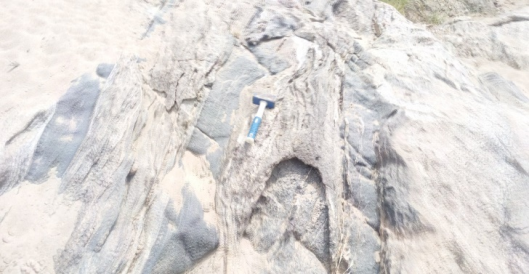
Figure 1. A low lying exposure of migmatite at N100 09′19.2″, E0090 23′44.3″, 646m showing the gneissic and amphibolite portion as A and B respectively around Nabardo area.
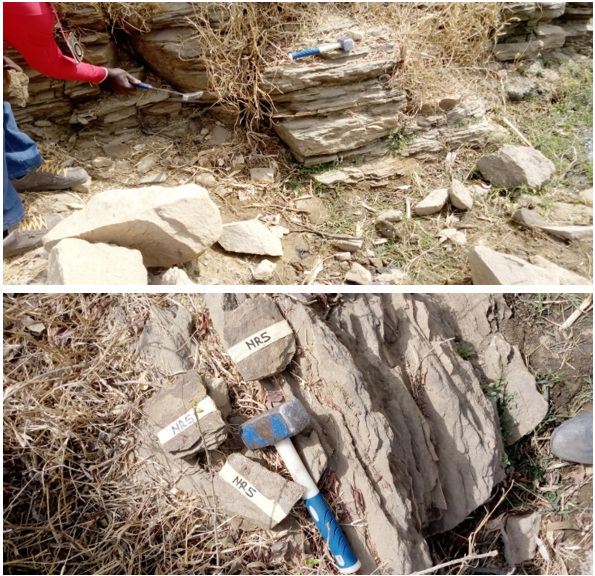
Figure 2. At location 5 showing a well foliated, weathered schist with a trend of 1500 at N100 10′ 27″, E0090 23′12.1″, 657m, Nabardo area.
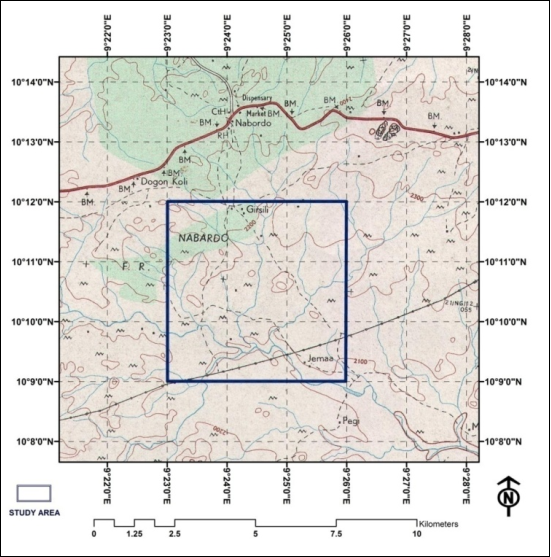
Figure 3. Location map of Nabardo and its environs drawn from ArcMap 10.3.
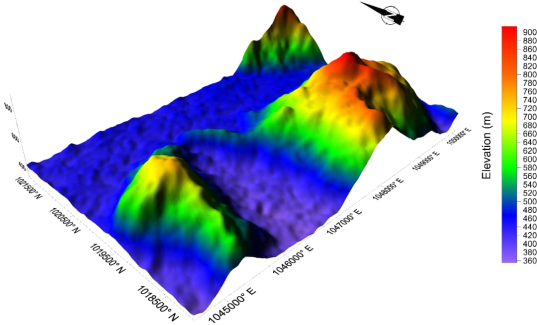
Figure 4. Digital Elevation model of the study area.
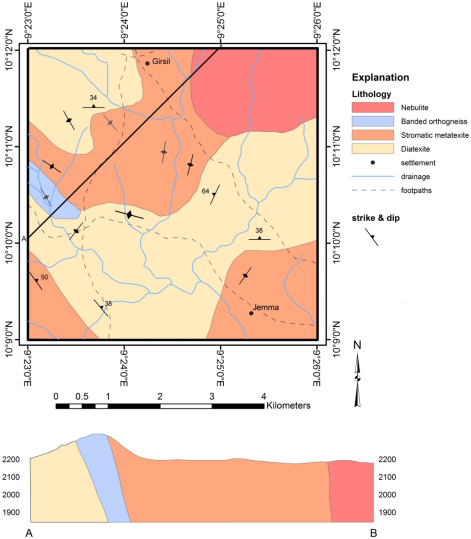
Figure 5. Geological map of the study area.
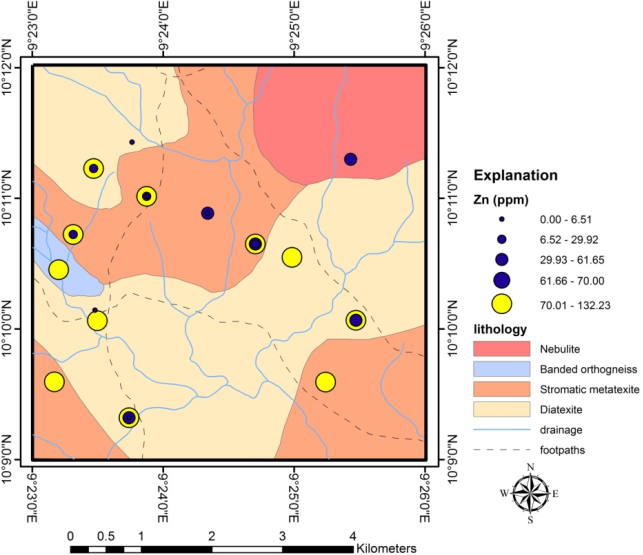
Figure 6. Point symbol map of zinc superimposed on the geology.
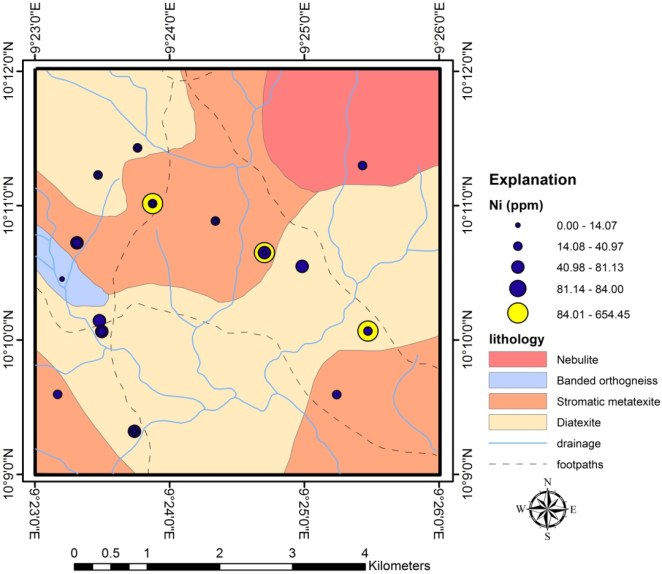
Figure 7. Point symbol map of Nickel superimposed on the geology.
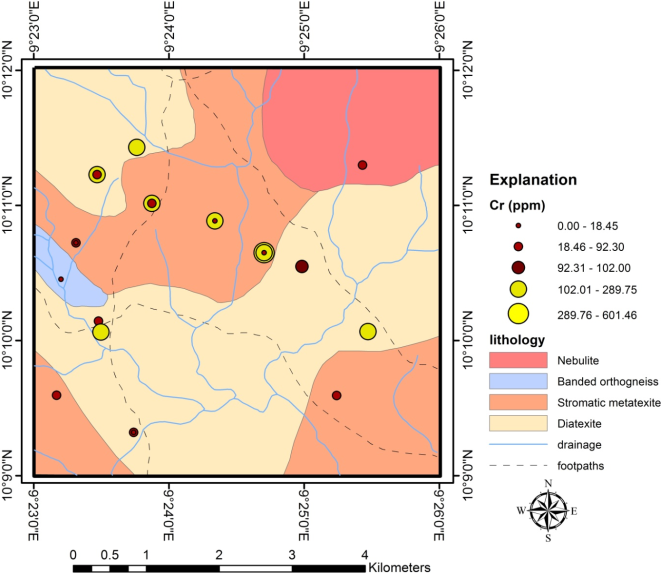
Figure 8. Point symbol map of Chromium superimposed on the geology.
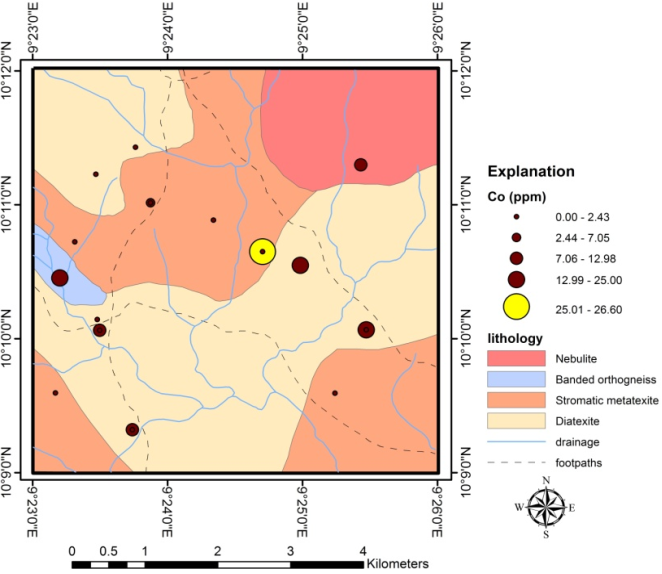
Figure 9. Point symbol map of Cobalt superimposed on the geology.
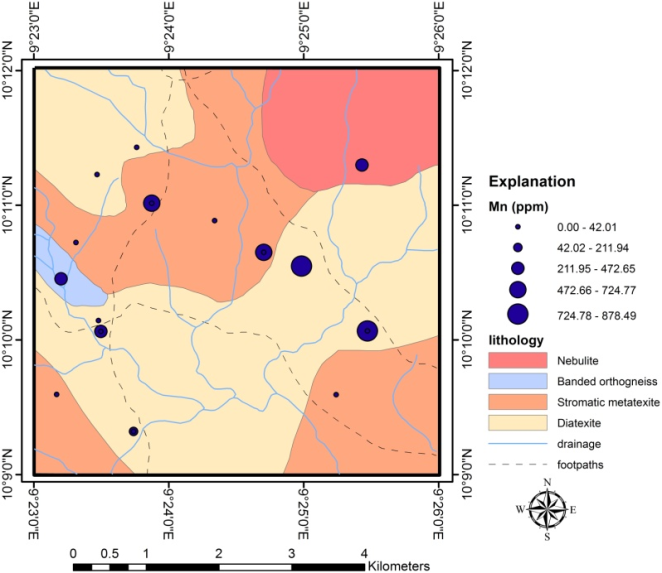
Figure 10. Point symbol map of manganese superimposed on the geology.
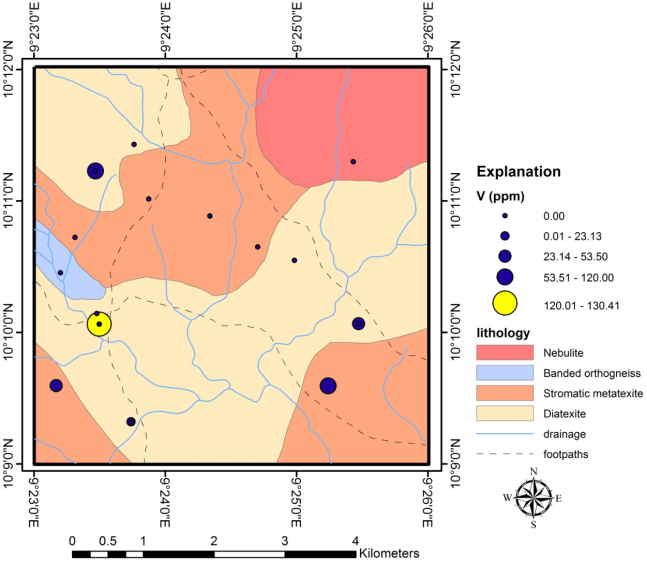
Figure 11. Point symbol map of vanadium superimposed on the geology.

Information



 Share This Article
 Twitter
 Linked In
 Facebook
 Copy
Copy Download