The distribution pattern of biodiversity along an elevation gradient in mountain ecosystems has always been a focal point in biodiversity research. As an important component of forest ecosystems, the understory herb layer occupies a significant position in forest succession and plays a crucial role in maintaining the stability of forest ecosystems, protecting biodiversity, and enhancing ecosystem functions. This study comprehensively analyzes the diversity characteristics of plant communities in the understory herb layer of different forest stands and their variation along an elevation gradient through research on typical artificial forest communities in Mount Taishan, elucidating the relationship between plant diversity and community productivity. The results indicate that there are significant differences in the impact of elevation gradient on the diversity of the herb layer under Robinia pseudoacacia forests and Quercus acutissima forests. In Robinia pseudoacacia forests, the richness and other diversity indices of the herb layer are significantly higher at low elevations than at medium and high elevations, exhibiting a "low-elevation advantage" pattern. The richness and other diversity indices of the herb layer in Quercus acutissima forests are lower at medium and low elevations but significantly increase at high elevations. In different forest types, there is a significant correlation between herb layer richness and biomass, but in opposite directions: a negative correlation in Robinia pseudoacacia forests and a positive correlation in Quercus acutissima forests. The differences between Robinia pseudoacacia and Quercus acutissima forests may stem from the different nature of species interactions under these two types of forest stands: competitive interactions dominate in Robinia pseudoacacia forests, while complementary interactions are more prominent in Quercus acutissima forests. This study suggests that tree species composition plays a key role in regulating the relationship between biodiversity and ecosystem functions.
This is an Open Access article, distributed under the terms of the Creative Commons Attribution 4.0 International License (http://creativecommons.org/licenses/by/4.0/), which permits unrestricted use, distribution and reproduction in any medium or format, provided the original work is properly cited.
Altitude, Species Diversity, Richness, Mount Taishan
1. Introduction
Mountainous regions possess unique and abundant biodiversity, serving as crucial components of global ecosystems. The distinctive terrain and extensive distribution of mountains contribute to the complexity of ecosystems, offering a rich ecological space for plants. Consequently, the distribution pattern of biodiversity along elevation gradients within mountainous ecosystems has always been a focal point in biodiversity research
[1]
Liu, B. R. Recent advances in altitudinal distribution patterns of biodiversity. Ecology and Environmental Sciences, 2021, 30(2), 438-444.
Liu, S. Relationship between forest stratum structure and topography in a coniferous and broad-leaved mixed forest in Jiaohe, Jilin Province. Acta Ecologica Sinica, 2021, 41(16): 31-34.
Plant species diversity is one of the key factors maintaining the multifunctionality and stability of terrestrial ecosystems
[3]
Jing, X., and He, J. S. Relationship between biodiversity, ecosystem multifunctionality and multiserviceability: literature overview and research advances. Chinese Journal of Plant Ecology, 2021, 45: 1094-1111.
. Altitudinal gradients, as a decisive factor affecting species distribution patterns, profoundly influence the spatial distribution of plant diversity by regulating environmental factors such as hydrothermal conditions, light intensity, and soil nutrients. Plant diversity gradually decreases with increasing altitude, which is the most common pattern of diversity distribution
[4]
Yu, C. Y., Li, Z. J., Liu, S. Y., Huang, Y. D., Duan, K. J., Li, P. L., Wang, R. H. Altitudinal gradient pattern of woody species diversity and soil nutrients in Baotianman National Nature Reserve. Journal of Northeast Forestry University, 2023, 51(9): 101-106.
. Diversity can also exhibit a unimodal pattern, increasing with altitude and then decreasing. Zhang et al. believe that low-altitude areas are susceptible to human disturbance and drought stress, while high-altitude areas are limited by low temperatures. Mid-altitude areas, due to suitable hydrothermal conditions and less disturbance, often maintain higher diversity
[5]
Zhang, Z., Wang, F., Wang, X. Biogeographic partly shapes woody plant diversity along an elevational gradient in subtropical forests. Plant Diversity, 2025, 06: 4-8.
. The above studies indicate that the impact of altitudinal gradients on plant diversity is not a single pattern, but varies depending on the study area, ecosystem type, and community composition.
As an important component of forest ecosystems, the understory herb layer occupies a significant position in forest succession and plays a crucial role in maintaining the stability of forest ecosystems, protecting biodiversity, and enhancing ecosystem functions. However, due to the dominant position of trees in forests, most research has primarily focused on woody plants, neglecting the importance of understory herbs
[6]
Tinya, F., Csépányi, P., Horváth, C. V., Kovács, B., Németh, C., Ódor, P. Fine-scale interventions can reinforce the forest character of the understory vegetation – The effects of different artificial gaps in an oak-dominated forest. Forest Ecology and Management, 2023, 578: 122471.
. In fact, understory herbs often have a rich variety and complex structure, and together with the tree layer and shrub layer, they influence the ecological environment, occupying unique ecological niches within the community and thereby affecting the stability of the community
[7]
Deng, J. J., Fang, X. M., Jin, Y. Q., Kuang, Y. W., Lin, F. M., Liu, J. Q., Ma, J. R. Forest understory vegetation study: current status and future trends. Forestry Research, 2023, 6: 55-59.
. Therefore, strengthening research on the diversity of the understory herb layer and its environmental impact mechanisms is of great significance for comprehensively understanding the structure and function of forest ecosystems.
Mount Taishan is one of the typical representatives of the warm temperate deciduous broad-leaved forest region in China, with relatively rich biodiversity. Typical artificial forest communities such as Robinia pseudoacacia forests and Quercus acutissima forests are widely distributed in the region, playing an important role in regional vegetation restoration and ecological function enhancement. Based on this, this study conducts a field-based investigation on typical artificial forest communities in Mount Taishan, comprehensively analyzing the diversity characteristics of herbaceous plant communities under different forest stands and their variation patterns along an elevation gradient, and elucidating the relationship between plant diversity and community productivity.
This study proposes the following hypotheses:
(1) There are significant differences in the diversity of herbaceous layers under different artificial forests;
(2) There is a significant positive correlation between herb layer diversity and biomass, indicating that higher diversity corresponds to greater biomass.
2. Research Methods
2.1. Community Survey
This study established sample plots based on elevation gradients and dominant tree species in the forest stand. According to the preliminary survey results, the elevation was divided into three gradients: low elevation (<500 m), medium elevation (500–700 m), and high elevation (>700 m). Within each elevation gradient, three sample plots were selected for Robinia pseudoacacia forests and three for Quercus acutissima forests, resulting in a total of 18 fixed sample plots measuring 20 m × 20 m. In each sample plot, the herb layer survey quadrats were arranged using the five-point sampling method. During the survey, the total coverage, dominant species, and species name, abundance, coverage, average height, and other indicators of all herbaceous plants within the quadrats were recorded.
2.2. Parameter Calculation and Analysis
In order to accurately and reasonably reflect the species diversity status of plants within the sample plots, this study selected the richness index, Simpson index, Shannon index, and Pielou index from α diversity for analysis. After the survey, ANOVA was used to analyze the differences in community species diversity between different altitudes and forest types, and multiple comparisons were conducted for each index. The Duncon method was used for post-hoc testing.
3. Research Results
3.1. Variability and Biomass Changes with Environmental Factors
The results of the two-factor variance analysis (Table 1) indicate that stand type, elevation, and their interaction (species × Elevation) have significant effects on some α diversity indices and herb layer biomass. The main effects of stand type and elevation are significant across all dependent variables. The interaction between the two has a significant impact on richness and herb layer biomass, but not on the Shannon-Wiener index, Simpson index, or evenness index.
Table 1. Results of two-way ANOVA on the effects of stand type and altitude on diversity indices and biomass of the herb layer.
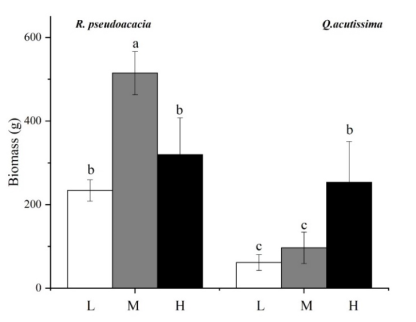
Figure 2. Herb biomass of two stand types at different altitudes. Letters indicate the results of multiple comparisons.
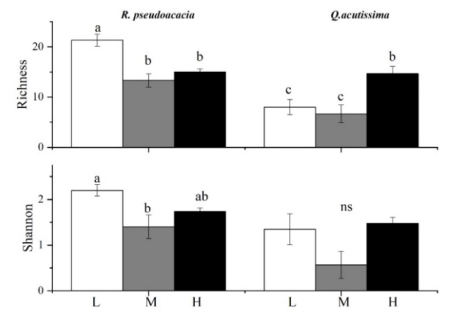
The results of multiple comparisons indicated that there were differences in herb layer richness between Robinia pseudoacacia forests and Quercus acutissima forests across different altitude gradients (Figure 1): in Robinia pseudoacacia forests, richness at low altitudes was significantly higher than that at medium and high altitudes. In Quercus acutissima forests, richness increased with altitude, reaching its highest at high altitudes and being significantly higher than that at low and medium altitudes. Across forest types, richness levels at high altitudes in Quercus acutissima forests were comparable to those at medium and high altitudes in Robinia pseudoacacia forests, with the highest richness at low altitudes in Robinia pseudoacacia forests and the lowest at low and medium altitudes in Quercus acutissima forests. Within Robinia pseudoacacia forests, the Shannon index at low altitudes was significantly higher than that at medium altitudes, while there were no significant differences between high altitudes and either of the other two. There were no significant differences in the Simpson index and Pielou evenness index among different altitudes within Quercus acutissima forests.
The herbaceous biomass under Robinia pseudoacacia forests first increases and then decreases with altitude, reaching its maximum at mid-altitude and being significantly higher than that at low and high altitudes (Figure 2). The herbaceous biomass under Quercus acutissima forests gradually increases with altitude, reaching its maximum at high altitude and being significantly higher than that at low and mid-altitude. Among the two forest types, the herbaceous biomass under Robinia pseudoacacia forests is significantly higher than that under Quercus acutissima forests at both low and mid-altitude, while there is no significant difference between the two forest types at high altitude.
3.2. Correlation Analysis Between Diversity Index and Herbaceous Biomass
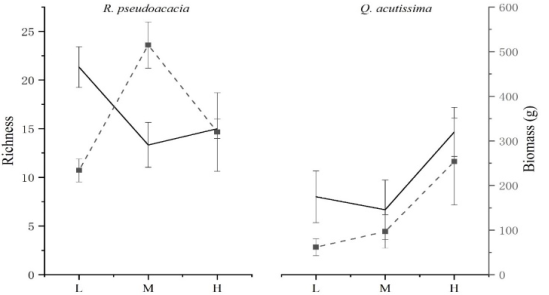
The correlation analysis results showed that there were differences in the correlation between herb diversity indices and herb biomass under different forest types (Table 2): in Robinia pseudoacacia forests, richness was significantly negatively correlated with biomass (r = -0.680, p = 0.045). The situation in Quercus acutissima forests was opposite to that in Robinia pseudoacacia forests, with biomass increasing with richness (Figure 3), but not reaching a significant level (r = 0.595, p = 0.092). Other diversity indices (Shannon, Simpson, Pielou) under the two forest types showed no significant correlation with biomass.
Figure 3. Changes in herb layer species richness and biomass along altitude gradients in Robinia pseudoacacia and Quercus acutissima stands. (Solid lines represent species richness, dashed lines represent biomass; L, M, and H on the x-axis denote low, medium, and high altitude, respectively).
Table 2. Correlation analysis results between herb layer biomass and diversity index under different forest stand types.
Stand type
Diversity Index
Regression Equation
Correlation Coefficient r
p
Robinia pseudoacacia
Richness
y=23.71−0.0201xy=23.71−0.0201x
-0.680
0.045*
Shannon
y=2.458−0.00191xy=2.458−0.00191x
-0.599
0.089
Simpson
y=0.955−0.000657xy=0.955−0.000657x
-0.615
0.078
Pielou
y=0.822−0.000466xy=0.822−0.000466x
-0.597
0.090
Quercus acutissima
Richness
y=6.29+0.0254xy=6.29+0.0254x
0.595
0.092
Shannon
y=0.875+0.00187xy=0.875+0.00187x
0.327
0.392
Simpson
y=0.401+0.000786xy=0.401+0.000786x
0.306
0.424
Pielou
y=0.472+0.000356xy=0.472+0.000356x
0.168
0.665
Note:* indicates p<0.05, indicating significant correlation; in the regression equation, x represents biomass (unit: g m-2), and y represents the corresponding diversity index.
4. Discussion
4.1. The Impact of Elevation Gradient on Herb Layer Diversity Under Two Types of Forest Stands
The results of this study indicate significant differences in the impact of altitude gradients on the herb layer diversity under Robinia pseudoacacia and Quercus acutissima forests. In the R. pseudoacacia forest, the herb layer richness and other diversity indices are significantly higher at low altitudes compared to medium and high altitudes, exhibiting a "low-altitude advantage" pattern. Previous studies have shown that herb layer diversity fluctuates and decreases with increasing altitude, and altitude has a significant impact on herb layer α diversity
[8]
Shi, G. F., Xu, N., Niu, Z. Q. Altitudinal differences in understory plant biodiversity in eastern Greater Khingan Mountains, Inner Mongolia. Acta Ecologica Sinica, 2024, 44(7), 3004-3015.
. This result may be related to the higher resource availability and more suitable environmental conditions in R. pseudoacacia forests at low altitudes. As a nitrogen-fixing tree species, R. pseudoacacia may exhibit stronger resource regulation capabilities in low-altitude areas, thereby promoting the coexistence and diversity maintenance of herb layer species under the forest. In contrast, the diversity of the Q. acutissima forest exhibits different patterns with altitude changes: richness and other diversity indices are lower at medium and low altitudes, but significantly increase at high altitudes. Similar studies on Q. acutissima forests on the southern slope of Funiu Mountain also showed that herb layer diversity increases with increasing altitude
[9]
Wang, J. H., Yang, C. L., Chen, Y. T. Diversity characteristics and environmental interpretation of trees, shrubs and herbs in the Quercus acutissima forest on the southern slope of the Funiu Mountains. Journal of Southwest Forestry University, 2026, 46(1), 1-8.
. As a deciduous broadleaf forest, Q. acutissima forests at high altitudes may provide ecological niche space for more herb species due to improved light conditions and reduced competitive pressure, thereby enhancing diversity. Furthermore, the impact of altitude gradients on diversity is consistent across different indices, indicating the stability of altitude's influence on community structure. Two-factor variance analysis further revealed that the interaction between species (forest type) and altitude significantly affects richness, indicating that the altitude effect depends on the forest type background. In karst forest ecosystems, shrubs and herbaceous plants exhibit opposite response patterns to altitude gradients, further confirming the differences in response strategies of different life forms to altitude gradients
[10]
Luo, W., Chen, W., Sun, C., Fan, S., Xie, J., Li, Z. Microclimate and soil nutrients jointly shaped contrasting elevational patterns of understory biodiversity and community assembly in subtropical karst forests. Global Ecology and Conservation, 2026, 65(c), e04053.
. This result emphasizes the need to comprehensively consider the synergistic effects of tree species composition and topographic factors when conducting research on understory vegetation in mountain forests.
4.2. Relationship Between Diversity and Biomass
In this study, a significant correlation was observed between herb layer richness and biomass across different forest types, but the direction of this correlation was opposite: negative in R. pseudoacacia forests and positive in Q. acutissima forests. This difference may reflect the varying mechanisms of resource competition and promotion in the two types of forests. In R. pseudoacacia forests, the negative correlation between richness and biomass aligns with the "selection effect" and "competitive exclusion" hypotheses, suggesting that in environments with relatively abundant resources, a few high-productivity species may dominate, inhibiting the coexistence of other species and leading to a negative trade-off between richness and biomass. Global-scale meta-analyses indicate that the selection effect is more pronounced when species biomass inequality is high and gradually weakens over time
[11]
Chen, C., Xiao, W. Y., Chen, H. Y. H. Meta-analysis reveals global variations in plant diversity effects on productivity. Nature, 2025, 637: 1-8.
. The high diversity and potentially low biomass in low-altitude sections of R. pseudoacacia forests further support this explanation. In Q. acutissima forests, the positive correlation between richness and biomass supports the "diversity-productivity positive correlation" hypothesis, suggesting that species richness promotes biomass accumulation through ecological niche complementarity and efficient resource utilization. Studies have shown that complementarity contributes approximately 65.6% of the net biodiversity effect in mixed species, and increases with the enhancement of phylogenetic and functional diversity
[12]
Zhao, K. Positive species diversity and above-ground biomass relationships are ubiquitous across forest strata despite interference from overstorey trees. Functional Ecology, 2017, 31, 419-428.
. The significant increase in diversity and high biomass in high-altitude sections of Q. acutissima forests align with this pattern. The differences between R. pseudoacacia and Q. acutissima forests may stem from the varying nature of species interactions in the two types of forests: competitive interactions dominate in R. pseudoacacia forests, while complementary interactions are more prominent in Q. acutissima forests. Some studies have pointed out that the relationship between diversity and productivity in the understory herb layer is significantly regulated by the upper canopy trees, and the resource filtering effect of the canopy may weaken the positive correlation in the understory
[13]
Ali, A., Chen, H. Y. H., You, W. H., Yan, E. R. Multiple abiotic and biotic drivers of aboveground biomass shift with forest stratum. Forest Ecology and Management, 2019, 436, 1-10.
Luo, Y. H. Greater than the sum of the parts: how the species composition in different forest strata influence ecosystem function. Ecology Letters, 2019, 22(9): 1449-1461.
Sun, L., Wang, H. F., Cai, Y., et al. Disentangling the interspecific and intraspecific variation in functional traits of desert plant communities under different moisture gradients. Forests, 2022, 13(7): 1088.
. This suggests that tree species composition plays a crucial role in regulating the relationship between biodiversity and ecosystem function. It is worth noting that other diversity indices showed no significant correlation with biomass, indicating that in this study, species richness is more sensitive to reflecting changes in herb layer productivity. This may be related to the strong dominance of dominant species in the herb layer on community biomass.
5. Conclusions
In conlusion, there are significant differences between Robinia pseudoacacia forests and Quercus acutissima forests in terms of the response patterns of herb layer diversity to altitude, the diversity-productivity relationship, and the composition structure of diversity. Herb diversity under R. pseudoacacia forests exhibits a "low-altitude advantage," while herb diversity under Q. acutissima forests increases with increasing altitude. The interaction between species and altitude significantly affects richness, indicating that the altitude effect depends on stand type factors. The relationship between herb layer richness and biomass is opposite across stand types: a significant negative correlation in R. pseudoacacia forests and a significant positive correlation in Q. acutissima forests, reflecting the dominant differences in competitive and complementary effects under different tree species compositions. Stand type plays a key role in regulating the altitude pattern of understory vegetation diversity and the diversity-productivity relationship, reflecting its crucial role in regulating the ecological process of understory vegetation.
Abbreviations
ANOVA
Analysis of Variance
Author Contributions
Yifu Yuan: Conceptualization, Writing – original draft
Liu, S. Relationship between forest stratum structure and topography in a coniferous and broad-leaved mixed forest in Jiaohe, Jilin Province. Acta Ecologica Sinica, 2021, 41(16): 31-34.
Jing, X., and He, J. S. Relationship between biodiversity, ecosystem multifunctionality and multiserviceability: literature overview and research advances. Chinese Journal of Plant Ecology, 2021, 45: 1094-1111.
Yu, C. Y., Li, Z. J., Liu, S. Y., Huang, Y. D., Duan, K. J., Li, P. L., Wang, R. H. Altitudinal gradient pattern of woody species diversity and soil nutrients in Baotianman National Nature Reserve. Journal of Northeast Forestry University, 2023, 51(9): 101-106.
Tinya, F., Csépányi, P., Horváth, C. V., Kovács, B., Németh, C., Ódor, P. Fine-scale interventions can reinforce the forest character of the understory vegetation – The effects of different artificial gaps in an oak-dominated forest. Forest Ecology and Management, 2023, 578: 122471.
Deng, J. J., Fang, X. M., Jin, Y. Q., Kuang, Y. W., Lin, F. M., Liu, J. Q., Ma, J. R. Forest understory vegetation study: current status and future trends. Forestry Research, 2023, 6: 55-59.
Wang, J. H., Yang, C. L., Chen, Y. T. Diversity characteristics and environmental interpretation of trees, shrubs and herbs in the Quercus acutissima forest on the southern slope of the Funiu Mountains. Journal of Southwest Forestry University, 2026, 46(1), 1-8.
Luo, W., Chen, W., Sun, C., Fan, S., Xie, J., Li, Z. Microclimate and soil nutrients jointly shaped contrasting elevational patterns of understory biodiversity and community assembly in subtropical karst forests. Global Ecology and Conservation, 2026, 65(c), e04053.
Zhao, K. Positive species diversity and above-ground biomass relationships are ubiquitous across forest strata despite interference from overstorey trees. Functional Ecology, 2017, 31, 419-428.
Ali, A., Chen, H. Y. H., You, W. H., Yan, E. R. Multiple abiotic and biotic drivers of aboveground biomass shift with forest stratum. Forest Ecology and Management, 2019, 436, 1-10.
Luo, Y. H. Greater than the sum of the parts: how the species composition in different forest strata influence ecosystem function. Ecology Letters, 2019, 22(9): 1449-1461.
Sun, L., Wang, H. F., Cai, Y., et al. Disentangling the interspecific and intraspecific variation in functional traits of desert plant communities under different moisture gradients. Forests, 2022, 13(7): 1088.
Yuan, Y., Liu, Y., Fan, Y., Zhao, H., Dong, J., et al. (2026). Changes in the Diversity of Herbaceous Layer Under Typical Artificial Forests Along an Altitude Gradient in Mount Taishan. Ecology and Evolutionary Biology, 11(1), 12-18. https://doi.org/10.11648/j.eeb.20261101.12
Yuan, Y.; Liu, Y.; Fan, Y.; Zhao, H.; Dong, J., et al. Changes in the Diversity of Herbaceous Layer Under Typical Artificial Forests Along an Altitude Gradient in Mount Taishan. Ecol. Evol. Biol.2026, 11(1), 12-18. doi: 10.11648/j.eeb.20261101.12
Yuan Y, Liu Y, Fan Y, Zhao H, Dong J, et al. Changes in the Diversity of Herbaceous Layer Under Typical Artificial Forests Along an Altitude Gradient in Mount Taishan. Ecol Evol Biol. 2026;11(1):12-18. doi: 10.11648/j.eeb.20261101.12
@article{10.11648/j.eeb.20261101.12,
  author = {Yifu Yuan and Yu Liu and Yawen Fan and Huayuan Zhao and Jin Dong and Yujie Luo},
  title = {Changes in the Diversity of Herbaceous Layer Under Typical Artificial Forests Along an Altitude Gradient in Mount Taishan},
  journal = {Ecology and Evolutionary Biology},
  volume = {11},
  number = {1},
  pages = {12-18},
  doi = {10.11648/j.eeb.20261101.12},
  url = {https://doi.org/10.11648/j.eeb.20261101.12},
  eprint = {https://article.sciencepublishinggroup.com/pdf/10.11648.j.eeb.20261101.12},
  abstract = {The distribution pattern of biodiversity along an elevation gradient in mountain ecosystems has always been a focal point in biodiversity research. As an important component of forest ecosystems, the understory herb layer occupies a significant position in forest succession and plays a crucial role in maintaining the stability of forest ecosystems, protecting biodiversity, and enhancing ecosystem functions. This study comprehensively analyzes the diversity characteristics of plant communities in the understory herb layer of different forest stands and their variation along an elevation gradient through research on typical artificial forest communities in Mount Taishan, elucidating the relationship between plant diversity and community productivity. The results indicate that there are significant differences in the impact of elevation gradient on the diversity of the herb layer under Robinia pseudoacacia forests and Quercus acutissima forests. In Robinia pseudoacacia forests, the richness and other diversity indices of the herb layer are significantly higher at low elevations than at medium and high elevations, exhibiting a "low-elevation advantage" pattern. The richness and other diversity indices of the herb layer in Quercus acutissima forests are lower at medium and low elevations but significantly increase at high elevations. In different forest types, there is a significant correlation between herb layer richness and biomass, but in opposite directions: a negative correlation in Robinia pseudoacacia forests and a positive correlation in Quercus acutissima forests. The differences between Robinia pseudoacacia and Quercus acutissima forests may stem from the different nature of species interactions under these two types of forest stands: competitive interactions dominate in Robinia pseudoacacia forests, while complementary interactions are more prominent in Quercus acutissima forests. This study suggests that tree species composition plays a key role in regulating the relationship between biodiversity and ecosystem functions.},
 year = {2026}
}
TY  - JOUR
T1  - Changes in the Diversity of Herbaceous Layer Under Typical Artificial Forests Along an Altitude Gradient in Mount Taishan
AU  - Yifu Yuan
AU  - Yu Liu
AU  - Yawen Fan
AU  - Huayuan Zhao
AU  - Jin Dong
AU  - Yujie Luo
Y1  - 2026/05/14
PY  - 2026
N1  - https://doi.org/10.11648/j.eeb.20261101.12
DO  - 10.11648/j.eeb.20261101.12
T2  - Ecology and Evolutionary Biology
JF  - Ecology and Evolutionary Biology
JO  - Ecology and Evolutionary Biology
SP  - 12
EP  - 18
PB  - Science Publishing Group
SN  - 2575-3762
UR  - https://doi.org/10.11648/j.eeb.20261101.12
AB  - The distribution pattern of biodiversity along an elevation gradient in mountain ecosystems has always been a focal point in biodiversity research. As an important component of forest ecosystems, the understory herb layer occupies a significant position in forest succession and plays a crucial role in maintaining the stability of forest ecosystems, protecting biodiversity, and enhancing ecosystem functions. This study comprehensively analyzes the diversity characteristics of plant communities in the understory herb layer of different forest stands and their variation along an elevation gradient through research on typical artificial forest communities in Mount Taishan, elucidating the relationship between plant diversity and community productivity. The results indicate that there are significant differences in the impact of elevation gradient on the diversity of the herb layer under Robinia pseudoacacia forests and Quercus acutissima forests. In Robinia pseudoacacia forests, the richness and other diversity indices of the herb layer are significantly higher at low elevations than at medium and high elevations, exhibiting a "low-elevation advantage" pattern. The richness and other diversity indices of the herb layer in Quercus acutissima forests are lower at medium and low elevations but significantly increase at high elevations. In different forest types, there is a significant correlation between herb layer richness and biomass, but in opposite directions: a negative correlation in Robinia pseudoacacia forests and a positive correlation in Quercus acutissima forests. The differences between Robinia pseudoacacia and Quercus acutissima forests may stem from the different nature of species interactions under these two types of forest stands: competitive interactions dominate in Robinia pseudoacacia forests, while complementary interactions are more prominent in Quercus acutissima forests. This study suggests that tree species composition plays a key role in regulating the relationship between biodiversity and ecosystem functions.
VL  - 11
IS  - 1
ER  -
Yuan, Y., Liu, Y., Fan, Y., Zhao, H., Dong, J., et al. (2026). Changes in the Diversity of Herbaceous Layer Under Typical Artificial Forests Along an Altitude Gradient in Mount Taishan. Ecology and Evolutionary Biology, 11(1), 12-18. https://doi.org/10.11648/j.eeb.20261101.12
Yuan, Y.; Liu, Y.; Fan, Y.; Zhao, H.; Dong, J., et al. Changes in the Diversity of Herbaceous Layer Under Typical Artificial Forests Along an Altitude Gradient in Mount Taishan. Ecol. Evol. Biol.2026, 11(1), 12-18. doi: 10.11648/j.eeb.20261101.12
Yuan Y, Liu Y, Fan Y, Zhao H, Dong J, et al. Changes in the Diversity of Herbaceous Layer Under Typical Artificial Forests Along an Altitude Gradient in Mount Taishan. Ecol Evol Biol. 2026;11(1):12-18. doi: 10.11648/j.eeb.20261101.12
@article{10.11648/j.eeb.20261101.12,
  author = {Yifu Yuan and Yu Liu and Yawen Fan and Huayuan Zhao and Jin Dong and Yujie Luo},
  title = {Changes in the Diversity of Herbaceous Layer Under Typical Artificial Forests Along an Altitude Gradient in Mount Taishan},
  journal = {Ecology and Evolutionary Biology},
  volume = {11},
  number = {1},
  pages = {12-18},
  doi = {10.11648/j.eeb.20261101.12},
  url = {https://doi.org/10.11648/j.eeb.20261101.12},
  eprint = {https://article.sciencepublishinggroup.com/pdf/10.11648.j.eeb.20261101.12},
  abstract = {The distribution pattern of biodiversity along an elevation gradient in mountain ecosystems has always been a focal point in biodiversity research. As an important component of forest ecosystems, the understory herb layer occupies a significant position in forest succession and plays a crucial role in maintaining the stability of forest ecosystems, protecting biodiversity, and enhancing ecosystem functions. This study comprehensively analyzes the diversity characteristics of plant communities in the understory herb layer of different forest stands and their variation along an elevation gradient through research on typical artificial forest communities in Mount Taishan, elucidating the relationship between plant diversity and community productivity. The results indicate that there are significant differences in the impact of elevation gradient on the diversity of the herb layer under Robinia pseudoacacia forests and Quercus acutissima forests. In Robinia pseudoacacia forests, the richness and other diversity indices of the herb layer are significantly higher at low elevations than at medium and high elevations, exhibiting a "low-elevation advantage" pattern. The richness and other diversity indices of the herb layer in Quercus acutissima forests are lower at medium and low elevations but significantly increase at high elevations. In different forest types, there is a significant correlation between herb layer richness and biomass, but in opposite directions: a negative correlation in Robinia pseudoacacia forests and a positive correlation in Quercus acutissima forests. The differences between Robinia pseudoacacia and Quercus acutissima forests may stem from the different nature of species interactions under these two types of forest stands: competitive interactions dominate in Robinia pseudoacacia forests, while complementary interactions are more prominent in Quercus acutissima forests. This study suggests that tree species composition plays a key role in regulating the relationship between biodiversity and ecosystem functions.},
 year = {2026}
}
TY  - JOUR
T1  - Changes in the Diversity of Herbaceous Layer Under Typical Artificial Forests Along an Altitude Gradient in Mount Taishan
AU  - Yifu Yuan
AU  - Yu Liu
AU  - Yawen Fan
AU  - Huayuan Zhao
AU  - Jin Dong
AU  - Yujie Luo
Y1  - 2026/05/14
PY  - 2026
N1  - https://doi.org/10.11648/j.eeb.20261101.12
DO  - 10.11648/j.eeb.20261101.12
T2  - Ecology and Evolutionary Biology
JF  - Ecology and Evolutionary Biology
JO  - Ecology and Evolutionary Biology
SP  - 12
EP  - 18
PB  - Science Publishing Group
SN  - 2575-3762
UR  - https://doi.org/10.11648/j.eeb.20261101.12
AB  - The distribution pattern of biodiversity along an elevation gradient in mountain ecosystems has always been a focal point in biodiversity research. As an important component of forest ecosystems, the understory herb layer occupies a significant position in forest succession and plays a crucial role in maintaining the stability of forest ecosystems, protecting biodiversity, and enhancing ecosystem functions. This study comprehensively analyzes the diversity characteristics of plant communities in the understory herb layer of different forest stands and their variation along an elevation gradient through research on typical artificial forest communities in Mount Taishan, elucidating the relationship between plant diversity and community productivity. The results indicate that there are significant differences in the impact of elevation gradient on the diversity of the herb layer under Robinia pseudoacacia forests and Quercus acutissima forests. In Robinia pseudoacacia forests, the richness and other diversity indices of the herb layer are significantly higher at low elevations than at medium and high elevations, exhibiting a "low-elevation advantage" pattern. The richness and other diversity indices of the herb layer in Quercus acutissima forests are lower at medium and low elevations but significantly increase at high elevations. In different forest types, there is a significant correlation between herb layer richness and biomass, but in opposite directions: a negative correlation in Robinia pseudoacacia forests and a positive correlation in Quercus acutissima forests. The differences between Robinia pseudoacacia and Quercus acutissima forests may stem from the different nature of species interactions under these two types of forest stands: competitive interactions dominate in Robinia pseudoacacia forests, while complementary interactions are more prominent in Quercus acutissima forests. This study suggests that tree species composition plays a key role in regulating the relationship between biodiversity and ecosystem functions.
VL  - 11
IS  - 1
ER  -




 Share This Article
 Twitter
 Linked In
 Facebook
 Copy
Copy Download