1. Introduction
Looking at the various aspects of the possible relationships between language, society, cultural practices and human behavior, a society can be said to be made up of a group of people who share cultural aspects of life such as language, dress, norms of behavior and artistic forms. This group of people has common interest or form themselves into associations, organizations or groups for common goal or any form of mutual benefit or relationship. Sociolinguistics is that aspect of language studies which deals with the study of language in relation to society. A lot of academic articles and discussions have been written on the studies on language and society and sociolinguistics. Some of these include:
| [1] | Akande, A. T. (2017). Morning Sir! Identity negotiation in Nigerian Army Barracks. Matatu, Journal of African Culture and Society, 49, 1, 201-224.
https://doi.org/10.1163/18757421-04901013 |
| [4] | Chambers, J. (2003). Sociolinguistic Theory: Linguistic variation and its social significance. 2nd edn. Oxford: Blackwell. |
| [8] | Fox, J. (1974). ‘Our ancestors spoke in pairs’: Rotinese views of language, dialect and code. In Bauman, R. and Sherzer, J. (eds) 1974. Explorations in the ethnography of speaking. London: Cambridge University Press. |
| [10] | Gal, S. (1979). Language shift: Social determinants of linguistic change in bilingual Austria. New York: Academic Press. Pp. xii+201. |
| [12] | Greenberg, R. (2004). Language and Identity in the Balkans: Serbo-Croatian and its disintegration. Oxford: Oxford University Press. |
| [13] | Gumperz, J. (1971). Language in social groups. Stanford, C. A: Stanford University Press. |
| [14] | Gumperz, J. and H. Dell. (eds). (1972). Directions in sociolinguistics: The Ethnography of communication. New York: Holt, Rinehart and Winston. |
| [16] | Johnstone, B. (2004). Place, globalization and linguistic variation. In Fought, C. (ed). Sociolinguistic variation: critical reflections. New York: Oxford University Press. |
| [23] | Trudgill, P. (2003). A glossary of Sociolinguistics. Oxford: Oxford University Press. |
| [24] | Wardhaugh, R. (2006). An Introduction to Sociolinguistics. (5th edn). Oxford: Blackwell Publishing. |
[1, 4, 8, 10, 12-14, 16, 23, 24]
.
Trudgill tries to summarize some of the earlier writings and makes all kinds of distinctions between all kinds of language studies
| [23] | Trudgill, P. (2003). A glossary of Sociolinguistics. Oxford: Oxford University Press. |
[23]
. He concludes that, studies that help people to learn more about language and also investigate topics such as the mechanisms of linguistic change, the nature of linguistic variability and the structure of linguistic systems are aimed at improving linguistic theory and at developing our understanding of the nature of language. Downes characterizes sociolinguistic research as
| [6] | Downes, W. (1998). Language and society. 2nd edn. Cambridge: Cambridge University Press. |
[6]
;
work which is intended to achieve a better understanding of the nature of human language by studying language in its social context and/or to achieve a better understanding of the nature of the relationship and interaction between language and society.
In an attempt to complement the quotation above, Wardhaugh in his writings, notes that one of the possible relationships between language and society is that social structure may either influence or determine linguistic structure and or behavior
| [24] | Wardhaugh, R. (2006). An Introduction to Sociolinguistics. (5th edn). Oxford: Blackwell Publishing. |
[24]
. One aspect of sociolinguistics which we have used as the theoretical framework for this work is ethnography which has to do with human social organizations and activities. Duranti says;
Ethnography is the written description of the social organization, social activities, symbolic and material resources, and interpretive practices characteristic of a particular group of people
| [5] | Duranti, A. (1997). Linguistic Anthropology. Cambridge: Cambridge University Press. |
[5]
.
In other words, ethnographers try to find out what is happening around the community and then try to provide accounts which show behavioral patterns and how such patterns make sense within the community that is being observed in
| [24] | Wardhaugh, R. (2006). An Introduction to Sociolinguistics. (5th edn). Oxford: Blackwell Publishing. |
[24]
. For example, Gardner notes the uncooperative attitude of the Puliyanese of South India in that they seem not to have much to talk about, yet, they live together
| [9] | Gardner, P. (1966). Symmetric Respect and Memorate Knowledge: The structure and ecology of individualistic culture. Southwestern Journal of Anthropology, 22: 389-415. |
[9]
. Fox reported that silence is interpreted as a sign of some kind of stress, confusion or dejection among the Roti in the island of Timor in Eastern Indonesia
| [10] | Gal, S. (1979). Language shift: Social determinants of linguistic change in bilingual Austria. New York: Academic Press. Pp. xii+201. |
[10]
. This is in contrast to the attitude of the Puliyanese of South India who hardly find much to talk about. Reisman also reports the social situation when one enters a small group among the Antigua in the West Indies as another kind of indulgence in talk
| [21] | Reisman, K. (1974). Contrapuntal conversations in an Antiguan village. In Bauman, R. and J. Sherzer. (eds) 1974. Explorations in the ethnography of speaking. London: Cambridge University Press. |
[21]
. A person just keeps on talking until others in the group decide to pay attention and listen. In other words, a speaker has to assert himself/herself to be able to enter a conversation. All these are behavioral patterns that are of interest to sociolinguists. Hymes then proposed an ethnographic framework that can take care of the various factors involved in speaking with the acronym SPEAKING which means setting, participants, ends, act, sequence, key, instrumentalities, norms of interaction and interpretation and genre
| [15] | Hymes, D. (1974). Foundations in sociolinguistics: An ethnographic approach. Philadelphia: University of Pennsylvania Press. |
[15]
.
In an article on pre-school in three cultures, Tobin notes the social awareness and harmony among the Japanese as opposed to the American encouragement of individual assertiveness and suggests the need for appropriate language use for different language groups as part of cultural knowledge
| [22] | Tobin, J., Wu, D. and Davidson, D. (eds). (1989). Preschool in three cultures: Japan, China and the United States. New Haven: Yale University Press. |
[22]
. Johnstone in a related article says “ethnography presupposes that the best explanations of human behavior are particular and culturally relative” rather than general and universal
| [16] | Johnstone, B. (2004). Place, globalization and linguistic variation. In Fought, C. (ed). Sociolinguistic variation: critical reflections. New York: Oxford University Press. |
[16]
. He notes further that in ethnographies the focus is not only on the language but also the cultural practices that the language reflects.
People generally fill certain socially specified roles and they have particular orientation towards those roles. This paper is therefore aimed at investigating participant orientation towards the wearing of masks in the wake of COVID-19 pandemic in Nigeria as the present researchers note the indiscriminate use of facemasks by the Nigerian populace. Therefore, using the principles of ethnography which is based on first hand observations of behavior in a group of people in their natural setting, we have tried to look into the use of face masks, the various types and their supposed functions as regards the corona virus pandemic in Nigeria.
3. Wearing Masks in Nigeria
Masks are no strange concepts in Nigeria or Africa as a whole. They are used in all spheres of life by traditional religion worshipers, entertainers, health workers and even criminals. Apart from being a multicultural or multilingual nation, Nigeria is also a multi-religious nation. It is interesting to note that most of the various tribes and adherents of some of the religious beliefs make use of masks for one reason or the other. In the Southwest, traditional religion adherents believe in dead ancestors coming back to life to help the living but that when they do, they are all covered (masked) with all kinds of clothes and fearful face masks that leave no part of the face open. It is believed they are from the land of the dead and they speak with unnatural voices. Whenever they appear, they are called masquerades.
Masquerades are presented as coming from the world beyond usually to bless the living. It is surprising that even though they are said to come to bless the living, while some of them go round the streets of major towns, they receive money from the living. This seems reciprocal as giving begets giving but the curious question to ask is – Do the dead still spend earthly money in the world beyond? The Igbo people in the Eastern part of Nigeria also have different kinds of masquerades with different kinds of masks. The masquerades do not only come as beings from the world beyond but they also entertain by dancing and doing all kinds of acrobatic displays.
Some musicians in the entertainment industry have also tried to carve out an identity for themselves either by painting their faces or wearing masks to hide their real identity. An example is the popular singer ‘Lagbaja’ in the music industry and who for years now has been identified with a special kind of masquerade dressing or outfit. He has not only masked his personality but has also masked his name because ‘Lagbaja’ in Yoruba language literally means ‘somebody’. So, culturally in Nigeria, it can be said that masks are used for hiding identity.
Facemasks are used in the health sector by medical professionals for personal protection in different sections of the hospitals or medical centers, e.g, laboratories, theaters, pharmacies, blood banks, consulting rooms etc. Medical/surgical facemasks used by health workers are usually disposable. It is actually part of the ethics of their profession to discard facemasks or gloves after being used for a patient or as often as when they deem it fit to do so.
Mask along with a hood that covers both the head and the facial part of the body is also used by criminals to perpetuate all kinds of crimes such as armed robbery, kidnapping, rape, internet fraud especially in front of ATM machines.
Research on masks has been done looking at the use of masks from different angles in Nigeria. In addressing the topic on the criminality and implications of masks for security in Nigeria, Ayodele notes that apart from the fact that mask provides covers for wearers; it encourages anonymity which hinders public identification. He reviews the linkage between masks and aberrant behavior in the Nigerian society
. Ayodele hinged his article on the dratological theory and notes the insecurity and aberrant acts that unbridled use of masks can cause
. He went further to comment on legal masks for government officials which are the immunity that some government officials have which protects them from being prosecuted while in office. He suggests that such legal masks be removed to curb corruption and that surveillance cameras be installed in major facilities and public spaces.
In a technical study on masks from Cross River region of Nigeria and Cameroon at the National Museum of African Arts (NMAFA), Owczarek examines nineteen covered masks as regards the materials used such as; the wood, skin and surface applications, construction features etc
| [20] | Owczarek, N. (2014). Skin covered masks from the Cross river Region of Nigeria and Cameroon at the National Museum of African Art: A technical study. August 25 2014. Journal American Institute. Vol. 53, 2014. Issue 3. pp 182-197.
http://doi.org/10.1179/1945233014Y.0000000025 |
[20]
. Owczarek’s visual examination of masks is through x-radiography and other chemicals. The study shows that the skin covered masks in the NMAFA collection support and agree with the literature in this area of study and also illustrates a wider variety of techniques and materials.
Ogoina in an article on the rational use of face masks in Nigeria notes the Federal government’s insistence on mandatory use of masks in public places which has led to a lot of misuse and abuse by public, government and health workers
. He notes that inappropriate use could promote the spread of the virus and that indiscriminate disposal of face masks could also promote it. He goes further to say that the Federal and State governments should consider local applicability, feasibility and sustainability. The government should also identify and mitigate all potential risks and unintended consequences. He also notes the need for intensive public sensitization and education on appropriate use and disposal of facemasks in the country.
Many online sites also have various articles on masks in Nigeria. Some Nigerian celebrities are said to have appeared at a glitzy award ceremony wearing glittery, jeweled facemasks amid corona virus pandemic and it is reported that one of the stars said that they were using the mask to make a statement not to prevent the spread of the virus http://www.bbc.com.news. This corroborates the observations of Ogoina on the inappropriate use of facemasks
. Doctors have however warned that people do not have to wear a mask if they are not close to people and they are not coughing or sneezing.
Some other online sites such as reuters.com also note the letter from Nigeria Governor’s forum that the thirty-six governors in Nigeria urge the president of Nigeria, President Muhammadu Buhari to approve the compulsory use of facemasks in public places as a result of the increasing rise in the number of corona cases. They note that some Nigerian tailors and designers have taken their creativity to making fashionable facemasks that add glamour and style to health and safety. They note that some Nigerians wear facemasks with flair; healthcarewise.punch.ng.com however notes that facemasks made from local fabric is unfit for health workers. The National Agency for Food and Drug Administration and Control (NAFDAC) in Nigeria warns that such face masks may reduce the spread of droplets but cannot prevent infection.
Studies also abound across the globe on facemasks. For example, Macintyre, et al. note that many countries are stockpiling face masks to be used as non-pharmaceutical intervention to control virus transmission during an influenza pandemic
. They note that research conducted in 2006, 2007 on two hundred and eighty-six exposed adults from one hundred and forty-three households reveals that adherence to mask use reduced the risk of influenza-like illness (ILI).
On the efficacy of facemasks, Leung, et al. in an article on respiratory virus shedding and the efficacy of facemasks identifies seasonal human corona viruses, influenza viruses and rhino viruses in exhaled breath and coughs of children and adults with acute respiratory illness
| [17] | Leung, N., Chu D. and Cowling B. (2020). Respiratory virus shedding in exhaled breath and efficacy of face masks. Nature Medicine 26(5): 676-680. www.nature.com |
[17]
. They also note that surgical masks reduced the detection of influenza virus RNA in respiratory droplets etc. Their results show that surgical masks could prevent transmission of human corona viruses and influenza viruses from symptomatic individuals.
In an evidence review and analysis of the use of masks, Cheng et al. support mass masking in the advent of the corona virus pandemic
| [3] | Cheng, K. K., Tai H. & Leung, C. C. (2020). ‘Wearing face masks in the community during the COVID-19 pandemic: altruism and solidarity’ https://www.thelancet.com |
[3]
. They also note the need for a stronger public health awareness to protect others from infection through droplets. Esposito et al. note among other tests conducted that surgical masks can prevent the inhalation of large droplets and sprays but have limited ability to filter sub micro-sized airborne particles
| [7] | Esposito, S., Principi N., Leung C. and Migliori, G. B. (2020). Universal use of facemask for success against COVID-19: evidence and implications for prevention policies. European Respiratory Journal.
https//doi.org/10.1183/13993003.01260-2020 |
[7]
. To them, surgical masks have proved to intercept other human corona viruses during coughing. They also note that compliance is needed for protection. Most of the research works on masks that are reviewed above focus mainly on the efficacy of masks in curtailing the corona virus, the present study probes further by taking a sociological look at the use of facemasks in Nigeria.
In compliance to the directive of WHO, Nigeria as a nation through the President and National Centre for Disease Control (NCDC) has stressed the need to take responsibility by taking all necessary laid down instructions to prevent the spread of COVID-19 and this includes the wearing of masks in public places. It is to be noted that Ayodele wrote on the link between masks and aberrant behavior and insecurity in the Nigerian society but the corona virus pandemic has brought another dimension to the use of masks which has now put on hold the suggestions of Ayodele and this is of uttermost interest in sociolinguistic studies
. In this paper, the researchers note the indiscriminate use of masks which in addition to protection seems to be mocking the corona virus pandemic among different sets of people in Nigeria.
7. Functions of Masks
7.1. Virus Protection
It is observed that even though people wear masks, it is for different purposes. The fear and panic that followed the announcement of the virus made people to comply initially with whatever could prevent them from getting infected. While some people behave like the doubting Thomas, some people take the instructions seriously. By the middle of April 2020 when people saw that the record of infected people and deaths were not as serious as were recorded in overseas countries, people relaxed and said it is one of those ailments that could be cured using traditional medical approach. Some people wear the facemasks religiously everywhere as prescribed and directed by the President of Nigeria and NCDC.
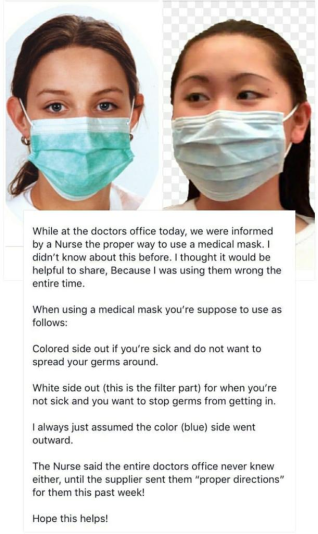
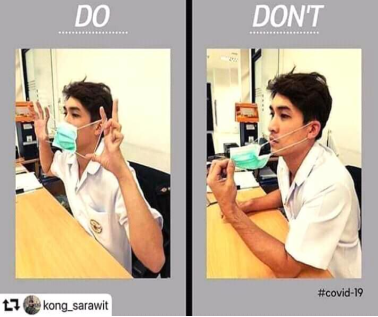
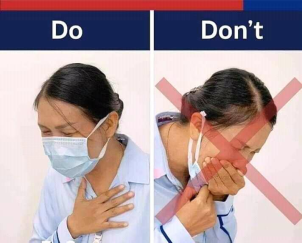
To help the populace, there are a lot of help images and videos on instructions on how to wear facemasks correctly and how to use them. Below are some examples.
Figure 4. A demonstration of the right and wrong use of nose mask.
Figure 5. A description of the proper placement of nose mask.
Figure 6. A depiction of how to cover the mouth while coughing or sneezing.
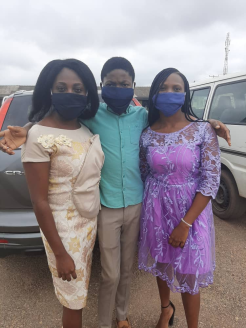
Figure 7. Students wearing facemasks.
Figure 4 instructs on which side of the face mask should be worn inside and which side should be worn on the outside which many people are ignorant of. The mask should be worn with the deeper color on the outside if you do not have any infection but the deeper color should be on the inside if you have any infection and do not want to infect others with it.
Figure 5 instructs on how to handle the facemask while putting it on and while removing it.
Figure 6 shows what to do in the advent of a cough which is one of the symptoms of the infection while
Figure 7 shows people wearing locally made facemasks correctly.
7.2. Facemasks for Culture Promotion
Apart from the main function of the facemask which is supposed to be for protection, promotion of culture is also noticed. Culture is the knowledge that a person must possess to get through the task of daily living in any society. This knowledge is socially constructed and it manifests in day-to-day language of communication, music, literature, dressing, general comportment, and all arts in general. Goodenough says:
A society’s culture consists of whatever it is one has to know or believe in order to operate in a manner acceptable to its members and to do so in any role that they accept for any one of themselves
| [11] | Goodenough, W. (1957). Cultural anthropology and linguistics. In Paul G. (ed), 1956 Report of the Seventh Roundtable Meeting on Linguistics and Language Study. Washington, DC: Georgetown University Press. |
[11]
.
To Goodenough, that kind of knowledge is socially acquired, and the necessary behaviors are learned and do not come from any kind of genetic endowment
| [11] | Goodenough, W. (1957). Cultural anthropology and linguistics. In Paul G. (ed), 1956 Report of the Seventh Roundtable Meeting on Linguistics and Language Study. Washington, DC: Georgetown University Press. |
[11]
. Some of the facemasks reflect the culture of the Yoruba in terms of the material used and the dressings. The three people in the images below are putting on three different kinds of
aso ofi.
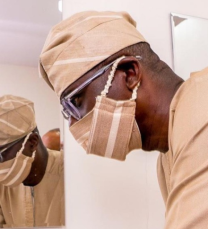
Figure 8 pictures a man with a traditional cap made with
aso ofi who also used the same material for his facemask.
Aso ofi or
aso oke is one of the highly valued attires of the Yoruba people in Southwestern Nigeria and ‘
aso ofi’ production is the main business of the people of Iseyin in Southwestern Nigeria. The type that the man in
Figure 8 below is wearing as cap and facemask is called
sanyan which is one of the most expensive types of
aso ofi. It is carton brown color and it is believed that
sanyan is the rich people’s choice because of the high price.
The use of some types of
aso ofi by some individuals could be indicative of the wealth or social status of the person because
aso ofi are of different types. The man in
Figure 8 is trying to make a statement with his use of
aso ofi. Apart from advertising Yoruba traditional attire, he is also trying to say that our local fabric is equally good for disease prevention. It is thick enough to prevent droplets from entering someone’s nose or eyes and also adequate as facemasks. In other words, we should look inwards for locally made items and materials we need to stop the spread of the corona virus. If imported masks are expensive, traditional fabric could be used as facemasks.
Figure 8. Man wearing aso ofi (sanyan cap and face mask).
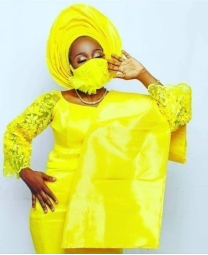
Figure 9. Aso ofi used for blouse and wrapper with facemask to match.
Figure 10. All for tradition and fashion.
Figure 9 shows a lady in yellow traditional attire who also displays culture. Blouse and wrapper with a wrap round material as extra cloth, (
ipele) which accompanies the main outfit is a typical traditional style of Yoruba women for occasions. She also tries to make a statement that restriction on large gatherings or ceremonies cannot be a hindrance from dressing the traditional way. A person can beat the virus to it by using part of the material for the outfit to sew the facemask and will be good to go for any ceremony.
Figure 10 shows an ‘all for tradition’ man. His outfit (trouser and top), shoe, chair he sits on, stool cover, cap, facemask, throw pillow are all made of stripped blue local material. Even the bottles on the table have a color that blends with his attire. He proves that he believes in using locally made materials and he is proud to use them for everything possible. He is probably saying that the solution to Nigeria’s economic problem is embracing locally made materials and the promotion of such materials. All these and others prove that culture is dynamic and can be adapted to suit different situations or different purposes.
7.3. Facemasks for Fashion
The need to look cute despite the restrictions on movement and the mandatory wearing of masks is probably one of the reasons for fashionable facemasks.
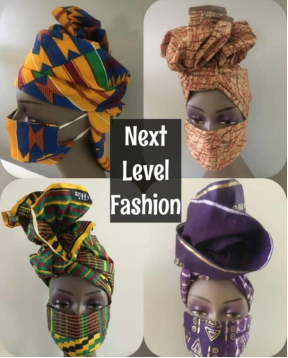
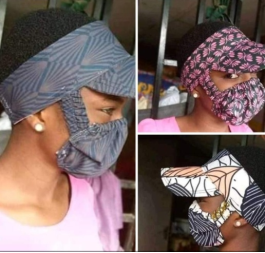
Figure 11 shows ladies wearing fashionable head gear and facemasks to match with
Adire and
Ankara materials. These are locally made materials designed stylishly in a fashionable manner to meet the needs of the hour.
Figure 11. Using gele fabrics for nose mask.
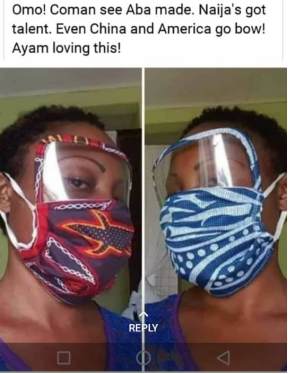
Figure 12. Pictures advertising ankara made face shield and nose mask.
Some of the wearers put them on for show amid corona virus fears and concerns. The ‘Ankara’ materials used by the ladies in
Figure 11 for headgear combined with facemasks to match are some of the current trendy fashion.
Figure 12 has a special transparent plastic to cover the eyes and this makes it look more compact. The wearers are trying to prove that corona virus cannot stop them from being fashionable. Some online reports have presented some Nigerian celebrities in glittery, jeweled facemasks at award ceremonies in the United Kingdom http://www.bbc.com.news
Corona virus: Nigerian celebrities wear blinged-up masks 15 March 2020)
. voanews.com also notes that in Nigeria, masks are new glamour accessory.
In another award ceremony, Big Brother Naija finalist, Omashola Kola Oburoh said he turned up to the Africa Magic viewer’s choice award (AMVCA) in glittery mask in protest and notes that fashion can also be a protest/educative not just a statement
. Some of these celebrities post their pictures with the hash tag- #coronavirusfashion. Some other online report has it that masks appeared at cat walk at Paris fashion week at the end of February 2020, just to prove that it is not only in Nigeria that corona virus facemasks have been made part of fashion
.
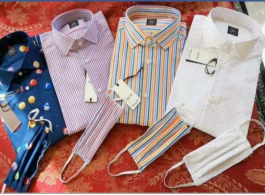
Figure 13. Packed shirts/ designer shirts with face masks.
Figure 14. Facemask plus face cap.
Figure 13 shows newly made packed/designer shirts with facemasks to match made in Aba, a popular city in the Eastern part of Nigeria. The interrelatedness of health and fashion is hereby highlighted making it possible to be fashionable despite a pandemic or even disability. Designer shirts and materials always have pieces or items to match to make them attractive and fashionable. The inclusion of facemasks has become an added assessory to designer materials or local materials as tailors now use part for the materials to be sewn for a fitting facemask alongside sown materials without being told to do so.
Adverts of locally customized clothing or facemasks (i.e
Figure 13) have inscriptions such as:
Aba couture???
Naija no dey carry last
No more bow ties
It’s now ‘nose ties’
The inscriptions are written in both Nigerian Pidgin and British English. The writer emphasizes the place of manufacture which is Aba in the Eastern part of the country, Nigeria which is stylishly called ‘Naija’. The fact that Nigeria does not waste time adjusting to new situations and change for good is clear in the Nigerian pidgin expression ‘Naija no dey carry last’. Instead of bow ties, it is now nose ties.
Figure 14 has three pictures of a young girl with locally made face cap with facemask. This is specially designed for young men/women who naturally want a hidden identity. The text on the advert of the facemask reads thus:
Aba made facemasks
book your own now
no try them
please let’s support African ingenuity
they may save the world from this pandemic
The linguistic elements are written in capital letters to emphasize the points made. They note the importance of the facemask and encourage made in Nigeria goods and materials. The advertiser notes that African made goods could be part of the solution to be pandemic troubling the whole world. ‘No try them’ which is written in Nigerian Pidgin means ‘Don’t think it’s a joke, they are serious minded people’. The introduction of Nigerian Pidgin here brings in a regional language variation touch that is meant to make users of the facemasks feel at home with the facemasks.
Our findings show that if they can afford it, most young people prefer the fashionable facemasks because they do not want the corona virus pandemic scare to make them engage in incomplete or unfashionable dressing or appearance. Some of the fashion designers understand this and have therefore keyed into this by making fashionable dresses/male outfits with fitting masks. It was also discovered that some people do not really like wearing the facemasks because it is a little uncomfortable as it hinders free flow of air into the lungs. With fashionable ones however, the young wear them stylishly without being forced. The older people on the other hand prefer the simple ones and would relax its use once out of a crowd. Although, some still wear it with all nose and mouth covered while walking alone on the street or alone in a car.
7.4. Facemasks for Religious Identity
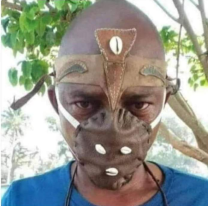
Figure 15 shows a traditionalist wearing a facemask with cowries on it. He probably sees the wearing of this type of face mask as a way of revealing his identity as a member of a society of elders who believe in the traditional way of handling issues of culture and power. Our findings on the other hand reveal that such cowry symbols could be an identification mark of the ‘Ogboni’ society of elders. The triangular cowry symbol on the face mask we are told means ‘it is only the elders who know the language of the cult’. Since their meetings are not as secretive as they used to be, adherents/members therefore see it as a thing of pride to display some of the emblems of the society on a facemask. Only members of the cult or society would want to wear such a special kind of mask as any other person could be queried by members if they put on such.
Figure 15. A traditionalist wearing a facemask with cowries.
Figure 16. A lady using a small pocket bible as a nose mask.
Figure 16 on the other hand shows a lady using a small pocket bible as a nose mask thinking that the powers behind the contents of the bible is able to protect from corona virus infection. People show their religious bias in various ways through acts such as the above or inscriptions on nose masks such as ‘Jesus saves’ etc.
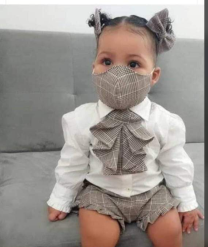
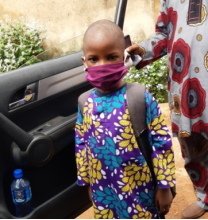
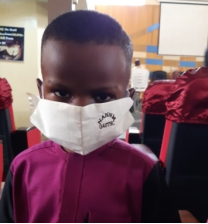
As regards facemask for children, some parents do not only dress themselves up using face masks but they also dress up little children with fitting face masks for the children’s colorful dresses or attire. Doctors have however advised that children need not be burdened with wearing facemasks especially if they are not in an endemic area.
Figures 17, 18 and 19 are examples. In
Figure 19, a mother who is a nurse allows the son to put on a customized masks made for the Association of Nigerian Nurses and Midwives.
Figure 17. Nose mask made from a baby’s dress for fashion.
Figure 18. A boy using nose mask for outing.
Figure 19. A boy using nose mask in church.
7.5. Face Masks for Political Identity
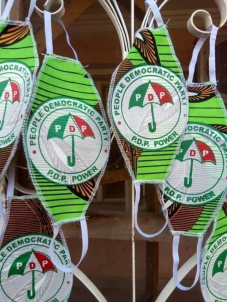
Figure 20. Nose mask depicting political party logo.
People can use anything to promote their political stand. By so doing, they identify with a political party.
Figure 20 shows face masks advertising the People’s Democratic Party (PDP), one of the major political parties in Nigeria. Giving out politically marked materials could be a form of propaganda for the party and it could make people more inclined towards the party ideals especially when they are distributed free and the materials meet the need of the hour
| [26] | Nigeria’s Governors seek to make face masks compulsory in public-reuters 26 April 2020. https://www.reuters.com |
[26]
. It is a form of political propaganda or attraction to the party.
Figure 20 is an example.
7.6. Face Masks for Professional Identity
Different professional groups also made facemasks for their group members. Wardhaugh actually notes that ethnographic studies often deal with issues of identity and power
| [24] | Wardhaugh, R. (2006). An Introduction to Sociolinguistics. (5th edn). Oxford: Blackwell Publishing. |
[24]
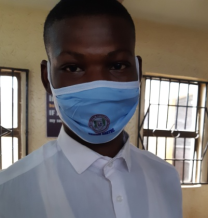
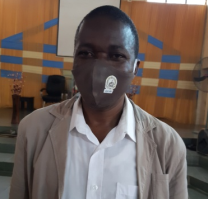
In different parts of Nigeria, different kinds of masks with different logos of different professional groups are noticed on people. For example, at Obafemi Awolowo University, Nigeria, professional groups like Academic Staff Union of Nigerian Universities (ASUU), Senior Staff Association (SSA) in Obafemi Awolowo University Teaching Hospitals Complex (OAUTHC), National Association of Nigerian Nurses and Mid-wives (NNANW) and many other groups have special facemasks made for their members.
Some companies, business outfits such as REAL Estates etc. have special customized facemasks with their logos on them. Just like customized Tee-shirts, the inscriptions on the face masks advertise the professional groups or business outfits. These masks are given freely to their members at work, family members and clients. The masks therefore serve dual function of protecting the wearer and also advertising their companies, associations, groups etc. For nurses and doctors and other health workers, the medically prescribed masks are the ones used in the theatres, laboratories etc. The specially made ones with fabrics are used outside work places.
Figures 21 and 22 are examples.
Figure 21. Facemask made for Senior Staff Association Members at OAUTHC, Ile Ife, Nigeria.
Figure 22. Facemask made for Academic staff members Obafemi Awolowo University Ile Ife, Nigeria.
9. Coping with the Challenges of Wearing Facemasks
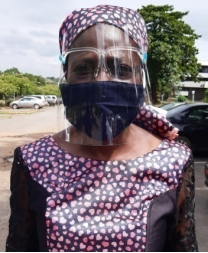
Human beings are good at inventing things and new ways of dealing with issues and problems of life. With the complaints about not having enough oxygen to breath in when the nose and mouth are covered, some face shields have been designed having transparent plastic cover for the entire face. This design is free enough to allow free flow of air but not covered enough to prevent infection. People have therefore been advised to use it with the medical/locally made one if it is to be used at all. Something similar to these types is noticed on school children in China with the resumption of schools after the lockdown and security personnel of some banks in Nigeria who stay outside to control the movement of customers into the bank. This type is also used by some lecturers in higher institutions, business people and individuals who feel committed to the non-spread of the corona virus infection in Nigeria and other places in the world. An example is
Figure 25 where the nose mask is worn separately from the face shield. The message is – ‘protecting yourself is not enough, protecting others is equally important to stop the spread of the virus’. This type is quite different from the one in
Figure 11 in this article where the eyes are covered by the plastic shield but the mouth and nose are covered using a local fabric, but sewn together. There are all kinds of innovative variations in the production and use of masks not only in Nigeria but worldwide all in an attempt to fight the pandemic.
Figure 25. Nose mask plus face shield.
Another challenge is how to prevent self-infection by keeping the facemask in place without touching the frontal part as advised by medical experts.
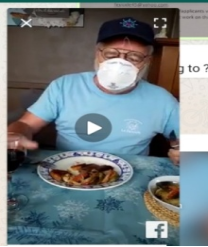
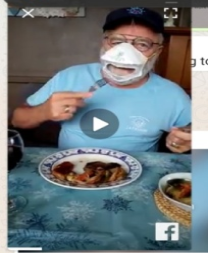
Figures 26 and 27 present another design of a facemask where a technique of opening the mouth is put in place which enables the wearer to eat without touching the face or the mask. It is done in such a way that the mask automatically gets lifted up to allow food into the mouth. It is important to devise these coping strategies as this killer virus may take some time to clear off from nations of the world.
Figure 26. The use of nose mask while eating.
Figure 27. The opening of the mouth with open nose mask to eat.
9.1. Socio-economic Effect of the Use of Masks
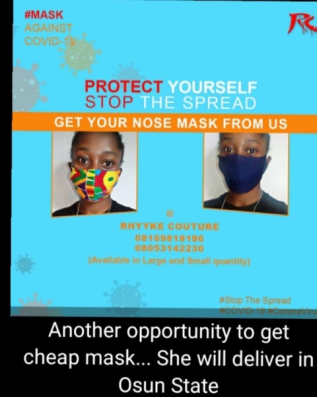
Emergency tailors emerged as a result of this sudden need for masks in Nigeria. Some of the young people who have been jobless keyed into this and some of them are making and hawking facemasks on the streets and some online.
Figure 3 advertises facemasks made from ‘Ankara’ and cotton fabrics. The entrepreneur is even ready to supply across states in the nation.
In the same vein, as a result of the restriction on large gatherings which prohibits social gatherings, ceremonies or at most, reduced the gatherings of people to twenty persons with good social or physical distance, many tailors were out of job. With the compulsion on the wearing of facemasks some of them bounced back to work and are able to sew and design fashionable facemasks not only for themselves but also for sale. Tailors in particular complained a lot because of the restriction on social gatherings because in this part of the nation, Southwest, tailors make most of their earnings from sewing aso ebi (family cloth) for many people going for the same ceremony at the same time. Such occasions include, wedding ceremonies, traditional wedding engagements, burial ceremonies, birthday ceremonies, chieftaincy titles, political meetings etc.
Aso ebi (family cloth) is the kind of uniform cloth sewn by family members during social engagements where many people are expected. Aso ebi is usually worn to identify with the celebrant. Tailors make a lot of money sewing different types of clothes for people and in particular aso ebi for different occasions that come up regularly every weekend in different places within the communities, across towns and cities and states because Nigerians love celebrations. The prices for sewing different cloths vary depending on the material and style. However, it is not only tailors that are adversely affected by the lockdown; every sector of the economy has been affected by the lockdown except those selling food items. People have to eat to survive the pandemic, so, those conveying food items are allowed to move apart from those on essential duties.
9.2. Psychological Effect of the Lockdown
It is however interesting to note that prior to the announcement of COVID-19 pandemic there were all kinds of cases and reports of suicide and attempted suicide among different categories of people who said they were either depressed or fed up with life in general. Some were rescued attempting to jump into the Lagoon, some drank Jik and Hypo (used for bleaching cloths) which are corrosive agents that could kill within minutes and some of them actually died. Some even put it on their status pages that they are contemplating suicide. So many comments would then follow advising them not to end their lives tragically or otherwise. It was so serious that within the last three years, some institutions had to set up counseling units in higher institutions to help students who had suicide tendencies. But since the announcement of the deadly corona virus that is able to claim lives, we do not hear much of people talking about having suicide tendencies. In fact, many people stayed indoors during the enforced lockdown because of the fear of death through COVID-19, so, one wonders what the dread is about COVID-19 that people do not want to be consumed by it.








 Share This Article
 Twitter
 Linked In
 Facebook
 Copy
Copy Download