Research Article | | Peer-Reviewed

UWEL Intervention Raises Programme Completion Rates in Higher Education Online Learning

Received: 16 April 2026     Accepted: 27 April 2026     Published: 16 May 2026
Views:       Downloads:
Abstract

Over the past twenty years, global research on online learning in higher education has consistently reported significantly lower programme completion rates for online students compared with face?to?face learners. Economic, technological, pedagogical, and equity aspirations have driven the shift to online learning, yet low completion rates continue to affect students, staff, institutional ratings, employers, and funders. Researchers attempting to improve completion rates through curriculum design and teaching innovations, have achieved only marginal gains. Recently, evidence has suggested a possible causal relationship between student wellbeing and programme completion. This emerging direction includes trialling targeted wellbeing interventions. This study reports on the investigation of a Universal Wellbeing Evaluation and Literacy Intervention (UWEL) programme. Underpinned by the evidence-based Universal Wellbeing Model (UWM) and incorporating a new Universal Wellbeing Evaluation Tool (UWET), the study hypothesised that the UWEL Intervention could increase completion rates by 8–30%. Results show a 94% completion rate for the experimental group compared with 51% for the control group—a 43% difference. These findings demonstrate the potential for standardised wellbeing intervention programmes to substantially increase global higher education online learning completion rates.

Published in Higher Education Research (Volume 11, Issue 3)
DOI 10.11648/j.her.20261103.13
Page(s) 62-78
Creative Commons

This is an Open Access article, distributed under the terms of the Creative Commons Attribution 4.0 International License (http://creativecommons.org/licenses/by/4.0/), which permits unrestricted use, distribution and reproduction in any medium or format, provided the original work is properly cited.

Copyright

Copyright © The Author(s), 2026. Published by Science Publishing Group

Keywords

Universal Wellbeing Model (UWM), Universal Wellbeing Evaluation & Literacy Intervention (UWEL), Higher Education, Online Learning, Programme Completions

1. Introduction
Massive Open Online Courses (MOOCs) and other online learning delivery modes were developed initially to address economic, and access challenges in higher education. However, these modes are now being questioned globally because of their persistently low completion rates. The negative impacts of low online completion rates for higher education students are well documented: reduced employment and life opportunities, lower home ownership and socioeconomic status, diminished confidence, increased debt, and, for many, lifelong shame within their communities of origin. Low completion rates also create significant challenges for institutions, as they lead to lower-than-projected income when expected retention levels are not met. These impacts compound year after year, when students are enrolled in pathway programmes or multi year degrees. Inevitably, constraints on staffing and resources follow, further affecting programme quality and institutional sustainability. Higher education funders are also affected, as low completion rates undermine value for money. When the number of graduates in key fields falls short, nations face skill shortages, reduced tax revenue, and broader declines in quality of life .
2. Literature Review
2.1. Online Learning Completion Rates and Understandings of Student Experience
From Nash’s work in 2005 to Rahmani et al.’s review of 110 investigations, high attrition and low online completion rates have dominated the MOOC and online learning literature consistently. Analysis of enrolment and completion data from 221 MOOCs found completion rates ranging from 0.7% to 52.1%, with a median of 12.6%. Shorter, more interactive, and more recent online programmes achieved higher completion rates, while longer, less interactive, and older programmes performed significantly worse.
In 2019, Misra et al. examined online programmes across 27 Commonwealth open universities and reported an average attrition rate of 84.74%, reinforcing the urgent need to investigate the causes of such poor outcomes. Data from one university showed that of 7,516 students enrolled in a Bachelor of Science degree, 48% (3,583 students) were incomplete or had dropped out between 2016 and 2023. Many researchers have attempted to understand the drivers of low completion and high dropout rates.
Mishra et al. hypothesised that student persistence was a causal factor and attempted to address this perceived student deficit. Deficit focused assumptions—such as inadequate preparation, lack of independence or ability, or choosing online learning because they believe it to be easier—are common in completion rate literature and often appear to go untested. Given that higher education students must meet prerequisite and entry criteria, institutions bear substantial responsibility for poor online completion rates.
A small group of researchers have examined broader causes of low MOOC and online programme completion. Badali et al. investigated motivational variables contributing to dropping out, and Rahmani et al. identified risk factors related to health, finances, isolation, workload, and support needs. Institution, and country specific factors—such as social or political dissatisfaction and employment pressures—also contribute to dropout rates globally .
Despite low completion rates and limited success in engaging learners, MOOCs remain highly accessible and attractive to students . Growing concern about persistently low completion rates has prompted deeper investigation; in 2025, Kokila Ranasinghe et al. , conducted face to face interviews, and identified 38 internal and external reasons students dropped out, they included (a) employment pressures, (b) academic burden, (c) flexibility needs, (d) self regulation challenges, and (e) family responsibilities. These findings provide a rich foundation for understanding online learners’ experiences and developing mitigation strategies, targeted interventions, and personalised support mechanisms.
Elibol and Bozkurt and Zawacki Richter and Qayyum similarly reported low completion rates across a range of online modes, but their reviews highlighted also the fragmented and limited understanding of their underlying causes. Many researchers now call for new hypotheses and more “targeted interventions and strategies to enhance the quality and effectiveness of online education” (Rahmani et al., p. 1, . Rahmani et al.’s investigation, draws attention to two pressing global challenges: (i) persistently low online higher education completion rates and (ii) limited understanding of students’ online learning experiences, derived from the student voice.
2.2. Online Learning Curriculum Design
An extensive body of scholarship has focused on online learning curriculum design with the aim of increasing programme completion rates. Relf et al. , building on Hodges et al. , examined intended, enacted, experienced, and hidden curricula in enabling online programmes. Their research identified five curriculum design principles that shape the student experience: (i) academic and personal development preparation, (ii) a student centric and holistic approach, (iii) explicitness, (iv) inclusion, and (v) transformative experience facilitation. They found also that making the hidden curriculum explicit was critical to improving completion rates in enabling and pathway programmes. Higher education staff it was noted assumed often that students possessed key capabilities already, rather than teaching and supporting their acquisition explicitly. Explicit capability development, in turn, strengthened student confidence and supported study continuity.
Xu et al. developed an online programme quality rubric comprising six components: website organisation and presentation, learning objectives, teaching materials, learning activities, logistics and course management, and targeted support to address online learning challenges. Similarly, the University of Florida produced comprehensive guides and resources for curriculum design, digital accessibility, online advising, technology implementation, and online teaching and learning .
In 2022, Badali et al. analysed 50 online learning investigations and identified six motivational factors influencing MOOC completion: academic, social, course related, personal, professional, and technological motivations. Academic motivation emerged as the strongest predictor of completion, leading the authors to urge curriculum designers to embed motivational elements into MOOCs and other online programmes. Kokila Ranasinghe et al. identified academic workload and course flexibility as the two key factors influencing whether students completed their programmes. In response, curriculum designers introduced policies addressing these areas, which resulted in improved online completion rates within their institutions.
Finally, Al Abri et al. argued that the rapid expansion of online learning highlights the need for high quality curriculum designs that engage students proactively and support programme completion actively. Their review produced guidelines for online curriculum designers, emphasising the careful selection and organisation of materials, coherent learning sequences, interactive elements, multimedia resources, and assessments that stimulate, engage, and motivate learners. They raised concerns also about inconsistent curriculum design quality and the need for robust quality assurance processes.
2.3. Online Learning Teaching Innovations
Teaching innovations have emerged over time to support students to complete online programmes. Tinto’s model highlighted how positive interactions between students, peers, and faculty can improve online completion rates and challenged researchers to measure both the quality and impact of these interactions. Subsequent studies examined telephone, blogging, tutorials, nudging, and other forms of interaction between students and staff during online learning. Findings show consistently that the greater the number of positive interactions, the more impact on programme completion . Jordan identified further that positive interactions in the first two weeks of an online programme are especially critical for achieving completions.
Hilliam and Williams experimented with faculty taking on administrative, teaching, and counselling functions simultaneously. Although effective, the approach was discontinued due to staff workload. Many teaching innovations face similar challenges, including staff time, resource demands, and capability building. Increasingly higher education staff are now being challenged to support students’ wellbeing in order to lift completion rates; for many, this additional responsibility is affecting their own wellbeing negatively .
Anghel et al. reviewed 68 MOOC teaching practice investigations and found that MOOCs improved teaching practice and positively influenced completion rates. Numerous studies have examined teaching effectiveness in MOOCs empirically . Others have focused on improving completion rates in specific fields or among particular populations .
Universal Design for Learning (UDL) principles , were developed to ensure all students can access and participate in meaningful learning both online and face to face. UDL emphasises engagement, multiple representations of knowledge, and opportunities for learners to demonstrate what they have learned. The principles require teachers to articulate clear learning objectives, organise materials effectively, incorporate interactive elements, and provide clear instructions, assessments, and evaluations through technologies that students can navigate easily.
Michelle Pacansky Brock , advocates for humanising online learning through scientific, inclusive, and culturally responsive teaching practices. In humanised online courses, the student–teacher relationship is regarded as “the connective tissue between students, engagement, and rigor” (p. 2). The approach aims to support students to fulfil their potential through the interweaving of trust, presence, awareness, and empathy. Relationships are established before the programme begins, and students are supported within their individual Zones of Proximal Development .
Graham’s evidence-based Teaching Conditions Theory provides insight into why the experiences advocated for by Pacansky Brock are critical. The theory identifies thirteen elements, seven of which must be present in the view of students for statistically significant behavioural change to occur. Eight elements identified by Pacansky Brock’s appear in the Graham’s framework, which has been used successfully to improve clinically low student self esteem significantly.
2.4. Online Learning Pastoral Care & Wellbeing Innovations
Researchers have demonstrated that they can create positive, caring and empathetic learning environments, and high programme completion rates through holistic pastoral care and wellbeing support systems . These supports have been implemented with both with students alone and across whole institutions to consistently achieve programme completion rates between 87% and 98% in contexts where national norms had ranged from 30% to 60% previously. Motta and Bennett’s pedagogies of care framework underscores the importance of responding to student voice to improve poor completion rates. Hilliam and Williams , McKelvie et al. , and Lister et al. also examined the relationship between pastoral care, wellbeing, and programme completion. Hilliam and Williams developed a successful partnership between academic and wellbeing staff that improved completion and reduced dropout rates, with minimal supports.
Pastoral care and wellbeing have historically been holistic—akin to the care a pastor provides to their community—and a strong evidence base supports conceptions of wellbeing that encompass social, physical, intellectual, emotional, and spiritual dimensions. Cowie advocated for “systems and interventions that reach out” (p. 321), and Pacansky Brock et al. for equity sensitive approaches that include ethnic and cultural wellbeing. Stevenson et al. responded to by creating the evidence-based UWM. Progress toward evidence based, and authentically holistic wellbeing frameworks slowed during COVID 19, as clinical mental health models rose to dominate wellbeing services internationally . Researchers applied an exclusively psychological lens that assumed that student stress and overwhelm during COVID were abnormal, and indicative of the onset of mental health conditions during this time period. These researchers viewed the onset of these mental-health conditions as the reason for students dropping out, seldom were other explanations investigated. University settings, guided by psychological models responded by encouraging staff to foster a “sense of belonging” to reduce dropouts and improve completions.
Chung et al. put the above in context by reviewing 2,599 studies published between 2009 and 2021, and they found higher education students experienced poorer mental health than the general population. They then evaluated support for students undertaking online learning and contrary to their assumptions, found that online students were largely mature, returning to study, employed, and/or in caregiving roles. Their review concluded that the psychological/mental health paradigm used in these studies limited the ability to identify holistic, influential, and other viable variables; they regarded their findings as inconclusive. They then shifted their focus to factors seldom investigated, wellbeing related approaches. They concluded that the impacts of wellbeing on online learners require further investigation, including more standardised and replicable intervention studies.
In 2024, McKenzie et al. implemented pandemic responsive wellbeing programmes for staff, students, and clinicians at a university. These programmes met staff needs for temporary, large scale wellbeing and online learning resources, although their impact on programme completion rates was not reported. In 2025, Katajavuori et al. noted that “students face many challenges during their studies, and the decline in university students’ well being is currently an internationally shared concern” (p. 1). They investigated participation in an online intervention course designed to promote psychological flexibility and time and effort management skills. While their study contributed to the online intervention literature, the researchers acknowledged the limitations of their approach in meeting diverse student needs.
Although some online curriculum designers report gains from learning progression, interaction levels, motivation, flexibility, workload, and explicitness—and some with multiple interactions, practice guidelines, relationship building, caring relationships, and humanising approaches—few of these innovations have demonstrated a consistent impact on programme completion. Innovators in online wellbeing supports also reported limited success when implementing mental health focused approaches. Absent are evidence based, holistic, and inclusive standardised wellbeing interventions; new hypotheses; replicable intervention studies; and proactive individually responsive wellbeing services. Crawford et al. concluded that it is only by shifting to an inclusive, whole student approach—where the wellbeing of the most vulnerable is prioritised—will higher education improve programme completion rates and equity outcomes is supported. The investigation that follows responds directly to these gaps and the needs identified in the above literature.
3. Methods
This investigation employed an experimental intervention design using a mixed methods approach to examine both the measurable outcomes and the impact of experiences associated with the intervention.
3.1. Quantitative Research Questions
RQ1. How do programme completion rates differ between adult online learners who experience a UWEL Intervention programme and those who experience a conventional pastoral care/wellbeing system?
RQ2. How do student dropout rates differ between adult online learners who experience a UWEL Intervention programme and those who experience a conventional pastoral care/wellbeing system?
3.2. Qualitative Research Questions (Experimental Group Only)
RQ3. What are your views on the Universal Wellbeing Model you learned about?
RQ4. What was your experience of completing the Universal Wellbeing Evaluation questionnaire?
3.3. Participants
Participants in this investigation were 200 diverse adult online learners working in learning support roles in New Zealand schools. The participants were as described by Stone et al. older, returning to education after a gap with family and other commitments. All participants were enrolled in Ministry of Education–approved online Professional Learning and Development (PLD) programmes. Their programme enrolments were funded by the Ministry of Education, their employing school, or private means. The highest educational achievement reported by 90% of participants was completion of Year 11 or 12 schooling.
3.4. Design
A mixed method experimental intervention design was conducted at two institutions that provide multi course online Professional Learning and Development (PLD) programmes for learning support staff. Institution A hosted the experimental cohort, who received the UWEL Intervention pastoral care and wellbeing programme, while Institution B hosted the control group, who received the institution’s conventional pastoral care and wellbeing support programme.
Trained internal staff delivered the pastoral care and wellbeing programmes in both institutions. Each institution appropriately inducted its higher education online students during online inductions held in the first two weeks of classes. Support was then provided as required for the duration of their programmes. After eighteen months, programme completion and dropout rates were compared.
3.5. Data Analysis
Quantitative programme completion data was collected and analysed using descriptive statistics from both institutions. Additional quantitative data from the experimental group through the UWET and analysed using Cronbach’s alpha .
Qualitative data from the experimental group was collected through two structured questions. Verbatim responses were analysed using thematic analysis .
3.6. Universal Wellbeing Evaluation Literacy (UWEL) Intervention
Over the past sixteen years, researchers have navigated an extensive body of literature to understand, define, measure, and positively influence and sustaining wellbeing. Focussed on have been four core questions:
1) What is wellbeing?
2) How is wellbeing influenced?
3) How can wellbeing be measured?
4) How can wellbeing be improved and sustained over time?
This research programme has generated:
1) underlying paradigms and philosophies,
2) the Universal Wellbeing Model,
3) a definition of Universal Wellbeing,
4) the Universal Wellbeing Evaluation Tool,
5) a Theory of Change, and
6) the standardised and replicable Universal Wellbeing Evaluation and Literacy Intervention.
3.7. Underpinning Paradigms and Philosophies
O’Brien and Guiney made a significant contribution to the research programme by distinguishing two frequently confused paradigms. The first paradigm is grounded in psychology, health, and medicine. The second in multi and transdisciplinary, and authentically holistic evidence base that is includes but is not limited to literature used by the first paradigm. Practitioners working within the first paradigm draw on Public Health, and Biomedical Models, their work focuses on the clinical diagnosis and treatment of ‘patients’ experiencing mental health related diseases. Their patients typically sit at the high risk end of a population and are evaluated against diagnostic criteria for conditions such as chronic anxiety and depression . Service provision is generally to less than 20% of the population over the lifespan. Researchers and practitioners operating within the second paradigm ground their work in holistic, evidence based models such as the UWM, . They align philosophically and theoretically with education, the social sciences, Indigenous and community knowledge systems, quantum physics, health sciences, medicine, psychology, and a wide range of philosophical, research, and practice fields. Their approach draws inclusively from all evidence-based literature.
The focus of the second paradigm is on evaluating and optimising UW to measurably enhance human functioning, potential, thriving, and flourishing. This paradigm is relevant to 100% of the population and supports proactive primordial prevention, alongside conventional evaluation, treatment, and recovery approaches. The research project reported incorporates a control group receiving reactive first paradigm aligned supports and services, and an intervention group receiving proactive second paradigm aligned supports, and services. Although the paradigms differ in purpose, function, and practice, they have a positive and reciprocal relationship. The second paradigm is able to reduce and prevent poor wellbeing at source and in so doing can reduce high societal needs for first paradigm clinical diagnosis and treatment. The second paradigm can also support individuals recovering from clinical conditions to improve and sustain positive wellbeing. Both paradigms aim to provide safe, effective, and measurable outcomes and to advance professional practice.
Note 2: First paradigm researchers hyphenate well-being (an APA publishing requirement), while second paradigm researchers use an unhyphenated form of wellbeing that reflects the holistic nature of the concept.
3.8. Universal Wellbeing Model (UWM)
In brief, the UWM comprises four components.
3.8.1. Sensory Inputs
While genetic makeup may influence wellbeing, it is shaped primarily over a lifetime by single, multiple, and combined inputs from our senses—what we see, hear, smell, taste, and touch during interactive, digital, or social learning experiences. Some sensory inputs are positive and controllable, while others are not. Over time, the cognitive processing and learning habits formed from these Sensory Inputs manifest as behaviours expressed through one or more of the model’s dimensions.
3.8.2. Dimensions
The UWM is a multidimensional and hierarchical model. From Sensory Inputs emerge Social, Physical, Intellectual, Cultural and Ethnic, Emotional, and Spiritual dimension behaviours. These behaviours span the full range of human possibility, including angry outbursts, negative self talk, displays of affection, and more. See Stevenson for dimension scope and focus descriptors.
3.8.3. Determinants of Universal Wellbeing (DoUW)
The third component of the UWM consists of the 70 DoUW, which form a person’s overall UW profile collectively. Each determinant represents a potential site for wellbeing change and may support, enhance, have no impact on, potentially harm, or actually harm a person’s UW. Literature reviews have identified bodies of evidence linking each determinant to wellbeing. See Stevenson for definitions of all 70 DoUW.
3.8.4. Principles
There are five overarching Principles that guide UWM interpretation and practice. These principles are:
1) Holistic and supports outcomes greater than the sum of its parts.
2) Integrated; all dimensions are interwoven, interlinked, and interdependent.
3) All dimensions are of equal importance, and balanced development is supported.
4) Designed to empower, appreciate, and support wellbeing enhancements.
5) Responsive to diverse individuals and collective differences and needs (e.g., age, ethnicity).
The purpose of the UWM is to explain what wellbeing is, how it is influenced, sustained, and measured.
3.9. Universal Wellbeing Definition
Universal Wellbeing is: “a multi-dimensional concept impacted by sensory inputs derived from diverse social interactions. This is comprised of social, physical, intellectual, ethnic, cultural, emotional, and spiritual dimensions at a macro level, and seventy determinants shown by research to determine Universal Wellbeing at a micro level. This achieves coherence through higher and associative analysis guided by five overarching principles”. .
3.10. Universal Wellbeing Evaluation Tool (UWET)
The UWET evaluates participants’ UW profiles and builds UW Profile Literacy. All 82 questions align with the six dimension scales in the UWM and are underpinned by the 70 DoUW; 12 questions differentiate the influence of Home, Work, and/or Study environments (these are optional if not applicable). The UWET includes 11 social, 21 physical, 18 intellectual, 10 cultural and ethnic, 12 emotional, and 8 spiritual questions. Integrated are 14 questions that contribute to a Risk Scale, this has been shown a pilot study to accurately predict physical violence and suicidal ideation risks in UWET respondents. The digitised UWET takes under 30 minutes to complete usually, either online or face to face. Participants respond using five point Likert self assessment scales .
All questions ask respondents how they usually view or feel; this ensures participants report their typical and relatively stable state, rather than reacting to events occurring on the day of completion. Two qualitative questions are asked during Draft UWET Report Back meetings, provided the respondent consents to their results being included anonymously in an ongoing UWET research project. These questions are designed to advance Theory of Change understandings related to their learning about the UWM and experience of the UWET. The inclusive, strengths focused, and confidential UWET has the capacity to transform participants’ understanding of their own UW profile. The UWET is supported by a technical profile document, professionally educated facilitators, and established quality and risk management systems. Reliability and validity research is ongoing. The most recent independent Cronbach’s alpha statistical analysis assessed UWET against the following interpretation benchmarks:
1) α ≥ 0.9: Excellent
2) 0.8 ≤ α < 0.9: Good
3) 0.7 ≤ α < 0.8: Acceptable
4) 0.6 ≤ α < 0.7: Questionable
5) α < 0.6: Poor
The analysis reported:
“Statistical interpretation and inference find the overall UWET scale reliability (α = 0.94).
The exceptionally high alpha for the full 70 item scale indicates superb internal consistency. This provides strong statistical evidence that the UWET is a highly reliable and coherent instrument. Respondents interpret the items consistently, and the tool reliably measures the complex, multi faceted construct of Universal Wellbeing as defined by the UWM. All six dimensions show Good to Excellent reliability .”
3.11. Theory of Change
More than 1,000 definitions and over 300 models of wellbeing exist, most without any supporting evidence base. Although complex, poor wellbeing is regarded as a causative factor in many negative metrics in New Zealand, including suicide, sexual and family violence, addictions, crime, chronic disease, low educational achievement and engagement, reduced productivity, low home ownership, and weakened social cohesion. Investigations into preventing low educational achievement—specifically low programme completion rates—by addressing poor wellbeing in higher education have shown promise consistently.
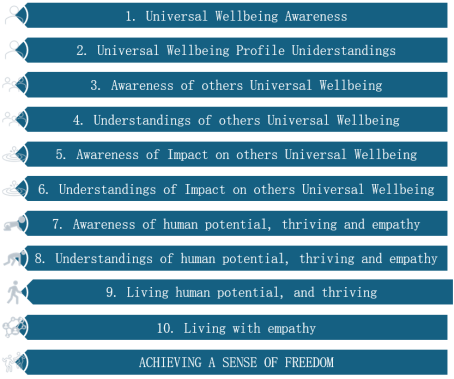
Building on past research, an Impact Evaluation identified key drivers of poor wellbeing and its associated consequences: a lack of clarity about what wellbeing is; limited evidence based information about what influences it; insufficient understanding of how it can change over time; and limited knowledge about how it can be measured and sustained. Evidence from previous investigations has informed the development of a Theory of Change that incorporates three key elements:
1) Provision of personally relevant, transformative, and powerful applied learning about Universal Wellbeing and one’s own Universal Wellbeing profile .
2) Recognition that survival related wellbeing needs take priority over all other needs and life demands ; that is, impenetrability is in play.
3) Development of empathetic identification of one’s impact on the Universal Wellbeing of others, formal operations and enactment of empathy are possible through progressively scaffolded learning .
The UWEL Intervention programme provides learning related to steps 1 to 5.

Download: Download full-size image

Figure 1. Universal Wellbeing Literacy - Theory of Change Steps.
3.12. Universal Wellbeing Evaluation Literacy (UWEL) Intervention
The UWEL is designed to facilitate UW literacy to a level where measurable improvements in programme completion, and dropout rates occur. This Intervention (one of three available) was selected as the most suitable for this investigation due to participants being volunteering learning support staff from diverse organisations.
The UWEL Intervention programme experienced by participants included:
1) Sixty minute online UWM and UWET Induction
2) Provision of Research Project Information and Consent Sheets
3) Participant Consent giving
4) UWET Administration
5) Draft UWET Report Back meeting
6) Answering two qualitative questions
7) Final UWET Report provision
8) Online UWEL Debrief
Note 3: A protocol variation is applied when a participant is identified as being at risk
4. Results
4.1. Quantitative Data Analysis
Participant demographics, programme completion rates, and dropout rate results are reported below.
4.1.1. Gender
The participant population was 94% female and 6% male; no participants identified with any other gender. Between-group gender differences were not statistically significant. The gender distribution reflected national learning-support workforce patterns.
4.1.2. Age
Table 1. Participants Ages.

19 to 26 years

26 to 35 years

36 to 45 years

46 to 55 years

56 to 65 years

66 to 75 years

14%

12%

24%

36%

11%

3%

There were no significant age differences between groups.
4.1.3. Ethnicity
Both groups were ethnically diverse; the experimental group included 16% more Indigenous participants than the control group. Indigenous students achieve 10% lower results in higher education typically. To protect participant confidentiality, the number of individuals associated with each descriptor is not reported.
Participants self identified using 48 unique ethnic descriptors, including (but not limited to): Māori; Māori–European; Indian; NZ European; NZ Māori; NZ Pākehā; Pacific; English; Welsh; French; Cook Island; Irish; West Asian; Turkish; Māori–Pākehā; Afrikaans; South African; South African–Indian; Māori–Iraqi; British; Nepalese; NZ European–NZ Māori; Māori–Cook Island Māori; European; European–Kiwi; Kiwi; White–South African; Samoan–Italian; New Zealand–Irish; White–European–Irish; Chinese; Aboriginal; Sri Lankan–Sinhalese; Māori–Australian; Caucasian–Māori; Samoan–Chinese; Samoan–Pacific; Italian–European; Australian; Māori–Kiwi; White South African; Chinese–European; Caucasian; Mixed; Mongrel; UK European; New Zealander; Chilean; Filipino; NZ Scottish; and Irish.
4.1.4. Programme
Table 2. Participant Groups, and Programme Modules.

Group

N

Mode

Number of Programme Modules

Control

100

Online learning

2

Experimental

100

Online learning

3

The experimental group completed 3 modules while the control group completed 2 modules over 18 months.
Table 3. Programme Completion, Dropout and Withdrawal Rates.

Group

Programme Completions

Total Dropouts

Withdrawals

Control

51%

36%

13%

Experimental

94%

0%

6%

Programme completions refer to students who completed full programmes and all required modules. Dropouts refer to students who left the programme without withdrawing formally or who became uncontactable. Withdrawals refer to students who withdrew formally from the programme.
4.2. Qualitative Data Analysis
Thematic analysis was applied to all qualitative data gathered. Experimental group participants were asked to two open ended questions by facilitators during their individual Draft UWET Report Back meetings. Participant responses were recorded verbatim; post analysis the following themes emerged.
4.2.1. Research Question 3
RQ3. What are your views on the Universal Wellbeing Model you learned about?
Table 4. Theme One – Learning about the Universal Wellbeing Model was a positive experience.

Participant

Response

30

It's a good model and the 6 dimensions are better than the usual 4 so often seen in models. These components are such an important part of who people are.

46

I identified with it, found it valid.

61

Very comprehensive. From my professional capacity with a staff of 1,500 people.

68

I think it’s great, I've read the WTR/W paper, now you've take everything further in this model. Its strength based, I like it. Most diagnose rather than give you a full picture.

70

Great, the determinants really help, includes everything, helps us know and identify ourselves, family and work mates.

Analysis found that participants regarded learning about the UWM as a positive experience. Their responses typically explained what they valued about it, including its components, validity, comprehensiveness, strengths based approach, and the applicability of the determinants to their personal, home, and work contexts.
Table 5. Theme Two – Learning about the Universal Wellbeing Model supports reflection and critical thinking.

Participant

Response

18

I did not see the background and what might be happening to the children before, learning about that has been really helpful.

39

The UWM is very good at helping you to focus you on wellbeing and where you are and what you are able to do.

58

It sparked so many thoughts and conversations that went on. I would really recommend this model to others.

65

In terms of my job, has made me critical about how poorly we manage our student’s whole wellbeing.

75

My initial thought was that the model was very dense but having had a facilitated report back session I now have clarity and can see it at work in my family and workplace.

Analysis also showed learning about the UWM supported participants to think in more reflective and critical ways and to consider new and different perspectives. They frequently described how they could apply the UWM.
Table 6. Theme Three – Learning about the Universal Wellbeing Model increased self and wellbeing knowledge.

Participant

Response

5

I have learnt a lot about myself and what I've been ignoring.

19

It has really totally expanded my ideas about what could be affecting the students I am working with.

42

The UWM shows us that sensory experiences can impact us directly and a lot of people don't know this. Learning about this has been amazing. Each part comes together to build wellbeing and we can see when we are conscious we can make them matter and our wellbeing better.

57

My Manager is eager for me to expand my knowledge base; this work was genuinely interesting and extending. More inclusive than current models we use. The seventy determinants really effect wellbeing. Touch on every aspect of life.

67

The holistic side of things was really eye opening. I had thought about it but didn't have the clarity about how the different dimensions could impact. It gave me awareness. I'm really looking forward to learning more deeply about the model and applying it to daily activities.

Participants reported that the UWM provided them with new knowledge about themselves and their wellbeing. They noted that the model enhanced their understanding of their own wellbeing, their students, and their daily lives.
Table 7. Theme Four – Learning about the Universal Wellbeing Model supported positive change.

Participant

Response

14

I thought the UWM was a kind of therapy, now I think it’s a map. The Universal Wellbeing Model shows you a lot of places you need to go to, look after and change to reach Universal Wellbeing. I am loving using it on myself and with the kids I support.

22

It has been valuable to be able to categorise and find reasons for me and my daughters relationship breakdown. I have made changes for me and my family that are working!

31

The model takes into account each individual and this is important for application. The model was a very practical one that help you to make changes and improvements.

48

I work with lots of wellbeing Tools and did not like how Whare Tapa Wha lumped Intellectual and Emotional together. I love working with a Model that is so inclusive and practical, it really guides me now.

64

I really like being able to reframe. When your UW is high, your hard work is paying off. I am doing well. I can now see in the past I was not so well, I had to learn how my thoughts effected my behaviour. This relates to my work with staff; I need to help them make the links I have. I’m currently exploring whether it can be the basis for our new psychosocial system.

Analysis further found that many participants felt prompted and empowered by what they learned to make positive changes. Many stated that they had already made changes or intended to make changes as a result of their learning.
4.2.2. Research Question 4
RQ4. What was your experience of completing the Universal Wellbeing Evaluation questionnaire?
Table 8. Theme One – Completing the UWET was a positive experience.

Participant

Response

16

It was interesting not scary.

41

A wow in a positive way.

69

Affirming. Very gratifying, enjoyable, validating.

73

Positive, enjoyable and interesting experience.

Analysis found that participants regarded completing the UWET as a positive experience. Participants reported the UWET was interesting, enjoyable, easy to complete, affirming, and validating.
Table 9. Theme Two – Participants support the UWET length and content.

Participant

Response

15

Good length has everything.

52

Its good, the volume of the questions makes the report more accurate.

63

Fine, a lot quicker than anticipated.

71

Good, quick and easy to do and understand.

Analysis also showed that participants supported both the length and content of the UWET.
Note 4: Respondents have been unanimously positive about the number and content of items included in UWET, this contrasts with the views of some trail reviewers who considered the number of items to be excessive.
Table 10. Theme Three – UWET can be challenging initially for some respondents.

Participant

Response

33

It's clear and being English based I hoped I could relate readily to it.

45

Frankly the questioning was triggering around family and ethnicity and culture, manageable though. My family were a source of harm; this is very helpful actually.

66

Calming, yet triggering. Doing UWET was more triggering than doing the report back, I was triggered but at a manageable level. I stopped feeling triggered when I submitted it.

78

I felt unsure about if I was getting it right, I usually try to work out what questionnaires want, like in assessments but in the end I just did what I thought using intuition and it turned out great.

A small number of participants (< than the expected 5%) reported experiencing initial doubts, anxiety or brief triggering (2 participants). They described these reactions resolved upon UWET submission and were manageable. Some noted that the UWET reminded them of school-based assessment, which elicited similar feelings of anxiety.
Note 5: The standardised UWET administration, analysis and reporting processes conducted by accredited facilitators are designed to identify risks and ensuring respondents holistic safety.
Table 11. Theme Four – Completing the UWET prompted reflection and critical thinking.

Participant

Response

4

We don’t normally think of these things and it’s been a big realisation. We should do these reflections more in our lives.

17

Many questions I had never thought about, it was like in a mirror pointing out and encouraging me to look at all parts of yourself.

49

Thought provoking, quite timely for me to be doing, feeds into things I was focusing on in my life.

77

Gave me some new things to think about and consider in terms of my overall wellbeing.

Analysis found that completing the UWET prompted participants to reflect on their wellbeing during and after the process. Participants reported thinking more deeply about their wellbeing and considering new aspects of themselves in new ways. They regarded the UWET as facilitating new wellbeing knowledge and insights due to its comprehensiveness and depth. Participants particularly noted gaining greater understandings of their personal wellbeing state.
Table 12. Theme Five – The UWET facilitated new knowledge and learning.

Participant

Response

8

Was thorough, I learnt heaps. I felt it covered everything, loved that.

20

It did give me new areas to think about in terms of my wellbeing.

62

A lot of new information has come from it I wasn’t expecting.

97

I needed to focus on the questions; they are not just shallow questions. They are very well thought through and helpful, they generated new understandings for me.

The analysis found that participants regarded the UWET as facilitating new wellbeing knowledge and insights due to its comprehensiveness and depth. Participants learnt more especially about their own personal wellbeing state.
Table 13. Theme Six – Completing the UWET empowered participants to make positive changes.

Participant

Response

21

I did not know the results would be so thorough and accurate. Enlightening, I've learnt so much, and now I’m making changes.

51

Really useful, thought provoking, I need to try to manage my sleep. I have now puts steps in place and am doing them to improve my sleep.

60

It feels easy to engage with, deceptively easy considering how much you can extract, and find out. Unpacking my UWET report was amazing, hearing back your results, learning about your strengths and capabilities, it really brings things together and you can do what comes next.

76

I hadn't considered myself in terms of UW, or the ethnic, cultural and spiritual areas at all. I understand why the report is best gone through together rather sent out ahead, it really helped me plan and make some changes in my life.

The analysis found that participants felt empowered and motivated to make positive changes based on what they learned during their Draft UWET Report Back meetings or from their Final UWET Reports. Many participants stated that they intended to or had already made changes as a result of their learning.
5. Discussion
Analysis of quantitative data answered research questions 1 and 2. It showed that the control group, supported by a conventional pastoral care and wellbeing system, achieved a 51% programme completion rate in contrast, with the experimental group, which participated in the UWEL Intervention programme, who achieved a 94% completion rate. The hypothesis proposed predicted that the intervention group would achieve an 8% to 30% higher completion rate than the control group; the experimental group exceeded this expectation, achieving a 43% higher completion rate. Dropout and withdrawal rates also contrasted sharply; the control group had a 36% dropout rate and a 13% withdrawal rate while the experimental group, which had a 0% dropout rate and a 6% withdrawal rate. The experimental group’s achievements are notable given two additional variables: participants in this group had to complete an extra module, and the group included 16% more Indigenous students, who typically achieve results approximately 10% lower than the general population.
Analysis of qualitative data provided by experimental group participants contributed insights on research questions 3 and 4. Four themes emerged from participant views of learning about the UWM revealing it was i) a positive experience, ii) supported reflection and critical thinking, iii) increased self and wellbeing knowledge and iv) supported positive behaviour changes. Seven themes emerged from participant experiences of completing the UWET: it was i) a positive experience, ii) the length and content was supported, iii) it was initially challenging for some participants, iv) prompted reflection and critical thinking, v) facilitated new knowledge and learning and vi) empowered participants to make positive changes.
There are synergies between the UWM and UWET themes suggesting learning about the UWM then and completing the UWET followed a spiral re-visit learning approach that was reinforcing, complementary and transformative. Only UWET themes ii) and iii) that address personal responses to the experience differ. When the emerging themes are compared with the three key Theory of Change elements the alignment with participant experiences is clear. Firstly, they engaged in personally relevant and powerful applied learning about UW and their own UW profiles, secondly it is clear 94% of the participants overcame survival level wellbeing needs (impenetrability occurred for some), and thirdly empathetic identification and enactment of this capability for themselves and others occurred. Overall, the themes indicate that the experimental group, predominantly achieved or exceeded UW Literacy Theory of Change Steps 1 through 5.
New insights emerging from this investigation include awareness that respondents supported both the length and content of the UWET; and that both the UWM and UWET facilitate the development of cognitive, reflective, and critical thinking capabilities. A final finding was that participants expressed feelings of being truly known voluntarily and understood fully during the Draft UWET Report Back meetings. These sentiments—and their potential value and impact—warrant further investigation.
The themes emerging from analysis relate to and support findings in the literature discussed. For example, the proactive relationship formation and positive interactions in the first two weeks of programmes was supported by the proactive administration of the UWEL Intervention programme. The facilitation and building of trust advocated for by Relf et al., , occurred during the UWET administration, analysis and report back processes. The need for inclusive and holistic approaches to student support , and the humanising and holistic support of learning , were supported by learning about and living the UWM and UWET during the Intervention programme. The Intervention equipped the students with the awareness, knowledge, and capabilities needed to recognise and address UW challenges faced during their online programmes. Overall, these findings support the conclusion that the UWEL Intervention effectively facilitated student UW Literacy to a transformative level that positively influenced programme completion and reduced dropout rates in the higher education online learning contexts investigated.
6. Conclusion
The conduct of this investigation raises four key issues for wellbeing researchers; each has been discussed extensively in the literature reviewed. Seary and Williams identified the first two issues when they asserted, a conception of wellbeing that effectively meets the holistic needs of higher education online students “is a complex yet under-researched matter in higher education” (p.19). The first key issue they detected is that of the complexity of wellbeing. Oades supported their view in an address, which indicated eloquently the biggest challenge facing the global development of wellbeing science; is ‘psychological reductivism’. Psychological reductivism is a term he uses to describe the simplistic five component psychological well-being models that dominant the field for example Ryan and Deci’s self-determination theory that claims to facilitate intrinsic motivation, social development and well-being, via ‘the only three innate psychological needs that exist; competence, autonomy and relatedness that supposedly when satisfied yield self-motivation and well-being, and Seligman’s, Perma Model which claims well-being has just five parts: Positive Emotion, Engagement, Relationships, Meaning, and Accomplishment.
While these and other health-based well-being models attempt to describe what it is they are reductive in nature, have unclear evidence bases, and may be misleading due to their limited perspectives, and lack of access to finding in other fields. These models also often borrow public health perspectives despite clinicians predominantly working with individuals. Missing from these reductionist models are evidence based multi, transdisciplinary, and authentically holistic understandings of human wellbeing. Examination of latter literature leads to complex multi-faceted and hierarchical conceptions of wellbeing such as the UWM.
The second issue identified is the lack of ongoing wellbeing, and replicable wellbeing intervention research programmes. Many researchers seem to visit and then leave this field. A third issue identified by Hilliam and Williams is the presence of successful partnerships between academic and wellbeing staff that have improved completion rates, and reduced dropout rates, even with minimal supports. Most successful initiatives (like theirs) were ceased due to unresolved staff capability, workload, and boundary concerns. Notably, none of the reviewed literature included a cost–benefit analyses before they were cancelled.
A fourth and associated institutional issue is the apparent lack of motivation and leadership to pursue improvements in low completion and high dropout rates in higher education despite their significant consequences. Consequentially the challenge of low online learning programme completions and high dropout rates in institutions continues globally. In 2024 the Australian Department of Education: Accord urged action on low completion rates and staff and student wellbeing. In 2025, Liam Knox (HEA, CEO) indicated that less than half of students at the largest nonprofit online institutions in the United States earned a degree after eight years. He was left asking: “Is it an unfortunate reality or a cry for accountability?”
The final issue identified is the chasm between evidence-based solutions, and widespread, multi ecological system level implementation of effective interventions. While funders could demand improved value for money outcomes and require institutions to innovate and pioneer new evidence-based replicable wellbeing interventions, only in the US has such a culture change began to occur. Despite the possible advances this investigation and others have heralded, in Australia and New Zealand degree programme completion expectations are increasing from 3 to 6 currently, to possibly 9 years. Continuing the above trajectory seems to be the status quo despite technological, wellbeing, and learning, science advances, low student wellbeing and programme completion rates continue.
Meanwhile possible societal equity improvements slip away…
7. Further Research
Intervention investigations including:
1) Large scale (possibly randomized control trial) multi ecological level system implementation with a primordial prevention orientation ;
2) Populations experiencing survival related wellbeing needs in order to better understand the relationship between wellbeing and impenetrability; and
3) A focus on the transformational power of participants feeling truly, known, and fully understood.
Abbreviations

DoUW

Determinants of Universal Wellbeing

MOOCs

Massive Open Online Courses

PLD

Professional Learning and Development

UDL

Universal Design for Learning

UWEL

Universal Wellbeing Evaluation and Literacy Intervention

UWM

Universal Wellbeing Model

UWET

Universal Wellbeing Evaluation Tool

ZPD

Zones of Proximal Development

Acknowledgments
The ongoing support of the named institutions, fellow researchers and participants is acknowledged, as is Dr Syed Shadid for his independent validation analysis and report on the UWET reliability and validity.
Author Contributions
Susan Frances Stevenson: Conceptualization, Data curation, Formal Analysis, Investigation, Methodology, Project administration, Resources, Software, Supervision, Visualization, Writing – original draft, Writing – review & editing
Kay Fielden: Writing – review & editing
Funding
The investigation reported received no funding.
Conflicts of Interest
There are no conflicts of interest.
References
[1] Al Abri, M., & Elhaj, A. (2025). Quality criteria for online courses. International Review of Research in Open and Distributed Learning, 26(2).
[2] Anghel, E., Littenberg-Tobiasi, J., & von Davier, M. (2025). What did we learn about massive open online courses for teachers? A scoping review. International Review of Research in Open and Distributed Learning, 26(2).
[3] Bağrıacık Yılmaz, A., & Karataş, S. (2022). Why do open and distance education students drop out? Views from various stakeholders. International Journal of Educational Technology in Higher Education, 19(1).
[4] Badali, M., Hatami, J., Banihashem, S. K., Rahimi, E., Noroozi, O., & Eslami, Z. (2022). The role of motivation in MOOCs’ retention rates: A systematic literature review. Research and Practice in Technology Enhanced Learning, 17(5).
[5] Brewster, L., Jone, E., Priestley, M., Wilbraham, S. J., Spanner, L., & Hughes, G. (2022). “Look after the staff and they would look after the students”: Cultures of wellbeing and mental health in the university setting. Journal of Further and Higher Education, 46(4), 548–560.
[6] Bronfenbrenner, U. (1979). The ecology of human development. Harvard University Press.
[7] Carlsen, A., Holmberg, C., Nehina, C., & Owusu-Boampong, A. (2016). Closing the gap: Opportunities for distance education to benefit adult learners in higher education. UNESCO.
[8] CAST. (2018). Universal design for learning guidelines version 2.2.
[9] Celik, B., & Cagiltay, K. (2024). Uncovering MOOC completion: A comparative study of completion rates from different perspectives. Open Praxis, 16(3), 445–456.
[10] Chung, J., McKenzie, S., Schweinsberg, A., & Mundy, M. E. (2022). Correlates of academic performance in online higher education: A systematic review. Frontiers in Education, 7, 820567.
[11] Cowie, H. (2022). Pastoral care in education today: Its continuing role in promoting mental health in children and young people. Pastoral Care in Education, 40(3), 321–327.
[12] Crawford, N., & Johns, S. (2018). An academic’s role? Supporting student wellbeing in pre?university enabling programs. Journal of University Teaching & Learning Practice, 15(3), 1–21.
[13] Crawford, N., Kift, S., & Jarvis, L. (2019). Supporting student mental wellbeing in enabling education: Practices, pedagogies and a philosophy of care in transitioning students into higher education. Routledge.
[14] Creswell, J. W. (2018). Research design: Qualitative, quantitative, and mixed methods approaches (5th ed.). Sage Publications.
[15] Deng, W., Hu, D., Xu, S., Wang, Y., Zhang, J., Tang, X., & Xiao, Z. (2019). The efficacy of virtual reality exposure therapy for PTSD symptoms: A systematic review and meta?analysis. Journal of Affective Disorders, 257, 698–709.
[16] Department of Education. (2024). Australian Universities Accord Final Report.
[17] Dillie, K. B., & Røkenes, F. M., (2021). Teachers’ professional development in formal online communities: A scoping review. Teaching and Teacher Education: An International Journal of Research and Studies, 105, p. 1–17.
[18] Douglas, V, Pattison, N. Warren, K. & Karanika-Murray, M. (2024). Wellbeing in the higher education sector: A qualitative study of staff perceptions in UK universities. Journal of Workplace Behavioral Health,
[19] Elibol, S., & Bozkurt, A., (2023), Student Dropout as a Never-Ending Evergreen Phenomenon of Online Distance Education. European Journal of Investigation in Health, Psychology and Education, Vol. 13. pp. 906-918.
[20] Fielden, K., Stevenson, S., Going, N., Grant, S., & Zagala, K. (2020a). Whare Tapa Rima – The Five-Sided Home: a best practice holistic learner support model project. Ako Aotearoa. Ako Aotearoa.
[21] Fielden, K., Stevenson, S., Going, N., Grant, S., & Zagala, K. (2020b). Whare Tapa Rima. In Digital Video. Ako Aotearoa Norther Hub Project Colloquium. Ako Aotearoa.
[22] Graham, S. F. (2001). Testing Graham’s Teaching Conditions Theory. Australia New Zealand Dance Research Society Journal, Vol. 1 P. 21-37.
[23] Hilliam, R., & Williams, G., (2019). Academic and pastoral teams working in partnership to support distance learning students according to curriculum area, Higher Education Pedagogies, 4: 1, pp. 32-40,
[24] Hodges, B., (2013). Enabling Retention: processes and strategies for improving student retention in university-based enabling programs – Final Report. Office of Teaching and Learning, Australian Government.
[25] Jordan, K., (2015). Massive Open Online Courses Completion Rates Revisited: Assessment, length and Attrition. International Review of Research in Open and Distributed Learning. Volume 16, Number 3 June – 2015.
[26] Katajavuori, N., Hailikari, T., & Asikainen, H., (2025). Enhancing students’ well-being and studying in higher education: a comparison of two different study skill courses. Front. Educ. 10: 1485784.
[27] Knox, L. (2025, January 8). At large online colleges, students struggle to earn degrees. Inside Higher Ed.
[28] Kokila Ranasinghe, T., Fernando, L. D., Vineeshiya, N., & Bozkurt, A. (2025). Identifying Reasons That Contribute to Dropout Rates in Open and Distance Learning. International Review of Research in Open and Distributed Learning, Volume 26, Number 2, May – 2025.
[29] Lay, C., Allman, B., Cutri, R., & Kimmons, R., (2020). Examining a Decade of Research in Online Teacher Professional Development. Frontiers in Education, Vol. 5,
[30] Lister, K., Riva, E., Hartley, A., Waterhouse, P., Moller, N., Downes, L., Coughlan, T., Kukulska-Hulme, A., McPherson, E., Macdonald, I., Jones-Tinsley, S., Brown, C., & Tudor, R., (2024). Positive Digital Practices: Supporting Positive Learner Identities and Student Mental Wellbeing in Technology Enhanced Higher Education. Journal of Interactive Media in Education, Vol. 1, Number 5, pp. 1–20.
[31] Maslow, A. H., (1943). A theory of human motivation. Psychological Review, 50(4), 370-396.
[32] McKelvie-Sebileau, P., Baddock, S., Iosua, E., Smith, L., Wu, L., Andersen, P., Miller, S., Leonard, G., Haggerty, C., Te Maihāroa, K., Brownie, S., & Tipene-Leach, D., (2022). A Longitudinal Study Exploring Resilience and Wellbeing of Staff from Five Institutions Across the Te Pūkenga Network During the 2020 COVID-19 Lockdown and Subsequent Lifting of Social Restrictions. In ITP Research Symposium. Conference proceedings, November 2022.
[33] Motta, S., & Bennett, A., (2018). Pedagogies of care, care‑full epistemological practice and caring subjectivities in enabling education. Teaching in Higher Education, 23(5), 631–646.
[34] McKenzie, S., Jongenelis, M. I., & Kiropoulos, L. (2024). The Encyclopedia of COVID: Book Chapter: Wellbeing in the Time of COVID. Volumes 1-18 Volume 1-18, 1 January 2024, pp. 3679-3693 Nova Science Publishers, Inc.
[35] Mishra, A., & Kanti Das, T., (2017). Methods of Impact Evaluation. in SSRN Electronic Journal April 2017. pp. 1-29.
[36] Misra, S., & Mishra, A., (2019). Is Ultimate Attribution Error Universal? Inter-group Attribution for Success and Failure among University Students in Delhi. Psychological Studies,. Psycholology Studies, pp. 1-13.
[37] Nash, R.D., (2005). Course Completion Rates among Distance Learners: Identifying Possible Methods to Improve Retention. Online Journal of Distance Learning Administration, Volume 8 No. 4 Winter.
[38] Neut-Aguayo, G. H., & Rivera-Vargas, P., (2022). Pedagogies of Precariousness in Neoliberal Educational Order: Insecurity and recomposition of possibilities in the current political-pedagogical context. Foro de educación, 20(2) pp. 39-60.
[39] Oades, L. G., (2018). MGSE Deans Lecture - How do we Learn to Thrive? The Emergence of Wellbeing Science. 22nd November 2018.
[40] O’Brien, T., & Guiney, D., (2018). Staff Wellbeing in Higher Education. London: Education Support Partnership.
[41] Pacansky-Brock, M., Smedshammer, M., & Vincent‑Layton, K., (2020). Humanizing online teaching to equitize higher education. Current Issues in Education, Volume 21, Number 2.
[42] Papadakis, S., (2023). MOOCs 2012-2022: An overview. Advances in Mobile Learning Educational. Research, 3(1), 682-693.
[43] Patton, M. Q., & Campbell-Patton, C. E., (2021). Utilization-focused evaluation (5th ed.). SAGE Publications.
[44] Piaget, J. (1971). The theory of stages in cognitive development. In D. R. Green, M. P. Ford, & G. B. Flamer, Measurement and Piaget. McGraw-Hill.
[45] Pelletier, K., Brown, M., Christopher Brooks, D., McCormack, M., Reeves, J., & Arbino, N., with Bozkurt, A., Crawford, S., Czerniewicz, L., Gibson, R., Linder, K., Mason, J., and Mondelli, V., (2021). EDUCAUSE Horizon Report, Teaching and Learning Edition (Boulder, CO: EDUCAUSE, 2021).
[46] Rahman et al. (2024). Health and wellbeing of staff working at higher education institutions globally during the post‑COVID‑19 pandemic period: evidence from a cross‑sectional study. BMC Public Health, 24: 1848
[47] Rahmani, A. M, Groot, W., & Rahmani, H., (2024). Dropout in online higher education: a systematic literature review. International Journal in Educational Technology Higher Education (2024) 21: 19
[48] Rekkedal, T., (1985). Introducing the personal tutor/counsellor in the system of distance education. project report 2: final report. NKI-Skolen Undervisningssentrum, Oslo (Norway). 109p.; Project: Early Withdrawal in Distance Education; Organized by the Norwegian Association for Distance Education.
[49] Relf, B., Crawford, N., O’Rourke, J., Sharp, S., Hodges, B., Shah, M., Katersky Branes, R. (2017). Lighting the path(way): articulating curriculum design principles for open access enabling programs. Australian Government, Department of Education and Training.
[50] Ryan, R. M., & Deci, E. L. (2000). Self-determination theory and the facilitation of intrinsic motivation, social development, and well-being. American Psychologist, 55(1), pp. 68-78.
[51] Salmon, J., Hesketh, K. D., Arundell, L., Downing, K. L., & Biddle, S. J. H., (2020). Changing behavior using ecological models. In M. S. Hagger, L. D. Cameron, K. Hamilton, N. Hankonen, & T. Lintunen (Eds.), The Handbook of Behavior Change (pp. 237-250). Cambridge: Cambridge University Press.
[52] Schofield, A., Walker, L., & Going, N. (2011). Supporting academic success to minority group students in a private tertiary establishment. Ako Aotearoa.
[53] Seary, K., & Williams, J., Pastoral Care and the Caring Teacher – Value Adding to Enable Education. Student Success. Volume 11 (1) 2020
[54] Seligman, M. E. P. (2011). Flourish: A visionary new understanding of happiness and wellbeing. Free Press.
[55] Shahid, S. (2025). Independent reliability and validity evaluation of the Universal Wellbeing Evaluation Tool report. Unpublished report, Freedom Wellbeing Institute. Available upon request.
[56] Shikulo, L., & Lekhetho, M., (2020). Exploring student support services of a distance learning centre at a Namibian university, Cogent Social Sciences, 6: 1, 1737401, Link to article:
[57] Stevenson, S. F., Fielden, K. Gurung, M. & Zagala, K. (2023). The Universal Wellbeing Model: A Theory Designed to Transform Praxis. Journal on Excellence in College Teaching, 34(4), pp. 101-133.
[58] Stevenson, S. F., Gurung, M., & Zagala, K. (2024a). Emergence of the Universal Wellbeing Model - A Journey from Indigenous Cultural Responsiveness to International Relevance and Applicability. Journal of University Teaching and Learning Practice SPECIAL ISSUE: Internationalisation of Higher Education at Home: Implications for an Evolving World. Vol. 21 No. 04
[59] Stevenson, S. F., (2024b). Universal Wellbeing Evaluation Tool Overview and Profile. Hamilton, New Zealand: House of Montrose Ltd.
[60] Stevenson, S. F., (2025a). Technology Supported Universal Wellbeing Evaluation Tool Based Interventions. Hamilton, New Zealand: House of Montrose Ltd.
[61] Stevenson, S. F., & Fielden, K. (2025b). Impact Evaluation Contributes Ethnic and Cultural Perspectives on the Universal Wellbeing Model Development Journey. Evaluation Journal of Australasia, 0(0).
[62] Stevenson, F. (2025c). Universal Wellbeing in a Nutshell. Publisher, House of Montrose Ltd. Hamilton, New Zealand. Available at
[63] Stone, C., & O’Shea, S. (2016). Older, online and first: Recommendations for retention and success. Australasian Journal of Educational Technology, 35(1), 57-69.
[64] Sweet, R. (1986). Student dropout in distance education: An application of Tinto’s model. Distance Education, 7(2), 201–213.
[65] Terry, G., & Hayfield, N. (2021). Essentials of thematic analysis. American Psychological Association.
[66] Tinto, V., & Cullen, J., (1973). Dropout in higher education: a review and theoretical synthesis of recent research. Office of Education (DHEW), Contract OEC-0-73-1409, 99. Retrieved from
[67] Tinto, V. (1975). Dropout from higher education: a theoretical synthesis of recent research. Review of Educational Research, 45(1), 89-125.
[68] Tinto, V. (1997). Classrooms as communities: exploring the educational character of student persistence. The Journal of Higher Education, 68(6), 599-623.
[69] Turner, K., & Garvis, S., (2023). Teacher Educator Wellbeing, Stress and Burnout: A Scoping Review. Educ. Sci, 2023, 13, 351.
[70] Van de Poël, J. F., & Verpoorten, D., (2019). Designing a MOOC – A new channel for teacher professional development? In M. Calise, C. Delgado Kloos, J. Reich, J. Ruiperez?Valiente, & M. Wirsing (Eds.), Digital Education: At the MOOC Crossroads Where the Interests of Academia and Business Converge (Lecture Notes in Computer Science, Vol. 11475, pp. 91–101). Springer.
[71] Veletsianos, G., & Shepherdson, P., (2016). A systematic analysis and synthesis of the empirical MOOC literature published in 2013–2015. The International Review of Research in Open and Distributed Learning, 17(2), 198–221.
[72] Vygotsky, L., (1980). Mind in society: The development of higher psychological processes. Harvard University Press.
[73] Wheelan, C. J. (2013). Naked statistics: Stripping the dread from the data. W. W. Norton & Company.
[74] Wilson, C., Knight, G., Leadbeater, W., Shephard, N., Shokr, H., Taylor, J., Vettraino, E., Warren, A., & Higson, H., (2022). Curriculum design for mental health and wellbeing: guidance and resources for learning and teaching development programmes in higher education. AdvanceHE.
[75] Xavier, M., & Menses, J., (2024). The Tensions Between Student Dropout and Flexibility in Learning Design: The Voices of Professors in Open Online Higher Education. International Review of Research in Open and Distance Learning. Vol. 22, pp 1-17. 22(4): 72-88
[76] Xu, D., Li, Q., & Zhou, X., (2020). Online Course Quality Rubric: A Tool Box. Online Learning Research Center, University of California, Irvine.
[77] Zawacki-Richter, O., & Latchem, C., (2018). Exploring four decades of research in Computers and Education. Computers and Education,
[78] Zawacki-Richter, O., & Qayyum, A. (2019). Open and Distance Education in Asia, Africa and the Middle East: National Perspectives in a Digital Age. Springer.
Cite This Article
  • APA Style

    Stevenson, S. F., Fielden, K. (2026). UWEL Intervention Raises Programme Completion Rates in Higher Education Online Learning. Higher Education Research, 11(3), 62-78. https://doi.org/10.11648/j.her.20261103.13

    Copy | Download

    ACS Style

    Stevenson, S. F.; Fielden, K. UWEL Intervention Raises Programme Completion Rates in Higher Education Online Learning. High. Educ. Res. 2026, 11(3), 62-78. doi: 10.11648/j.her.20261103.13

    Copy | Download

    AMA Style

    Stevenson SF, Fielden K. UWEL Intervention Raises Programme Completion Rates in Higher Education Online Learning. High Educ Res. 2026;11(3):62-78. doi: 10.11648/j.her.20261103.13

    Copy | Download

  • @article{10.11648/j.her.20261103.13,
      author = {Susan Frances Stevenson and Kay Fielden},
      title = {UWEL Intervention Raises Programme Completion Rates in Higher Education Online Learning},
      journal = {Higher Education Research},
      volume = {11},
      number = {3},
      pages = {62-78},
      doi = {10.11648/j.her.20261103.13},
      url = {https://doi.org/10.11648/j.her.20261103.13},
      eprint = {https://article.sciencepublishinggroup.com/pdf/10.11648.j.her.20261103.13},
      abstract = {Over the past twenty years, global research on online learning in higher education has consistently reported significantly lower programme completion rates for online students compared with face?to?face learners. Economic, technological, pedagogical, and equity aspirations have driven the shift to online learning, yet low completion rates continue to affect students, staff, institutional ratings, employers, and funders. Researchers attempting to improve completion rates through curriculum design and teaching innovations, have achieved only marginal gains. Recently, evidence has suggested a possible causal relationship between student wellbeing and programme completion. This emerging direction includes trialling targeted wellbeing interventions. This study reports on the investigation of a Universal Wellbeing Evaluation and Literacy Intervention (UWEL) programme. Underpinned by the evidence-based Universal Wellbeing Model (UWM) and incorporating a new Universal Wellbeing Evaluation Tool (UWET), the study hypothesised that the UWEL Intervention could increase completion rates by 8–30%. Results show a 94% completion rate for the experimental group compared with 51% for the control group—a 43% difference. These findings demonstrate the potential for standardised wellbeing intervention programmes to substantially increase global higher education online learning completion rates.},
     year = {2026}
    }
    

    Copy | Download

  • TY  - JOUR
    T1  - UWEL Intervention Raises Programme Completion Rates in Higher Education Online Learning
    AU  - Susan Frances Stevenson
    AU  - Kay Fielden
    Y1  - 2026/05/16
    PY  - 2026
    N1  - https://doi.org/10.11648/j.her.20261103.13
    DO  - 10.11648/j.her.20261103.13
    T2  - Higher Education Research
    JF  - Higher Education Research
    JO  - Higher Education Research
    SP  - 62
    EP  - 78
    PB  - Science Publishing Group
    SN  - 2578-935X
    UR  - https://doi.org/10.11648/j.her.20261103.13
    AB  - Over the past twenty years, global research on online learning in higher education has consistently reported significantly lower programme completion rates for online students compared with face?to?face learners. Economic, technological, pedagogical, and equity aspirations have driven the shift to online learning, yet low completion rates continue to affect students, staff, institutional ratings, employers, and funders. Researchers attempting to improve completion rates through curriculum design and teaching innovations, have achieved only marginal gains. Recently, evidence has suggested a possible causal relationship between student wellbeing and programme completion. This emerging direction includes trialling targeted wellbeing interventions. This study reports on the investigation of a Universal Wellbeing Evaluation and Literacy Intervention (UWEL) programme. Underpinned by the evidence-based Universal Wellbeing Model (UWM) and incorporating a new Universal Wellbeing Evaluation Tool (UWET), the study hypothesised that the UWEL Intervention could increase completion rates by 8–30%. Results show a 94% completion rate for the experimental group compared with 51% for the control group—a 43% difference. These findings demonstrate the potential for standardised wellbeing intervention programmes to substantially increase global higher education online learning completion rates.
    VL  - 11
    IS  - 3
    ER  - 

    Copy | Download

Author Information
  • Abstract
  • Keywords
  • Document Sections

    1. 1. Introduction
    2. 2. Literature Review
    3. 3. Methods
    4. 4. Results
    5. 5. Discussion
    6. 6. Conclusion
    7. 7. Further Research
    Show Full Outline
  • Abbreviations
  • Acknowledgments
  • Author Contributions
  • Funding
  • Conflicts of Interest
  • References
  • Cite This Article
  • Author Information