
Pharmaceutical formulation development and manufacturing have evolved rapidly with the advent of nanotechnology-enabled delivery, biopharmaceuticals, continuous manufacturing, and data-driven quality systems. This review synthesizes the state-of-the-art across formulation science and production technologies, with emphasis on industry adoption, regulatory expectations, and practical barriers. We discuss nano- and micro-structured drug products, patient-centric and long-acting designs such as implantable depots and microneedle patches, lyophilization and stabilization of biologics including monoclonal antibodies and vaccines, and digital design-of-experiments under Quality-by-Design (QbD). On the manufacturing side, we examine continuous processing for solid oral dosage forms, Process Analytical Technology (PAT) integrated with real-time monitoring, automation and robotics in aseptic filling lines, and technology transfer from lab to commercial scale. Persistent challenges include material variability from natural excipients, scale-up/scale-out complexities in multiphase systems, regulatory compliance amid evolving FDA/EMA guidelines, cost-to-value trade-offs in personalized medicine, and sustainability concerns like waste generation in solvent-based processes. Critically, we highlight how these challenges can lead to delays in tech-transfer or increased failure rates, as evidenced by recent industry reports from companies like Pfizer and Novartis. In addition to summarizing scientific advances, this review aims to provide practical insights for researchers and industry stakeholders by mapping opportunities against known limitations and regulatory expectations. The inclusion of recent case studies, such as lipid nanoparticle scaling for mRNA vaccines, and decision frameworks is intended to support both academic and industrial audiences. Actionable recommendations and future directions—AI-augmented development for predictive modeling, model-informed control strategies, and green chemistry principles—are proposed to accelerate reliable, affordable, and resilient supply, drawing from 2024–2025 trends in Pharma 4.0.
| Published in | International Journal of Biomedical Science and Engineering (Volume 14, Issue 1) |
| DOI | 10.11648/j.ijbse.20261401.14 |
| Page(s) | 33-41 |
| Creative Commons |
This is an Open Access article, distributed under the terms of the Creative Commons Attribution 4.0 International License (http://creativecommons.org/licenses/by/4.0/), which permits unrestricted use, distribution and reproduction in any medium or format, provided the original work is properly cited. |
| Copyright |
Copyright © The Author(s), 2026. Published by Science Publishing Group |
Pharmaceutical Formulation, Drug Delivery, Biologics, Nanotechnology, Continuous Manufacturing, QbD, PAT, Regulatory Science
Platform | Strengths | Key Risks | Scale-Up Notes |
|---|---|---|---|
Liposomes/LNPs | Biocompatible; versatile cargo | Oxidation; fusion; leakage | Microfluidic mixing; solvent removal |
Polymeric NPs | Controlled release; targeting | Residual solvents; burst release | Emulsion/precipitation; PAT for size |
SLN/NLC | High load for lipophilic APIs | Polymorphic transitions | Hot/cold homogenization; DSC control |
Nanosuspensions | Simple composition | Crystal growth; Ostwald ripening | Wet media milling; stabilizer screening |
Attribute | Batch | Continuous |
|---|---|---|
Scale strategy | Scale-up | Scale-out/intensification |
Attribute | Batch | Continuous |
Quality control | End-product testing | Inline PAT & RTRT |
Footprint | Larger | Compact |
Changeover | Long | Short |
Disturbance handling | Rework/discard | Automated diversion |
Risk | Root Cause | Mitigation | Decision Aid |
|---|---|---|---|
Physical instability | Phase transitions; moisture | Excipient screening; packaging | Stress maps; isotherms |
Scale-up variability | Flow/heat transfer changes | Dimensionless scaling; PAT | RTD models; DoE |
Regulatory delays | Insufficient prior knowledge | QbD dossier; ETP engagement | Established conditions |
Supply chain | Single-source excipients | Dual sourcing; SUT strategy | Risk registers; FMEA |
Sustainability | Solvent/energy intensity | Green metrics; intensification | Life-cycle assessment |
QbD | QbD Quality-by-Design |
PAT | Process Analytical Technology |
RTRT | Real-Time Release Testing |
MPC | Model Predictive Control |
| [1] |
ICH Q8 (R2) Pharmaceutical Development. (2009).
https://database.ich.org/sites/default/files/Q8_R2_Guideline.pdf |
| [2] |
ICH Q9 Quality Risk Management. (2005).
https://database.ich.org/sites/default/files/Q9_Guideline.pdf |
| [3] |
ICH Q11 Development and Manufacture of Drug Substances.
https://database.ich.org/sites/default/files/Q11%2520Guideline.pdf |
| [4] |
ICH Q12 Technical and Regulatory Considerations for Pharmaceutical Product Lifecycle Management.
https://database.ich.org/sites/default/files/Q12_Guideline_Step4_2019_1119.pdf |
| [5] |
ICH Q13 Continuous Manufacturing of Drug Substances and Drug Products.
https://database.ich.org/sites/default/files/ICH_Q13_Step4_Guideline_2022_1116.pdf |
| [6] |
ICH Q14 Analytical Procedure Development.
https://database.ich.org/sites/default/files/ICH_Q14_Guideline_2023_1116_1.pdf |
| [7] | FDA. Guidance for Industry: PAT — A Framework for Innovative Pharmaceutical Development, Manufacturing, and Quality Assurance. |
| [8] | FDA. Quality Considerations for Continuous Manufacturing of Solid Oral Drug Products. |
| [9] | EMA. Guideline on the use of near-infrared spectroscopy in the pharmaceutical industry. |
| [10] |
EMA. Reflection paper on CM and RTRT (where applicable).
https://www.ema.europa.eu/en/real-time-release-testing-scientific-guideline |
| [11] | Amabilino, D. B., et al. Solid form screening and selection—review articles. |
| [12] | Jermain, S. V., et al. Hot-melt extrusion for ASD manufacture. |
| [13] | Jiang, S., et al. Polysorbate degradation in biopharmaceuticals. |
| [14] |
Shire, S. J. High-concentration mAb formulation challenges.
https://www.sciencedirect.com/science/article/pii/S1740674920300202 |
| [15] | Bhugra, C., Pikal, M. Lyophilization cycle development. |
| [16] | Hussain, A. S., et al. NIR spectroscopy for blend uniformity. |
| [17] | Rossi, M., et al. FBRM in crystallization monitoring. |
| [18] | Rogers, T. L., et al. Nanosuspensions for BCS II drugs. |
| [19] |
Müller, R. H., et al. Solid lipid nanoparticles—production and applications.
https://www.sciencedirect.com/science/article/pii/S0169409X12002815 |
| [20] | Thakkar, R., et al. Risk management and FMEA in pharma. |
| [21] |
ICH M4Q(R1) The CTD quality module.
https://database.ich.org/sites/default/files/M4Q_R1_Guideline.pdf |
| [22] | EMA Guideline on process validation for finished products. |
| [23] | Yu, L. X., et al. QbD: an industrial perspective. |
| [24] |
Developing high-concentration monoclonal antibody formulations. Springer. (2025).
https://link.springer.com/article/10.1007/s12551-025-01346-2 |
| [25] | Innovative nanoparticle-based technique. European Pharmaceutical Review. (2025). |
| [26] | Advance in peptide-based drug development. Nature. (2025). |
| [27] |
Recent advancements toward the increment of drug solubility using nanoparticles. Frontiers. (2024).
https://www.frontiersin.org/journals/medicine/articles/10.3389/fmed.2024.1467289/full |
| [28] |
Aulton’s Pharmaceutics: The Design and Manufacture of Medicines (Textbook).
https://shop.elsevier.com/books/aultons-pharmaceutics/taylor/978-0-7020-8154-5 |
APA Style
Hosseini, S. A. (2026). Current Advances and Challenges in Pharmaceutical Formulation Development and Manufacturing: A Comprehensive Review for Industry Applications. International Journal of Biomedical Science and Engineering, 14(1), 33-41. https://doi.org/10.11648/j.ijbse.20261401.14
ACS Style
Hosseini, S. A. Current Advances and Challenges in Pharmaceutical Formulation Development and Manufacturing: A Comprehensive Review for Industry Applications. Int. J. Biomed. Sci. Eng. 2026, 14(1), 33-41. doi: 10.11648/j.ijbse.20261401.14
AMA Style
Hosseini SA. Current Advances and Challenges in Pharmaceutical Formulation Development and Manufacturing: A Comprehensive Review for Industry Applications. Int J Biomed Sci Eng. 2026;14(1):33-41. doi: 10.11648/j.ijbse.20261401.14
@article{10.11648/j.ijbse.20261401.14,
  author = {Seyyed Amir Hosseini},
  title = {Current Advances and Challenges in Pharmaceutical Formulation Development and Manufacturing:
A Comprehensive Review for Industry Applications},
  journal = {International Journal of Biomedical Science and Engineering},
  volume = {14},
  number = {1},
  pages = {33-41},
  doi = {10.11648/j.ijbse.20261401.14},
  url = {https://doi.org/10.11648/j.ijbse.20261401.14},
  eprint = {https://article.sciencepublishinggroup.com/pdf/10.11648.j.ijbse.20261401.14},
  abstract = {Pharmaceutical formulation development and manufacturing have evolved rapidly with the advent of nanotechnology-enabled delivery, biopharmaceuticals, continuous manufacturing, and data-driven quality systems. This review synthesizes the state-of-the-art across formulation science and production technologies, with emphasis on industry adoption, regulatory expectations, and practical barriers. We discuss nano- and micro-structured drug products, patient-centric and long-acting designs such as implantable depots and microneedle patches, lyophilization and stabilization of biologics including monoclonal antibodies and vaccines, and digital design-of-experiments under Quality-by-Design (QbD). On the manufacturing side, we examine continuous processing for solid oral dosage forms, Process Analytical Technology (PAT) integrated with real-time monitoring, automation and robotics in aseptic filling lines, and technology transfer from lab to commercial scale. Persistent challenges include material variability from natural excipients, scale-up/scale-out complexities in multiphase systems, regulatory compliance amid evolving FDA/EMA guidelines, cost-to-value trade-offs in personalized medicine, and sustainability concerns like waste generation in solvent-based processes. Critically, we highlight how these challenges can lead to delays in tech-transfer or increased failure rates, as evidenced by recent industry reports from companies like Pfizer and Novartis. In addition to summarizing scientific advances, this review aims to provide practical insights for researchers and industry stakeholders by mapping opportunities against known limitations and regulatory expectations. The inclusion of recent case studies, such as lipid nanoparticle scaling for mRNA vaccines, and decision frameworks is intended to support both academic and industrial audiences. Actionable recommendations and future directions—AI-augmented development for predictive modeling, model-informed control strategies, and green chemistry principles—are proposed to accelerate reliable, affordable, and resilient supply, drawing from 2024–2025 trends in Pharma 4.0.},
 year = {2026}
}
TY  - JOUR
T1  - Current Advances and Challenges in Pharmaceutical Formulation Development and Manufacturing:
A Comprehensive Review for Industry Applications
AU  - Seyyed Amir Hosseini
Y1  - 2026/03/04
PY  - 2026
N1  - https://doi.org/10.11648/j.ijbse.20261401.14
DO  - 10.11648/j.ijbse.20261401.14
T2  - International Journal of Biomedical Science and Engineering
JF  - International Journal of Biomedical Science and Engineering
JO  - International Journal of Biomedical Science and Engineering
SP  - 33
EP  - 41
PB  - Science Publishing Group
SN  - 2376-7235
UR  - https://doi.org/10.11648/j.ijbse.20261401.14
AB  - Pharmaceutical formulation development and manufacturing have evolved rapidly with the advent of nanotechnology-enabled delivery, biopharmaceuticals, continuous manufacturing, and data-driven quality systems. This review synthesizes the state-of-the-art across formulation science and production technologies, with emphasis on industry adoption, regulatory expectations, and practical barriers. We discuss nano- and micro-structured drug products, patient-centric and long-acting designs such as implantable depots and microneedle patches, lyophilization and stabilization of biologics including monoclonal antibodies and vaccines, and digital design-of-experiments under Quality-by-Design (QbD). On the manufacturing side, we examine continuous processing for solid oral dosage forms, Process Analytical Technology (PAT) integrated with real-time monitoring, automation and robotics in aseptic filling lines, and technology transfer from lab to commercial scale. Persistent challenges include material variability from natural excipients, scale-up/scale-out complexities in multiphase systems, regulatory compliance amid evolving FDA/EMA guidelines, cost-to-value trade-offs in personalized medicine, and sustainability concerns like waste generation in solvent-based processes. Critically, we highlight how these challenges can lead to delays in tech-transfer or increased failure rates, as evidenced by recent industry reports from companies like Pfizer and Novartis. In addition to summarizing scientific advances, this review aims to provide practical insights for researchers and industry stakeholders by mapping opportunities against known limitations and regulatory expectations. The inclusion of recent case studies, such as lipid nanoparticle scaling for mRNA vaccines, and decision frameworks is intended to support both academic and industrial audiences. Actionable recommendations and future directions—AI-augmented development for predictive modeling, model-informed control strategies, and green chemistry principles—are proposed to accelerate reliable, affordable, and resilient supply, drawing from 2024–2025 trends in Pharma 4.0.
VL  - 14
IS  - 1
ER  -
Department of Cellular and Molecular Biology, Islamic Azad University, Kermanshah, Iran
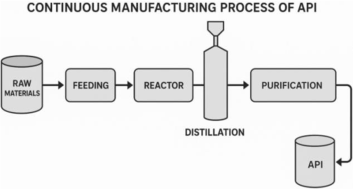
Figure 1. Process flow diagram for continuous pharmaceutical manufacturing of an API (created by author, CC0).
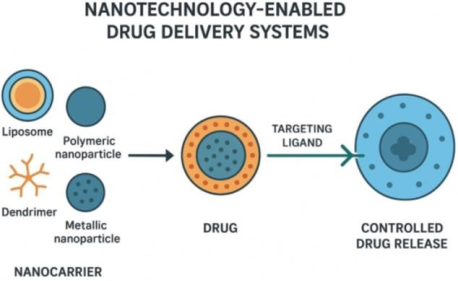
Figure 2. Nanotechnology-enabled drug delivery systems. (created by author, CC0).
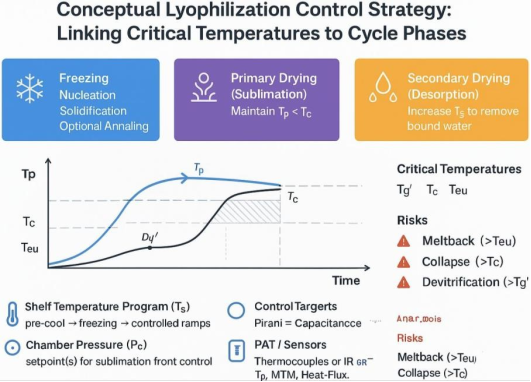
Figure 3. Conceptual lyophilization control strategy linking critical temperatures to cycle phases. (created by author, CC0).
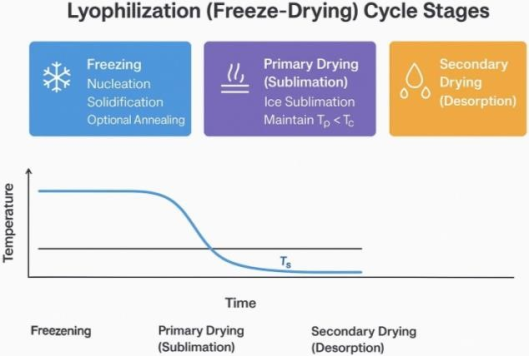
Figure 4. Lyophilization (freeze-drying) cycle stages (created by author, CC0).
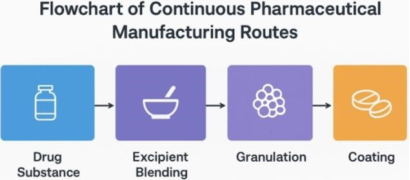
Figure 5. Flowchart of continuous pharmaceutical manufacturing routes. (created by author, CC0).
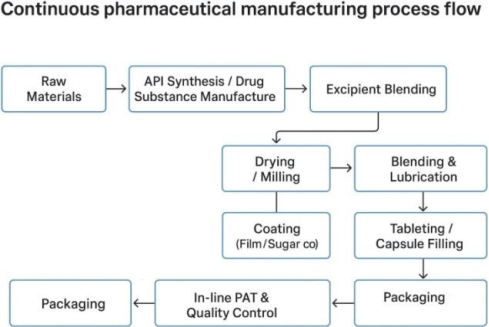
Figure 6. Continuous pharmaceutical manufacturing process flow (created by author, CC0).
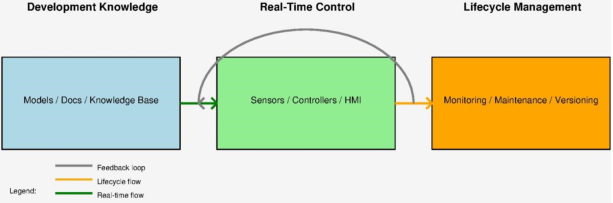
Figure 7. Conceptual data flow linking development knowledge to real-time control and lifecycle management. (created by author, CC0).

Information



 Share This Article
 Twitter
 Linked In
 Facebook
 Copy
Copy Download