Research Article | | Peer-Reviewed

Morphological and Agronomic Variability of Edible Tiger Nut (Cyperus esculentus L.) Accessions Cultivated in Côte d’Ivoire

Received: 1 February 2026     Accepted: 14 February 2026     Published: 4 March 2026
Views:       Downloads:
Abstract

In Côte d'Ivoire, the cultivation of edible nutgrass (Cyperus esculentus L.) is mainly carried out by Senufo, Djimini, and Lobi women using traditional techniques. Given its importance in terms of food, medicine, and economics, promoting this sector is a major asset in reducing nutritional insecurity. However, the diversity of this crop remains poorly researched. This study aimed to characterize the agromorphological diversity of 27 tigernut accessions from four major production areas (Korhogo, Sinématiali, Dabakala, and Doropo) in a randomized experimental design with three replicates, set up in Bouaflé. Twenty-one morphological and agronomic traits related to growth, flowering, production, and yield were measured. High coefficients of variation (CV > 30%) revealed significant variability between accessions. Hierarchical classification analysis (HCA) structured the accessions into two distinct genetic groups. Group I was characterized by vegetative parameters and formed from accessions from the four study locations. Group II consisted of accessions from Korhogo and Doropo and was characterized by production parameters. Discriminant factor analysis (DFA) identified the number of mature tubers (NMT) and the total number of leaves (TNL) as the most discriminating traits. The results of this study will contribute to the implementation of a genetic improvement program for edible tiger nuts in Côte d'Ivoire.

Published in International Journal of Genetics and Genomics (Volume 14, Issue 1)
DOI 10.11648/j.ijgg.20261401.13
Page(s) 25-38
Creative Commons

This is an Open Access article, distributed under the terms of the Creative Commons Attribution 4.0 International License (http://creativecommons.org/licenses/by/4.0/), which permits unrestricted use, distribution and reproduction in any medium or format, provided the original work is properly cited.

Copyright

Copyright © The Author(s), 2026. Published by Science Publishing Group

Keywords

Cyperus esculentus, Diversity, Morphology, Tiger Nut, Production

1. Introduction
Senufo, Djimini, and Lobi women are the main producers of edible tiger nuts in Côte d'Ivoire. . This plant provides important food and financial support for this vulnerable segment of the Ivorian population. Nutritionally, edible tiger nut tubers are rich in carbohydrates, lipids, proteins, trace elements, and essential amino acids . They are also prized for their high content of bioactive compounds and antioxidants, which makes them increasingly attractive to the agri-food industry and for human nutrition . In local and urban markets in Côte d'Ivoire, the price of edible tiger nuts varies from 700 to 1,200 CFA francs, reflecting high demand and continued expansion of the sector . The technical approach to this crop of interest remains traditional and is characterized by the widespread use of non-improved seeds on farms run by women producers. The result of this approach is low production of edible tiger nuts in farmers' fields . In this context, there is an urgent need to implement a genetic improvement program. The first step and the key to the success of this vision is knowledge of the diversity of edible tiger nut accessions available in Côte d'Ivoire. The second step is to identify improved varieties that are adapted to different agroecological zones. Genetic diversity is the foundation of sustainable varietal improvement . It allows for the selection of genotypes that perform well agronomically, are tolerant to biotic and abiotic stress, and meet consumer needs. In this context, studying the agromorphological diversity of edible tiger nut accessions appears to be a key step in identifying discriminating traits and guiding selection work . The technical approach to this crop of interest remains traditional, and three types of genetic markers are generally used to identify genetic diversity, namely phenotypic, biochemical, and molecular. The first strategy is the most widespread, certainly because of its low cost and ease of use . This group includes quantitative and qualitative agronomic parameters, which are essential for the classification and selection of agronomic elites. Principal component analysis (PCA) is one of the most relevant statistical tools for this type of study, as it facilitates the grouping of genotypes according to their similarity by highlighting the most discriminating traits . However, although similar work has been carried out in Nigeria, Ghana, and Spain , scientific data on the agromorphological diversity of edible tiger nuts in Côte d'Ivoire is virtually non-existent. It is therefore necessary to undertake in-depth studies to better characterize local accessions, identify potential breeding stock, and propose varieties adapted to agricultural and industrial needs. The long-term aim of this study is to contribute to strengthening the productivity of edible tiger nuts in Côte d'Ivoire, promoting the economic empowerment of local producers, and supporting the sustainable development of this strategic crop. Thus, the overall objective of this study is to improve the production of edible tiger nuts in Côte d'Ivoire. Specifically, this involves determining the agromorphological diversity of edible tiger nut accessions and identifying the best varieties.
2. Materials and Methods
2.1. Collection Areas and Study Site
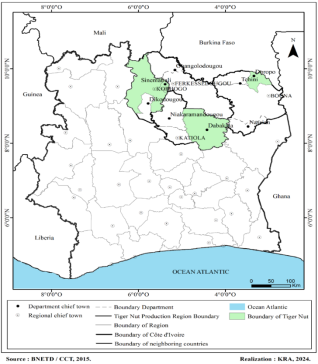
Edible tiger nuts are found in the northern Sudanese part of Côte d'Ivoire, but samples were collected in three main regions: the Poro region (Korogo and Sinementiali), the Hambol region (Dabakala), and the Bounkani region (Doropo). These regions are considered traditional areas for the cultivation of edible tiger nuts, and the reasons why these populations are interested in producing this crop are generally cultural and economic (Figure 1).
Figure 1. Geographic location of collection areas (Korhogo, Sinementiali, Dabakala, and Doropo) for edible tiger nut samples on a map of Côte d'Ivoire .
The trials were set up on an experimental plot in the town of Bouafle (6°59’00’‘North; 5°45'00’' West), the capital of the Marahoue region, located in the central-western part of Côte d'Ivoire. This study site was chosen because of its similarity to traditional tiger nut growing areas and the economic importance of its tubers for certain female traders in Marahoue.
The Bouafle department is a transition zone between forest and savanna with gallery forests and fallow land in places . Rainfall varies between 800 and 1,800 mm per year. The terrain is generally composed of ferralitic and hydromorphic soils . The climate is tropical humid with two rainy seasons and two dry seasons .
2.2. Plant Material
The study of the diversity of edible tiger nuts in Côte d'Ivoire involved identifying the different production areas and collecting samples by production area, locality, and variety, then sowing them at the cultivation site. A total of 972 tiger nut plants from 27 tuber accessions collected in 19 villages in northern Côte d'Ivoire were included in this study. These different accessions were coded and each was assigned a number based on its area of origin (Table 1).
Table 1. Characterization of edible tigernut accessions according to their origin and the size of the different varieties.

Accessions

Origin

Locality

Varieties

Codes

Accession 1

Sinementiali

Fononkaha

Large tuber

AC1

Accession 2

Sinementiali

Nabegnikaha

Large tuber

AC2

Accession 3

Sinementiali

Fononkaha

Large tuber

AC3

Accession 4

Sinementiali

Meguekaha

Large tuber

AC4

Accession 5

Sinementiali

Zimekaha

Large tuber

AC5

Accession 6

Sinementiali

Nahouokaha

Large tuber

AC6

Accession 7

Sinementiali

Nogotienekaha

Large tuber

AC7

Accession 8

Korhogo

Toulekaha

Large tuber

AC8

Accession 9

Korhogo

Oleokaha

Large tuber

AC9

Accession 10

Korhogo

Toulekaha

Large tuber

AC10

Accession 11

Korhogo

Toulekaha

Large tuber

AC11

Accession 12

Korhogo

Latiene

Large tuber

AC12

Accession 13

Korhogo

Kafonnonkaha

Large tuber

AC13

Accession 14

Korhogo

Pederikaha

Small tuber

AC14

Accession 15

Korhogo

Toulekaha

Small tuber

AC15

Accession 16

Dabakala

Kongo-Banadougou

Large tuber

AC16

Accession 17

Dabakala

Sokala-Sobara

Large tuber

AC17

Accession 18

Dabakala

Kafoudougou

Large tuber

AC18

Accession 19

Dabakala

Dienagana

Large tuber

AC19

Accession 20

Dabakala

Tagbonon

Large tuber

AC20

Accession 21

Dabakala

Kafoudougou

Large tuber

AC21

Accession 22

Dabakala

Kafoudougou

Small tuber

AC22

Accession 23

Dabakala

Kafoudougou

Large tuber

AC23

Accession 24

Doropo

Nougbara

Large tuber

AC24

Accession 25

Doropo

Olara 1

Large tuber

AC25

Accession 26

Doropo

Youtedouo

Large tuber

AC26

Accession 27

Doropo

Olara 1

Large tuber s

AC27

2.3. Experimental Setup and Treatment
The tubers from the 27 accessions were sown on elementary plots comprising 36 sowing points with three replicates in a randomized experimental design on a large plot covering an area of 1,540 m² (67 m x 23 m). The three blocks were separated from each other by 1 m. Each block (23 m x 21 m) comprised 36 elementary plots (6.6 m x 1.2 m), each constituting one accession. The distance between two consecutive elementary plots was 0.6 m. Each elementary plot contained 36 pits arranged in 3 rows and 12 columns. The elementary plots and pits were spaced evenly at a distance of 0.6 m. A 1 m border was created around the blocks.
2.4. Cultivation and Maintenance of the Plot
Before sowing, the tubers from each accession were soaked in pots containing water for 48 hours to promote turgidity and facilitate germination. In the system designed at each experimental site, the tubers were sown at a depth of 2 cm. Each planting hole contained two tubers. Thinning was carried out one week after sowing and consisted of removing one plant and keeping only one vigorous tiger nut plant per planting hole. After sowing, the plots were watered regularly in the absence of rain. They were constantly weeded to avoid competition with weeds. The crop takes about three months to grow, and harvesting takes place when the tubers reach full maturity, which is indicated by the yellowing of the leaves.
2.5. Data Collection
The parameters involved in this experiment were vegetative parameters, growth parameters, production parameters, yield parameters, and flowering parameters. The vegetative parameters concerned the total number of leaves (TNL); the number of dry leaves (NDL), the number of yellow leaves (YL), the number of partially yellow leaves (PYL), the number of leaves on the mother plant (NMPL), the number of last leaves (NLL); leaf biomass (LBB) and root biomass (RBB). Growth parameters related to the length of mature plants (LPLT), diameter at the collar (DIACO); distance between the mother plant and the tillers (DISP); root length (LORA); and number of tillers per clump (NTAL). Flowering referred to floral branches (FLO) and number of spikelets (NEPI). For production and yield, the parameters considered were: tuber mass per clump (MTP); tuber length (LOT); tuber width (LAT); number of mature tubers (NTM), mass of 100 tubers (M100), and yield (RED). These agromorphological parameters from each accession will be measured and subjected to statistical analysis. Evaluating the different accessions using these agromorphological parameters will provide information on the diversity of edible tiger nuts.
2.6. Statistical Data Analysis
The measured parameters were subjected to four statistical analyses: Analyses of variance (ANOVA1), preceded by multiple comparison tests of means using Fischer's Least Significant Difference test, to assess the difference between accessions. Descriptive analyses including PCA (Principal Component Analysis), HCA (Hierarchical Cluster Analysis), and DFA (Discriminant Factor Analysis) were performed to identify homogeneous groups among accessions based on the variables and determine the discriminating parameters. All these analyses were performed using two software programs: Statistica version 7.1 and R .
3. Results
3.1. Variability Among Collected Accessions of Edible Tiger Nut
The results of the descriptive statistical analysis show that edible tiger nut accessions are highly diverse across Côte d'Ivoire. They vary from one growing area to another and within the same growing area. The results of the coefficient of variation show that the parameters are organized into two groups. Group 1, which has the smallest number of samples (06), has low coefficients of variation (CV < 30%). This group includes root length (14.32%), plant length (15.53%), number of leaves on the mother plant (16.49%), tuber length (21.08%), number of last leaves (26.42%), and tuber width (27.69%). Group 2, which has the largest number of parameters (15), has very high coefficients of variation (CV > 30%). It consists of the mass of 100 tubers (32.60%), the total number of leaves (32.92%), the distance between the mother plant and the tillers (36.92%), the number of dry leaves (38.63%), the number of partially yellow leaves (39.25%), the number of yellow leaves (41.61%), root biomass (44.29%), the number of mature tubers (44.40%), leaf biomass (44.79%), yield (57.22%), tuber mass per clump (57.28%) and collar diameter (64.56%), number of spikelets (77.51%) and floral branching (81.42%). The coefficient of variation for certain characteristics therefore varies very little, whereas a high degree of variation is observed for others. The very large differences between the minimum and maximum values confirm this high degree of diversity (Table 2).
Table 2. Results of the descriptive statistical analysis of the agronomic and morphological parameters of edible tigernut.

Parameters

Average

Median

Minimum

Maximum

SD

CV (%)

NFS

76,23

70,50

20,00

218,00

29,45

38,63

NFJ

42,34

39,00

8,00

110,00

17,62

41,61

NFPJ

41,45

40,00

4,00

96,00

16,27

39,25

NTF

159,58

153,00

11,00

371,00

52,59

32,96

NTAL

18,10

16,00

3,00

60,00

8,57

47,35

NFPM

16,69

16,00

9,00

32,00

2,75

16,49

RAFLO

1,71

0,00

0,00

20,00

3,94

81,42

NEPI

32,27

0,00

0,00

398,00

73,42

77,51

NDF

4,44

4,00

4,00

12,00

1,17

26,42

LPLT

85,68

85,00

40,00

131,00

13,30

15,53

DIACO

1,17

1,00

0,40

14,00

0,75

64,56

DISP

9,72

10,00

4,00

82,00

3,59

36,92

LORA

61,03

62,00

11,00

93,00

8,74

14,32

NTM

74,33

67,00

28,00

265,00

33,00

44,40

LOT

2,36

2,38

1,10

4,38

0,50

21,08

LAT

1,40

1,41

0,81

11,31

0,39

27,69

MTP

51,79

44,25

10,06

176,27

29,67

57,28

BIOFO

29,32

26,13

8,63

97,76

13,14

44,79

BIORA

10,75

9,88

2,50

69,23

4,75

44,22

RED

18,29

15,64

3,56

62,37

10,47

57,22

M100

68,90

67,35

20,38

151,54

22,46

32,60

NFS: Number of dry leaves; NFJ: Number of yellow leaves; NFPJ: Number of partially yellow leaves; NTF: Total number of leaves; NTAL: Number of tillers; NFPM: Number of leaves of the mother plant; RAFLO: Number of flowering branches; NEPI: Number of spikelets; NDF: Number of last leaves; LPLT: Plant height; DIACO: Collar diameter; DISP: Distance between mother plant and tillers; LORA: Root length; NTM: Number of mature tubers; LOT: Tuber length; LAT: Tuber width; MTP: Tuber mass per planting hole; BIOFO: Leaf biomass; BIORA: Root biomass; RED: Yield per hectare; M100: Mass of 100 tubers; SD: Standard deviation; CV: Coefficient of variation
3.2. Correlation of Variables
The degree of association between the different variables studied was estimated using Pearson's correlation coefficient r. Some strong correlations were observed between the variables measured (Table 3). It was noted that most of the correlation coefficients were weak. Only 28 pairs showed positive and strong values. These pairs are: NTF-NFS (0.76); NTAL-NFS (0.77); NTF-NTAL (0.90); DIACO-NTAL (0.70); RAFLO-NEPI (0.99); RAFLO-NDF (0.97); NEPI-NDF (0.99); LPLT-NTM (0.71); LPLT-BIOFO (0.83); NTM-BIOFO (0.78); BIOFO-NTAL (0.76); BIORA-NTAL (0.76); NTF-BIORA (0.70); BIORA-MTP (0.79); LAT-DISP (0.70); MTP-NPFJ (0.76); MTP-NTM (0.74); MTP-LOT (0.76); BIOFO-DIACO (0.70); RED-NPFJ (0.76); RED-NTM (0.74); RED-MTP (1); NTM-M100 (0.76); RED-LAT (0.77); M100-LOT (0.80); M100-LAT (0.78) and M100-RED (0.78). This means that there is a correlation between these variables. Thus, the higher the number of shoots (NTAL), the higher the total number of leaves (NTF) and dry leaves (NFS), as well as the leaf biomass (BIOFO) and root biomass (BIORA). The diameter at breast height (DIBAH) varies according to the number of shoots (NTAL) and leaf biomass. In fact, the higher the diameter at breast height, the greater the number of shoots and leaf biomass. The number of spikelets (NEPI) and last spikelets (NDF) are also linked to the number of floral branches (RAFLO). In addition, the greater the number of floral branches (RAFLO), the greater the number of final leaves (NDF) and spikelets (NEPI). Leaf biomass (BIOFO) and the number of mature tubers (NTM) change together depending on the length of the nutgrass plants (LPLT). Consequently, leaf biomass (BIOFO) and the number of mature tubers (NTM) are significant when the length of the nutgrass plants (LPLT) is high. The greater the leaf biomass (BIOFO), the higher the number of mature tubers (NTM). Root biomass (BIORA), total number of leaves (NTF), and mature tuber mass (MTP) are also related. The total number of leaves influences root biomass formation and tuber mass. The distance between the mother plant and the suckers influences tuber width (LAT). When the distance between the mother plant and the suckers is large, the tubers are very wide. In addition, the mass of tubers per clump (MTPC) varies according to the number of young partial leaves (NPYL), the number of mature tubers (NMT) and the length of the tubers (LOT). Consequently, the Slow yellowing of many leaves promotes an increase in the size, number, and mass of tubers. The number of partially yellow leaves (NFPY), the number of mature tubers (NMT), the mass of tubers per clump (MTPC), the width of tubers (LAT), the mass of 100 tubers (M100), and the yield (RED) are closely related. The higher the number of leaves that yellow slowly, the higher the number, diameter, mass of tubers, and yield. Finally, tuber length (LOT), tuber width (LAT), weight of 100 tubers (M100), and yield (RED) are also related. Indeed, tuber length, width, and weight have a positive influence on yield (Table 3).
Table 3. Correlation matrix between the twenty-one variables measured in twenty-seven accessions of tiger nut at the Bouafle site.

Characters

NFS

NFJ

NFPJ

NTF

NTAL

NFPM

RAFLO

NEPI

NDF

LPLT

NFS

1

NFJ

0,26

1

NFPJ

-0,14

0,05

1

NTF

0,75

0,67

0,37

1

NTAL

0,77

0,62

0,27

0,9

1

NFPM

0,35

-0,05

-0,21

0,1

0,11

1

RAFLO

-0,39

-0,41

0,04

-0,4

-0,44

-0,28

1

NEPI

-0,39

-0,44

0,05

-0,5

-0,46

-0,24

0,99

1

NDF

-0,31

-0,48

-0,08

-0,5

-0,47

-0,22

0,97

0,98

1

LPLT

0,23

0,06

0,38

0,4

0,48

0,27

-0,12

-0,13

-0,2

1

DIACO

0,42

0,51

0,18

0,6

0,7

0,24

-0,37

-0,4

-0,4

0,59

DISP

0,17

-0,27

-0,06

-0

0,04

0,03

0,16

0,15

0,16

0,26

LORA

-0,38

-0,57

0,49

-0,3

-0,28

0,1

0,16

0,19

0,13

0,42

NTM

0,37

0,26

0,51

0,6

0,64

0,22

-0,24

-0,25

-0,3

0,71

LOT

-0,35

-0,56

0,44

-0,3

-0,37

-0,08

0,52

0,54

0,5

0,17

LAT

-0,24

-0,43

0,58

-0,1

-0,08

-0,12

0,07

0,09

0,03

0,48

MTP

0,04

-0,1

0,76

0,3

0,28

0,07

0,05

0,06

-0

0,65

BIOFO

0,52

0,32

0,39

0,7

0,76

0,31

-0,24

-0,25

-0,3

0,83

BIORA

0,54

0,42

0,37

0,7

0,75

0,34

-0,3

-0,3

-0,3

0,52

RED

0,05

-0,1

0,76

0,3

0,28

0,07

0,05

0,05

-0

0,65

M100

-0,29

-0,38

0,68

-0,1

-0,16

-0,19

0,35

0,37

0,29

0,35

Characters

DIACO

DISP

LORA

NTM

LOT

LAT

MTP

BIOFO

BIORA

RED

M100

NFS

NFJ

NFPJ

NTF

NTAL

NFPM

RAFLO

NEPI

NDF

LPLT

DIACO

1

DISP

0,17

1

LORA

-0,04

0,21

1

NTM

0,48

0,27

0,14

1

LOT

-0,17

-0,06

0,63

-0,14

1

LAT

0,13

0,23

0,7

0,41

0,48

1

MTP

0,29

0,15

0,45

0,74

0,42

0,76

1

1

BIOFO

0,7

0,24

0,15

0,78

-0,09

0,2

0,57

1

BIORA

0,57

0,19

0

0,66

-0,22

-0,02

0,33

0,79

1

RED

0,29

0,15

0,46

0,74

0,42

0,77

1

0,57

0,33

1

M100

0,01

0,09

0,59

0,21

0,76

0,8

0,78

0,12

-0,13

0,78

1

NFS: Number of dry leaves; NFJ: Number of yellow leaves; NFPJ: Number of partially yellow leaves; NTF: Total number of leaves; NTAL: Number of tillers; NFPM: Number of leaves of the mother plant; RAFLO: Number of flowering branches; NEPI: Number of spikelets; NDF: Number of last leaves; LPLT: Plant height; DIACO: Collar diameter; DISP: Distance between mother plant and tillers; LORA: Root length; NTM: Number of mature tubers; LOT: Tuber length; LAT: Tuber width; MTP: Tuber mass per planting hole; BIOFO: Leaf biomass; BIORA: Root biomass; RED: Yield per hectare; M100: Mass of 100 tubers
3.3. Genetic Structures
3.3.1. Contribution of Characters to the Structuring of the Two Main Axes of PCA
The matrix of eigenvalues and percentages of variation are explained by the first principal components of PCA and the correlation coefficients of the 21 characteristics analyzed for 27 accessions of edible tiger nut. The first component accounts for 34.90% of the variability. It is defined by the total number of leaves (NTF), the number of shoots (NTAL), the length of mature plants (LPLT), the diameter at the collar (DIACO), the number of mature tubers (NTM), the leaf biomass (BIOFO), and the root biomass (BIORA). These seven (07) parameters are negatively correlated with axis 1. This axis indicates that an increase in the number of mature tubers (NTM) is favored by a high number of tillers (NTAL), total number of leaves (NTF), and collar diameter (DIACO), as well as a large amount of leaf and root biomass. Axis 2, which expresses only 25.38% of the variability, is defined by root length (LORA), tuber length (LOT), tuber width (LAT), tuber mass per clump (MTP), mass of 100 tubers (M100), and yield (RED). Root length (LORA), tuber width (LAT) and tuber mass per cluster (MTP) are negatively correlated with axis 2, while tuber length (LOT), mass of 100 tubers (M100) and yield (RED) are positively correlated with axis 2. These latter traits contribute significantly to the formation of axis 2. This axis indicates that tuber weight is favored by long roots (LORA) and wide tubers (LAT). In addition, increased yield (RED) is favored when tuber length (LOT) and 100-tuber weight (M100) are high (Table 4).
Table 4. Eigenvalues and percentage of variation explained by the PCA axes for 21 traits in 27 edible tiger nut accessions.

Principal Component

Axis 1

Axis 2

Eigenvalue

7.33

5.94

Total variance (%)

34.90

28.29

Cumulative variance

7.33

13.27

Cumulative total variance (%)

34.90

63.19

NTF

-0.85*

-0.23

NFS

-0.61

-0.38

NFJ

0.50

0.55

NFPJ

-0.45

0.65

RAFLO

0.54

-0.51

NEPI

0.55

0.53

NDF

0.60

-0.44

NPFM

-0.30

-0.13

NTAL

-0.88*

-0.25

LPLT

-0.70*

0.43

DIACO

-0.76*

-0.08

DISP

-0.13

0.22

NTM

-0.83*

0.28

BIOFO

-0.88*

0.16

BIORA

-0.81

-0.07

LORA

-0.006

-0.76*

LOT

0.24

0.79

LAT

-0.22

-0.82*

MTP

-0.57

-0.76*

RED

-0.57

0.76*

M100

-0.07

0.91*

NFS: Number of dry leaves; NFPJ: Number of partially yellow leaves; NTF: Total number of leaves; NTAL: Number of tillers; RAFLO: Number of floral branches; NEPI: Number of spikelets; NDF: Number of last leaves; LPLT: Length of mature plants; DIACO: Collar diameter; NFJ: Number of yellow leaves; NFPM: Number of leaves on the mother plant; DISP: Distance between mother plant and tillers; LORA: Root length; NTM: Number of mature tubers; LAT: Width of mature tubers; MTP: Tuber mass per clump; BIOFO: Leaf biomass; BIORA: Root biomass; RED: Yield; M100: Mass of 100 tubers. (Significant values): variables that contribute the most to the formation of the axes.
3.3.2. Characterization of Accessions by Region Based on Measured Variables
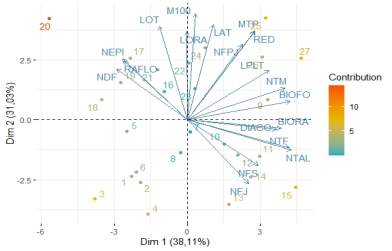
Figure 2. Distribution of the collected accessions based on the measured variables.
NFS: Number of dry leaves; NFJ: Number of yellow leaves; NFPJ: Number of partially yellow leaves; NTF: Total number of leaves; NTAL: Number of tillers; NFPM: Number of mother plant leaves; RAFLO: Number of floral branches; NEPI: Number of spikelets; NDF: Number of lower leaves; LPLT: Plant length; DIACO: Collar diameter; DISP: Distance between mother plant and tillers; LORA: Root length; NTM: Number of mature tubers; LOT: Tuber length; LAT: Tuber width; MTP: Tuber mass per hill; BIOFO: Leaf biomass; BIORA: Root biomass; RED: Yield per hectare; M100: Mass of 100 tubers.
The different accessions of edible tiger nuts collected in four locations in Côte d'Ivoire, namely Doropo, Korhogo, Dabakala, and Sinematiali, were grouped according to variables measured in the field (Figure 2). The accessions (AC24, AC25, AC26, and AC27) from the first locality (Doropo) are grouped around the variables LORA, LAT, NFPJ, MTP, RED, LPLT, and NTM. They are characterized by production and yield parameters. For the second city (Korhogo), the accessions (AC8, AC9, AC10, AC11, AC12, AC13, AC14, and AC15) are identified through the parameters: DIACO, BIORA, NTF, NFS, NTAL, NFJ, and BIOFO. The Dabakala accessions (AC16, AC17, AC18, AC19, AC20, AC21, AC22, and AC23) were structured according to the variables NEPI, NDF, RAFLO, LOT, and M100. The last locality, i.e., the Sinementiali accessions (AC1, AC2, AC3, AC4, AC5, AC6, and AC7), are based on parameters from both the Dabakala and Korhogo accessions. The accessions from these last three localities are distinguished by their vegetative parameters (Figure 2).
3.3.3. ACP of Accessions
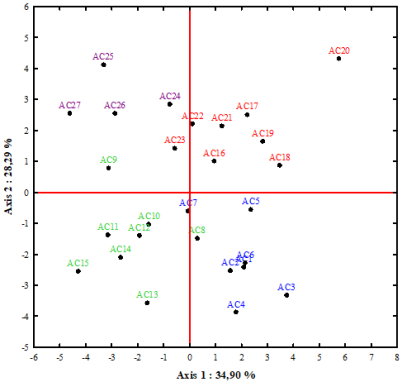
The Sinémentiali accessions (AC1–A7) and the Dabakala accessions (AC16–AC23) are mainly located on axis 1. In contrast, the Korhogo accessions (AC8–AC15) and the Doropo accessions (AC24–AC27) are mainly located on axis 2 (Figure 3).
Figure 3. Distribution of the 27 edible tiger nut accessions along the PCA axes.
Sinementiali: PCA1-PCA2-PCA3-PCA4-PCA5-PCA6-PCA7
Korhogo: AC8-AC9-AC10-AC11-AC12-AC13-AC14-AC15
Dabakala: AC16-1C17-AC18-AC19-AC20-AC21-AC22-AC23
Doropo: AC24-AC25-AC26-AC27
3.3.4. Adjustment of Accession Classification
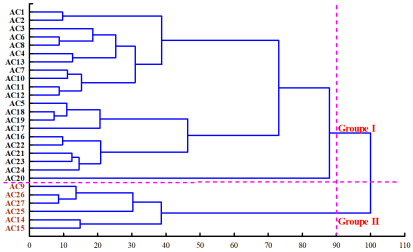
For the structuring of the 27 accessions of edible Ivory Coast edible nuts, the truncation line was set at 90. The resulting dendrogram showed significant heterogeneity between them. Two genetic groups were recorded. Group 1 is highly diverse and variable in terms of the number of accessions from the four survey locations. The second group contains an equal number of accessions from Doropo and Korhogo. (Figure 4).
GI: Group I (21 accessions) and GII: Group II (6 accessions)

Download: Download full-size image

Figure 4. Dendrogram of the 27 tiger nut accessions based on Euclidean distances.

3.3.5. Characterization of CAH Groups Using Student's T-test
The two groups differed by 90 Euclidean distance units. MANOVA analysis of these groups showed a significant difference (F = 6.62; p < 0.02). Examination of the data indicated that the two groups differed on the basis of ten (10) characteristics of the 27 accessions analyzed. These characteristics are the number of dry leaves (NFS), the number of partially yellow leaves (NFPJ), the total number of leaves (NTF), the number of tillers (NTAL), plant length (PLL), number of tubers (NT), tuber mass (TM), leaf biomass (LBB), root biomass (RBB), and yield (Y). Individuals in group I had the lowest values and those in group II had the highest values. Individuals in group II have on average the highest number of dry leaves, partially yellow leaves, tillers, and tubers. They also have on average the largest plants and very high tuber masses, leaf and root biomass, and yields (Table 5).
Table 5. Average values of the characteristics used to distinguish the 27 accessions into two clearly differentiated groups.

Group-CAH

NFS

NFPJ

NTF

NTAL

LPLT

GroupI (N=21)

71,07±17,24

38,58±9,46

144,18±16,55

14,81±2,34

83,61±9,76

GoupII (N=6)

94,29±13,38

51,52±8,08

185,77±19,04

23,71±3,24

92,93±8,66

t

-3,03

-3,04

-4,86

-4,86

-2,11

p

0,006

0,005

˂ 0,001

˂ 0,001

˂ 0,045

Group-CAH

NTM

MTP

BIOFO

BIORA

RED

GroupI (N=21)

67,60±12,27

44,95±14,99

26,50±6,74

10,01±1,97

15,86±5,53

GoupII (N=6)

97,86±12,26

75,72±18,91

39,22±6,52

13,32±1,63

26,78±1,53

t

-5,18

-4,20

-4,10

-3,74

-4,21

p

˂ 0,001

˂ 0,001

˂ 0,001

˂ 0,001

˂ 0,001

N: number of individuals; significant: p ≤ 0.05; very significant: p ≤ 0.01; highly significant: p ≤ 0.001; p: % probability; t: Student's t-test; NFS: number of dry leaves; NFPJ: number of partially yellow leaves; NTF: total number of leaves; NTAL: number of shoots; LPLT: length of mature plants; NTM: number of mature tubers; MTP: mass of tubers per clump; BIOFO: leaf biomass; BIORA: root biomass; RED: yield.
Analysis of the data also showed that eleven characteristics did not allow the 27 accessions to be differentiated. These characteristics are the number of yellow leaves (NFJ), the number of mother plants (NFPM), the number of floral branches (RAFLO), the number of spikelets (NEPI), the number of last leaves (NDF), the diameter at the collar (DIACO), the distance between the mother plant and the tillers (DISP), the length of the roots (LORA), the length of the tubers (LOT), the width of the tubers (LAT), and the weight of 100 tubers (M100) (Table 6).
Table 6. Average values of characteristics that do not allow the 27 accessions to be divided into two clearly differentiated groups.

Group-CAH

NFJ

NFPM

RAFLO

NEPI

NDF

GroupI (N=21)

40,77±12,00

16,69±0,77

1,87±2,44

35,21±42,68

4,49±0,61

GoupII (N=6)

47,86±12,21

16,69±0,72

1,76±1,53

21,97±26,86

4,25±0,35

t

-1,27

0,02

0,67

0,71

0,93

p

0,22

0,99

0,51

0,48

0,36

Group-CAH

D1ACO

DISP

LORA

LOT

LAT

M100

GroupI (N=21)

1,13±0,22

9,60±0,97

61,30±6,72

2,38±0,34

1,38±5,53

66,31±18,06

GoupII (N=6)

1,29±0,1

10,16±1,1

60,10±6,57

2,28±0,50

1,50±1,12

77,98±19,93

t

-1,73

-1,22

0,39

0,55

-1,31

-1,37

p

0,1

0,23

0,7

0,58

0,20

0,18

N: number of individuals; significant: p ≤ 0.05; very significant: p ≤ 0.01; highly significant: p ≤ 0.001; p: % probability; t: Student's t-test; NFJ: number of yellow leaves; NFPM: number of leaves on the mother plant; RAFLO: floral branches; NEPI: number of spikelets; NDF: number of last leaves; DIACO: diameter at the collar; DISP: distance between mother plant and tillers; LORA: root length; LOT: tuber length; LAT: tuber width; M100: mass of 100 tubers.
3.3.6. Determination of Discriminant Parameters
The discriminant function derived from the variables used to classify the units formed in the different groups was presented. The second function (axis 2) alone has the highest magnitude (1) and accounts for 63.19% of the total variability. It discriminates between the number of mature tubers (NTM) and the total number of leaves (NTF). These are inversely correlated with this axis. Axis 2 allows group II to be classified as a group characterized by individuals with numerous mature tubers (NTM) and numerous leaves (NTF). In contrast, the accessions in group I include individuals with fewer tubers and fewer leaves. The number of mature tubers (NMT) and the total number of leaves are the discriminating parameters for edible tiger nut accessions grown in Côte d'Ivoire (Table 7).
Table 7. Percentage of inertia and definition of axes in DFA.

Axis

2

Eigenvalue

1.71

Prop-Cum

1

R

0.79

Wilks’ Lambda

0.37

Chi2

23.88

dl

2

p-value

˂ 0.001

Variance explained (%)

100

Cumulative variance (%)

100

NTM

-0.70*

NTF

-0.62*

NTM: Number of mature tubers; NTF: Total number of leaves
4. Discussion
The success of any genetic improvement program depends on a study evaluating the genetic diversity of cultivated species. The results of this study would provide breeders with good starting material or seed . In general, diversity studies rely on phenotypic, biochemical, and molecular markers. The present study on the diversity of Cyperus esculentus cultivated in Ivorian farming communities used highly malleable and inexpensive phenotypic markers. The results of statistical tests showed that more than half of the variables analyzed had very high coefficients of variation, i.e., CV> 30%. This trend reflects the existence of genetic diversity among the accessions collected in the surveyed localities. This result could be explained by the way farmers acquire seeds during the growing season for this crop. The lack of an approved structure for the distribution of improved edible nutgrass seeds in Côte d'Ivoire forces farmers to turn to their counterparts in the same village or those in surrounding villages (regions) . This dynamic process therefore promotes the flow of genes that contribute to genetic variability. However, our results corroborate the work of certain authors on edible nutgrass (Cyperus esculentus L.) accessions in Burkina Faso , Senegal , and Ghana . In addition, strong correlations observed between certain vegetative parameters and some production parameters clearly show that the vegetative vigor of edible nutgrass plants inevitably influences the production and yield of this crop. Several production parameters, such as the number of mature tubers (NMT), the mass of tubers per clump (MTP), and the yield (RED), are influenced by vegetative growth. Thus, yield (RED) is influenced by the number of mature tubers (NTM) and tuber mass per clump (MTP), which are closely related to plant length (LPLT) and leaf biomass (BIOFO) and root biomass (BIORA). This study therefore demonstrates the cause-and-effect relationship between vegetative vigor and yield. This result is similar to that of , who, working on edible tiger nut ecotypes from several countries (Mali, Burkina Faso, Niger, Benin, and Senegal), found strong correlations between vegetative and yield parameters. Vegetative vigor generally influences the yield of tiger nut ecotypes regardless of their origin. Furthermore, the diversity of edible tiger nut accessions revealed in this study was structured into two large, contrasting genetic groups. The first group is highly heterogeneous with a very broad base involving accessions from the four areas surveyed. This structure is distinguished by vegetative parameters. The second group was structured on the basis of production parameters and consisted of accessions from Doropo and Korhogo. The contrast observed between these two groups could be explained by climatic and pedological causes. Certainly, the plants in each group were strongly influenced by ecological changes in the study environment. Furthermore, several researchers have clearly established that phenotypic markers are conditioned by the environment. Our results, compared to those of other researchers who have worked on the same species, found a higher number of genetic groups, notably five groups in Burkina Faso and seven groups in Ghana . There are several possible explanations for the difference between these results. On the one hand, the number or size of accessions collected for this study is significantly different from the sample sizes used by other researchers, i.e., 27 accessions compared to 44 and 42 in Burkina Faso and Ghana, respectively. It should be noted that in Côte d'Ivoire, only the variety of edible tiger nut with yellow tubers is cultivated and consumed. Consequently, the current study focused on this group. This is not the case with the two researchers who included black and brown varieties. A third argument would be the definition of the dendrogram truncation line. This value is often left to the discretion of the researcher, who also defines the number of groups of individuals that share the same similarities. Statistically, discriminant factor analysis (DFA) specifies that the two genetic groups formed are justified by the variables, the number of mature tubers and the total number of leaves. These parameters could be accepted as morphological markers for the structuring and expression of agromorphological diversity. These results confirm the observations of on the predominance of vegetative and productive parameters in the variability of cultivated plants. However, they differ from the work of and , which favored tuber size, shape, and color as differentiation criteria. These differences illustrate the complementarity of vegetative, productive, and morphological criteria for the overall assessment of edible tiger nut diversity.
5. Conclusion
Varietal selection or the introduction of improved seeds for edible tiger nuts in Côte d'Ivoire depends on knowledge of the existing diversity of this useful plant. To this end, a study of the phenotypic diversity of Ivorian Cyperus esculentus accessions revealed two genetic groups. The first group is characterized by vegetative parameters and the second by production variables. The existence of these two genetic structures is due to two discriminating variables, namely the number of mature tubers (NMT) and the total number of leaves (TNL). Seed exchanges between producers and ecological factors justified the results obtained in this study. However, further studies, such as the use of molecular markers, are needed to confirm or refute these results.
Abbreviations

AC

Accessions

NFS

Number of Dry Leaves

NFJ

Number of Yellow Leaves

NFPJ

Number of Partially Yellow Leaves

NTF

Total Number of Leaves

NTAL

Number of Tillers

NFPM

Number of Leaves of the Mother Plant

RAFLO

Number of Flowering Branches

NEPI

Number of Spikelets

NDF

Number of Last Leaves

LPLT

Plant Height

DIACO

Collar Diameter

DISP

Distance Between Mother Plant and Tillers

LORA

Root Length

NTM

Number of Mature Tubers

LOT

Tuber Length

LAT

Tuber Width

MTP

Tuber Mass per Planting Hole

BIOFO

Leaf Biomass

BIORA

Root Biomass

RED

Yield per Hectare

M100

Mass of 100 Tubers

SD

Standard Deviation

CV

Coefficient of Variation

Author Contributions
Ehui Kirioua Jean-Baptiste: Conceptualization, Resources, Writing – original draft, data curation, Investigation
Gore Bi Boh Nestor: Methodology, supervision, Formal analysis, Writing – review & editing
Adjahossou Videdji Naesse: Software
Dago Lydia Karmelle Ornella: Visualization
Yao Kouakou Abessika Georges: Visualization
Coulibaly Belechonni François: Data curation
Akaffou Doffou Selastique: Validation, project administration
Conflicts of Interest
The authors declare no conflicts of interest.
References
[1] Koffi B. L., Nemlin G. J., Lefevre S. &Kamenan A Physicochemical characterization and therapeutic potential of sweet tiger nut (Cyperus esculentus L. Cyperaceae). African Agronomy, (2005) 17(1): 63-71.
[2] Koné M., Kaboré S., Bamba S. Role of rural women in tiger nut marketing in Côte d’Ivoire. African Journal of Agricultural Development (2015) 7(3), 51-50.
[3] Kouamé E. P. G., Yapi H. Y. D. P., Ekissi E. S. G., Konan K. H. (2022). Physical parameters of tiger nut (Cyperus esculentus L.) yellow and black varieties harvested in Bondoukou (North-Est, Côte d’Ivoire) (2022) p 9.
[4] Niamketchi G. L. Physicochemical and nutritional values of tiger nut (Cyperus esculentus) oil from three regions of Côte d’Ivoire. Centre National de Recherche Agronomique, (2025) 671-677.
[5] Goré B. B. N., Ehui K. J. B., N’dri K. E., Dago L. K. O., Coulibaly B. F., Gbayoro S. F., Akaffou D. S. (2025). Identification of producers and cultivation areas of African edible tiger nut (Cyperus esculentus L.) in Côte d’Ivoire. 10 pp. (PDF).
[6] Belewu M. A. &Belewu K. Y. Comparative physicochemicalevaluation of tigernut, soybean and coconutmilk. International Journal of Agriculture and Biology, (2007) 9: 785-787.
[7] Zapata S. E., Lôpez F. J. & Alvarez P. A. J. «Tiger Nut (Cyperus esculentus) Commercialization: Health Aspects, Composition, Properties, and Food Applications». The ComprehensiveReviews in Food Science and Food Safety, (2012) 11: 366-377.
[8] Arafat S. M., Gaafar A. M., Basuny A. M. &Nassef S. L. ChufaTubers (Cyperus esculentus L.): As à New Source of Food. World Applied Sciences Journal, (2009) 7(2): 151-156.
[9] Etejeré E. O., Akinboye K. G., Owole A. O. (2018). Processing and utilization of tiger nut (Cyperus esculentus) for human consumption. Journal of food Science and Nutrition, 3(1), 22-29.
[10] Aka B., Koanan N. Y., Aurèle A., Guessan K. N. Nutritional and Sensory Analysis of Milk Processed from Seeds of Sweet Pea (Cyperus esculentus L.) Consumed in Côte d'Ivoire. Journal of Applied Life Sciences International, (2016) 8(2): 1-12.
[11] CIAT. Characterization of early-maturing accessions of edible tiger nut (Cyperus esculentus L.) cultivated in Côte d’Ivoire, presented at the International Confeence on Tropical Agroforestery (2023) p 196.
[12] Hamlmer K., Gladis T., Diederichsen A. Genetic ressources of medecinal and aromatic plants-A worldwide inventory Fedral Centre of Breeding Research on Cultivated plants (2001).
[13] Govindaraj M., Vetriventhan M., Srinivasan M. Importance of genetic diversity for crop improvement. Journal of plant Breeding and genetics, (2015) 3(1), 1-22.
[14] Amanabo M. A., Alikwe P. C., Olatunji L. A. Agromorphological characterization of Cyperus esculentus accessions for crop improvement. Journal of Genetic Plant Improvenant (2017) 5(3), 78-89.
[15] De Vicente M. C. & Fulton T. Genetic diversity analysis using molecular markers. Biodiersity International Technical Manual Series (2020) p 194.
[16] Dagnelie P. (Belgique): Theoretical and Applied Statistics. Volume 1. Descriptive Statistics and Foundations of Statistcal Inference. Third Edition of Bussels Boeck, (2013) 516 p.
[17] Oladeji O. S., Tijani K. O., Adegboyeaga T. T. Morphological variation and nutritional quality of Cyperus esculentus varieties in Nigeria. Journal of Applied Agricural Science, (2019) 14(3), 121-132.
[18] Kowalski R., Krol K., Nowak A. Tiger nut (Cyperus esculentus): Worldwide cultivation, use and potentiel. Industrial Crops & products, (2021) 164, 113435.
[19] BNETD/CCT. National Bureau of Technical Studies and Development and the Center for Cartography and Remote Sensing (2025).
[20] Douka A. M. Food crops from subsistence farming to the market economy in the Gouro area (Central-Western Côte d’Ivoire. (2012). pp. 25–26.
[21] N’da D. H., N’guessan K. E., Wadja E. M. Contribution of remote sensing to the monitoring of deforestation in Marahoue National Park (Côte d’Ivoire), (2008) 34 p. (PDF).
[22] Assoko A. V. S. Design of forecasting tools for hydrological extremes in the West African tropical region: The case of the Marahoue watershed in Côte d’Ivoire, (2022) 240 pp (PDF).
[23] N’guessan B. V.H., Saley M., Oga Y., Yapi A. & Biémi J. Characteristics of hydrological drought in the Marahoue region (Central-Western Côte d’Ivoire). (2017) 74 p.
[24] StatSoft. STATISTICA, data analysis software. Version 7.1.
[25] Hamissou Z., Ibraham A., Seiny B., Hamissou M. A. Agromorphological characterization of sesame accessions (Sesamum indicum L.). Collected in Niger. International Journal of Innovation and Applied Studies (2020) 2028-9324 Vol 902-914.
[26] Dede, E. L., N’da, A. H., Akanvou, L., & Sié, R. S. Agromorphological and botanical diversity of 357 sorghum [Sorghum bicolor (L.) Moench] accessions collected in Côte d’Ivoire. African Agronomy, 32(3) (2020): 297–308.
[27] Kombeleme A. N., Koussao S., Djakaridja T., Tonde H. W., Yamwemba S., Kando B. P. Genetic diversity of genotypes of tiger nuts (Cyperus esculentus L.) using morphological descriptors in Burkina Faso. Int. J. Biosci. Research paper. International Journal of Biosciences | IJB |, (2024) (Print) 2222-5234 Vol. 25, No. 3, p. 21-31.
[28] Sane S., Ngom M., NdoyeF., Niang E., Deme A., Ndiaye C., Diallo B., Cissoko M., Sy O. M. Agromorphological characterization of West African provenances of tiger nut (Cyperus esculentus, L.) for sustainable food and nutritional security in Senegal. Journal of Experimental Biology and Agricultural Sciences Journal of Experimental Biology and Agricultural Sciences, (2025) Volume –13(6) page 829–845.
[29] Asare P. A, Kpankpari R, Adu M. O, Afutu E, Adewumi A. S. Phenotypic characterization of Tiger Nuts (Cyperus esculentus L.) from major growing areas in Ghana. The Scientific World Journal (2020), 1-11.
[30] Twumasi P., Asare A. P., Afutu E., Amenorpe G., Addy T. T. N. S., Premph R., Donkor F. E. Genetic Diversity of Tiger Nuts (Cyperus esculentus L.) Grown in Ghana Based on Morpho-Descriptors and SSR Markers. The Journal of Agricultural Sciences- Sri Lanka, (2024). Vol. 19, No 2, May 2024. Pp 316-335
[31] Gbemavo, J. C., Gandji, K., Gnangle, P. C., Assogbadjo, E. A., & Kalaï, G. L. R. (2015). Morphological variability and conservation of Jatropha curcas Linn. (Euphorbiaceae) morphotypes in Benin. Journal of Agriculture and Environment for International Development, 109(1): 55–69.
[32] Coskuner Y., Ercan R., Karababa E. &Nazlcan A. N. (2002). "Physical and chemical properties of chu fa (Cyperus esculentus L.) tubersgrown in the Cukurovaregion of Turkey," Journal of the Science of Food and Agriculture, 82(6): 625-631
Cite This Article
  • APA Style

    Jean-Baptiste, E. K., Nestor, G. B. B., Naesse, A. V., Ornella, D. L. K., Georges, Y. K. A., et al. (2026). Morphological and Agronomic Variability of Edible Tiger Nut (Cyperus esculentus L.) Accessions Cultivated in Côte d’Ivoire. International Journal of Genetics and Genomics, 14(1), 25-38. https://doi.org/10.11648/j.ijgg.20261401.13

    Copy | Download

    ACS Style

    Jean-Baptiste, E. K.; Nestor, G. B. B.; Naesse, A. V.; Ornella, D. L. K.; Georges, Y. K. A., et al. Morphological and Agronomic Variability of Edible Tiger Nut (Cyperus esculentus L.) Accessions Cultivated in Côte d’Ivoire. Int. J. Genet. Genomics 2026, 14(1), 25-38. doi: 10.11648/j.ijgg.20261401.13

    Copy | Download

    AMA Style

    Jean-Baptiste EK, Nestor GBB, Naesse AV, Ornella DLK, Georges YKA, et al. Morphological and Agronomic Variability of Edible Tiger Nut (Cyperus esculentus L.) Accessions Cultivated in Côte d’Ivoire. Int J Genet Genomics. 2026;14(1):25-38. doi: 10.11648/j.ijgg.20261401.13

    Copy | Download

  • @article{10.11648/j.ijgg.20261401.13,
      author = {Ehui Kirioua Jean-Baptiste and Gore Bi Boh Nestor and Adjahossou Videdji Naesse and Dago Lydia Karmelle Ornella and Yao Kouakou Abessika Georges and Coulibaly Belechonni François and Akaffou Doffou Selastique},
      title = {Morphological and Agronomic Variability of Edible Tiger Nut (Cyperus esculentus L.) Accessions Cultivated in Côte d’Ivoire},
      journal = {International Journal of Genetics and Genomics},
      volume = {14},
      number = {1},
      pages = {25-38},
      doi = {10.11648/j.ijgg.20261401.13},
      url = {https://doi.org/10.11648/j.ijgg.20261401.13},
      eprint = {https://article.sciencepublishinggroup.com/pdf/10.11648.j.ijgg.20261401.13},
      abstract = {In Côte d'Ivoire, the cultivation of edible nutgrass (Cyperus esculentus L.) is mainly carried out by Senufo, Djimini, and Lobi women using traditional techniques. Given its importance in terms of food, medicine, and economics, promoting this sector is a major asset in reducing nutritional insecurity. However, the diversity of this crop remains poorly researched. This study aimed to characterize the agromorphological diversity of 27 tigernut accessions from four major production areas (Korhogo, Sinématiali, Dabakala, and Doropo) in a randomized experimental design with three replicates, set up in Bouaflé. Twenty-one morphological and agronomic traits related to growth, flowering, production, and yield were measured. High coefficients of variation (CV > 30%) revealed significant variability between accessions. Hierarchical classification analysis (HCA) structured the accessions into two distinct genetic groups. Group I was characterized by vegetative parameters and formed from accessions from the four study locations. Group II consisted of accessions from Korhogo and Doropo and was characterized by production parameters. Discriminant factor analysis (DFA) identified the number of mature tubers (NMT) and the total number of leaves (TNL) as the most discriminating traits. The results of this study will contribute to the implementation of a genetic improvement program for edible tiger nuts in Côte d'Ivoire.},
     year = {2026}
    }
    

    Copy | Download

  • TY  - JOUR
    T1  - Morphological and Agronomic Variability of Edible Tiger Nut (Cyperus esculentus L.) Accessions Cultivated in Côte d’Ivoire
    AU  - Ehui Kirioua Jean-Baptiste
    AU  - Gore Bi Boh Nestor
    AU  - Adjahossou Videdji Naesse
    AU  - Dago Lydia Karmelle Ornella
    AU  - Yao Kouakou Abessika Georges
    AU  - Coulibaly Belechonni François
    AU  - Akaffou Doffou Selastique
    Y1  - 2026/03/04
    PY  - 2026
    N1  - https://doi.org/10.11648/j.ijgg.20261401.13
    DO  - 10.11648/j.ijgg.20261401.13
    T2  - International Journal of Genetics and Genomics
    JF  - International Journal of Genetics and Genomics
    JO  - International Journal of Genetics and Genomics
    SP  - 25
    EP  - 38
    PB  - Science Publishing Group
    SN  - 2376-7359
    UR  - https://doi.org/10.11648/j.ijgg.20261401.13
    AB  - In Côte d'Ivoire, the cultivation of edible nutgrass (Cyperus esculentus L.) is mainly carried out by Senufo, Djimini, and Lobi women using traditional techniques. Given its importance in terms of food, medicine, and economics, promoting this sector is a major asset in reducing nutritional insecurity. However, the diversity of this crop remains poorly researched. This study aimed to characterize the agromorphological diversity of 27 tigernut accessions from four major production areas (Korhogo, Sinématiali, Dabakala, and Doropo) in a randomized experimental design with three replicates, set up in Bouaflé. Twenty-one morphological and agronomic traits related to growth, flowering, production, and yield were measured. High coefficients of variation (CV > 30%) revealed significant variability between accessions. Hierarchical classification analysis (HCA) structured the accessions into two distinct genetic groups. Group I was characterized by vegetative parameters and formed from accessions from the four study locations. Group II consisted of accessions from Korhogo and Doropo and was characterized by production parameters. Discriminant factor analysis (DFA) identified the number of mature tubers (NMT) and the total number of leaves (TNL) as the most discriminating traits. The results of this study will contribute to the implementation of a genetic improvement program for edible tiger nuts in Côte d'Ivoire.
    VL  - 14
    IS  - 1
    ER  - 

    Copy | Download

Author Information
  • Abstract
  • Keywords
  • Document Sections

    1. 1. Introduction
    2. 2. Materials and Methods
    3. 3. Results
    4. 4. Discussion
    5. 5. Conclusion
    Show Full Outline
  • Abbreviations
  • Author Contributions
  • Conflicts of Interest
  • References
  • Cite This Article
  • Author Information