Research Article | | Peer-Reviewed

Forward-mover Versus Nation-builder: Metaphorical Framing of Corporate Self-representation in Top Executive Letters from US Bay Area and China's Greater Bay Area Companies

Received: 16 June 2026     Accepted: 2 July 2026     Published: 3 July 2026
Views:       Downloads:
Abstract

This study investigates how nominal metaphors frame corporate self-representation in top executive letters of sustainability reports from US Bay Area and China's Greater Bay Area Fortune Global 500 companies between 2018 and 2023. Drawing on 85 letters (80,516 tokens) in the Chinese corpus and 117 letters (69,524 tokens) in the US corpus, quantitative analysis identifies thirteen vehicle groupings that differ significantly across the two corpora — with physical power and movement the most strongly overused in the US corpus, and fight/war and building the most strongly overused in the Chinese corpus — while qualitative analysis further reveals self-representational differences beneath the quantitative similarity of mechanism and theatre. The US corpus jointly uses physical power and movement to frame firms as the IMPACT-MAKING FORWARD MOVER, while the Chinese corpus jointly uses fight/war and building to frame firms as the STRATEGIC NATION-BUILDER. mechanism and theatre with similar frequency suggest both similarities and differences in vehicle-topic mappings and self-representation patterns. The findings suggest that metaphorical framing is sensitive to the analytical level at which they are examined, and that examining cross-cultural CEO discourse at the vehicle-topic level complements the conceptual-domain-level analysis predominant in prior research. The study contributes to cross-cultural metaphor research by providing empirical insight into how a preferred corporate self is framed for US versus Chinese stakeholder audiences. It also guides practitioners in using metaphor with sensitivity to the cultural-institutional contexts shaping meaning in cross-cultural sustainability communication.

Published in International Journal of Language and Linguistics (Volume 14, Issue 4)
DOI 10.11648/j.ijll.20261404.11
Page(s) 149-159
Creative Commons

This is an Open Access article, distributed under the terms of the Creative Commons Attribution 4.0 International License (http://creativecommons.org/licenses/by/4.0/), which permits unrestricted use, distribution and reproduction in any medium or format, provided the original work is properly cited.

Copyright

Copyright © The Author(s), 2026. Published by Science Publishing Group

Keywords

Nominal Metaphor, Corporate Self-representation, Top Executive Letters, Sustainability Reporting, Vehicle Grouping, Systematic Metaphor, Cross-cultural Discourse Analysis

1. Introduction
Top executive letters, including CEO letters and equivalent opening statements in annual and sustainability reports, constitute a distinctive promotional genre in corporate communication . Within this genre, corporate leaders utilise different discursive resources to communicate accountability and commitments, manage relationships with diverse stakeholders, and maintain corporate legitimacy . However, inappropriate use of these resources may lead to distorted or negative stakeholder perceptions of the company . Thus, understanding how discursive choices are deployed and co-pattern to construct corporate self-representation — how a corporation linguistically frames itself in discourse — is significant for both corporate communication research and practice.
Among these discursive resources, metaphor occupies a particularly central role. As a powerful framing device, it is not merely decorative but constitutive: metaphor constructs what kind of actor the corporation appears to be, shapes how its actions and commitments are perceived, and reveals the ideological values underlying corporate discourse . The framing power of metaphor does not depend solely on the conceptual structures involved but also on the dynamic interaction between linguistic choices and their co-textual environment . As such, metaphor constitutes a primary resource through which corporations discursively construct their corporate self to stakeholders .
Cross-cultural studies of metaphor in top executive letters across corporate reporting genres, including CSR reports and annual reports, have shown that companies from different national contexts, while sharing certain conceptual metaphors, vary systematically in the metaphorical resources and scenarios through which they construct corporate self-representations, with these variations reflecting divergent cultural values, institutional alignments, and stakeholder orientations .
Existing cross-cultural studies on metaphor in corporate sustainability discourse have focused mainly on conceptual domains and metaphor scenarios , with the patterning of linguistic metaphor vehicles at the discourse-dynamic systematic metaphor level receiving comparatively little attention in this specific genre. Although systematic metaphor analysis has been applied to other discourse types , its application to CEO letters, and in particular to cross-cultural comparison of CEO letters between China and the US, remains underdeveloped. Within this level, nominal vehicles are especially consequential: nouns name, label, and categorise activities and properties, so nominal metaphors directly construct what the corporation is in promotional discourse. This study contributes to this discussion by examining the cross-cultural similarities and differences in the distribution of nominal metaphors in top executive letters of sustainability reports from US Bay Area and and China's Greater Bay Area (GBA) companies, and by interpreting the corporate self-representation patterns against their cultural-institutional contexts.
This study aims to address the following research questions:
RQ1: What are the similarities and differences in the distribution of nominal metaphors between two corpora of sustainability reports' top executive letters from US Bay Area and China's GBA firms?
RQ2: What similar and different corporate self-representation patterns underlie the systematic metaphors across two corpora, and what cultural-institutional contexts shape them?
By doing so, this study extends cross-cultural metaphor research in corporate discourse by shifting the analytical focus from conceptual domains alone to the discourse-dynamic metaphor analysis framework , while offering empirical insights for corporate communication practitioners navigating divergent cultural and institutional contexts.
2. Top Executive Letters, Metaphor, and Framing
2.1. Top Executive Letters as Strategic Communication
A growing body of studies on sustainability communication has documented top executive letters as a tool of strategic communication through which companies establish credibility and gain legitimacy . Across this body of work, a consistent finding is that CEOs' discursive choices are not fixed but adapted to the cultural and institutional contexts in which letters are produced. For instance, Nguyen finds that US bank CEOs employ more emotion/attitude and evaluation stance devices to express an interactional tone that engages stakeholders, while Vietnamese bank CEOs use fewer such markers and rely more on the volition/prediction modal verb will to signal corporate determination to expand into global markets. He attributes this variation to low-context Western versus high-context Asian communicative norms. These studies establish that CEOs' discursive choices in top executive letters are systematically shaped by cultural and institutional contexts.
Comparative studies on CEO letters as strategic discursive practice have developed along two main lines. One examines how the genre varies across reporting contexts, particularly between annual and sustainability reports, to identify genre-specific conventions . For instance, Mäkelä and Laine compare CEO letters in annual reports and CSR reports and find that CEOs emphasise "well-being" discourse in CSR reports but economic growth and profitability in annual reports. The other examines how CEO letters vary across cultural and institutional contexts, comparing the discursive resources — stance markers , move structures and interdiscursivity , metadiscursive nouns , and metaphor — through which Chinese and Anglo-American corporations construct their self-representation and accomplish sustainability communication. These studies show that CEOs draw on diverse discursive resources to construct corporate self-representation across cultural and institutional contexts. Among such resources, metaphor warrants particular attention given its potent framing function. Yet metaphor in this genre remains comparatively underexplored, particularly across cross-institutional and cross-cultural contexts.
2.2. Comparative Studies on Metaphor and Framing in Top Executive Letters
Comparative studies on metaphor in top-executive promotional discourse document both similarities and differences in how Chinese and Anglo-American corporations construct their self-representation. Hu, Zhang, and Xu examine 256 Chinese and 374 American CEO letters from CSR reports and identify four metaphors with similar frequency in two corpora— machine & tool, force, plant and human. They find that Chinese CEOs draw more on war and building to construct the corporation as an active architect following national policy and a determined environmental protector, while American CEOs draw more on game/sports and journey to project it as an environment-conscious traveller and a responsible steward. Wang, Xu, and Hu , focusing on banking CEOs' Letters to Shareholders, identify six genre-specific source domains and show through scenario analysis that Chinese and American banks construct distinct corporate identities through differential scenario selection. They find that Chinese banks foreground policy compliance and peer-leadership, while American banks foreground policy scepticism, peer-competition, and shareholder stewardship.
These studies examine metaphor use in CEO letters through a top-down trajectory, moving from pre-specified conceptual domains toward scenario-level narrative, in which linguistic metaphors serve primarily as instantiations of underlying conceptual metaphors. These higher-level analyses map broad cross-cultural contrasts well. However, Semino et al. note that the framing effects of metaphor are sensitive to the analytical level at which they are examined: the same source domain can be realised through linguistic vehicles that carry different evaluative and experiential orientations. Gibbs and Cameron further note that conceptual mapping is only one of seven forces shaping metaphor use; others such as "specific language and culture" can equally shape how metaphor is used in discourse. The discourse dynamics framework takes these multiple forces into consideration and holds that systematic metaphors emerge from dynamic discourse rather than pre-existing as fixed conceptual mappings . Systematic-metaphor-level analysis thus offers a complementary lens for identifying systematic metaphors through the situated linguistic choices that frame corporate self-representation. The present study contributes to this discussion by conducting a comparative analysis of nominal metaphors in top executive letters from China's GBA and US Bay Area companies, following systematic metaphor analysis. Rather than treating the two corpora as realisations of competing conceptual metaphors, it traces, at the level of the vehicle grouping, both the shared patterns and the cross-corpus distributional differences, and interprets the systematic metaphors and corporate self-representational patterns they construct through concordance evidence.
3. Methods and Materials
3.1. Corpus
Two comparable corpora of English top-executive letters were compiled from corporate sustainability reports published between 2018 and 2023. The sampling frame comprised all companies listed in the 2022 Fortune Global 500 and headquartered in China's Guangdong-Hong Kong-Macao Greater Bay Area (GBA), the US San Francisco Bay Area, and the US New York Bay Area. All those that published standalone English-language sustainability reports containing top executive letters within this period were included, yielding 16 China's GBA and 23 US Bay Area companies, as detailed in Table 1.
Table 1. Overview of the two corpora.

Feature

China's GBA corpus

US Bay Areas corpus

Number of companies

16

23

Number of letters

85

117

Number of tokens

80,516

69,524

Reporting period

2018-2023

2018-2023

Representative companies

Vanke, Huawei, BYD, Tencent, Ping An, Lenovo, China Resources, China Merchants Bank

Apple, JPMorgan, Goldman Sachs, Intel, Cisco, Meta, HP, Chevron

The bay areas from two regions were chosen as institutionally contrasting but economically comparable major economic regions. Fortune Global 500 membership ensures comparable economic scale, international exposure, and reporting maturity. As leading multinationals with established stakeholder communication practices, these companies are most likely to produce top executive letters that conform to genre conventions and reflect institutionalised discursive norms, making cross-regional metaphor comparison both feasible and meaningful. Corpus comparability is further ensured through normalised frequency measures.
3.2. Metaphor Identification
Metaphor identification followed the Metaphor Identification Procedure . The analysis was restricted to nominal metaphors which directly label and categorise the entities they describe, and are therefore especially salient in corporate self-representation. Metaphor identification was then carried out independently by me and a co-rater on approximately 415 candidates randomly selected from 42,284 noun metaphor candidates. The results show that the reliability of our metaphor identification on the 415 metaphor candidates is 'substantial' since the Cohen's κ is .689 (p <.001) . Finally, the two corpora identified 3,290 nominal metaphors in the Chinese data and 3,283 in the US data.
3.3. Vehicle Grouping
Identified nominal metaphors in both corpora were grouped into vehicle groupings, drawing on labels from previous studies and the semantic fields of metaphor vehicles' basic meanings . Because assigning labels to metaphor vehicles is not straightforward, the labelling proceeded iteratively: initial labels were assigned on the basis of semantic fields, then refined through examination of co-text to ensure internal coherence and external distinctiveness. This procedure yielded a final set of 46 vehicle groupings for the US corpus and 52 for the Chinese corpus, developed inductively from the 3283 and 3290 identified metaphors in the US and Chinese corpus, respectively.
Inter-rater reliability for vehicle grouping was assessed on 73 out of 415 candidates both raters had previously agreed to be metaphors. Agreement was 'substantial' for the US corpus (Cohen's κ =.876, p <.001) and 'substantial' for the Chinese corpus (Cohen's κ =.674, p <.001) . Disagreements were resolved through discussion to reach consensus before the full coding proceeded.
3.4. Analytical Framework
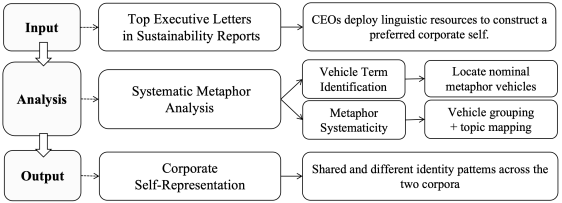
Figure 1. Analytical Framework for Metaphorical Framing of Corporate Self-Representation.
As shown in Figure 1, this study adopts a three-layer analytical framework to examine how nominal metaphors in top executive letters construct corporate self-representation across US Bay Areas and China's GBA companies.
In the input layer of Figure 1, two corpora were compiled by collecting top executive letters from sustainability reports of corporations in the China's GBA and US Bay Areas. These texts are treated as sites of strategic corporate communication , in which top executives, writing on behalf of their organisations, draw on linguistic resources — including metaphor — to construct a preferred corporate self for diverse stakeholder audiences.
The analysis layer operationalises the analysis through Cameron et al.'s systematic metaphor analysis framework, which holds that metaphor is an emergent phenomenon that arises from discourse and exhibits both stability and variability in the discourse process. Following this framework, the study applies two analytical procedures in sequence: vehicle term identification, which locates nominal metaphor vehicles in the two corpora following MIP ; and metaphor systematicity analysis, which groups co-patterned vehicles into vehicle groupings that are then mapped to targeted topics, capturing the stable patterns of metaphors that emerge from dynamic discourse. Such patterns are connected to broader cultural and institutional contexts, through which they both reflect and shape how corporations represent themselves.
The output layer synthesises these systematic framing patterns into an interpretive construct of corporate self-representation, revealing how China's GBA and US Bay Areas corporations frame themselves through nominal metaphors.
4. Findings and Discussion
4.1. Distribution of Vehicle Groupings
The distribution of vehicle groupings across the two corpora exhibits both similarities and differences. Cross-corpus differences in frequencies of vehicle groupings were assessed using the log-likelihood (LL) statistic, calculated following Rayson and Garside , with the precise corpus token counts (CN = 80,516; US = 69,524) entered as the corpus totals. LL is preferred over chi-square for corpus frequency comparisons because it does not assume normality and remains reliable for low-frequency items. The 13 vehicle groupings that differ significantly between the two corpora are shown in Table 2.
As shown in Table 2, 13 vehicle groupings differ significantly between the two corpora at p <.05 or below, with the divergence pattern dominated by US-preferred items at the top of the ranking. The vehicle groupings with the highest log-likelihood value is physical power, which the US corpus deploys at nearly four times the Chinese normalised frequency. The other vehicle groupings with high log-likelihood values are movement, game/sports and journey, which are overused in the US corpus. These vehicle groupings signal a sustained US preference for forward-force and competition-based vehicles in constructing corporate self-representation, as illustrated in (1) and (2). This finding aligns with Hu, Zhang, and Xu’s finding of overused game/sports and journey in their US data and also extends existing studies by identifying physical power as a further US-side overused vehicle grouping alongside movement.
(1) It's why we work every day to make our technology an even greater force for good. (Apple, 2022)
(2) Our aspiration to be a leader in corporate responsibility is woven into Wells Fargo's Vision, Values & Goals. (Wells Fargo, 2018)
Table 2. Vehicle groupings with significant cross-corpus differences (sorted by LL descending).

Vehicle grouping

Freq

Norm freq per 10,000

LL

Overused

Sig.

CN

US

CN

US

PHYSICAL POWER

103

339

12.8

48.8

170.31

US+

****

MOVEMENT

108

233

13.4

33.5

67.24

US+

****

GAME/SPORTS

242

347

30.1

49.9

37.55

US+

****

PLACE/SPACE

127

200

15.8

28.8

28.97

US+

****

PHYSICAL CONNECTION

29

1

3.6

0.1

28.88

CN+

****

SOUND

6

33

0.7

4.7

24.76

US+

****

FIGHT/WAR

494

315

61.4

45.3

18.11

CN+

****

LIGHT/DARKNESS

6

23

0.7

3.3

13.29

US+

***

BUILDING

327

216

40.6

31.1

9.51

CN+

**

JOURNEY

363

390

45.1

56.1

9.03

US+

**

SEEING

111

137

13.8

19.7

7.89

US+

**

PHYSICAL DAMAGE

1

7

0.1

1.0

5.99

US+

*

NATURAL PHENOMENON

45

21

5.6

3.0

5.77

CN+

*

Note. **** p <.0001 (LL ≥ 15.13); *** p <.001 (LL ≥ 10.83); ** p <.01 (LL ≥ 6.63); * p <.05 (LL ≥ 3.84); "CN+" = overused in the Chinese corpus; "US+" = overused in the US corpus.
On the Chinese side, the three highest-ranked overused vehicle groupings are physical connection, fight/war, and building. For instance, physical connection predominantly groups together vehicles such as links and chain in (3), foregrounding relational and supply-side imagery that anchors the firm within an integrated industrial ecology. fight/war such as mission in (4), depicts a self-chosen commercial goal as an externally entrusted duty carrying moral weight while building such as cornerstone in (5) depicts Ping An’s operating value as an immovable foundation that bears the firm's continued leadership.
(3) Our strategy is to comprehensively address all links in the industry chain and all corners of the market, constituting a one-stop solution for green cities. (BYD, 2019)
(4) Our mission is to deliver "technological innovations for a better life". (BYD, 2019)
(5)... and"expertise creates value" is the cornerstone of our continuous leadership. (Ping An, 2018)
In sum, the US-preferred groupings tend to depict firms acting outward on their environment — exerting force, advancing movement, competing for position, while the Chinese-preferred groupings tend to depict firms being placed within a pre-existing structure — linked into a chain, charged with a mission, and founded on a base.
Table 3. Vehicle groupings with similar frequency in two corpora.

Vehicle grouping

Freq

Norm freq per 10,000

LL

CN

US

CN

US

MECHANISM

227

192

28.2

27.6

0.04

THEATRE

75

69

9.3

9.9

0.14

Note. Vehicle groupings with substantial frequency in both corpora (each ≥ 50 tokens).
By contrast, mechanism and theatre are the two groupings that do not differ significantly across the two corpora, as shown in Table 3. This grouping-level similarity does not by itself mean the two corpora share the same vehicles and self-representation pattern. Section 4.2.1 examines what lies beneath it at the vehicle and vehicle-topic pairing layers.
4.2. Self-representation Patterns Suggested by Systematic Metaphors
Building on the LL-based quantitative comparison in section 4.1, this section conducts a qualitative analysis driven by — and tailored to — the quantitative results. It moves from vehicle groupings to self-representation patterns through systematic metaphor analysis, which examines how recurrent vehicle-topic pairings within each vehicle grouping frame the corporation's self.
4.2.1. Self-representation Patterns Within Mechanism and Theatre in Two Corpora
Citation analysis of mechanism and theatre — the two vehicle groupings with similar frequency in two corpora — shows both similarities and variations in the metaphor vehicles used to write about ESG topics. At the linguistic metaphor level, both corpora share operation(s) as the dominant lexis of mechanism, as in (6) and (7). Variation is observed in other frequently used vehicles: mechanism(s) and cycle are frequently used to depict the firm as a self-contained machine in the Chinese corpus, as in (8), while part(s) and network/hub depict the firm as one piece inside a larger machine in the US corpus, as in (9).
(6) Adhering to prudent operation, we have built a sound risk management system, and carried out risk identification, assessment and improvement work. (Vanke, 2021)
(7) On our operations, thanks to innovations in our data center and office designs, we’ve driven up efficiency and driven down our environmental footprint. (Meta, 2021)
(8) We optimized our benefit-sharing mechanism, acquired development resources,. through cooperation with central enterprises and local entities. (CR, 2022)
(9) And today, over 250 of our suppliers — accounting for over 85 percent of Apple’s direct manufacturing spend — are a part of our Supplier Clean Energy Program. (Apple, 2023)
At the systematic-metaphor level, the linguistic metaphors grouped under mechanism in both corpora suggest corporate sustainability conduct is a mechanism, which indicates both similarities and variations in self-representation patterns across the two corpora. For instance, operation(s) recurrently co-occur in both corpora with topics of internal performance monitoring such as risk control and footprint reduction, framing the firm as a SELF-MONITORING OPERATOR whose internal workings are continuously observed, measured, and reported, as in (6) and (7). On this shared base, the two corpora differ in who the monitoring is performed for and how far the machine boundary extends. In the Chinese corpus, machine-related vehicles recurrently co-occur with risk-management and compliance topics, as in (6) and (8), extending the monitored machine outward toward authoritative third parties and framing the firm as an AUDITED OPERATOR. In contrast, machine-related vehicles in the US corpus recurrently co-occur with community programmes and industry-wide initiatives, as in (9) and (10), extending the machine boundary outward across the industry and framing the firm as an EMBEDDED PARTICIPANT — one component of a larger programme.
(10) We work with teachers, advocates, and entrepreneurs from diverse backgrounds as part of our Racial Equity and Justice Initiative. (Apple, 2022)
Within theatre, both corpora share role(s) as the dominant linguistic metaphor, as in (11) and (12). The two corpora differ in their second-tier vehicles: the Chinese corpus extends theatre through play and backdrop used with macro-policy or carbon-neutral conditions, as in (13) and (14), while the US corpus extends theatre through scenario used with stress-test conditions, as in (15).
(11) AIA looks forward to continuing to play a vital role in creating a more sustainable tomorrow as we help the people we serve live Healthier, Longer, Better Lives. (AIA, 2018)
(12) we believe the private sector plays an important role in creating solutions that help grow the economy and addressing challenges such as climate change. (JPMorgan, 2018)
(13) We should give full play to the guiding role of the government and prevent market failure. (CR, 2019)
(14) Against the backdrop of a carbon-neutral economy, we have made green and low-carbon transformation the cornerstone of our strategic development in 2023. (Vanke, 2023)
(15) We may not have been able to predict this pandemic, but we have been stress testing our balance sheet for this scenario for decades to ensure we could withstand it. (New York Life, 2019)
At the systematic-metaphor level, the linguistic metaphors grouped under theatre in both corpora suggest corporate sustainability conduct is a staged performance, which indicates both similarities and variations in self-representation patterns across the two corpora. Both corpora recurrently use role(s) with public-interest topics such as sustainability and climate in (11) and (12) to frame the firm as a PURPOSE-CLAIMING PLAYER. On this shared base, the two corpora also suggest variation in who is on the stage. In the Chinese corpus, role and play frequently co-occur with collective actors such as government in (13), staging the firm on a national-collective scene and framing the firm as a NATIONAL-COLLECTIVE PLAYER.
(16) By 2030, we're committed to achieving 50/50 gender equality in HP leadership and making sure that women represent greater than 30% of our workforce in technical and engineering roles. (HP, 2020)
(17) Companies have critically important roles to play in solving these problems — not simply because it's the right thing to do, but because it's a business imperative. (HP, 2018)
In the US corpus, role(s) frequently co-occur with internal corporate positions such as leadership roles and technical roles, and with sector-level roles in solving societal problems, as in (16) and (17), framing the firm as a SECTORAL/INTRA-FIRM PLAYER.
The shared SELF-MONITORING OPERATOR and PURPOSE-CLAIMING PLAYER within mechanism and theatre reflect the globalised generic conventions of CSR reporting . The Chinese AUDITED OPERATOR and NATIONAL-COLLECTIVE PLAYER self-representation align with the setting in which Chinese CEO discourse makes frequent reference to Chinese government policies, reflecting high-power-distance cultural norms and the prioritisation of collective institutional authority over individual voice , while the US’s EMBEDDED PARTICIPANT and SECTORAL/INTRA-FIRM PLAYER align with the industry-oriented and low-power-distance orientation of US CEO letters, in which corporations position themselves as stakeholder-engaged participants within broader industry and societal networks .
4.2.2. Self-representation Patterns Within Physical Power and Movement in the US Corpus
The two most strongly US-overused vehicle groupings, physical power and movement, are analysed jointly because their dominant vehicles suggest a mutually reinforcing self-representation in the US corpus. Both groupings also occur in the Chinese corpus, but at significantly lower frequencies.
At the linguistic-metaphor level, within physical power, impact/impacts dominate, followed by power, force, and resilience. Within movement, progress dominates, followed by pace and motion. These vehicles are illustrated in (18) - (21).
(18) At Apple, we believe the measure of any great innovation is the positive impact it has on people's lives. (Apple, 2022)
(19) At Cisco, we believe in the power of technology and what it makes possible. (Cisco, 2020)
(20) We share our progress—and our goals—because transparency and accountability are two sides of the same coin. (Apple, 2023)
(21) The pace of change in the world around us is accelerating, and so must our efforts to create the future we want to see. (HP, 2020)
At the systematic-metaphor level, the linguistic metaphors grouped under physical power and movement in the US corpus jointly suggest two systematic metaphors: corporate sustainability influence is a physical force and corporate sustainability performance is forward motion. The two groupings are not semantically independent — impact is what motion accomplishes — and thus jointly construct a single composite self-representation.
Within this integrated framing, the US corpus is dominated by two recurrent vehicle-topic patterns. First, impact co-occurs predominantly with external-beneficiary co-text such as the environment, people's lives and communities—often pre-modified by positive, as in (22)-(24), framing corporate force as outward-directed and socially generative.
(22) At Facebook, sustainability means more than operating responsibly and minimizing our environmental impact. (Meta, 2019)
(23) Our commitment to positive global impact is embedded in our purpose to create world-changing technology that enriches the lives of every person on earth. (Intel, 2019)
(24) how our focus on making a positive impact guides the work we do serving our customers, partners, employees, and communities. (Cisco, 2021)
Second, progress co-occurs predominantly with reportability co-text such as reports and transparency as in (20), framing corporate motion as continuously inspectable to external audiences. Together, these two recurrent patterns within the two systematic metaphors frame the firm as an IMPACT-MAKING FORWARD MOVER: a corporate agent whose force is directed outward toward stakeholder beneficiaries and whose forward motion is made inspectable through transparent reporting.
Within this institutional setting, the IMPACT-MAKING FORWARD MOVER operates as an identity-construction resource through which US firms demonstrate measurable, externally-directed impact to align with stakeholder expectations, a pattern consistent with previous findings that US CSR reports systematically favour instrumental rationalization realized through present continuous constructions and quantified progress claims .
4.2.3. Self-representation Patterns Within Fight/War and Building in the Chinese Corpus
The two most strongly CN-overused vehicle groupings, fight/war and building, are analysed jointly because their dominant vehicles suggest a mutually reinforcing self-representation in the Chinese corpus.
At the linguistic-metaphor level, within fight/war, strategy/strategies dominate, followed by mission and targets/target; prototypically combative fight and battle together account for only 5.7% of Chinese tokens. Within building, support dominates, followed by platform/platforms and foundation, as in (25) - (28).
(25) 2018 is the first year for Vanke to implement the strategy of becoming an "urban and rural developer and life services provider". (Vanke, 2018)
(26) This mission inspires our employees to join Lenovo’s efforts to close the digital divide by providing access to... (Lenovo 2023)
(27) We contributed to the "Beautiful China" education support program and rural teacher support program to sow seeds of advanced education on the barren land. (Vanke, 2018)
(28) In terms of ESG particularly, by virtue of a solid technological foundation and deep integration with internal practice, Ping An has created the AI-ESG platform that caters to China's national conditions. (Ping An, 2020)
At the systematic-metaphor level, the linguistic metaphors within the two groupings suggest two systematic metaphors that work in tandem: strategic sustainability action is a mission-led campaign and governance and social development are infrastructure-building.
The recurrent patterns within the two systematic metaphors seem to frame the firm as a STRATEGIC NATION-BUILDER. Lexis such as mission and strategy co-occur predominantly with national-developmental and quality-of-life commitments, as in (25) - (26), framing corporate action as the acting of a nationally-aligned strategy. Lexis such as support and platform co-occur predominantly with governance and social-development co-text such as education and technology, as in (27) - (28), framing corporate action as supporting structures for social development. Even the most overtly combative vehicle, battle, occurs in a collective-mobilisation frame rather than a market-competition frame, underscoring that the fight/war preference is mission-directed rather than adversarial, as in (29).
(29) General Secretary Xi, Jinping pointed out at the Symposium on the decisive battle against poverty,... (CR, 2019)
The STRATEGIC NATION-BUILDER in the Chinese corpus reflects a state-coordinated institutional context in which corporate legitimacy is granted by alignment with national development strategies and policy mandates . This alignment is rooted in a collectivist cultural logic in which the primacy of collective goods over individual rights constitutes a core value of Chinese socialist ideology .
Table 4. Vehicle groupings, systematic metaphors, and self-representation patterns in the two corpora.

Vehicle grouping

Corpus

Systematic metaphor

Self-representation pattern

mechanism

Shared

corporate sustainability conduct is a mechanism

SELF-MONITORING OPERATOR

mechanism

CN

corporate sustainability conduct is a mechanism

AUDITED OPERATOR

mechanism

US

corporate sustainability conduct is a mechanism

EMBEDDED PARTICIPANT

theatre

Shared

corporate sustainability conduct is a staged performance

PURPOSE-CLAIMING PLAYER

theatre

CN

corporate sustainability conduct is a staged performance

NATIONAL-COLLECTIVE PLAYER

theatre

US

corporate sustainability conduct is a staged performance

SECTORAL/INTRA-FIRM PLAYER

physical power + movement

US

corporate sustainability influence is a physical force; corporate sustainability performance is forward motion

IMPACT-MAKING FORWARD MOVER

fight/war + building

CN

strategic sustainability action is a mission-led campaign; governance & social development are infrastructure-building

STRATEGIC NATION-BUILDER

Table 4 summarises the vehicle groupings, systematic metaphors, and self-representation patterns identified across sections 4.2.1 - 4.2.3, illustrating how the same systematic metaphor can yield both shared and divergent self-representations depending on its co-textual framing, which is shaped by the cultural and institutional contexts in which corporate discourse is produced .
5. Conclusions
Drawing on two comparable corpora of top executive letters from China's GBA and US Bay Area Fortune Global 500 companies (2018-2023), this study compared the distribution of nominal metaphors and the self-representation patterns suggested by systematic metaphor analysis.
Quantitative analysis shows that 13 vehicle groupings differ significantly across the two corpora, with physical power and movement the most strongly overused in the US corpus, and fight/war and building the most strongly overused in the Chinese corpus — while mechanism and theatre show no significant cross-corpus differences. The cross-corpus contrast resonates with prior findings that Chinese CEO letters favour war- and construction-related metaphors, while US CEO letters favour journey- and game/sports-related ones . The present study additionally identifies physical power as a US-side strongly overused vehicle grouping alongside movement — a pattern surfaced by cross-corpus log-likelihood comparison at the vehicle-grouping level, complementing the genre-specific metaphor selection approach of prior research.
Qualitative analysis shows that the US corpus jointly uses physical power and movement to construct the IMPACT-MAKING FORWARD MOVER. In contrast, the Chinese corpus jointly mobilises fight/war and building to construct the STRATEGIC NATION-BUILDER. Even mechanism and theatre, quantitatively similar, diverge qualitatively into the AUDITED OPERATOR and the NATIONAL-COLLECTIVE PLAYER in the Chinese corpus and the EMBEDDED PARTICIPANT and the SECTORAL/INTRA-FIRM PLAYER in the US corpus. These differences in metaphorical framing of self-representations in two corpora support Semino et al.'s claim that the framing effects of metaphor are sensitive to the analytical level at which they are examined: the same vehicle grouping, when instantiated through different linguistic vehicles and embedded in different topical co-text, may suggest different self-representational patterns. They also resonate with previous findings that similar discursive resources in CEO statements are deployed under different institutional logics and cultural values in Chinese and US contexts . The findings thus underscore the importance of conducting metaphor analysis not only at the conceptual-domain level but also at the linguistic-vehicle and systematic metaphor levels for cross-cultural studies on CEO discourse.
Theoretically, this study contributes to cross-cultural metaphor research on CEO letters by providing empirical insights into how nominal metaphors in local contexts — rather than conceptual domains alone — construct corporate self-representations. It further shows that a shared vehicle grouping can carry register-specific self-representational patterns that conceptual-domain and scenario-level analysis overlooks. Practically, the study invites practitioners to treat metaphor and other discursive resources not as decorative but as constitutive of corporate self-representations, and to deploy them with attentiveness to the cultural-institutional contexts that shape their meaning in cross-cultural sustainability communication.
Despite its contributions, this study acknowledges some limitations. The current analysis is geographically bounded to the Bay Area regions and to Fortune Global 500 firms. Future research can broaden the sampling to smaller firms and to other regional and national contexts within China and the US, offering a more comprehensive picture of how firm sizes and regional institutional settings shape metaphorical self-representation. Moreover, the Chinese corpus comprises English-language top executive letters published for international audiences, which may differ from Chinese-language originals in metaphor choice. Comparing parallel Chinese-language letters in future work would help disentangle translation effects from culturally-anchored self-representation.
Abbreviations

GBA

Guangdong-Hong Kong-Macao Greater Bay Area

CEO

Chief Executive Officer

CN

Chinese

US

The United States

Acknowledgments
Special thanks go to my co-rater from the Foshan University for her valuable work and comments on metaphor annotation in my data.
Author Contributions
Dongman Cai: Conceptualization, Data curation, Formal Analysis, Funding acquisition, Methodology, Project administration, Writing – original draft, Writing – review & editing
Funding
This work was supported by the Philosophy and Social Science “the 14th Five-Year Plan” Project of Guangdong [grant number GD22XWY03].
Conflicts of Interest
The author declares no conflicts of interest.
References
[1] Hyland, K. (1998). Exploring corporate rhetoric: Metadiscourse in the CEO’s letter. Journal of Business Communication, 35(2), 224-245.
[2] Garcia-Ortega, B., Galan-Cubillo, J., & de-Miguel-Molina, B. (2022). CSR and CEO’s Moral Reasoning in the Automotive Industry in the Era of COVID-19. Sage Open, 12(2), 1-16.
[3] Suchman, M. C. (1995). Managing Legitimacy: Strategic and Institutional Approaches. The Academy of Management Review, 20(3), 571-610.
[4] Amernic, J., & Craig, R. (2007). Guidelines for CEO-speak: Editing the language of corporate leadership. Strategy & Leadership, 35(3), 25-31.
[5] Hu, C., Zhang, A., & Xu, Y. (2024). Metaphor, Stance, and Identity: A Corpus-Based Study of CEO Letters in Chinese and American Corporate Social Responsibility Reports. IEEE Transactions on Professional Communication, 67(1), 47-62.
[6] Cameron, L., Low, G., & Maslen, R. (2010). Finding systematicity in metaphor use. In L. Cameron & R. Maslen (Eds.), Metaphor analysis: Research practice in applied linguistics, social sciences and the humanities (pp. 116-146). Equinox.
[7] Craig, R., & Amernic, J. (2021). Decoding CEO-speak. Toronto: University of Toronto Press.
[8] Wang, J., Xu, Y., & Hu, C. (2024). Metaphor scenarios, stances, and corporate identities: A corpus-based comparative study of Letters to Shareholders in Chinese and American banks’ Annual Reports. Ibérica, 48, 295-320.
[9] Cai. D. (2025). The Evolution of Protectionism Metaphors in English-Language Media: A Diachronic Study across China, the UK, and the US (2001-2019). Pragmatics and Society, 17(3), 356-381.
[10] Arvidsson, S., & Sabelfeld, S. (2023). Adaptive framing of sustainability in CEO letters. Accounting, Auditing & Accountability Journal, 36(9), 161-199.
[11] Berkin, A., Aerts, W., Roszkowska-Menkes, M., & Van Caneghem, T. (2025). CEO talk under scrutiny: Visibility and rhetorical impression management in sustainability narratives. Accounting, Auditing & Accountability Journal, 38(8), 1949-1978.
[12] Nguyen, M. H. (2026). Stance in CEO statements from U.S. and Vietnamese banks' annual reports: A corpus-based cross-cultural study. Journal of Business and Technical Communication, 40(2), 93-128.
[13] Yalçınyiğit, S., & Akbaş, H. E. (2026). A longitudinal analysis of legitimizing sustainability: Executive and institutional discourse as strategic communication. Corporate Social Responsibility and Environmental Management, 1-17.
[14] Mäkelä, H., & Laine, M. (2011). A CEO with many messages: Comparing the ideological representations provided by different corporate reports. Accounting Forum, 35(4), 217-231.
[15] Resche, C. (2023). Walmart’s communication techniques for sustaining stakeholder trust: How CEOs answer critics and reassure stakeholders in their annual and CSR report letters. Studies in Communication Sciences, 2020, 20(1).
[16] Liu, J., & Liu, Q. (2023). Stance constructions in CEO statements of CSR reports of Chinese and US companies. English for Specific Purposes, 70, 237-251.
[17] Deng, L., Min, R., & Gao, X. (2025). Exploring the Move Structure and Interdiscursive Strategies in Leader Messages in Corporate Social Responsibility Reports of Chinese and U.S. Corporations. Written Communication, 42(4), 894-934.
[18] Hu, C., Zhao, Z., & Lu, C. (2024). Metadiscursive nouns in corporate communication: A cross cultural study of CEO letters in the US and Chinese corporate social responsibility reports. English for Specific Purposes, 76, 28-40.
[19] Semino, E., Demjén, Z., & Demmen, J. (2018). An integrated approach to metaphor and framing in cognition, discourse, and practice, with an application to metaphors for cancer. Applied Linguistics, 39(5), 625-645.
[20] Gibbs, R. W., & Cameron, L. (2008). The social-cognitive dynamics of metaphor performance. Cognitive Systems Research, 9(1-2), 64-75.
[21] Pragglejaz Group. (2007). MIP: A method for identifying metaphorically used words in discourse. Metaphor and Symbol, 22(1), 1-39.
[22] Landis, J. R., & Koch, G. G. (1977). An application of hierarchical kappa-type statistics in the assessment of majority agreement among multiple observers. Biometrics, 33(2), 363-374.
[23] Breeze, R. (2013). Corporate discourse. London: Bloomsbury.
[24] Rayson, P., & Garside, R. (2000). Comparing corpora using frequency profiling. In Proceedings of the workshop on comparing corpora (pp. 1-6). Association for Computational Linguistics.
[25] Yu, D. (2020). Corporate environmentalism: A critical metaphor analysis of Chinese, American, and Italian corporate social responsibility reports. IEEE Transactions on Professional Communication, 63(3), 244-258.
[26] Hofstede, G., Hofstede, G. J., & Minkov, M. (2010). Cultures and organizations: Software of the mind. McGraw-Hill.
[27] Qian, W., Parker, L., & Zhu, J. (2024). Corporate environmental reporting in the China context: The interplay of stakeholder salience, socialist ideology and state power. The British Accounting Review, 56(1), Article 101198.
[28] Ngai, C. S. B., Singh, R. G., & Kwan, B. S. C. (2020). A comparative study of the linguistic manifestations of intertextuality in corporate leaders’ messages of global corporations in the US and China. English for Specific Purposes, 60, 65-84.
[29] Li, C., & Wang, Y. (2026). Strategic CSR communication: A comparative study of legitimation in Chinese and American energy companies. IEEE Transactions on Professional Communication, 69(2), 183-200.
[30] Mudaliar, A., Bass, R., & Dithrich, H. (2018). Annual impact investor survey 2018 (8th ed.). Global Impact Investing Network.
[31] Ngai, C. S.-B., & Singh, R. G. (2014). Communication with stakeholders through corporate websites: An exploratory study on the CEO messages of major corporations in Greater China. Journal of Business and Technical Communication, 28(3), 352-394.
Cite This Article
  • APA Style

    Cai, D. (2026). Forward-mover Versus Nation-builder: Metaphorical Framing of Corporate Self-representation in Top Executive Letters from US Bay Area and China's Greater Bay Area Companies. International Journal of Language and Linguistics, 14(4), 149-159. https://doi.org/10.11648/j.ijll.20261404.11

    Copy | Download

    ACS Style

    Cai, D. Forward-mover Versus Nation-builder: Metaphorical Framing of Corporate Self-representation in Top Executive Letters from US Bay Area and China's Greater Bay Area Companies. Int. J. Lang. Linguist. 2026, 14(4), 149-159. doi: 10.11648/j.ijll.20261404.11

    Copy | Download

    AMA Style

    Cai D. Forward-mover Versus Nation-builder: Metaphorical Framing of Corporate Self-representation in Top Executive Letters from US Bay Area and China's Greater Bay Area Companies. Int J Lang Linguist. 2026;14(4):149-159. doi: 10.11648/j.ijll.20261404.11

    Copy | Download

  • @article{10.11648/j.ijll.20261404.11,
      author = {Dongman Cai},
      title = {Forward-mover Versus Nation-builder: Metaphorical Framing of Corporate Self-representation in Top Executive Letters from US Bay Area and China's Greater Bay Area Companies},
      journal = {International Journal of Language and Linguistics},
      volume = {14},
      number = {4},
      pages = {149-159},
      doi = {10.11648/j.ijll.20261404.11},
      url = {https://doi.org/10.11648/j.ijll.20261404.11},
      eprint = {https://article.sciencepublishinggroup.com/pdf/10.11648.j.ijll.20261404.11},
      abstract = {This study investigates how nominal metaphors frame corporate self-representation in top executive letters of sustainability reports from US Bay Area and China's Greater Bay Area Fortune Global 500 companies between 2018 and 2023. Drawing on 85 letters (80,516 tokens) in the Chinese corpus and 117 letters (69,524 tokens) in the US corpus, quantitative analysis identifies thirteen vehicle groupings that differ significantly across the two corpora — with physical power and movement the most strongly overused in the US corpus, and fight/war and building the most strongly overused in the Chinese corpus — while qualitative analysis further reveals self-representational differences beneath the quantitative similarity of mechanism and theatre. The US corpus jointly uses physical power and movement to frame firms as the IMPACT-MAKING FORWARD MOVER, while the Chinese corpus jointly uses fight/war and building to frame firms as the STRATEGIC NATION-BUILDER. mechanism and theatre with similar frequency suggest both similarities and differences in vehicle-topic mappings and self-representation patterns. The findings suggest that metaphorical framing is sensitive to the analytical level at which they are examined, and that examining cross-cultural CEO discourse at the vehicle-topic level complements the conceptual-domain-level analysis predominant in prior research. The study contributes to cross-cultural metaphor research by providing empirical insight into how a preferred corporate self is framed for US versus Chinese stakeholder audiences. It also guides practitioners in using metaphor with sensitivity to the cultural-institutional contexts shaping meaning in cross-cultural sustainability communication.},
     year = {2026}
    }
    

    Copy | Download

  • TY  - JOUR
    T1  - Forward-mover Versus Nation-builder: Metaphorical Framing of Corporate Self-representation in Top Executive Letters from US Bay Area and China's Greater Bay Area Companies
    AU  - Dongman Cai
    Y1  - 2026/07/03
    PY  - 2026
    N1  - https://doi.org/10.11648/j.ijll.20261404.11
    DO  - 10.11648/j.ijll.20261404.11
    T2  - International Journal of Language and Linguistics
    JF  - International Journal of Language and Linguistics
    JO  - International Journal of Language and Linguistics
    SP  - 149
    EP  - 159
    PB  - Science Publishing Group
    SN  - 2330-0221
    UR  - https://doi.org/10.11648/j.ijll.20261404.11
    AB  - This study investigates how nominal metaphors frame corporate self-representation in top executive letters of sustainability reports from US Bay Area and China's Greater Bay Area Fortune Global 500 companies between 2018 and 2023. Drawing on 85 letters (80,516 tokens) in the Chinese corpus and 117 letters (69,524 tokens) in the US corpus, quantitative analysis identifies thirteen vehicle groupings that differ significantly across the two corpora — with physical power and movement the most strongly overused in the US corpus, and fight/war and building the most strongly overused in the Chinese corpus — while qualitative analysis further reveals self-representational differences beneath the quantitative similarity of mechanism and theatre. The US corpus jointly uses physical power and movement to frame firms as the IMPACT-MAKING FORWARD MOVER, while the Chinese corpus jointly uses fight/war and building to frame firms as the STRATEGIC NATION-BUILDER. mechanism and theatre with similar frequency suggest both similarities and differences in vehicle-topic mappings and self-representation patterns. The findings suggest that metaphorical framing is sensitive to the analytical level at which they are examined, and that examining cross-cultural CEO discourse at the vehicle-topic level complements the conceptual-domain-level analysis predominant in prior research. The study contributes to cross-cultural metaphor research by providing empirical insight into how a preferred corporate self is framed for US versus Chinese stakeholder audiences. It also guides practitioners in using metaphor with sensitivity to the cultural-institutional contexts shaping meaning in cross-cultural sustainability communication.
    VL  - 14
    IS  - 4
    ER  - 

    Copy | Download

Author Information