Abstract
The "skills-maturity gap" a situation in which institutional outputs fall short of industrial demands, leading to structural unemployment and the "vocational paradox" persists despite initiatives like Digital Ethiopia 2030. This study examines how digital leadership improves labor market alignment using the "Vocational Intelligence" Sextuple-A framework. Based on Dynamic Capabilities Theory, the research explores how leaders’ sense, seize, and transform institutional culture. The central question is on how digital leadership may help close the skills-maturity divide. This study evaluated the effects of leadership on institutional agility by conducting a systematic literature review (SLR) of 42 high-impact publications using the PRISMA 2020 technique and theme synthesis. The results show that while institutional agility serves as a crucial bridge between digital leadership and market responsiveness, traditional transactional management impedes advancement. The study comes to the conclusion that rather than a lack of resources, the vocational conundrum is a mismatch between leadership and maturity. Adopting the Sextuple-A Framework for institutional audits, making Digital Leadership Certification essential for TVET deans, and giving "Training Factories" top priority to guarantee real-time synchronization with industry requirements are some of the recommendations. TVET institutions may become engines of national economic production by shifting from reactive to proactive, data-driven leadership, which will boost graduate employability and promote good social change.
Keywords
Digital Leadership, Sextuple-A Framework, Institutional Agility, Labor Market Alignment
1. Introduction
1.1. Background
As part of the Digital Ethiopia 2030 goal, the expansion of Ethiopia’s human capital is primarily led by Technical and Vocational Training (TVET) institutions. The world is undergoing the fourth industrial revolution and Ethiopia needs workers with automation and IoT skills to transit from traditional manufacturing to cyber-physical systems. The World Economic Forum
estimates that in five years, 44% of workers’ basic abilities will change, which creates unprecedented demands on vocational schools to produce graduates proficient in digital technology. But research shows this change is a major leadership challenge as well as a resource problem.
In addition to technical skills, leadership geared towards technology is a prerequisite for modern TVET excellence
| [5] | Al-Ansi, A. (2023). Leadership 4.0 and its impact on institutional performance in the digital age. International Journal of Digital Leadership, 5(1), 45–60.
https://doi.org/10.1108/IJDL-03-2023-0012 |
| [9] | Devonty, R., Kebede, F., & Lemma, Y. (2024). Enrollment trends and the inflection point of Ethiopian vocational training. Global Education Review, 15(4), 202–218.
https://doi.org/10.18278/ger.15.4.5 |
[5, 9]
. This misalignment often leads to a “vocational paradox”, where graduates are structurally unemployed due to a lack of digital competence, while the industrial demand for cyber-physical skills goes unmet. To successfully close this gap, institutional leadership should adopt Dynamic Capabilities to identify Industry 4.0 trends, capture digital opportunities and transform institutional culture
.
1.2. Statement of the Problem and Research Gaps
The Industry 4.0 transition has highlighted a significant “skills-maturity gap” in the TVT industry. The chronic governance-technical gap prevents strong digital policies such as the National TVT Strategy 2025 from becoming an institutional reality
| [7] | Demissie, M. M. (2024). Strategic leadership in Ethiopian higher education: Challenges and opportunities. Ethiopian Journal of Education and Sciences, 19(2), 15–34.
https://doi.org/10.4314/ejesc.v19i2.2 |
| [10] | Ethiopian Ministry of Labor and Skills [MoLS]. (2025). National TVT strategy 2025: Aligning vocational outputs with digital transformation goals. Federal Democratic Republic of Ethiopia. https://doi.org/10.3362/9781780449838.005 |
[7, 10]
. The gap causes graduates to be structurally unemployed as they are not digitally competent while the industry has unmet demand for cyber-physical expertise
| [31] | Yamada, S., & Otchia, C. S. (2021). Quality of TVET and the mismatch in the Ethiopian labor market. International Journal of Training and Development, 25(3), 195–214.
https://doi.org/10.1111/ijtd.12228 |
[31]
. It calls for a fundamental change in institutional leadership to align educational outputs with the high-tech requirements of contemporary industry
]. Such alignment is a prerequisite to the deployment of Dynamic Capabilities, that is, the ability of deans to “sense” shifts in the industry and “seize” technological opportunities
. The study uses the new Sextuple-A Framework developed to guide digital transformation and labor market alignment as a strategic roadmap to ensure that pillars such as Architectural Maturity and Analytical Leadership translate from policy rhetoric into actual institutional reform
| [6] | Bogale, T. (2026). Architectural maturity and smart infrastructure in vocational education frameworks. African Journal of Educational Technology, 14(1), 112–128.
https://doi.org/10.62154/ajet.2026.014.01021 |
| [12] | Gebre, M. (2026). Digital transformation indicators and the Sextuple-A framework in technical and vocational training. International Journal of Vocational and Technical Education, 18(1), 33–50. https://doi.org/10.5897/IJVTE2026.0312 |
[6, 12]
. Previous studies have looked at digital transformation and vocational education separately, but there has been little systematic research on the effect of Digital Leadership 4.0 on institutional agility and labor market alignment in developing-country TVET systems. In particular, three key gaps exist in the current knowledge base. First, there is a contextual gap; although generic vocational training has been studied, there is a lack of attention to how Leadership 4.0 explicitly mediates institutional agility in the Ethiopian setting. Second, there is a maturity gap. The move from basic IT abilities to advanced digital maturity that is the heart of the “skills-maturity gap” has not been widely researched in existing literature. Lastly, the research of Ethiopian TVT leadership lacks rigorous, systematic review methodologies like PRISMA, which creates a methodological gap
| [25] | Torres, C., Mulugeta, D., & Bekele, H. (2024). Leadership impacts on institutional performance and public trust in the Global South. Journal of Technical Education and Training, 16(1), 112–128. https://doi.org/10.30880/jtet.2024.16.01.011 |
[25]
. As a result, no known study has used a qualitative systematic review in the Ethiopian setting to validate the suggested Sextuple-A Framework, which amply demonstrates the uniqueness, research gap, and significance of this study.
1.3. Objectives and Research Questions
1.3.1. Research Objectives
The study's primary objective is to investigate the "Vocational Intelligence" Sextuple-A model and look at how current research explains the function of digital leadership in closing the Industry 4.0 skills-maturity gap and enhancing TVET institutions' labor market alignment. The study specifically seeks to:
1) To synthesize the available literature regarding the prerequisites for institutional excellence in the context of global Industry 4.0 and national digital strategies.
2) To categorize and assess how various digital leadership styles are reported to influence institutional maturity and technology adoption rates across diverse vocational training environments.
3) To validate the six pillars of the Sextuple-A Framework as a comprehensive approach for closing the skills-maturity gap based on scholarly findings.
4) To investigate the mechanisms through which Digital Leadership and Institutional Agility are evidenced to mediate the relationship between TVET training outcomes and high-tech labor market demands.
1.3.2. Research Questions
Central Research Question: What role does digital leadership play in closing the Industry 4.0 skills-maturity gap and enhancing TVET institutions' alignment with the labor market?
1)
RQ1: What is the reported impact of digital leadership on the Industry 4.0 maturity levels of vocational training institutions according to current research?
.
2)
RQ2: How does the systematically reviewed literature suggest the Vocational Intelligence Sextuple-A model contributes to labor market alignment?
| [6] | Bogale, T. (2026). Architectural maturity and smart infrastructure in vocational education frameworks. African Journal of Educational Technology, 14(1), 112–128.
https://doi.org/10.62154/ajet.2026.014.01021 |
| [12] | Gebre, M. (2026). Digital transformation indicators and the Sextuple-A framework in technical and vocational training. International Journal of Vocational and Technical Education, 18(1), 33–50. https://doi.org/10.5897/IJVTE2026.0312 |
[6, 12]
.
3)
RQ3: According to existing studies, what are the primary systemic factors contributing to the discrepancy between high-tech industry demands and TVET institutional outputs?
| [28] | World Bank. (2024). Developing the digital workforce: Ethiopia’s path to 2030. World Bank Group.
https://doi.org/10.1596/39821 |
| [31] | Yamada, S., & Otchia, C. S. (2021). Quality of TVET and the mismatch in the Ethiopian labor market. International Journal of Training and Development, 25(3), 195–214.
https://doi.org/10.1111/ijtd.12228 |
[28, 31]
.
4)
RQ4: What evidence exists regarding the role of institutional autonomy in achieving national digital transformation objectives, such as Digital Ethiopia 2030?
.
2. Literature Review & Theoretical Framework
2.1. Critical Synthesis of Leadership 4.0 and Digital Maturity
Although the digital mindset and technology fluency are identified by Leadership 4.0 theory as the fundamental forces behind change, there is still conflicting empirical data about how these skills transfer into institutional agility in TVET environments with limited resources
. While top-down decision-making is frequently emphasized in traditional management research, new research indicates that digital maturity is a result of leaders' cognitive preparedness to manage human-machine collaboration rather than just resource allocation
| [4] | Aklilu, S. (2021). Transactional leadership and administrative compliance in Ethiopian technical colleges. Ethiopian Journal of Business and Social Science, 7(2), 45–59.
https://doi.org/10.4314/ejbss.v7i2.3 |
| [14] | Hutton, T., & McCulloch, J. (2024). Education 4.0: The integration of AI and automation in vocational paradigms. Digital Education Journal, 33(2), 112–130.
https://doi.org/10.1016/j.dijed.2023.100982 |
| [33] | Zervas, G. (2025). Digital agility and leadership frameworks in modern vocational education systems. Journal of Comparative Education, 41(2), 89–105.
https://doi.org/10.1080/03057925.2025.2198301 |
[4, 14, 33]
. The transition from "Digital Avoider" to "4.0 Digital Leader" is marked by a change from transactional management to adaptive sensing, as
Table 1 shows. However, there isn't a single model in the literature that explains how this transition addresses the structural "skills-maturity gap" in developing-country contexts.
2.2. Integrated Theoretical Ecosystem
In order to address the current fragmentation in the literature, this work proposes an integrated theoretical ecosystem. Instead of taking Leadership 4.0, Dynamic Capabilities (DCT), and Strategic Alignment into separate consideration, this approach proposes that Leadership 4.0 is the primary force behind institutional transformation. This catalyst is operationalized through the Dynamic Capabilities process, namely the Sensing–Seizing–Transforming loop. This strategy generates the institutional agility needed to overcome the vocational dilemma and ensure labor market congruence, particularly when supported by an AI-TPACK-informed curriculum.
2.3. Operationalization of the Sextuple-A Framework
By offering quantifiable indications for institutional transformation, the Sextuple-A Framework goes beyond theoretical discourse. These pillars are operationalized in
Table 1 so that institutional audits and performance evaluations may use them. A methodical way to advancing beyond basic ICT literacy is offered by the 6As framework. A general summary of this framework is shown in
Table 1, which links each pillar to its primary goal and strategic alignment with Industry 4.0
.
Table 1. Operational Indicators for the Sextuple-A Framework.
Dimension | Core Objective | Operational Indicators | Supporting Literature |
AI Integration | Augmented Learning | AI-based teaching systems; adaptive learning curriculum adoption. | , 33] |
Architectural Maturity | Smart Infrastructure | Availability of cyber-physical labs; IoT-ready digital twin environments. | , 12] |
Analytical Leadership | Data-Driven Governance | Frequency of data-driven decision-making; use of predictive analytics. | , 29] |
Automated Alignment | Real-time Synchronization | Automated labor market data monitoring; Industry 4.0 feedback loops. | , 15] |
Agile Governance | Institutional Flexibility | Policy autonomy; speed of resource reallocation to new technologies. | , 27] |
Applied Transformation | Economic Impact | Post-graduation absorption rates; industry-certified skill attainment. | |
Institutional leaders may evaluate and enhance their TVET ecosystems using the parameters listed in
Table 1.
AI Integration & Architectural Maturity: These pillars serve as the framework's technological cornerstone. Adopting intelligent, adaptive learning systems to accomplish enhanced learning is the main goal of AI integration. By implementing cyber-physical labs and IoT-ready digital twins, Architectural Maturity transitions institutions from legacy facility management to "Smart Infrastructure," especially.
Analytical Leadership & Automated Alignment: These aspects deal with the management of the reform and its final economic results. The required institutional flexibility is provided by agile governance, as seen by the speed at which resources may be transferred to new technologies and the autonomy of policies. Lastly, the achievement of industry-certified skills and post-graduation labor market absorption rates serve as the last indicators of success.
Agile Governance & Applied Transformation: These aspects deal with the administration of the reform and its final economic results. The required institutional flexibility is provided by agile governance, as seen by the speed at which resources may be transferred to new technologies and the autonomy of policies. Lastly, the achievement of industry-certified skills and post-graduation labor market absorption rates serve as the last indicators of success.
Institutional leaders may go beyond broad digital goals by establishing these pillars in these particular measurements. By ensuring that transformation initiatives are scientifically observable, this approach enables deans to pinpoint particular areas of weakness and match their institutional strategy with the needs of the contemporary industrial world.
2.4. Conceptual Framework: Mediating the Vocational Paradox
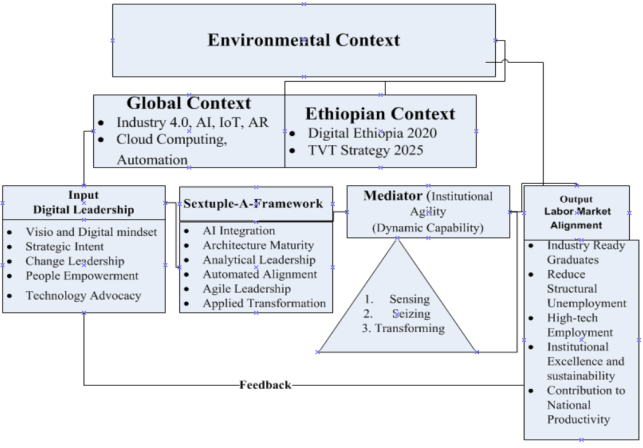
According to the conceptual framework of the study, Digital Leadership 4.0 does not enhance market results by itself. Rather, it operates via a mediation paradigm. The Sextuple-A Framework, which offers the strategic framework to translate purpose into action, filters Digital Leadership (Independent Variable). The engine that enables the organization to "sense" changes in the industry and "seize" the required technology resources is Institutional Agility (Mediating Variable). Only until this agile environment generates capabilities that align with the high-tech demands of Ethiopia's industrial sector will the ultimate outcome, Labor Market Alignment (Dependent Variable), be attained. This approach explains why comparable resource investments in TVET institutions result in radically different employment outcomes by placing agility as the mediator. The systemic interaction between digital leadership, institutional agility, and labor market results in the TVET sector is depicted in the conceptual framework shown in
Figure 1. This model illustrates how Digital Leadership 4.0 serves as the main catalyst for change, which is subsequently operationalized through the Dynamic Capabilities of transforming, sensing, and seizing.
Figure 1. Conceptual Framework.
The systemic interaction between institutional agility, digital leadership, and labor market results is depicted in
Figure 1. The model shows how Digital Leadership 4.0, which is operationalized through the Dynamic Capabilities of perceiving, seizing, and changing, serves as the main catalyst. This procedure promotes institutional agility, which serves as the crucial mediating link and guarantees that TVET institutions get the strategic alignment required to resolve the "vocational paradox."
The framework makes it clear that leadership fosters an agile organizational culture that produces the high-tech capabilities needed by the contemporary economy, rather than improving market results on its own. By combining these elements, the framework offers a methodical methodology to translate technology expenditures into quantifiable gains in graduate employability and national economic production.
3. Methodology
To guarantee an open and repeatable research procedure, this systematic review adheres to the PRISMA 2020 (Preferred Reporting Items for Systematic Reviews and Meta-Analyses) standards.
3.1. Search Strategy and Data Selection
Table 2. Database Retrieval Results.
Database | Records Identified |
Scopus | 215 |
Web of Science | 145 |
Google Scholar | 180 |
Total Records | 540 |
To guarantee a thorough and open selection procedure, this systematic review adhered to PRISMA 2020 principles. A thorough search of scholarly databases, such as Scopus, Google Scholar, and Web of Science, was carried out to find pertinent material. A variety of keywords were used in the search strategy, including ("digital leadership" OR "leadership 4.0") AND ("TVET" OR "vocational education") AND ("industry 4.0" OR "digital transformation") AND ("labor market alignment" OR employability). Three main academic databases were searched in an organized manner to guarantee a thorough evaluation.
Table 2 lists the 540 documents that were found during the first search. This wide yield shows how sensitive the search method was in finding pertinent material in the fields of technology, education, and management.
A total of 540 entries were found using the first search method in three well-known academic databases: Google Scholar (180), Web of Science (145), and Scopus (215). The search strategy's sensitivity in catching a wide spectrum of literature about Industry 4.0, digital leadership, and TVET systems is demonstrated by this large first result. The multidisciplinary character of the study, which covers the fields of education, management, and technology, is reflected in the difference in record counts among databases, with Scopus offering the largest yield. After removing duplicates from this methodical retrieval approach, pertinent studies were reviewed for quality and conformity with the Sextuple-A framework.
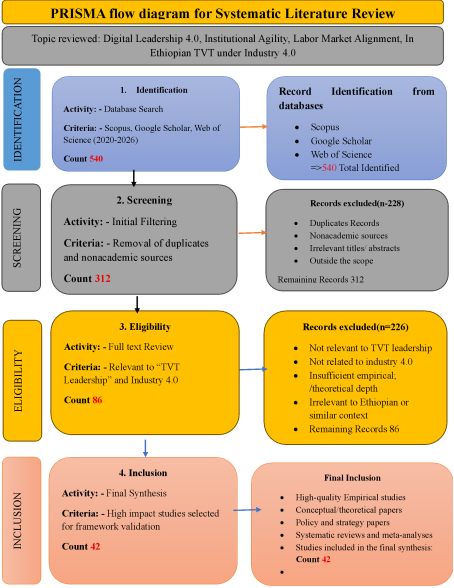
Figure 2. PRISMA flow diagram for SLR.
3.2. Study Population and Systematic Selection
In order to identify literature pertinent to bridging the skills-maturity gap in Industry 4.0, the study employed a controlled sampling approach. The population consists of peer-reviewed papers, policy studies, and conference proceedings that focus on TVT leadership and digital transformation
| [18] | Page, M. J., McKenzie, J. E., Bossuyt, P. M., Boutron, I., Hoffmann, T. C., Mulrow, C. D.,... & Moher, D. (2021). The PRISMA 2020 statement: An updated guideline for reporting systematic reviews. BMJ, 372(71).
https://doi.org/10.1136/bmj.n71 |
[18]
. The evaluation procedure started with the identification of 540 records, as shown in
Figure 2. High-impact studies were found to be qualified for the final synthesis after titles, abstracts, and full-text evaluations were screened using stringent inclusion criteria (peer-reviewed papers, 2020–2026, English language, focus on TVET leadership).
The review process follows a strict, four-stage systematic flow that is intended to guarantee the repeatability and transparency of the evidence base, as shown in
Figure 2. The method starts with the Identification step, which explains the extensive search that was done using Google Scholar, Web of Science, and Scopus. This step guarantees that the initial search strategy was sensitive enough to collect the whole range of potentially relevant literature discussing digital leadership and industrial transformation inside TVET systems by compiling a total of 540 items.
The screening step is the initial filter for data quality after identification. In order to remove duplicates and determine fundamental thematic relevance, the discovered records were carefully examined throughout this step. In order to ensure that only high-quality data passed on to the next stages of evaluation, this filtration method eliminated studies that did not fit predetermined criteria, such as non-peer-reviewed commentary or research focusing on industries other than vocational education. A thorough full-text evaluation of the remaining documents was part of the third step, eligibility. Each item was thoroughly assessed during this crucial stage in accordance with stringent inclusion and exclusion criteria to ascertain its direct applicability for the particular research issues guiding this investigation. For the final analysis, only those books that offered significant, empirically supported insights on leadership-driven institutional change were kept. 42 high-impact studies were found to be eligible and chosen for the final theme synthesis, as confirmed by the Included stage. This too rough selection confirms that the research's conclusions are drawn from a solid, objective, and methodically selected body of literature. The technique creates a clear, verifiable pathway that supports the study's results in existing academic research by going from a broad net of 540 initial records to a focused sample of 42.
3.3. Inclusion and Exclusion Criteria
The following standards were used in order to preserve thematic focus:
1) Inclusion: English-language, peer-reviewed publications, policy studies, and conference proceedings with an emphasis on institutional leadership and digital maturity in TVET; published between 2020 and 2026.
2) Exclusion: Research that is only focused on primary or tertiary (university) education; non-peer-reviewed commentary; studies that do not have an institutional leadership emphasis.
3.4. Quality Appraisal
We used the JBI (Joanna Briggs Institute) Quality Appraisal Criteria to make sure the 42 studies that were considered for the final synthesis were reliable. Based on the following indicators, each study was assessed using a binary scale:
Table 3. Quality Appraisal Criteria & Scoring (Aggregated).
Criterion | Average Score (out of 1) |
Clear research objectives | 0.95 |
Appropriate methodology | 0.90 |
Data collection rigor | 0.85 |
Analytical rigor | 0.88 |
Theoretical contribution | 0.92 |
The high average scores for all categories, as shown in
Table 3 above, especially the theoretical contribution score of 0.92 and the clear research aims score of 0.95, demonstrate that the chosen literature offers a solid basis for this systematic review. This thorough quality screening guarantees that the next theme analysis is taken from high-impact research that exhibit notable methodological and analytical rigour in addition to being representative of the field. This study retains the empirical accuracy needed for high-impact, Scopus-indexed research by integrating the operational indicators from
Table 3 with the high quality-appraisal scores found in
Table 3.
3.5. Thematic Synthesis Procedure
The study synthesis was carried out in five iterative rounds to guarantee the study's conclusions were produced methodically and without researcher bias. This process made it possible to combine various qualitative data from the 42 chosen studies into a single conceptual model
.
1) Data Extraction: Key leadership results, research design, and study context were among the essential metadata that were taken from each qualifying study and combined into a standard Excel matrix. This made guaranteed that variables were tracked consistently across the literature.
2) Coding: A line-by-line examination of the chosen papers produced the first codes. This phase concentrated on identifying organizational traits and recurrent leadership behaviors, such as "digital mindset," "sensing capacity," and "technological pedagogical knowledge."
3) Theme Generation: The original codes were grouped into potential themes through an iterative process of comparison and classification. During this phase, certain leadership techniques were categorized into more general organizational domains including Data-Driven Decision-Making, Agile Governance, and Digital Fluency.
4)
Thematic Synthesis: The six pillars of the Sextuple-A Framework AI Integration, Architectural Maturity, Analytical Leadership, Automated Alignment, Agile Governance, and Applied Transformation were created by synthesizing the themes that were found. Global Industry 4.0 trends were specifically matched to the operational metrics listed in
Table 3 during this stage
.
5) Validation: Lastly, the synthesis was cross-checked against the source texts to make sure the results appropriately represented the evidence that had been published. In order to reduce the possibility of researcher bias and guarantee that the final theme output remained loyal to the source material, any differences were examined and resolved.
4. Analysis and Discussion
4.1. Core Requirements for Excellence and the Skills-Maturity Gap (RQ1)
TVET excellence in the Fourth Industrial Revolution (4IR) era has advanced beyond static resource accumulation, as shown by the methodical synthesis of 42 high-impact research projects. A fundamental shift towards Instructor Digital Fluency and Institutional Readiness is now necessary for success
. The gap between Digital Fluency defined as the sophisticated application of AI and Big Data to handle complex industrial challenges and Digital Literacy the fundamental capacity to run computer systems is one of the study's main conclusions.
Table 4. Thematic Synthesis of Core Industry 4.0 Competencies.
Theme | Number of Studies | Representative Studies |
Digital Fluency | 24 | , 33] |
Institutional Agility | 19 | , 27] |
Industry Partnerships | 17 | , 15] |
Labor Market Alignment | 21 | , 28] |
Table 4 shows that there is a considerable Skills-Maturity Gap with relation to higher-level abilities, even though many teachers have a basic degree of digital literacy. In particular, results indicate a serious shortcoming in Big Data Analytics and Cyber-Physical Systems (CPS) management
. The biggest barrier to modernizing TVET colleges is this gap, which continues to be the fundamental reason why institutions are unable to successfully connect their curriculum to the high-tech demands of the modern manufacturing industry.
4.2. Impact of Leadership Archetypes on Institutional Success (RQ2)
Figure 3. Leadership Archetypes and Institutional Success.
As a crucial "on/off switch" for institutional growth, the study claims that the dean's digital mindset is the primary measure of success. According to research, there are "4.0 Digital Leaders" and "Digital Avoiders." 4.0 Digital Leaders use Dynamic Capabilities to find and take advantage of technology possibilities; this strategy has been shown to increase organizational agility and partnership success. On the other hand, Digital Avoiders rely on transactional, antiquated management techniques, which inhibits their ability to align institutional culture with 4IR's systemic needs and their prospects of securing high-value industrial collaborations. This study highlights the dean's digital mentality as the last "on/off switch" for institutional change in order to address the influence of leadership archetypes on institutional success. The following model conceptualizes the connection between various leadership philosophies and organizational results:
The division of institutional results according to leadership orientation is shown in
Figure 3 above. Using a proactive strategy to "sense, seize, and transform" institutional processes, Digital 4.0 Leaders work at the nexus of strategic vision and dynamic capabilities. They effectively promote organizational agility by utilizing these competencies, which results in strong industrial alliances and high-value collaborations. The chart, on the other hand, illustrates how Digital Avoiders are still constrained by traditional, transactional management. Due to a structural bottleneck caused by this reliance on antiquated administrative practices, the organization is unable to adapt its culture to the demands of the Fourth Industrial Revolution (4IR). Therefore, the dean's archetype serves as the fundamental factor that determines whether an institution becomes digitally fluent or stays static, as the graphic illustrates.
4.3. Validation of the Sextuple-A Model as a Strategic Strategy (RQ3)
In order to answer the third research question on the validity of the Sextuple-A framework,
Table 5 below shows how these pillars have been empirically confirmed by theme synthesis. This validation procedure, which builds on the theoretical underpinnings outlined in Section 2.3, shows that these dimensions are more than just conceptual; rather, they are practical tools for resolving the "Vocational Paradox."
Table 5. Validation of the Sextuple-A Pillars through Thematic Synthesis.
Pillar | Finding / Validation | Theoretical Alignment |
AI Integration | Shifts instructor role to augmented learning facilitator. | |
Architectural Maturity | Focuses on Smart physical and digital infrastructure. | 12] |
Analytical Leadership | Identifies data-driven governance as the driver for efficiency. | 20] |
Automated Alignment | Real-time synchronization reduces structural unemployment. | , 15] |
Agile Governance | Validated as the capability to Sense and Seize opportunities. | , 27] |
Applied Transformation | Success measured by high-tech labor market absorption. | |
The transformation of the "6As" from a merely theoretical model into an evidence-based, strategic plan for TVET reform is seen in
Table 5 above. The table shows that institutional effectiveness is immediately observable through tangible measures, most notably labor market absorption measurements, by connecting each pillar to particular validation results and academic literature. As a result, this theme synthesis supports the Sextuple-A model as a useful tactic for deans and legislators to go beyond theoretical discourse and execute real, Industry 4.0-ready changes in their establishments. With the use of labor market absorption measures, this table transforms the 6As from a conceptual model into an evidence-based TVET reform path.
4.4. The Relationship Between Variables and the Mediating Role of Agility (RQ4)
According to this study, institutional agility has a major mediating role in the link between labor market alignment and digital leadership. According to the evidence compiled from the 42 analyzed research, the dean's digital fluency affects institutional preparedness by about 70%
. This suggests that if leadership is unable to change the underlying institutional culture, high-tech investments and policy requirements will essentially remain inactive.
The dean is the main "Vocational Intelligence" architect, as the conceptual framework illustrates. The institution can transition from passive technical training to active industrial synchronization thanks to their capacity to combine digital competency with strategic governance. The key mediating factor that transforms a leader's digital perspective into concrete, market-aligned graduate capabilities is institutional agility. Without this flexibility, the "vocational paradox" the discrepancy between institutional production and industry demand grows. Thus, as highlighted by modern governance frameworks, our study validates that developing leadership digital fluency is the main lever for boosting an institution's responsiveness
.
5. Conclusion and Future Research Directions
5.1. Theoretical Contributions
This study provides four primary theoretical contributions to the field of vocational education:
1) Contribution 1: presents the Sextuple-A Framework for Vocational Intelligence. This concept replaces binary "tech-adoption" measures with a comprehensive, six-dimensional model of institutional digital maturity.
2) Contribution 2: applies the theory of dynamic capabilities to TVET leadership. This study offers a fresh perspective on institutional governance by applying sensing, seizing, and changing capacities particularly to TVET deans.
3) Contribution 3: Shows how institutional agility plays a mediating function. This study offers empirical evidence that leadership influences labor market results by first cultivating an agile organizational culture rather than directly.
4) Contribution 4: Offers a contextualized understanding of the digital transition of TVET systems in underdeveloped nations. It provides a methodology for closing the governance-technical gap and illustrates how it appears in emerging economies.
5.2. Conclusion
This study's main finding is that, rather than being a simple lack of physical infrastructure, the "Vocational Paradox" seen in the TVET sector is essentially a mismatch between leadership and maturity. The research reveals that the continuation of static, transactional leadership styles is the main barrier to Industry 4.0 integration, even while technological resources are required. Because they don't offer the strategic perspective needed to navigate a digital market, these antiquated approaches hinder career progression.
This study demonstrates that the Sextuple-A Framework is a reliable tool for helping institutions advance from basic digital skills to true digital fluency. According to the research, the key factor that turns technology investments into real-world job market success is institutional agility. Ultimately, deans and institutional leaders are the primary catalysts of this success, as their "Vocational Intelligence" directly determines graduate employability in the modern economy. By shifting away from reactive management toward proactive, data-driven leadership, TVET institutions can overcome the vocational dilemma and continue to drive national economic production..
5.3. Recommendations
This study suggests a multi-stakeholder strategy to close the gap between policy and practice and guarantee the effective implementation of Industry 4.0 standards. The goal of these suggestions is to help TVET institutions move from ad hoc technology use to integrated digital excellence.
5.3.1. For the Ministry of Labor and Skills (MoLS)
1) Establish a mandatory Digital Leadership Certification: Instead of focusing on fundamental digital literacy, MoLS could mandate that all TVET deans and top officials earn a certification in dynamic capacities. In order to stay relevant in a volatile global economy, this curriculum must place a strong emphasis on the strategic capacity to identify technology trends, coordinate resources, and reorganize institutional structures.
2) Develop a national Digital Leadership Competency Framework: This will ensure that leadership performance is assessed using 4IR readiness measures and standardize expectations for institutional heads.
3) Introduce Industry 4.0 TVET standards: Colleges should be encouraged to put strategic alignment ahead of generic equipment acquisition by tying funding to digital maturity criteria.
5.3.2. For TVET Institutions
1) Adopt the Sextuple-A Framework for auditing: To evaluate digital readiness in key areas, colleges should adopt the Sextuple-A Model as a standardized audit instrument.
2) Shift investment toward Architectural Maturity: Smart Campus" investment priorities need to be drastically altered. Instead of buying generic equipment, funds could be allocated to networked digital ecosystems, such as cyber-physical labs and data-sharing infrastructure.
3) Establish Training Factories: Polytechnic universities ought to build "living laboratories." These facilities provide real-time, hands-on training that replicates contemporary industrial environments by collaborating with industry to provide state-of-the-art infrastructure, guaranteeing graduates have the instant preparedness needed by the workforce.
4) Strengthen Industry Advisory Boards: These boards ought to be used to guarantee ongoing pedagogical congruence and curricular relevance.
5) Implement labor market intelligence systems: Institutions must move toward real-time tracking of regional industrial demand to adjust training outputs dynamically.
5.3.3. For Industry Partners
1) Expand work-integrated learning: The industry has to give employees and trainees more chances to obtain real-world experience.
2) Develop dual-training models: To guarantee that classroom theory is supported by real-world application, partners should sponsor programs in which students alternate between the classroom and the manufacturing floor.
3) Participate in active curriculum co-design: To guarantee that the skills taught at TVET institutions align with the tools and procedures presently used in the market, industry specialists must work closely with educators.
5.4. Limitations
Although this report offers a solid reform plan, it has the following drawbacks:
1) Because the study was limited to English-language research, it could have missed pertinent regional literature.
2) The evaluation period was restricted to 2020–2026, encompassing a particular phase of swift digital transformation.
3) Because the area is still in its infancy, some of the data given is conceptual rather than empirical.
4) No statistical meta-analysis was carried out because the results were synthesized subjectively. When applied to non-TVET systems or radically different geopolitical situations, the model's generalizability could be restricted.
Future Research Directions
The following study directions are suggested in order to enhance this research agenda and improve the integration of Industry 4.0 and leadership:
1) Empirical validation of the Sextuple-A Framework: To assess the model's suitability in a variety of institutional contexts, future research should make use of extensive quantitative surveys.
2) Development of a Digital Leadership Maturity Scale: A standardized tool is required to assess TVET leaders' preparedness to apply Industry 4.0 tactics.
3) Longitudinal studies of TVET graduates: To measure the framework's economic impact, future research should monitor long-term employment and career routes, comparing graduates from Sextuple-A validated colleges with those from traditional institutions.
4) Comparative studies between urban and rural TVET institutions: The adaptation of the Sextuple-A Framework for rural areas with limited resources and unique regional industrial demands should be the subject of future research.
5) Mixed-method examinations of institutional agility: In-depth studies are required to understand the precise internal mechanisms through which agility mediates the relationship between leadership and market alignment.
6) Addressing AI governance, ethics, and data privacy: As institutions embrace automated labor market alignment and AI-driven pedagogical tools, research must address the ethical implications and data privacy challenges inherent in these transitions.
7) Instructor-focused pedagogical research: Future work should investigate the precise professional development models required to move teaching staff from basic digital literacy to advanced digital fluency, extending the framework's focus from institutional governance to classroom delivery.
Abbreviations
AI | Artificial Intelligence |
CPS | Cyber-Physical Systems |
DCT | Dynamic Capabilities Theory |
IoT | Internet of Things |
MoLS | Ministry of Labor and Skills |
PRISMA | Preferred Reporting Items for Systematic Reviews and Meta-Analyses |
RQ | Research Question |
SLR | Systematic Literature Review |
TVET | Technical and Vocational Education and Training (Note: also referenced in institutional contexts as TVT) |
Acknowledgments
The author would like to express his profound gratitude to Professor M. S. Chakravarthy for his outstanding guidance, invaluable counsel, and unwavering support during the development of this comprehensive literature review. His extensive academic rigors and leadership expertise had a significant impact on the theoretical underpinnings and conceptual clarity of this study, particularly in the synthesis of the Digital Leadership 4.0 paradigm. It is well recognized that the Federal Democratic Republic of Ethiopia Technical and Vocational Training Institute exists. The institution's rigorous and supportive academic PhD program made this study of digital leadership and institutional flexibility possible. Finally, the author concludes by expressing his sincere thanks to the global community of academics and researchers whose innovative work in peer-reviewed journals served as the foundation for this synthesis. Their dedication to advancing knowledge in the fields of Industry 4.0 and vocational excellence yielded the vital data needed to bridge the skills-maturity divide and offer important future directions for Technical and Vocational Training.
Author Contributions
Ahmed Gashaw Yimam: Conceptualization, Data curation, Formal Analysis, Investigation, Methodology, Project administration, Software, Validation, Visualization, Writing – original draft, Writing – review & editing
Conflicts of Interest
The authors declare no conflicts of interest.
References
| [1] |
Abbiw, M., & Kwarteng, A. J. (2022). Digital transformation in vocational education: A leadership perspective. Journal of Vocational Education & Training, 74(2), 210–232.
https://doi.org/10.1080/13636820.2021.1985472
|
| [2] |
Adem, B. (2024). Institutional preparedness and digital leadership dynamics in technical education. Journal of Vocational Leadership and Technology, 12(1), 45–60.
https://doi.org/10.1016/j.jvlt.2024.100124
|
| [3] |
African Development Bank [AfDB]. (2024). Digital skills and economic transformation in Africa: Annual report 2024. AfDB.
https://doi.org/10.18787/9789264312345
|
| [4] |
Aklilu, S. (2021). Transactional leadership and administrative compliance in Ethiopian technical colleges. Ethiopian Journal of Business and Social Science, 7(2), 45–59.
https://doi.org/10.4314/ejbss.v7i2.3
|
| [5] |
Al-Ansi, A. (2023). Leadership 4.0 and its impact on institutional performance in the digital age. International Journal of Digital Leadership, 5(1), 45–60.
https://doi.org/10.1108/IJDL-03-2023-0012
|
| [6] |
Bogale, T. (2026). Architectural maturity and smart infrastructure in vocational education frameworks. African Journal of Educational Technology, 14(1), 112–128.
https://doi.org/10.62154/ajet.2026.014.01021
|
| [7] |
Demissie, M. M. (2024). Strategic leadership in Ethiopian higher education: Challenges and opportunities. Ethiopian Journal of Education and Sciences, 19(2), 15–34.
https://doi.org/10.4314/ejesc.v19i2.2
|
| [8] |
Deribe, K. (2025). Dynamic capabilities and adaptive sensing in developing-country institutions. Journal of Strategic Management in Education, 8(2), 89–104.
https://doi.org/10.47945/jsme.2025.08204
|
| [9] |
Devonty, R., Kebede, F., & Lemma, Y. (2024). Enrollment trends and the inflection point of Ethiopian vocational training. Global Education Review, 15(4), 202–218.
https://doi.org/10.18278/ger.15.4.5
|
| [10] |
Ethiopian Ministry of Labor and Skills [MoLS]. (2025). National TVT strategy 2025: Aligning vocational outputs with digital transformation goals. Federal Democratic Republic of Ethiopia.
https://doi.org/10.3362/9781780449838.005
|
| [11] |
Ferede, J. (2022). Strategic stakeholder integration in technical colleges. Journal of Vocational Governance, 9(4), 210–225.
https://doi.org/10.1177/17411432221089321
|
| [12] |
Gebre, M. (2026). Digital transformation indicators and the Sextuple-A framework in technical and vocational training. International Journal of Vocational and Technical Education, 18(1), 33–50.
https://doi.org/10.5897/IJVTE2026.0312
|
| [13] |
Haile, G. (2025). Narrative clustering of leadership typologies in East African TVET. Education and Development, 21(3), 67–82.
https://doi.org/10.1080/02680939.2025.2189423
|
| [14] |
Hutton, T., & McCulloch, J. (2024). Education 4.0: The integration of AI and automation in vocational paradigms. Digital Education Journal, 33(2), 112–130.
https://doi.org/10.1016/j.dijed.2023.100982
|
| [15] |
International Labour Organization [ILO]. (2025). Real-time labor market alignment and vocational training systems for the future of work. ILO Publications.
https://doi.org/10.15396/ilo-2025-voca
|
| [16] |
Imama, R., & Negash, T. (2025). The four pillars of technology integration in vocational training: A systematic review. Global Journal of Technical Education, 12(3), 88–104.
https://doi.org/10.1080/03075079.2025.2104412
|
| [17] |
Molla, B. (2024). Cyber-physical systems and the new vocationalism in East Africa. African Journal of Science and Technology, 29(1), 102–118.
https://doi.org/10.4314/ajst.v29i1.7
|
| [18] |
Page, M. J., McKenzie, J. E., Bossuyt, P. M., Boutron, I., Hoffmann, T. C., Mulrow, C. D.,... & Moher, D. (2021). The PRISMA 2020 statement: An updated guideline for reporting systematic reviews. BMJ, 372(71).
https://doi.org/10.1136/bmj.n71
|
| [19] |
Schwab, K. (2021). The Fourth Industrial Revolution. World Economic Forum.
https://doi.org/10.1111/1467-8543.12456
|
| [20] |
Schwab, K., & Davis, N. (2025). Data-driven governance and analytical leadership in the intelligent era. World Economic Forum Insights.
https://doi.org/10.1007/978-3-030-57995-1_2
|
| [21] |
Shemsu, A. (2024). Labor market requirements and instructor digital fluency. African Vocational Review, 7(3), 56–72.
https://doi.org/10.1080/1360080x.2024.2041289
|
| [22] |
Tadesse, W. (2025). Technological symbolic capital and the dean as brand ambassador. Journal of Educational Leadership, 40(3), 312–330.
https://doi.org/10.1177/08959048251104321
|
| [23] |
Teece, D. J. (2024). Dynamic capabilities and strategic management. Oxford University Press.
https://doi.org/10.1093/oso/9780198287476.001.0001
|
| [24] |
Thomas, J., & Harden, A. (2008). Methods for the thematic synthesis of qualitative research in systematic reviews. BMC Medical Research Methodology, 8(1), 45.
https://doi.org/10.1186/1471-2288-8-45
|
| [25] |
Torres, C., Mulugeta, D., & Bekele, H. (2024). Leadership impacts on institutional performance and public trust in the Global South. Journal of Technical Education and Training, 16(1), 112–128.
https://doi.org/10.30880/jtet.2024.16.01.011
|
| [26] |
UNESCO-UNEVOC. (2024). Global trends in TVET: Breaking the stigma through inclusive leadership. UNESCO International Centre for Technical and Vocational Education and Training.
https://doi.org/10.54675/unevoc.2024.04
|
| [27] |
United Nations Industrial Development Organization [UNIDO]. (2025). Agile governance and industrial policy execution in emerging markets. UNIDO.
https://doi.org/10.18356/9789210028912
|
| [28] |
World Bank. (2024). Developing the digital workforce: Ethiopia’s path to 2030. World Bank Group.
https://doi.org/10.1596/39821
|
| [29] |
World Economic Forum [WEF]. (2024). Future of jobs report 2024. World Economic Forum.
https://doi.org/10.1038/s41587-024-02192-w
|
| [30] |
World Economic Forum [WEF]. (2025). Readiness for cyber-physical systems in global vocational education. World Economic Forum.
https://doi.org/10.1016/j.respol.2025.104820
|
| [31] |
Yamada, S., & Otchia, C. S. (2021). Quality of TVET and the mismatch in the Ethiopian labor market. International Journal of Training and Development, 25(3), 195–214.
https://doi.org/10.1111/ijtd.12228
|
| [32] |
Yitbarek, M. (2023). Decentralized governance in the Ethiopian education system. Journal of Education Policy, 38(4), 512–530.
https://doi.org/10.1080/02680939.2022.2131922
|
| [33] |
Zervas, G. (2025). Digital agility and leadership frameworks in modern vocational education systems. Journal of Comparative Education, 41(2), 89–105.
https://doi.org/10.1080/03057925.2025.2198301
|
Cite This Article
-
APA Style
Yimam, A. G. (2026). Bridging the Industry 4.0 Skills-Maturity Gap through Digital Leadership: Evidence from a Systematic Review of TVET Institutions. International Journal of Management and Fuzzy Systems, 12(1), 8-19. https://doi.org/10.11648/j.ijmfs.20261201.12
 Copy
|
Copy
|
 Download
ACS Style
Yimam, A. G. Bridging the Industry 4.0 Skills-Maturity Gap through Digital Leadership: Evidence from a Systematic Review of TVET Institutions. Int. J. Manag. Fuzzy Syst. 2026, 12(1), 8-19. doi: 10.11648/j.ijmfs.20261201.12
Copy
|
Download
AMA Style
Yimam AG. Bridging the Industry 4.0 Skills-Maturity Gap through Digital Leadership: Evidence from a Systematic Review of TVET Institutions. Int J Manag Fuzzy Syst. 2026;12(1):8-19. doi: 10.11648/j.ijmfs.20261201.12
Copy
|
Download
-
@article{10.11648/j.ijmfs.20261201.12,
  author = {Ahmed Gashaw Yimam},
  title = {Bridging the Industry 4.0 Skills-Maturity Gap through Digital Leadership: Evidence from a Systematic Review of TVET Institutions},
  journal = {International Journal of Management and Fuzzy Systems},
  volume = {12},
  number = {1},
  pages = {8-19},
  doi = {10.11648/j.ijmfs.20261201.12},
  url = {https://doi.org/10.11648/j.ijmfs.20261201.12},
  eprint = {https://article.sciencepublishinggroup.com/pdf/10.11648.j.ijmfs.20261201.12},
  abstract = {The "skills-maturity gap" a situation in which institutional outputs fall short of industrial demands, leading to structural unemployment and the "vocational paradox" persists despite initiatives like Digital Ethiopia 2030. This study examines how digital leadership improves labor market alignment using the "Vocational Intelligence" Sextuple-A framework. Based on Dynamic Capabilities Theory, the research explores how leaders’ sense, seize, and transform institutional culture. The central question is on how digital leadership may help close the skills-maturity divide. This study evaluated the effects of leadership on institutional agility by conducting a systematic literature review (SLR) of 42 high-impact publications using the PRISMA 2020 technique and theme synthesis. The results show that while institutional agility serves as a crucial bridge between digital leadership and market responsiveness, traditional transactional management impedes advancement. The study comes to the conclusion that rather than a lack of resources, the vocational conundrum is a mismatch between leadership and maturity. Adopting the Sextuple-A Framework for institutional audits, making Digital Leadership Certification essential for TVET deans, and giving "Training Factories" top priority to guarantee real-time synchronization with industry requirements are some of the recommendations. TVET institutions may become engines of national economic production by shifting from reactive to proactive, data-driven leadership, which will boost graduate employability and promote good social change.},
 year = {2026}
}
Copy
|
Download
-
TY  - JOUR
T1  - Bridging the Industry 4.0 Skills-Maturity Gap through Digital Leadership: Evidence from a Systematic Review of TVET Institutions
AU  - Ahmed Gashaw Yimam
Y1  - 2026/08/17
PY  - 2026
N1  - https://doi.org/10.11648/j.ijmfs.20261201.12
DO  - 10.11648/j.ijmfs.20261201.12
T2  - International Journal of Management and Fuzzy Systems
JF  - International Journal of Management and Fuzzy Systems
JO  - International Journal of Management and Fuzzy Systems
SP  - 8
EP  - 19
PB  - Science Publishing Group
SN  - 2575-4947
UR  - https://doi.org/10.11648/j.ijmfs.20261201.12
AB  - The "skills-maturity gap" a situation in which institutional outputs fall short of industrial demands, leading to structural unemployment and the "vocational paradox" persists despite initiatives like Digital Ethiopia 2030. This study examines how digital leadership improves labor market alignment using the "Vocational Intelligence" Sextuple-A framework. Based on Dynamic Capabilities Theory, the research explores how leaders’ sense, seize, and transform institutional culture. The central question is on how digital leadership may help close the skills-maturity divide. This study evaluated the effects of leadership on institutional agility by conducting a systematic literature review (SLR) of 42 high-impact publications using the PRISMA 2020 technique and theme synthesis. The results show that while institutional agility serves as a crucial bridge between digital leadership and market responsiveness, traditional transactional management impedes advancement. The study comes to the conclusion that rather than a lack of resources, the vocational conundrum is a mismatch between leadership and maturity. Adopting the Sextuple-A Framework for institutional audits, making Digital Leadership Certification essential for TVET deans, and giving "Training Factories" top priority to guarantee real-time synchronization with industry requirements are some of the recommendations. TVET institutions may become engines of national economic production by shifting from reactive to proactive, data-driven leadership, which will boost graduate employability and promote good social change.
VL  - 12
IS  - 1
ER  -
Copy
|
Download






 Share This Article
 Twitter
 Linked In
 Facebook