Abstract
Binge watching can also be called binge viewing, marathon viewing. Binge watching is basically watching television or other entertainment material for a long time at once. The main purpose of the research was to investigate the relationship between Binge watching, Sleep, Aggression, Loneliness and Mental welling due to the use social Netflix among the university students. It was hypothesized that there exists relationship between Binge watching, Sleep, Aggression, Loneliness and Mental welling. Pearson product-moment was used to check the relationship between variables. The sample comprised of 291 students from different universities of Pakistan. The age range of the sample is 18-25 with (M=24.81, SD=2.67). English version of the Binge-Watching scale Sleep, Aggression and Mental Wellbeing scale were used. Different analysis was applied which are Pearson correlation, regression, psychometric analysis and t-test. The correlational analysis shows that binge watching only significantly positively correlate with aggression while have negatively relationship with all other variables. Sleep has significant negative relationship with aggression. Aggression has strong negative relationship with mental wellbeing and weak negative relationship with aggression. Loneliness has strong significance relationship with mental well binge. T-test shows that there is no significant provincial differences between men and women. Since all their significant values were > 0.5.
Keywords
Binge Watching, Sleep, Aggression, Loneliness, Mental Welling
1. Introduction
1.1. Binge-watching
Binge watching can also be called binge viewing, marathon viewing. Binge watching is basically watching television or other entertainment material for a long time at once. In a survey conducted by the Netflix conducted in 2014, showed that 73% of people define binge watching of watching 2 to 6 TV shows in a single setting. Other researches define binge watching is watching TV for long time for actual information. Some define binge watching as watching TV or other media for different things for long time at once. Overall, they propose that binge watching is basically watching media for long time whether at once or finishing a single series in several days continuously [1].
Binge watching is observable cultural phenomenon and rises with passage of time and rise of video streaming service i.e., Netflix, amazon, prime video and other channels through with a person can watch videos on demand. For example, a survey conducted by Netflix showed that 60% they watch or binge regularly. Recently conducted research in US showed that 60% of the people say that people binge watched almost once a year.
1.2. Effect on Sleep
A study was conducted I n 2017 and result was shocking that binge watching increases insomnia and in some case it case alter cognitions so therefore binge watching badly effect sleep. The result showed that people who binge watch have very poor sleep quality, have very poor sleep time, have more fatigue before sleep and even they have to take medicine to sleep. But the researche also showed that binge watching can not predict negative relationship between binge waching and sleep and therefore a new research should be conducted to fine the deference between theme.
1.3. Psychological Well-being
Psychological Well-being is a multi-dimensional concept which includes many different concepts like playfulness, cheerfulness, resilience optimism and self-control among the individuals across the cultures
| [16] | West, Kelly (December 13, 2013). "Unsurprising: Netflix Survey Indicates People Like to Binge-Watch TV". Cinema Blend. Retrieved February 12, 2014. |
[16]
. McCulloch (1991) demonstrated that social support, self-esteem, positive emotions and satisfaction are the terms which comprises psychological well-being in all age groups.
Psychological well-being is recognized as a universal indicator for the presence of subjective readiness to perceive a certain social space as important to the individual. This construct still does not have consistent content. Nevertheless, it allows for integration within different explanatory models in connection with individuals psychological functioning. It is even possible for separate parameters to be studied as the indicators of psychological well-being, which would aid the empirical approach.
Since the late 1950s, several conceptual frameworks have addressed positive mental health. These frameworks include a range of emphasis, such as cultural definitions of mental health, subjective sense of well-being, and capacity for coping and resiliency in face of stressors (World Health Organization, 2004). In the adolescent’s health field, similar efforts have expanded the definition of health from one that examines negative behaviors and outcomes to one that incorporates positive youth development and functioning
| [2] | Corey, K. (2002). The mental health continuum: From languishing to flourishing in life. Journal of Health and Social Behavior, Vol. 43(2), p 207-222. |
[2]
.
The concept of psychological well-being has been defined as positive psychological functioning and experiences
| [16] | West, Kelly (December 13, 2013). "Unsurprising: Netflix Survey Indicates People Like to Binge-Watch TV". Cinema Blend. Retrieved February 12, 2014. |
[16]
. Psychological well-being in this sense may be understand as a positive mental health but here we also have to see that what defines the psychological functioning and what positive experiences makes our life good has been a controversial issue. Nonetheless, many researchers followed different approaches of psychological well-being in the field of well-being.
The one who showed that well-being includes psychological as well as social facets of the self. He proposed five social dimensions of well-being; 1. Social Acceptance (i.e. in this the people must feel positive about others and about themselves and accept them as they are), 2. Social actualization (i.e. in this people must being comfortable within the society and must believe in the potential of their growth), 3. Social contribution (i.e. in this the person feels like having a contribution to make the society and that this contribution is valued by others), 4. Social Coherence (i.e. in this the person is being interested in the social world and viewing it as comprehensible and predictable), 5. Social Integration (i.e. in this the person must believe that he/she is belongs to the community, and is supported and share common interests with others in the community and feeling as the part of the community). Thus, according to this approach, well-being is being as intra-personal, and it also influences and influenced by social factors
| [14] | Suldo, S. M., Riley, K. N., and Shaffer, E. J. (2006). Academic correlates of children and adolescents’ life satisfaction. School Psychology International, Vol. 27(5), p. 567-585. |
[14]
.
1.4. Factors Affecting Psychological Well-being
However, there are relative information about specific indicators of wellness and how the relate to adolescent’s mental health
| [2] | Corey, K. (2002). The mental health continuum: From languishing to flourishing in life. Journal of Health and Social Behavior, Vol. 43(2), p 207-222. |
[2]
.
1.4.1. Life Satisfaction
The life satisfaction is one of the positive indicators of well-being which receives attention in many recent studies relative to beneficial outcomes for youth is life satisfaction. Life satisfaction is one of the most well-established indicators of wellness, and moreover, positive functioning
| [13] | Sinha, J. N. P., and Verma. J. (1992). Social support as the moderator of the relationship between allocentric and psychological well-being. Social and Applied Issues. |
[13]
. Studies have evidenced that there is positive relation between life satisfaction and adolescent’s achievement
| [4] | Fergusson, D. M., & Horwood, L. J. (2008). Cannabis use and later life outcomes. Addiction, Vol. 103(6), p. 969-976. |
[4]
. Moreover, high level of life satisfaction is associated with social-emotional outcomes such as lower rates of suicide attempts
| [9] | Kim, H. S., & Kim, H. S. (2008). Risk factors for suicide attempts among Korean adolescents. Child Psychiatry & Human Development, Vol. 39(3), P. 221-235. |
[9]
, decreased substance use (Fergusson & Boden, 2008), and greater parent-peer attachment (Ma & Huebner, 2008). Such findings demonstrate the positive implications high levels of life satisfaction have for adolescent development and success.
1.4.2. Social Support
Positive psychology has been informed by decades of research examining positive emotions, emotions, characteristics, values, and institutions that support and enhance individuals (Beaver, 2008). The social support is one of the enhancing agents that has received too much attention in child and adolescent literature. Research has described that social support is an very expansive construct used to enhance the physical and emotional comfort given to the individuals by their families, friends and others who are significant to their lives
| [7] | Israel, B., & Schurman, S. (1990). Social support, control, and the stress process. In K. Glanz, M. Frances, & B. Rimer (Eds.), Health behavior and health education: Theory, research, and practices (p. 187-215). San Francisco, CA: Jossey-Bass. |
[7]
. Research has consistently shown that low levels of social support are related to the variety of poor psychological, social
| [3] | Demaray, M. K., & Elliott, S. N. (2001). Perceived social support by children with characteristics of attention-deficit/hyperactivity disorder. School Psychology Quarterly, Vol. 16, p. 68-90. |
[3]
, academic
| [12] | Richman, J. M., Rosenfeld, L. B., and Bowen, G. L. (1998). Social support for adolescents at risk of school failure. Social Work, Vol. 43, p. 309-323. |
[12]
, and health-related
| [5] | Frey, C. U., & Rothlisberger, C. (1996). Social support in healthy adolescents. Journal of Youth and Adolescence, Vol. 25, p. 17-31. |
[5]
outcomes for adolescents.
1.5. Loneliness
It is an unpleasant emotional and psychological response or perception of binge a lone while having family and friends. It can also be defined as social pain that can motivate a person to seek attention towards and to seek social interaction and connection. It is can associated a person of an unwanted lack of connection. Loneliness and solitude is two different terms and cannot be overlap. Solitude is simply define as binge apart from others while loneliness is something else. Evry one who have experiencing solitude can not be said that he or she is in loneliness. The causes of loneliness can be social, emotional and psychological. Binge lonely means binge with other but feeling of lonely because of perception.
Some researches showed that almost every person feel lonely whether he or she is married, businessman or a successful person. Some people feel it at some situation and other feel everywhere and every time. Researcher also showed that short term loneliness is good for health but long-term loneliness is very bad for health. It can affect health as like as cancer and can Couse loneliness.
Loneliness has been the centre of focuses for a long time since incident Greek and Hippocrates. Now researcher and NGOs have found physical avoidances and they are ready to tackle it.
1.6. Internet and Loneliness
Studies have found moderate correlation between loneliness and internet use. Result have shown that lonely people are attracted towards internet to seek pleasure and to maintain their life. Displacement hypothesis showed that some people Withrow from real world to have some time form internet.
Over use of internet can Couse anxiety and depression and that is a condition which can provoke more loneliness. Some researchers also showed that internet can reduce the perception of people feeling lonely. But some researches showed that internet even in a small amount can Couse excessive loneliness.
Some researchers are agree to to use internet so that it is good for health and loneliness while others are not agree because they said that internet use can Couse loneliness but if we use it an excessive amount.
1.7. Sleep
Sleep is natural phenomenon of mind and body state, that is known by the altered consciousness. It includes reduction in muscles activity, and partially loss in connection with surrounding.
1.8. Aggression
Aggression is a behavior characterize harming to other or oneself. Aggression in term of research is the enduring pattern of behavior that are characterize by showing extreme type of behavior that is not acceptable in normal daily life and in society.
1.9. Aggression and Media
Aggression can be learned from media and other researcher show that media have small effect on aggression. Study shows that long term relationship was not found between violent video gaming and aggression. Some study shows that violent video gaming has slam effect on aggression then violent television videos. In short result showed that there is no avoidance that show positive relationship between violent video games and aggression.
1.10. Objectives of the Study
1) To find out the relationship between binge watching and sleep.
2) To find out the relationship between binge watching and aggression.
3) To find out the relationship between binge watching and loneliness.
4) To find out the relationship between binge watching and mental wellbeing.
1.11. Hypothesis of the Study
1) Binge watching is likely to have positive relationship with sleep.
2) Binge watching is likely to have positive relationship with aggression.
3) Binge watching is likely to have positive relationship with loneliness.
4) Binge watching is likely to have positive relationship with mental wellbeing.
5) There would be a significant relationship between binge watching, sleep, aggression. Loneliness and mental wellbeing among university students.
6) There would be a significant difference in binge watching, sleep, aggression. Loneliness and mental wellbeing among university students.
7) Being watching is likely to predict sleep.
8) Being watching is likely to predict aggression.
9) Being watching is likely to predict loneliness.
10) Being watching is likely to predict mental wellbeing.
11) There would be a gender difference between binge watching, sleep, aggression. Loneliness and mental wellbeing among university students.
2. Literature
Granow and his college conducted research on N_499 student to see the effect of binge watching on psychological will being. The result shows that binge watching can increase and decrease psychological will being at a time. It can increase will being by providing entertainment to ussers and can decrease will being by goals conflect and feeling of guilt. The result also shows that binge watching positively effect well-being. They slso shows that self-determination and media perception is their central theme
| [6] | Granow, V. C., Reinecke, L., & Ziegele, M. (2018). Binge-watching and psychological well-being: media use between lack of control and perceived autonomy. Communication Research Reports, 35(5), 392-401. |
[6]
.
In 2019 Troles conducted research on binge watching behaviour and its effect on health and daily life activity. The sample was consisting of 45 students on 15 days trials of watching video for 89 mints daily. Results shows that psychological and daily life activity were affected by binge and video streaming. Positive relationship was found between video streaming and happy mood and relaxation after streaming. No negative consequences of video streaming were found on psychological wellbeing. Bivariant correlation were nor found between negligence on daily life activity and video streaming and also there is no adverse effect of video streaming of health
| [15] | Troles, H. (2019). Binge-watching and its influence on psychological well-being and important daily life duties: An Experience Sampling Study (Bachelor's thesis, University of Twente). |
[15]
.
In 2013 Randler and Vollmer conducted a research on sleep pattern and aggression among young adults. They sued Buss-Perry aggression scale and questioner and sleep timing and time duration of sleep scale. Results shows that sleep duration were negatively correlate with aggression and short sleeper were more aggressive than long sleepers. Short sleepers mainly concern with physical aggression, verbal aggression and anger. Short sleepers also face social rejection due to aggression and short tempered
| [11] | Randler, C., & Vollmer, C. (2013). Aggression in young adults—a matter of short sleep and social jetlag? Psychological reports, 113(3), 754-765. |
[11]
.
Kalpana (2016) the purpose of this study was to find out the association between media use and Psychological Well-Being (PWB) among young working adults and to study Gender differences in this relationship. 286 individuals volunteered to participate in the study within age range between 21 to 28 years. The sample consisted of 173 males and 113 females who were currently employed. PSS was measured using Multidimensional Scale of Perceived Social Support and PWB by Ryff’s Scale of Psychological Well-Being
| [8] | Kalpana, R. E. (2016). Perceived Social Support and Psychological Well-Being: Testing the Unique Association and Gender Differences among Young Working Adults. The International Journal of Indian Psychology, Vol. 3, p. 98-113. |
[8]
.
The data was analyzed using independent samples ‘t’ test, Pearson Product Moment Correlation analysis and Regression analysis. The results indicated that PSS has a significant positive correlation with PWB indicating that the higher the level of use of media, the higher the level of PWB. Further, significant gender differences were found in PSS, with women reporting receiving more social support than men and women were also high in support from two of the three types of sources: family and friends. In addition, both men and women reported availability of higher social support from family as compared to what they can obtain from friends and significant other. No significant gender differences were found in PWB. Regression analysis indicated that media use could significantly contribute to the prediction of PWB accounting for about twelve percent variance in it. Besides, PSS explained relatively higher variance in PWB among men as compared to women. Positive relations and self-acceptance dimensions of PWB were better influenced by PSS in both men and women
| [10] | Ma, C. Q., Huebner, E. S. (2008). Attachment relationships and adolescents’ life satisfaction: Some relationships matter more to girls than boys. Psychology in the schools, Vol. 45(2), p. 177-190. |
[10]
.
2.1. Summary
In this chapter different researches have been included that is most relevant from the present research. All researches which have been included were conducted in different countries of the world which represent their problem related to the use of binge watching, sleep, aggression, loneliness and mental wellbeing among young adults and University students.
2.2. Rationale of the Study
The research aimed at determining the possible relationship for binge watching behaviour, mental well-being, loneliness, sleep, and aggression among Netflix users. To bring awareness to Netflix binging habits and encourage further research of this subject, why it is important to promote healthy television practices due to the lack of societal concern of the risks of binge-watching behaviour. Do lonelier and depressed people are, the more likely they are to binge-watch television or there is some other relationship. The relationship between Netflix binge watching and mental well- being is most crucial one. As it determines both positive and negative impact one has on other. When it comes to streaming services and sleep, are they friends or foes? To find out whether streaming services are a friend or enemy of sleep, we asked respondents how they felt streaming content impacted their sleep. How as One psychological model proposes that frequent exposure to violent media helps establish aggressive behavioural scripts and more positive attitudes toward aggression works. It will allow to Explore ethical and personal values to counter or by one way or decrease the negative impact of Netflix.
3. Method
3.1. Study Design
Correlational survey method was applied to the study as the subject variable (i.e.; gender).
3.2. Participants or Sample
In this study the size of the participants is N=290 (Men=201, women=89 all of them will be selected from different universities. Due to COVID-19 All the data was collected through online from the students of different universities.
3.2.1. Inclusion Criteria
There will be no limitations for the participants, like, age must be between 15- 18 or 19, there will be no limitations for gender and sex. The participants which belong to universities can fill the questionnaire.
3.2.2. Exclusion Criteria
People which do not met the criteria of the research will be unable to fulfil the questionnaire.
3.3. Operational Definitions
Operational definitions of research variables are as follow.
3.3.1. Binge Watching
Binge watching can also be called binge viewing, marathon viewing. Binge watching is basically watching television or other entertainment material for a long time at once
| [16] | West, Kelly (December 13, 2013). "Unsurprising: Netflix Survey Indicates People Like to Binge-Watch TV". Cinema Blend. Retrieved February 12, 2014. |
[16]
.
3.3.2. Sleep
Sleep is natural phenomenon of mind and body state, that is known by the altered consciousness. It includes reduction in muscles activity, and partially loss in connection with surrounding.
3.3.3. Aggression
Aggression is an enduring type of behaviour that is characterized by harming oneself, others or distracting the property.
3.3.4. Psychological Well-being
Psychological well-being is a positive attribute such that a person can reach enhanced level of mental health even if they do not have any diagnosable mental health condition
| [2] | Corey, K. (2002). The mental health continuum: From languishing to flourishing in life. Journal of Health and Social Behavior, Vol. 43(2), p 207-222. |
[2]
.
3.4. Instruments or Materials
In this research we use three scales to collect the data from the students of university. These scales are given below.
3.4.1. Binge Watching Scale (BWS)
In the present study, binge watching was used to measure the binge watching. It is a 15-item scale and the response format are 5-point Likert scale ranging from 1 strongly disagree to 5 strongly agree. Studies have shown that BWC has good internal test-retest reliability as well as adequate construct validity with different samples. A study conducted by Salami (2010) on moderating effect of resilience, self-esteem and social support on adolescents’ reactions to violence found that Cronbach’s alpha coefficient of BWC ranged from .86 to .90.
3.4.2. Sleep Scale
To measure the sleep 12 items sleep scale was used. The response format is 6-point Likert scale ranging from 1 strongly disagree to 6 strongly agree. Internal consistency of the resilience scale was consistently high in 11 of 12 reviewed studies and Cronbach’s alpha coefficient ranged from .85 to .90.
3.4.3. Aggression Scale
To measure the aggression 12 items, sleep scale was used. The response format is 7-point Likert scale ranging from 0 strongly disagree to 6 strongly agree. The initial reliability of the scale was very good i.e., 97.
3.4.4. Warwick-edinburg Mental Well-being Scale (WEMWBS)
To measure psychological well-being Warwick-Edinburg Mental Well-being scale was used. This scale is consisted of 14 items and having a 5-point Likert scale. Tennant in (2007) found that Cronbach’s alpha coefficients for WEMWBS ranges from .89 to .91.
3.4.5. Demographic Data Form
An appropriate demographic sheet in was developed and attached along with the questionnaires to obtain necessary demographic information of the participants. This information included age, gender, education, type of family system, monthly income, parents alive or dead, no. of siblings etc.
3.5. Ethical Consideration
Approval from the university research committee and make sure that this research would not unrevealed the results and it would be informative for any one, I assure that this research would not humiliate any one’s rights and would not violate the ethical and social rules of the university.
3.6. Proposed Data Analysis
The collected data through the questioner will be later put on the SPSS abbreviated as the ‘statistical package for social sciences’.
3.7. Procedure
In this part of the study of Binge-Watching scale, Sleep Scale, Aggression Scale, loneliness scale and Warwick-Edinburg Mental Well-being Scale (WEMWBS) are used. The sample size was 291 and all of them were university students. Due to this pandemic situation and COVID-19 it was not possible to collect data in hard form so all the data was collected through online resources. Informed consent was taken from each sample by assuring the complete confidentiality of data. The instruction about each questionnaire were explained individually. Participants were requested to share their real information. After administration of questionnaires, they were thanked four their cooperation.
4. Results
The main purpose of the research was to investigate the relationship between Binge watching, Sleep, Aggression, Loneliness and Mental welling due to the use social Netflix among the university students. Pearson Product Moment Correlation Coefficient analysis was used to see the relationship between variables. Regression analysis was used to see the effect of independent variable on dependent variable. The independent sample t test was used to compare the gender difference between the samples.
Table 1. Demographic Characteristics of the university students (N=291).
Variables | M (SD) | f (%) |
Age (years) | 24.81(2.67) | |
Gender | | |
Men | | 201(69.4) |
Women | | 89(30.6) |
Residence | | |
Hostilities | | 140(48.1) |
Day scholar | | 151(51.9) |
CGPA of participants | 3.22(.50) | |
Discipline | | |
BS | | 180(61.9) |
MS | | 109(37.5) |
PhD | | 2(0.7) |
Siblings | 1.47(0.51) | |
Birth order | 2.63(1.50) | |
Family system | | |
Nuclear family | | 150(51.5) |
Joint family | | 139(47.8) |
Family statues | | |
High | | 189(64.9) |
Medium | | 63(21.6) |
Low | | 3(1) |
Table shows demographic descriptive of the study where f=frequencies, %=percentage, M=Mean, SD=Standard Deviation.
Majority of the students in this study among males were 20 years old and minority of female student were of 25 years old similarly for the male student’s majority of students were 21 years old. Majority of the female were from the department of basic sciences and males were from the department of computer sciences. Majority of students were from undergraduate program and minority of student’s were from graduate program of study.
Table 2 of psychometric properties of instruments was examined for measuring all subscales of tools to find out that what they intend to measure. This table shows Mean, Standard Deviation and Cronbach alpha values of the present instrument in present research.
Table 2. Psychometric properties binge watching, Sleep, Aggression, Loneliness and Mental wellbeing (N=291).
| | | | | Range |
| k | M | SD | α | Actual | potential |
Binge Watching | 15 | 46.81 | 7.48 | .42 | 15-75 | 15-75 |
Sleep | 12 | 48.56 | 10.61 | .59 | 12-72 | 12-72 |
Aggression | 11 | 21.80 | 9.07 | .73 | 11-66 | 11-66 |
Loneliness | 20 | 47.71 | 6.64 | .68 | 20-80 | 20-80 |
Mental Wellbeing | 9 | 41.21 | 7.27 | .50 | 14-70 | 14-70 |
The reliability of Binge Watching, Sleep, Aggression, Loneliness and mental well-being scale are above is greater than .5 so all the scales have moderate to good reliability.
It was hypothesized that there exists relationship between Binge watching, Sleep, Aggression, Loneliness and Mental welling. Pearson product-moment was used to check the relationship between variables.
Table 3. Pearson correlation between binge watching, Sleep, Aggression, Loneliness and Mental welling among university students (N=291).
Measures | 1 | 2 | 3 | 4 | 5 |
1. Bing Watching | - | -.01 | .41** | -.01 | -.00 |
2. Sleep | | - | -.11* | .04 | .06 |
3. Aggression | | | - | -.44 | -.15** |
4. loneliness | | | | - | .15** |
5. mental wellbeing | | | | | - |
The correlational analysis shows that binge watching only significantly positively correlate with aggression while have negatively relationship with all other variables. Sleep has significant negative relationship with aggression while have weak non-significant relation with other variables. Aggression has strong negative relationship with mental wellbeing and weak negative relationship with aggression. Loneliness has strong significance relationship with mental well binge.
It was hypothesized that Binge Watching, independent variable predicts Sleep. Simple linear regression was used check whether Binge Watching predicts Sleep or not. Table below show Binge Watching predicting Sleep.
Table 4. Binge Watching predicting Sleep in University students (N= 291).
Variables | B | β | 95%CI |
Sleep | 49.41 | | 41.61(57.21) |
Binge Watching | -.01 | -.01 | -0.18(.14) |
R | | -.01 | |
R2 | .00 | | |
F | .03 | | |
P | .84 | | |
Result of regression analysis shows that binge watching does not predict Sleep
It was hypothesized that Binge Watching, independent variable predicts Aggression. Simple linear regression was used check whether Binge Watching predicts Aggression or not. Table below show Binge Watching predicting Aggression.
Table 5. Binge Watching predicting Aggression in University students (N= 291).
Variables | B | β | 95%CI |
Aggression | -1.53 | | -7.61(4.54) |
Binge Watching | .49 | .41 | .36(.62) |
R | | .41 | |
R2 | .16 | | |
F | 58.23 | | |
P | .001 | | |
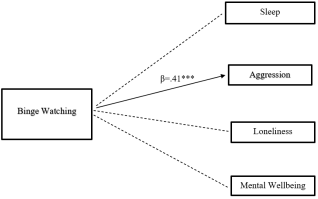
Result of regression analysis shows that binge watching strongly positively predicting Aggression.
It was hypothesized that Binge Watching, independent variable predicts Loneliness. Simple linear regression was used check whether Binge Watching predicts Loneliness or not. Table below show Binge Watching predicting Loneliness.
Table 6. Binge Watching predicting Loneliness in University students (N= 291).
Variables | B | β | 95%CI |
loneliness | 48.38 | | 43.49(53.27) |
Binge Watching | -.01 | -.01 | -.11(.08) |
R | | -.01 | |
R2 | .00 | | |
F | .08 | | |
P | .77 | | |
Result of regression analysis shows that binge watching does not predict loneliness.
Table 7. Binge Watching predicting Mental Wellbeing in University students (N= 291).
Variables | B | β | 95%CI |
Mental wellbeing | 41.22 | | 35.87(46.58) |
Binge Watching | -.00 | -.00 | -.11(.11) |
R | | -.00 | |
R2 | .00 | | |
F | .00 | | |
P | .98 | | |
Result of regression analysis shows that binge watching does not predict mental wellbeing.
It was hypothesized that Binge Watching, independent variable predicts Mental wellbeing. Simple linear regression was used check whether Binge Watching predicts Mental wellbeing or not. Table below show Binge Watching predicting Mental wellbeing.
Figure 1. Statistical Model.
Figure shows that Binge Watching is highly predicting Aggression.
Independent sample T-test analysis was used to find out the gender differences in variables of present research.
Table 8. Independence sample t-test for gender differences on scales between students (N=291).
| Man | Women | | | Confidence Interval |
| M | SD | M | SD | t (289) | P | Lower limit | Upper limit |
Binge Watching | 46.76 | 7.58 | 46.93 | 7.28 | -1.09 | .86 | -2.05 | 1.72 |
Sleep | 48.47 | 8.89 | 48.78 | 13.08 | -4.44 | .81 | -2.97 | 2.34 |
Aggression | 22.25 | 9.31 | 20.78 | 8.44 | -5.64 | .20 | -.80 | 3.87 |
Lowliness | 47.35 | 6.93 | 48.53 | 5.91 | 4.75 | .16 | -2.74 | .47 |
Mental Wellbeing | 41.12 | 7.17 | 41.41 | 7.54 | 2.56 | .75 | -2.11 | 1.53 |
The independent sample T test was used to compare the gender differences for the dependent variables i.e. watching, Sleep, Aggression, Loneliness and Mental welling. Table shows that there is no significant gender differences between men and women. Since all their significant values were > 0.5.
Summary
Psychometric, correlation and regression analysis were used to check the relationship among Binge watching, Sleep, Aggression, Loneliness and Mental welling.
The correlational analysis shows that binge watching only significantly positively correlate with aggression while have negatively relationship with all other variables. Sleep has significant negative relationship with aggression while have weak non-significant relation with other variables. Aggression has strong negative relationship with mental wellbeing and weak negative relationship with aggression. Loneliness has strong significance relationship with mental well binge. Result of regression analysis shows that Binge Watching does not predict Sleep, Loneliness and Mental welling while binge watching is highly predicting Aggression.
5. Discussion
T test analysis was non-significant so there existed no difference between men and women when it comes to binge watching in predicting sleep, aggression, loneliness and mental wellbeing. Hence in both men and women binge-watching predicted sleep, aggression, loneliness mental wellbeing in the same manner.
Research in well-being can lead to discovering and identifying the ways which could promote the level of psychological well-being and mental health of members of society. In addition, research about well-being and its ingredients could enrich the theoretical foundations of the subject. Thus, investigating the relation of binge watching, sleep, aggression, loneliness and well-being not only increases our understanding from the well-being itself, but also contributes for promoting the psychological well-being of individuals.
5.1. Limitation of the Study
The present study sample population is small in number, so further research should take larger number of sample population to better know the clear picture. Response among students was not good because of lengthy questionnaires. Demographics were not filled appropriately by the students especially the monthly income and CGPA was mostly missing.
5.2. Suggestions
Conducting a study in future with large sample size from different universities can improve the results of the study.
5.3. Implications
This study will be helpful for the participant who uses social media most of the time. Most of the students are unaware of the consequences of social media addiction. This research will help them know the very consequences. This will allow them to manage their time properly so that they can get rid of problems associated with the use of social media i.e., Netflix. Hence, they can improve their studies or grades. Similarly, the health issues related with the use of social media will also be tackled by acknowledging it as caused by social media use among the students. Improvement in the sleep patterns will result in overall wellbeing of students hence making them work efficiently.
5.4. Conclusion
The main purpose of the research was to investigate the relationship between Binge watching, Sleep, Aggression, Loneliness and Mental welling due to the use social Netflix among the university students. Pearson Product Moment Correlation Coefficient analysis was used to see the relationship between variables. Regression analysis was used to see the effect of independent variable on dependent variable. The independent sample t test was used to compare the gender difference between the samples. The correlational analysis show that binge watching only significantly positively correlate with aggression while have negatively relationship with all other variables. Sleep has significant negative relationship with aggression while have weak non-significant relation with other variables. Aggression has strong negative relationship with mental wellbeing and weak negative relationship with aggression. Loneliness has strong significance relationship with mental well binge. Result of regression analysis shows that binge watching strongly positively predicting Aggression while does not predict any other variable of the study. The independent sample T test was used to compare the gender differences for the dependent variables i.e watching, Sleep, Aggression, Loneliness and Mental welling. Table shows that there is no significant provincial differences between men and women. Since all their significant values were > 0.5.
Abbreviations
k | Total Numbers of Items |
M | Mean |
SD | Standard Deviation |
α | Alpha; Cronbach’s Index of Internal Consistency |
Author Contributions
Muhammad Salman: Writing-original draft, Project administration, Conceptualization, Supervision
Bisma Khan: Formal Analysis
Mahnoor Ejaz: Methodology
Zainad Ali: Validation, Supervision
Abid Hussain: Validation, Software, Formal Analysis, Writing – review & editing
Abdullah Shah: Data curation, Visualization
Conflicts of Interest
The authors declare no conflicts of interest.
References
| [1] |
Bernat, D. H., & Resnick, M. D. (2006). Healthy youth development: Science and strategies. Journal of Public Health and Management and Practices, Supplement, Vol 6, p S10-S16.
|
| [2] |
Corey, K. (2002). The mental health continuum: From languishing to flourishing in life. Journal of Health and Social Behavior, Vol. 43(2), p 207-222.
|
| [3] |
Demaray, M. K., & Elliott, S. N. (2001). Perceived social support by children with characteristics of attention-deficit/hyperactivity disorder. School Psychology Quarterly, Vol. 16, p. 68-90.
|
| [4] |
Fergusson, D. M., & Horwood, L. J. (2008). Cannabis use and later life outcomes. Addiction, Vol. 103(6), p. 969-976.
|
| [5] |
Frey, C. U., & Rothlisberger, C. (1996). Social support in healthy adolescents. Journal of Youth and Adolescence, Vol. 25, p. 17-31.
|
| [6] |
Granow, V. C., Reinecke, L., & Ziegele, M. (2018). Binge-watching and psychological well-being: media use between lack of control and perceived autonomy. Communication Research Reports, 35(5), 392-401.
|
| [7] |
Israel, B., & Schurman, S. (1990). Social support, control, and the stress process. In K. Glanz, M. Frances, & B. Rimer (Eds.), Health behavior and health education: Theory, research, and practices (p. 187-215). San Francisco, CA: Jossey-Bass.
|
| [8] |
Kalpana, R. E. (2016). Perceived Social Support and Psychological Well-Being: Testing the Unique Association and Gender Differences among Young Working Adults. The International Journal of Indian Psychology, Vol. 3, p. 98-113.
|
| [9] |
Kim, H. S., & Kim, H. S. (2008). Risk factors for suicide attempts among Korean adolescents. Child Psychiatry & Human Development, Vol. 39(3), P. 221-235.
|
| [10] |
Ma, C. Q., Huebner, E. S. (2008). Attachment relationships and adolescents’ life satisfaction: Some relationships matter more to girls than boys. Psychology in the schools, Vol. 45(2), p. 177-190.
|
| [11] |
Randler, C., & Vollmer, C. (2013). Aggression in young adults—a matter of short sleep and social jetlag? Psychological reports, 113(3), 754-765.
|
| [12] |
Richman, J. M., Rosenfeld, L. B., and Bowen, G. L. (1998). Social support for adolescents at risk of school failure. Social Work, Vol. 43, p. 309-323.
|
| [13] |
Sinha, J. N. P., and Verma. J. (1992). Social support as the moderator of the relationship between allocentric and psychological well-being. Social and Applied Issues.
|
| [14] |
Suldo, S. M., Riley, K. N., and Shaffer, E. J. (2006). Academic correlates of children and adolescents’ life satisfaction. School Psychology International, Vol. 27(5), p. 567-585.
|
| [15] |
Troles, H. (2019). Binge-watching and its influence on psychological well-being and important daily life duties: An Experience Sampling Study (Bachelor's thesis, University of Twente).
|
| [16] |
West, Kelly (December 13, 2013). "Unsurprising: Netflix Survey Indicates People Like to Binge-Watch TV". Cinema Blend. Retrieved February 12, 2014.
|
Cite This Article
-
APA Style
Khan, B., Ejaz, M., Ali, Z., Hussain, A., Salman, M., et al. (2026). Effect of Binge-watching Behaviour on Mental Well-being, Loneliness, Sleep and Aggression Among Netflix Users. International Journal of Science, Technology and Society, 14(3), 121-130. https://doi.org/10.11648/j.ijsts.20261403.12
 Copy
|
Copy
|
 Download
ACS Style
Khan, B.; Ejaz, M.; Ali, Z.; Hussain, A.; Salman, M., et al. Effect of Binge-watching Behaviour on Mental Well-being, Loneliness, Sleep and Aggression Among Netflix Users. Int. J. Sci. Technol. Soc. 2026, 14(3), 121-130. doi: 10.11648/j.ijsts.20261403.12
Copy
|
Download
AMA Style
Khan B, Ejaz M, Ali Z, Hussain A, Salman M, et al. Effect of Binge-watching Behaviour on Mental Well-being, Loneliness, Sleep and Aggression Among Netflix Users. Int J Sci Technol Soc. 2026;14(3):121-130. doi: 10.11648/j.ijsts.20261403.12
Copy
|
Download
-
@article{10.11648/j.ijsts.20261403.12,
  author = {Bisma Khan and Mahnoor Ejaz and Zainad Ali and Abid Hussain and Muhammad Salman and Abdullah Shah},
  title = {Effect of Binge-watching Behaviour on Mental Well-being, Loneliness, Sleep and Aggression Among Netflix Users},
  journal = {International Journal of Science, Technology and Society},
  volume = {14},
  number = {3},
  pages = {121-130},
  doi = {10.11648/j.ijsts.20261403.12},
  url = {https://doi.org/10.11648/j.ijsts.20261403.12},
  eprint = {https://article.sciencepublishinggroup.com/pdf/10.11648.j.ijsts.20261403.12},
  abstract = {Binge watching can also be called binge viewing, marathon viewing. Binge watching is basically watching television or other entertainment material for a long time at once. The main purpose of the research was to investigate the relationship between Binge watching, Sleep, Aggression, Loneliness and Mental welling due to the use social Netflix among the university students. It was hypothesized that there exists relationship between Binge watching, Sleep, Aggression, Loneliness and Mental welling. Pearson product-moment was used to check the relationship between variables. The sample comprised of 291 students from different universities of Pakistan. The age range of the sample is 18-25 with (M=24.81, SD=2.67). English version of the Binge-Watching scale Sleep, Aggression and Mental Wellbeing scale were used. Different analysis was applied which are Pearson correlation, regression, psychometric analysis and t-test. The correlational analysis shows that binge watching only significantly positively correlate with aggression while have negatively relationship with all other variables. Sleep has significant negative relationship with aggression. Aggression has strong negative relationship with mental wellbeing and weak negative relationship with aggression. Loneliness has strong significance relationship with mental well binge. T-test shows that there is no significant provincial differences between men and women. Since all their significant values were > 0.5.},
 year = {2026}
}
Copy
|
Download
-
TY  - JOUR
T1  - Effect of Binge-watching Behaviour on Mental Well-being, Loneliness, Sleep and Aggression Among Netflix Users
AU  - Bisma Khan
AU  - Mahnoor Ejaz
AU  - Zainad Ali
AU  - Abid Hussain
AU  - Muhammad Salman
AU  - Abdullah Shah
Y1  - 2026/07/03
PY  - 2026
N1  - https://doi.org/10.11648/j.ijsts.20261403.12
DO  - 10.11648/j.ijsts.20261403.12
T2  - International Journal of Science, Technology and Society
JF  - International Journal of Science, Technology and Society
JO  - International Journal of Science, Technology and Society
SP  - 121
EP  - 130
PB  - Science Publishing Group
SN  - 2330-7420
UR  - https://doi.org/10.11648/j.ijsts.20261403.12
AB  - Binge watching can also be called binge viewing, marathon viewing. Binge watching is basically watching television or other entertainment material for a long time at once. The main purpose of the research was to investigate the relationship between Binge watching, Sleep, Aggression, Loneliness and Mental welling due to the use social Netflix among the university students. It was hypothesized that there exists relationship between Binge watching, Sleep, Aggression, Loneliness and Mental welling. Pearson product-moment was used to check the relationship between variables. The sample comprised of 291 students from different universities of Pakistan. The age range of the sample is 18-25 with (M=24.81, SD=2.67). English version of the Binge-Watching scale Sleep, Aggression and Mental Wellbeing scale were used. Different analysis was applied which are Pearson correlation, regression, psychometric analysis and t-test. The correlational analysis shows that binge watching only significantly positively correlate with aggression while have negatively relationship with all other variables. Sleep has significant negative relationship with aggression. Aggression has strong negative relationship with mental wellbeing and weak negative relationship with aggression. Loneliness has strong significance relationship with mental well binge. T-test shows that there is no significant provincial differences between men and women. Since all their significant values were > 0.5.
VL  - 14
IS  - 3
ER  -
Copy
|
Download





 Share This Article
 Twitter
 Linked In
 Facebook