
Thermal convection in fluid-saturated porous media has attracted considerable attention due to its wide-ranging applications in engineering and geophysical systems, such as geothermal energy extraction, underground contaminant transport, nuclear waste disposal, and heat exchangers. In these systems, buoyancy-driven flow arises when a temperature gradient is imposed across the medium. The onset of convection is primarily governed by the Rayleigh number, which quantifies the balance between thermal driving forces and dissipative effects, including viscosity and thermal diffusion. Conventional studies often assume local thermal equilibrium (LTE) between the solid matrix and the saturating fluid. However, this assumption becomes inadequate in many practical situations where the heat exchange between the two phases is not instantaneous. To overcome this limitation, the concept of local thermal non-equilibrium (LTNE) has been introduced, wherein separate energy equations are employed for the solid and fluid phases, allowing a more realistic representation of interphase heat transfer. Moreover, porous media encountered in practical applications are frequently anisotropic, with permeability and thermal conductivity varying with direction. Such anisotropy significantly influences both fluid flow and heat transport characteristics. The complexity of the problem is further enhanced when non-Newtonian fluids, particularly Maxwell fluids, are considered. Due to their viscoelastic nature, these fluids introduce additional parameters, such as stress relaxation time, which play a crucial role in determining the stability behavior of the system. Therefore, a comprehensive analysis that simultaneously incorporates LTNE effects, anisotropy, and non-Newtonian fluid behavior is essential for accurately predicting the onset of convection and gaining deeper insight into the associated stability mechanisms in porous media systems.
| Published in | International Journal of Theoretical and Applied Mathematics (Volume 12, Issue 2) |
| DOI | 10.11648/j.ijtam.20261202.11 |
| Page(s) | 37-45 |
| Creative Commons |
This is an Open Access article, distributed under the terms of the Creative Commons Attribution 4.0 International License (http://creativecommons.org/licenses/by/4.0/), which permits unrestricted use, distribution and reproduction in any medium or format, provided the original work is properly cited. |
| Copyright |
Copyright © The Author(s), 2026. Published by Science Publishing Group |
Convection, Anisotropy, Maxwell Fluid, Thermal Non-equilibrium
| Horizontal Wave Number, |
| Specific Heat |
| Height of the Porous Layer |
| Gravitational Acceleration |
| Permeability Tensor, |
| Thermal Conductivity Tensor of Fluid Phase |
| Thermal Conductivity Tensor of Solid Phase |
| Wave Numbers in the x and y Direction Respectively |
| Pressure |
| Velocity Vector: (u, v, w) |
| Temperature |
| Time |
RL | Rayleigh Number, |
Ta | Taylor Number |
| Darcy-Prandtl Number, |
H | Non-dimensional Inter Phase Heat Transfer Coefficient, |
| Space Coordinates |
| Diffusive Ratio |
| Coefficient of Thermal Expansion |
| Porosity-modified Conductivity Ratio |
| Porosity |
| Fluid Viscosity |
| Couple Stress Viscosity |
| Effective Viscosity |
| Kinematic Viscosity, |
| Non-dimensional Stress Relaxation Parameter |
| Dynamic Viscosity |
| Kinematic Viscosity, |
| Thermal Diffusivity, |
| Frequency |
| Anisotropic Permeability Parameter, |
| Growth Rate |
| Stream function |
| Non dime$nsional Temperature of Solid Phase |
| Non dimen$sional Temperature of Fluid Phase |
| Fluid Density |
l | Lower |
s | Solid phase |
c | Critical |
b | Base state |
h | Horizontal |
f | Fluid phase |
| Reference |
* | Dimensionless quantity |
| Perturbed quantity |
| Time |
| [1] | Kulkarni Sridhar, (2013): Unsteady thermal convection in a rotating anisotropic porous layer using a thermal non equilibrium model. International Journal of Physics and Mathematical Science, 2277-211. |
| [2] | I. S. Shivakumara, Lee Jinho, A. L. Mamatha and M. Ravish, Local thermal non equilibrium effects on thermal convection in rotating anisotropic porous layer, Appl. Mathematic and Computation 259 (2015), 838-857. |
| [3] | Krishna B. Chavaraddi, N. K. Enagi and Sridhar Kulkarni, On the onset of convection in a couple stress fluid saturated rotating anisotropic porous layer using thermal non equilibrium model, JP Journal of Heat and Mass Transfer 16(1) (2019), 125-142. |
| [4] | Leiv Storesletten and D. A. S. Rees, Onset of convection in an inclined anisotropic porous layer with internal heat generation, Fluids 4(2) (2019), 75. |
| [5] | Shivakumara, I. S., & Sureshkumar, S. (2020). Convective instability in a Maxwell fluid-saturated porous layer with internal heat generation. Journal of Non-Newtonian Fluid Mechanics, 281, 104292, |
| [6] | Kumar, J., & Singh, A. K. (2020). Double-diffusive convection in a viscoelastic fluid-saturated porous medium under LTNE conditions. International Journal of Heat and Mass Transfer, 152, 119512; |
| [7] | Shehzad, S. A., Abbasi, F. M., & Hayat, T. (2021). Thermal instability of Maxwell fluid in porous media with anisotropic permeability. Physics of Fluids, 33(3), 033106. |
| [8] | Shivakumara, I. S., Ravish, M., & Lee, J. (2022). Combined effects of LTNE and anisotropy on convection in porous media. Transport in Porous Media, 141(1), 123–145. |
| [9] | Enagi, N. K., Chavaraddi, K. B., Kulkarni, S. Effect of maximum density and internal heating on the stability of rotating fluid saturated porous layer using LTNE model. Heliyon. 2022; e09620. |
| [10] | Chen Yin, Panpan pan (2022): Thermal Convection for an Oldroyd-B Fluid in an Anisotropic Porous Medium Underlying a Fluid Layer, J. Heat Transfer, 144(11), 113601 |
| [11] | Zhang, Y., & Li, D. Thermal convection in anisotropic porous media with internal heat source. Applied Mathematics and Computation, 2022 419, 126865. |
| [12] | K. B. Chavaraddi, N. K. Enagi and Sridhar Kulkarni, Non-equilibrium thermal convection in an anisotropic porous layer saturated with a viscoelastic fluid, AIP Conference Proceedings 2022. |
| [13] | N. K. Enagi, Krishna B. Chavaraddi, Sridhar Kulkarni, Couple stress fluid saturated rotating porous layer with internal heat generation and density maximum, JP Journal of Heat and Mass Transfer 35(1) (2023), 1-19. |
| [14] | N. K. Enagi, Krishna B. Chavaraddi and Sridhar Kulkarni, The effect of anisotropy on Darcy-Brinkman convection in a Maxwell fluid saturated porous layer, Advances and Applications in Fluid Mechanics 31(1) (2024), 1-22. |
| [15] | Kumar, V., & Gupta, U: Stability analysis of viscoelastic fluid convection in anisotropic porous media under LTNE conditions. Journal of Thermal Analysis and Calorimetry, 2024, 149(2), 987–1002. |
| [16] | M. Kousalya and S. Saravanan, Effect of gravity and anisotropy on the convective instability in nanofluid porous medium, Numerical Heat Transfer (2024). |
| [17] | S. Bixaathi and A. B. Babu, Casson fluid flow of rotating magneto-convection in a vertical porous medium, Phys. Fluids 37(1) (2025), 014125. |
| [18] | N. K. Enagi and Sridhar Kulkarni, The effect of anisotropy on the stability of rotating fluid saturated porous layer using LTNE model, Advances and Applications in Fluid Mechanics 32(1) (2025), 19-35. |
| [19] | Ravish, M., Shivakumara, I. S., & Lee, J. Combined effects of LTNE and anisotropy on convection in porous media. Transport in Porous Media, 2022, 141(1), 123–145. |
APA Style
Enagi, N., Kulkarni, S. (2026). Local Thermal Nonequilibrium and Anisotropy Effects on Convective Instability of Maxwell Fluid. International Journal of Theoretical and Applied Mathematics, 12(2), 37-45. https://doi.org/10.11648/j.ijtam.20261202.11
ACS Style
Enagi, N.; Kulkarni, S. Local Thermal Nonequilibrium and Anisotropy Effects on Convective Instability of Maxwell Fluid. Int. J. Theor. Appl. Math. 2026, 12(2), 37-45. doi: 10.11648/j.ijtam.20261202.11
@article{10.11648/j.ijtam.20261202.11,
  author = {Nagappa Enagi and Sridhar Kulkarni},
  title = {Local Thermal Nonequilibrium and Anisotropy Effects on Convective Instability of Maxwell Fluid},
  journal = {International Journal of Theoretical and Applied Mathematics},
  volume = {12},
  number = {2},
  pages = {37-45},
  doi = {10.11648/j.ijtam.20261202.11},
  url = {https://doi.org/10.11648/j.ijtam.20261202.11},
  eprint = {https://article.sciencepublishinggroup.com/pdf/10.11648.j.ijtam.20261202.11},
  abstract = {Thermal convection in fluid-saturated porous media has attracted considerable attention due to its wide-ranging applications in engineering and geophysical systems, such as geothermal energy extraction, underground contaminant transport, nuclear waste disposal, and heat exchangers. In these systems, buoyancy-driven flow arises when a temperature gradient is imposed across the medium. The onset of convection is primarily governed by the Rayleigh number, which quantifies the balance between thermal driving forces and dissipative effects, including viscosity and thermal diffusion. Conventional studies often assume local thermal equilibrium (LTE) between the solid matrix and the saturating fluid. However, this assumption becomes inadequate in many practical situations where the heat exchange between the two phases is not instantaneous. To overcome this limitation, the concept of local thermal non-equilibrium (LTNE) has been introduced, wherein separate energy equations are employed for the solid and fluid phases, allowing a more realistic representation of interphase heat transfer. Moreover, porous media encountered in practical applications are frequently anisotropic, with permeability and thermal conductivity varying with direction. Such anisotropy significantly influences both fluid flow and heat transport characteristics. The complexity of the problem is further enhanced when non-Newtonian fluids, particularly Maxwell fluids, are considered. Due to their viscoelastic nature, these fluids introduce additional parameters, such as stress relaxation time, which play a crucial role in determining the stability behavior of the system. Therefore, a comprehensive analysis that simultaneously incorporates LTNE effects, anisotropy, and non-Newtonian fluid behavior is essential for accurately predicting the onset of convection and gaining deeper insight into the associated stability mechanisms in porous media systems.},
 year = {2026}
}
TY  - JOUR
T1  - Local Thermal Nonequilibrium and Anisotropy Effects on Convective Instability of Maxwell Fluid
AU  - Nagappa Enagi
AU  - Sridhar Kulkarni
Y1  - 2026/05/16
PY  - 2026
N1  - https://doi.org/10.11648/j.ijtam.20261202.11
DO  - 10.11648/j.ijtam.20261202.11
T2  - International Journal of Theoretical and Applied Mathematics
JF  - International Journal of Theoretical and Applied Mathematics
JO  - International Journal of Theoretical and Applied Mathematics
SP  - 37
EP  - 45
PB  - Science Publishing Group
SN  - 2575-5080
UR  - https://doi.org/10.11648/j.ijtam.20261202.11
AB  - Thermal convection in fluid-saturated porous media has attracted considerable attention due to its wide-ranging applications in engineering and geophysical systems, such as geothermal energy extraction, underground contaminant transport, nuclear waste disposal, and heat exchangers. In these systems, buoyancy-driven flow arises when a temperature gradient is imposed across the medium. The onset of convection is primarily governed by the Rayleigh number, which quantifies the balance between thermal driving forces and dissipative effects, including viscosity and thermal diffusion. Conventional studies often assume local thermal equilibrium (LTE) between the solid matrix and the saturating fluid. However, this assumption becomes inadequate in many practical situations where the heat exchange between the two phases is not instantaneous. To overcome this limitation, the concept of local thermal non-equilibrium (LTNE) has been introduced, wherein separate energy equations are employed for the solid and fluid phases, allowing a more realistic representation of interphase heat transfer. Moreover, porous media encountered in practical applications are frequently anisotropic, with permeability and thermal conductivity varying with direction. Such anisotropy significantly influences both fluid flow and heat transport characteristics. The complexity of the problem is further enhanced when non-Newtonian fluids, particularly Maxwell fluids, are considered. Due to their viscoelastic nature, these fluids introduce additional parameters, such as stress relaxation time, which play a crucial role in determining the stability behavior of the system. Therefore, a comprehensive analysis that simultaneously incorporates LTNE effects, anisotropy, and non-Newtonian fluid behavior is essential for accurately predicting the onset of convection and gaining deeper insight into the associated stability mechanisms in porous media systems.
VL  - 12
IS  - 2
ER  -
Department of Mathematics, KRCE Society’s Arts and Science College, Bailhongal, India
Department of Mathematics, Government First Grade College, Paschapur, India
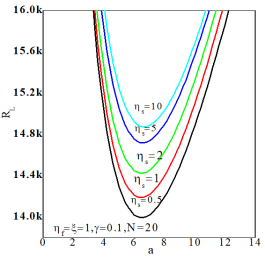
Figure 1. Variation of RL w.r.t 'a' for different values of ηs.
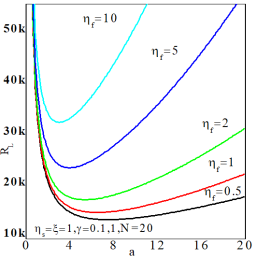
Figure 2. Variation of RL w.r.t 'a' for different values of ηf.
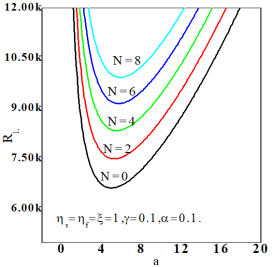
Figure 3. Variation of RL w.r.t 'a' for different values of N.
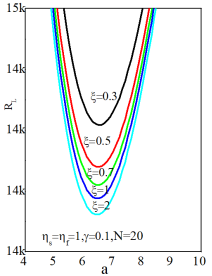
Figure 4. Variation of RL w.r.t 'a' for different values of ξ.
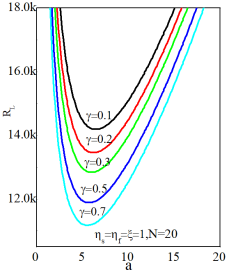
Figure 5. Variation of RL w.r.t 'a' for different values of γ.
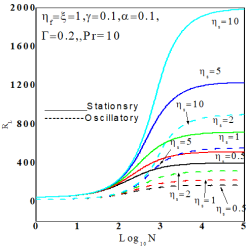
Figure 6. Variation of RLos w.r.t N for different values of ηs.
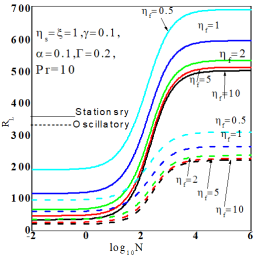
Figure 7. Variation of RLos w.r.t N for different values of ηf.
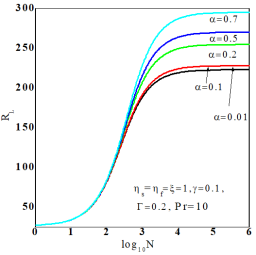
Figure 8. Variation of RLos w.r.t N for different values of α.
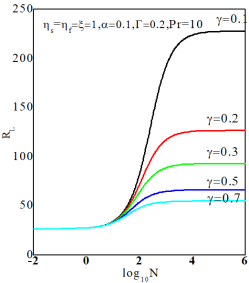
Figure 9. Variation of RLos w.r.t N for different values of γ.
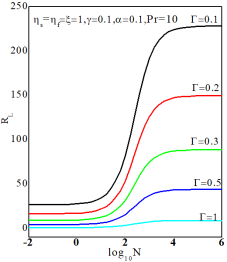
Figure 10. Variation of RLos w.r.t N for different values of Г.
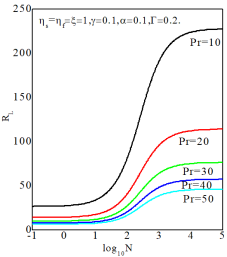
Figure 11. Variation of RLos w.r.t N for different values of Pr.
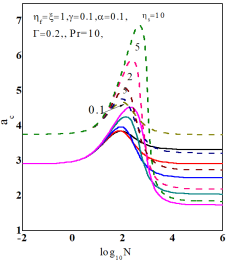
Figure 12. Variation of 'ac' w.r.t N for different values of ηs.
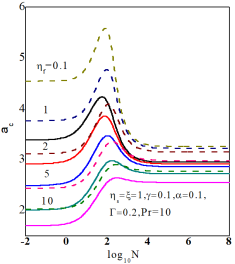
Figure 13. Variation of 'ac' w.r.t N for different values of ηf.
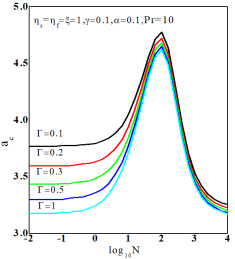
Figure 14. Variation of 'ac' w.r.t N for different values of Г.
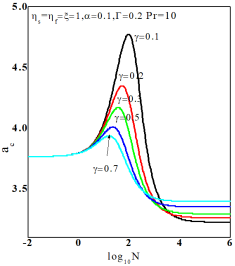
Figure 15. Variation of 'ac' w.r.t N for different values of γ.
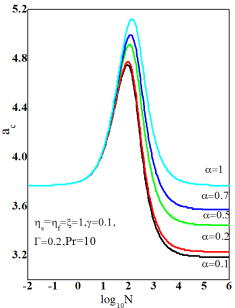
Figure 16. Variation of 'ac' w.r.t N for different values of α.
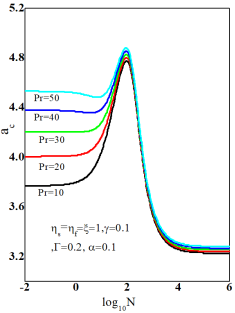
Figure 17. Variation of 'ac' w.r.t N for different values of Pr.

Information



 Share This Article
 Twitter
 Linked In
 Facebook


 Copy
Copy Download