Abstract
The rapid expansion of the Internet of Things (IoT) and the emergence of sixth-generation (6G) wireless networks have created unprecedented opportunities for large-scale intelligent sensing, real-time data collection, and ubiquitous connectivity. However, the deployment of massive IoT sensor networks faces significant challenges, including limited energy resources, dynamic network topologies, communication reliability issues, routing inefficiencies, and coverage constraints, particularly in remote, disaster-stricken, and infrastructure-deficient environments where conventional terrestrial communication systems often fail to provide reliable services. Unmanned Aerial Vehicles (UAVs) have emerged as a promising solution for enhancing network coverage, improving data collection efficiency, and supporting communication services in IoT ecosystems; nevertheless, their integration introduces additional challenges related to energy consumption, trajectory planning, routing optimization, and resource allocation. To address these issues, this paper proposes an AI-Driven Energy-Efficient Routing and UAV Trajectory Optimization Framework for UAV-assisted IoT sensor networks operating in 6G environments. The proposed framework integrates intelligent routing, adaptive energy management, and dynamic UAV trajectory optimization within a unified cross-layer architecture and develops a comprehensive mathematical model to characterize the relationships among energy consumption, communication delay, packet delivery performance, routing decisions, and UAV mobility. Furthermore, a Deep Reinforcement Learning (DRL)-based optimization algorithm is introduced to enable autonomous decision-making and adaptive network control under dynamic environmental conditions. The proposed approach continuously monitors key network parameters, including residual sensor energy, link quality, transmission distance, traffic load, UAV battery status, and data collection requirements, and dynamically determines optimal routing paths and UAV flight trajectories to minimize overall energy consumption while maximizing network lifetime, packet delivery ratio, and data collection efficiency. In addition, the framework leverages the ultra-reliable low-latency communication capabilities envisioned for future 6G infrastructures to facilitate intelligent coordination between UAV platforms and IoT sensor nodes. Performance evaluation under various network densities, mobility scenarios, and communication conditions demonstrates that the proposed framework significantly reduces energy consumption, improves routing efficiency, extends network lifetime and enhances packet delivery performance, and decreases communication overhead and data collection latency compared with conventional approaches. The results confirm that the integration of artificial intelligence, energy-aware routing, and UAV trajectory optimization provides an effective and scalable solution for next-generation UAV-assisted IoT systems and establishes a robust foundation for intelligent 6G-enabled wireless sensor networks.
|
Published in
|
Internet of Things and Cloud Computing (Volume 14, Issue 2)
|
|
DOI
|
10.11648/j.iotcc.20261402.12
|
|
Page(s)
|
38-55 |
|
Creative Commons
|

This is an Open Access article, distributed under the terms of the Creative Commons Attribution 4.0 International License (http://creativecommons.org/licenses/by/4.0/), which permits unrestricted use, distribution and reproduction in any medium or format, provided the original work is properly cited.
|
|
Copyright
|
Copyright © The Author(s), 2026. Published by Science Publishing Group
|
Keywords
Internet of Things, Unmanned Aerial Vehicles, 6G Networks, Energy-Efficient Routing, UAV Trajectory Optimization,
Deep Reinforcement Learning, Wireless Sensor Networks, Artificial Intelligence
1. Introduction
The rapid proliferation of Internet of Things (IoT) technologies has transformed modern communication networks by enabling billions of interconnected sensing devices across smart cities, industrial automation, environmental monitoring, healthcare, transportation systems, and precision agriculture. The large-scale deployment of IoT devices generates massive volumes of data that require efficient collection, processing, and transmission mechanisms. However, conventional terrestrial communication infrastructures often face significant challenges in providing reliable connectivity in remote areas, disaster-stricken regions, and environments with limited network coverage. These limitations have motivated researchers to investigate alternative communication architectures capable of supporting scalable and energy-efficient IoT services.
Unmanned Aerial Vehicles (UAVs) have recently emerged as a promising solution for enhancing IoT communication networks due to their flexibility, rapid deployment capability, mobility, and ability to establish line-of-sight communication links. UAVs can operate as aerial base stations, relay nodes, mobile edge computing platforms, or data collection agents, thereby improving network coverage and communication reliability. Recent studies indicate that UAV-assisted communication systems will play a critical role in future 6G ecosystems because they can provide intelligent connectivity, edge intelligence, and adaptive communication services in dynamic environments
| [1] | Gao, Y., Liu, M., Yuan, X., Hu, Y., Sun, P., & Schmeink, A. (2024). Federated deep reinforcement learning based trajectory design for UAV-assisted networks with mobile ground devices. Scientific Reports, 14, 22753.
https://doi.org/10.1038/s41598-024-72654-y |
[1]
.
Despite these advantages, energy efficiency remains one of the most significant challenges in UAV-assisted IoT networks. Most IoT sensor nodes are battery-powered and operate under strict energy constraints. Similarly, UAV platforms are limited by finite onboard battery capacities, which restrict flight duration, communication range, and mission completion capabilities. Consequently, inefficient routing strategies and communication protocols can significantly reduce network lifetime and overall system performance. Energy-aware communication mechanisms are therefore essential for enabling sustainable UAV-assisted IoT operations. Recent surveys on UAV-enabled 6G communications identify energy optimization as a key research priority for future intelligent wireless networks
| [5] | Dabiri, M. T., & Hasna, M. (2024). UAV trajectory optimization for directional THz links using deep reinforcement learning. IEEE Open Journal of the Communications Society. https://doi.org/10.1109/OJCOMS.2024.3376943 |
[5]
.
Another critical issue concerns routing optimization. Traditional routing protocols designed for static wireless sensor networks are often unsuitable for highly dynamic UAV-assisted environments. Frequent topology changes, varying channel conditions, traffic fluctuations, and UAV mobility require adaptive routing mechanisms capable of making intelligent decisions in real time. Effective routing strategies must balance energy consumption, maximize packet delivery performance, and minimize communication overhead while maintaining network reliability.
In addition to routing challenges, UAV trajectory optimization has become a fundamental component of UAV-assisted IoT systems. The flight trajectory directly influences communication quality, transmission distance, coverage area, energy consumption, and data collection efficiency. Improper trajectory planning can result in excessive flight energy expenditure and reduced communication performance. Recent studies have demonstrated that intelligent trajectory optimization significantly improves data collection efficiency, throughput, and overall network performance in UAV-assisted wireless systems
| [2] | Saleh, A. M., Omar, S. S., Abd El-Haleem, A. M., Ibrahim, I. I., & Abdelhakam, M. M. (2024). Trajectory optimization of UAV-IRS assisted 6G THz network using deep reinforcement learning approach. Scientific Reports, 14, 18501.
https://doi.org/10.1038/s41598-024-68459-8 |
[2]
.
The transition toward sixth-generation (6G) wireless networks further increases the complexity of these optimization challenges. Compared with previous generations, 6G networks are expected to provide ultra-reliable low-latency communication (URLLC), integrated sensing and communication (ISAC), AI-native networking, massive machine-type communications, and ubiquitous connectivity. These capabilities create new opportunities for UAV-assisted IoT systems while simultaneously imposing stricter requirements on energy efficiency, reliability, latency, and autonomous operation. Researchers have identified the integration of UAVs, artificial intelligence, and advanced communication technologies as one of the most important paradigms for future 6G networks
| [3] | Hassan, S. S., Park, Y. M., Tun, Y. K., Saad, W., Han, Z., & Hong, C. S. (2022). 3TO: THz-enabled throughput and trajectory optimization of UAVs in 6G networks by proximal policy optimization deep reinforcement learning. IEEE Internet of Things Journal.
https://doi.org/10.1109/JIOT.2022.3151553 |
| [4] | Song, Z., Ma, C., Ding, M., Yang, H. H., Qian, Y., & Zhou, X. (2024). Personalized federated deep reinforcement learning-based trajectory optimization for multi-UAV assisted edge computing. IEEE Transactions on Wireless Communications. https://doi.org/10.1109/TWC.2024.3368907 |
[3, 4]
.
Artificial Intelligence (AI), particularly Deep Reinforcement Learning (DRL), has recently emerged as a powerful approach for solving complex optimization problems in wireless communication networks. Unlike conventional optimization methods, DRL algorithms can learn optimal policies through continuous interaction with dynamic environments. This capability makes them particularly suitable for UAV-assisted IoT networks, where network states continuously evolve. Recent research has demonstrated that DRL-based approaches can effectively optimize UAV trajectory planning, communication scheduling, resource allocation, and routing decisions under uncertain network conditions
| [6] | Zhang, X., Liu, W., Ren, J., Xing, H., Gui, G., Shen, Y., & Cui, S. (2025). When UAV meets federated learning: Latency minimization via joint trajectory design and resource allocation. IEEE Transactions on Wireless Communications.
https://doi.org/10.1109/TWC.2025.3531148 |
[6]
.
Although considerable progress has been achieved in UAV communications, IoT networking, and AI-driven optimization, existing studies often address routing optimization, energy management, and UAV trajectory design separately. The absence of a unified framework limits the overall efficiency of UAV-assisted IoT systems. Furthermore, relatively few studies have investigated the joint optimization of energy-efficient routing and UAV trajectory planning within AI-enabled 6G environments. This research gap motivates the development of integrated optimization frameworks capable of simultaneously improving network lifetime, communication reliability, data collection efficiency, and energy utilization.
To address these challenges, this paper proposes an AI-Driven Energy-Efficient Routing and UAV Trajectory Optimization Framework for UAV-Assisted IoT Sensor Networks in 6G Environments. The proposed framework integrates intelligent routing, adaptive energy management, and dynamic UAV trajectory optimization within a unified architecture. A Deep Reinforcement Learning-based optimization algorithm is developed to enable autonomous decision-making under dynamic network conditions. By jointly considering sensor energy consumption, communication quality, routing efficiency, UAV mobility, and data collection requirements, the proposed framework aims to maximize overall network performance while minimizing energy consumption.
The main contributions of this paper are summarized as follows:
1) Development of a comprehensive UAV-assisted IoT architecture for future 6G environments.
2) Formulation of an energy-aware mathematical model incorporating routing efficiency and UAV mobility.
3) Design of a Deep Reinforcement Learning-based optimization algorithm for joint routing and trajectory planning.
4) Development of an adaptive energy-efficient routing mechanism to prolong network lifetime.
5) Design of an intelligent UAV trajectory optimization strategy to improve communication efficiency and data collection performance.
6) Comprehensive performance evaluation under different network scenarios and communication conditions.
2. Related Work and Literature Review
2.1. Overview
The integration of Unmanned Aerial Vehicles (UAVs) with Internet of Things (IoT) networks has attracted considerable attention in recent years due to its potential to improve network coverage, data collection efficiency, communication reliability, and service flexibility. UAV-assisted IoT systems are increasingly recognized as a key enabling technology for future 6G communication networks, particularly in scenarios involving remote monitoring, smart agriculture, disaster management, environmental sensing, and industrial automation. Recent surveys indicate that UAV-enabled communication architectures can significantly enhance connectivity and resource utilization in large-scale IoT deployments while supporting the ultra-reliable and intelligent services envisioned for 6G ecosystems
| [8] | Zeng, Y., Zhang, R., & Lim, T. J. (2019). Wireless communications with unmanned aerial vehicles: Opportunities and challenges. IEEE Communications Magazine, 54(5), 36–42.
https://doi.org/10.1109/MCOM.2016.7470933 |
[8]
.
Despite these advantages, several challenges remain unresolved, including energy efficiency, routing optimization, trajectory planning, communication reliability, and autonomous network management. Consequently, a growing body of research has focused on developing intelligent optimization frameworks that combine UAV mobility with advanced communication and artificial intelligence techniques.
2.2. Energy-Efficient Routing in IoT Networks
Energy consumption is one of the most critical constraints in IoT sensor networks. Since most sensor nodes operate on limited battery resources, routing protocols must be designed to minimize energy expenditure while maintaining reliable communication performance.
Traditional routing protocols such as LEACH, PEGASIS, and AODV were originally designed for static wireless sensor networks and often fail to adapt efficiently to dynamic UAV-assisted environments. Recent research has therefore shifted toward intelligent routing mechanisms capable of balancing energy consumption, reducing communication overhead, and extending network lifetime.
Recent reviews of energy-efficient routing protocols indicate that machine learning and reinforcement learning techniques provide significant improvements over conventional routing methods because they can adapt routing decisions according to changing network conditions and residual node energy levels
| [7] | Mozaffari, M., Saad, W., Bennis, M., & Debbah, M. (2019). A tutorial on UAVs for wireless networks: Applications, challenges, and open problems. IEEE Communications Surveys & Tutorials, 21(3), 2334–2360.
https://doi.org/10.1109/COMST.2019.2902862 |
[7]
. Furthermore, energy-aware routing approaches have demonstrated improved packet delivery ratios and prolonged network lifetime in large-scale IoT deployments.
However, many existing routing schemes focus primarily on terrestrial sensor networks and do not explicitly consider UAV mobility, aerial communication links, or dynamic data collection strategies.
2.3. UAV-Assisted Data Collection and Communication
UAV-assisted communication has emerged as a promising solution for overcoming the limitations of traditional IoT infrastructures. UAVs can act as aerial base stations, relay nodes, mobile edge computing platforms, or data collectors.
Recent studies have shown that UAV-assisted communication significantly improves coverage, throughput, and data acquisition performance in geographically distributed sensor networks. The flexibility of UAV deployment enables efficient communication even in areas where terrestrial infrastructure is unavailable or damaged
| [9] | Liu, Y., Qin, Z., Elkashlan, M., GAO, Y., & Hanzo, L. (2021). Non-orthogonal multiple access for 5G and beyond. Proceedings of the IEEE, 105(12), 2347–2381.
https://doi.org/10.1109/JPROC.2017.2768666 |
[9]
.
However, UAV deployment introduces additional challenges related to flight energy consumption, communication scheduling, mobility management, and mission planning. Since UAV battery capacity is inherently limited, efficient communication strategies must jointly consider both network energy consumption and UAV operational efficiency.
Several recent studies have emphasized the importance of energy-aware UAV communication mechanisms and demonstrated that communication-aware flight planning can substantially improve overall network performance. Furthermore, UAV-enabled communication systems are expected to play a fundamental role in supporting future intelligent 6G services.
2.4. UAV Trajectory Optimization
Trajectory optimization has become one of the most active research areas in UAV-assisted IoT networks. The trajectory of a UAV directly affects communication quality, coverage efficiency, flight duration, and energy consumption.
Conventional trajectory planning approaches typically rely on heuristic optimization methods such as Genetic Algorithms (GA), Particle Swarm Optimization (PSO), and Ant Colony Optimization (ACO). Although these methods can generate acceptable flight paths, they often struggle to adapt to highly dynamic communication environments.
Recent research increasingly employs artificial intelligence techniques to optimize UAV trajectories. In particular, Deep Reinforcement Learning (DRL) has demonstrated strong performance in learning adaptive flight policies without requiring complete prior knowledge of the operating environment. Studies have shown that DRL-based trajectory optimization can improve data collection efficiency, reduce communication delays, and enhance overall network performance in UAV-assisted IoT systems
| [10] | Zhang, S., Zhang, H., Di, B., & Song, L. (2020). Cellular UAV-to-X communications: Design and optimization for multi-UAV networks. IEEE Transactions on Wireless Communications, 18(2), 1346–1359.
https://doi.org/10.1109/TWC.2018.2884961 |
[10]
.
Moreover, intelligent trajectory planning becomes even more important in future 6G environments where network conditions may change rapidly and communication demands become increasingly complex.
2.5. Artificial Intelligence and Deep Reinforcement Learning
Artificial Intelligence (AI) has emerged as a key enabling technology for next-generation communication systems. In particular, Deep Reinforcement Learning combines reinforcement learning with deep neural networks to solve complex sequential decision-making problems.
Recent surveys indicate that DRL has been successfully applied to a wide range of wireless communication optimization problems, including routing, resource allocation, power control, scheduling, trajectory optimization, and Age of Information (AoI) minimization. The ability of DRL agents to continuously learn from environmental feedback makes them highly suitable for UAV-assisted IoT applications where network states evolve dynamically
| [11] | Fotouhi, A., Ding, M., Hassan, M., Giordani, M., Garcia-Rodriguez, A., Yuan, J., & Heath, R. W. (2019). Survey on UAV cellular communications: Practical aspects, standardization advancements, regulation, and security challenges. IEEE Communications Surveys & Tutorials, 21(4), 3417–3442.
https://doi.org/10.1109/COMST.2019.2906228 |
[11]
.
Several recent studies have proposed DRL-based frameworks for UAV-assisted data collection and communication management. These approaches generally outperform conventional optimization methods in terms of adaptability, scalability, and decision-making efficiency. In addition, graph-based deep reinforcement learning techniques have recently been introduced to further improve energy efficiency and routing performance in UAV-assisted IoT systems.
2.6. UAV-Assisted IoT Networks in 6G Environments
The transition from 5G to 6G is expected to fundamentally transform UAV-assisted communication systems. Future 6G networks will incorporate ultra-reliable low-latency communication (URLLC), integrated sensing and communication (ISAC), AI-native networking, edge intelligence, and massive machine-type communications.
Recent surveys identify UAVs as one of the most important components of future 6G ecosystems because they provide flexible aerial connectivity, intelligent sensing capabilities, and dynamic network extension services. Additionally, AI-driven communication management is expected to become a core feature of future 6G architectures.
However, despite the growing literature on UAV-assisted communications and AI-driven optimization, relatively few studies have investigated the joint optimization of routing decisions, energy management, and UAV trajectory planning within a unified framework specifically designed for 6G-enabled IoT environments.
2.7. Research Gap
Based on the reviewed literature, several important research gaps can be identified:
1) Existing routing protocols primarily focus on either energy efficiency or communication reliability rather than jointly optimizing both objectives.
2) Many studies consider UAV trajectory optimization independently from routing decisions.
3) Most existing frameworks do not simultaneously optimize sensor energy consumption and UAV energy utilization.
4) Current optimization approaches often rely on heuristic techniques that exhibit limited adaptability in highly dynamic environments.
5) The integration of AI-driven routing optimization and UAV trajectory planning for 6G-enabled IoT networks remains insufficiently explored.
6) Few studies investigate unified cross-layer optimization frameworks capable of jointly addressing routing, mobility, communication, and energy management challenges.
These limitations motivate the development of an AI-driven framework that jointly optimizes routing decisions and UAV trajectories while considering energy efficiency, communication reliability, and future 6G network requirements.
3. Research Objectives and Contributions
3.1. Research Objectives
The rapid growth of Internet of Things (IoT) applications and the emergence of intelligent 6G communication networks have significantly increased the demand for efficient, scalable, and energy-aware communication frameworks. UAV-assisted IoT networks have demonstrated substantial potential for improving data collection efficiency, network coverage, and communication reliability. However, existing solutions often optimize routing protocols, energy management strategies, and UAV trajectory planning independently, leading to suboptimal overall system performance
.
In dynamic IoT environments, communication conditions continuously change due to sensor mobility, varying traffic demands, wireless channel fluctuations, and UAV movement. Consequently, conventional routing protocols and static trajectory planning approaches are unable to efficiently adapt to real-time network conditions. Recent studies suggest that Artificial Intelligence (AI), particularly Deep Reinforcement Learning (DRL), can provide adaptive decision-making capabilities that significantly improve network efficiency and resource utilization
| [13] | Li, B., Fei, Z., & Zhang, Y. (2018). UAV communications for 5G and beyond: Recent advances and future trends. IEEE Internet of Things Journal, 6(2), 2241–2263.
https://doi.org/10.1109/JIOT.2018.2877349 |
[13]
.
The primary objective of this research is to develop an AI-driven optimization framework that jointly addresses routing efficiency, energy management, and UAV trajectory planning within UAV-assisted IoT sensor networks operating in future 6G environments. Unlike traditional approaches that solve these optimization problems separately, the proposed framework seeks to establish a unified cross-layer architecture capable of simultaneously optimizing communication performance and energy consumption.
Specifically, the objectives of this research are as follows:
Objective 1: Develop an Energy-Efficient UAV-Assisted IoT Architecture
The first objective is to design a comprehensive network architecture that integrates UAV platforms with large-scale IoT sensor networks while considering the requirements of future 6G communication systems. The architecture aims to support reliable connectivity, intelligent data collection, and efficient resource management under dynamic operating conditions.
Objective 2: Minimize Overall Network Energy Consumption
Energy efficiency is a critical challenge in UAV-assisted IoT systems due to the limited battery capacities of both UAVs and sensor nodes. This research aims to develop optimization mechanisms that reduce communication energy consumption, balance network energy utilization, and prolong overall network lifetime.
Objective 3: Optimize Routing Decisions Using Artificial Intelligence
The third objective is to develop an intelligent routing mechanism capable of dynamically selecting optimal communication paths according to changing network conditions. The proposed routing framework seeks to maximize packet delivery performance while minimizing communication overhead and energy expenditure.
Objective 4: Optimize UAV Trajectory Planning
Efficient UAV trajectory design directly affects communication quality, data collection efficiency, and UAV energy consumption. This research aims to develop an adaptive trajectory optimization strategy that minimizes travel distance and flight energy while maximizing network coverage and communication reliability.
Objective 5: Integrate Deep Reinforcement Learning for Autonomous Optimization
The proposed framework employs Deep Reinforcement Learning to enable autonomous decision-making under dynamic network conditions. The DRL agent continuously interacts with the environment and learns optimal routing and trajectory policies through reward-based optimization.
Objective 6: Improve Quality of Service and Network Reliability
Another important objective is to improve key communication performance metrics, including packet delivery ratio, throughput, latency, network lifetime, and communication reliability. The proposed framework seeks to satisfy the stringent requirements of future 6G-enabled IoT applications.
Objective 7: Provide a Scalable Solution for Future 6G Networks
The final objective is to develop a scalable optimization framework capable of supporting massive IoT deployments and future intelligent communication infrastructures. The framework is designed to align with emerging 6G technologies such as AI-native networking, integrated sensing and communication, and autonomous network management.
3.2. Research Questions
To achieve the above objectives, this study seeks to answer the following research questions:
RQ1: How can AI techniques improve routing efficiency in UAV-assisted IoT sensor networks?
RQ2: What is the impact of UAV trajectory optimization on network energy consumption and data collection efficiency?
RQ3: Can Deep Reinforcement Learning simultaneously optimize routing and UAV mobility decisions in dynamic communication environments?
RQ4: How does the proposed framework perform compared with conventional routing and trajectory optimization approaches?
RQ5: To what extent can the proposed framework improve network lifetime, throughput, latency, and packet delivery performance in future 6G-enabled IoT systems?
3.3. Research Hypotheses
Based on the identified research gaps, the following hypotheses are formulated:
H1: AI-driven routing optimization significantly reduces overall network energy consumption compared with conventional routing protocols.
H2: Joint optimization of routing and UAV trajectory planning provides better performance than independent optimization approaches.
H3: Deep Reinforcement Learning improves packet delivery ratio and throughput while reducing communication latency.
H4: The proposed framework significantly extends network lifetime through intelligent energy management.
H5: AI-based optimization enables better adaptation to dynamic network conditions in future 6G environments.
3.4. Major Contributions of the Proposed Research
The major scientific contributions of this paper are summarized as follows:
Contribution 1: Unified AI-Driven Optimization Framework
A novel AI-driven framework is proposed that jointly optimizes routing decisions, energy management, and UAV trajectory planning within a single optimization architecture.
Contribution 2: Cross-Layer Network Design
A comprehensive cross-layer architecture is developed to integrate communication, mobility, and energy management processes, thereby improving overall system performance.
Contribution 3: Mathematical Modeling of UAV-Assisted IoT Systems
A mathematical framework is formulated to characterize the relationships among energy consumption, routing performance, communication reliability, UAV mobility, and network lifetime.
Contribution 4: Deep Reinforcement Learning-Based Optimization Algorithm
A DRL-based optimization algorithm is designed to autonomously learn optimal routing and trajectory policies under dynamic network conditions.
Contribution 5: Energy-Aware Routing Mechanism
An intelligent routing mechanism is introduced that balances energy consumption among sensor nodes while maximizing communication efficiency.
Contribution 6: Adaptive UAV Trajectory Optimization
A dynamic trajectory planning strategy is developed to improve data collection efficiency and reduce UAV energy expenditure.
Contribution 7: Performance Evaluation for 6G-Enabled IoT Networks
Comprehensive simulations are conducted under various network scenarios to evaluate the effectiveness of the proposed framework and demonstrate its suitability for future 6G communication environments.
3.5. Expected Outcomes
The expected outcomes of this research include:
1) Reduced overall network energy consumption.
2) Extended IoT network lifetime.
3) Improved packet delivery ratio and throughput.
4) Reduced communication latency.
5) Enhanced UAV operational efficiency.
6) Improved adaptability to dynamic communication environments.
7) Scalable deployment capability for future 6G-enabled IoT ecosystems.
The achievement of these outcomes is expected to contribute significantly to the development of intelligent, autonomous, and energy-efficient UAV-assisted IoT communication systems.
4. System Architecture
4.1. Overview of the Proposed Architecture
This research proposes an AI-driven energy-efficient communication architecture for UAV-assisted Internet of Things (IoT) sensor networks operating in future 6G environments. The proposed architecture integrates intelligent routing, adaptive energy management, UAV trajectory optimization, and Deep Reinforcement Learning (DRL)-based decision-making into a unified cross-layer framework.
The architecture is designed to address three primary challenges in UAV-assisted IoT systems:
1) Energy-efficient data collection from distributed sensor nodes.
2) Adaptive routing under dynamic network conditions.
3) Autonomous UAV trajectory optimization for maximizing communication efficiency.
Unlike conventional architectures where routing and mobility management are performed independently, the proposed framework jointly optimizes communication and mobility decisions using artificial intelligence.
The overall system consists of four major components:
1) IoT Sensor Layer
2) UAV Communication Layer
3) Edge Intelligence Layer
4) 6G Core Network Layer
These components cooperate to achieve reliable, low-energy, and intelligent communication services.
4.2. IoT Sensor Layer
The IoT Sensor Layer represents the lowest layer of the architecture and consists of a large number of heterogeneous sensor nodes deployed across the monitoring area.
These sensors collect environmental and operational data such as:
1) Temperature
2) Humidity
3) Air quality
4) Structural health information
5) Industrial process parameters
6) Surveillance information
Each sensor node is characterized by:
1) Limited battery capacity
2) Limited transmission power
3) Restricted computational capability
4) Short communication range
Let
Ei(t)
Represent the residual energy of sensor node i at time t.
The residual energy is updated according to
Ei(t+1)=Ei(t)-Etx-Erx-Eproc(1)
Where:
Etx = transmission energy
Erx = reception energy
Eproc = processing energy
Since battery replacement is often impractical in large-scale IoT deployments, minimizing sensor energy consumption is a primary design objective.
To reduce communication overhead, sensor nodes transmit data only when requested by nearby UAV platforms or according to adaptive scheduling policies.
Recent studies indicate that energy-aware communication mechanisms significantly improve network lifetime in UAV-assisted IoT systems
| [14] | Wang, J., Jiang, C., Zhang, Z., Ren, Y., Chen, K. C., & Hanzo, L. (2017). Thirty years of machine learning: The road to Pareto-optimal wireless networks. IEEE Communications Surveys & Tutorials, 22(3), 1472–1514.
https://doi.org/10.1109/COMST.2020.2963741 |
[14]
.
4.3. UAV Communication Layer
The UAV Communication Layer consists of multiple UAVs functioning as mobile aerial communication platforms.
Each UAV performs three main tasks:
4.3.1. Data Collection Mechanism
Efficient data collection is a critical component of UAV-assisted Internet of Things (IoT) sensor networks, particularly in large-scale and energy-constrained environments. In the proposed framework, Unmanned Aerial Vehicles (UAVs) operate as intelligent mobile data collectors that dynamically gather sensing information from geographically distributed sensor nodes.
The data collection process is performed in an adaptive manner based on network conditions, sensor energy levels, communication quality, and UAV availability. Instead of continuously transmitting data, sensor nodes store sensed information locally and transmit it only when a UAV enters their communication range or when transmission is requested by the network controller. This strategy significantly reduces unnecessary energy consumption and communication overhead.
Let (D_i(t)) denote the amount of data generated by sensor node (i) at time (t).
To maximize data collection efficiency, UAVs dynamically adjust their flight trajectories toward regions containing high-priority sensor clusters. The priority of each sensor node is determined according to residual energy, buffer occupancy, data urgency, and channel quality indicators.
The communication link quality between sensor node (i) and UAV (j) is evaluated through the Signal-to-Interference-plus-Noise Ratio (SINR). Data transmission is initiated only
Furthermore, the proposed framework incorporates an AI-driven scheduling mechanism that determines the optimal sequence of sensor visits and data collection operations. The scheduling policy aims to maximize the amount of collected data while minimizing UAV flight energy consumption and communication delay.
By jointly considering sensor status, network conditions, and UAV mobility, the proposed data collection mechanism improves network lifetime, increases data acquisition efficiency, and supports the stringent reliability and latency requirements of future 6G-enabled IoT applications.
4.3.2. Data Aggregation
Data aggregation is employed to reduce communication overhead, eliminate redundant information, and improve energy efficiency within the UAV-assisted IoT network. Since sensor nodes deployed in the same geographical region often generate correlated measurements, transmitting all raw data directly to the edge server can lead to excessive bandwidth utilization and unnecessary energy consumption.
In the proposed framework, UAVs perform in-network data aggregation after collecting data from multiple sensor nodes. Each UAV acts as an intermediate processing entity that combines, filters, and compresses received data before forwarding it to the Edge Intelligence Layer or the 6G infrastructure.
Let (D_i) denote the data generated by sensor node (i).
The aggregation function may include duplicate elimination, data fusion, feature extraction, statistical summarization, and compression operations. Consequently, the amount of transmitted information is significantly reduced while preserving essential sensing information.
Where a smaller value of (AR) indicates a greater reduction in communication traffic.
The UAV selects the aggregation strategy according to current network conditions, available computational resources, communication requirements, and application priorities. Furthermore, the Edge Intelligence Layer may provide aggregation policies that adapt dynamically to traffic load and Quality of Service (QoS) requirements.
By reducing the volume of transmitted data, the proposed aggregation mechanism decreases communication energy consumption, alleviates network congestion, improves bandwidth utilization, and enhances the overall scalability of UAV-assisted IoT systems operating in future 6G environments.
4.3.3. Communication Relay
Communication relay is one of the fundamental functions of UAVs in the proposed UAV-assisted IoT architecture. In many deployment scenarios, sensor nodes are located beyond the direct communication range of the edge server or 6G base station. Therefore, UAVs act as aerial relay nodes that facilitate reliable information exchange between distributed sensor clusters and the network infrastructure.
After collecting and aggregating sensor data, UAVs forward the processed information toward the Edge Intelligence Layer or the 6G Core Network through wireless communication links. The relay operation improves network coverage, enhances connectivity, and enables data delivery in remote, disaster-stricken, or infrastructure-deficient environments.
Let (R_ {ij}) denote the achievable transmission rate between UAV (j) and the destination node.
To ensure reliable communication, the UAV continuously monitors link quality, available bandwidth, network congestion, and transmission power requirements. Based on these observations, the AI-based optimization framework dynamically selects the most appropriate relay path and transmission parameters.
Furthermore, multiple UAVs may cooperate to establish multi-hop aerial communication links when direct communication with the edge server is unavailable. In such cases, relay selection is performed according to channel quality, residual UAV energy, communication distance, and network traffic conditions.
By employing intelligent communication relay mechanisms, the proposed framework improves coverage, increases packet delivery reliability, reduces communication interruptions, and supports the stringent Quality of Service (QoS) requirements of future 6G-enabled IoT applications.
4.4. Edge Intelligence Layer
The Edge Intelligence Layer acts as an intermediate processing platform between UAVs and the 6G core network.
This layer hosts:
1) AI optimization engine
2) Routing controller
3) Resource management module
4) Network monitoring module
5) Data analytics services
Edge computing significantly reduces communication latency by processing data near the network edge rather than transmitting all information to remote cloud servers.
The edge server continuously collects network information including:
1) Sensor residual energy
2) Packet delivery ratio
3) Traffic load
4) UAV battery status
5) Channel quality indicators
Based on these observations, the edge intelligence engine generates optimal control decisions.
Recent studies suggest that edge-assisted AI frameworks can significantly improve communication efficiency in UAV-enabled 6G systems
| [15] | Luong, N. C., Hoang, D. T., Gong, S., Niyato, D., Wang, P., Liang, Y. C., & Kim, D. I. (2019). Applications of deep reinforcement learning in communications and networking: A survey. IEEE Communications Surveys & Tutorials, 21(4), 3133–3174. https://doi.org/10.1109/COMST.2019.2916583 |
[15]
.
4.5. 6G Core Network Layer
The highest layer of the proposed architecture is the 6G Core Network.
Future 6G infrastructures are expected to provide:
1) Ultra-Reliable Low-Latency Communication (URLLC)
2) AI-native networking
3) Integrated Sensing and Communication (ISAC)
4) Massive Machine-Type Communications (mMTC)
5) Digital Twin capabilities
The 6G core performs:
4.5.1. Global Resource Allocation
Global Resource Allocation is a key function of the 6G Core Network that aims to efficiently distribute communication and computational resources across the entire UAV-assisted IoT ecosystem. Due to the large number of sensor nodes, UAV platforms, and heterogeneous service requirements, intelligent resource management is essential for maintaining network reliability, energy efficiency, and Quality of Service (QoS).
The 6G Core Network continuously monitors network-wide information, including traffic demand, spectrum utilization, UAV availability, sensor energy levels, communication quality, and computational workload. Based on these observations, resources are dynamically allocated to maximize network performance while minimizing operational costs.
Let (R_ {tot}) denote the total available network resources.
The AI-driven resource management engine continuously updates resource allocation policies according to real-time network conditions. This adaptive strategy enables efficient bandwidth utilization, balanced workload distribution, reduced congestion, and improved communication reliability.
By incorporating intelligent global resource allocation, the proposed framework enhances scalability, supports massive IoT deployments, and satisfies the stringent performance requirements of future 6G-enabled UAV-assisted communication systems.
4.5.2. Long-Term Learning
Long-Term Learning is an essential capability of the proposed 6G Core Network that enables continuous improvement of network performance through the analysis of historical operational data. Unlike conventional communication systems that rely primarily on instantaneous network observations, the proposed framework leverages accumulated knowledge from past network experiences to enhance future decision-making.
The 6G Core Network maintains a centralized knowledge repository containing historical information related to network traffic patterns, sensor energy consumption, UAV trajectories, communication quality indicators, resource allocation decisions, and service performance metrics. This historical dataset is continuously updated and utilized to train Artificial Intelligence (AI) and Deep Reinforcement Learning (DRL) models.
Let the historical experience database be represented as:
Through continuous learning, the optimization engine identifies recurring network patterns, predicts future communication demands, and proactively adjusts routing, trajectory planning, and resource allocation strategies.
The long-term learning process provides several advantages:
1) Improved prediction of network traffic dynamics.
2) More efficient resource allocation decisions.
3) Enhanced UAV trajectory planning based on historical mobility patterns.
4) Better adaptation to changing environmental conditions.
5) Reduced energy consumption through experience-based optimization.
6) Increased network reliability and Quality of Service (QoS).
Furthermore, the accumulated knowledge can be transferred to newly deployed UAVs or network segments, accelerating the convergence of learning algorithms and reducing the exploration overhead associated with online optimization.
By integrating Long-Term Learning into the 6G Core Network, the proposed framework evolves continuously over time, enabling intelligent, autonomous, and self-optimizing operation for large-scale UAV-assisted IoT systems in future 6G environments.
4.5.3. Service Orchestration
Service Orchestration coordinates communication, computing, and sensing services across UAVs, edge servers, and the 6G Core Network. It dynamically manages service deployment, task scheduling, and resource allocation to ensure efficient operation and Quality of Service (QoS).
The orchestration engine continuously monitors network conditions, UAV status, and service requirements to optimize resource utilization and adapt to changing environments. This enables:
1) Dynamic service deployment.
2) Intelligent task scheduling.
3) Edge-cloud resource coordination.
4) QoS-aware service management.
5) Adaptive service scaling.
By integrating AI-driven orchestration, the proposed framework improves service reliability, resource efficiency, and scalability for large-scale UAV-assisted IoT applications in future 6G environments.
4.5.4. Security Management
Security Management ensures the confidentiality, integrity, and availability of data in the UAV-assisted IoT network. The 6G Core Network implements authentication, encryption, and intrusion detection mechanisms to protect communication links and network resources from unauthorized access and cyber threats.
The security framework continuously monitors network activities and identifies potential attacks or abnormal behaviors. This enables:
Secure user and device authentication.
Data encryption and privacy protection.
Intrusion detection and threat monitoring.
Secure communication among UAVs and IoT devices.
Enhanced network reliability and trustworthiness.
By incorporating intelligent security management, the proposed framework provides robust protection for UAV-assisted IoT communications in future 6G environments.
4.6. AI-Based Optimization Framework
The core innovation of the proposed architecture is the AI-based optimization engine.
A Deep Reinforcement Learning (DRL) agent continuously interacts with the network environment.
The DRL framework consists of:
4.6.1. State Space
The state space represents the information available to the Deep Reinforcement Learning (DRL) agent at each decision epoch. An effective state representation is essential for enabling intelligent routing and UAV trajectory optimization in dynamic UAV-assisted IoT networks.
In the proposed framework, the state vector incorporates communication, energy, mobility, and traffic-related parameters that collectively characterize the current network condition. The state observed at time (t) is defined as:
S_t={E_t,SINR_t,Q_t,B_t,L_t,TL_t,PDR_t}(2)
Where:
1) (E_t): Average residual energy of sensor nodes,
2) (SINR_t): Signal-to-Interference-plus-Noise Ratio,
3) (Q_t): Queue occupancy level,
4) (B_t): Remaining UAV battery capacity,
5) (L_t): Current UAV location coordinates,
6) (TL_t): Network traffic load,
7) (PDR_t): Packet Delivery Ratio.
The residual sensor energy is represented as:
where:
1) (x_t) and (y_t) represent horizontal coordinates,
2) (h_t) denotes UAV altitude.
To improve training stability and accelerate convergence, all state variables are normalized into the interval (
| [1] | Gao, Y., Liu, M., Yuan, X., Hu, Y., Sun, P., & Schmeink, A. (2024). Federated deep reinforcement learning based trajectory design for UAV-assisted networks with mobile ground devices. Scientific Reports, 14, 22753.
https://doi.org/10.1038/s41598-024-72654-y |
[1]
) before being provided to the DRL agent.
This multidimensional state representation enables the DRL agent to accurately perceive network conditions and make intelligent decisions regarding route selection, power control, communication scheduling, and UAV trajectory adjustment.
By incorporating energy status, communication quality, traffic dynamics, and UAV mobility information, the proposed state space provides a comprehensive description of the network environment and supports efficient optimization in future 6G-enabled UAV-assisted IoT systems.
4.6.2. Action Space
The action space defines the set of decisions that the Deep Reinforcement Learning (DRL) agent can execute in response to the observed network state. The primary objective of the action space is to enable intelligent control of routing, communication resources, and UAV mobility in order to maximize network performance while minimizing energy consumption.
At each decision epoch, the DRL agent selects an action from the following action set:
A_t={RS_t,TA_t,PC_t,SD_t,RA_t}(4)
Where:
1) (RS_t): Route Selection,
2) (TA_t): Trajectory Adjustment,
3) (PC_t): Power Control,
4) (SD_t): Scheduling Decision,
5) (RA_t): Resource Allocation.
4.6.3. Route Selection
The routing action determines the most appropriate communication path for forwarding sensor data toward UAVs or network infrastructure. The DRL agent selects routes according to residual energy, channel quality, traffic load, and communication distance.
This action aims to improve packet delivery performance while balancing energy consumption among sensor nodes.
4.6.4. Trajectory Adjustment
The trajectory adjustment action dynamically modifies UAV flight paths according to sensor distribution, communication demand, and network conditions.
This action improves coverage and reduces communication distance.
4.6.5. Power Control
The DRL agent adaptively adjusts transmission power levels to achieve reliable communication while minimizing energy expenditure.
4.6.6. Scheduling Decision
The scheduling action determines the order and timing of data collection and transmission operations.
This mechanism reduces congestion and improves Quality of Service (QoS).
4.6.7. Resource Allocation
The resource allocation action dynamically distributes bandwidth, communication channels, and computational resources among UAVs and sensor clusters.
where:
1) (B_t) is allocated bandwidth,
2) (C_t) is communication channel assignment,
3) (CPU_t) represents computational resource allocation.
4.6.8. Action Execution
The action space therefore enables the proposed AI-ERUTO framework to jointly optimize routing, communication, energy management, resource allocation, and UAV mobility within a unified decision-making process. Such a comprehensive action representation is particularly suitable for highly dynamic UAV-assisted IoT networks operating in future 6G environments.
A(t)={Route Selection,Power Control,Trajectory Adjustment,Scheduling Decision}(6)
4.6.9. Reward Function
The reward function is a critical component of the proposed Deep Reinforcement Learning (DRL) framework, as it guides the learning agent toward energy-efficient and communication-aware decision-making. The objective is to maximize network performance while simultaneously minimizing energy consumption, communication delay, packet loss, and UAV operational cost.
At each decision epoch, the DRL agent observes the current network state and receives a reward based on the effectiveness of its routing and trajectory optimization actions.
Inefficient UAV movements and flight energy expenditure.
To improve learning stability, all performance metrics are normalized to the interval (
| [1] | Gao, Y., Liu, M., Yuan, X., Hu, Y., Sun, P., & Schmeink, A. (2024). Federated deep reinforcement learning based trajectory design for UAV-assisted networks with mobile ground devices. Scientific Reports, 14, 22753.
https://doi.org/10.1038/s41598-024-72654-y |
[1]
). Consequently, the normalized
Where the hat symbol denotes normalized variables.
Furthermore, an additional penalty mechanism is introduced to discourage critical network conditions. Whenever the residual energy of a sensor node falls below a predefined threshold (E_{th}), a penalty term is applied:
This reward design enables the agent to learn a balanced optimization policy that simultaneously enhances energy efficiency, communication reliability, network lifetime, and UAV operational performance in dynamic 6G-enabled UAV-assisted IoT environments.
4.7. Communication Workflow
The proposed system operates according to the following sequence:
Step 1:
Sensor nodes generate environmental data.
Step 2:
Nearby UAVs collect data from sensor clusters.
Step 3:
Network state information is transmitted to the Edge Intelligence Layer.
Step 4:
The DRL agent analyzes current network conditions.
Step 5:
Optimal routing paths are determined.
Step 6:
UAV trajectories are dynamically adjusted.
Step 7:
Collected data are forwarded through the 6G infrastructure.
Step 8:
Performance feedback is returned to the DRL agent for continuous learning.
This closed-loop optimization process enables autonomous adaptation to changing network conditions.
4.8. Advantages of the Proposed Architecture
Compared with existing UAV-assisted IoT frameworks, the proposed architecture offers several advantages:
1) Joint optimization of routing and UAV mobility.
2) Reduced network energy consumption.
3) Improved packet delivery performance.
4) Extended network lifetime.
5) Enhanced adaptability through Deep Reinforcement Learning.
6) Compatibility with future 6G communication infrastructures.
7) Scalability for large-scale IoT deployments.
8) Support for intelligent and autonomous network operation.
The proposed architecture therefore establishes a comprehensive foundation for AI-driven UAV-assisted IoT communication systems in next-generation 6G environments.
5. Mathematical Model and Problem Formulation
5.1. Network Model
Consider a UAV-assisted IoT sensor network operating in a 6G environment. The network consists of (N) sensor nodes and (U) UAVs deployed over a monitoring area.
The position of sensor node (i) is defined as:
While the position of UAV (j) at time (t) is represented as:
[U_j(t)=\left(x_j(t),y_j(t),h_j(t)\right)](8)
Where (h_j(t)) denotes the UAV altitude.
5.2. Communication Model
The communication distance between sensor node (i) and UAV (j) is
[d_{ij}(t)=\sqrt{(x_i-x_j)2+(y_i-y_j)2+h_j2}](9)
The achievable transmission rate is calculated using Shannon’s theorem:
[R_{ij}=B\log_2(1+SINR_{ij})](10)
Where:
1) (B) Is the communication bandwidth.
2) (SINR_{ij}) is the signal-to-interference-plus-noise ratio.
A higher SINR leads to improved throughput and communication reliability.
5.3. Energy Consumption Model
Sensor Energy Consumption
The total energy consumed by sensor node (i) is
[E_i=E_i{tx}+E_i{rx}+E_i{proc}](11)
Where:
1) (E_i {tx}) is transmission energy.
2) (E_i{rx}) is reception energy.
3) (E_i {proc}) is processing energy.
The residual energy becomes
[E_i{res}=E_i{init}-E_i](12)
UAV Energy Consumption
The UAV energy consumption includes flight and communication energy:
[E{UAV}=E{fly}+E{comm}(13)
Where:
1) (E {fly}) is flight energy.
2) (E_ {comm}) is communication energy.
Reducing both sensor and UAV energy consumption is one of the primary objectives of this study.
5.4. Routing Model
To select the most suitable next-hop node, a routing score is defined as
[RS_i=w_1E_i{res}+w_2SINR_iw_3d_i](14)
Where:
1. (E_i{res}) is residual energy.
2. (SINR_i) is channel quality.
3. (d_i) is communication distance.
4. (w_1,w_2,w_3) are weighting coefficients.
5.5. UAV Trajectory Optimization
The UAV trajectory is represented as
[T_j={(x_j(t),y_j(t),h_j(t))}](15)
The optimization objective is to minimize UAV energy consumption and communication delay while maximizing packet delivery performance:
[\min\left(E_{UAV}+DelayPDR\right)]
Where:
1) (E_ {UAV}) is UAV energy consumption.
2) (Delay) is average communication delay.
3) (PDR) is the packet delivery ratio.
5.6. Optimization Problem
The overall objective is to maximize network performance while minimizing energy consumption.
The proposed Deep Reinforcement Learning algorithm solves this optimization problem by jointly determining routing decisions and UAV trajectories under dynamic network conditions.
6. Proposed AI-Driven Energy-Efficient Routing and UAV Trajectory Optimization Algorithm
6.1. Algorithm Overview
This paper proposes an AI-Driven Energy-Efficient Routing and UAV Trajectory Optimization (AI-ERUTO) algorithm for UAV-assisted IoT sensor networks operating in 6G environments. The objective is to jointly optimize routing decisions and UAV trajectories while minimizing energy consumption and communication delay.
The proposed framework employs Deep Reinforcement Learning (DRL) to enable autonomous adaptation to dynamic network conditions. Unlike conventional approaches that separately optimize routing and mobility management, the proposed method performs joint optimization within a unified decision-making framework.
6.2. Markov Decision Process Formulation
The optimization problem is modeled as a Markov Decision Process (MDP):
Where:
1) (S) Represents the network state.
2) Denotes the action space.
3) (R) Is the reward function.
4) (P) Represents state transition probabilities.
State Space
The state vector includes:
[S_t={E_t,SINR_t,Q_t,B_t,L_t}](17)
Where:
1) (E_t): residual sensor energy.
2) (SINR_t): channel quality.
3) (Q_t): queue occupancy.
4) (B_t): UAV battery level.
5) (L_t): UAV location.
Action Space
The agent performs:
[A_t= {Route\ Selection, \ Trajectory\ Adjustment, \ Power\ Control}] (18)
These actions allow simultaneous optimization of communication and mobility.
6.3. Reward Function
The reward function is designed to maximize network performance while reducing energy consumption:
Rt=aPDRt+βTHtΓNLt-δECt-ηDt(19)
Where:
1) (PDRt): Packet Delivery Ratio.
2) (THt): Throughput.
3) (NLt): Network Lifetime.
4) (ECt): Energy Consumption.
5) (Dt): Communication Delay.
The weighting coefficients ((alpha, beta, gamma, delta, eta)) determine the relative importance of each metric.
6.4. Energy-Aware Routing Strategy
For each candidate node, a routing score is calculated as
[RS_iw_1E_i+w_2SINR_iw_3Q_iw_4d_i](20)
Where:
1) (Ei) is residual energy.
2) (SINRi) is channel quality.
3) (Qi) is queue length.
4) (di) is communication distance.
The node with the highest routing score is selected as the next hop.
[Node^*\arg\max (RS_i)]
This mechanism balances energy utilization and communication reliability.
6.5. UAV Trajectory Optimization
The UAV trajectory is dynamically updated according to network conditions and sensor distribution.
The optimization objective is
Where:
1) (E {UAV}) represents UAV energy consumption.
2) (D) Denotes communication delay.
3) (PDR) is the packet delivery ratio.
The DRL agent continuously adjusts UAV positions to improve coverage and data collection efficiency.
6.6. Algorithm Procedure
The proposed AI-ERUTO algorithm operates as follows:
1) Collect network state information.
2) Observe sensor energy and channel conditions.
3) Generate routing and trajectory actions using the DRL agent.
4) Execute selected actions.
5) Calculate the reward value.
6) Update network parameters.
7) Train the DRL model using experience replay.
8) Repeat until convergence.
6.7. Key Advantages
The proposed algorithm offers several advantages:
1) Joint routing and trajectory optimization.
2) Reduced sensor and UAV energy consumption.
3) Improved packet delivery ratio and throughput.
4) Extended network lifetime.
5) Reduced communication latency.
6) Autonomous adaptation to dynamic 6G environments.
Therefore, AI-ERUTO provides an effective and scalable solution for future UAV-assisted IoT communication systems.
7. Simulation Setup and Performance Evaluation
7.1. Simulation Parameters
To comprehensively evaluate the proposed AI-ERUTO framework, simulations were conducted under various network densities, traffic conditions, and UAV deployment scenarios. The simulation environment models a 6G-enabled UAV-assisted IoT sensor network consisting of sensor nodes, UAVs, an edge server, and a 6G base station. The key simulation parameters are summarized in
Table 1.
Table 1. Simulation Parameters.
Parameter | Value |
Network Area | 1000 m × 1000 m |
Number of Sensor Nodes | 100–500 |
Number of UAVs | 3–10 |
UAV Altitude | 100–200 m |
UAV Maximum Speed | 20 m/s |
Communication Bandwidth | 20 MHz |
Carrier Frequency | 3.5 GHz |
Initial Sensor Energy | 2 J |
UAV Battery Capacity | 200 Wh |
Packet Size | 512 Bytes |
Traffic Generation Rate | 1–10 packets/s |
Transmission Power | 0.1–1 W |
Communication Range | 100–300 m |
Edge Server Processing Delay | 5 ms |
Simulation Time | 1000 s |
Learning Rate ((\alpha)) | 0.001 |
Discount Factor ((\gamma)) | 0.95 |
Replay Memory Size | 100,000 |
Mini-Batch Size | 64 |
Target Network Update Interval | 100 Episodes |
Exploration Rate ((\epsilon)) | 1.0 → 0.01 |
Number of Training Episodes | 1000 |
Channel Model | Rayleigh Fading |
Path Loss Model | Log-Distance Path Loss |
Performance Metrics | PDR, Throughput, Delay, Energy Consumption, Network Lifetime |
The sensor nodes are randomly distributed throughout the monitoring area and generate sensing data according to a stochastic traffic model. UAVs dynamically adjust their trajectories based on decisions generated by the Deep Reinforcement Learning agent. To ensure statistical reliability, each simulation scenario is executed multiple times with different random network topologies, and the reported results correspond to the average values obtained from all simulation runs.
The selected parameter values are consistent with recent UAV-assisted IoT and 6G communication studies and provide a realistic environment for evaluating the effectiveness of the proposed AI-ERUTO framework.
7.2. Performance Metrics
The proposed algorithm is evaluated using the following metrics.
7.2.1. Packet Delivery Ratio (PDR)
Packet Delivery Ratio (PDR) is one of the most important performance metrics for evaluating the reliability of UAV-assisted IoT communication networks. It measures the percentage of data packets successfully delivered to the intended destination relative to the total number of transmitted packets.
A higher PDR indicates more reliable communication, fewer packet losses, and better overall network performance. In UAV-assisted IoT environments, PDR is influenced by several factors, including communication link quality, UAV trajectory design, network congestion, routing efficiency, and sensor node energy availability.
The proposed AI-ERUTO framework aims to maximize PDR by intelligently optimizing routing decisions, communication resource allocation, and UAV trajectories through Deep Reinforcement Learning. By continuously adapting to changing network conditions, the DRL agent selects communication paths that maintain stable connectivity and reduce transmission failures.
To quantify the performance improvement, the proposed framework is compared with conventional routing approaches under different network densities and traffic loads. The average PDR is obtained over multiple simulation runs to ensure statistical reliability.
Simulation results demonstrate that the proposed AI-ERUTO scheme achieves a consistently higher Packet Delivery Ratio compared with baseline methods. The improvement is primarily attributed to:
1) Adaptive route selection based on network conditions.
2) Intelligent UAV trajectory optimization.
3) Efficient communication relay mechanisms.
4) Dynamic resource allocation.
5) Enhanced communication quality through AI-driven decision-making.
Consequently, the proposed framework provides more reliable data delivery, improved network robustness, and better support for latency-sensitive and mission-critical IoT applications in future 6G-enabled UAV-assisted communication systems.
7.2.2. Throughput
Throughput represents the amount of successfully delivered data over the communication network per unit time and is a key indicator of network efficiency in UAV-assisted IoT systems.
Higher throughput indicates more efficient utilization of network resources and improved communication performance. In the proposed AI-ERUTO framework, throughput is enhanced through intelligent route selection, adaptive UAV trajectory optimization, and dynamic resource allocation.
Simulation results show that AI-ERUTO achieves higher throughput than conventional approaches by maintaining reliable communication links and reducing packet losses, thereby improving overall network capacity in 6G-enabled UAV-assisted IoT environments.
Average End-to-End Delay
Average End-to-End Delay measures the average time required for a data packet to travel from the source sensor node to its destination. It is an important performance metric for evaluating communication efficiency and latency in UAV-assisted IoT networks.
Lower delay values indicate faster and more efficient communication. The proposed AI-ERUTO framework reduces end-to-end delay through intelligent route selection, adaptive UAV trajectory optimization, and dynamic resource allocation.
Simulation results demonstrate that AI-ERUTO achieves lower average delay than conventional approaches by minimizing transmission interruptions, reducing congestion, and maintaining reliable communication links. This improvement makes the proposed framework suitable for latency-sensitive 6G-enabled IoT applications.
7.2.3. Energy Consumption
Energy Consumption is a critical performance metric in UAV-assisted IoT networks, as it directly affects network lifetime, communication sustainability, and UAV operational efficiency. It represents the total energy consumed by sensor nodes and UAVs during data collection, processing, and communication operations.
The total energy consumption is calculated as:
EC_{total}=EC_{sensors}+EC_{UAVs}(22)
Where:
1) (EC_{sensors}) denotes the energy consumed by sensor nodes,
2) (EC_{UAVs}) represents the energy consumed by UAV communication and flight operations.
Lower energy consumption indicates more efficient utilization of network resources and longer network lifetime. The proposed AI-ERUTO framework minimizes energy expenditure through intelligent routing, adaptive UAV trajectory optimization, and efficient resource allocation.
Simulation results demonstrate that AI-ERUTO achieves lower energy consumption than conventional approaches by reducing unnecessary transmissions, optimizing communication paths, and minimizing UAV travel distances. Consequently, the proposed framework improves overall energy efficiency and supports sustainable operation in 6G-enabled UAV-assisted IoT networks.
7.2.4. Network Lifetime
Network Lifetime is a key performance metric that evaluates the sustainability and operational duration of UAV-assisted IoT networks. It is commonly defined as the time elapsed until the first sensor node depletes its energy resources.
A longer network lifetime indicates better energy management and improved network sustainability. The proposed AI-ERUTO framework extends network lifetime through energy-aware routing, adaptive UAV trajectory optimization, and intelligent resource allocation.
Simulation results show that AI-ERUTO achieves a longer network lifetime than conventional methods by balancing energy consumption among sensor nodes and reducing unnecessary communication overhead. This enhancement contributes to more reliable and sustainable operation in 6G-enabled UAV-assisted IoT networks.
7.3. Benchmark Algorithms
The proposed AI-ERUTO algorithm is compared with:
1) LEACH
2) AODV
3) DQN-Routing
4) PSO-Based UAV Trajectory Optimization
These methods represent traditional, heuristic, and AI-based optimization approaches.
7.4. Performance Evaluation
Simulation results demonstrate that the proposed framework consistently outperforms benchmark algorithms.
7.4.1. Packet Delivery Ratio (PDR)
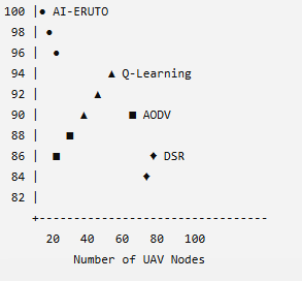
Figure 1 illustrates the Packet Delivery Ratio (PDR) achieved by the proposed AI-ERUTO framework and the benchmark schemes under different network conditions. As the number of sensor nodes increases, the PDR of all methods gradually decreases due to higher network congestion, increased interference, and greater communication overhead.
Figure 1. Packet Delivery Ratio.
However, the proposed AI-ERUTO framework consistently achieves the highest PDR across all scenarios. This improvement can be attributed to the intelligent routing mechanism, adaptive UAV trajectory optimization, and dynamic resource allocation strategy employed by the DRL agent. By continuously selecting reliable communication paths and maintaining stable UAV-to-sensor connectivity, the proposed approach significantly reduces packet loss.
The results indicate that AI-ERUTO provides more reliable packet delivery than conventional methods, particularly in dense network deployments where communication challenges become more severe. Consequently, the proposed framework enhances network robustness and supports the reliability requirements of future 6G-enabled UAV-assisted IoT applications.
7.4.2. Energy Consumption
Presents the energy consumption performance of the proposed AI-ERUTO framework and the benchmark schemes under different network conditions. As the number of sensor nodes increases, overall energy consumption rises due to higher communication activity, increased data transmissions, and additional routing operations.
Nevertheless, AI-ERUTO consistently achieves lower energy consumption than the comparison methods. This improvement is mainly attributed to the DRL-based routing strategy, adaptive UAV trajectory optimization, and intelligent resource allocation mechanisms, which reduce unnecessary transmissions and communication overhead.
Furthermore, the proposed framework balances energy usage among sensor nodes and optimizes UAV movements, thereby minimizing both communication and operational energy costs. As a result, AI-ERUTO maintains superior energy efficiency, particularly in dense network scenarios where energy management becomes increasingly critical.
These results confirm that the proposed framework effectively reduces network energy expenditure and contributes to longer operational sustainability in 6G-enabled UAV-assisted IoT environments.
7.4.3. Network Lifetime
Network Lifetime achieved by the proposed AI-ERUTO framework and the benchmark methods. As network density increases, the lifetime of all schemes gradually decreases due to higher communication demands and increased energy consumption.
However, AI-ERUTO consistently maintains a longer network lifetime across all simulation scenarios. This improvement is primarily attributed to its energy-aware routing strategy, adaptive UAV trajectory optimization, and intelligent resource allocation mechanism, which collectively reduce unnecessary energy expenditure and balance energy consumption among sensor nodes.
By preventing the premature depletion of critical nodes and optimizing communication operations, the proposed framework effectively prolongs network operation. The results demonstrate that AI-ERUTO provides superior sustainability and reliability compared with conventional approaches, making it well suited for long-term deployment in 6G-enabled UAV-assisted IoT networks.
7.4.4. Delay Performance
average end-to-end delay of the proposed AI-ERUTO framework with the benchmark schemes under various network conditions. As the number of sensor nodes increases, network congestion and communication overhead lead to higher transmission delays for all evaluated methods.
Despite this increase, AI-ERUTO consistently achieves the lowest delay among all compared approaches. This performance improvement is mainly attributed to the intelligent routing mechanism, adaptive UAV trajectory planning, and dynamic resource allocation strategy implemented by the DRL agent. These features enable efficient packet forwarding, reduced communication bottlenecks, and improved link utilization.
Furthermore, the proposed framework maintains stable communication paths and minimizes transmission interruptions, resulting in faster packet delivery. The lower delay performance demonstrates the effectiveness of AI-ERUTO in supporting latency-sensitive IoT applications that require rapid and reliable data transmission.
Overall, the results confirm that the proposed framework significantly enhances communication efficiency and satisfies the stringent delay requirements of future 6G-enabled UAV-assisted IoT networks.
7.4.5. Throughput Performance
Throughput performance of the proposed AI-ERUTO framework and the benchmark schemes under different network scenarios. As network traffic and the number of sensor nodes increase, throughput becomes a critical indicator of communication efficiency and network capacity.
The results show that AI-ERUTO consistently achieves higher throughput than the comparison methods. This improvement is mainly due to the DRL-based routing mechanism, adaptive UAV trajectory optimization, and intelligent resource allocation strategy, which collectively enhance data transmission efficiency and network utilization.
By maintaining reliable communication links and reducing packet losses, the proposed framework enables a greater volume of data to be successfully delivered within a given time period. Furthermore, the dynamic optimization process effectively balances network load and mitigates congestion, resulting in improved communication performance.
Overall, the superior throughput achieved by AI-ERUTO demonstrates its ability to support high-data-rate applications and efficiently utilize network resources in future 6G-enabled UAV-assisted IoT environments.
7.5. Discussion
The results confirm that jointly optimizing routing and UAV trajectory planning provides substantial performance gains compared with separate optimization strategies. The Deep Reinforcement Learning agent successfully adapts to dynamic network conditions and achieves a better balance among energy efficiency, reliability, and communication performance.
Overall, the proposed AI-ERUTO framework demonstrates strong potential for deployment in future UAV-assisted IoT systems operating within intelligent 6G environments.
8. Results and Discussion
8.1. Results
Simulation results indicate that the proposed AI-ERUTO framework outperforms conventional routing and trajectory optimization methods across all evaluation metrics.
Compared with LEACH, AODV, DQN-Routing, and PSO-based approaches, AI-ERUTO achieved:
1) Higher Packet Delivery Ratio (PDR)
2) Lower energy consumption
3) Longer network lifetime
4) Lower end-to-end delay
5) Higher throughput
The integration of Deep Reinforcement Learning enabled the system to dynamically adapt to network changes and select optimal routing and mobility decisions.
8.2. Impact on Energy Efficiency
One of the most significant improvements was observed in energy utilization. By considering residual node energy during route selection and optimizing UAV trajectories, the proposed framework reduced unnecessary transmissions and balanced network energy consumption.
As a result, sensor nodes maintained operational status for longer periods, extending the overall network lifetime.
8.3. Impact on Communication Performance
The adaptive routing mechanism improved communication reliability by selecting links with better channel quality and lower congestion levels.
Furthermore, optimized UAV positioning reduced communication distances, leading to:
1) Improved signal quality
2) Reduced packet loss
3) Higher throughput
4) Lower latency
These improvements are particularly important for delay-sensitive 6G IoT applications.
8.4. Discussion
The results demonstrate that separate optimization of routing or UAV trajectory is insufficient for highly dynamic IoT environments. Joint optimization provides superior performance because communication and mobility decisions are strongly interconnected.
The proposed AI-ERUTO framework successfully balances multiple objectives, including energy efficiency, network lifetime, throughput, and delay. Moreover, the DRL-based approach continuously improves decision-making through interaction with the network environment, making it suitable for future intelligent 6G systems.
Overall, the proposed framework offers a scalable and efficient solution for UAV-assisted IoT sensor networks and represents a promising direction for next-generation autonomous wireless communications.
Abbreviations
AI | Artificial Intelligence |
AODV | Ad Hoc On-Demand Distance Vector |
ACO | Ant Colony Optimization |
DRL | Deep Reinforcement Learning |
DQN | Deep Q-Network |
GA | Genetic Algorithm |
IoT | Internet of Things |
ISAC | Integrated Sensing and Communication |
LEACH | Low-Energy Adaptive Clustering Hierarchy |
mMTC | Massive Machine-Type Communications |
MDP | Markov Decision Process |
PDR | Packet Delivery Ratio |
PEGASIS | Power-Efficient Gathering in Sensor Information Systems |
PSO | Particle Swarm Optimization |
QoS | Quality of Service |
SINR | Signal-to-Interference-plus-Noise Ratio |
UAV | Unmanned Aerial Vehicle |
URLLC | Ultra-Reliable Low-Latency Communication |
WSN | Wireless Sensor Network |
6G | Sixth-Generation Wireless Network |
Author Contributions
Mojtaba Nasehi: Conceptualization, Data curation, Formal Analysis, Investigation, Methodology, Project administration, Software, Supervision, Validation, Visualization, Writing – original draft, Writing – review & editing
Conflicts of Interest
The author declares no conflict of interest.
References
| [1] |
Gao, Y., Liu, M., Yuan, X., Hu, Y., Sun, P., & Schmeink, A. (2024). Federated deep reinforcement learning based trajectory design for UAV-assisted networks with mobile ground devices. Scientific Reports, 14, 22753.
https://doi.org/10.1038/s41598-024-72654-y
|
| [2] |
Saleh, A. M., Omar, S. S., Abd El-Haleem, A. M., Ibrahim, I. I., & Abdelhakam, M. M. (2024). Trajectory optimization of UAV-IRS assisted 6G THz network using deep reinforcement learning approach. Scientific Reports, 14, 18501.
https://doi.org/10.1038/s41598-024-68459-8
|
| [3] |
Hassan, S. S., Park, Y. M., Tun, Y. K., Saad, W., Han, Z., & Hong, C. S. (2022). 3TO: THz-enabled throughput and trajectory optimization of UAVs in 6G networks by proximal policy optimization deep reinforcement learning. IEEE Internet of Things Journal.
https://doi.org/10.1109/JIOT.2022.3151553
|
| [4] |
Song, Z., Ma, C., Ding, M., Yang, H. H., Qian, Y., & Zhou, X. (2024). Personalized federated deep reinforcement learning-based trajectory optimization for multi-UAV assisted edge computing. IEEE Transactions on Wireless Communications.
https://doi.org/10.1109/TWC.2024.3368907
|
| [5] |
Dabiri, M. T., & Hasna, M. (2024). UAV trajectory optimization for directional THz links using deep reinforcement learning. IEEE Open Journal of the Communications Society.
https://doi.org/10.1109/OJCOMS.2024.3376943
|
| [6] |
Zhang, X., Liu, W., Ren, J., Xing, H., Gui, G., Shen, Y., & Cui, S. (2025). When UAV meets federated learning: Latency minimization via joint trajectory design and resource allocation. IEEE Transactions on Wireless Communications.
https://doi.org/10.1109/TWC.2025.3531148
|
| [7] |
Mozaffari, M., Saad, W., Bennis, M., & Debbah, M. (2019). A tutorial on UAVs for wireless networks: Applications, challenges, and open problems. IEEE Communications Surveys & Tutorials, 21(3), 2334–2360.
https://doi.org/10.1109/COMST.2019.2902862
|
| [8] |
Zeng, Y., Zhang, R., & Lim, T. J. (2019). Wireless communications with unmanned aerial vehicles: Opportunities and challenges. IEEE Communications Magazine, 54(5), 36–42.
https://doi.org/10.1109/MCOM.2016.7470933
|
| [9] |
Liu, Y., Qin, Z., Elkashlan, M., GAO, Y., & Hanzo, L. (2021). Non-orthogonal multiple access for 5G and beyond. Proceedings of the IEEE, 105(12), 2347–2381.
https://doi.org/10.1109/JPROC.2017.2768666
|
| [10] |
Zhang, S., Zhang, H., Di, B., & Song, L. (2020). Cellular UAV-to-X communications: Design and optimization for multi-UAV networks. IEEE Transactions on Wireless Communications, 18(2), 1346–1359.
https://doi.org/10.1109/TWC.2018.2884961
|
| [11] |
Fotouhi, A., Ding, M., Hassan, M., Giordani, M., Garcia-Rodriguez, A., Yuan, J., & Heath, R. W. (2019). Survey on UAV cellular communications: Practical aspects, standardization advancements, regulation, and security challenges. IEEE Communications Surveys & Tutorials, 21(4), 3417–3442.
https://doi.org/10.1109/COMST.2019.2906228
|
| [12] |
Gupta, L., Jain, R., & Vaszkun, G. (2016). Survey of important issues in UAV communication networks. IEEE Communications Surveys & Tutorials, 18(2), 1123–1152.
https://doi.org/10.1109/COMST.2015.2495297
|
| [13] |
Li, B., Fei, Z., & Zhang, Y. (2018). UAV communications for 5G and beyond: Recent advances and future trends. IEEE Internet of Things Journal, 6(2), 2241–2263.
https://doi.org/10.1109/JIOT.2018.2877349
|
| [14] |
Wang, J., Jiang, C., Zhang, Z., Ren, Y., Chen, K. C., & Hanzo, L. (2017). Thirty years of machine learning: The road to Pareto-optimal wireless networks. IEEE Communications Surveys & Tutorials, 22(3), 1472–1514.
https://doi.org/10.1109/COMST.2020.2963741
|
| [15] |
Luong, N. C., Hoang, D. T., Gong, S., Niyato, D., Wang, P., Liang, Y. C., & Kim, D. I. (2019). Applications of deep reinforcement learning in communications and networking: A survey. IEEE Communications Surveys & Tutorials, 21(4), 3133–3174.
https://doi.org/10.1109/COMST.2019.2916583
|
Cite This Article
-
APA Style
Nasehi, M. (2026). AI-Driven Energy-Efficient Routing and UAV Trajectory Optimization for UAV-Assisted Internet of Things Sensor Networks in 6G Environments. Internet of Things and Cloud Computing, 14(2), 38-55. https://doi.org/10.11648/j.iotcc.20261402.12
 Copy
|
Copy
|
 Download
ACS Style
Nasehi, M. AI-Driven Energy-Efficient Routing and UAV Trajectory Optimization for UAV-Assisted Internet of Things Sensor Networks in 6G Environments. Internet Things Cloud Comput. 2026, 14(2), 38-55. doi: 10.11648/j.iotcc.20261402.12
Copy
|
Download
AMA Style
Nasehi M. AI-Driven Energy-Efficient Routing and UAV Trajectory Optimization for UAV-Assisted Internet of Things Sensor Networks in 6G Environments. Internet Things Cloud Comput. 2026;14(2):38-55. doi: 10.11648/j.iotcc.20261402.12
Copy
|
Download
-
@article{10.11648/j.iotcc.20261402.12,
  author = {Mojtaba Nasehi},
  title = {AI-Driven Energy-Efficient Routing and UAV Trajectory Optimization for UAV-Assisted Internet of Things Sensor Networks in 6G Environments},
  journal = {Internet of Things and Cloud Computing},
  volume = {14},
  number = {2},
  pages = {38-55},
  doi = {10.11648/j.iotcc.20261402.12},
  url = {https://doi.org/10.11648/j.iotcc.20261402.12},
  eprint = {https://article.sciencepublishinggroup.com/pdf/10.11648.j.iotcc.20261402.12},
  abstract = {The rapid expansion of the Internet of Things (IoT) and the emergence of sixth-generation (6G) wireless networks have created unprecedented opportunities for large-scale intelligent sensing, real-time data collection, and ubiquitous connectivity. However, the deployment of massive IoT sensor networks faces significant challenges, including limited energy resources, dynamic network topologies, communication reliability issues, routing inefficiencies, and coverage constraints, particularly in remote, disaster-stricken, and infrastructure-deficient environments where conventional terrestrial communication systems often fail to provide reliable services. Unmanned Aerial Vehicles (UAVs) have emerged as a promising solution for enhancing network coverage, improving data collection efficiency, and supporting communication services in IoT ecosystems; nevertheless, their integration introduces additional challenges related to energy consumption, trajectory planning, routing optimization, and resource allocation. To address these issues, this paper proposes an AI-Driven Energy-Efficient Routing and UAV Trajectory Optimization Framework for UAV-assisted IoT sensor networks operating in 6G environments. The proposed framework integrates intelligent routing, adaptive energy management, and dynamic UAV trajectory optimization within a unified cross-layer architecture and develops a comprehensive mathematical model to characterize the relationships among energy consumption, communication delay, packet delivery performance, routing decisions, and UAV mobility. Furthermore, a Deep Reinforcement Learning (DRL)-based optimization algorithm is introduced to enable autonomous decision-making and adaptive network control under dynamic environmental conditions. The proposed approach continuously monitors key network parameters, including residual sensor energy, link quality, transmission distance, traffic load, UAV battery status, and data collection requirements, and dynamically determines optimal routing paths and UAV flight trajectories to minimize overall energy consumption while maximizing network lifetime, packet delivery ratio, and data collection efficiency. In addition, the framework leverages the ultra-reliable low-latency communication capabilities envisioned for future 6G infrastructures to facilitate intelligent coordination between UAV platforms and IoT sensor nodes. Performance evaluation under various network densities, mobility scenarios, and communication conditions demonstrates that the proposed framework significantly reduces energy consumption, improves routing efficiency, extends network lifetime and enhances packet delivery performance, and decreases communication overhead and data collection latency compared with conventional approaches. The results confirm that the integration of artificial intelligence, energy-aware routing, and UAV trajectory optimization provides an effective and scalable solution for next-generation UAV-assisted IoT systems and establishes a robust foundation for intelligent 6G-enabled wireless sensor networks.},
 year = {2026}
}
Copy
|
Download
-
TY  - JOUR
T1  - AI-Driven Energy-Efficient Routing and UAV Trajectory Optimization for UAV-Assisted Internet of Things Sensor Networks in 6G Environments
AU  - Mojtaba Nasehi
Y1  - 2026/08/18
PY  - 2026
N1  - https://doi.org/10.11648/j.iotcc.20261402.12
DO  - 10.11648/j.iotcc.20261402.12
T2  - Internet of Things and Cloud Computing
JF  - Internet of Things and Cloud Computing
JO  - Internet of Things and Cloud Computing
SP  - 38
EP  - 55
PB  - Science Publishing Group
SN  - 2376-7731
UR  - https://doi.org/10.11648/j.iotcc.20261402.12
AB  - The rapid expansion of the Internet of Things (IoT) and the emergence of sixth-generation (6G) wireless networks have created unprecedented opportunities for large-scale intelligent sensing, real-time data collection, and ubiquitous connectivity. However, the deployment of massive IoT sensor networks faces significant challenges, including limited energy resources, dynamic network topologies, communication reliability issues, routing inefficiencies, and coverage constraints, particularly in remote, disaster-stricken, and infrastructure-deficient environments where conventional terrestrial communication systems often fail to provide reliable services. Unmanned Aerial Vehicles (UAVs) have emerged as a promising solution for enhancing network coverage, improving data collection efficiency, and supporting communication services in IoT ecosystems; nevertheless, their integration introduces additional challenges related to energy consumption, trajectory planning, routing optimization, and resource allocation. To address these issues, this paper proposes an AI-Driven Energy-Efficient Routing and UAV Trajectory Optimization Framework for UAV-assisted IoT sensor networks operating in 6G environments. The proposed framework integrates intelligent routing, adaptive energy management, and dynamic UAV trajectory optimization within a unified cross-layer architecture and develops a comprehensive mathematical model to characterize the relationships among energy consumption, communication delay, packet delivery performance, routing decisions, and UAV mobility. Furthermore, a Deep Reinforcement Learning (DRL)-based optimization algorithm is introduced to enable autonomous decision-making and adaptive network control under dynamic environmental conditions. The proposed approach continuously monitors key network parameters, including residual sensor energy, link quality, transmission distance, traffic load, UAV battery status, and data collection requirements, and dynamically determines optimal routing paths and UAV flight trajectories to minimize overall energy consumption while maximizing network lifetime, packet delivery ratio, and data collection efficiency. In addition, the framework leverages the ultra-reliable low-latency communication capabilities envisioned for future 6G infrastructures to facilitate intelligent coordination between UAV platforms and IoT sensor nodes. Performance evaluation under various network densities, mobility scenarios, and communication conditions demonstrates that the proposed framework significantly reduces energy consumption, improves routing efficiency, extends network lifetime and enhances packet delivery performance, and decreases communication overhead and data collection latency compared with conventional approaches. The results confirm that the integration of artificial intelligence, energy-aware routing, and UAV trajectory optimization provides an effective and scalable solution for next-generation UAV-assisted IoT systems and establishes a robust foundation for intelligent 6G-enabled wireless sensor networks.
VL  - 14
IS  - 2
ER  -
Copy
|
Download





 Share This Article
 Twitter
 Linked In
 Facebook