
Poly (2-acrylamido-2-methyl-1-propane sulphonic acid) [PAMPS] hydrogel was synthesized via free radical polymerization using 2-Acrylamido 2-methyl 1-propane sulphonic acid (AMPS) monomer, N, N-Methylenebisacrylamide (MBAA) cross-linker and potassium per sulphate (KPS) as the initiator and evaluated as an efficient adsorbent for the removal of Brilliant Green (BG) dye from aqueous solutions. Batch sorption experiments were conducted to investigate the influence of key operational parameters, such as pH, temperature, initial concentration of dye and sorbent doses. Equilibrium data were analyzed using common adsorption isotherm models and sorption isotherm data was found to fit best with the Dubinin-Radushkevich model with the highest correlation (R2=0.9808) at the temperature of 37.5°C. Thermodynamic parameters such as Gibbs free energy (ΔG°), enthalpy (ΔH°), and entropy (ΔS°) were determined to elucidate the nature of the adsorption process. The positive Gibbs free energy (ΔG°) suggesting non-spontaneous process and a positive enthalpy change (ΔH°= 0.003 kJ/ mol), indicating an endothermic process. The maximum sorption capacity was observed at 37.5°C with a removal efficiency up to 97.28% under optimized conditions. In addition, desorption studies using different types of solvents revealed the impact of the nature of the solvents on this sort of surface phenomenon. Overall, the findings demonstrate that PAMPS hydrogel is a promising and thermally responsive adsorbent for the effective removal of Brilliant Green dye, highlighting its potential application in wastewater treatment.
| Published in | Journal of Chemical, Environmental and Biological Engineering (Volume 10, Issue 1) |
| DOI | 10.11648/j.jcebe.20261001.11 |
| Page(s) | 1-12 |
| Creative Commons |
This is an Open Access article, distributed under the terms of the Creative Commons Attribution 4.0 International License (http://creativecommons.org/licenses/by/4.0/), which permits unrestricted use, distribution and reproduction in any medium or format, provided the original work is properly cited. |
| Copyright |
Copyright © The Author(s), 2026. Published by Science Publishing Group |
Sorption, Hydrogel, Brilliant Green, PAMPS, Thermodynamics, Desorption Study
Isotherm Models | Coefficients | Temperature (C) | |||
|---|---|---|---|---|---|
17.5 | 27.5 | 37.5 | 47.5 | ||
Langmuir | qm (mg/g) | -4.512 | 4.4623 | 2.1413 | -1.403 |
KL (L/mg) | -0.009 | 0.0868 | 0.2569 | -0.112 | |
R2 | 0.000 | 0.1323 | 0.5556 | 0.0898 | |
Freundlich | KF (mg/g) | 0.0362 | 0.3490 | 0.4044 | 0.1657 |
N | 0.8764 | 1.0506 | 1.1679 | 07287 | |
R2 | 0.5160 | 0.9180 | 0.8824 | 0.8560 | |
Temkin | KT | 0.3705 | 3.3153 | 3.8660 | 1.3246 |
BT (kJ/mol) | 0.5096 | 0.3606 | 0.3774 | 0.5630 | |
R2 | 0.7014 | 0.9071 | 0.9596 | 0.7557 | |
Dubinin-Radushkevich | qs (mg/g) | 1.6874 | 1.5370 | 1.692 | 2.515 |
E (kJ/mol) | 10.619 | 25.00 | 26.73 | 18.26 | |
(mol2/kJ2) | 0.3069 | 0.0008 | 0.0007 | 0.0015 | |
R2 | 0.8814 | 0.9587 | 0.9808 | 0.9221 | |
Temperature (K) | Kd | G (kJmol-1) | H (kJmol-1) | S (JK-1mol-1) | R2 | Reference |
|---|---|---|---|---|---|---|
290.5 | 0.089136 | 5.839 | 0.003 | 87.62 | 0.783 | Current Research |
300.5 | 0.267665 | 3.292 | ||||
310.5 | 0.47642 | 1.912 | ||||
320.5 | 0.262553 | 3.458 | ||||
288 | 6.7 | -16.2 | 20.1 | 29.9 | 0.998 | [37] |
298 | 6.9 | -17.1 | 0.997 | |||
313 | 7.1 | -8.51 | 0.988 | |||
323 | 7.3 | -19.6 | 0.989 | |||
298 | 8.0631 | -6.413 | 36.439 | 143.8 | - | [38] |
308 | 13.153 | -7.8514 | ||||
318 | 20.218 | -9.2890 | ||||
328 | 33.281 | -10.584 | ||||
298 | 11.3 | 6.05 | 27.92 | 113.1 | - | [39] |
308 | 13.3 | 6.63 | ||||
318 | 19 | 7.78 | ||||
328 | 32.3 | 9.48 |
Reagents | (%) Desorption | (%) Regeneration | Transparency of Gel | Physical Structure of Gel | Appearance of Gel |
|---|---|---|---|---|---|
Water | 2 | - | Coloured | Not deformed |
|
NaCl (0.1M) | 8 | Coloured | Not deformed |
| |
HCl (0.1 M) | Transparent but slightly yellowish in colour | Slightly deformed |
| ||
NaOH (0.1M) | - | - | Opaque | Slightly deformed |
|
Acetone (0.1M) | - | - | Slightly transparent | Not deformed |
|
Ethanol (0.1M) | - | - | Slightly transparent | Not deformed |
|
PAMPS | Poly (2-Acrylamido-2-Methyl-1-Propane Sulphonic Acid) |
AMPS | 2-Acrylamido 2-Methyl 1-Propane Sulphonic Acid |
MBAA | N, N-Methylenebisacrylamide |
KPS | Potassium Persulphate |
| [1] | Slama, H. B., Chenari Bouket, A., Pourhassan, Z., Alenezi, F. N., Silini, A., Cherif-Silini, H., Oszako, T., Luptakova, L., Golińska, P. and Belbahri, L, Diversity of synthetic dyes from textile industries, discharge impacts and treatment methods. Applied Sciences, 2021, 11(14), p. 6255. |
| [2] | Ali, H, Biodegradation of synthetic dyes—a review. Water, Air, & Soil Pollution, 2010, 213(1), pp. 251-273. |
| [3] | Singh, K. and Arora, S., Removal of synthetic textile dyes from wastewaters: a critical review on present treatment technologies. Critical reviews in environmental science and technology, 2010, 41(9), pp. 807-878. |
| [4] | Vigneshpriya, D., Krishnaveni, N., Renganathan, S. and Sri Sakthi Priyadarshini, R., Impact of untreated and Sargassum wightii-treated brilliant green dye exposure on Indian major carp, Labeo rohita Ham.: hematology, biochemistry, enzymology and histopathology. International Journal of Phytoremediation, 2010, 22(8), pp. 819-826. |
| [5] | Singh, S., Gupta, H., Dhiman, S. and Sahu, N. K., Decontamination of cationic dye brilliant green from the aqueous media. Applied Water Science, 2022, 12(4), p. 61. |
| [6] | Abdel-Fadeel, M. A., Aljohani, N. S., Al-Mhyawi, S. R., Halawani, R. F., Aljuhani, E. H. and Salam, M. A., A simple method for removal of toxic dyes such as Brilliant Green and Acid Red from the aquatic environment using Halloysite nanoclay. Journal of Saudi Chemical Society, 2022, 26(3), p. 101475. |
| [7] | Akter, T., Protity, A. T., Shaha, M., Al Mamun, M. and Hashem, A, The impact of textile dyes on the environment. In Nanohybrid materials for treatment of textiles dyes 2023, pp. 401-431. Singapore: Springer Nature Singapore. |
| [8] | Yildirim, O. A., Bahadir, M. and Pehlivan, E., Detrimental effects of commonly used textile dyes on the aquatic environment and human health–a review. Fresenius Environ Bull, 2022, 31, pp. 9329-45. |
| [9] | Mehra, S., Singh, M. and Chadha, P. J. T. I., Adverse impact of textile dyes on the aquatic environment as well as on human beings. Toxicol. Int, 2021, 28(2), p. 165 |
| [10] | du Plessis, A., Primary water quality challenges, contaminants and the world’s dirtiest places. In Water as an Inescapable Risk: Current Global Water Availability, Quality and Risks with a Specific Focus on South Africa 2018 (pp. 79-114). Cham: Springer International Publishing. |
| [11] | Aggour, Y. A., Kenawy, E. R., Magdy, M. and Elbayoumy, E, Multifunctional copolymers for brilliant green dye removal: adsorption kinetics, isotherm and process optimization. Environmental Science: Advances, 4(5), 2025, pp. 787-808. |
| [12] | Moradihamedani, P. J. P. B. Recent advances in dye removal from wastewater by membrane technology: a review. Polymer Bulletin, 2022, 79(4), pp. 2603-2631. |
| [13] | Aziz, A. A., Mokhter, M. A., Ghazali, A. I. and Hanaffi, N. Removal of Remazol brilliant blue R dye from water using eggshell mixed matrix membrane through filtration and adsorption. Journal of Applied Membrane Science & Technology, 2024, 28(3), pp. 17-31. |
| [14] | Garud, R. M., Kore, S. V., Kore, V. S. and Kulkarni, G. S., A Short Review on Process and Applications of Reverse Osmosis. Universal Journal of Environmental Research & Technology, 2011, 1(3). |
| [15] | Muniasamy, S. K., AlObaid, A. A., Warad, I. and Ravindiran, G., 2023. Removal of Brilliant Green dye in aqueous solution using synthetic coagulation and flocculation technique. Desalination and Water Treatment, 2023, 314, pp. 231-240. |
| [16] | Aqeel, K., Mubarak, H. A., Amoako-Attah, J., Abdul-Rahaim, L. A., Al Khaddar, R., Abdellatif, M., Al-Janabi, A. and Hashim, K. S., 2020, July. Electrochemical removal of brilliant green dye from wastewater. In IOP Conference Series: Materials Science and Engineering (Vol. 888, No. 1, p. 012036). IOP Publishing. |
| [17] | Nandi, B. K., Goswami, A. and Purkait, M. K., Adsorption characteristics of brilliant green dye on kaolin. Journal of hazardous materials, 2009, 161(1), pp. 387-395. |
| [18] | Mane, V. S., Mall, I. D. and Srivastava, V. C., Kinetic and equilibrium isotherm studies for the adsorptive removal of Brilliant Green dye from aqueous solution by rice husk ash. Journal of environmental management, 2007, 84(4), pp. 390-400. |
| [19] | Tripathi, P., Tiwari, S., Sonwani, R. K. and Singh, R. S., A step towards enhancing the efficiency of biofilm mediated degradation of brilliant green dye in packed bed bioreactor: Statistical and toxicity analysis. Process Safety and Environmental Protection, 2023, 170, pp. 1228-1239. |
| [20] | Zabłocka-Godlewska, E. and Przystaś, W., Fed-batch decolourization of mixture of Brilliant Green and Evans Blue by bacteria species applied as pure and mixed cultures: influence of growth conditions. Water, Air, & Soil Pollution, 2020, 231(2), p. 75. |
| [21] | González, V., Abalde, J. and Torres, E. Discoloration and biosorption of Brilliant green dye in seawater using living biomass of the microalga Phaeodactylum tricornutum. Journal of Applied Phycology, 2024, 36(4), pp. 1823-1835. |
| [22] | Kaushik, P. and Malik, A., Comparative performance evaluation of Aspergillus lentulus for dye removal through bioaccumulation and biosorption. Environmental Science and Pollution Research, 2013, 20(5), pp. 2882-2892. |
| [23] | Mane, V. S. and Babu, P. V., Studies on the adsorption of Brilliant Green dye from aqueous solution onto low-cost NaOH treated saw dust. Desalination, 2011, 273(2-3), pp. 321-329. |
| [24] | Zolgharnein, J., Bagtash, M. and Shariatmanesh, T., Simultaneous removal of binary mixture of Brilliant Green and Crystal Violet using derivative spectrophotometric determination, multivariate optimization and adsorption characterization of dyes on surfactant modified nano-γ-alumina. Spectrochimica Acta Part A: Molecular and Biomolecular Spectroscopy, 2015, 137, pp. 1016-1028. |
| [25] | Darban, Z., Shahabuddin, S., Gaur, R., Ahmad, I. and Sridewi, N.,. Hydrogel-based adsorbent material for the effective removal of heavy metals from wastewater: A comprehensive review. Gels, 2022, 8(5), p. 263. |
| [26] | Godiya, C. B., Ruotolo, L. A. M. and Cai, W, Functional biobased hydrogels for the removal of aqueous hazardous pollutants: current status, challenges, and future perspectives. Journal of Materials Chemistry A, 2020, 8(41), pp. 21585-21612. |
| [27] | Shalla, A. H., Bhat, M. A. and Yaseen, Z., Hydrogels for removal of recalcitrant organic dyes: A conceptual overview. Journal of environmental chemical engineering, 2018, 6(5), pp. 5938-5949. |
| [28] | Lim, J. Y., Goh, S. S., Liow, S. S., Xue, K. and Loh, X. J., Molecular gel sorbent materials for environmental remediation and wastewater treatment. Journal of Materials Chemistry A, 2019, 7(32), pp. 18759-18791. |
| [29] | Demirci, S., Ari, B., Aktas, N. and Sahiner, N.,. pH-responsive amphoteric p (APTMACl-co-AMPS) hydrogel as effective multiple dye sponge network from aqueous media. Frontiers in Materials, 2022, 9, p. 837701. |
| [30] | Phonlakan, K., Meetam, P., Chonlaphak, R., Kongseng, P., Chantarak, S. and Budsombat, S., Poly (acrylic acid-co-2-acrylamido-2-methyl-1-propanesulfonic acid)-grafted chitosan hydrogels for effective adsorption and photocatalytic degradation of dyes. RSC advances, 2023, 13(44), pp. 31002-31016. |
| [31] | Zhou, G., Luo, J., Liu, C., Chu, L., Ma, J., Tang, Y., Zeng, Z. and Luo, S., A highly efficient polyampholyte hydrogel sorbent based fixed-bed process for heavy metal removal in actual industrial effluent. Water research, 2016, 89, pp. 151-160. |
| [32] | Krishnan, M., Michal, F., Alsoughayer, S., Almohsin, A. and Alsharaeh, E., October. Thermodynamic and kinetic investigation of water absorption by PAM composite hydrogel. In SPE Kuwait Oil and Gas Show and Conference (p. D043S022R002). 2019, SPE. |
| [33] | Omer, A. M., Sadik, W. A. A., El Demerdash, A. G. M., Tamer, T. M., Khalifa, R. E., Mohyeldin, M. S. and Abdelwahed, N. A., 2021. Fabrication of semi-interpenetrated PVA/PAMPS hydrogel as a reusable adsorbent for cationic methylene blue dye: isotherms, kinetics and thermodynamics studies. Polymer Bulletin, 78(11), pp. 6649-6673. |
| [34] | Kumar, N., Mittal, H., Alhassan, S. M. and Ray, S. S., Bionanocomposite hydrogel for the adsorption of dye and reusability of generated waste for the photodegradation of ciprofloxacin: a demonstration of the circularity concept for water purification. ACS Sustainable Chemistry & Engineering, 2018, 6(12), pp. 17011-17025. |
| [35] | Mustafa, A., Yaqoob, N., Almas, M., Kamal, S., Zia, K. M. and Rehman, S.,. Adsorptive removal of Drimarene Brilliant Blue by thermo stable and eco-friendly graphene oxide reinforced polyvinyl alcohol hydrogels with high reusability potential. Journal of Polymer Research, 2022, 29(8), p. 332. |
| [36] | Poplewska, I., Strachota, B., Strachota, A., Poplewski, G. and Antos, D., Thermo-and pH-responsible gels for efficient protein adsorption and desorption. Molecules, 2024, 29(20), p. 4858. |
| [37] | Ragab, A., Ahmed, I. and Bader, D., The removal of brilliant green dye from aqueous solution using nano hydroxyapatite/chitosan composite as a sorbent. Molecules, 2019, 24(5), p. 847. |
| [38] | Abbas, M., Removal of brilliant green (BG) by activated carbon derived from medlar nucleus (ACMN)–Kinetic, isotherms and thermodynamic aspects of adsorption. Adsorption Science & Technology, 2020, 38(9-10), pp. 464-482. |
| [39] | Kismir, Y. and Aroguz, A. Z., 2011. Adsorption characteristics of the hazardous dye Brilliant Green on Saklıkent mud. Chemical Engineering Journal, 172(1), pp. 199-206. |
| [40] | Karim, A. B., Mounir, B., Hachkar, M., Bakasse, M. and Yaacoubi, A., 2017. Adsorption/desorption behavior of cationic dyes on Moroccan clay: equilibrium and mechanism. Journal of Materials and Environmental Science, 8(3), pp. 1082-1096. |
| [41] | Malekbala, M. R., Khan, M. A., Hosseini, S., Abdullah, L. C. and Choong, T. S., 2015. Adsorption/desorption of cationic dye on surfactant modified mesoporous carbon coated monolith: equilibrium, kinetic and thermodynamic studies. Journal of Industrial and Engineering Chemistry, 21, pp. 369-377. |
APA Style
Hasan, S., Haque, M. A., Towsif-Ur-Rahman, M., Ahmed, N. (2026). Poly (2-Acrylamido 2-Methyl 1-Propane Sulphonic Acid) Hydrogel for the Sorption Studies of Brilliant Green Dye: Isotherm and Thermodynamic Studies. Journal of Chemical, Environmental and Biological Engineering, 10(1), 1-12. https://doi.org/10.11648/j.jcebe.20261001.11
ACS Style
Hasan, S.; Haque, M. A.; Towsif-Ur-Rahman, M.; Ahmed, N. Poly (2-Acrylamido 2-Methyl 1-Propane Sulphonic Acid) Hydrogel for the Sorption Studies of Brilliant Green Dye: Isotherm and Thermodynamic Studies. J. Chem. Environ. Biol. Eng. 2026, 10(1), 1-12. doi: 10.11648/j.jcebe.20261001.11
@article{10.11648/j.jcebe.20261001.11,
  author = {Sakib Hasan and Md. Anamul Haque and Md. Towsif-Ur-Rahman and Nafees Ahmed},
  title = {Poly (2-Acrylamido 2-Methyl 1-Propane Sulphonic Acid) Hydrogel for the Sorption Studies of Brilliant Green Dye: Isotherm and Thermodynamic Studies},
  journal = {Journal of Chemical, Environmental and Biological Engineering},
  volume = {10},
  number = {1},
  pages = {1-12},
  doi = {10.11648/j.jcebe.20261001.11},
  url = {https://doi.org/10.11648/j.jcebe.20261001.11},
  eprint = {https://article.sciencepublishinggroup.com/pdf/10.11648.j.jcebe.20261001.11},
  abstract = {Poly (2-acrylamido-2-methyl-1-propane sulphonic acid) [PAMPS] hydrogel was synthesized via free radical polymerization using 2-Acrylamido 2-methyl 1-propane sulphonic acid (AMPS) monomer, N, N-Methylenebisacrylamide (MBAA) cross-linker and potassium per sulphate (KPS) as the initiator and evaluated as an efficient adsorbent for the removal of Brilliant Green (BG) dye from aqueous solutions. Batch sorption experiments were conducted to investigate the influence of key operational parameters, such as pH, temperature, initial concentration of dye and sorbent doses. Equilibrium data were analyzed using common adsorption isotherm models and sorption isotherm data was found to fit best with the Dubinin-Radushkevich model with the highest correlation (R2=0.9808) at the temperature of 37.5°C. Thermodynamic parameters such as Gibbs free energy (ΔG°), enthalpy (ΔH°), and entropy (ΔS°) were determined to elucidate the nature of the adsorption process. The positive Gibbs free energy (ΔG°) suggesting non-spontaneous process and a positive enthalpy change (ΔH°= 0.003 kJ/ mol), indicating an endothermic process. The maximum sorption capacity was observed at 37.5°C with a removal efficiency up to 97.28% under optimized conditions. In addition, desorption studies using different types of solvents revealed the impact of the nature of the solvents on this sort of surface phenomenon. Overall, the findings demonstrate that PAMPS hydrogel is a promising and thermally responsive adsorbent for the effective removal of Brilliant Green dye, highlighting its potential application in wastewater treatment.},
 year = {2026}
}
TY  - JOUR
T1  - Poly (2-Acrylamido 2-Methyl 1-Propane Sulphonic Acid) Hydrogel for the Sorption Studies of Brilliant Green Dye: Isotherm and Thermodynamic Studies
AU  - Sakib Hasan
AU  - Md. Anamul Haque
AU  - Md. Towsif-Ur-Rahman
AU  - Nafees Ahmed
Y1  - 2026/01/16
PY  - 2026
N1  - https://doi.org/10.11648/j.jcebe.20261001.11
DO  - 10.11648/j.jcebe.20261001.11
T2  - Journal of Chemical, Environmental and Biological Engineering
JF  - Journal of Chemical, Environmental and Biological Engineering
JO  - Journal of Chemical, Environmental and Biological Engineering
SP  - 1
EP  - 12
PB  - Science Publishing Group
SN  - 2640-267X
UR  - https://doi.org/10.11648/j.jcebe.20261001.11
AB  - Poly (2-acrylamido-2-methyl-1-propane sulphonic acid) [PAMPS] hydrogel was synthesized via free radical polymerization using 2-Acrylamido 2-methyl 1-propane sulphonic acid (AMPS) monomer, N, N-Methylenebisacrylamide (MBAA) cross-linker and potassium per sulphate (KPS) as the initiator and evaluated as an efficient adsorbent for the removal of Brilliant Green (BG) dye from aqueous solutions. Batch sorption experiments were conducted to investigate the influence of key operational parameters, such as pH, temperature, initial concentration of dye and sorbent doses. Equilibrium data were analyzed using common adsorption isotherm models and sorption isotherm data was found to fit best with the Dubinin-Radushkevich model with the highest correlation (R2=0.9808) at the temperature of 37.5°C. Thermodynamic parameters such as Gibbs free energy (ΔG°), enthalpy (ΔH°), and entropy (ΔS°) were determined to elucidate the nature of the adsorption process. The positive Gibbs free energy (ΔG°) suggesting non-spontaneous process and a positive enthalpy change (ΔH°= 0.003 kJ/ mol), indicating an endothermic process. The maximum sorption capacity was observed at 37.5°C with a removal efficiency up to 97.28% under optimized conditions. In addition, desorption studies using different types of solvents revealed the impact of the nature of the solvents on this sort of surface phenomenon. Overall, the findings demonstrate that PAMPS hydrogel is a promising and thermally responsive adsorbent for the effective removal of Brilliant Green dye, highlighting its potential application in wastewater treatment.
VL  - 10
IS  - 1
ER  -
Department of Chemistry, Jagannath University, Dhaka, Bangladesh
Biography: Sakib Hasan is an early-career researcher in environment, physical and analytical chemistry, with his academic training from Jagannath university, where he completed B. Sc. and M. Sc. program. His undergraduate thesis focused on dye sorption, specially investigating the sorption behavior of Brilliant green dye using PAMPS hydrogel. Through this work, he gained strong expertise in sorption kinetics, thermodynamics, equilibrium modeling and batch experimental technique. He is skilled in applying model such as pseudo-first order, pseudo-second order. His interest lies in hydrogel-based adsorbent, polymer materials, and the removal of organic pollutants from aqueous systems. Motivated and research-oriented, he aims to purse a PhD in environment chemistry, materials science or coordination chemistry with the long-term goal of developing innovative adsorption materials for sustainable water treatment.
Research Fields: Physical Chemistry, Electrochemistry, Environment chemistry, Material Science, polymer Chemistry.


Department of Chemistry, Jagannath University, Dhaka, Bangladesh
Biography: Md. Towsif-Ur-Rahman is a Masters student in the Department of Chemistry, Jagannath University, Dhaka, Bangladesh. He completed his Bachelor degree in Chemistry from the same institution in 2023. His undergraduate thesis focused on dye sorption, specially investigating the sorption behavior of Crystal dye using PAMPS hydrogel. His research interest includes surface chemistry, electrochemistry, material science and nanochemistry. Some of his recent works are based on the removal of organic pollutants from aqueous systems by hydrogel-based adsorbent.
Research Fields: Electrochemistry, Material Science, Polymer Chemistry, Surface Chemistry, Nanochemistry.

Department of Chemistry, Jagannath University, Dhaka, Bangladesh
Biography: Nafees Ahmed is a Professor of Chemistry at Jagannath University, Dhaka, Bangladesh. Professor Ahmed completed his B. Sc. (Hons) and M. Sc. in chemistry from the Department of Chemistry, University of Dhaka in 2006 and 2008 respectively. He was rewarded Ph.D. in polymer science from the Division of Biological Sciences, Graduate School of Science, Hokkaido University, Japan in 2011. He began his teaching career from Stamford University of Bangladesh in 2012 and then joined the Department of Chemistry, Jagannath University as Lecturer. Professor Ahmed started his research in Physical Chemistry in this institution besides teaching. His research interest covers the area of physical chemistry, surface chemistry, polymer chemistry, material science and environmental chemistry. He has got published 21 research articles in nationally and internationally reputed journals and attended numerous scientific conferences at home and abroad. Besides scientific activities he is involved in curriculum designing and institutional quality assurance program.
Research Fields: Physical Chemistry, Surface Chemistry, Material Science, Polymer Chemistry, Environmental Chemistry.

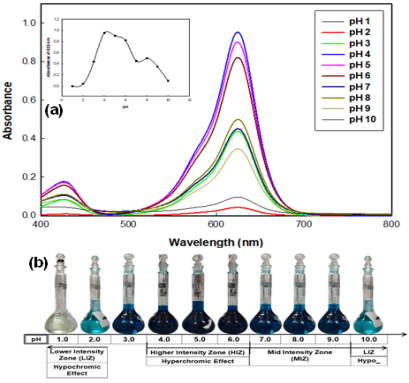
Figure 1. (a) Absorption Spectra of BG Dye of 50 mg L-1 at Different pH Values. Inset Figure Variation of Absorbance with pH at <i></i>max 625 nm and (b) pH Dependent Chromaticity of BG dye.
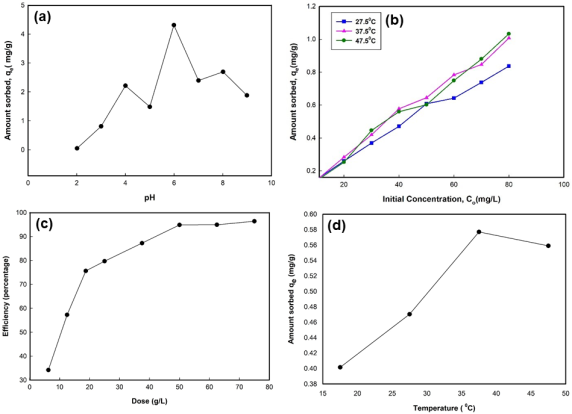
Figure 2. Variable Factors Such as (a) pH, (b) Initial Concentration, (c) Dose, (d) Temperature That Can Affect on Thermodynamic Studies.
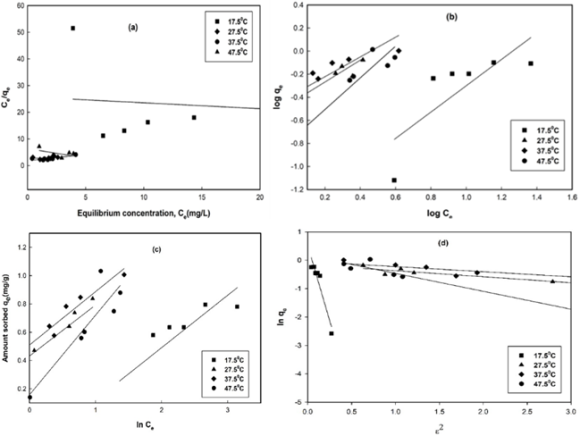
Figure 3. Fitting of Isotherm Data with (a) Langmuir Isotherm, (b) Freundlich Isotherm, (c) Temkin Isotherm and (d) Dubinin-Radushkevich Isotherm Models for the Sorption of BG Dye onto PAMPS Hdyrogel at Different Temperatures.
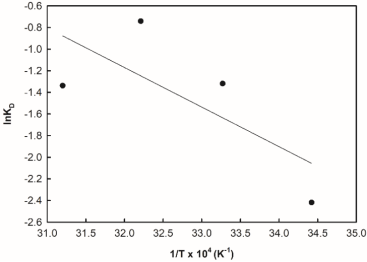
Figure 4. A Plot of lnKd vs 1/T for the Sorption of Brilliant Green onto PAMPS Hydrogel at pH 6.
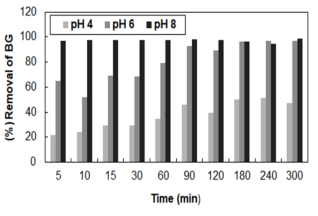
Figure 5. Percent Removal of BG Onto PAMPS With Time at Different pH Levels.

Information



 Share This Article
 Twitter
 Linked In
 Facebook


 Copy
Copy Download