Review Article | | Peer-Reviewed

A Review of Uganda’s Medicinal Tree Species as Sources of Potential Therapeutic Compounds for Disease Management

Received: 29 January 2026     Accepted: 10 February 2026     Published: 4 March 2026
Views:       Downloads:
Abstract

Ethnomedicinal relevance: Medicinal plants are a source of many potent drugs since they possess diverse phytochemical compounds. Studies on different plant life forms are voluminous, except trees. No single study has been done on tree species used to manage diseases in different regions of Uganda from 1995 up to 2023. Aim of the study: This review aimed to compile tree species used to manage different diseases and disease symptoms in various areas in Uganda. Materials and methods: The review examined 20 studies with ethnobotanical surveys done in Uganda. Data extraction focused on plant families and species, plant parts used, preparation methods and routes of administration, and the region in Uganda where the ethnobotanical field surveys were conducted. Results: 151 tree species from 52 families were identified. Leaves (34.7%) were highly depended on followed by bark (32.0%) and roots (19.7%) were also commonly used. The majority of the herbal remedies were prepared by decoction and taken orally. In regard to disease management using medicinal tree species, the diseases that were prevalent and posing public health concerns were malaria, diarrhea, breast cancer, syphilis, HIV/ AIDs, ulcers, tuberculosis, and skin infections. Conclusion: Many tree species in Uganda are used to manage several ailments. However, other tree species with medicinal importance remain undocumented and yet some of them are being destroyed by anthropogenic activities. Efforts to ensure sustainable harvesting of these medicinal tree species are thus required.

Published in Journal of Diseases and Medicinal Plants (Volume 12, Issue 1)
DOI 10.11648/j.jdmp.20261201.13
Page(s) 20-56
Creative Commons

This is an Open Access article, distributed under the terms of the Creative Commons Attribution 4.0 International License (http://creativecommons.org/licenses/by/4.0/), which permits unrestricted use, distribution and reproduction in any medium or format, provided the original work is properly cited.

Copyright

Copyright © The Author(s), 2026. Published by Science Publishing Group

Keywords

Herbal Medicine, Medicinal Plants, Traditional Knowledge, Traditional Medicine

1. Introduction
It is pertinent to mention that plants have been used over the years as they possess phytochemical compounds that are of immense benefit . Some of these phytochemical compounds in plants include tannins, terpenoids, alkaloids, and flavonoids . The use of plants is skyrocketing across the globe with the situation not being different in Africa . In regions such as East Africa, countries such as Burundi and Tanzania have relied on traditional medicine. Reports have put forth that at least 80% of the population in rural areas hinge on traditional medicine . This same situation is also in Uganda, where traditional medicine forms a paramount part of primary health care .
It is accentuate to note that Uganda is among the countries in Africa with the richest biodiversity, and its standing among all African countries is extremely high . In East Africa, Uganda is the richest in flora diversity with about 5000 plant species from which its people access natural resources . Conversely, unsustainable harvesting, an act which is so alarming, continues to be done . This thus makes the documentation, sustainable utilization, and conservation to be of supreme importance . The documentation of these plants together with their medicinal benefits thus becomes mandatory for their conservation . Interestingly, the current body of literature on medicinal plants for treatment of various diseases in Uganda is extensive .
However, numerous medicinal plants and their indigenous uses have not yet been documented even though the knowledge on their uses is being lost . The loss of their knowledge is owing to death of knowledge custodians prior to transferring the knowledge to the young people . Due to this, there is dire need for concrete information on their level of use . Recording of traditional knowledge through ethnobotany surveys is pivotal as it can channel sustainable use of these natural resources . This is because the extent at which the ecosystems of these medicinal plants are being destroyed is surging. For example, studies have shown that the average deforestation rate is approximately 1.53% annually in East Africa, with a high contribution from Uganda .
To date, there is plethora of information of medicinal plants but majorly focusing on shrubs, herbs, climbers, and runners yet studies on other life forms especially trees are scarce. These trees are vulnerable as they are greatly depended on for timber and charcoal thus posing a major threat for their existence . Furthermore, some of these tree species take long to grow . This study thought it indispensable to compile a single study of medicinal plants (with focus on tree species) utilized in Uganda to manage different diseases and disease symptoms.
2. Materials and Methods
A systematic literature search was conducted from 1995 to 2023, and included published scientific literature, unpublished studies, theses, and dissertations. The following databases, Google Scholar, ResearchGate, AJOL, and PubMed were searched for articles on medicinal plants used in Uganda. It is then from these articles that specific information on medicinal trees was obtained. In the review process, the following keywords were included: Central Uganda, Eastern Uganda, ethnobotanical survey, ethnomedicine, medicinal plants, Northern Uganda, traditional medicine, Uganda, Western Uganda. Study titles and abstracts viewed for retrieval were saved to a reference management tool (Mendeley V1.19.8) together with details of where the reference had been found.
The inclusion criteria for the research articles selected were: (i) studies documenting medicinal plants (particularly trees) used to treat different diseases in Uganda, (ii) research articles published in peer-reviewed journals, and (iii) papers published in English. Studies from non-peer-reviewed sources (blogs, newspaper articles) were excluded. To be included in the review, a publication was expected to include clear details of a specific ethnobotanical use, for instance, a plant used to manage sexual dysfunction in males. The scientific name of the plant species should have been included as well as the method of preparation and administration should have been indicated.
Figure 1. PRISMA flowchart summarizing the workflow adopted in this systematic review.
The selection of the articles was done in four steps. The first step involved checking the relevance of the studies basing on their title. The second step involved evaluating the abstracts to make sure that they match to the inclusion criteria. If primary inspection of an abstract of a paper did not give adequate information to make an informed judgment, the full paper was looked for in the third step and reviewed by the authors prior to making a decision concerning inclusion in the review. Lastly, those that appeared to meet the inclusion criteria were retrieved for extra appraisal (Figure 1). From each article, medicinal plants particularly those belonging to trees as a life form/ habit were scrutinized and then extracted into spreadsheets for easy data management. All the scientific names of the plants were re-checked and named according to the kew data base using the link; http://powo.science.kew.org. Plant families were verified using the Angiosperm phylogeny group IV https://www.gbif.org/dataset/fa8ab13c-52ed-4754-b838-aeff74c79718.
Descriptive statistics were done to analyse the data gathered. This was made possible with the use of Statistical Packages for Social Scientists (SPSS) (Version 20; IBM Inc.). Data visualization was done using GraphPad Prism 8.0.2 program (GraphPad Software, Inc., San Diego, CA) to generate figures while visualization of study areas to generate a map showing areas where ethnobotanical surveys have been conducted was done using Quantum Geographic Information System (Version 3.34.15) to generate maps.
3. Results
3.1. Study Characteristics
A total of 55 publication records were identified, and all were assessed and only 20 passed the selection criteria for review and data extraction. All the reviewed studies were from Uganda.
3.2. Use of Medicinal Tree Species in Uganda to Manage Different Diseases
151 medicinal plant species from 52 families were recorded (Table 1). Information in Table 1 and Table 2 on the different medicinal plant species was obtained from different published sources . Some of the plant species recorded were used to boost the immunity of patients, while others were used to treat and manage various diseases. The family with the most species was Fabaceae (21).
Table 1. Medicinal tree species used to manage diseases and disease symptoms in Uganda.

Family Name

Scientific Name

Common name

Local names

Diseases and disease symptoms managed

Study Area

Author

Fabaceae

Acacia campylacantha Hochst. ex A. Rich

White thorn

Mugogwe [Jap], Kibere [Lus]

Malaria

Tororo district, Eastern Uganda

Fabaceae

Acacia constricta Benth.

Whitethorn acacia

Muwelamanyo [Lug]

Diabetes, Sinuses, convulsions in children

Mabira Central Forest Reserve, Central Uganda

Mimosaceae

Acacia gerrardii Benth.

Grey-haired acacia

Muwawa [Lug]

Used to manage HIV/ AIDs

Kamuli, Ssembabule, Kabale and Gulu districts

Fabaceae

Acacia hockii De Wild.

Shittim Wood

Obugando [Ru], Akaasana [Lug], Okuto atino [Lan]

Used to manage cough and tuberculosis, swollen joints and feet

Mbarara and Isingiro districts, Western Uganda

Mimosaceae

Acacia mearnsii De Wild.

Black wattle

Burikoti [Ru]

Management of bacterial and fungal infections

Around Queen Elizabeth Biosphere Reserve in Bushenyi and Kasese districts, Western Uganda

Mimosaceae

Acacia seyal Del.

Whistling thorn

Kikongoito [Lus], Akasana [Lug]

Used to manage HIV/ AIDs

Kamuli, Ssembabule, Kabale and Gulu districts

Fabaceae

Acacia siberiana (DC.) Kyal. & Boatwr.

Paperbark thorn

Muwawa [Lug], Mufunuwanduzi [Lus]

Sinuses, convulsions in children

Mabira Central Forest Reserve, Central Uganda

Podocarpaceae

Afrocarpus usambarensis (Pilg.) C. N. Page

African yellow-wood

Musenene [Lus]

Dizziness, headaches

Arua in the Northwest, Dokolo in the North, Mbale and Iganga in the East, Bushenyi in the West, Rakai in the South, Luwero in the central and Kaabong in the North East

Fabaceae

Afzelia africana Pers

African mahogany

Eiya [Lgb]

Malaria, pain, vomiting, stomach aches, aphrodisiac

Arua in the Northwest, Dokolo in the North, Mbale and Iganga in the East, Bushenyi in the West, Rakai in the South, Luwero in the central and Kaabong in the North East

Alangiaceae

Alangium chinense (Lour) Harms.

Chinese Alangium

Omusiisa [Lug]

Anemia

Sango bay forest reserve, Southern Uganda near Lake Victoria

Fabaceae

Albizia coriaria Oliv

Worm-bark, cherry-blossom, false-thorn, worm-cure Albizia tree

Omugavu [Lug], Musiita [Lus] Kiluku [Ik], Omusisa [Ru], Oberi [Jap]

Used to manage cancer, heart diseases, allergy, nausea, headaches & mental illness, diarrhea, cough, tuberculosis, anemia Used to manage a swollen rectum Used to manage cough and tuberculosis, used to manage diarrheal infections, herpes zoster Used to manage bacterial and fungal infections

Arua in the Northwest, Dokolo in the North, Mbale and Iganga in the East, Bushenyi in the West, Rakai in the South, Luwero in the central and Kaabong in the North East Mabira Central Forest Reserve, Central Uganda Mbarara and Isingiro districts, Western Uganda Ibanda and Kiruhura districts, Western Uganda

Fabaceae

Albizia grandibracreata Taub

Large-bract Albizia

Nongo

Yellow fever, Anemia, fungal infections of the scalp

Mabira Central Forest Reserve, Central Uganda

Fabaceae

Albizia macrophylla (A. Rich.) Walp. var. ugandensis Bak. f

Albizia

Skin rash

Arua in the Northwest, Dokolo in the North, Mbale and Iganga in the East, Bushenyi in the West, Rakai in the South, Luwero in the central and Kaabong in the North East

Fabaceae

Albizia zygia (DC.) J. F. Macbr.

Albizia

Ackla [Lgb]

Skin rash, diarrhea

Arua in the Northwest, Dokolo in the North, Mbale and Iganga in the East, Bushenyi in the West, Rakai in the South, Luwero in the central and Kaabong in the North East

Euphorbiaceae

Alchornea cordifolia (Schum & Thonn.) Muell. Arg.

Christmas bush

Pre-hepatic jaundice, Fever

Sango bay forest reserve, Southern Uganda near Lake Victoria

Apiaceae

Alstonia boonei De Wild.

Cheese wood, pattern wood

Mubajjangalabi [Lug]

Malaria, fevers

Arua in the Northwest, Dokolo in the North, Mbale and Iganga in the East, Bushenyi in the West, Rakai in the South, Luwero in the central and Kaabong in the North East

Fabaceae

Alysicarpus vaginalis (L.) DC.

Alyce clover

Nakalimikamu

Irregular menstrual periods

Mabira Central Forest Reserve, Central Uganda

Annonaceae

Annona senegalensis Pers.

African custard-apple, wild custard apple

Mugaali [Lug], Ilipaku [Lgb], Obolo [Jap]

Used to manage diarrhea & respiratory infections

Arua in the Northwest, Dokolo in the North, Mbale and Iganga in the East, Bushenyi in the West, Rakai in the South, Luwero in the central and Kaabong in the North East

Annonaceae

Annona muricata L.

Soursop

Kitafeeri [Lug]

Cancer

Arua in the Northwest, Dokolo in the North, Mbale and Iganga in the East, Bushenyi in the West, Rakai in the South, Luwero in the central and Kaabong in the North East

Moraceae

Antiaris toxicaria Lesch.

Upas tree, Sacking tree

Kilundu [Lug]

Headache, Weakness in pregnant women Treatment of malaria

Mabira Central Forest Reserve, Central Uganda Mpigi district, Central Uganda

Meliaceae

Azadirachta indica A. Juss.

Neem tree

Neem*, Arubaine [Jap]

Treat bacterial and fungal infections Liver, kidney, disease, cough, fever diarrhea, sexually transmitted infections, abdominal pain, swelling & vomiting

Mbarara and Isingiro districts, Western Uganda Uganda

Balanitaceae

Balanites aegyptiaca (L) Delile

Desert date

Liggwa limu [Lug], Mutete [Ru]

Yellow fever, diarrhea, wounds, Skin rash, Flu, Paronychia, Impotency Breast cancer, Diabetes mellitus, measles, diarrhea, Flu, uterine fibroids

Mabira Central Forest Reserve, Central Uganda Wakiso, Kampala, and Mukono districts in Central Uganda

Balanitaceae

Balanites wilsoniana Dawe & Spraque

Wathul

Naliggwalimu [Lug]

Cracks of soles of feet

Mabira Central Forest Reserve, Central Uganda

Passifloraceae

Barteria nigritana Hook. f.

African sour apple

Abwolo mono [Lan]

Fever, diarrhea, headache

Arua in the Northwest, Dokolo in the North, Mbale and Iganga in the East, Bushenyi in the West, Rakai in the South, Luwero in the central and Kaabong in the North East

Caesalpiniacea

Bauhinia thonningii Schum

Camel’s foot

Ogali [Lan]

Diarrhea, pain

Arua in the Northwest, Dokolo in the North, Mbale and Iganga in the East, Bushenyi in the West, Rakai in the South, Luwero in the central and Kaabong in the North East

Sapindaceae

Blighia unijugata Baker

Akee apple or Ackee apple

Mukuzanyana [Lug]

Cervical cancer, Fibroids Treatment of malaria

Mabira Central Forest Reserve, Central Uganda Mpigi district, Central Uganda

Euphorbiaceae

Bridelia micrantha (Hochst) Baill

Bridelia, Mitzeerie, Mitzeeri

Katazamiti [Lug], Ijio (Obua/ cuajo) [Lgb]

Syphilis

Sango bay forest reserve, Southern Uganda near Lake Victoria

Myrtaceae

Callistemon citrinus (Curtis) Skeels

Crimson bottlebrush, Bottle brush, Lemon Bottlebrush, Bottle brush tree, Lemon-scented bottlebrush

Akatuusi [Ru],

Mwambalabutonya [Lug, Lus] Bottle brush*

Pain in the Fallopian tubes Fatigue, Gonorrhea Bacterial and fungal infections Used to manage cough and tuberculosis

Mabira Central Forest Reserve, Central Uganda Arua in the Northwest, Dokolo in the North, Mbale and Iganga in the East, Bushenyi in the West, Rakai in the South, Luwero in the central and Kaabong in the North East Ibanda and Kiruhura districts, Western Uganda Mbarara and Isingiro districts, Western Uganda

Theaceae

Camellia sinensis (L.) Kuntze

Tea plant

Majaani [Gis]

Fatigue

Arua in the Northwest, Dokolo in the North, Mbale and Iganga in the East, Bushenyi in the West, Rakai in the South, Luwero in the central and Kaabong in the North East

Burseraceae

Canarium schweinfurthii Engl.

Bush Candle Tree

Muwafu [Lug], Mubafu [Lus & Ru]

High blood pressure, Diabetes, Cough Female organ system, diarrhea, fatigue, inappetence

Mabira Central Forest Reserve, Central Uganda Arua in the Northwest, Dokolo in the North, Mbale and Iganga in the East, Bushenyi in the West, Rakai in the South, Luwero in the central and Kaabong in the North East

Cannabaceae

Cannabis sativa L.

Marijuana

Njaye /Njaga [Lug]

Breast cancer, Measles, body pain, diarrhea, syphilis

Wakiso, Kampala, and Mukono districts in Central Uganda

Meliaceae

Carapa grandiflora Sprangue

Zebrawood

Mario [Lgb]

Infections

Arua in the Northwest, Dokolo in the North, Mbale and Iganga in the East, Bushenyi in the West, Rakai in the South, Luwero in the central and Kaabong in the North East

Caricaceae

Carica papaya L.

Pawpaw

Paapali [Lug & Lus], Mupaapali [Lus], Apapalo [Lan], Paipai [Lgb], Mapapali [Jap]

Skin infections, ulcers, anemia, cough, fatigue

Arua in the Northwest, Dokolo in the North, Mbale and Iganga in the East, Bushenyi in the West, Rakai in the South, Luwero in the central and Kaabong in the North East

Cannabaceae

Celtis africana Burm. f.

White Stinkwood, Common celtis, Rough-leaved white-stinkwood

Management of hernia

Mpigi District, Central Uganda

Sapotaceae

Chrysophyllum albidum G. Don

White star apple

Nkalati [Lug]

Mental illness

Arua in the Northwest, Dokolo in the North, Mbale and Iganga in the East, Bushenyi in the West, Rakai in the South, Luwero in the central and Kaabong in the North East

Lauraceae

Cinnamomum verum J. Persl

True cinnamon or Ceylon cinnamon

Treatment of HIV ⁄ AIDS

Around Queen Elizabeth Biosphere Reserve in Bushenyi and Kasese districts, western Uganda

Sterculiaceae

Citropsis articulata Swingle & Kellerman

African cherry orange

Katimbolo [Lug]

Management of sexual impotence and erectile dysfunction

Areas in and around Queen Elizabeth Biosphere Reserve and some other sub counties such as Katerera, Kichwamba and Kitagata in Bushenyi and Munkunyu, Kayonza and Kitsinga in Kasese districts, Western Uganda

Rutaceae

Citrus limon (L.) Osbeck.

Lemon

Nimawa [Lug], Nimoo [Jap], Lemun [Luo]

High blood pressure, Cough, Blotting

Mabira Central Forest Reserve, Central Uganda

Rutaceae

Citrus sinensis (L.) Osbeck

Sweet orange

Muchungwa [Lug]

Diarrhea

Iganga district, Eastern Uganda

Lamiaceae

Clerodendrum myricoides (Hochst.) R. Br. Vatke

Uganda Glory Bower

Kikonge [Lug]

Stomachache

Mabira Central Forest Reserve, Central Uganda

Rubiaceae

Coffea canephora A. Froehner

Robusta coffee

Mwanyi [Lug]

Pre-hepatic jaundice

Sango bay forest reserve, Southern Uganda near Lake Victoria

Sterculiaceae

Cola acuminata (Pal. de Beauv)

Cola Nut

Treatment of HIV ⁄ AIDS

Around Queen Elizabeth Biosphere Reserve in Bushenyi and Kasese districts, Western Uganda

Combretaceae

Combretum molle R. Br. Ex. G. Don

Velvet bushwillow or common bushwillow

Ndagi [Lug], Omurama [Ru], Ioro [Lan]

Used to manage cough and tuberculosis Cough Bacterial and fungal infections Syphilis, cough

Mbarara and Isingiro districts, Western Uganda Mabira Central Forest Reserve, Central Uganda Ibanda and Kiruhura districts, Western Uganda Arua in the Northwest, Dokolo in the North, Mbale and Iganga in the East, Bushenyi in the West, Rakai in the South, Luwero in the central and Kaabong in the North East

Rubiaceae

Craterispermum schweinfurthii Hiern

Maroon screw vine

Musekera/Omuseka [Lug]

Ulcers & oral Sores

Arua in the Northwest, Dokolo in the North, Mbale and Iganga in the East, Bushenyi in the West, Rakai in the South, Luwero in the central and Kaabong in the North East

Euphorbiaceae

Croton macrostachyus Hochst. ex Delile

Ethiopian bishopwood

Musogasoga [Lug], Murangara [Ru]

Constipation, diarrhea, cough & sexually transmitted infections Snake bites

Arua in the Northwest, Dokolo in the North, Mbale and Iganga in the East, Bushenyi in the West, Rakai in the South, Luwero in the central and Kaabong in the North East Mabira Central Forest Reserve, Central Uganda

Vitaceae

Cyphostemma

Omumara [Ru]

Treats syphilis, cleans baby, and used to manage gastro intestinal disorders

Kyeizooba sub county Bushenyi District, Western Uganda

Mimosaceae

Dichrostachys cinerea (L.) Wight & Arn.

Sickle bush, Chinese lantern tree, Marabou thorn

Management of sexual impotence and erectile dysfunction

Areas in and around Queen Elizabeth Biosphere Reserve and some other sub counties such as Katerera, Kichwamba and Kitagata in Bushenyi and Munkunyu, Kayonza and Kitsinga in Kasese districts, Western Uganda.

Ebenaceae

Diospyros abyssinica (Hiern) F. White

African ebony

Mpojja [Lug]

Stomach upsets

Mabira Central Forest Reserve, Central Uganda

Liliaceae

Dracaena afromontana Mildbr

Mountain dragon tree or Kilimanjaro dragon tree.

Hypertension

Bundibugyo District, Western Uganda

Dracaenaceae

Dracaena steudneri Engl.

Kilimanjaro palm, Kilimanjaro plant.

Kajjolyenjovu [Lug & Lus] Mugorora [Ru]

Cough, Snake bites Tuberculosis & cough

Mabira Central Forest Reserve, Central Uganda Arua in the Northwest, Dokolo in the North, Mbale and Iganga in the East, Bushenyi in the West, Rakai in the South, Luwero in the central and Kaabong in the North East

Boraginaceae

Ehretia cymosa Thonn.

Kinkeliba

Emeku [Lug]

Fevers, convulsions, headaches

Arua in the Northwest, Dokolo in the North, Mbale and Iganga in the East, Bushenyi in the West, Rakai in the South, Luwero in the central and Kaabong in the North East

Meliaceae

Ekebergia capensis Sparrm.

Cape Ash or the Dog Plum

Blood cleanser, fever, diarrhea, skin infections, malaria

Arua in the Northwest, Dokolo in the North, Mbale and Iganga in the East, Bushenyi in the West, Rakai in the South, Luwero in the central and Kaabong in the North East

Celastraceae

Elaeodendron buchananii Loes.

Leathery-Leafed Saffron

Blocked fallopian tube, Prostate cancer

Mabira Central Forest Reserve, Central Uganda

Fabaceae

Entada abyssinica A. Rich

African dream herb

Mwolola [Lug, Lus] Musambamadi [Lus, Gis]

Syphilis, blood tonic, fever, chest pain, abdominal pain, fatigue, anemia ulcers, skin ulcers/ lesions Body weakness

Arua in the Northwest, Dokolo in the North, Mbale and Iganga in the East, Bushenyi in the West, Rakai in the South, Luwero in the central and Kaabong in the North East Mabira Central Forest Reserve, central Uganda

Fabaceae

Entada africana Guill. & Perr.

African climbing tree or twining entada

Mwolola [Lug]

Managing malaria

Mpigi district, central Uganda

Fabaceae

Erythrina abyssinica DC.

Coral tree, Uganda coral, kaffir boom, erythrina, flame tree, red-hot-poker tree, and lucky-bean tree

Jjirikiti [Lug], Murinzi/Kiko [Ru], Oluo [Lgb], Muyirikiti [Lus]

Fatigue, mental illness, anemia, chest pain, skin infections/ lesions, ulcers, cancer, stomach aches, diarrhea, STI, fevers Convulsions, Anemia, Infertility in women, Hiccups, vomiting Used to manage herpes zoster, used for diarrheal infections Used to treat bacterial and fungal infections

Arua in the Northwest, Dokolo in the North, Mbale and Iganga in the East, Bushenyi in the West, Rakai in the South, Luwero in the central and Kaabong in the North East Mabira Central Forest Reserve, Central Uganda Mbarara and Isingiro districts, western Uganda Ibanda and Kiruhura district, Western Uganda

Fabaceae

Erythrina excelsa Bak.

Tambookie tree or kaffirboom

Treatment of malaria

Mpigi district, Central Uganda

Myrtaceae

Eucalyptus camaldulensis Denhn

River red gum

Kalitusi [Jap], Kalatuc [Lan]

Malaria

Tororo district, Eastern Uganda

Mimosaceae

Eucalyptus cirtiodora Hook.

Lemon eucalyptus

Treatment of bacterial and fungal infections

Around Queen Elizabeth Biosphere Reserve in Bushenyi and Kasese districts, western Uganda

Myrtaceae

Eucalyptus globulus Labil.

Tasmanian bluegum

Karutusi [Ru]

Used to manage cough and tuberculosis

Mbarara and Isingiro districts, western Uganda

Myrtaceae

Eucalyptus grandis W. Hill

Flooded Gum

Kalituusi [Lug]

Oral sores, Cough

Arua in the Northwest, Dokolo in the North, Mbale and Iganga in the East, Bushenyi in the West, Rakai in the South, Luwero in the central and Kaabong in the North East

Myrtaceae

Eucalyptus sp

Kalituusi [Lug]

Boils

Mabira Central Forest Reserve, Central Uganda

Myrtaceae

Eucalyptus viminalis Labill.

Manna Gum

Kalatuc [Luo]

Management of snakebites

Soroti, Serere, Kaberamaido, Kitgum, Kaabong districts

Euphorbiaceae

Euphorbia tirucali L.

African Milkbush, Pencil Tree, or Finger Tree,

Oruyenje [Ru], Lukoni/nkoni [Lug]

Used to manage cough and tuberculosis

Mbarara and Isingiro districts, Western Uganda

Rutaceae

Fagaropsis angolensis (Engl.) Dale

Angolan fagara

Rokoo [Jap]

Malaria

Tororo district, Eastern Uganda

Moraceae

Ficus cyathistipula Warb

African fig tree

Bongi [Jap]

Malaria

Tororo district, Eastern Uganda

Moraceae

Ficus dawei Hutch.

Dawei fig

Muwo [Lug]

Breast cancer

Mabira Central Forest Reserve, Central Uganda

Moraceae

Ficus mucuso Welw. ex Ficalho

wildcard fig

Kabalira [Lug], Olam [Ach]

Swollen eyes

Mabira Central Forest Reserve, Central Uganda

Moraceae

Ficus natalensis Hochst.

Natal fig

Mutuba [Lug], Kitoma [Ru]

Gonorrhea Diarrhea, dysentery, Vomiting

Mabira Central Forest Reserve, Central Uganda Arua in the Northwest, Dokolo in the North, Mbale and Iganga in the East, Bushenyi in the West, Rakai in the South, Luwero in the central and Kaabong in the North East

Moraceae

Ficus platyphylla Delile

Desert fig,

Mutuba [Lug]

Malaria

Arua in the Northwest, Dokolo in the North, Mbale and Iganga in the East, Bushenyi in the West, Rakai in the South, Luwero in the central and Kaabong in the North East

Moraceae

Ficus saussureana DC.

Saussure fig or Saussurea-leaved fig

Muwo [Lug]

Urinary tract infections, syphilis & skin rash Treatment of malaria

Arua in the Northwest, Dokolo in the North, Mbale and Iganga in the East, Bushenyi in the West, Rakai in the South, Luwero in the central and Kaabong in the North East Mpigi district, Central Uganda

Moraceae

Ficus vallis Chaude

Haroni fig

Olam [Lan]

Dysentery, diarrhea

Ngai and Otwal sub counties in Oyam district, Northern Uganda

Rubiaceae

Fleroya rubrostipulata (K .Schum) Y. F. Deng

Muziko [Ru]

Tuberculosis & respiratory infections

Arua in the Northwest, Dokolo in the North, Mbale and Iganga in the East, Bushenyi in the West, Rakai in the South, Luwero in the central and Kaabong in the North East

Celastraceae

Garcinia buchananii Baker

African garcinia or brindleberry

Musali [Lug, Lus]

Hurting bones, Diabetes Vomiting

Mabira Central Forest Reserve, Central Uganda Arua in the Northwest, Dokolo in the North, Mbale and Iganga in the East, Bushenyi in the West, Rakai in the South, Luwero in the central and Kaabong in the North East

Proteaceae

Grevillea robusta A. Cunn. ex R. Br

Australian silver oak, the southern silky oak, and the golden penda

Grevillia [Jap]

Malaria

Tororo district, Eastern Uganda

Rubiaceae

Hallea rubrostipulata (K. Schum.) J. Fleroy

Mitragyna

Omuziko [Ru]

Used to boost appetite and immunity Pre-hepatic jaundice; malaria; Pregnancy-related illnesses Management of sexual impotence and erectile dysfunction

Mbarara and Isingiro districts, Western Uganda Sango bay forest reserve, Southern Uganda near Lake Victoria Areas in and around Queen Elizabeth Biosphere Reserve and some other sub counties such as Katerera, Kichwamba and Kitagata in Bushenyi and Munkunyu, Kayonza and Kitsinga in Kasese districts, Western Uganda

Guttiferae

Harungana madagascariensis Poir.

Dragon’s blood tree

Mukabiiransiko [Lug]

Ante-natal treatment

Sango bay forest reserve, Southern Uganda near Lake Victoria

Phyllanthaceae

Hymenocardia acida Tul.

West African rubber tree, African corkwood

Nabbaluka/Mbaluka [Lug, Lus]

Skin rashes, fatigue

Arua in the Northwest, Dokolo in the North, Mbale and Iganga in the East, Bushenyi in the West, Rakai in the South, Luwero in the central and Kaabong in the North East

Euphorbiaceae

Jatropha curcas L.

Physic nut, purging nut, Jamaican castor

Kiroowa [Lug]

Fatigue

Arua in the Northwest, Dokolo in the North, Mbale and Iganga in the East, Bushenyi in the West, Rakai in the South, Luwero in the central and Kaabong in the North East

Meliaceae

Khaya anthotheca Welw

East African Mahogany

Treatment of candidiasis

Pader district, Northern Uganda

Bignoniaceae

Kigelia africana (Lam.) Benth.

Sausage tree

Mussa [Lug & Lus], Mufungedha/ Mwisa [Lus] Mwisya [Ru], Ibologo [Lug]

Cough

Arua in the Northwest, Dokolo in the North, Mbale and Iganga in the East, Bushenyi in the West, Rakai in the South, Luwero in the central and Kaabong in the North East

Acanthaceae

Lannea barteri (Oliv.) Engl.

Mukontambaale [Lus], Kibumbu [Gis]

Fever

Arua in the Northwest, Dokolo in the North, Mbale and Iganga in the East, Bushenyi in the West, Rakai in the South, Luwero in the central and Kaabong in the North East

Fabaceae

Leucaena leucocephala (Lam.) de Wit

Leucaena, Lead Tree, White Tamarind

Akangi [Lan]

Epilepsy /convulsions

Arua in the Northwest, Dokolo in the North, Mbale and Iganga in the East, Bushenyi in the West, Rakai in the South, Luwero in the central and Kaabong in the North East

Lamiaceae

Leucas martinicensis (Jacq.) R. Br.

Martinique Leucas

Diarrhea, Malaria

Kigulu County, Iganga District, eastern Uganda

Papilionaceae

Lonchocarpus laxiflorus Guill. & Perr

Guajo

Muzugangoma [Lus], Eputon [Ateso]

Management of HIV/ AIDs

Kamuli, Sembabule, Kabale, and Gulu district

Meliaceae

Lovoa trichilioides Harms

African walnut

Musonko [Lug]

Skin lesions, cancer, infections, diarrhea

Arua in the Northwest, Dokolo in the North, Mbale and Iganga in the East, Bushenyi in the West, Rakai in the South, Luwero in the central and Kaabong in the North East

Euphorbiaceae

Macaranga schweinfurthii Pax

African oil palm

Malaria

Mawokota, Mpigi district, central Uganda at an institution of Traditional Healers called Prometra Uganda

Polygalaceae

Maesa lanceolata Forssk

White maesa

Omuhanga [Ru]

Stomachache and bodily pains Diarrhea, skin rash Bacterial and fungal infections Ulcers, Diarrhea

Bupompoli Ridge, on the northern part of the Rwenzori Mountain in Bundibugyo District, western Uganda Arua in the Northwest, Dokolo in the North, Mbale and Iganga in the East, Bushenyi in the West, Rakai in the South, Luwero in the central and Kaabong in the North East Ibanda and Kiruhura districts, Western Uganda Mabira central forest reserve, Central Uganda

Rhamnaceae

Maesopsis eminii Engl.

Umbrella tree

Musizi [Lug]

Syphilis Malaria, fevers, stomach aches Gonorrhea

Mabira central forest reserve, Central Uganda Arua in the Northwest, Dokolo in the North, Mbale and Iganga in the East, Bushenyi in the West, Rakai in the South, Luwero in the central and Kaabong in the North East Sango bay forest reserve, Southern Uganda near Lake Victoria

Anacardiaceae

Mangifera indica L.

Mango

Omuyembe [Ru], Muyembe [Lug & Gis], Mahembe [Lan], Mengu [Lgb], Mayembe [Jap]

Infertility in women Convulsions Managing cough and tuberculosis Bacterial and fungal infections

Mabira central forest reserve, Central Uganda Mbarara and Isingiro districts, Western Uganda Ibanda and Kiruhura districts, Western Uganda

Euphobiaceae

Margaritaria discoidea (Baill). G. L. Webster

African pearl-berry.

Kamenyambazi [Lug]

Oversleeping Pre-hepatic jaundice

Mabira central forest reserve, central Uganda Sango bay forest reserve, Southern Uganda near Lake Victoria

Bignoniaceae

Markhamia lutea (Benth.) K. Schum

Siala tree

Omushambya [Ru], Lusambya [Lus], Lusoola [Gis], Sambya [Lug]

Ear & eye infections in children Malaria Hoarse voice Used for diarrheal infections Bacterial and fungal infections

Mabira central forest reserve, Central Uganda Mbarara and Isingiro districts, Western Uganda Ibanda and Kiruhura districts, Western Uganda

Celestraceae

Maytenus senegalensis (Lam) Exell

African mayten

Omunyabiriko [Ru]

Used to manage herpes zoster Bacterial and fungal infections

Mbarara and Isingiro districts, Western Uganda Ibanda and Kiruhura districts, Western Uganda

Meliaceae

Melia azedarach L.

Chinaberry tree

Lira [Jap]

Malaria

Tororo district, Eastern Uganda

Moraceae

Milicia excelsa (Welw.) C. C. Berg

African Teak

Muvule [Lug, Lus, Lan]

Skin rash Asthma, cough, skin lesions, pain, fatigue.

Mabira central forest reserve, Central Uganda Arua in the Northwest, Dokolo in the North, Mbale and Iganga in the East, Bushenyi in the West, Rakai in the South, Luwero in the central and Kaabong in the North East

Rubiaceae

Mitragyna stipulosa Kuntze

Borneo Kratom

Nzigu [Lug]

Prolapsed rectum

Mabira central forest reserve, Central Uganda

Annonaceae

Monodora myristica (Gaertn.) Dunal

Calabash-nutmeg, African-nutmeg, Jamaica-nutmeg, False nutmeg

Management of hernia

Buwama Subcounty, Mpigi District, Central Uganda

Rubiaceae

Morinda lucida Benth.

Brimstone tree, morinda, Indian Mullbery, Hog tree apple

Kabaja nsayi [Lug]

Management of hernia

Buwama Subcounty, Mpigi District, Central Uganda

Moringaceae

Moringa oleifera Lam.

Horseradish tree, drumstick tree, benzolive tree, kelor tree, mlonge tree, marango tree, saijihan tree, sajna tree and mulangay tree

Molinga*, Kakwalu [Ach]

Aching joints Fatigue, inappetence, cough, malaria Used to boost appetite and immunity

Mabira central forest reserve, Central Uganda Arua in the Northwest, Dokolo in the North, Mbale and Iganga in the East, Bushenyi in the West, Rakai in the South, Luwero in the central and Kaabong in the North East Mbarara and Isingiro districts, Western Uganda

Musaceae

Musa paradisiaca L.

Edible banana

Gonja [Lug]

Management of HIV/ AIDs

Kamuli, Sembabule, Kabale and Gulu districts

Mimosaceae

Newtonia buchananii (Baker) Gilb.&Perr.

Buchanania

Treatment of malaria

Mawokota, Mpigi district, Central Uganda

Urticaceae

Obetia radula (Baker) Baker ex B. D. Jacks.

Cough

Kigulu County, Iganga District, Eastern Uganda

Oleaceae

Olea europaea L

Olive tree

Olive oil [Ach]

Management of HIV/ AIDs

Kamuli, Sembabule, Kabale and Gulu districts

Chrysobalanaceae

Parinari curatellifolia Planch.

African almond

Stomach ache

Sango bay forest reserve, Southern Uganda near Lake Victoria

Lauraceae

Persea americana Mill.

Avocado

Ovakedo [Lug, Ru, Lgb] Vadeko [Lus]

Cough Ulcers, cough, anemia, fatigue Used to boost appetite and immunity

Mabira central forest reserve, Central Uganda Arua in the Northwest, Dokolo in the North, Mbale and Iganga in the East, Bushenyi in the West, Rakai in the South, Luwero in the central and Kaabong in the North East Mbarara and Isingiro districts, western Uganda

Leguminosae

Piliostigma thonningii (Schum.) Milne Redh. Kilama

Nigerian almond

Kilaama [Lus]

Diarrhea

Iganga District

Fabaceae

Piptadeniastrum africanum (Hook F.) Brenan

Sherlock or African memi

Mpewere [Lug]

Cough Cough Allergies and syphilis

Mabira central forest reserve, central Uganda Sango bay forest reserve, Southern Uganda near Lake Victoria Arua in the Northwest, Dokolo in the North, Mbale and Iganga in the East, Bushenyi in the West, Rakai in the South, Luwero in the central and Kaabong in the North East

Apocynaceae

Plumeria obtusa L.

Temple tree

Omusikamori [Ru]

Treat bacterial and fungal infections, used to manage herpes zoster

Mbarara and Isingiro districts, western Uganda

Apocynaceae

Plumeria rubra L.

Nosegay or frangipani

Musikamoli [Lug], Musikamori [Ru]

Herpes zoster For viral infections

Arua in the Northwest, Dokolo in the North, Mbale and Iganga in the East, Bushenyi in the West, Rakai in the South, Luwero in the central and Kaabong in the North East Ibanda and Kiruhura districts, Western Uganda

Araliaceae

Polyscias fulva Harms.

Ming aralia,

Setaala [Lug]

Managing HIV/ AIDs

Kamuli, Sembabule, Kabale, Gulu district

Sapotaceae

Pouteria adolfi-friedericii (Engl.) A. Meeuse

Bape

Yet ngok kede [Lan]

Abdominal pain, swelling & vomiting

Arua in the Northwest, Dokolo in the North, Mbale and Iganga in the East, Bushenyi in the West, Rakai in the South, Luwero in the central and Kaabong in the North East

Rosaceae

Prunus africana (Hook. f.) Kalkman

African cherry

Ngwabuzito [Lug], Ntaseesa [Lus], Sirumandu [Gis], Muba [Ru]

Prostate cancer, epilepsy, heart diseases, diarrhea, cough, chest pain Fainting, Prostate cancer

Arua in the Northwest, Dokolo in the North, Mbale and Iganga in the East, Bushenyi in the West, Rakai in the South, Luwero in the central and Kaabong in the North East Mabira central forest reserve, Central Uganda

Meliaceae

Pseudocedrela kotschyi (Schweinf.) Harms

Nigerian Cedar

Oputu [Ach]

Managing HIV/ AIDs

Kamuli, Sembabule, Kabale, and Gulu districts

Acanthaceae

Pseudospondias microcarpa (A. Rich.)

African mango

Muziru [Lus]

Yellow fever Wounds

Mabira central forest reserve, Central Uganda Arua in the Northwest, Dokolo in the North, Mbale and Iganga in the East, Bushenyi in the West, Rakai in the South, Luwero in the central and Kaabong in the North East

Anacardiaceae

Psidium guajava L.

Guava

Amapeera [Ru]

Mupeera [Lug, Ru]

Bacterial and fungal infections Used to manage cough and tuberculosis, used for diarrheal infections

Ibanda and Kiruhura districts, Western Uganda Mbarara and Isingiro districts, Western Uganda

Guttiferae

Psorespermum febrifugum Spach

Congo fever tree

Syphilis

Sango bay forest reserve, Southern Uganda near Lake Victoria

Myristicaceae

Pycnanthus angolensis (Welw.) Warb.

African nutmeg

Olunaaba [Lug]

Treatment of malaria

Mawokota, Mpigi district, Central Uganda

Anacardiaceae

Rhus natalensis Bern ex. Krauss

Natal guarri

Omusheeshe [Ru]

Bacterial and fungal infections Managing cough and tuberculosis Used for diarrheal infections Used to manage herpes zoster and viral infections

Ibanda and Kiruhura districts, Western Uganda Mbarara and Isingiro districts, Western Uganda Ibanda and Kiruhura districts, Western Uganda

Anacardiaceae

Rhus vulgaris Meikle

Sicilian Sumac, Sumac, and Venetian Sumac

Obukanja [Ru]

Bacterial and fungal infections

Ibanda and Kiruhura districts, Western Uganda

Rubiaceae

Rytigynia beniensis (De Wild) Robyns.

Septic ear

Sango bay forest reserve, Southern Uganda near Lake Victoria

Polygalaceae

Securida longipedunculata Fresen.

Violet tree, fibre tree, or Rhodesian violet

Mukondwe [Lug], Mukondwa [Lus], Elila [Lan]

Fatigue, joints & chest pain, cough, ulcers & oral sores Breast cancer

Arua in the Northwest, Dokolo in the North, Mbale and Iganga in the East, Bushenyi in the West, Rakai in the South, Luwero in the central and Kaabong in the North East Wakiso, Kampala, and Mukono districts in Central Uganda

Fabaceae

Senna didymobotrya (Fresen.) H. S. Irwin & Barneby

Popcorn senna or peanut butter cassia

Muvuvumira [Lus], Guberubenu [Gis], Mugabagaba [Ru]

Bacterial and fungal infections Skin rashes

Ibanda and Kiruhura districts, Western Uganda Arua in the Northwest, Dokolo in the North, Mbale and Iganga in the East, Bushenyi in the West, Rakai in the South, Luwero in the central and Kaabong in the North East

Fabaceae

Senna hirsuta (L.) H. S. Irwin & Barneby

Hairy senna, Texas senna

Elekumare [Ateso]

Management of snakebites

Soroti, Serere, Kaberamaido, Kitgum, Kaabong districts

Fabaceae

Senna siamea (Lam.) H. S. Irwin & Barneby

Siamese cassia or Thai cassia

Garcia [Lug]

Treatment and Prevention of Malaria

Cegere Sub-County, Apac District

Fabaceae

Senna singueana (Delile) Lock

Wild coffee or coffee senna

Lokeru [Ik]

Arua in the Northwest, Dokolo in the North, Mbale and Iganga in the East, Bushenyi in the West, Rakai in the South, Luwero in the central and Kaabong in the North East

Fabaceae

Senna spectabilis (DC.) H .S. Irwin & Barneby

Mucuula [Lug]

Cough, diarrhea

Arua in the Northwest, Dokolo in the North, Mbale and Iganga in the East, Bushenyi in the West, Rakai in the South, Luwero in the central and Kaabong in the North East

Euphorbiaceae

Shirakiopsis elliptica (Hochst.) Esser

Asian pigeon wings, butterfly wings

Management of hernia

Mpigi District, central Uganda

Bignoniaceae

Spathodea campanulata P. Beauv.

African tulip tree

Kifabakazi [Lug, Lus], Shitsubi [Gis], Bwizibwingi [Ru]

Gastro intestinal disorders and uterine infections, used in pregnancy care Increase vaginal fluids, skin infection, Hernia

Bushenyi District, Western Uganda Mabira central forest reserve, central Uganda

Bignoniaceae

Spathodea nilotica Seem

African Tulip tree

Yellow fever

Iganga District, eastern Uganda

Apiaceae

Steganotaenia araliacea Hochst.

Carrot tree, cabbage tree

Buco [Lgb], Elwilwi [Lan], Kinulaŋombe/ Kimulyangimbe [Lug], Kibundubundu/ Ndujule [Lus]

Diabetes Yellow fever Diarrhea, fatigue, syphilis Used to treat Breast Cancer

Sango bay forest reserve, Southern Uganda near Lake Victoria Iganga District, eastern Uganda Arua in the Northwest, Dokolo in the North, Mbale and Iganga in the East, Bushenyi in the West, Rakai in the South, Luwero in the central and Kaabong in the North East Wakiso, Kampala, and Mukono district

Bignoniaceae

Steriospermamum kanthium Cham.

Pink jacaranda

Kinyarisa [Ru]

Malaria & fevers

Arua in the Northwest, Dokolo in the North, Mbale and Iganga in the East, Bushenyi in the West, Rakai in the South, Luwero in the central and Kaabong in the North East

Celastraceae

Symphonia globulifera L. f.

Boarwood

Musaali [Lug]

Cough & mental illness Cough

Arua in the Northwest, Dokolo in the North, Mbale and Iganga in the East, Bushenyi in the West, Rakai in the South, Luwero in the central and Kaabong in the North East Sango bay forest reserve, Southern Uganda near Lake Victoria

Myrtaceae

Syzygium cumini (L.) Skeels

Jambolan, Java Plum

Jjambula [Lug, Gis]

Diarrhea, dysentery & stomach aches, Skin rash

Arua in the Northwest, Dokolo in the North, Mbale and Iganga in the East, Bushenyi in the West, Rakai in the South, Luwero in the central and Kaabong in the North East

Myrtaceae

Syzygium cordatum Hochst.

Water berry

Mwambala zitonya [Lug]

Skin rash Pregnancy-related illnesses, Pre-hepatic jaundice

Mabira central forest reserve, central Uganda Sango bay forest reserve, Southern Uganda near Lake Victoria

Myrtaceae

Syzygium guineense (Willd.) D. C.

Water berry

Pre-hepatic jaundice

Sango bay forest reserve, Southern Uganda near Lake Victoria

Apocynaceae

Tabernemontana holstii (K. Schum) Stapf.

Pancreatic insufficiency

Sango bay forest reserve, Southern Uganda near Lake Victoria

Fabaceae

Tamarindus indica L.

Tamarind

Nkooge [Lug], Eti [Lgb], Chwa [Jap]

Stomachache Diarrhea, liver disease & cough

Mabira central forest reserve, Central Uganda Arua in the Northwest, Dokolo in the North, Mbale and Iganga in the East, Bushenyi in the West, Rakai in the South, Luwero in the central and Kaabong in the North East

Rubiaceae

Tarenna pavettoides (Harv)

Pavettoides Bush

Omunywamaiz [Ru]

Cleans baby and stops the flow of water during pregnancy

Kyeizooba sub county Bushenyi District, Western Uganda

Rutaceae

Teclea nobilis Del.

Desert Date or Mukheit

Nzo [Lug]

Body cleanser

Mabira central forest reserve, Central Uganda

Combretaceae

Terminalia schimperiana Hochs t. ex Delile

Abyssinian Almond

Kadri [Lgb]

Ulcers, skin lesions &infections

Arua in the Northwest, Dokolo in the North, Mbale and Iganga in the East, Bushenyi in the West, Rakai in the South, Luwero in the central and Kaabong in the North East

Lamiaceae

Tetradenia riparia (Hochst.) Codd

Misty plume bush, ginger bush

Kyewamala [Lug]

Eye & ear infections

Mabira central forest reserve, Central Uganda

Euphorbiaceae

Tetrochidium didymostemon (Baill.) Pax & K. Hoffm

Mukejje [Lug]

Measles Indigestion (gastrointestinal)

Mabira central forest reserve, Central Uganda Sango bay forest reserve, Southern Uganda near Lake Victoria

Apocynaceae

Thevetia peruviana K. Schum

Yellow oleander, Luckynut, Be-still-tree

Omusenene (Ru)

Managing cough and tuberculosis

Mbarara and Isingiro districts, Western Uganda

Meliaceae

Toona ciliata M. Roem.

Red cedar, Indian mahogany,

Yat bwoc/Yat luu pa coo [Luo]

Management of snakebites

Soroti, Serere, Kaberamaido, Kitgum, Kaabong districts

Meliaceae

Trichilia ematica Vahl.

Natal mahogany.

Akwirakwir [Lan]

Worms, heart problems, syphilis, gonorrhea, snake bite, body pain, impotence

Apac District, Northern Uganda

Rubiaceae

Vangueria apiculata K. Schum.

Apiculate Vangueria

Constipation

Sango bay forest reserve, Southern Uganda near Lake Victoria

Sapotaceae

Vitellaria paradoxa C .F. Gaertn.

Shea butter tree

Komero [Lgb]

Stomach aches, skin infections

Arua in the Northwest, Dokolo in the North, Mbale and Iganga in the East, Bushenyi in the West, Rakai in the South, Luwero in the central and Kaabong in the North East

Verbenaceae

Vitex doniana Sweet

Black Plum

Yuelo/Uwelo [Jap]

Malaria

Tororo district, Eastern Uganda

Canellaceae

Warburgia ugandensis Sprague

Ugandan greenheart

Omwiha [Ru], Abasi/Muya [Lug], Balwegiira [Lus], Balwejiira /Abasi [Gis] Abac [Lan], Atiko [Jap]

Stomach ache, sore throat, ulcers, fatigue, fever, blood infections cough/ TB/asthma, diarrhea, allergies, syphilis, skin lesions/rash Bacterial and fungal infections, cough and tuberculosis Diarrheal infections, flu, and cough

Arua in the Northwest, Dokolo in the North, Mbale and Iganga in the East, Bushenyi in the West, Rakai in the South, Luwero in the central and Kaabong in the North East Mbarara and Isingiro districts, Western Uganda Mabira central forest reserve, Central Uganda

Rutaceae

Zanthoxylum chalybeum Engl.

Knob wood

Entale ya Ddungu [Lug], Ddungu lya ntale [Lus], Rukuts [Ik], Outiku [Lugb]

Cervical cancer Headaches & mental illness

Mabira central forest reserve, Central Uganda Arua in the Northwest, Dokolo in the North, Mbale and Iganga in the East, Bushenyi in the West, Rakai in the South, Luwero in the central and Kaabong in the North East

Rutaceae

Zanthoxylum gilletii (De Wild)

African satinwood

Omutatembwa [Ru]

Induces labor

Kyeizooba sub county Bushenyi District, Uganda

Key: Languages spoken: Lgb=Lugbara, Lan=Langi, Gis=Lugisu, Lus=Lusoga, Ru=Runyankore, Lug=Luganda, Jap= Japadhola, Ach=Acholi, Ik=Ik/Karimojong,* = No local name. Western name adopted
Table 2. Parts used on tree species and the mode of preparation and administration of herbal medicine.

Scientific Name of tree species

Part used

Mode of Preparation and Administration

Acacia campylacantha Hochst. ex A. Rich

Root bark

Oral

Acacia constricta Benth.

Root

Decoction drunk, steam bathe

Acacia gerrardii Benth.

Stem bark

**

Acacia hockii De Wild.

Leaf/Bark

Root

Chew or boil the leaf or bark and drink 500 ml 3 times daily

Pound the roots, and then boil with cows hooves and drink soup

Acacia mearnsii De Wild.

Leaf, Bark

Steaming, then insert in the birth canal

Acacia seyal Del.

Stem bark

**

Acacia siberiana (DC.) Kyal. & Boatwr.

Bark

Roots

Decoction drunk

Herbal bathe

Afrocarpus usambarensis (Pilg.) C. N. Page

Leaf

Herbal bathe

Afzelia africana Pers.

Bark

Decoction drunk

Alangium chinense (Lour) Harms.

Leaf

Infusion drunk

Albizia coriaria Oliv.

Bark

Root/ Bark

Bark

Bark /Root

Decoction drunk/ Ointment

Boil the bark and sit in the water

Dry the roots/ bark, boil them and then drink 500 ml daily

Decoction drunk, 250 ml twice a day

Crush the bark into powder, apply on the affected area

Boil, add honey and drink 100 ml 3x daily

Albizia grandibracreata Taub

Leaf

Bark

Pound, dry and mix with water and drink

Pound inner bark, mix in water and wash the head

Albizia macrophylla (A. Rich.) Walp. var. ugandensis Bak. f

**

Decoction drunk

Albizia zygia (DC.) J. F. Macbr.

Bark

Decoction drunk

Alchornea cordifolia (Schum & Thonn.) Muell. Arg.

Twig

Decoction drunk

Alstonia boonei De Wild.

Bark

Decoction drunk

Alysicarpus vaginalis (L.) DC.

Leaf

Decoction drunk

Annona senegalensis Pers.

Bark and Leaf

Decoction drunk

Annona muricata L.

Root/ Leaf/ Fruit

Decoction drunk

Antiaris toxicaria Lesch.

Leaf

Bark

Crush in water and bathe

Make a decoction by boiling until the water is half way. Take half a glass a day for 7 days

Azadirachta indica A. Juss.

Leaf

Root, Leaf, Bark

Mix leaf extract with honey and drink

Decoction drunk

Balanites aegyptiaca (L) Delile

Leaf

Root

Bark

Leaf/ Root/ Bark

Decoction drunk

Mixed with Citrus limon leaves, boiled and drunk

Boil and wash

Crush and tie on finger

Decoction drunk

Decoction drunk

Balanites wilsoniana Dawe & Spraque

Leaf

Crush and smear on feet

Barteria nigritana Hook. f.

Leaf

Decoction drunk

Bauhinia thonningii Schum

Decoction drunk

Blighia unijugata Baker

Bark

Decoction drunk

Make a decoction by boiling until the water is half way and drink half glass twice a day for seven days.

Bridelia micrantha (Hochst) Baill

Bark, Leaf

Decoction drunk

Callistemon citrinus (Curtis) Skeels

Leaf

Root

Leaf

Leaf/Bark

Decoction drunk

Decoction drunk

Chew or boil, drink 250 ml daily

Decoction drunk 500 ml daily

Camellia sinensis (L.) Kuntze

Leaf

Decoction drunk

Canarium schweinfurthii Engl.

Bark

Decoction drunk

Cannabis sativa L.

Leaf/ Flower/ Fruit

Decoction drunk

Carapa grandiflora Sprangue

Leaf

Decoction drunk

Carica papaya L.

Leaf/ Root/ Fruit

Decoction drunk

Celtis africana Burm. f.

Root

Decoction drunk

Chrysophyllum albidum G. Don

Root, Bark

Decoction drunk

Cinnamomum verum J. Persl

Leaf, Bark

**

Citropsis articulata Swingle & Kellerman

Fruit

Pounding, boiling, chewing and then taken orally in tea or porridge

Citrus limon (L.) Osbeck.

Fruit

Juice drunk

Citrus sinensis (L.) Osbeck

Bark

Boil in water for not less than 30 minutes, and drink

Clerodendrum myricoides (Hochst.) R. Br. Vatke

Root

Pound add water and drink

Coffea canephora A. Froehner

Leaf

Decoction drunk

Cola acuminata (Pal. de Beauv)

Seed

**

Combretum molle R. Br. Ex. G. Don

Leaf (shoot)

Bark

Leaf, Bark, Root

Bark

Chew shoots or boil and drink 1 teaspoon 3 times a day

Decoction drunk

Boil, drink 1teaspoon 3x daily

Decoction drunk

Craterispermum schweinfurthii Hiern

Bark

Make tea and drink

Croton macrostachyus Hochst. ex Delile

Leaf

Tuber

Decoction drunk

Pound and smear on the bite

Cyphostemma

Leaf

Boil in water and drink

Dichrostachys cinerea (L.) Wight & Arn.

Bark

Pounding, boiling and then taken orally

Diospyros abyssinica (Hiern) F. White

Leaf

Decoction drunk

Dracaena afromontana Mildbr

Leaf

Pounded and extracted with water

Dracaena steudneri Engl.

Leaf

Bark

Bark, Leaf

Burn the leaves and collect the ash, add salt and lick

Pound and press on the bitten part

Lick powder

Ehretia cymosa Thonn.

Leaf

Decoction drunk

Ekebergia capensis Sparrm.

Root

Pound/Decoction

Elaeodendron buchananii Loes.

Bark

Decoction drunk

Entada abyssinica A. Rich

Bark, Leaf

Bark

Decoction/Ointment

Boil in water and bathe when cold

Entada africana Guill. & Perr.

Bark

Decoction (4 and 3 teaspoons after every 8 hours for adults and children, respectively, for a week).

Erythrina abyssinica DC.

Bark, root

Bark

Bark

Leaf/Bark/Root

Leaf, bark

Decoction drunk

Pound, add salt, put in a clean cloth and squeeze in the mouth

Apply powder on the affected area

Boil, add honey and take 2 table spoons 3 times a day

Boil, bathe, drink 50 ml 2x daily

Erythrina excelsa Bak.

Bark

Make a decoction by boiling until the water is half way. Take half a glass 3 times a day for 7 days.

Eucalyptus camaldulensis Denhn

Leaf

Topical bath

Eucalyptus cirtiodora Hook.

Leaf, Fruit

Pounding

Eucalyptus globulus Labil.

Leaf

Chew; or drink decoction 500 ml daily

Eucalyptus grandis W. Hill

Leaf

Decoction drunk

Eucalyptus sp

Leaf

Mix with 10 seeds of Jackfruit and leaves of Erythrina abyssinica DC and mix in 4 cups of water and boil to 3 cups, drink

Eucalyptus viminalis Labill.

Roots/ Leaves

Decoction drunk

Euphorbia tirucali L.

Leaf

Steam on fire and chew

Fagaropsis angolensis (Engl.) Dale

Roots, leaves, fruits, seeds

Oral

Ficus cyathistipula Warb

Leaf

Oral

Ficus dawei Hutch.

Bark

Decoction drunk

Ficus mucuso Welw. ex Ficalho

Leaf

Pound, burn and press on the eye

Ficus natalensis Hochst.

Bark

Decoction drunk

Ficus platyphylla Delile

Seed

Decoction drunk

Ficus saussureana DC.

Bark

Decoction drunk

Make a decoction by boiling until the water is half way. Take half a glass 3 times a day for 7 days.

Ficus vallis Chaude

Root

Crushed, mixed in cold water, Extract drunk half glass once a day

Fleroya rubrostipulata (K. Schum) Y. F. Deng

Bark, Leaf

Lick powder

Garcinia buchananii Baker

Root

Bark

Pound and add to tea

Make tea and drink

Grevillea robusta A. Cunn. ex R. Br

Leaf

Oral

Hallea rubrostipulata (K. Schum.) J. Fleroy

Leaf, bark

Bark

Bark and Root

Decoction drunk, 500 ml daily

Decoction drunk

Pounding, boiling and then taken orally

Harungana madagascariensis Poir.

Bark

Decoction drunk

Hymenocardia acida Tul.

Bark

Decoction/ Ointment

Jatropha curcas L.

Seed

Infusion drunk

Khaya anthotheca Welw

Roots

**

Kigelia africana (Lam.) Benth.

Leaf

Decoction + honey

Lannea barteri (Oliv.) Engl.

Bark

Decoction drunk

Leucaena leucocephala (Lam.) de Wit

Root

Decoction drunk

Leucas martinicensis (Jacq.) R. Br.

Root

Crushed in water

Lonchocarpus laxiflorus Guill. & Perr

Root bark

**

Lovoa trichilioides Harms

Bark, Seed, Leaf

Ointment

Macaranga schweinfurthii Pax

Bark

Make a decoction by boiling until the water is half way. Take half a glass 3 times for 5 days

Maesa lanceolata Forssk

Bark

Bark

Seed

Leaf/ Root

Root

Pounded and extracted with water

Decoction + Honey/ Sugar/ Salt

Dry, mix powder with jelly smear body

Boil, drink 100 ml daily

Decoction drunk

Maesopsis eminii Engl.

Root

Bark

Bark, Leaf

Decoction drunk

Decoction drunk

Decoction drunk

Mangifera indica L.

Bark

Leaf

Leaf, bark, root

Decoction drunk

Steaming

Pound, boil, add honey drink 250 ml daily, one tea spoon for child

Pound, boil add honey drink 250 ml daily

Margaritaria discoidea (Baill). G. L. Webster

Bark

Decoction drunk

Markhamia lutea (Benth.) K. Schum

Flower

Leaf

Root/ Leaf

Root

Pound and drop in the ear or eye

Decoction drunk

Chew

Decoction drunk 250 ml; 1 teaspoon child

Boil, drink 250 ml twice a day

Maytenus senegalensis (Lam) Exell

Leaf

Bark, Leaf

Apply powder on affected part of body

Boil, drink 100 ml a day

Melia azedarach L.

Leaf, Root

Oral

Milicia excelsa (Welw.) C. C. Berg

Bark

Bark, Leaf

Boil and bathe

Decoction/Tea

Mitragyna stipulosa Kuntze

Leaf

Pound, place sap on rectum and tie some leaves on.

Monodora myristica (Gaertn.) Dunal

Root

Decoction drunk

Morinda lucida Benth.

Seed

Decoction drunk

Moringa oleifera Lam.

Flower

Leaf, Root, Seed

Leaf

Pound, dry sieve, mix with Vaseline and smear on joints

Sauce/Tea

Leaves steamed and eaten as vegetable

Musa paradisiaca L.

Leaf

**

Newtonia buchananii (Baker) Gilb.&Perr.

Bark

Powder bark. One table spoon in half a litre of water and boil. Drink half glass once a day for 7 days.

Obetia radula (Baker) Baker ex B. D. Jacks.

Leaf

Powder licked

Olea europaea L

**

**

Parinari curatellifolia Planch.

Leaf

Decoction drunk

Persea americana Mill.

Bark

Leaf, Seed, Bark

Leaf

Decoction drunk

Decoction drunk

Decoction, 500 ml drunk daily

Piliostigma thonningii (Schum.) Milne Redh. Kilama

Bark

Boiled in water for not less than 30 minutes

Piptadeniastrum africanum (Hook F.) Brenan

Leaf

Bark

Steam bathe

Decoction drunk

Plumeria obtusa L.

Leaf

Apply sap or powder in jelly on the affected area

Apply leaf sap or powder on the affected area

Plumeria rubra L.

Sap

Apply sap on the affected area

Polyscias fulva Harms.

Stem bark

**

Pouteria adolfi-friedericii (Engl.) A. Meeuse

Root

Decoction

Prunus africana (Hook. f.) Kalkman

Bark, Leaf

Leaf

Decoction/Tea

Decoction drunk

Pseudocedrela kotschyi (Schweinf.) Harms

**

**

Pseudospondias microcarpa (A. Rich.)

Bark

Pound, decoction drunk

Decoction drunk

Psidium guajava L.

Leaf

Boil, drink 500 ml daily

Decoction drunk 1/2 glass twice daily

Decoction drunk, 250 ml 3 times daily

Psorespermum febrifugum Spach

Bark, Leaf

Decoction drunk; bathe

Pycnanthus angolensis (Welw.) Warb.

Leaf

Boil a handful of leaves in one litre of water and take half a glass a day for a week.

Rhus natalensis Bern ex. Krauss

Leaf

Boil, drink and bathe

Boil and drink 500 ml daily; child; 1 teaspoon twice daily

Boil and drink 250 ml daily

Apply powder on the affected area

Boil and bathe, or dry apply powder on affected area

Rhus vulgaris Meikle

Leaf /root

Boil, then drink; chew seeds

Rytigynia beniensis (De Wild) Robyns.

Leaf

Ash baked crushed leaves mixed with cow ghee, apply to infected ear

Securida longipedunculata Fresen.

Roots, Leaf

Decoction +Milk

Decoction drunk

Senna didymobotrya (Fresen.) H. S. Irwin & Barneby

Leaf

Boil and drink or pound and smear body

Decoction/ Ointment

Senna hirsuta (L.) H. S. Irwin & Barneby

Root

Mix powder with cold water & drink 3 times daily for at least 3 days

Senna siamea (Lam.) H. S. Irwin & Barneby

Root

Pound fresh roots. Squeeze out juice with a little water in a cup. Take one cup (about 500 ml) once a day for 3 days.

Senna singueana (Delile) Lock

Leaf

Decoction drunk

Senna spectabilis (DC.) H. S. Irwin & Barneby

Leaf

Decoction + Sugar

Shirakiopsis elliptica (Hochst.) Esser

Bark

Decoction drunk

Spathodea campanulata P. Beauv.

Bark

Leaf

Bark

Root

Boil in water or dry and obtain powder and mix with hot water and drink

Crush add water & bathe

Pound, decoction drunk

Boil and bathe

Decoction drunk

Spathodea nilotica Seem

Bark

Boiled in water for not less than 30 minutes

Steganotaenia araliacea Hochst.

Leaf

Root

Root/ Leaf/ Bark

Leaf/ Root

Decoction drunk

Powder in herbal tea

Decoction/ Infusion

Decoction drunk

Steriospermamum kanthium Cham.

Bark

Decoction drunk

Symphonia globulifera L. f.

Root

Bark

Decoction drunk

Decoction drunk

Syzygium cumini (L.) Skeels

Leaf, Bark, Shoot

Decoction drunk

Syzygium cordatum Hochst.

Leaf

Crush and mix in vaseline and smear

Decoction drunk

Syzygium guineense (Willd.) D. C.

Bark

Decoction drunk

Tabernemontana holstii (K. Schum) Stapf.

Bark

Decoction drunk

Tamarindus indica L.

Leaf

Bark, Leaf, Fruit

Decoction drunk

Tarenna pavettoides (Harv)

Leaf

Boil in water and drink

Teclea nobilis Del.

Leaf

Boil with afromomum and drink

Terminalia schimperiana Hochs t. ex Delile

Leaf

Decoction drunk

Tetradenia riparia (Hochst.) Codd

Leaf

Pound mix in water and bathe

Tetrochidium didymostemon (Baill.) Pax & K. Hoffm

Leaf

Bark

Crush add to water and drink

Decoction drunk

Thevetia peruviana K. Schum Omusenene (Ru)

Root

Boil with rock salt and give 3 table spoons daily

Toona ciliata M. Roem.

Root

Pound, mix with water & drink only once

Trichilia ematica Vahl.

Root

Root extract mixed with that of Momordica foetida Schumach. Treats sexually transmitted diseases (STDs) and relieves pain in AIDS patient, dysentery, worms. Root extract of this plant mixed with that of Vernonia grantii Oliv. is drunk to treat impotence

Vangueria apiculata K. Schum.

Leaf

Infusion/decoction drunk; infusion bathed

Vitellaria paradoxa C. F. Gaertn.

Root, Seed

Decoction drunk

Vitex doniana Sweet

Leaf, root

Oral

Warburgia ugandensis Sprague

Leaf, Bark, Root

Leaf

Bark

Root/ Bark

Bark

Decoction/Ointment

Boil and bathe or add powder in Jelly and smear affected area

Use 1 tablespoon of powder in 500 ml water and drink 2 table spoons 3 times a day

Boil fresh roots mix with beef soup and eat; pound fresh bark add honey and drink extract

Decoction drunk

Zanthoxylum chalybeum Engl.

Root

Root, bark

Pound, add water & drink

Sniff/Tea

Zanthoxylum gilletii (De Wild)

Bark/Root

Pound and mix with cold boiled drinking water and drink or chew

Key: ** means information not provided by the author.
3.3. Ethnobotanical Studies in Uganda Focusing on Tree Species
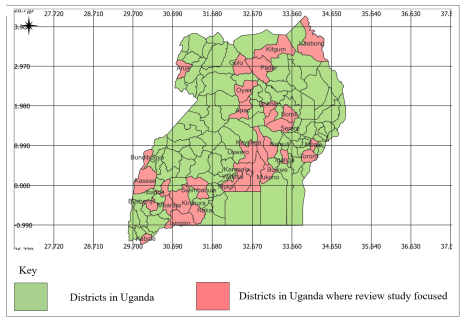
In the present systematic review, it is indicative that Ethnobotanical studies have been conducted in all the regions of Uganda. These regions are central, western, eastern, southern, west Nile, and northern regions of Uganda. The districts in these regions in which the studies were done were 32 in number and they included; Wakiso, Kampala, Bundibugyo, Soroti, Serere, Pader, Kitgum, Kaberamaido, Kaabong, Tororo, Buikwe, Mukono, Kayunga, Kamuli, Ssembabule, Kabale, Gulu, Mbarara, Isingiro, Bushenyi, Kasese, Rakai, Ibanda, Kiruhura, Mbale, Arua, Dokolo, Iganga, Luwero, Mpigi, Oyam, and Apac district. Based on this review, it is clear that majority of studies on medicinal plants have been conducted in western and central Uganda compared to other regions (Figure 2).
Figure 2. Map of Uganda showing regions where studies on medicinal tree species have been conducted from 1995 to 2023.
3.4. Parts Used on Medicinal Tree Species
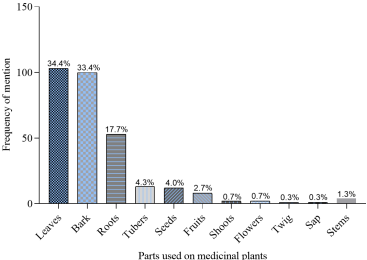
Diverse parts on medicinal plants were being used. Specifically, leaves (34.7%) were highly depended on (Figure 3). The bark (32.0%) (including stem and root bark) and roots (19.7%) were also commonly used. Additionally, other parts that were infrequently used included; stems, sap, twigs, flowers, shoots, fruits, seeds, and tubers.
Figure 3. Parts used on medicinal plants against their frequency of mention.
3.5. Mode of Administration and Preparation
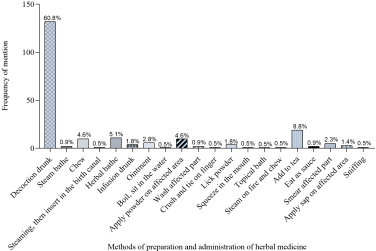
According to Figure 4, herbal medicines were mainly prepared as decoctions (60.8%) and as teas (8.8%). This was followed by herbal bathe (5.1%), applying powder of herbal medicine on the affected part (4.6%), and chewing (4.6%). The other methods of preparation and administration, such as steam bathe, sniffing, crushing and tying on the affected part, steaming on fire and chewing, and boiling, then sitting in the water were not frequently used (Table 2). During the preparation of the herbal medicine, some adjuncts such as milk and honey were added for different reasons.
Figure 4. Method of preparation and administration of herbal medicine against frequency of mention.
3.6. Diseases and Disease Symptoms Managed Using Medicine Tree Species
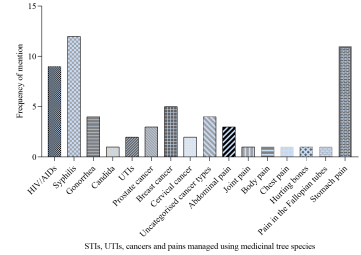
Over 60 diseases (including disease symptoms) (Table 1) were reported to be managed using medicinal tree species. These diseases and disease symptoms were grouped into different categories such as sexually transmitted infections (STIs), urinary tract infections (UTIs), cancers, lifestyle diseases, mental health illnesses, and digestive system related diseases and disorders, vector-borne diseases, respiratory related diseases, and skin infections. Animal bites and symptoms to some diseases were also reported. Most importantly, some tree species were being used to make herbal medicine used to cleanse blood in the body. Among the STIs, syphilis had the highest frequency of mention followed by HIV/ AIDs (Figure 5), implying that syphilis and HIV/ AIDs are some of the STIs that are prevalent in Uganda and mostly in rural communities thus forcing people to rely on herbal medicine. For cancer, breast cancer had the highest frequency of mention followed by prostate cancer and cervical cancer (Figure 5). Pain in the stomach, fallopian tube, chest, and joints was also reported with stomach pain topping among the pains (Figure 5).
Figure 5. STIs, UTIs, cancers, and pains managed using medicinal plants against their frequency of mention.
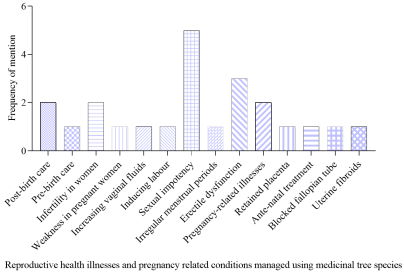
Several reproductive health illnesses were reported, and among these, sexual impotency was highly prevalent, followed by erectile dysfunction in men, and infertility in women (Figure 6). The findings also revealed that medicinal tree species were relied on to manage different pregnancy-related conditions but mostly for post-birth care and pregnancy-related illnesses (Figure 6).
Figure 6. Reproductive health illnesses and pregnancy-related conditions managed using medicinal plants against their frequency of mention.
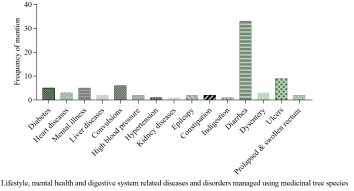
Diseases that are enhanced due to lifestyle were also reported and among these, diabetes had the highest frequency of mention (Figure 7). Among the digestive system diseases and disorders reported, diarrhea had the highest frequency of mention, followed by ulcers (Figure 7). Mental health related illnesses and brain disorders such as epilepsy were also reported.
Figure 7. Lifestyle, mental health, and digestive system-related diseases and disorders managed using medicinal plants against their frequency of mention.
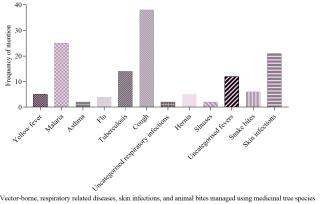
Vector-borne diseases were also reported to be managed using herbal medicine prepared from tree species, with malaria being the most frequently mentioned disease, followed by yellow fever (Figure 8). Respiratory-related diseases caused by viruses and bacteria were also being managed using herbal medicine, with cough having the highest frequency of mention followed by tuberculosis (Figure 8). Snake bites and skin infections were also being managed using herbal medicine from tree species.
Figure 8. Vector-borne, respiratory-related diseases, skin infections, and animal bites managed using medicinal plants against their frequency of mention.
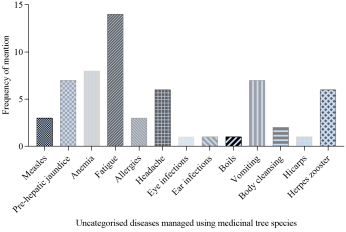
Figure 9. Uncategorized diseases managed using medicinal plants against their frequency of mention.
Some diseases managed using herbal medicine prepared from medicinal tree species were uncategorized as shown in Figure 9. Among these, fatigue was very common, followed by anemia, and pre-hepatic jaundice. Other diseases were also caused by viral infections; for example measles, herpes zoster, and flu.
4. Discussion
4.1. Common Plant Families Used to Manage Diseases in Uganda
The family with the most species was Fabaceae, followed by Euphorbiaceae, Rubiaceae, Myrtaceae, Meliaceae, and Moraceae. The plant family, Fabaceae had the most species and this finding has been reported in another study, which highlighted that this plant family was one of those with widely used by local indigenous communities of Mpanga and Mabira core forest reserves to treat diseases such as anemia, diarrhea, and cancer . Other similar studies also reported the same finding . Additionally, plant species under the Fabaceae family have been proven to be effective in treating a number of infectious disorders .
4.2. Plant Parts Used to Manage Different Diseases in Uganda
Diverse parts on medicinal plants used to treat and manage different ailments were revealed in the present review. Leaves were highly depended on followed by bark and roots. Stems, sap, twigs, flowers, shoots, fruits, seeds, and tubers were however infrequently used. This finding aligns with that of other studies which highlighted leaves as being the frequently used plant parts, whilst seeds and fruits were not commonly used . Similar findings have been described in Ethiopia and other African countries . Studies highlighting the choice for leaves consider that their frequent use is due to their abundance together with the high content of phytochemicals .
Additionally, the wide usage of leaves, flowers, roots, and bark is an extensive habit in Uganda as recorded in central parts of Uganda , southern parts of Uganda , western parts of Uganda , areas near Kibale National Park , and Mpigi in central Uganda . Similar practices have also been reported in different countries, such as Italy , Ethiopia , and in Tanzania . The frequent use of leaves can also be attributed to their high regeneration rate and, in most situations, does not result in the plant dying, allowing the same plant to be constantly employed for a considerable amount of time .
4.3. Mode of Preparation and Administration of Herbal Medicine from Trees
Findings of the present review revealed decoctions as the most common method of preparing herbal medicine. This finding is consistent with another study carried in some East African countries and the African regions at large, where decoction was the most rampant method used to prepare herbal medicine. Decoctions may be reckoned when the plant part used is easily accessible . Additionally, the extreme usage of water as a solvent is also linked to its availability . Therefore, water serving as a natural solvent fuels the immediate retrieval of bioactive compounds during herbal medicine preparation . Decoctions being the most mode of herbal medicine preparation may also be linked to the ease of preparation and administration for individuals using oral medications when compared to alternative routes of application and preparation options .
4.4. Diseases and Disease Symptoms Managed Using Medicinal Tree Species
Many diseases ranging from STIs, cancers, lifestyle diseases, mental health-related diseases, digestive system-related diseases, vector-borne diseases, respiratory system-related diseases, to skin infections, were being managed using herbal medicine from tree species. The high prevalence of syphilis followed by HIV/ AIDs calls for extensive measures to combat STIs. It is pivotal to highlight that syphilis is an important public health burden in low-income countries such as Uganda . Since women can also be infected with syphilis, untreated early syphilis especially in pregnant women, can result in perinatal death in up to 40% of cases .
HIV/ AIDs, which is also rampant in Uganda , continues to be another universal public health issue as it has caused 42.3 million deaths so far . Currently, STIs such as syphilis and HIV/ AIDs are likely to be on the rise in Uganda due to the cutting of financial aid provided by USAID to support HIV/ AIDs programs. This will in turn increase the harvesting of tree species that are known to be used to manage syphilis and HIV/ AIDs in Uganda.
For cancer, breast cancer having the highest frequency of mention followed by prostate cancer points out the increasing public health concerns posed by breast cancer and prostate cancer. This is because cancer is a major public health problem and is responsible for one in six deaths worldwide . Moreover, breast cancer and prostate cancer are among the top causes of deaths arising from cancer .
Reproductive health illnesses such as erectile dysfunction in men and infertility in women were also reported. This finding aligns with another study which reported that there are several reproductive ailments that local communities have been handling and treating . Reproductive health illnesses such as erectile dysfunction and infertility may be enhanced further by poverty . Other diseases such as hernia reported in this review are neglected and yet they occur universally and pose a significant public health burden . Epilepsy was among the neurological disorders (NDs) reported. It is alarming to report that such NDs are quite neglected in the modern healthcare systems . Other diseases that are of great interest and had very high frequencies of mention were malaria (Figure 8) and diarrhea (Figure 7).
Malaria has and continues to be a serious global health burden in Uganda . It remains the most important infectious disease globally, with about 214 million cases per year and over 438,000 deaths resulting from it . Moreover, it is not only a health hazard in Uganda, but also one of the causes of major financial constraints . There is thus a need for more effective approaches in Uganda to limit the distribution of malaria. As reported by this present study, the reliance on medicinal plants to manage malaria can be relied on, but this should be used alongside other malaria prevention methods. This will help to reduce the over-reliance on medicinal plants by people especially those who are far from modern healthcare facilities or can’t even afford the costs charged in modern healthcare facilities. Fever (Figure 8), fatigue, and headache (Figure 9) reported in this review might have been due to malaria outbreaks . Diarrhea, which was rampant based on the frequency of mention, accounts for more than 750,000 deaths in children under the age of 5 per year . It is also the second leading cause of death in this population .
4.5. Conservation Status of Medicinal Tree Species
Some of the tree species included in this review have been listed as threatened. For example, Milicia excelsa Welw. CC Berg as near threatened, Afrocarpus usambarensis (Pilg.) C.N.Page is listed as endangered. Prunus africana (Hook. f.) Kalkman and Vitellaria paradoxa CF Gaertn have also been listed as vulnerable in the wild. There is thus an urgent desire to ensure that much as these tree species are still relied on as sources of treatment and management of different diseases, their existence through cultivation and sustainable harvesting should be highly encouraged.
5. Limitations of the Study
There are many biases that arise while collecting ethnobotanical data, and these impact the reliability of research findings. For example, the reliance on limited studies which are also localized results into collection of a narrow segment of traditional medicine knowledge . Another common bias is recall bias, where informants describe medicinal plants based on memory instead of critical observation .
The review did not consider the phytochemistry and bioactivity of the 151 tree species. Furthermore, the review did not cover aspects of toxicity yet some of the tree species included in the review are toxic. For example, Warburgia ugandensis Sprague is highly cytotoxic to U87 cells , cytotoxic to intestinal epithelial cells IEC-6, with IC50 values < 50 μg/ml ; Albizia coriaria Welw. ex Oliv has minimal acute toxicity in mice, LD50 = 3.2 g/kg , is highly cytotoxic to U87 cells ; Erythrina abyssinica Lam has minimal toxicity on the liver, kidney, and hematopoietic tissue ; Tamarindus indica L. is cytotoxic to liver tumour cells ; Senna siamea (Lam.) H.S.Irwin & Barneby has alkaloids which are often toxic to man and may have dramatic physiological activities ; for Melia azedarach L., poisoning may occur which may further result in gastrointestinal, respiratory, cardiovascular, /neurological effects, and death in severe cases ; for Artocarpus heterophyllus Lam., low acute toxicity with zero lethality may occur; for Zanthoxylum chalybeum Engl., it has showed a high potent toxicity in Brine shrimp lethality assay .
6. Conclusions
Diverse tree species in Uganda have been used to treat and manage a number of ailments. This research puts forth that although a number of tree species are greatly being relied on for medicinal purposes, many other tree species with medicinal importance still remain undocumented and with this immeasurable ethnobotanical knowledge remaining in the hands of the ancestors. Some tree species are also being destroyed by anthropogenic activities. The study thus recommends thorough sustainable harvesting of these medicinal tree species.
Abbreviations

NDs

Neurological Disorders

STI

Sexually Transmitted Infections

UTI

Urinary Transmitted Infections

HIV/ AIDs

Human Immunodeficiency Virus/ Acquired Immunodeficiency Syndrome

Acknowledgments
The author thanks Simon Bbumba for the guidance during crafting of the review paper.
Author Contributions
Thomas James Wanyama: Conceptualization, Data curation, Formal Analysis, Methodology, Visualization, Writing – original draft, Writing – review & editing.
Funding
This work is not supported by any external funding.
Data Availability Statement
The data generated from the present study is within the manuscript.
Conflicts of Interest
The author declares no conflicts of interest.
References
[1] K. I. Umaru, E. S. Ugoeze, I. J. Umaru, C. Nanmar, A. A. Tensaba, and B. C. David, “Phytochemical Profiling, and Antifungal Potentials of Stem-Bark Extracts of East African (Khaya Anthotheca),” Asian J. Sci. Technol. Eng. Art, vol. 2, no. 3, pp. 418–435, 2024,
[2] I. J. Umaru, F. A. Badruddin, and H. A. Umaru, “Phytochemical, antifungal and antibacterial potential of Leptadenia hastata stem-bark extract,” MOJ Toxicol, vol. 4, no. 4, pp. 263–268, 2018,
[3] S. Asiimwe, A. Namutebi, A.-K. Borg-Karlson, M. K. Mugisha, E. K. Kakudidi, and O.-O. Hannington, “Documentation and consensus of indigenous knowledge on medicinal plants used by the local communities of western Uganda,” J. Nat. Prod. Plant Resour., vol. 4, no. 1, pp. 34–42, 2014.
[4] K. Senthilkumar, V. Aravindhan, and A. Rajendran, “Ethnobotanical survey of medicinal plants used by Malayali tribes in Yercaud hills of Eastern Ghats, India.,” 2013.
[5] J. Ngezahayo, F. Havyarimana, L. Hari, C. Stévigny, and P. Duez, “Medicinal plants used by Burundian traditional healers for the treatment of microbial diseases,” J. Ethnopharmacol., vol. 173, pp. 338–351, 2015,
[6] R. A. Kitula, “Use of medicinal plants for human health in Udzungwa Mountains Forests: a case study of New Dabaga Ulongambi Forest Reserve, Tanzania,” J. Ethnobiol. Ethnomed., vol. 3, pp. 1–4, 2007,
[7] J. Ngeywo, E. Basweti, and A. Shitandi, “Influence of gender, age, marital status and farm size on coffee production: a case of Kisii County, Kenya,” Asian J. Agric. Extension, Econ. Sociol., vol. 5, no. 3, pp. 117–125, 2015,
[8] M. M. Kamatenesi, A. Acipa, and H. Oryem-Origa, “Medicinal plants of Otwal and Ngai sub counties in Oyam district, Northern Uganda,” J. Ethnobiol. Ethnomed., vol. 7, pp. 1–14, 2011,
[9] R. A. Butler, “The top 10 most biodiverse countries,” Mongabay News, 2016.
[10] A. B. Katende, P. Ssegawa, A. Birnie, C. Holding, and B. Tengnäs, Wild food plants and mushrooms of Uganda. Regional Land Management Unit, RELMA/Sida, 1999.
[11] M. Kamatenesi-Mugisha and H. Oryem-Origa, “Medicinal plants used to induce labour during childbirth in western Uganda,” J. Ethnopharmacol., vol. 109, no. 1, pp. 1–9, 2007,
[12] M. J. Balunas and A. D. Kinghorn, “Drug discovery from medicinal plants,” Life Sci., vol. 78, no. 5, pp. 431–441, 2005,
[13] P. Ssegawa and J. M. Kasenene, “Medicinal plant diversity and uses in the Sango bay area, Southern Uganda,” J. Ethnopharmacol., vol. 113, no. 3, pp. 521–540, 2007,
[14] J. R. S. Tabuti, C. B. Kukunda, D. Kaweesi, and O. M. J. Kasilo, “Herbal medicine use in the districts of Nakapiripirit, Pallisa, Kanungu, and Mukono in Uganda.,” J. Ethnobiol. Ethnomed., vol. 8, p. 35, Sep. 2012,
[15] P. Tugume et al., “Ethnobotanical survey of medicinal plant species used by communities around Mabira Central Forest Reserve, Uganda,” J. Ethnobiol. Ethnomed., vol. 12, pp. 1–28, 2016,
[16] A. Ahrends et al., “Conservation and the botanist effect,” Biol. Conserv., vol. 144, no. 1, pp. 131–140, 2011,
[17] C. Muthu, M. Ayyanar, N. Raja, and S. Ignacimuthu, “Medicinal plants used by traditional healers in Kancheepuram District of Tamil Nadu, India,” J. Ethnobiol. Ethnomed., vol. 2, no. 1, pp. 1–10, 2006,
[18] E. Mwangi, P. Cerutti, and R. Nasi, “The current state of Eastern Africa’s forests,” Eur. Union, 2018.
[19] M. M. Adia et al., “Medicinal plants used in malaria treatment by Prometra herbalists in Uganda,” J. Ethnopharmacol., vol. 155, no. 1, pp. 580–588, 2014,
[20] T. Yamada et al., “Grow or die: A 49‐year growth history of a Japanese warm‐temperate tree species,” Ecosphere, vol. 15, no. 5, p. e4839, 2024,
[21] J. R. S. Tabuti et al., “Medicinal plants used for treatment of malaria by indigenous communities of Tororo District, Eastern Uganda,” Trop. Med. Health, vol. 51, no. 1, p. 34, 2023,
[22] M. Lamorde et al., “Medicinal plants used by traditional medicine practitioners for the treatment of HIV/AIDS and related conditions in Uganda,” J. Ethnopharmacol., vol. 130, no. 1, pp. 43–53, 2010,
[23] S. Asiimwe, M. Kamatenesi-Mugisha, A. Namutebi, A.-K. Borg-Karlsson, and P. Musiimenta, “Ethnobotanical study of nutri-medicinal plants used for the management of HIV/AIDS opportunistic ailments among the local communities of western Uganda.,” J. Ethnopharmacol., vol. 150, no. 2, pp. 639–648, Nov. 2013,
[24] M. Kamatenesi‐Mugisha, H. Oryem‐Origa, O. Odyek, and D. W. Makawiti, “Medicinal plants used in the treatment of fungal and bacterial infections in and around Queen Elizabeth Biosphere Reserve, western Uganda,” Afr. J. Ecol., vol. 46, pp. 90–97, 2008,
[25] G. Anywar, E. Kakudidi, R. Byamukama, J. Mukonzo, A. Schubert, and H. Oryem-Origa, “Indigenous traditional knowledge of medicinal plants used by herbalists in treating opportunistic infections among people living with HIV/AIDS in Uganda,” J. Ethnopharmacol., vol. 246, p. 112205, 2020,
[26] M. K. Mugisha, S. Asiimwe, A. Namutebi, A.-K. Borg-Karlson, and E. K. Kakudidi, “Ethnobotanical study of indigenous knowledge on medicinal and nutritious plants used to manage opportunistic infections associated with HIV/AIDS in western Uganda.,” J. Ethnopharmacol., vol. 155, no. 1, pp. 194–202, Aug. 2014,
[27] S. Lutoti, B. Kaggwa, P. F. Kamba, J. Mukonzo, C. D. Sesaazi, and E. Katuura, “Ethnobotanical Survey of Medicinal Plants Used in Breast Cancer Treatment by Traditional Health Practitioners in Central Uganda,” J. Multidiscip. Healthc., pp. 635–651, 2023,
[28] M. S. Kibuuka and G. Anywar, “Medicinal plant species used in the management of hernia by traditional medicine practitioners in central Uganda,” Ethnobot. Res. Appl., vol. 14, pp. 289–298, 2015,
[29] M. Kamatenesi-Mugisha and H. Oryem-Origa, “Traditional herbal remedies used in the management of sexual impotence and erectile dysfunction in western Uganda.” Afr. Health Sci., vol. 5, no. 1, pp. 40–49, Mar. 2005.
[30] P. Nalumansi, M. Kamatenesi-Mugisha, and G. Anywar, “Medicinal plants used in paediatric health care in namungalwe sub county, iganga district, Uganda,” Nov. J. Med. Biol. Sci., vol. 2, no. 3, pp. 1–14, 2014,
[31] K. Catherine, K. M. Mugisha, W. Bright, P. E. Ogwang, and I. Kahwa, “Documentation and Phytochemical Screening of Most Commonly used Nutri-Medicinal Plants by Pregnant Women in Kyeizooba, Bushenyi District, Western Uganda,” 2020.
[32] H. Oryem-Origa, E. K. Z. Kakudidi, A. B. Katande, and Z. R. Bukenya, “Preliminary ethnobotanical studies of the Rwenzori Mountain forest area in Bundibugyo district, Uganda,” Bothalia, vol. 25, no. 1, pp. 111–119, 1995,
[33] D. F. Okot, G. Anywar, J. Namukobe, and R. Byamukama, “Medicinal plants species used by herbalists in the treatment of snakebite envenomation in Uganda,” Trop. Med. Health, vol. 48, pp. 1–14, 2020,
[34] B. Akwongo et al., “In vitro antifungal activities of medicinal plants used for treatment of candidiasis in Pader district, Northern Uganda,” Trop. Med. Health, vol. 52, no. 1, p. 84, 2024,
[35] G. Anywar et al., “Medicinal plants used in the treatment and prevention of malaria in Cegere Sub-County, Northern Uganda,” 2015,
[36] J. Okello and P. Ssegawa, “Medicinal plants used by communities of Ngai Subcounty, Apac District, northern Uganda,” Afr. J. Ecol., vol. 45, pp. 76–83, 2007,
[37] S. Asiimwe, J. Namukobe, R. Byamukama, and B. Imalingat, “Ethnobotanical survey of medicinal plant species used by communities around Mabira and Mpanga Central Forest Reserves, Uganda,” Trop. Med. Health, vol. 49, no. 1, p. 52, 2021,
[38] G. Anywar, A. Ssegabo, J. Wanyama, and C. S. Weckerle, “A review of ethnoveterinary botanical medicines used in Uganda: Their phytochemistry, bioactivity and toxicity,” J. Ethnopharmacol., vol. 358, p. 120917, 2026,
[39] A. Maroyi, “A comparative study of medicinal plants used in rural areas of Namibia and Zimbabwe,” 2015.
[40] S. Maling et al., “Medicinal plants used by traditional medicine practitioners in treatment of alcohol-related disorders in Bushenyi District, southwestern Uganda,” Front. Pharmacol., vol. 15, p. 1407104, 2024,
[41] N. I. Mongalo and M. V Raletsena, “An Inventory of South African Medicinal Plants Used in the Management of Sexually Transmitted and Related Opportunistic Infections: An Appraisal and Some Scientific Evidence (1990–2020),” Plants, vol. 11, no. 23, p. 3241, 2022,
[42] K. Feyisa et al., “Medicinal plants traditionally used to treat human ailments in Ethiopia: A systematic review,” Phytomedicine Plus, vol. 4, no. 1, p. 100516, 2024,
[43] J. Nankaya, N. Gichuki, C. Lukhoba, and H. Balslev, “Medicinal plants of the Maasai of Kenya: a review,” Plants, vol. 9, no. 1, p. 44, 2019,
[44] J. Namukobe et al., “Traditional plants used for medicinal purposes by local communities around the Northern sector of Kibale National Park, Uganda,” J. Ethnopharmacol., vol. 136, no. 1, pp. 236–245, 2011,
[45] F. Schultz, G. Anywar, B. Wack, C. L. Quave, and L.-A. Garbe, “Ethnobotanical study of selected medicinal plants traditionally used in the rural Greater Mpigi region of Uganda,” J. Ethnopharmacol., vol. 256, p. 112742, 2020,
[46] J. Petelka, B. Plagg, I. Säumel, and S. Zerbe, “Traditional medicinal plants in South Tyrol (northern Italy, southern Alps): Biodiversity and use,” J. Ethnobiol. Ethnomed., vol. 16, pp. 1–15, 2020,
[47] A. Moges and Y. Moges, “Ethiopian common medicinal plants: their parts and uses in traditional medicine-ecology and quality control,” Plant Sci. Anat. Physiol. plants Cult. vivo Vitr., vol. 21, pp. 78–101, 2019,
[48] E. Amri and D. P. Kisangau, “Ethnomedicinal study of plants used in villages around Kimboza forest reserve in Morogoro, Tanzania,” J. Ethnobiol. Ethnomed., vol. 8, pp. 1–9, 2012,
[49] A. Kudamba et al., “Review of Herbal Medicinal Plants Used in the Management of Cancers in the East Africa Region from 2019 to 2023,” Integr. Cancer Ther., vol. 23, p. 15347354241235584, 2024,
[50] G. Alebie, B. Urga, and A. Worku, “Systematic review on traditional medicinal plants used for the treatment of malaria in Ethiopia: trends and perspectives,” Malar. J., vol. 16, pp. 1–13, 2017,
[51] H. Gumisiriza, E. A. Olet, P. Mukasa, J. B. Lejju, and T. Omara, “Ethnomedicinal plants used for malaria treatment in Rukungiri District, Western Uganda,” Trop. Med. Health, vol. 51, no. 1, p. 49, 2023,
[52] J. E. Ssenku et al., “Medicinal plant use, conservation, and the associated traditional knowledge in rural communities in Eastern Uganda,” Trop. Med. Health, vol. 50, no. 1, p. 39, 2022,
[53] M. E. Patton, J. R. Su, R. Nelson, H. Weinstock, and C. for D. C. and P. (CDC), “Primary and secondary syphilis—United States, 2005–2013,” MMWR Morb Mortal Wkly Rep, vol. 63, no. 18, pp. 402–406, 2014.
[54] G. P. Schmid, B. P. Stoner, S. Hawkes, and N. Broutet, “The need and plan for global elimination of congenital syphilis,” Sex. Transm. Dis., vol. 34, no. 7, pp. S5–S10, 2007,
[55] I. Kasirye, “HIV/AIDS sero‐prevalence and socio‐economic status: Evidence from Uganda,” African Dev. Rev., vol. 28, no. 3, pp. 304–318, 2016,
[56] WHO, “Data on the size of the HIV epidemic.” Accessed: Jan. 19, 2026. Available:
[57] R. Siegel, K. Miller, H. Fuchs, and A. Jemal, “Cancer Statistics, 2021,” CA. Cancer J. Clin., vol. 71, 2021,
[58] D. Debela et al., “New approaches and procedures for cancer treatment: Current perspectives,” SAGE open Med., vol. 9, p. 20503121211034370, 2021,
[59] P. Brennan and G. Davey-Smith, “Identifying novel causes of cancers to enhance cancer prevention: new strategies are needed,” JNCI J. Natl. Cancer Inst., vol. 114, no. 3, pp. 353–360, 2022,
[60] H. S. S. P. (HSSP), “Health Sector Strategic Plan 2000/2001–2004/2005. Ministry of Health, The Republic of Uganda.,” 2000.
[61] P. O. & I. K. Odula, “Groin hernia in Mulago Hospital, Kampala.,” East Cent. Africa J. Surg., vol. 9, no. 1, pp. 48–52, 2004.
[62] S. Asiimwe, G. U. Anywar, E. K. Kakudidi, and P. Tugume, “Medicinal Plants in Uganda as Potential Therapeutics against Neurological Disorders,” Med. Herbs Fungi Neurotox. vs. Neuroprotection, pp. 421–443, 2021,
[63] K. C. Mezieobi et al., “Economic burden of malaria on developing countries: A mini review,” Parasite Epidemiol. Control, vol. 30, p. e00435, 2025,
[64] WHO, “World Malaria Report,” Geneva, 2015.
[65] Y. Sanoussi, A. Y. Zounmenou, and M. Ametoglo, “Catastrophic health expenditure and household impoverishment in Togo,” J. Public health Res., vol. 12, no. 3, p. 22799036231197196, 2023,
[66] P. Chanda-Kapata, N. Kapata, and A. Zumla, “COVID-19 and malaria: A symptom screening challenge for malaria endemic countries,” Int. J. Infect. Dis., vol. 94, pp. 151–153, 2020,
[67] WHO, “Diarrhoeal disease.” Accessed: Jan. 19, 2026. [Online]. Available:
[68] J. R. S. Tabuti, C. B. Kukunda, and P. J. Waako, “Medicinal plants used by traditional medicine practitioners in the treatment of tuberculosis and related ailments in Uganda,” J. Ethnopharmacol., vol. 127, no. 1, pp. 130–136, 2010,
[69] A. B. Cunningham, Applied Ethnobotany: People, wild plant use and Conservation. London, UK: Dev S EartnScan, 2001.
[70] G. Anywar, “Ethnopharmacology, cytotoxicity, antiviral and immunomodulatory profiles of medicinal plant species used by herbalists in treating people living with HIV/AIDS in Uganda,” Makerere University, 2020.
[71] C. Anywar, G. U., Kakudidi, E., Oryem-Origa, H., Schubert, A., Jassoy, “Cytotoxicity of Medicinal Plant Species Used by Traditional Healers in Treating People Suffering From HIV/AIDS in Uganda,” Front. Toxicol, 2022,
[72] P. G. Mwitari, P. A. Ayeka, J. Ondicho, E. N. Matu, and C. C. Bii, “Antimicrobial activity and probable mechanisms of action of medicinal plants of Kenya: Withania somnifera, Warbugia ugandensis, Prunus africana and Plectrunthus barbatus,” PLoS One, vol. 8, no. 6, p. e65619, 2013,
[73] V. J. Omara, T., Kiprop, A. K., Kosgei, “Albizia coriaria Welw ex Oliver: a review of its ethnobotany, phytochemistry and ethnopharmacology,” Adv. Tradit. Med., vol. 23, pp. 631–646, 2023,
[74] G. Anywar, “Cytotoxicity Data for medicinal plants used by herbalists in treating people living with HIV/AIDS in Uganda,” 2022,
[75] S. B. Obakiro et al., “Traditional medicinal Uses, phytoconstituents, bioactivities, and toxicities of Erythrina abyssinica Lam. ex DC.(fabaceae): a systematic review,” Evidence‐Based Complement. Altern. Med., vol. 2021, no. 1, p. 5513484, 2021,
[76] I. Iskandar, F. Setiawan, L. D. Sasongko, and I. K. Adnyana, “Six-Month Chronic Toxicity Study of Tamarind Pulp (Tamarindus indica L.) Water Extract,” Scientia Pharmaceutica, vol. 85, no. 1. p. 10, 2017,
[77] M. G. Shelton, “Standardized senna in the management of constipation in the puerperium-a clinical trial,” South African Med. J., vol. 57, no. 3, pp. 78–80, 1980.
[78] D. H. Phua, W.-J. Tsai, J. Ger, J.-F. Deng, and C.-C. Yang, “Human Melia azedarach poisoning,” Clin. Toxicol., vol. 46, no. 10, pp. 1067–1070, 2008,
[79] L. M. Burci et al., “Acute and subacute (28 days) toxicity, hemolytic and cytotoxic effect of Artocarpus heterophyllus seed extracts,” Toxicol. Reports, vol. 6, pp. 1304–1308, 2019,
[80] S. Mguni, F. Mashinya, C. Khabo-Mmekoa, and L. J. Shai, “A review of Zanthoxylum chalybeum Engl: Ethnomedicinal uses, pharmacology, phytochemistry and toxicology,” J. Med. Plants Econ. Dev., vol. 7, no. 1, p. 202, 2023,
Cite This Article
  • APA Style

    Wanyama, T. J. (2026). A Review of Uganda’s Medicinal Tree Species as Sources of Potential Therapeutic Compounds for Disease Management. Journal of Diseases and Medicinal Plants, 12(1), 20-56. https://doi.org/10.11648/j.jdmp.20261201.13

    Copy | Download

    ACS Style

    Wanyama, T. J. A Review of Uganda’s Medicinal Tree Species as Sources of Potential Therapeutic Compounds for Disease Management. J. Dis. Med. Plants 2026, 12(1), 20-56. doi: 10.11648/j.jdmp.20261201.13

    Copy | Download

    AMA Style

    Wanyama TJ. A Review of Uganda’s Medicinal Tree Species as Sources of Potential Therapeutic Compounds for Disease Management. J Dis Med Plants. 2026;12(1):20-56. doi: 10.11648/j.jdmp.20261201.13

    Copy | Download

  • @article{10.11648/j.jdmp.20261201.13,
      author = {Thomas James Wanyama},
      title = {A Review of Uganda’s Medicinal Tree Species as Sources of Potential Therapeutic Compounds for Disease Management},
      journal = {Journal of Diseases and Medicinal Plants},
      volume = {12},
      number = {1},
      pages = {20-56},
      doi = {10.11648/j.jdmp.20261201.13},
      url = {https://doi.org/10.11648/j.jdmp.20261201.13},
      eprint = {https://article.sciencepublishinggroup.com/pdf/10.11648.j.jdmp.20261201.13},
      abstract = {Ethnomedicinal relevance: Medicinal plants are a source of many potent drugs since they possess diverse phytochemical compounds. Studies on different plant life forms are voluminous, except trees. No single study has been done on tree species used to manage diseases in different regions of Uganda from 1995 up to 2023. Aim of the study: This review aimed to compile tree species used to manage different diseases and disease symptoms in various areas in Uganda. Materials and methods: The review examined 20 studies with ethnobotanical surveys done in Uganda. Data extraction focused on plant families and species, plant parts used, preparation methods and routes of administration, and the region in Uganda where the ethnobotanical field surveys were conducted. Results: 151 tree species from 52 families were identified. Leaves (34.7%) were highly depended on followed by bark (32.0%) and roots (19.7%) were also commonly used. The majority of the herbal remedies were prepared by decoction and taken orally. In regard to disease management using medicinal tree species, the diseases that were prevalent and posing public health concerns were malaria, diarrhea, breast cancer, syphilis, HIV/ AIDs, ulcers, tuberculosis, and skin infections. Conclusion: Many tree species in Uganda are used to manage several ailments. However, other tree species with medicinal importance remain undocumented and yet some of them are being destroyed by anthropogenic activities. Efforts to ensure sustainable harvesting of these medicinal tree species are thus required.},
     year = {2026}
    }
    

    Copy | Download

  • TY  - JOUR
    T1  - A Review of Uganda’s Medicinal Tree Species as Sources of Potential Therapeutic Compounds for Disease Management
    AU  - Thomas James Wanyama
    Y1  - 2026/03/04
    PY  - 2026
    N1  - https://doi.org/10.11648/j.jdmp.20261201.13
    DO  - 10.11648/j.jdmp.20261201.13
    T2  - Journal of Diseases and Medicinal Plants
    JF  - Journal of Diseases and Medicinal Plants
    JO  - Journal of Diseases and Medicinal Plants
    SP  - 20
    EP  - 56
    PB  - Science Publishing Group
    SN  - 2469-8210
    UR  - https://doi.org/10.11648/j.jdmp.20261201.13
    AB  - Ethnomedicinal relevance: Medicinal plants are a source of many potent drugs since they possess diverse phytochemical compounds. Studies on different plant life forms are voluminous, except trees. No single study has been done on tree species used to manage diseases in different regions of Uganda from 1995 up to 2023. Aim of the study: This review aimed to compile tree species used to manage different diseases and disease symptoms in various areas in Uganda. Materials and methods: The review examined 20 studies with ethnobotanical surveys done in Uganda. Data extraction focused on plant families and species, plant parts used, preparation methods and routes of administration, and the region in Uganda where the ethnobotanical field surveys were conducted. Results: 151 tree species from 52 families were identified. Leaves (34.7%) were highly depended on followed by bark (32.0%) and roots (19.7%) were also commonly used. The majority of the herbal remedies were prepared by decoction and taken orally. In regard to disease management using medicinal tree species, the diseases that were prevalent and posing public health concerns were malaria, diarrhea, breast cancer, syphilis, HIV/ AIDs, ulcers, tuberculosis, and skin infections. Conclusion: Many tree species in Uganda are used to manage several ailments. However, other tree species with medicinal importance remain undocumented and yet some of them are being destroyed by anthropogenic activities. Efforts to ensure sustainable harvesting of these medicinal tree species are thus required.
    VL  - 12
    IS  - 1
    ER  - 

    Copy | Download

Author Information
  • Department of Plant Sciences, Microbiology & Biotechnology, Makerere University, Kampala, Uganda

    Biography: Thomas James Wanyama is a graduate student at Makerere University where he is currently pursuing a Master’s degree in ethnobotany (particularly herbal medicine development). As an upcoming researcher, Mr. Thomas has been engaged in international projects such as a project that focused on “Traditional Medicine in Transition”. Though still a student, Mr. Thomas works with the teaching staff of the Department of Plant Sciences, Microbiology, and Biotechnology, School of Biosciences, Makerere University, Uganda. Thomas James Wanyama has been awarded an offer by the Erasmus body to go for a mobility exchange program at the Nicolaus Copernicus University, Torun, Poland from 17th February 2026 to 2nd July 2026.

    Research Fields: ethnobotany, ethnomedicine, ethnopharmacology, data analysis, machine learning, deep learning.

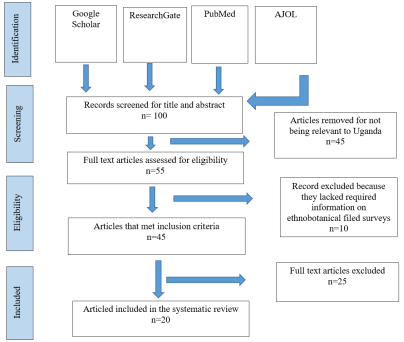
  • Abstract
  • Keywords
  • Document Sections

    1. 1. Introduction
    2. 2. Materials and Methods
    3. 3. Results
    4. 4. Discussion
    5. 5. Limitations of the Study
    6. 6. Conclusions
    Show Full Outline
  • Abbreviations
  • Acknowledgments
  • Author Contributions
  • Funding
  • Data Availability Statement
  • Conflicts of Interest
  • References
  • Cite This Article
  • Author Information