Research Article | | Peer-Reviewed

Emulsion-Based Transportation of Nigerian Heavy Oil Using Alkaline Oil-in-Water Emulsions

Received: 12 April 2026     Accepted: 22 April 2026     Published: 16 May 2026
Views:       Downloads:
Abstract

Nigerian heavy crude oil has substantial potential as a transportable energy resource, but its high viscosity creates major challenges for pipeline flow. This study evaluated oil-in-water emulsification as a viscosity-reduction strategy for Agbabu heavy crude oil using a full factorial design. Emulsions were prepared at two temperatures (25 and 75°C), two NaOH concentrations (0.07 and 0.10 M), and two NaCl salinities (1 and 4 wt%) at a fixed oil-to-water ratio of 65:35 by weight, with butanol used as a co-surfactant. The emulsions were pumped through a 3.20 m pilot-scale pipeline and assessed in terms of flow rate, velocity, pressure drop, Reynolds number, apparent viscosity, and oil recovery after thermal demulsification. The results showed that temperature was the dominant factor affecting transportability. The formulation prepared at 75°C with 0.10 M NaOH and 4 wt% NaCl produced the most stable emulsion, the highest flow rate, the lowest pressure drop, and the smallest oil loss after pumping. Lower-temperature formulations were less stable and displayed substantially higher losses. Overall, the study demonstrates that appropriately formulated alkaline oil-in-water emulsions can significantly improve the pipeline transport of Nigerian heavy oil and may reduce the pumping energy required for future field applications.

Published in Journal of Energy and Natural Resources (Volume 15, Issue 2)
DOI 10.11648/j.jenr.20261502.11
Page(s) 45-50
Creative Commons

This is an Open Access article, distributed under the terms of the Creative Commons Attribution 4.0 International License (http://creativecommons.org/licenses/by/4.0/), which permits unrestricted use, distribution and reproduction in any medium or format, provided the original work is properly cited.

Copyright

Copyright © The Author(s), 2026. Published by Science Publishing Group

Keywords

Heavy Crude Oil, Oil-In-Water Emulsion, Pipeline Transport, Viscosity Reduction, Alkaline Stabilizer

1. Introduction
Emulsion-based transportation has emerged as a promising strategy for handling the high viscosity and flow challenges associated with Nigerian heavy oil resources. Heavy crude oils, particularly those found in regions such as the Niger Delta, are characterized by high asphaltene content, and strong non-Newtonian behavior, which significantly hinder pipeline transport . These properties complicate conventional pipeline transportation, often necessitating energy-intensive thermal methods or the addition of costly diluents. Conventional methods such as thermal treatment and dilution with light hydrocarbons are often energy-intensive and economically burdensome, thereby necessitating alternative transport technologies. In this context, oil-in-water (O/W) emulsification has gained increasing attention as an effective viscosity reduction technique, where heavy crude is dispersed in a continuous aqueous phase to enhance flowability .
The principle underlying emulsion-based transport lies in interfacial science and rheological modification. By incorporating suitable surfactants or emulsifying agents, stable dispersions can be formed that minimize droplet coalescence and maintain flow assurance over long distances. This approach not only reduces pumping energy requirements but also mitigates issues such as pipeline fouling and wax deposition . Furthermore, advances in surfactant chemistry, including the development of green and biodegradable emulsifiers, have improved the environmental compatibility of these systems . For Nigerian heavy oils, which often exhibit complex compositions and variable physicochemical properties, tailored emulsion systems are required to ensure stability under fluctuating temperature, pressure, and shear conditions .
Recent studies have highlighted the economic and environmental advantages of emulsion transport over traditional methods. By significantly lowering apparent viscosity, emulsions reduce pumping energy requirements and enhance throughput efficiency . Unlike thermal upgrading or dilution, emulsion systems can be reversed at the destination through demulsification processes, allowing recovery of both oil and water phases with minimal loss . Furthermore, the use of locally sourced surfactants and water reduces dependency on imported diluents, aligning with sustainability goals and cost optimization strategies in Nigeria’s oil sector . Advances in nanotechnology and green chemistry have also contributed to the development of more efficient and environmentally benign emulsifiers, enhancing the feasibility of large-scale deployment .
Despite these advantages, several technical challenges remain. Emulsion stability must be sufficiently robust to withstand shear and temperature variations during transport, yet flexible enough to allow efficient breaking at processing facilities . Additionally, issues related to corrosion, microbial activity, and water management require integrated engineering solutions . Ongoing research is therefore focused on optimizing formulation parameters, understanding flow behavior under dynamic conditions, and integrating emulsion transport into existing infrastructure.
Nigeria’s oil sector underpins the national economy, and a significant share of the country’s in-place petroleum resources consists of heavy oil and bitumen. However, the high viscosity of these crudes makes pipeline transport difficult and costly. Conventional mitigation options such as heating, dilution, and upgrading are expensive, so alternative fluidification strategies remain important. One promising approach is the preparation of oil-in-water (O/W) emulsions, in which heavy-oil droplets are dispersed in water with the aid of surfactants and alkali.
Emulsions are dispersions of one immiscible liquid in another. Although they are thermodynamically unstable, properly designed systems can remain stable long enough for transport operations. Previous studies have shown that surfactants, alkali, and salt can reduce interfacial tension, improve droplet dispersion, and lower the apparent viscosity of heavy oils, thereby improving flow through pipelines . These studies also indicate that temperature, alkalinity, and salinity are key formulation variables because they influence droplet size, emulsion stability, and pressure drop.
The present study examined the emulsification and transport behavior of Agbabu heavy oil under a factorial design in which temperature, NaOH concentration, and NaCl salinity were varied systematically. The objective was to identify a formulation that produced a stable emulsion with low apparent viscosity, high flowability, and limited oil loss during pumping. Transport tests were carried out in a pilot-scale pipe loop, and the emulsion was thermally demulsified after pumping to quantify oil recovery.
2. Materials and Methods
2.1. Materials
The heavy crude oil used in this study was sourced from Agbabu field, Ondo State, Nigeria. The aqueous phase consisted of distilled water containing sodium hydroxide (NaOH) at 0.07 or 0.10 M, sodium chloride (NaCl) at 1 or 4 wt%, and butanol as a co-surfactant. The oil-to-water ratio was fixed at 65:35 by weight for all runs. Table 1 summarizes the eight formulation combinations tested.
Table 1. Emulsion formulation factorial combinations.

Run

Temperature (°C)

Heavy oil (%)

Water (%)

NaOH (M)

NaCl (wt%)

Butanol (mL)

1

25

65

35

0.07

1.0

106.25

2

25

65

35

0.07

4.0

106.25

3

25

65

35

0.10

1.0

106.25

4

25

65

35

0.10

4.0

106.25

5

75

65

35

0.07

1.0

106.25

6

75

65

35

0.07

4.0

106.25

7

75

65

35

0.10

1.0

106.25

8

75

65

35

0.10

4.0

106.25

Note: The oil-to-water ratio was kept constant so that the influence of temperature, alkalinity, and salinity could be evaluated directly.
2.2. Emulsion Preparation
For each run, 1.3 kg of heavy oil was placed in a 5-L glass reactor and heated to the target temperature (25 or 75°C). The pre-mixed aqueous solution of NaOH, NaCl, and butanol was then added to the oil. The mixture was emulsified by mechanical stirring at 1200 rpm for 15 min. Care was taken not to over-stir the mixture so that droplet breakup would not be excessive. Each prepared emulsion was transferred to a reservoir tank for subsequent pumping tests. A separate sample was retained for visual stability checks over several days.
2.3. Pipeline Flow Experiments
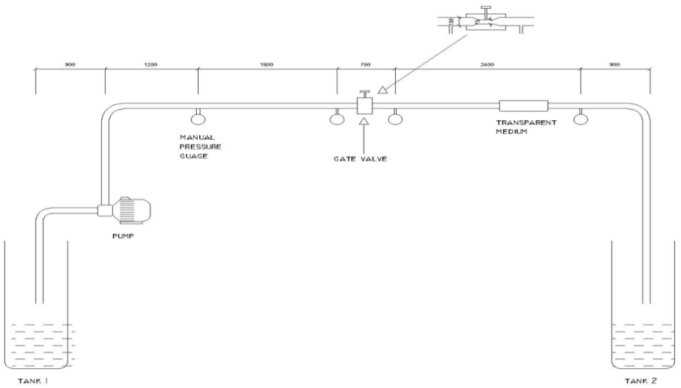
A stainless-steel horizontal pipe loop with a length of 3.20 m and an internal diameter of 1.77 cm was used for the transport tests. The setup included a gear-type centrifugal pump, inlet and outlet tanks, and pressure gauges placed along the pipeline. Each emulsion was pumped at constant power, and the volumetric flow rate was determined by measuring the volume collected at the outlet over a known time interval. Flow velocity, pressure drop, friction factor, Reynolds number, and head loss were calculated using standard pipe-flow relations.
Figure 1. Pilot-scale pipe system used for the emulsion transport experiments.
2.4. Oil Recovery Measurement
After each pumping test, the collected emulsion was thermally demulsified by heating it to approximately 80°C for 30 min. The separated oil was then measured to determine how much oil had been transported through the pipeline and how much had been lost during pumping. Oil recovery was expressed as the oil fraction recovered after demulsification relative to the original formulation.
3. Results
3.1. Emulsion Characteristics and Pumping Performance
All eight emulsions were successfully prepared, but their stability and flow performance varied noticeably with formulation. The transport data in Table 2 show that the highest pump performance was obtained for Run 8, which was prepared at 75°C with 0.10 M NaOH and 4 wt% NaCl. This run produced the highest flow rate and velocity, together with the lowest pressure drop. In contrast, the emulsions prepared at 25°C generally showed poorer stability, lower flowability, and higher apparent resistance to flow.
Table 2. Measured pipeline transport parameters for each emulsion.

Run

Vol. Pumped (×10^-3 m^3)

Time (s)

Flow Rate (m^3/s)

Velocity (m/s)

Δp (Pa)

Re (×10^3)

Apparent Viscosity (Pa·s)

1

34.47

10

7.96×10^-5

0.25

5.65×10^3

5.65

2.50×10^-3

2

13.79

6

1.37×10^-4

0.42

8.47×10^3

8.47

2.50×10^-3

3

20.68

8

9.95×10^-4

3.13

4.51×10^3

4.51

2.50×10^-3

4

10.34

5

1.59×10^-3

5.00

1.05×10^3

1.05

2.50×10^-3

5

24.13

8

9.95×10^-4

3.13

3.53×10^3

3.53

2.50×10^-3

6

11.72

5

1.59×10^-3

5.00

1.03×10^3

1.03

2.50×10^-3

7

22.75

6

1.38×10^-3

4.33

6.26×10^2

0.626

2.60×10^-3

8

13.79

3

2.76×10^-3

8.67

1.47×10^2

0.147

2.60×10^-3

Note: Δp is pressure drop; Re is Reynolds number. Apparent viscosity was back-calculated from the flow data.
The results also indicate that the high-temperature runs exhibited more favorable flow conditions overall. Run 8 gave the highest Reynolds number and the lowest pressure drop, suggesting that the emulsion remained highly mobile under pumping conditions. Although several runs operated in the turbulent-flow regime, their pressure losses were substantially higher than those of Run 8, which is consistent with differences in emulsion viscosity and stability.
3.2. Oil Transport and Recovery
Table 3 shows that the amount of emulsion transported through the pipe and the recovered oil fraction depended strongly on formulation. Runs prepared at 75°C, especially Runs 6 and 8, transported more than 90% of the emulsion volume and retained most of the oil after demulsification. By contrast, the lower-temperature formulations transported less of the emulsion and lost more oil during pumping.
Table 3. Emulsion throughput and oil recovery.

Run

Emulsion Transported (vol%)

Emulsion Transported (wt%)

Oil in Emulsion Before Pump (%)

Oil After Pump (%)

Oil Loss (%)

1

70.0

82.2

65.0

60.7

4.3

2

83.3

88.2

65.0

62.1

2.9

3

52.0

47.1

65.0

52.0

13.0

4

64.0

55.6

65.0

50.1

14.9

5

30.0

42.5

65.0

48.7

16.3

6

91.3

91.7

65.0

62.6

2.4

7

61.5

50.0

65.0

57.2

7.8

8

92.3

88.9

65.0

63.3

1.7

Note: Oil loss was calculated as the difference between the original oil fraction and the oil fraction recovered after demulsification.
Run 8 again performed best, with the smallest oil loss and the highest recovered oil fraction. The low losses recorded for Runs 6 and 8 show that the emulsions prepared at 75°C provided sufficient stability to carry the oil through the pipeline with minimal deposition. The poorer results obtained for Runs 3 to 5 show that emulsion instability at lower temperature can significantly reduce transport efficiency.
4. Discussion
4.1. Effect of Temperature
Temperature was the most influential parameter in this study. Increasing the emulsification temperature from 25 to 75°C led to lower pressure drop, higher flow rate, and improved oil recovery. This behavior is consistent with the idea that greater thermal energy enhances droplet dispersion and reduces the effective viscosity of the emulsion. The comparison between the low-temperature and high-temperature runs suggests that elevated temperature improved both the mobility and stability of the dispersed phase.
4.2. Effect of NaOH Concentration
Increasing NaOH concentration from 0.07 to 0.10 M generally improved emulsion stability, although the effect on viscosity was modest. At the higher temperature, the 0.10 M formulation produced the best overall performance when combined with 4 wt% NaCl. This indicates that alkali contributed to interfacial stabilization and helped maintain the integrity of the droplets during pumping.
4.3. Effect of NaCl Salinity
Raising NaCl from 1 to 4 wt% also improved stability, particularly under the 75°C condition. The saline aqueous phase likely promoted smaller droplets and stronger interfacial interactions, which reduced oil loss during transport. Although salinity can increase viscosity in some emulsion systems, the present data show that its stabilizing effect was beneficial under the conditions studied.
Overall, the trends observed here agree with earlier reports that chemically stabilized heavy-oil emulsions can lower pumping resistance and support pipeline transportation . The present study extends that knowledge to the Agbabu crude system and shows that a properly selected combination of temperature, alkali, and salinity can produce a transportable emulsion with limited oil loss.
5. Conclusions
Oil-in-water emulsions of Nigerian heavy oil were prepared under a factorial design involving temperature, NaOH concentration, and NaCl salinity. The study showed that the formulation prepared at 75°C with 0.10 M NaOH and 4 wt% NaCl gave the best overall performance. This emulsion exhibited the highest flow rate, the lowest pressure drop, the smallest oil loss, and the best transport efficiency in the pilot pipeline. The findings confirm that hot, alkaline oil-in-water emulsions can be an effective route for reducing the transport difficulty of Nigerian heavy oil and may lower the pumping energy required for future pipeline applications.
Abbreviations

O/W

Oil-in-Water

NaOH

Sodium Hydroxide

NaCl

Sodium Chloride

wt%

Weight Percent

M

Molarity (mol/L)

m

Meter

cm

Centimeter

mL

Milliliter

kg

Kilogram

rpm

Revolutions per Minute

s

Second

°C

Degrees Celsius

Δp

Pressure Drop

Re

Reynolds Number

Pa

Pascal

Pa·s

Pascal-second (Dynamic Viscosity)

m³/s

Cubic Meters per Second (Flow Rate)

m/s

Meters per Second (Velocity)

ORCID

Open Researcher and Contributor ID

Acknowledgments
The authors acknowledge the support of the Department of Chemical Engineering, Obafemi Awolowo University.
Author Contributions
Bayonle Tolani Ademodi: Conceptualization, Supervision, Resources, Writing – review & editing
Adebayo Bamidele Olanrewaju: Investigation, Methodology, Formal Analysis, Writing – original draft
Conflicts of Interest
The authors declare that they have no conflicts of interest.
References
[1] Abdulrahman, M. A., Sanni, S. E., & Peters, E. J. (2023). Pipeline transport of viscous crude oils using emulsification techniques. Journal of Pipeline Science and Engineering, 2(1), 45–58.
[2] Adewuyi, A. O., Salami, L. A., & Okonkwo, C. C. (2023). Emulsion flow behavior of Nigerian heavy crude in pipeline systems. Journal of Petroleum Science and Engineering, 223, 111589.
[3] Bello, M. T., Akinlade, O. O., & Yusuf, R. O. (2024). Surfactant-enhanced viscosity reduction in heavy oil transportation. Energy Reports, 10, 245–256.
[4] Chen, X., Li, Y., & Wang, Z. (2024). Advances in oil-in-water emulsions for heavy oil transport. Chemical Engineering Journal, 468, 143512.
[5] Eze, P. N., Okafor, I. S., & Chukwu, G. N. (2024). Demulsification strategies for crude oil recovery in emulsion transport systems. Fuel Processing Technology, 245, 107689.
[6] Garcia, M. C., Torres, D. F., & Lopez, R. (2023). Flow assurance challenges in heavy crude oil pipelines. Energy & Fuels, 37(5), 3890–3902.
[7] Ibrahim, H. K., Musa, U. M., & Lawal, S. A. (2025). Rheological characterization of Nigerian heavy crude emulsions under varying flow conditions. Journal of Energy Resources Technology, 147(2), 023001.
[8] Kumar, R., Singh, P., & Mohanty, K. K. (2024). Emulsion-based viscosity reduction techniques for heavy oil. Fuel, 350, 128756.
[9] Liang, J., Zhou, H., & Sun, Q. (2025). Green surfactants for crude oil emulsification and transport. Journal of Cleaner Production, 412, 137389.
[10] Nwachukwu, C. E., Udeh, C. F., & Okoye, N. E. (2024). Corrosion and microbial challenges in oil-water emulsion pipelines. Corrosion Science, 216, 111012.
[11] Ogunleye, O. O., Ajayi, T. O., & Oladipo, A. A. (2023). Sustainable approaches to heavy crude oil transportation in Nigeria. Sustainable Energy Technologies and Assessments, 57, 103214.
[12] Okolie, J. A., & Zhang, L. (2023). Interfacial properties and stability of crude oil emulsions: A review. Colloids and Surfaces A: Physicochemical and Engineering Aspects, 656, 130427.
[13] Onoja, E. O., Ibrahim, J. S., & Bala, A. (2023). Characterization of Nigerian heavy crude oils for flow improvement studies. Petroleum Research, 8(3), 210–219.
[14] Yakubu, M. L., Danjuma, G. G., & Abdullahi, B. (2025). Nanoparticle-assisted emulsification of heavy crude oil for improved transport efficiency. Nanotechnology for Environmental Engineering, 10(1), 15.
[15] Zhang, T., Liu, H., & Chen, S. (2024). Stability mechanisms of oil-water emulsions in pipeline transport. Langmuir, 40(12), 4567–4578.
Cite This Article
  • APA Style

    Ademodi, B. T., Olanrewaju, A. B. (2026). Emulsion-Based Transportation of Nigerian Heavy Oil Using Alkaline Oil-in-Water Emulsions. Journal of Energy and Natural Resources, 15(2), 45-50. https://doi.org/10.11648/j.jenr.20261502.11

    Copy | Download

    ACS Style

    Ademodi, B. T.; Olanrewaju, A. B. Emulsion-Based Transportation of Nigerian Heavy Oil Using Alkaline Oil-in-Water Emulsions. J. Energy Nat. Resour. 2026, 15(2), 45-50. doi: 10.11648/j.jenr.20261502.11

    Copy | Download

    AMA Style

    Ademodi BT, Olanrewaju AB. Emulsion-Based Transportation of Nigerian Heavy Oil Using Alkaline Oil-in-Water Emulsions. J Energy Nat Resour. 2026;15(2):45-50. doi: 10.11648/j.jenr.20261502.11

    Copy | Download

  • @article{10.11648/j.jenr.20261502.11,
      author = {Bayonle Tolani Ademodi and Adebayo Bamidele Olanrewaju},
      title = {Emulsion-Based Transportation of Nigerian Heavy Oil Using Alkaline Oil-in-Water Emulsions},
      journal = {Journal of Energy and Natural Resources},
      volume = {15},
      number = {2},
      pages = {45-50},
      doi = {10.11648/j.jenr.20261502.11},
      url = {https://doi.org/10.11648/j.jenr.20261502.11},
      eprint = {https://article.sciencepublishinggroup.com/pdf/10.11648.j.jenr.20261502.11},
      abstract = {Nigerian heavy crude oil has substantial potential as a transportable energy resource, but its high viscosity creates major challenges for pipeline flow. This study evaluated oil-in-water emulsification as a viscosity-reduction strategy for Agbabu heavy crude oil using a full factorial design. Emulsions were prepared at two temperatures (25 and 75°C), two NaOH concentrations (0.07 and 0.10 M), and two NaCl salinities (1 and 4 wt%) at a fixed oil-to-water ratio of 65:35 by weight, with butanol used as a co-surfactant. The emulsions were pumped through a 3.20 m pilot-scale pipeline and assessed in terms of flow rate, velocity, pressure drop, Reynolds number, apparent viscosity, and oil recovery after thermal demulsification. The results showed that temperature was the dominant factor affecting transportability. The formulation prepared at 75°C with 0.10 M NaOH and 4 wt% NaCl produced the most stable emulsion, the highest flow rate, the lowest pressure drop, and the smallest oil loss after pumping. Lower-temperature formulations were less stable and displayed substantially higher losses. Overall, the study demonstrates that appropriately formulated alkaline oil-in-water emulsions can significantly improve the pipeline transport of Nigerian heavy oil and may reduce the pumping energy required for future field applications.},
     year = {2026}
    }
    

    Copy | Download

  • TY  - JOUR
    T1  - Emulsion-Based Transportation of Nigerian Heavy Oil Using Alkaline Oil-in-Water Emulsions
    AU  - Bayonle Tolani Ademodi
    AU  - Adebayo Bamidele Olanrewaju
    Y1  - 2026/05/16
    PY  - 2026
    N1  - https://doi.org/10.11648/j.jenr.20261502.11
    DO  - 10.11648/j.jenr.20261502.11
    T2  - Journal of Energy and Natural Resources
    JF  - Journal of Energy and Natural Resources
    JO  - Journal of Energy and Natural Resources
    SP  - 45
    EP  - 50
    PB  - Science Publishing Group
    SN  - 2330-7404
    UR  - https://doi.org/10.11648/j.jenr.20261502.11
    AB  - Nigerian heavy crude oil has substantial potential as a transportable energy resource, but its high viscosity creates major challenges for pipeline flow. This study evaluated oil-in-water emulsification as a viscosity-reduction strategy for Agbabu heavy crude oil using a full factorial design. Emulsions were prepared at two temperatures (25 and 75°C), two NaOH concentrations (0.07 and 0.10 M), and two NaCl salinities (1 and 4 wt%) at a fixed oil-to-water ratio of 65:35 by weight, with butanol used as a co-surfactant. The emulsions were pumped through a 3.20 m pilot-scale pipeline and assessed in terms of flow rate, velocity, pressure drop, Reynolds number, apparent viscosity, and oil recovery after thermal demulsification. The results showed that temperature was the dominant factor affecting transportability. The formulation prepared at 75°C with 0.10 M NaOH and 4 wt% NaCl produced the most stable emulsion, the highest flow rate, the lowest pressure drop, and the smallest oil loss after pumping. Lower-temperature formulations were less stable and displayed substantially higher losses. Overall, the study demonstrates that appropriately formulated alkaline oil-in-water emulsions can significantly improve the pipeline transport of Nigerian heavy oil and may reduce the pumping energy required for future field applications.
    VL  - 15
    IS  - 2
    ER  - 

    Copy | Download

Author Information
  • Department of Chemical Engineering, Obafemi Awolowo University, Ile-Ife, Nigeria

  • Department of Chemical Engineering, University of Lagos, Lagos, Nigeria

  • Abstract
  • Keywords
  • Document Sections

    1. 1. Introduction
    2. 2. Materials and Methods
    3. 3. Results
    4. 4. Discussion
    5. 5. Conclusions
    Show Full Outline
  • Abbreviations
  • Acknowledgments
  • Author Contributions
  • Conflicts of Interest
  • References
  • Cite This Article
  • Author Information