Background: Childhood vaccination is one of the most effective public health interventions for preventing infectious diseases and reducing infant morbidity and mortality. Despite the availability of national immunization programs, incomplete or delayed vaccination schedules remain a major challenge, particularly in low-resource settings. Parental misconceptions, vaccine hesitancy, limited access to healthcare services, and socioeconomic factors contribute to poor vaccination adherence. Objective: To determine the level of adherence to the vaccination schedule among children younger than one year of age. Materials and Methods: A descriptive, observational, cross-sectional, prospective study was conducted. Vaccination records from 260 children under one year of age were reviewed to evaluate adherence to the national immunization schedule. Vaccination status was classified according to predefined adherence categories based on the completeness and timeliness of the recommended vaccines. Results: Among the 260 children included, 141 (54.2%) demonstrated significant non-adherence to the vaccination schedule, whereas 119 (45.8%) showed poor adherence. Overall, adherence to the recommended immunization schedule was below expected levels. Conclusions: Adherence to the vaccination schedule among children younger than one year was insufficient. These findings highlight the need to strengthen educational interventions for parents, improve access to vaccination services, and implement strategies that promote timely childhood immunization in primary healthcare settings.
This is an Open Access article, distributed under the terms of the Creative Commons Attribution 4.0 International License (http://creativecommons.org/licenses/by/4.0/), which permits unrestricted use, distribution and reproduction in any medium or format, provided the original work is properly cited.
Vaccination is one of the most effective and cost-efficient public health interventions for preventing infectious diseases, reducing childhood morbidity and mortality, and improving life expectancy worldwide. Vaccines stimulate the immune system to develop protective immunity against specific pathogens, thereby decreasing the severity of disease and preventing outbreaks of vaccine-preventable illnesses such as poliomyelitis, measles, pertussis, and diphtheria
[1]
World Health Organization. Immunization Agenda 2030: A Global Strategy to Leave No One Behind. 2020.
[1]
.
According to the World Health Organization (WHO), routine childhood immunization prevents approximately 3.5 to 5 million deaths each year from diseases including diphtheria, tetanus, pertussis, influenza, and measles
[2]
Centers for Disease Control and Prevention. General Best Practice Guidelines for Immunization (2023 update).
[2]
. Nevertheless, vaccination coverage declined in several countries during and after the COVID-19 pandemic, leaving millions of children at increased risk for vaccine-preventable diseases
[3]
WHO & UNICEF. Progress and Challenges with Global Immunization Coverage. 2023–2024.
[3]
. These declines have highlighted the importance of strengthening immunization programs and ensuring timely completion of recommended vaccination schedules.
Several studies have identified multiple factors associated with incomplete vaccination schedules. These include parental vaccine hesitancy, misinformation regarding vaccine safety, concerns about adverse events, limited knowledge of immunization schedules, socioeconomic inequalities, barriers to healthcare access, and missed opportunities for vaccination during healthcare visits
[4]
CDC. General Best Practice Guidelines for Immunization. Updated 2023.
[5]
UNICEF. The State of the World's Children 2023.
[6]
World Health Organization. Immunization Agenda 2030 (2020).
[7]
UNICEF & WHO. Progress and Challenges with Immunization Coverage (WUENIC 2023/2024).
[4-7]
. Although most post-vaccination adverse events are mild and self-limiting, misconceptions about vaccine safety continue to influence parental decision-making and reduce vaccine acceptance.
Primary healthcare plays a fundamental role in improving vaccination coverage. Family physicians and primary care professionals are responsible not only for disease treatment but also for preventive care through health education, identification of risk factors, and promotion of timely immunization. Effective communication between healthcare professionals and parents is essential to address concerns, improve vaccine confidence, and increase adherence to national immunization schedules
[8]
Shenton LM, Wagner AL, Carlson BF, Mubarak MY, Boulton ML. Vaccination status of children aged 1–4 years in Afghanistan and associated factors, 2015. Vaccine. 2018; 36(34): 5141–9.
[8]
.
Although numerous international studies have evaluated childhood vaccination coverage, information regarding adherence to vaccination schedules in children younger than one year remains limited in several regions of Mexico. Understanding the local magnitude of incomplete vaccination is essential for designing targeted interventions aimed at improving immunization coverage and reducing the burden of vaccine-preventable diseases.
Therefore, the aim of the present study was to determine the level of adherence to the vaccination schedule among children younger than one year of age attending a primary healthcare facility.
Vaccination adherence was classified according to the national immunization schedule. Complete adherence was defined as receiving all age-appropriate vaccines within the recommended time frame. Poor adherence was defined as the omission or delayed administration of one or more recommended vaccines, whereas significant non-adherence referred to multiple missed or delayed vaccines according to the established schedule
[9]
Nozaki I, Hachiya M, Kitamura T. Factors influencing basic vaccination coverage in Myanmar: Secondary analysis of 2015 Myanmar demographic and health survey data. BMC Public Health. 2019; 19(1): 1–8.
[9]
. Data were independently reviewed by two investigators, and discrepancies were resolved by consensus to ensure data accuracy.
The present study demonstrated that adherence to the childhood vaccination schedule among children younger than one year was lower than expected, with more than half of the participants presenting significant non-adherence. These findings underscore the need to strengthen immunization strategies within primary healthcare.
Educational interventions aimed at parents and caregivers, improved communication regarding vaccine safety, reminder systems, and enhanced access to vaccination services could contribute to increasing timely vaccine uptake
[13]
Ogbuanu IU, Li AJ, Anya B philomene M, Tamadji M, Chirwa G, Chiwaya KW, et al. Can vaccination coverage be mproved by reducing missed opportunities for vaccination?
[13]
. Healthcare professionals should actively identify children with incomplete vaccination schedules and implement catch-up vaccination strategies whenever appropriate.
The results of this study provide valuable local evidence regarding childhood vaccination adherence and may assist health authorities in designing targeted public health interventions to improve vaccination coverage and reduce the risk of vaccine-preventable diseases in vulnerable pediatric populations.
Objectives:
Identify the level of compliance with the vaccination schedule in children under 1 year.
2. Materials and Methods
A descriptive, observational, cross-sectional and prospective study was conducted from May to August 2024 in the Family Medicine Unit No. 73. Sampling was carried out for convenience, including 260 children under 1 year of age of both sexes in the vaccination records; assigned to UMF No. 73 from the calculation by estimating proportions in a finite population with 95% reliability and 5% margin of error based on the prevalence of 86% described by the National Center for Child and Adolescent Health (CNSIA)
[5]
UNICEF. The State of the World's Children 2023.
[5]
. Those whose parents refused to participate were excluded by signing informed consent. Data were collected such as age, sex and the reasons why their children had not been vaccinated; this was done in order to develop a database that could be used for statistical analysis of the variables.
measles at 12 months of age; 2) Partially vaccinated: children who received at least one but not all recommended vaccines before the age of 12 months and; 3) Unvaccinated: children who did not receive any of the recommended vaccines before the age of 12 months.
The statistical analysis was descriptive and the results were expressed in frequencies, percentages, averages, modes and medians using the IBM SPSS Statistics version 26 statistical program. The development of this research project was previously authorized by the Local Committee for Research 3005 and Ethics in Health Research 3005 of the Mexican Institute of Social Security in Poza rica Veracruz. This study and the procedures for carrying it out were in accordance with existing national and international ethical standards, the rules of the General Health Law on health research, and the Declaration of Helsinki made at the World Medical Assembly and its latest amendment.
3. Results
260 participants were included during the study period. 59.6% represent the male generation, while 40.4% represent the female generation where the distribution by age group was 170 participants (65.3%) in the range of 0 to 6 months and 90 (34.6%) from 6-12 months, with an average of 1.35 1.35 months.
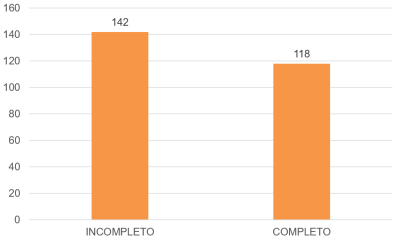
When reviewing the national health card, it was identified that 141 (54.2%) had significant non-compliance, while 119 (45.7%) showed poor compliance (Figure 1). It was also found that the vaccines with fewer applications were conjugated pneumococcal (n=2, 0.7%), BCG and hexavalent (n=16, 6.5%, each respectively).
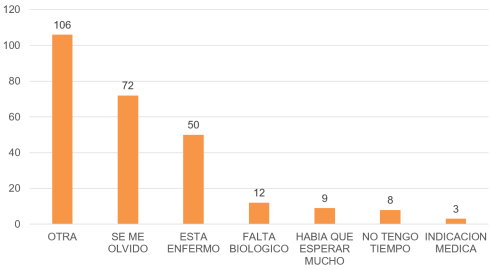
As to the reason why the child was not vaccinated, it was reported that 34.2% (n=89) go to the medical unit for another reason, 9.2% (n=12) due to lack of biological, 6.9% (n=9) due to waiting for the arrival of vaccines, 6.2% (n=8) who could not wait for the application and 3.8% (n=5) because you are sick at the time of vaccination (Figure 2).
Vaccination and vaccine resistance among high-income, highly educated people has become an important public health issue in several countries
[6]
World Health Organization. Immunization Agenda 2030 (2020).
[6]
. Although in highly developed countries, many sociodemographic characteristics are linked to vaccination coverage: having a single mother, a young mother, having a large number of siblings and living in multiple households. However, when indicators of parents' socio-economic status are considered, such as level of education, household income, employment status, the results are inconsistent
[7]
UNICEF & WHO. Progress and Challenges with Immunization Coverage (WUENIC 2023/2024).
[7]
. vaccination also affects, due to concerns about the possible interference or manipulation of commercial interests in it, which compromises the possibility of eliciting well-founded public policies from discussions with the population
[10]
Nadjib AM, Attoh-Touré H, Abdel-Mahamoud A, Baron S, Brunet-Houdard S, Rusch E, et al. Knowledge, attitudes and practices of parents on vaccination against polio in Abeche-Tchad. Pan Afr Med J. 2018; 31: 1–12.
[10]
. A review by Rainey in 2011 identified from 202 relevant articles, we summarized 838 reasons associated with sub-vaccination; 379 (45%) were related to immunization systems, 220 (26%) with family characteristics, 181 (22%) with parental attitudes and knowledge, and 58 (7%) with limitations in communication and information related to immunization. Of the 19 reasons taken from 11 identified articles describing the unvaccinated child, 6 (32%) were related to immunization systems, 8 (42%) to parental attitudes and knowledge, 4 21%) to family characteristics and 1 (5%) to communication and information
[11]
Riaz A, Husain S, Yousafzai MT, Nisar I, Shaheen F, Mahesar W, et al. Reasons for non-vaccination and incomplete vaccinations among children in Pakistan. Vaccine. 2018; 36(35): 5288–93.
[11]
. Recently, non-socio-demographic problems on the demand side, such as awareness of the need and timing of routine childhood vaccinations, fears about some or all routine vaccinations and parents' beliefs regarding false contraindications to routine vaccinations have been reported as reasons linked to vaccination and non-vaccination of children
[12]
Hu Y, Wang Y, Chen Y, Liang H, Chen Z. Measles vaccination coverage, determinants of delayed vaccination and reasons for non-vaccination among children aged 24-35 months in Zhejiang province, China. BMC Public Health. 2018; 18(1): 1–8.
[12]
. included small groups or used secondary data, were carried out in areas with low vaccination coverage and found that low coverage was mainly related to inequity
[13]
Ogbuanu IU, Li AJ, Anya B philomene M, Tamadji M, Chirwa G, Chiwaya KW, et al. Can vaccination coverage be mproved by reducing missed opportunities for vaccination?
[13]
.
The limitations of the current study to be considered were the descriptive methodological approach and a smaller sample size. Neither are follow-up strategies or interventions evaluated on the study group, in order to assess the impact on knowledge and awareness about vaccination.
5. Conclusions
The importance of identifying non-compliance lies in the fact that when it is detected, actions can be carried out and training given to staff and the general population in order to comply with preventive care.
The level of compliance with the vaccination scheme for children under one year in UMF 73, Poza Rica, Veracruz, is poor, with a 54.2% non-compliance rate. In the present case, factors and barriers to using available vaccination services were the causes observed for non-vaccination.
Abbreviations
UMF
Unidad de Medicina Familiar
Author Contributions
Mejia Belloso Isabel Teresa De La Chiquinquira: Conceptualization, Formal Analysis, Investigation, Methodology, Project administration, Writing – original draft
World Health Organization. Immunization Agenda 2030: A Global Strategy to Leave No One Behind. 2020.
[2]
Centers for Disease Control and Prevention. General Best Practice Guidelines for Immunization (2023 update).
[3]
WHO & UNICEF. Progress and Challenges with Global Immunization Coverage. 2023–2024.
[4]
CDC. General Best Practice Guidelines for Immunization. Updated 2023.
[5]
UNICEF. The State of the World's Children 2023.
[6]
World Health Organization. Immunization Agenda 2030 (2020).
[7]
UNICEF & WHO. Progress and Challenges with Immunization Coverage (WUENIC 2023/2024).
[8]
Shenton LM, Wagner AL, Carlson BF, Mubarak MY, Boulton ML. Vaccination status of children aged 1–4 years in Afghanistan and associated factors, 2015. Vaccine. 2018; 36(34): 5141–9.
[9]
Nozaki I, Hachiya M, Kitamura T. Factors influencing basic vaccination coverage in Myanmar: Secondary analysis of 2015 Myanmar demographic and health survey data. BMC Public Health. 2019; 19(1): 1–8.
[10]
Nadjib AM, Attoh-Touré H, Abdel-Mahamoud A, Baron S, Brunet-Houdard S, Rusch E, et al. Knowledge, attitudes and practices of parents on vaccination against polio in Abeche-Tchad. Pan Afr Med J. 2018; 31: 1–12.
[11]
Riaz A, Husain S, Yousafzai MT, Nisar I, Shaheen F, Mahesar W, et al. Reasons for non-vaccination and incomplete vaccinations among children in Pakistan. Vaccine. 2018; 36(35): 5288–93.
[12]
Hu Y, Wang Y, Chen Y, Liang H, Chen Z. Measles vaccination coverage, determinants of delayed vaccination and reasons for non-vaccination among children aged 24-35 months in Zhejiang province, China. BMC Public Health. 2018; 18(1): 1–8.
[13]
Ogbuanu IU, Li AJ, Anya B philomene M, Tamadji M, Chirwa G, Chiwaya KW, et al. Can vaccination coverage be mproved by reducing missed opportunities for vaccination?
Chiquinquira, M. B. I. T. D. L., Alberto, P. S. E. (2026). Level of Compliance with the Vaccination Scheme in Children Under 1 Year. Journal of Family Medicine and Health Care, 12(3), 55-58. https://doi.org/10.11648/j.jfmhc.20261203.12
Chiquinquira, M. B. I. T. D. L.; Alberto, P. S. E. Level of Compliance with the Vaccination Scheme in Children Under 1 Year. J. Fam. Med. Health Care2026, 12(3), 55-58. doi: 10.11648/j.jfmhc.20261203.12
Chiquinquira MBITDL, Alberto PSE. Level of Compliance with the Vaccination Scheme in Children Under 1 Year. J Fam Med Health Care. 2026;12(3):55-58. doi: 10.11648/j.jfmhc.20261203.12
@article{10.11648/j.jfmhc.20261203.12,
  author = {Mejia Belloso Isabel Teresa De La Chiquinquira and Pina Salguero Elias Alberto},
  title = {Level of Compliance with the Vaccination Scheme in Children Under 1 Year},
  journal = {Journal of Family Medicine and Health Care},
  volume = {12},
  number = {3},
  pages = {55-58},
  doi = {10.11648/j.jfmhc.20261203.12},
  url = {https://doi.org/10.11648/j.jfmhc.20261203.12},
  eprint = {https://article.sciencepublishinggroup.com/pdf/10.11648.j.jfmhc.20261203.12},
  abstract = {Background: Childhood vaccination is one of the most effective public health interventions for preventing infectious diseases and reducing infant morbidity and mortality. Despite the availability of national immunization programs, incomplete or delayed vaccination schedules remain a major challenge, particularly in low-resource settings. Parental misconceptions, vaccine hesitancy, limited access to healthcare services, and socioeconomic factors contribute to poor vaccination adherence. Objective: To determine the level of adherence to the vaccination schedule among children younger than one year of age. Materials and Methods: A descriptive, observational, cross-sectional, prospective study was conducted. Vaccination records from 260 children under one year of age were reviewed to evaluate adherence to the national immunization schedule. Vaccination status was classified according to predefined adherence categories based on the completeness and timeliness of the recommended vaccines. Results: Among the 260 children included, 141 (54.2%) demonstrated significant non-adherence to the vaccination schedule, whereas 119 (45.8%) showed poor adherence. Overall, adherence to the recommended immunization schedule was below expected levels. Conclusions: Adherence to the vaccination schedule among children younger than one year was insufficient. These findings highlight the need to strengthen educational interventions for parents, improve access to vaccination services, and implement strategies that promote timely childhood immunization in primary healthcare settings.},
 year = {2026}
}
TY  - JOUR
T1  - Level of Compliance with the Vaccination Scheme in Children Under 1 Year
AU  - Mejia Belloso Isabel Teresa De La Chiquinquira
AU  - Pina Salguero Elias Alberto
Y1  - 2026/08/17
PY  - 2026
N1  - https://doi.org/10.11648/j.jfmhc.20261203.12
DO  - 10.11648/j.jfmhc.20261203.12
T2  - Journal of Family Medicine and Health Care
JF  - Journal of Family Medicine and Health Care
JO  - Journal of Family Medicine and Health Care
SP  - 55
EP  - 58
PB  - Science Publishing Group
SN  - 2469-8342
UR  - https://doi.org/10.11648/j.jfmhc.20261203.12
AB  - Background: Childhood vaccination is one of the most effective public health interventions for preventing infectious diseases and reducing infant morbidity and mortality. Despite the availability of national immunization programs, incomplete or delayed vaccination schedules remain a major challenge, particularly in low-resource settings. Parental misconceptions, vaccine hesitancy, limited access to healthcare services, and socioeconomic factors contribute to poor vaccination adherence. Objective: To determine the level of adherence to the vaccination schedule among children younger than one year of age. Materials and Methods: A descriptive, observational, cross-sectional, prospective study was conducted. Vaccination records from 260 children under one year of age were reviewed to evaluate adherence to the national immunization schedule. Vaccination status was classified according to predefined adherence categories based on the completeness and timeliness of the recommended vaccines. Results: Among the 260 children included, 141 (54.2%) demonstrated significant non-adherence to the vaccination schedule, whereas 119 (45.8%) showed poor adherence. Overall, adherence to the recommended immunization schedule was below expected levels. Conclusions: Adherence to the vaccination schedule among children younger than one year was insufficient. These findings highlight the need to strengthen educational interventions for parents, improve access to vaccination services, and implement strategies that promote timely childhood immunization in primary healthcare settings.
VL  - 12
IS  - 3
ER  -
Chiquinquira, M. B. I. T. D. L., Alberto, P. S. E. (2026). Level of Compliance with the Vaccination Scheme in Children Under 1 Year. Journal of Family Medicine and Health Care, 12(3), 55-58. https://doi.org/10.11648/j.jfmhc.20261203.12
Chiquinquira, M. B. I. T. D. L.; Alberto, P. S. E. Level of Compliance with the Vaccination Scheme in Children Under 1 Year. J. Fam. Med. Health Care2026, 12(3), 55-58. doi: 10.11648/j.jfmhc.20261203.12
Chiquinquira MBITDL, Alberto PSE. Level of Compliance with the Vaccination Scheme in Children Under 1 Year. J Fam Med Health Care. 2026;12(3):55-58. doi: 10.11648/j.jfmhc.20261203.12
@article{10.11648/j.jfmhc.20261203.12,
  author = {Mejia Belloso Isabel Teresa De La Chiquinquira and Pina Salguero Elias Alberto},
  title = {Level of Compliance with the Vaccination Scheme in Children Under 1 Year},
  journal = {Journal of Family Medicine and Health Care},
  volume = {12},
  number = {3},
  pages = {55-58},
  doi = {10.11648/j.jfmhc.20261203.12},
  url = {https://doi.org/10.11648/j.jfmhc.20261203.12},
  eprint = {https://article.sciencepublishinggroup.com/pdf/10.11648.j.jfmhc.20261203.12},
  abstract = {Background: Childhood vaccination is one of the most effective public health interventions for preventing infectious diseases and reducing infant morbidity and mortality. Despite the availability of national immunization programs, incomplete or delayed vaccination schedules remain a major challenge, particularly in low-resource settings. Parental misconceptions, vaccine hesitancy, limited access to healthcare services, and socioeconomic factors contribute to poor vaccination adherence. Objective: To determine the level of adherence to the vaccination schedule among children younger than one year of age. Materials and Methods: A descriptive, observational, cross-sectional, prospective study was conducted. Vaccination records from 260 children under one year of age were reviewed to evaluate adherence to the national immunization schedule. Vaccination status was classified according to predefined adherence categories based on the completeness and timeliness of the recommended vaccines. Results: Among the 260 children included, 141 (54.2%) demonstrated significant non-adherence to the vaccination schedule, whereas 119 (45.8%) showed poor adherence. Overall, adherence to the recommended immunization schedule was below expected levels. Conclusions: Adherence to the vaccination schedule among children younger than one year was insufficient. These findings highlight the need to strengthen educational interventions for parents, improve access to vaccination services, and implement strategies that promote timely childhood immunization in primary healthcare settings.},
 year = {2026}
}
TY  - JOUR
T1  - Level of Compliance with the Vaccination Scheme in Children Under 1 Year
AU  - Mejia Belloso Isabel Teresa De La Chiquinquira
AU  - Pina Salguero Elias Alberto
Y1  - 2026/08/17
PY  - 2026
N1  - https://doi.org/10.11648/j.jfmhc.20261203.12
DO  - 10.11648/j.jfmhc.20261203.12
T2  - Journal of Family Medicine and Health Care
JF  - Journal of Family Medicine and Health Care
JO  - Journal of Family Medicine and Health Care
SP  - 55
EP  - 58
PB  - Science Publishing Group
SN  - 2469-8342
UR  - https://doi.org/10.11648/j.jfmhc.20261203.12
AB  - Background: Childhood vaccination is one of the most effective public health interventions for preventing infectious diseases and reducing infant morbidity and mortality. Despite the availability of national immunization programs, incomplete or delayed vaccination schedules remain a major challenge, particularly in low-resource settings. Parental misconceptions, vaccine hesitancy, limited access to healthcare services, and socioeconomic factors contribute to poor vaccination adherence. Objective: To determine the level of adherence to the vaccination schedule among children younger than one year of age. Materials and Methods: A descriptive, observational, cross-sectional, prospective study was conducted. Vaccination records from 260 children under one year of age were reviewed to evaluate adherence to the national immunization schedule. Vaccination status was classified according to predefined adherence categories based on the completeness and timeliness of the recommended vaccines. Results: Among the 260 children included, 141 (54.2%) demonstrated significant non-adherence to the vaccination schedule, whereas 119 (45.8%) showed poor adherence. Overall, adherence to the recommended immunization schedule was below expected levels. Conclusions: Adherence to the vaccination schedule among children younger than one year was insufficient. These findings highlight the need to strengthen educational interventions for parents, improve access to vaccination services, and implement strategies that promote timely childhood immunization in primary healthcare settings.
VL  - 12
IS  - 3
ER  -





 Share This Article
 Twitter
 Linked In
 Facebook
 Copy
Copy Download