Research Article | | Peer-Reviewed

The Governance-Development Nexus in Sierra Leone: Exploring Institutional Path to Human Progress

Received: 30 October 2025     Accepted: 27 November 2025     Published: 19 January 2026
Views:       Downloads:
Abstract

This study examines the long-term effects of governance indicators on human development in Sierra Leone. The analysis utilizes a 20-year dataset covering the period 2004 to 2023, allowing for an assessment of how sustained changes in governance quality have influenced human development outcomes in the country over time. Data for governance indicators were obtained from World Governance Indicators produced by the World Bank, whereas human development data were obtained from the UNICEF’s human development index. The study employed the Autoregressive Distributed Lag (ARDL) modeling technique. Unlike in the short-run that shows that governance indicators do not impact HDI, the results indicate that control of corruption and rule of law exert statistically significant long-term effects on human development in Sierra Leone, while the other governance indicators are statistically insignificant. Overall, these findings highlight the pivotal role of corruption control and legal integrity as foundational drivers of sustained human development in Sierra Leone. Consistent efforts to strengthen anti-corruption measures and uphold legal institutions are associated with measurable improvements in key human development dimensions, including education, health, and income. Additionally, these findings highlight the need for governance reforms that focus on enhancing political stability, improving regulatory quality, and addressing inefficiencies in government expenditure, ensuring proper financial management. The policymakers should focus on creating a situation that promotes good governance.

Published in Journal of Public Policy and Administration (Volume 10, Issue 1)
DOI 10.11648/j.jppa.20261001.13
Page(s) 27-37
Creative Commons

This is an Open Access article, distributed under the terms of the Creative Commons Attribution 4.0 International License (http://creativecommons.org/licenses/by/4.0/), which permits unrestricted use, distribution and reproduction in any medium or format, provided the original work is properly cited.

Copyright

Copyright © The Author(s), 2026. Published by Science Publishing Group

Keywords

ADRL, Governance Indicators, Sierra Leone, HDI

1. Introduction
The interrelationship between governance and human development suggests that countries with better governance system report improvement in education, health and standard of living of their citizens. On one hand, good governance promotes and sustains human development; on the other hand, human resources with a good level of health and education can make a more optimal contribution to the production process . In general, better governance improves human capital development in term of skill development, improved quality of life, and improved health .
Governance factors such as political stability, regulatory quality, government effectiveness, and control of corruption are crucial for fostering economic stability and long-term growth (Poudel, Khatri and Acharya, 2025). highlights how government effectiveness can serve as a gateway for favourable policy environment and competent implementation of the policies, especially in providing public goods. Conversely, ineffective government can trigger political stability, impeding political, human and economic development. Political instability often increases inflation and unemployment, creating social unrest and uncertainty that can lead to general strikes and violence. In summary, poor governance delays economic progress and human development due to these negative consequences .
The proxies of Human Development Index (HDI) include education, health, poverty and standard of living, moving beyond traditional measures such as Gross Domestic Product (GDP). GDP and related measures are crude indicators of development because they rarely capture essential aspects of human well-being . Viewing development from human welfare perspective ensures that countries focus on addressing poverty and inequality. Essentially, this approach emphasises developing people’s abilities and giving them opportunities to utilise them . A long and healthy life, knowledge and a decent standard of living are the three core HDI dimensions , directly related to SDGs 3 (Good Health and Well-being), 4 (Quality Education), 1 (No Poverty) and 8 (Decent Work and Economic Growth).
Recognising the significance of human capital development, Sierra Leone has focused on improving its HDI dimensions. For example, the government implemented the Free Quality Secondary Education and Radical Inclusion Policy to improve access to education and reduce illiteracy level. The health sector has also seen progress through infrastructural development and various reforms. However, found that government expenditure on human capital had a negative impact on economic growth. Similarly, argue that the size of the budget allocation cannot influence growth if planning is poor and policy implementation is ineffective.
Despite these efforts, Sierra Leone continues to face challenges such as poverty, corruption, economic recession, substance abuse and high youth unemployment . According to , high levels of corruption in many countries impede their development process. Consequently, good governance is essential for achieving comprehensive human development, as its absence encourages corruption . However, previous studies have produced mixed conclusions regarding the impact of governance and its indicators on human development. To address these inconsistencies, this study investigates the impact of governance on human development in Sierra Leone.
This study uses data from 2004 to 2023 to determine whether political economy framework can explain the impact of governance on HDI in Sierra Leone. Regression analysis was employed to determine the direction and significance of the relationship between the variables of interest. The political economy framework is appropriate since it explains how interaction between political and economic factors drive development in any given country. Focusing on a single-country context allows for deeper insights specific to Sierra Leone, which is ignored in cross-country panel studies. Furthermore, there is limited empirical evidence on the impact of governance on human development.
2. Literature Review
Research on human development and governance indicators has received increasing attention, with diverse results. Some studies agree that good governance significantly impacts human development either in the short or long term, while others find otherwise. For example, established that good governance is a significant factor in improving citizens’ capability. Similarly, found that good governance contributes to sustainable human development in Egypt over the long term. also confirmed a significant positive relationship between good governance and human development in the long-run. These studies collectively emphasize that governance quality plays a vital role in enhancing human capabilities, though its impact may vary depending on time horizons and national contexts.
Other studies assess the individual effects of the World Governance Indicator (WGI) on HDI or its components. Among the six WGI dimensions, found that government effectiveness, political stability, control of corruption, and regulatory quality significantly influence human development. However, , in a panel study of 33 European Union (EU) countries, concluded that only government effectiveness, regulatory quality and rule of law significantly correlate with human development levels. Likewise, observed that control of corruption and government effectiveness significantly reduce poverty, unlike political stability and absence of violence/terrorism. Conversely, found no statistical significant relationship between any of the six good governance indicators and human development in Jordan. Taken together, these findings reveal that while certain governance dimensions—particularly government effectiveness and regulatory quality—tend to support human development, their influence is not uniform across countries.
Studies focusing on specific WGI components also yield mixed results. For example, revealed that corruption has a negative and significant effect on human development in both the short and long run. Similarly, showed that corruption stifles human development by diverting resources from education, health, and social protection. However, found that corruption does not significantly affect HDI. These contrasting conclusions suggest that the effect of corruption on human development depends on the institutional strength and governance context of individual countries.
According to , government effectiveness and public health expenditure improve HDI; however, found no significant association between these variables. Similarly, observe that while government spending on education positively affects human development, spending on health does not. Likewise, reveal that health care spending has a significant but inverse relationship with HDI. This mixed evidence highlights that not all forms of public spending contribute equally to human development, emphasizing the need for effective allocation and governance of resources.
Beyond direct governance effects, economic variables such as inflation, economic growth and export - as well as environmental factors like carbon emissions - mediate the relationship between good governance and HDI. found that governance and carbon emissions positively and significantly influence human development. also revealed that government expenditure can positively and significantly influence HDI when moderated by GDP. Furthermore, provided strong evidence that governance quality positively impacts human development in Ethiopia in both the short and long run. proved that corruption indirectly affects HDI through Gross national income (GNI) per capita. These studies underscore that the governance-development nexus is often indirect, operating through economic and environmental channels that shape human well-being.
The literature review reveal that panel studies have been widely used to investigate the impact of governance on human development. Consequently, their findings are not country specific and are contradictory, emphasizing the need for further empirical investigation. The body of research reveals inconsistent evidence explaining how governance influences human development. Variations across contexts, governance structures, and economic conditions make the relationship complex and context-specific, warranting additional country-level analysis such as the present study on Sierra Leone.
In summary, the reviewed literature demonstrates that while governance remains a key determinant of human development, the magnitude and direction of its impact differ across nations, justifying this study’s focus on Sierra Leone’s unique political economy context. While many studies agree that government effectiveness, corruption and regulatory quality significantly affect human development, rule of law, political stability and accountability and voice have been the hotspot for disagreement.
3. Methodology
In this section, the researcher outlined the methodological approach employed to examine the impact of good governance on human development in Sierra Leone from 2004 to 2023.
The study depends on the governance index issued by the World Bank in the Global Governance Indicators (WGI) project that are published regularly since 1996. The Global Governance Index measures six sub indicators: voice and accountability, Political stability and absence of violence, government effectiveness, regulatory quality, rule of law, and corruption control. The global governance indicators are expressed in standardized normal units with a value ranging from -2.5 (very low score) to 2.5 (very high score). The global governance indicators for each country can also be expressed in the percentile rank, which ranges between zero and 100. According to this indicator, the higher scores, the better performance is. This study however uses the estimated scores that range from -2.5 to 2.5 in the analysis. Governance indicators were obtained from the World Bank website.
The study also used the Human Development Index issued by the United Nations Development Program (UNDP), which began prepared and regularly published in 1990. The Human Development Index (HDI) is a Brief measure of average achievement in the main dimensions of human development such as a healthy life, knowledge, and a decent living level. The Human Development Index is the geometric mean for all indicators and each of the three dimensions. The health dimension is measured by expecting age from birth, and the educational dimension is measured by the average years of schooling for adults aged 25 years and above, and the expected years of teaching children of school age. The level of living dimension is measured by the per capita national income. The HDI uses the logarithm of income to reflect the importance of decreasing income with the increasing GNI. The scores of the three dimensions of the human development index are collected in a composite index using the geometric mean. The data of the Human Development Index were obtained through the website of the United Nations Development Program (UNDP).
Study model:
The study depends on measuring the long-term relationship between the variable of overall good governance and human development by using the Autoregressive Distributed Lag (ARDL). The good governance indicators were obtained from the Worldwide Governance Indicators through the World Bank.
The relationship between overall good governance and sustainable human development can be expressed through the following equation
HDt01GGtt(1)
Whereas:
HDt = Human Development Index
GGt = The arithmetic mean of the indicators of good governance
For further analysis to find out which aspects of the four good governance indicators have the most impact on human development in Sierra Leone during the period from 2004 to 2023, this study followed the equation
HDt01HDt-12CCt3GEt4RLt5VAt(2)
Whereas:
HDt= Human Development Index
HDt-1= The first lag of the Human Development Index
CCt= control of corruption
GEt= Government Effectiveness
RLt=Rule of Law
VAt= Voice and Accountability
Model estimation that was based on the Generalized linear models (GLM) method with the Bootstrap method. This method helps to overcome the estimation problems such as autocorrelation and heteroscedasticity and estimate non-linear regression.
4. Empirical Results
Table 1. Descriptive Statistics.

HDI

GE

CC

PS

RQ

RL

VA

Mean

0.424300

-1.189554

-0.775675

-0.202199

-0.931082

-0.900879

-0.233258

Median

0.434000

-1.190340

-0.850760

-0.171582

-0.938814

-0.867720

-0.211156

Maximum

0.467000

-1.063283

-0.396056

-0.039427

-0.710573

-0.794501

-0.066452

Minimum

0.363000

-1.343932

-1.085492

-0.514732

-1.142182

-1.151016

-0.530996

Std. Dev.

0.032342

0.062668

0.215850

0.133378

0.136427

0.106264

0.106815

Skewness

-0.523934

-0.364603

0.437497

-0.899956

0.196552

-1.213177

-0.870392

Kurtosis

2.095526

3.616675

1.743877

3.156769

1.896613

3.696652

4.094749

Jarque-Bera

1.596750

0.760024

1.952885

2.720218

1.143327

5.310428

3.524001

Probability

0.450060

0.683853

0.376649

0.256633

0.564585

0.070284

0.171701

Sum

8.486000

-23.79108

-15.51350

-4.043975

-18.62163

-18.01759

-4.665163

Sum Sq. Dev.

0.019874

0.074618

0.885231

0.338004

0.353632

0.214550

0.216778

Observations

20

20

20

20

20

20

20

The mean values presented on Table 1 show that HDI maintained a moderately increased over the 20-year period, while all governance indicators—including government effectiveness, control of corruption, political stability, regulatory quality, rule of law, and voice and accountability—declined, suggesting that governance performance remained generally poor throughout the period. The closeness of the mean and median values indicates that the data are relatively stable around their central tendencies, showing no significant outliers. The low standard deviations also confirm that governance conditions did not fluctuate widely over time but instead remained consistently poor. Most variables exhibit negative skewness, indicating that more observations fall on the lower end of governance performance, reflecting persistent institutional weaknesses. Kurtosis values above three for several variables suggest peaked distributions with heavy tails, implying occasional years of exceptionally poor governance outcomes. The Jarque-Bera test results show that most variables are normally distributed, although rule of law and voice and accountability demonstrate slight deviations, possibly due to outlier governance events.
Table 2. Correlation Matrix.

Sample: 2004 2023

Included observations: 20

Correlation

Probability

HDI

GE

CC

PS

RQ

RL

VA

HDI

1.000000

-----

GE

0.068567

1.000000

0.7739

-----

CC

0.791076

0.399125

1.000000

0.0000

0.0813

-----

PS

0.672486

-0.043737

0.450904

1.000000

0.0012

0.8547

0.0460

-----

RQ

0.255792

-0.233493

-0.045257

0.205626

1.000000

0.2764

0.3218

0.8497

0.3845

-----

RL

0.894913

0.176802

0.687401

0.712407

0.394659

1.000000

0.0000

0.4559

0.0008

0.0004

0.0851

-----

VA

0.554725

0.549830

0.695626

0.564046

0.143122

0.640858

1.000000

0.0111

0.0120

0.0007

0.0096

0.5472

0.0023

-----

The correlation analysis shows strong and statistically significant positive relationships between human development and three of the governance indicators: rule of law, control of corruption, and political stability. This means that improvements in legal institutions, reductions in corruption, and stable political climate enhance human development. The strongest relationship exists between human development and rule of law, highlighting the importance of a functioning justice system in promoting welfare and development. Similarly, strong correlations among rule of law, political stability, and voice and accountability indicate that democratic freedoms and institutional effectiveness reinforce each other. Moderate correlations, such as between control of corruption and political stability, suggest that stable environments support efforts to reduce corrupt practices. In contrast, government effectiveness shows weak and insignificant correlations with most variables, implying that effectiveness alone does not translate into improved development or institutional performance when other governance weaknesses persist. The presence of several strong correlations among governance indicators also suggests potential multicollinearity concerns for regression analysis, indicating that these variables may influence each other closely. Overall, the results imply that development outcomes are highly dependent on institutional quality, legal frameworks, and political stability, reinforcing the argument that strengthening governance structures is essential for improving societal welfare and democratic trust.
Table 3. Granger Causality.

Null Hypothesis:

Obs

F-Statistic

Prob.

GE does not Granger Cause HDI

18

1.59799

0.2396

HDI does not Granger Cause GE

0.34675

0.7133

CC does not Granger Cause HDI

18

0.42722

0.6612

HDI does not Granger Cause CC

0.73207

0.4997

PS does not Granger Cause HDI

18

0.11798

0.8897

HDI does not Granger Cause PS

1.10034

0.3618

RQ does not Granger Cause HDI

18

0.09134

0.9133

HDI does not Granger Cause RQ

0.22480

0.8017

RL does not Granger Cause HDI

18

2.95359

0.0876

HDI does not Granger Cause RL

2.67222

0.1066

VA does not Granger Cause HDI

18

0.41143

0.6710

HDI does not Granger Cause VA

0.04373

0.9574

CC does not Granger Cause GE

18

0.54071

0.5949

GE does not Granger Cause CC

2.12908

0.1586

PS does not Granger Cause GE

18

0.41954

0.6659

GE does not Granger Cause PS

2.69059

0.1052

RQ does not Granger Cause GE

18

3.59802

0.0571

GE does not Granger Cause RQ

0.58099

0.5732

RL does not Granger Cause GE

18

0.54145

0.5945

GE does not Granger Cause RL

2.10334

0.1617

VA does not Granger Cause GE

18

0.20068

0.8207

GE does not Granger Cause VA

0.18225

0.8355

PS does not Granger Cause CC

18

0.69476

0.5168

CC does not Granger Cause PS

1.15521

0.3453

RQ does not Granger Cause CC

18

0.17945

0.8378

CC does not Granger Cause RQ

1.03611

0.3824

RL does not Granger Cause CC

18

0.86109

0.4455

CC does not Granger Cause RL

0.49887

0.6184

VA does not Granger Cause CC

18

0.14721

0.8645

CC does not Granger Cause VA

3.53884

0.0593

RQ does not Granger Cause PS

18

0.97722

0.4024

PS does not Granger Cause RQ

1.39144

0.2834

RL does not Granger Cause PS

18

2.25036

0.1448

PS does not Granger Cause RL

1.24270

0.3207

VA does not Granger Cause PS

18

1.31957

0.3008

PS does not Granger Cause VA

0.05115

0.9503

RL does not Granger Cause RQ

18

0.85767

0.4468

RQ does not Granger Cause RL

1.32842

0.2986

VA does not Granger Cause RQ

18

1.61232

0.2369

RQ does not Granger Cause VA

0.98493

0.3997

VA does not Granger Cause RL

18

0.06701

0.9355

RL does not Granger Cause VA

0.12595

0.8827

The Granger causality results reveal that, at 0.05 significance threshold, there is no evidence of predictive relationships among the variables examined. In other words, none of the governance indicators—Government Effectiveness, Control of Corruption, Political Stability, Regulatory Quality, Rule of Law, and Voice and Accountability—show statistically significant Granger causality with the Human Development Index (HDI), nor does HDI predict any of these governance measures. Although Rule of Law and Regulatory Quality produced p-values below 0.10, these do not meet the stricter 0.05 criterion and therefore cannot be considered statistically meaningful within the accepted standard of analysis. This implies that past changes in governance performance do not systematically forecast future changes in human development outcomes, and improvements in human development similarly do not predict subsequent governance shifts within the period studied. The absence of causality suggests that any relationship between governance and development may be long-term, indirect, or influenced by external factors not captured in the short-run dynamics of the dataset.
Table 4. ARDL Long-Run Result.

Variable

Coefficient

Std. Error

t-Statistic

Prob.

GE

-0.075927

0.066560

-1.140731

0.2746

CC

0.074268

0.023072

3.219016

0.0067

PS

0.022730

0.036193

0.628028

0.5409

RQ

0.001438

0.027632

0.052058

0.9593

RL

0.185462

0.056112

3.305219

0.0057

VA

-0.046458

0.051239

-0.906681

0.3811

C

0.553766

0.083190

6.656666

0.0000

R-squared

0.906819

Mean dependent var

0.424300

Adjusted R-squared

0.863812

S.D. dependent var

0.032342

S.E. of regression

0.011935

Akaike info criterion

-5.749399

Sum squared resid

0.001852

Schwarz criterion

-5.400893

Log likelihood

64.49399

Hannan-Quinn criter.

-5.681367

F-statistic

21.08557

Durbin-Watson stat

1.098760

Prob(F-statistic)

0.000005

The long-run ARDL results assessed at the 5 percent significance level reveal that among the governance indicators included in the model, only Control of Corruption and Rule of Law exert a statistically significant influence on the dependent variable. Control of Corruption, with a positive coefficient of 0.074268 and a p-value of 0.0067, indicates that improvements in corruption control significantly enhance the dependent variable in the long run, suggesting that reducing corrupt practices strengthens institutional performance and economic outcomes. Similarly, Rule of Law demonstrates a positive and significant long-run effect, with a coefficient of 0.185462 and a p-value of 0.0097, implying that stronger legal frameworks, enforcement mechanisms, and judicial effectiveness contribute meaningfully to long-term improvements in the dependent variable. Conversely, Government Effectiveness, Political Stability, Regulatory Quality, and Voice and Accountability all exhibit p-values greater than 0.05, indicating that their long-run effects are statistically insignificant within the study period. This suggests that changes in these governance dimensions do not reliably influence the dependent variable over time. Overall, the results indicate that only improvements in corruption control and the rule of law have a meaningful and statistically supported long-run impact when evaluated at the 5 percent significance level.
Normality test
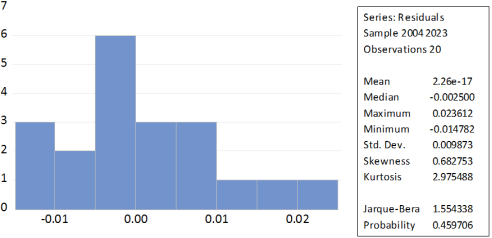
The model also passed the Normality test based on the Jarquer-Bera value of 1.554338- and the probability of 0.459706 which is above the required normal 5 percent level. Hence, the residuals are normally distributed across observations as shown in Figure 1.
Figure 1. Histogram of Regression Residuals.
Serial correlation Test
The null hypothesis cannot be rejected as the probability value is greater than the normal 5 percent requirement of no serial correlation in the model. Therefore, the model is free from serial correlation as shown in Table 5.
Table 5. Breusch-Godfrey Serial Correlation LM Test.

Null hypothesis: No serial correlation at up to 2 lags

F-statistic

1.500937

Prob. F (2,11)

0.2652

Obs*R-squared

4.287817

Prob. Chi-Square (2)

0.1172

Heteroskedasticity test
The estimated model passes the test for heteroscedasticity test based on the regression of squared residuals on squared fitted values. The White Heteroscedasticity test below clearly shows that the p-value of about 0.4806 which is approximately 48 percent is more than the critical value of 5 percent.
Table 6. Heteroskedasticity Test: Breusch-Pagan-Godfrey.

Null hypothesis: Homoskedasticity

F-statistic

0.820076

Prob. F(6,13)

0.4806

Obs*R-squared

5.491442

Prob. Chi-Square(6)

0.4825

Scaled explained SS

2.291698

Prob. Chi-Square(6)

0.8910

Stability Test
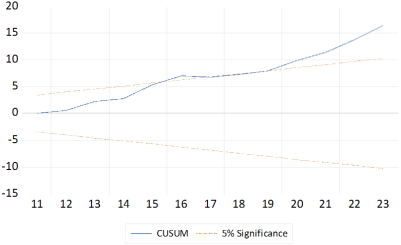
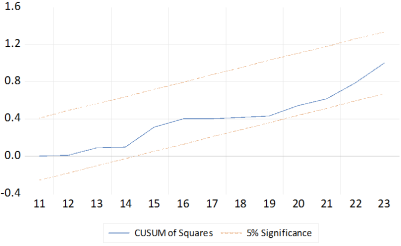
Pesaran and Pesaran (1997) suggests that the test for the stability for parameters using cumulative sum of recursive residuals (CUSUM) and cumulative sum of squares of recursive residuals (CUSUMSQ) plots be conducted after the model is estimated. This is done to get rid of any bias in the results of the estimated model due to unstable parameters. The results for CUSUM and the results depict that the plots of CUSUM and CUSUMSQ for the estimated ARDL model shows CUSUMSQ are depicted in Figure 2 and Figure 3 respectively. The absences of instability of the coefficients since the plots of all coefficients fall within the critical bounds at 5 percent significance level. Therefore, the estimated coefficients in the model are stable over the study period.
Figure 2. CUSUM Test for Parameter Stability of the Regression Model.
Figure 3. CUSUM of Squares Test for Parameter Stability of the Regression Model.
5. Discussions of Results
The findings of this study reveal that governance is a key factor for human development in the long term. Specifically, Rule of Law and control of corruption significantly and positively influenced human development. The result indicates that stronger judicial independence, predictable legal systems, and equitable law enforcement is relevant for achieving higher levels of human development. It aligns with the findings of .
Similarly, the study confirmed that control of corruption has positive significant impact on human development. This is in line with and , who explain the negative role of corruption in diverting resources toward personal gain. Hence, the study’ finding highlights the critical role of transparency and accountability in fostering efficient resource allocation, service delivery, and public trust, which are vital for improving education, health, and living standards.
In contrast, despite their theoretical importance in the political economy framework, Government Effectiveness, Regulatory Quality, Political Stability and Voice and Accountability did not show any significant relationships with HDI. With regard to government effectiveness, this study disagrees with and . This contradiction may be due to the difference in the methodology, wherein these studies adopted panel data.
In terms of regulatory quality, the result disagrees with , who report that strong and effective regulatory frameworks play a significant role in improving human development by enhancing institutional performance, strengthening accountability, and creating a conducive environment for economic activity. However, the current study finds no significant long-term impact of regulatory quality on HDI, suggesting that regulatory reforms may not yield measurable improvements unless they are accompanied by effective enforcement, institutional coherence, and sustained governance commitments.
The result that political stability insignificantly impacts HDI in the long-term accords with the findings of , revealing that the benefits of political stability on human development are often indirect and materialize only when stability is sustained over long periods and supported by consistent policy implementation. This aligns with the present finding, indicating that political stability alone is insufficient to drive HDI without accompanying long-term development investments.
Finally, accountability and voice were not a significant determinant for human development. Similar findings have been reported in studies by , who did not find any significant relationship between any of the governance indicator and HDI. In the context of Sierra Leone, the finding denotes the mere presence of democratic mechanisms or administrative structures that does not guarantee developmental outcomes by allowing citizens to hold public official responsible for their actions and decisions.
6. Conclusion
The study determines the governance factors drive human development in Sierra Leone. Based on the ADRL long-run results, control of corruption and rule of law are significant governance factors that affect human development. However, government effectiveness, political stability, regulatory quality and accountability and voice lack any impact on HDI. Hence, the study recommends that judicial independence, equitable access to justice, and consistency in law enforcement. Additionally, the fight against corruption should be strengthened and there is a strong need to promote integrity among public servants. Citizens’ role in holding public officials accountable is necessary for improving the influence of accountability and voice on human development. Moreover, beyond effective allocation of resources toward health and education, the government should monitor budget implementation to avoid wastages and diversion of resources for personal gain. Finally, based on the limitations of the study - small sample size and the presence of positive autocorrelation, future studies should expand the dataset across a longer time frame or include additional governance indicators to address issues of autocorrelation and capture dynamic interactions. Employing advanced econometric methods such as panel regression or structural equation modelling could further clarify causal pathways between governance and human development.
Abbreviations

HDI

Human Development Index

CC

Control of Corruption

GE

Government Effectiveness

PS

Political Stability

RQ

Regulatory Quality

RL

Rule of Law

VA

Voice and Accountability

ADRL

Autoregressive Distributed Lag

Author Contributions
Shekou Ansumana Nuni is the sole author. The author read and approved the final manuscript.
Conflicts of Interest
The author declares no conflict of interest in any form.
References
[1] S. E. Saputro, M. Z. Hamzah, and B. Santosa, “Determinant Factors of Human Development and Its Impact on Level of Productivity in ASEAN Countries,” in Proceedings of the International Conference on Sustainable Collaboration in Business, Technology, Information, and Innovation (SCBTII 2023), vol. 265.
[2] F. N. Nwobodo, “Cost of governance and human development in Enugu State,” J. Policy Dev. Stud., vol. 15, no. 1, pp. 41-57, Mar. 2024,
[3] Md. M. Ahmed, “Government Effectiveness and Development: South Asian Perspective,” Asian Soc. Sci., vol. 18, no. 8, p. 35, Aug. 2022,
[4] T. Stylianou, R. Nasir, and M. Waqas, “Inclusive Human Development and Governance Nexus: Causality Analysis of Selected Asian Countries,” Economies, vol. 11, no. 3, p. 97, Mar. 2023,
[5] L. G. Banda, “Good Governance and Human Welfare Development in Malawi,” Malawi J. Soc. Sci., vol. 22, pp. 88-119, 2023.
[6] A. Becherair and M. Tahtane, “THE CAUSALITY BETWEEN CORRUPTION AND HUMAN DEVELOPMENT IN MENA COUNTRIES: A PANEL DATA ANALYSIS,” J. Econ. Bus., vol. XX, no. 2, pp. 63-84, 2017.
[7] D. Chaudhary, “Prospect of Good Governance and Human Development in Nepal,” Open J. Polit. Sci., vol. 10, no. 02, pp. 135-147, 2020,
[8] A. Tarawalie and E. Pokawa, “Examining Government Spending and Its Impact on Economic Growth in Sierra Leone: Spotlight on Human Capital and Military Expenditure,” Int. J. Econ. Finance Manag. Sci., vol. 12, no. 6, pp. 515-525, Dec. 2024,
[9] A. Arifin, R. Priyono, and G. Binardjo, “Government Budget: Good Governance and Human Capital for Poverty Alleviation in Central Java,” J. Econ. Soc. Humanit., vol. 3, no. 2, Aug. 2025,
[10] M. Fayiah, “Corruption Trends and Graft Control Progress in Sierra Leone: Study of Causes and Remedies,” J. Econ. Behav. Stud., vol. 14, no. 1(J), pp. 39-49, May 2022,
[11] I. A. Gbla, I. Munu, and M. Yusuf, “Local Governance and Service Delivery in Sierra Leone: Challenges Faced by Bo City Council,” Open J. Soc. Sci., vol. 12, no. 09, pp. 236-249, 2024,
[12] G. O. Eze, N. Onyishi, F. C. Nnaji, A. Jalloh, K. K. Kpallu, and K. Goba, “Pattern of Psychoactive Substance Use in Sierra Leone: A Descriptive Retrospective Study,” Sierra Leone J. Med., vol. 1, no. 2, pp. 90-96, Oct. 2024,
[13] S. M. Koroma, M. Yusuf, E. Dauda, and J. G. T. Gando, “The Effects of Corruption On Local Government Service Delivery In Sierra Leone: The Case of Bonthe District Council,” 2024,
[14] A. B. Tarawalie and E. T. Gbondo, “EDUCATION, HEALTH AND ECONOMIC GROWTH NEXUS: NEW EVIDENCE FROM SIERRA LEONE,” Eur. J. Econ. Financ. Res., vol. 9, no. 1, Jun. 2025,
[15] A. M. Emara, “The Impact of Corruption on Human Development in Egypt,” Asian Econ. Financ. Rev., vol. 10, no. 5, pp. 574-589, 2020,
[16] O. N. Castillo, A. L. V. Santibáñez, and H. F. Márquez, “Effects of corruption on human development. Evidence for developed and developing countries,” Acta Oeconomica, vol. 74, no. 4, pp. 507-541, Dec. 2024,
[17] H. A. Pham, “The Impact of Corruption on the Human Development Index in Countries Worldwide and Policy Implications for Vietnam,” Int. J. Econ. Bus. Manag. Res., vol. 09, no. 01, pp. 253-273, 2025,
[18] R. P. Pradhan, “Good governance and human development: Evidence form Indian States,” J. Soc. Dev. Sci., vol. 1, no. 1, pp. 1-8, Feb. 2011,
[19] W. Rizkallah, “Good governance and sustainable human development: Evidence from the Egyptian experience,” Egypte Contemp., vol. 113, no. 548, pp. 548-577, Oct. 2022,
[20] Z. Ahmad and A. Saleem, “Impact of governance on human development,” Pak. J. Commer. Soc. Sci., vol. 8, no. 3, pp. 612-628, 2014.
[21] A. Keser and Y. Gökmen, “Governance and Human Development: The Impacts of Governance Indicators on Human Development,” J. Public Adm. Gov., vol. 8, no. 1, p. 26, Jan. 2018,
[22] Dr. V. O. Aninwagu and Prof. A. A. Momodu, “Effect Of Political Instability On Human Development In Nigeria,” Int. J. Res. Publ. Rev., vol. 6, no. 6, pp. 11416-11424, Jun. 2025,
[23] R. M. H. Radaideh, “The Impact of Good Governance on Human Development in Jordan: A Case Study,” J. Educ. Soc. Res., vol. 12, no. 5, p. 81, Sep. 2022,
[24] C. O. Omodero, “Government General Spending and Human Development: A Case Study of Nigeria,” Acad. J. Interdiscip. Stud., vol. 8, no. 1, pp. 51-59, Mar. 2019,
[25] S. Akinbode, J. Olabisi, R. Adegbite, T. Aderemi, and A. Alawode, “Corruption, Government Effectiveness and Human Developmentin Sub-Saharan Africa,” J. Adv. Dev. Econ., pp. 16-34, 2020,
[26] D. A. S. Lantion, G. V. Musngi, and R. R. Cabauatan, “Assessing the Relationship of Human Development Index (HDI) and Government Expenditure on Health and Education in Selected ASEAN Countries,” Int. J. Soc. Manag. Stud., vol. 4, no. 6, pp. 13-26, 2023.
[27] A. O. T. Wiratmoko and L. Purwanti, “IMPACT OF GOVERNMENT EXPENDITURE ON HUMAN DEVELOPMENT INDEX IN INDONESIA BY FUNCTIONS,” EUrASEANs J. Glob. Socio-Econ. Dyn., vol. 6, no. 43, pp. 191-201, Nov. 2023,
[28] J. T. Ezako, “The nexus between human development, official development assistance, carbon emissions, and governance in developing countries for the realization of sustainable development goals,” Cogent Econ. Finance, vol. 12, no. 1, p. 2330452, Dec. 2024,
[29] R. R. Manullang, E. Amran, H. Syofya, I. Harsono, and Awalauddin, “The Influence of Government Expenditures on the Human Development Index With Gross Domestic Product As A Moderating Variable,” Reslaj Relig. Educ. Soc. Laa Roiba J., vol. 6, no. 4, pp. 2059-2068, Mar. 2024,
[30] M. Yu. Malkina and S. G. Mulaw, “The Impact of Governance Quality on Human Development: When Politics Drives the Economy (the Case of Ethiopia),” J. Institutional Stud., vol. 17, no. 3, pp. 050-066, Sep. 2025,
[31] S. Wahyudi and R. Alfian, “The Impact of Corruption on the Development of the Quality of Human Life in Southeast Asia,” Bp. Int. Res. Crit. Inst.-J., vol. 3, no. 4, pp. 6640-6647, 2021.
Cite This Article
  • APA Style

    Nuni, S. A. (2026). The Governance-Development Nexus in Sierra Leone: Exploring Institutional Path to Human Progress. Journal of Public Policy and Administration, 10(1), 27-37. https://doi.org/10.11648/j.jppa.20261001.13

    Copy | Download

    ACS Style

    Nuni, S. A. The Governance-Development Nexus in Sierra Leone: Exploring Institutional Path to Human Progress. J. Public Policy Adm. 2026, 10(1), 27-37. doi: 10.11648/j.jppa.20261001.13

    Copy | Download

    AMA Style

    Nuni SA. The Governance-Development Nexus in Sierra Leone: Exploring Institutional Path to Human Progress. J Public Policy Adm. 2026;10(1):27-37. doi: 10.11648/j.jppa.20261001.13

    Copy | Download

  • @article{10.11648/j.jppa.20261001.13,
      author = {Shekou Ansumana Nuni},
      title = {The Governance-Development Nexus in Sierra Leone: Exploring Institutional Path to Human Progress},
      journal = {Journal of Public Policy and Administration},
      volume = {10},
      number = {1},
      pages = {27-37},
      doi = {10.11648/j.jppa.20261001.13},
      url = {https://doi.org/10.11648/j.jppa.20261001.13},
      eprint = {https://article.sciencepublishinggroup.com/pdf/10.11648.j.jppa.20261001.13},
      abstract = {This study examines the long-term effects of governance indicators on human development in Sierra Leone. The analysis utilizes a 20-year dataset covering the period 2004 to 2023, allowing for an assessment of how sustained changes in governance quality have influenced human development outcomes in the country over time. Data for governance indicators were obtained from World Governance Indicators produced by the World Bank, whereas human development data were obtained from the UNICEF’s human development index. The study employed the Autoregressive Distributed Lag (ARDL) modeling technique. Unlike in the short-run that shows that governance indicators do not impact HDI, the results indicate that control of corruption and rule of law exert statistically significant long-term effects on human development in Sierra Leone, while the other governance indicators are statistically insignificant. Overall, these findings highlight the pivotal role of corruption control and legal integrity as foundational drivers of sustained human development in Sierra Leone. Consistent efforts to strengthen anti-corruption measures and uphold legal institutions are associated with measurable improvements in key human development dimensions, including education, health, and income. Additionally, these findings highlight the need for governance reforms that focus on enhancing political stability, improving regulatory quality, and addressing inefficiencies in government expenditure, ensuring proper financial management. The policymakers should focus on creating a situation that promotes good governance.},
     year = {2026}
    }
    

    Copy | Download

  • TY  - JOUR
    T1  - The Governance-Development Nexus in Sierra Leone: Exploring Institutional Path to Human Progress
    AU  - Shekou Ansumana Nuni
    Y1  - 2026/01/19
    PY  - 2026
    N1  - https://doi.org/10.11648/j.jppa.20261001.13
    DO  - 10.11648/j.jppa.20261001.13
    T2  - Journal of Public Policy and Administration
    JF  - Journal of Public Policy and Administration
    JO  - Journal of Public Policy and Administration
    SP  - 27
    EP  - 37
    PB  - Science Publishing Group
    SN  - 2640-2696
    UR  - https://doi.org/10.11648/j.jppa.20261001.13
    AB  - This study examines the long-term effects of governance indicators on human development in Sierra Leone. The analysis utilizes a 20-year dataset covering the period 2004 to 2023, allowing for an assessment of how sustained changes in governance quality have influenced human development outcomes in the country over time. Data for governance indicators were obtained from World Governance Indicators produced by the World Bank, whereas human development data were obtained from the UNICEF’s human development index. The study employed the Autoregressive Distributed Lag (ARDL) modeling technique. Unlike in the short-run that shows that governance indicators do not impact HDI, the results indicate that control of corruption and rule of law exert statistically significant long-term effects on human development in Sierra Leone, while the other governance indicators are statistically insignificant. Overall, these findings highlight the pivotal role of corruption control and legal integrity as foundational drivers of sustained human development in Sierra Leone. Consistent efforts to strengthen anti-corruption measures and uphold legal institutions are associated with measurable improvements in key human development dimensions, including education, health, and income. Additionally, these findings highlight the need for governance reforms that focus on enhancing political stability, improving regulatory quality, and addressing inefficiencies in government expenditure, ensuring proper financial management. The policymakers should focus on creating a situation that promotes good governance.
    VL  - 10
    IS  - 1
    ER  - 

    Copy | Download

Author Information