
Wax precipitation and deposition remain critical flow assurance challenges in offshore and onshore production systems. This study evaluates the effects of ethylene–vinyl acetate (EVA) copolymer, magnesium oxide (MgO) nanofluid, and their blend on the rheology of crude oil from field X in the Niger Delta. Baseline characterization (API gravity, pour point and cloud point) confirmed a heavy, high-viscosity crude prone to gelation at low temperature. Using ASTM-based protocols for density/API and pour/cloud points and a rotational viscometer, viscosity was measured across 5–25°C at multiple shear rates. Gas chromatography fingerprinting indicated reduced n-paraffins (C14–C18) with concentration of heavy ends. Relative to the blank sample, EVA alone produced a marked viscosity reduction; MgO nanofluid alone was also effective, but the EVA+MgO blend delivered the largest reduction across temperatures and shear rates. The blend lowered apparent viscosity by an order of magnitude at 300 rpm and improved low-temperature flow, with an observed pour-point reduction from −5°C to ≈ −12°C. These results support a synergistic mechanism in which EVA modifies wax crystallization while MgO-based nanodispersion aids dispersion and disrupts agglomeration, together mitigating gelation and deposition risk. Operational implications include lower restart pressures and extended pigging intervals for pipelines transporting waxy crude.
| Published in | Petroleum Science and Engineering (Volume 10, Issue 1) |
| DOI | 10.11648/j.pse.20261001.14 |
| Page(s) | 45-50 |
| Creative Commons |
This is an Open Access article, distributed under the terms of the Creative Commons Attribution 4.0 International License (http://creativecommons.org/licenses/by/4.0/), which permits unrestricted use, distribution and reproduction in any medium or format, provided the original work is properly cited. |
| Copyright |
Copyright © The Author(s), 2026. Published by Science Publishing Group |
Wax Deposition, Wax Appearance Temperature, Pour-Point Depressant, Eva Copolymer, Magnesium Oxide Nanofluid, Rheology, Niger Delta Crude
Property | Value |
|---|---|
API @72C | 17.0 |
API @60/60 | 16.4 |
Specific Gravity | 0.9567 |
Cloud Point (°C) | 0 |
Pour Point (°C) | -5 |
Density (kg/m3) | 956.7 |
PEVA | Polyethylene Vinyl Acetate |
MgO | Magnesium Oxide |
PEB | Polyethylene Butene |
EVA | Ethylene–Vinyl Acetate |
| [1] | Aji, A., Mohyaldinn, M. E., & Mahmud, H. B. (2025). The role of polymer nanocomposites in sustainable wax deposition control in crude oil systems - systematic review [J]. AIMS Environmental Science, 2025, 12(1): 16-52. |
| [2] | Alves, B., Silva, C., Nunes, R., et al. (2022). Production of EVA: MMT nanocomposite and evaluation as flow improver. SPE Brazil Flow Assurance Technology Congress. |
| [3] | Becker, J. R. "Oilfield Paraffin Treatments: Hot Oil and Hot Water Compared to Crystal Modifiers." Paper presented at the SPE Annual Technical Conference and Exhibition, Dallas, Texas, October 2000. |
| [4] | Bosh, F. G.; Eastlund, B. J. Evaluation of downhole electric impedance heating systems for paraffin control in oil wells. 37th Annual Conference on Petroleum and Chemical Industry, Houston, TX, USA, 1990, pp. 223-227, |
| [5] | Chala GT, Sulaiman SA, Japper-Jaafar A. (2018): Flow start-up and transportation of waxy crude oil in pipelines-a review. J Non- Newton Fluid Mech. 2018; 251: 69–87. |
| [6] | Ganeeva YM, Yusupova TN, Romanov GV. Waxes in asphaltenes of crude oils and wax deposits. Pet Sci. 2016; 13(4): 737–45. |
| [7] | Ghannam MT, Hasan SW, Abu-Jdayil B, Esmail N. Rheological properties of heavy and light crude oil mixtures for improving flowability. J Pet Sci Eng. 2012; 81: 122–8. |
| [8] | Ghobashy, M. M., Siddiq, A., El?Adasy, A. A. A. M., et al. (2025). Flowability enhancement of waxy crude oil using gamma?irradiated EVA?copolymers grafted with functional monomers. Journal of Polymer Research. |
| [9] | Isiakepre M. and Odutola T. O. (2024): “Preventing Wax Gelation Using Zinc Oxide Nanoparticles”, Pet Coal (2024); 66(3): 1032-1039. |
| [10] | Kumar L, Paso K, Sjo¨blom J. (2015): “Numerical study of flow restart in the pipeline filled with weakly compressible waxy crude oil in non-isothermal condition”. J Non-Newton Fluid Mech. 2015; 223: 9–19. |
| [11] | Lucas, E. F. (2002). Influence of ethylene?co?vinyl acetate copolymers on flow properties of wax synthetic systems. Journal of Applied Polymer Science. |
| [12] | Odutola T. O. and Allaputa V. (2020): “Effect of Aluminum Oxide (AL203) Nanoparticle on the Viscosity of Niger Delta Waxy Crude at Varying Temperatures”, 'International Journal of Scientific & Engineering Research, Volume 11, Issue 1, pp 791-794. |
| [13] | Odutola T. O and Idemili C. A. (2020): Effect of poly (ethylene-butene) and nano-aluminium oxide blend on the viscosity of Nigerian crude oil, Journal of Petroleum Exploration and Production Technology, Vol. 10, issue 4. |
| [14] | Ridzuan, N., Gbonhinbor, J. R., & Agi, A. (2024). Polyethylene?Co?Vinyl Acetate (EVA) and Nanoparticle Effect on Wax Deposition: A Molecular Dynamics Simulation Approach. SPE Nigeria Annual International Conference. |
| [15] | Sulaimon A. A., Falade G. K. and DeLandro W. (2010): A proactive approach for predicting and preventing wax deposition in production tubing strings: A Niger Delta experience, Journal of Petroleum and Gas Engineering Vol. 1(2), pp. 26-36, April 2010. |
| [16] | Wang, L., Duan, J., Liu, B., et al. (2024). Effect of EVA on wax crystal and hydrate formation processes. Chinese Journal of Chemical Engineering. |
| [17] | Weidong L., Qiyu H., Wenda W., Yijie R., Xue D., Qi Z., Hou L. 2019): "Study on Wax Removal During Pipeline-Pigging Operations." SPE Prod & Oper 34 (2019): 216–231. |
APA Style
Christopher, N. H., Olabisi, O. T., Abdulaziz, O. I. (2026). Synergistic Control of Wax Deposition and Rheology in Niger Delta Crude Oil Using EVA Copolymer and Magnesium Oxide Nanofluid. Petroleum Science and Engineering, 10(1), 45-50. https://doi.org/10.11648/j.pse.20261001.14
ACS Style
Christopher, N. H.; Olabisi, O. T.; Abdulaziz, O. I. Synergistic Control of Wax Deposition and Rheology in Niger Delta Crude Oil Using EVA Copolymer and Magnesium Oxide Nanofluid. Pet. Sci. Eng. 2026, 10(1), 45-50. doi: 10.11648/j.pse.20261001.14
@article{10.11648/j.pse.20261001.14,
  author = {Nwaobi Henry Christopher and Odutola Toyin Olabisi and Odutola Ibukunoluwa Abdulaziz},
  title = {Synergistic Control of Wax Deposition and Rheology in Niger Delta Crude Oil Using EVA Copolymer and Magnesium Oxide Nanofluid},
  journal = {Petroleum Science and Engineering},
  volume = {10},
  number = {1},
  pages = {45-50},
  doi = {10.11648/j.pse.20261001.14},
  url = {https://doi.org/10.11648/j.pse.20261001.14},
  eprint = {https://article.sciencepublishinggroup.com/pdf/10.11648.j.pse.20261001.14},
  abstract = {Wax precipitation and deposition remain critical flow assurance challenges in offshore and onshore production systems. This study evaluates the effects of ethylene–vinyl acetate (EVA) copolymer, magnesium oxide (MgO) nanofluid, and their blend on the rheology of crude oil from field X in the Niger Delta. Baseline characterization (API gravity, pour point and cloud point) confirmed a heavy, high-viscosity crude prone to gelation at low temperature. Using ASTM-based protocols for density/API and pour/cloud points and a rotational viscometer, viscosity was measured across 5–25°C at multiple shear rates. Gas chromatography fingerprinting indicated reduced n-paraffins (C14–C18) with concentration of heavy ends. Relative to the blank sample, EVA alone produced a marked viscosity reduction; MgO nanofluid alone was also effective, but the EVA+MgO blend delivered the largest reduction across temperatures and shear rates. The blend lowered apparent viscosity by an order of magnitude at 300 rpm and improved low-temperature flow, with an observed pour-point reduction from −5°C to ≈ −12°C. These results support a synergistic mechanism in which EVA modifies wax crystallization while MgO-based nanodispersion aids dispersion and disrupts agglomeration, together mitigating gelation and deposition risk. Operational implications include lower restart pressures and extended pigging intervals for pipelines transporting waxy crude.},
 year = {2026}
}
TY  - JOUR
T1  - Synergistic Control of Wax Deposition and Rheology in Niger Delta Crude Oil Using EVA Copolymer and Magnesium Oxide Nanofluid
AU  - Nwaobi Henry Christopher
AU  - Odutola Toyin Olabisi
AU  - Odutola Ibukunoluwa Abdulaziz
Y1  - 2026/05/16
PY  - 2026
N1  - https://doi.org/10.11648/j.pse.20261001.14
DO  - 10.11648/j.pse.20261001.14
T2  - Petroleum Science and Engineering
JF  - Petroleum Science and Engineering
JO  - Petroleum Science and Engineering
SP  - 45
EP  - 50
PB  - Science Publishing Group
SN  - 2640-4516
UR  - https://doi.org/10.11648/j.pse.20261001.14
AB  - Wax precipitation and deposition remain critical flow assurance challenges in offshore and onshore production systems. This study evaluates the effects of ethylene–vinyl acetate (EVA) copolymer, magnesium oxide (MgO) nanofluid, and their blend on the rheology of crude oil from field X in the Niger Delta. Baseline characterization (API gravity, pour point and cloud point) confirmed a heavy, high-viscosity crude prone to gelation at low temperature. Using ASTM-based protocols for density/API and pour/cloud points and a rotational viscometer, viscosity was measured across 5–25°C at multiple shear rates. Gas chromatography fingerprinting indicated reduced n-paraffins (C14–C18) with concentration of heavy ends. Relative to the blank sample, EVA alone produced a marked viscosity reduction; MgO nanofluid alone was also effective, but the EVA+MgO blend delivered the largest reduction across temperatures and shear rates. The blend lowered apparent viscosity by an order of magnitude at 300 rpm and improved low-temperature flow, with an observed pour-point reduction from −5°C to ≈ −12°C. These results support a synergistic mechanism in which EVA modifies wax crystallization while MgO-based nanodispersion aids dispersion and disrupts agglomeration, together mitigating gelation and deposition risk. Operational implications include lower restart pressures and extended pigging intervals for pipelines transporting waxy crude.
VL  - 10
IS  - 1
ER  -
Department of Petroleum and Gas Engineering, University of Port Harcourt, Port Harcourt, Nigeria
Department of Petroleum and Gas Engineering, University of Port Harcourt, Port Harcourt, Nigeria
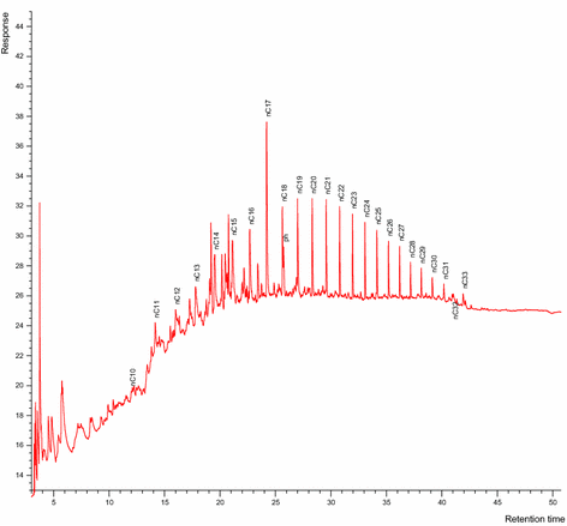
Figure 1. Chromatogram of Blank Crude Sample.
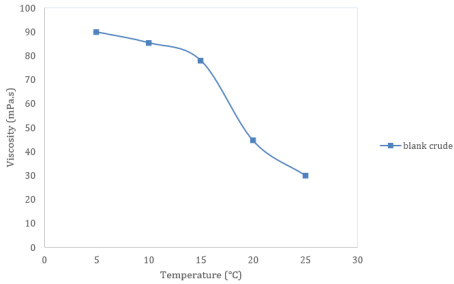
Figure 2. Plot of the viscosity against temperature for the blank crude.
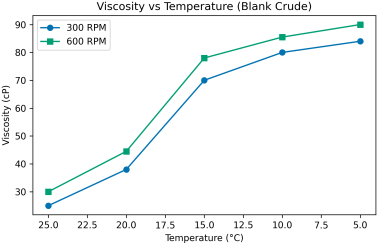
Figure 3. Viscosity vs temperature for blank crude at 300 and 600 rpm.
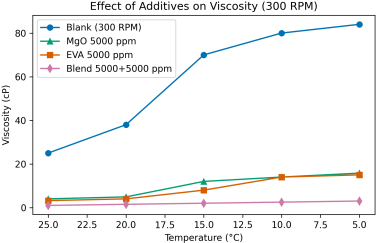
Figure 4. Additive strategies at 300 rpm: blank vs MgO 5000 ppm, EVA 5000 ppm, and equal-parts blend (5000+5000 ppm).
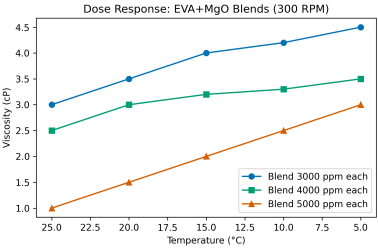
Figure 5. Dose response of EVA+MgO blends (equal ppm each) at 300 rpm.

Information



 Share This Article
 Twitter
 Linked In
 Facebook
 Copy
Copy Download