
Essential oils are complex mixtures of volatile compounds obtained from plants where they serve aromatic purposes, and defensive roles. They have been used for centuries in medicine, industry, and agriculture due to their broad spectrum of biological activity. Exhibiting antiviral, anti-inflammatory, antioxidant antimicrobial, and smooth muscle relaxant properties. Essential oils have been important substances the most common component is D-Limonene or 4-isopropenyl-1-methylcyclohexene (C10H16) is a monocyclic monoterpene abundant in citrus plants like orange, and grape. It used for a flavor and fragrance additive in perfumes, soaps, foods, and beverages is consistently increased due to its high-quality fragrance property, other uses and important were treated in this study indicates that the compound is neither mutagenic nor carcinogenic in humans, maintaining a low toxicity limit even with protracted administration over several years. the effects of D-limonene such as antioxidant, anticancer, anti-inflammatory, gastroprotective and acid reflux due to its gastric acid-neutralizing properties, Botanical Pesticide and Vermin Control, Oil Spill Correction and The ability to dissolve expanded polystyrene (EPS). This paper provides an overview of the properties of essential oils. D-Limonene is a bioactive compound of high economic and medicinal value. its Environmental Benefit D-Limonene has high biodegradability and lower Volatile Organic Compound (VOC) emissions compared to traditional solvents The study opening opportunities for its use in food by proved the efficiency of its extraction from fruit waste, pharmaceutical, and environmentally friendly pesticide industries D-limonene does not endure in the soil or contaminate groundwater.
| Published in | Science Discovery Chemistry (Volume 1, Issue 2) |
| DOI | 10.11648/j.sdc.20260102.11 |
| Page(s) | 63-72 |
| Creative Commons |
This is an Open Access article, distributed under the terms of the Creative Commons Attribution 4.0 International License (http://creativecommons.org/licenses/by/4.0/), which permits unrestricted use, distribution and reproduction in any medium or format, provided the original work is properly cited. |
| Copyright |
Copyright © The Author(s), 2026. Published by Science Publishing Group |
Essential Oils, Anti-inflammatory, Antiviral, Activity, Toxicity, Antimicrobial
Property | Value |
|---|---|
Description | Colourless liquid with a pleasant, lemon-like odor |
Melting-point | -74.3°C |
Boiling-point | 175.5-176°C |
Density | 0.8411 g/cm3 at 20°C/4°C |
Solubility | insoluble in water; soluble in benzene, carbon tetrachloride, diethyl ether, ethanol and petroleum ether; slightly soluble in glycerine |
Biological/ Industrial Effect | Description |
|---|---|
Anti-Inflammatory | Reduces inflammatory cytokines and protects tissues from oxidative stress [30] . |
Anticancer potential | Inhibits tumor growth and induces apoptosis (cell death) in cancer cell [31] . |
Anti-ulcer | Effectively treats gastroessophageal reflux (GERD) and protect the stomach lining [32] . |
Antimicrobial | Disrupts the cell membranes of bacteria and fungi, acting as a natural preservative [33] . |
Anxiolytic (calming) | Acts on the central nervous system to reduce anxiety through Inhalation (aromatherapy). |
Category | Primary uses |
|---|---|
Industrial cleaning | Degreasing and solvent |
Food & beverage | Flavouring agent, antioxidant |
Cosmetic & care | Fragrance, penetration Enhancer |
Agriculture/ pests | Natural Insecticide, Repellent |
Medicine/ health | Therapeutic, pharmaceuticals |
Scientific Lab | Histology clearing, green extraction |
Household products | General cleaners, Hand Soaps |
EP | Efflux Pump |
EPS | Expanded Polystyrene |
VOC | Volatile Organic Compound |
GERD | Gastro Esophageal Reflux Disease |
MIC | Minimum Inhibitory Concentration |
| [1] | P. Yamuna, P. Abirami, P. Vijayashalini, and M. Sharmila, GC-MS analysis of bioactive compounds in the entire plant parts of ethanolic extract of Gomphrena decumbens Jacq, Journal of Medicinal Plants Studies, 2017, 5(3), pp. 31-37. |
| [2] | R. Kumar, S. Kumar, A. Patra, and S. Jayalakshmi, Hepatoprotective activity of aerial parts of Plumbago zeylanica linn against carbon tetrachloride-induced hepatotoxicity in rats, International Journal of Pharmacy and Pharmaceutical Sciences, 2009, 1(SUPPL. 1), pp. 171-5. |
| [3] |
B. Pleasant. (2013, 2/8/2019). Spring Onions, Green Onions, Welsh Onions or Scallions? Available:
https://www.growveg.co.uk/guides/spring-onions-green-onions-welsh-onions-or-scallions/ |
| [4] | S. Dawang, D. Affiah, N. Lanka, and L. Fannap, Preliminary checklist of spices and culinary Herbs sold in Jos, Plateau State, Nigeria, IOSR Journal of Pharmacy and Biological Sciences, 2016, 11(4), pp. 24-29. |
| [5] | B. Singh and Y. Ramakrishna, Welsh onion (Allium fistulosum L.): A promising spicing-culinary herb of Mizoram, Indian Journal of Hill Farming, 2017, 30(2), pp. 201-208. |
| [6] | L. Vlase, M. Parvu, E. Parvu, and A. Toiu, Phytochemical analysis of Allium fistulosum L. and A. ursinum L, Digest Journal of Nanomaterials & Biostructures (DJNB), 2013, 8(1), p. 457. |
| [7] | T. Nohara, Y. Fujiwara, R. Kudo, K. Yamaguchi, T. Ikeda, K. Murakami, M. Ono, T. Kajimoto, and M. Takeya, Isolation and characterization of new onionins A2 and A3 from Allium cepa, and of onionins A1, A2, and A3 from Allium fistulosum, Chemical and Pharmaceutical Bulletin, 2014, 62(11), pp. 1141-1145. |
| [8] | P. L. Crowell and M. N. Gould, Chemoprevention and therapy of cancer by d-limonene, Critical Reviews™ in Oncogenesis, 1994, 5(1), pp. 1-22. |
| [9] | A. Sobel. (2023, 31/12/2025). What Is Limonene? Everything You Need to Know. Available: |
| [10] | L. Yu, J. Yan, and Z. Sun, D-limonene exhibits anti-inflammatory and antioxidant properties in an ulcerative colitis rat model via regulation of iNOS, COX-2, PGE2 and ERK signaling pathways, Molecular medicine reports, 2017, 15, pp. 2339-2346. |
| [11] | M. Souza, A. Siani, M. Ramos, O. Menezes-de-Lima Jr, and M. Henriques, Evaluation of anti-inflammatory activity of essential oils from two Asteraceae species, the Pharmacy-An International Journal of Pharmaceutical Sciences, 2003, 58(8), pp. 582-586. |
| [12] | B. Sever Yılmaz and H. Özbek, Investigation of the anti-inflammatory, hypoglycemic activity and median lethal dose (LD50) level of limonene in mice and rats, ACTA Pharmaceutica Sciencia, 2018, 56(1), pp. 85-94. |
| [13] | J. Sun, D-Limonene: safety and clinical applications, Alternative medicine review, 2007, 12(3), p. 259. |
| [14] | W. W. Nazaroff and C. J. Weschler, Cleaning products and air fresheners: exposure to primary and secondary air pollutants, Atmospheric environment, 2004, 38(18), pp. 2841-2865. |
| [15] | S. Chemat, V. Tomao, and F. Chemat, Limonene as green solvent for extraction of natural products, in Green solvents I: properties and applications in chemistry, ed: Springer, 2012, pp. 175-186. |
| [16] | J. S. Sidhu and T. A. Zafar, Bioactive compounds in banana fruits and their health benefits, Food quality and safety, 2018, 2(4), pp. 183-188. |
| [17] | H. Zhang, S. Yang, D. C. Joyce, Y. Jiang, H. Qu, and X. Duan, Physiology and quality response of harvested banana fruit to cold shock, Postharvest Biology and Technology, 2010, 55(3), pp. 154-159. |
| [18] | E. Babaeenezhad, F. Hadipour Moradi, S. Rahimi Monfared, M. D. Fattahi, M. Nasri, A. Amini, O. Dezfoulian, and H. Ahmadvand, D‐limonene alleviates acute kidney injury following gentamicin administration in rats: Role of NF‐κB pathway, mitochondrial apoptosis, oxidative stress, and PCNA, Oxidative medicine and cellular longevity, 2021, 2021, p. 6670007. |
| [19] | D. G. Barceloux, Medical toxicology of natural substances: foods, fungi, medicinal herbs, plants, and venomous animals: John Wiley & Sons, 2012. |
| [20] | P. F. Onyekere, D. O. Nnamani, C. O. Peculiar-Onyekere, and P. F. Uzor, Green Sustainable Process for Chemical and Environmental Engineering and Science: Limonene: Elsevier, 2021. |
| [21] | M. K. Park, J. Y. Cha, M. C. Kang, H. W. Jang, and Y. S. Choi, The effects of different extraction methods on essential oils from orange and tangor: From the peel to the essential oil, Food Science & Nutrition, 2024, 12, pp. 804-814. |
| [22] | M. Golmohammadi, A. Borghei, A. Zenouzi, N. Ashrafi, and M. J. Taherzadeh, Optimization of essential oil extraction from orange peels using steam explosion, Heliyon, 2018, 4(11), pp. 1-18. |
| [23] | J. Guo, M. Mäkinen, and J. Jänis, Comprehensive chemical profiling of citrus peel essential oils by direct‑infusion ultrahigh‑resolution FT‑ICR MS and high‑resolution GC–QTOF MS, Journal of Food Composition and Analysis, 2025, 148(1), p. 108204. |
| [24] | F. Rizzioli, V. Benedetti, F. Patuzzi, M. Baratieri, D. Bolzonella, and F. Battista, Valorization of orange peels in a biorefinery loop: recovery of limonene and production of volatile fatty acids and activated carbon, Biomass Conversion and Biorefinery, 2024, 14, pp. 9793-9803. |
| [25] | M. D. Ibáñez, N. M. Sanchez-Ballester, and M. A. Blázquez, Encapsulated limonene: A pleasant lemon-like aroma with promising application in the agri-food industry. A review, Molecules, 2020, 25(11), p. 2598. |
| [26] | D. A. Teigiserova, L. Tiruta-Barna, A. Ahmadi, L. Hamelin, and M. Thomsen, A step closer to circular bioeconomy for citrus peel waste: A review of yields and technologies for sustainable management of essential oils, Journal of environmental management, 2021, 280, p. 111832. |
| [27] | B. Sandei, V. Massardier, and R. Brunel, Alternative building blocks sources for poly (ethylene terephthalate): A short review with socio-economical points of view, Frontiers in Materials, 2022, 9, p. 1005770, 2022. |
| [28] | M. Usman, A. Rehman, F. Saleem, A. Abbas, V. C. Eze, and A. Harvey, Synthesis of cyclic carbonates from CO 2 cycloaddition to bio-based epoxides and glycerol: an overview of recent development, RSC advances, 2023, 13(33), pp. 22717-22743. |
| [29] | A. T. Rufino, M. Ribeiro, C. Sousa, F. Judas, L. Salgueiro, C. Cavaleiro, and A. F. Mendes, Evaluation of the anti-inflammatory, anti-catabolic and pro-anabolic effects of E-caryophyllene, myrcene and limonene in a cell model of osteoarthritis, European journal of pharmacology, 2015, 750, pp. 141-150. |
| [30] | X. Yu, H. Lin, Y. Wang, W. Lv, S. Zhang, Y. Qian, X. Deng, N. Feng, H. Yu, and B. Qian, D-limonene exhibits antitumor activity by inducing autophagy and apoptosis in lung cancer, OncoTargets and therapy, 2018, pp. 1833-1847. |
| [31] | M. C. de Souza, A. J. Vieira, F. P. Beserra, C. H. Pellizzon, R. H. Nóbrega, and A. L. Rozza, Gastroprotective effect of limonene in rats: Influence on oxidative stress, inflammation and gene expression, Phytomedicine, 2019, 53, pp. 37-42. |
| [32] | H. Igimi, R. Tamura, K. Toraishi, F. Yamamoto, A. Kataoka, Y. Ikejiri, T. Hisatsugu, and H. Shimura, Medical dissolution of gallstones: Clinical experience of d-limonene as a simple, safe, and effective solvent, Digestive diseases and sciences, 1991, 36, pp. 200-208. |
| [33] | E. Jongedijk, K. Cankar, M. Buchhaupt, J. Schrader, H. Bouwmeester, and J. Beekwilder, Biotechnological production of limonene in microorganisms, Applied microbiology and biotechnology, 2016, 100, pp. 2927-2938. |
| [34] | H. Karne, V. Kelkar, A. Mundhe, M. Ikar, S. Betawar, and N. Chaudhari, Essential oil extraction from orange and lemon peel, in E3S web of conferences, 2023, p. 01005. |
| [35] | W. B. Cunningham, J. D. Tibbetts, M. Hutchby, K. A. Maltby, M. G. Davidson, U. Hintermair, P. Plucinski, and S. D. Bull, Sustainable catalytic protocols for the solvent free epoxidation and anti-dihydroxylation of the alkene bonds of biorenewable terpene feedstocks using H2O2 as oxidant, Green Chemistry, 2020, 22, pp. 513-524. |
| [36] | A. Braga, C. Guerreiro, and I. Belo, Generation of flavors and fragrances through biotransformation and de novo synthesis, Food and Bioprocess Technology, 2018, 11, pp. 2217-2228. |
| [37] | A. N. R. Corrêa, P. Weimer, R. C. Rossi, J. F. Hoffmann, L. S. Koester, E. S. Suyenaga, and C. D. Ferreira, Lime and orange essential oils and d-limonene as a potential COVID-19 inhibitor: Computational, in chemico, and cytotoxicity analysis, Food Bioscience, 2023, 51, p. 102348. |
| [38] | K. L. Vasquez-Gomez, D. Mori-Mestanza, A. C. Caetano, G. Idrogo-Vasquez, C. Culqui-Arce, E. A. Auquiñivin-Silva, E. M. Castro-Alayo, R. Cruz-Lacerna, H. A. Perez-Ramos, and C. R. Balcázar-Zumaeta, Exploring chemical properties of essential oils from citrus peels using green solvent, Heliyon, 2024, 10(21), pp. 1-14. |
| [39] | T. P. Toker, M. Bouali, M. H. M. Al Bayatı, and M. F. Cengiz, Extraction and Comparison of Limonene Contents of Wastes in Citrus Species for Reuse, International Journal of Life Sciences and Biotechnology, 2025, 8(2), pp. 85-94. |
| [40] | W. O. Okunowo, O. Oyedeji, L. O. Afolabi, and E. Matanmi, Essential oil of grape fruit (Citrus paradisi) peels and its antimicrobial activities, American Journal of Plant Sciences, 2013, 4(7B), pp. 1-9. |
| [41] | Y. Chen, M. Shu, X. Yao, K. Wu, K. Zhang, Y. He, K. Nishinari, G. O. Phillips, X. Yao, and F. Jiang, Effect of zein-based microencapsules on the release and oxidation of loaded limonene, Food hydrocolloids, 2018, 84, pp. 330-336. |
| [42] | H. Lin, Z. Li, Y. Sun, Y. Zhang, S. Wang, Q. Zhang, T. Cai, W. Xiang, C. Zeng, and J. Tang, D-Limonene: Promising and sustainable natural bioactive compound, Applied Sciences, 2024, 14(11), p. 4605. |
| [43] | M. Assali, N. Jaradat, and L. Maqboul, The Formation of self-assembled nanoparticles loaded with doxorubicin and d-limonene for cancer therapy, ACS omega, 2022, 7(46), pp. 42096-42104. |
| [44] | H. Alipanah, M. Farjam, E. Zarenezhad, G. Roozitalab, and M. Osanloo, Chitosan nanoparticles containing limonene and limonene-rich essential oils: potential phytotherapy agents for the treatment of melanoma and breast cancers, BMC Complementary Medicine and Therapies, 2021, 21(186), p. 1-10. |
| [45] | E. V. Campos, P. L. Proença, T. G. da Costa, R. de Lima, L. F. Fraceto, and D. R. de Araujo, Using chitosan‐coated polymeric nanoparticles‐thermosensitive hydrogels in association with limonene as skin drug delivery strategy, BioMed Research International, 2022, 2022(1), p. 9165443. |
| [46] | V. Rani, J. Venkatesan, and A. Prabhu, D-limonene-loaded liposomes target malignant glioma cells via the downregulation of angiogenic growth factors, Journal of Drug Delivery Science and Technology, 2023, 82, p. 104358. |
| [47] | B. C. Monk and A. Goffeau, Outwitting multidrug resistance to antifungals, Science, 2008, 321(5887), pp. 367-369. |
| [48] | F. S. e. El-Tokhy, M. M. Abdel-Mottaleb, E. A. El-Ghany, and A. S. Geneidi, Design of long acting invasomal nanovesicles for improved transdermal permeation and bioavailability of asenapine maleate for the chronic treatment ofschizophrenia, International journal of pharmaceutics, 2021, 608, p. 121080. |
| [49] | P. R. Freitas, A. C. J. de Araújo, C. R. dos Santos Barbosa, D. F. Muniz, R. S. de Almeida, I. R. A. de Menezes, J. G. M. da Costa, F. F. G. Rodrigues, J. E. Rocha, and F. N. Pereira-Junior, Inhibition of the MepA efflux pump by limonene demonstrated by in vitro and in silico methods, Folia Microbiologica, 2022, 67(1), pp. 15-20. |
| [50] | N. Caballero Gómez, J. Manetsberger, N. Benomar, S. Castillo Gutiérrez, and H. Abriouel, Antibacterial and antibiofilm effects of essential oil components, EDTA and HLE disinfectant solution on Enterococcus, Pseudomonas and Staphylococcus sp. multiresistant strains isolated along the meat production chain, Frontiers in Microbiology, 2022, 13, p. 1014169. |
| [51] | N. Tao, Y. Chen, Y. Wu, X. Wang, L. Li, and A. Zhu, The terpene limonene induced the green mold of citrus fruit through regulation of reactive oxygen species (ROS) homeostasis in Penicillium digitatum spores, Food chemistry, 2019, 277, pp. 414-422. |
| [52] | V. Rolseth, R. Djurhuus, and A. M. Svardal, Additive toxicity of limonene and 50% oxygen and the role of glutathione in detoxification in human lung cells, Toxicology, 2002, 170(1-2), pp. 75-88. |
| [53] | C. Ravichandran, P. C. Badgujar, P. Gundev, and A. Upadhyay, Review of toxicological assessment of d-limonene, a food and cosmetics additive, Food and Chemical Toxicology, 2018, 120, pp. 668-680. |
| [54] | M. Sawamura, Citrus essential oils: flavor and fragrance: John Wiley & Sons, 2011. |
| [55] | R. Ciriminna, M. Lomeli-Rodriguez, P. D. Cara, J. A. Lopez-Sanchez, and M. Pagliaro, Limonene: a versatile chemical of the bioeconomy, Chemical Communications, 2014, 50(97), pp. 15288-15296. |
| [56] |
T. Noguchi, M. Miyashita, Y. Inagaki, and H. Watanabe, A new recycling system for expanded polystyrene using a natural solvent. Part 1. A new recycling technique, Packaging Technology and Science: An International Journal, 1998, 11(1), pp. 19-27.
https://doi.org/10.1002/(SICI)1099-1522(199802)11:1<19::AID-PTS414>3.0.CO;2-5 |
| [57] | R. G. Hollingsworth, Limonene, a citrus extract, for control of mealybugs and scale insects, Journal of Economic Entomology, 2005, 98(3), pp. 772-779. |
APA Style
Humaida, S. Z. A., Alhussein, A. A. M., Deifalla, M. H. H. (2026). Extraction, Chemical Analysis, and Therapeutic Potential of D-Limonene from Citrus Peels: A Comprehensive Review. Science Discovery Chemistry, 1(2), 63-72. https://doi.org/10.11648/j.sdc.20260102.11
ACS Style
Humaida, S. Z. A.; Alhussein, A. A. M.; Deifalla, M. H. H. Extraction, Chemical Analysis, and Therapeutic Potential of D-Limonene from Citrus Peels: A Comprehensive Review. Sci. Discov. Chem. 2026, 1(2), 63-72. doi: 10.11648/j.sdc.20260102.11
@article{10.11648/j.sdc.20260102.11,
  author = {Salma Zaki Abdulrhman Humaida and Adil Ali Mohammed Alhussein and Mohamad Hassan Hamadelnil Deifalla},
  title = {Extraction, Chemical Analysis, and Therapeutic Potential of D-Limonene from Citrus Peels: A Comprehensive Review},
  journal = {Science Discovery Chemistry},
  volume = {1},
  number = {2},
  pages = {63-72},
  doi = {10.11648/j.sdc.20260102.11},
  url = {https://doi.org/10.11648/j.sdc.20260102.11},
  eprint = {https://article.sciencepublishinggroup.com/pdf/10.11648.j.sdc.20260102.11},
  abstract = {Essential oils are complex mixtures of volatile compounds obtained from plants where they serve aromatic purposes, and defensive roles. They have been used for centuries in medicine, industry, and agriculture due to their broad spectrum of biological activity. Exhibiting antiviral, anti-inflammatory, antioxidant antimicrobial, and smooth muscle relaxant properties. Essential oils have been important substances the most common component is D-Limonene or 4-isopropenyl-1-methylcyclohexene (C10H16) is a monocyclic monoterpene abundant in citrus plants like orange, and grape. It used for a flavor and fragrance additive in perfumes, soaps, foods, and beverages is consistently increased due to its high-quality fragrance property, other uses and important were treated in this study indicates that the compound is neither mutagenic nor carcinogenic in humans, maintaining a low toxicity limit even with protracted administration over several years. the effects of D-limonene such as antioxidant, anticancer, anti-inflammatory, gastroprotective and acid reflux due to its gastric acid-neutralizing properties, Botanical Pesticide and Vermin Control, Oil Spill Correction and The ability to dissolve expanded polystyrene (EPS). This paper provides an overview of the properties of essential oils. D-Limonene is a bioactive compound of high economic and medicinal value. its Environmental Benefit D-Limonene has high biodegradability and lower Volatile Organic Compound (VOC) emissions compared to traditional solvents The study opening opportunities for its use in food by proved the efficiency of its extraction from fruit waste, pharmaceutical, and environmentally friendly pesticide industries D-limonene does not endure in the soil or contaminate groundwater.},
 year = {2026}
}
TY  - JOUR
T1  - Extraction, Chemical Analysis, and Therapeutic Potential of D-Limonene from Citrus Peels: A Comprehensive Review
AU  - Salma Zaki Abdulrhman Humaida
AU  - Adil Ali Mohammed Alhussein
AU  - Mohamad Hassan Hamadelnil Deifalla
Y1  - 2026/05/12
PY  - 2026
N1  - https://doi.org/10.11648/j.sdc.20260102.11
DO  - 10.11648/j.sdc.20260102.11
T2  - Science Discovery Chemistry
JF  - Science Discovery Chemistry
JO  - Science Discovery Chemistry
SP  - 63
EP  - 72
PB  - Science Publishing Group
UR  - https://doi.org/10.11648/j.sdc.20260102.11
AB  - Essential oils are complex mixtures of volatile compounds obtained from plants where they serve aromatic purposes, and defensive roles. They have been used for centuries in medicine, industry, and agriculture due to their broad spectrum of biological activity. Exhibiting antiviral, anti-inflammatory, antioxidant antimicrobial, and smooth muscle relaxant properties. Essential oils have been important substances the most common component is D-Limonene or 4-isopropenyl-1-methylcyclohexene (C10H16) is a monocyclic monoterpene abundant in citrus plants like orange, and grape. It used for a flavor and fragrance additive in perfumes, soaps, foods, and beverages is consistently increased due to its high-quality fragrance property, other uses and important were treated in this study indicates that the compound is neither mutagenic nor carcinogenic in humans, maintaining a low toxicity limit even with protracted administration over several years. the effects of D-limonene such as antioxidant, anticancer, anti-inflammatory, gastroprotective and acid reflux due to its gastric acid-neutralizing properties, Botanical Pesticide and Vermin Control, Oil Spill Correction and The ability to dissolve expanded polystyrene (EPS). This paper provides an overview of the properties of essential oils. D-Limonene is a bioactive compound of high economic and medicinal value. its Environmental Benefit D-Limonene has high biodegradability and lower Volatile Organic Compound (VOC) emissions compared to traditional solvents The study opening opportunities for its use in food by proved the efficiency of its extraction from fruit waste, pharmaceutical, and environmentally friendly pesticide industries D-limonene does not endure in the soil or contaminate groundwater.
VL  - 1
IS  - 2
ER  -
Chemical Engineering Department, Karary University, Omdurman, Sudan
Biography: Salma Zaki Abdulrhman Humaida was a lecturer at University of Science and Technology, chemical Engineering Department. She completed her MSc of Engineering in Environmental and Biochemical from University of Science and Technology in 2019, and her bachelor of Chemical Engineering from the same institution in 2016.
Chemical Engineering Department, Karary University, Omdurman, Sudan
Biography: Adil Ali Mohammed Alhussein is an associate professor in department of chemical engineering, college of engineering, University of Karary, Khartoum, Sudan. He received his B.Sc. and M.Sc. degrees in chemical engineering from Karary University, and his Ph.D. degree in chemical engineering from Cairo University, Egypt. His current research interests include catalysis and catalytic reactor, kinetics and reactor design, catalysis deactivation, process automation and control, computer application in chemical engineering, kinetics modeling, synthesis and characterization, and thermodynamics.

Chemical Engineering Department, Sudan University of Science and Technology, Khartoum, Sudan
Biography: Mohamad Hassan Hamadelnil Deifalla is an assistant professor in Chemical Engineering Department, College of Engineering and Technology of Industries, Sudan University of Science and Technology (SUST), Khartoum, Sudan. He received his B.Sc and M.Sc degrees in Chemical Engineering from Sudan University of Science and Technology and University of Science and Technology (UST), respectively. He also received his Ph.D degree in Chemical Engineering from Karary University. His current research interests include modeling, simulation and control of chemical processes.

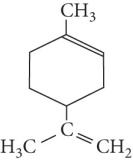
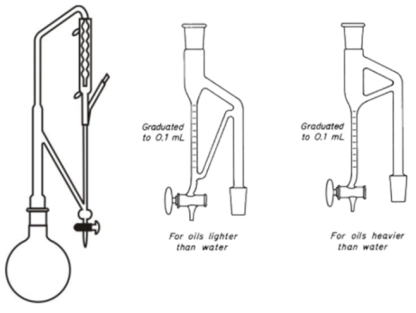
Figure 2. Apparatus for the quantitation of essential oils in peels (Clevenger apparatus).
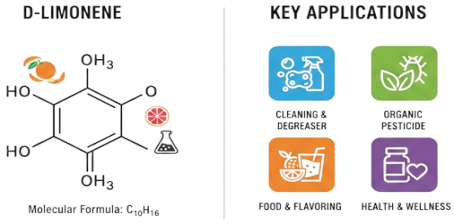
Figure 3. D-Limonene Structure and importance.
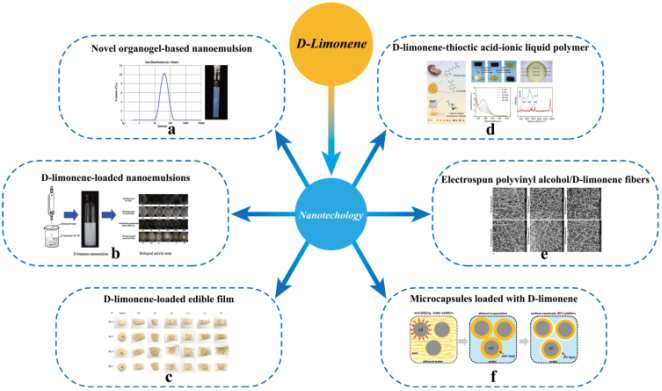
Figure 4. Various delivery and application systems incorporating D-limonene: (a) D-limonene formulated in a novel organogel-based nanoemulsion; (b) nanoemulsions encapsulating D-limonene; (c) edible films containing D-limonene; (d) D-limonene–thioctic acid–ionic liquid polymer systems; (e) electrospun poly (vinyl alcohol)/ D-limonene fibrous mats; and (f) microcapsules encapsulating D-limonene [42].
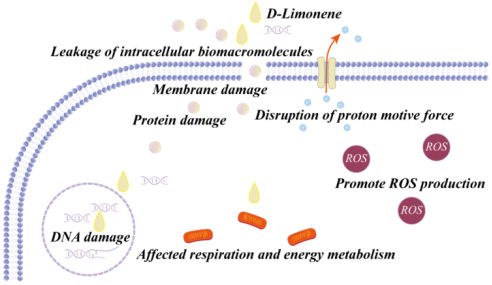
Figure 5. Schematic illustration of the antimicrobial mechanisms associated with D-limonene [42].

Information



 Share This Article
 Twitter
 Linked In
 Facebook
 Copy
Copy Download