An expansion of irrigated agriculture is greatly contributing to the build-up of and spread of salinity problems. A small-scale evaluation and demonstration of soil salinity reclamation technology was done to evaluate yield and profitability performances on onion crop under farmers management conditions at small scale irrigation farms in Dugda district, Oromia, Ethiopia. Appropriate sites were selected in collaboration with district level agricultural experts and development agents based on soil salinity problems. Plots were divided in to two treatments of gypsum applied at 100 gypsum requirement which is 4ton/ha in combination with 2.5ton/ha of compost and farmers fertilization practices with no application of gypsum and compost. The treatments were replicated across 10 trial farmers’ fields. Both quantitative and qualitative data were collected and analyzed using descriptive statistics, t-test and qualitatively. The best yield was gained from plots where gypsum (4ton/ha) and compost (2.5ton/ha) were applied together. This combined approach outperformed the other treatments, and the difference were statistically significant based on t-test results. Notably, gypsum treated plots produced a yield advantage of 12.4% higher than the untreated plots and a marginal rate of return of 1.75. The participant farmers also gave positive feedback regarding the soil salinity reclamation technology. Hence, applying gypsum at 100 gypsum requirement in combination with compost is recommended for reclaiming salt affected soils in the district and similar agro-ecologies.
This is an Open Access article, distributed under the terms of the Creative Commons Attribution 4.0 International License (http://creativecommons.org/licenses/by/4.0/), which permits unrestricted use, distribution and reproduction in any medium or format, provided the original work is properly cited.
. Globally this condition impacts roughly 7% of the total landmass
[3]
Aly Z, Bonn F, Magagi R. Modelling the Backscattering Coefficient of Salt-Affected Soil: Application To Wadi El-Natrun Bottom, Egypt. EARSeL EProceedings 2004: 372–81.
. Such soils are predominantly found in dryland areas where there is limited rainfall to leach the accumulated soluble salt
[4]
Demo AH, Gemeda MK, Abdo DR, Guluma TN, Adugna DB. Impact of soil salinity, sodicity, and irrigation water salinity on crop production and coping mechanism in areas of dryland farming. Agrosystems, Geosci Environ 2025; 8: e70072.
. The accumulation of salt in agricultural soil compromises their structural stability suppresses microbial activity and leads to a reduction in soil porosity
[3]
Aly Z, Bonn F, Magagi R. Modelling the Backscattering Coefficient of Salt-Affected Soil: Application To Wadi El-Natrun Bottom, Egypt. EARSeL EProceedings 2004: 372–81.
. Consequently, vegetative growth is hindered because of physiological stress, reduced mineral and moisture uptake
[5]
Manhou K, Moussadek R, Dakak H, Zouahri A, Ghanimi A, Sanad H, Oueld Lhaj M, Hmouni D. Effect of Irrigation with Saline Water on Germination, Physiology, Growth, and Yield of Durum Wheat Varieties on Silty Clay Soil. Agric 2025, Vol 15, Page 2364 2025; 15: 2364.
In Ethiopia, in regions where there is escalated evapotranspiration outpacing rainfall, severe soil salinity poses a critical challenge particularly across heavily irrigated areas
[6]
Getahun M, Adgo E, Regassa Tolossa A, Getahun Z. Soil salinity sodicity and irrigation water quality in the Ethiopian Main Rift Valley and implications for sustainable management. Res Sq 2026.
Gelu G, Komai K, Dane C, Ayza A, Ayele T. Investigating the salinity distribution using field measurements in the semi-arid region of southern Ethiopia. Environ Monit Assess 2025 1972 2025; 197: 159-.
, in Ethiopia, salinity is a widespread concern affecting the livelihood of 9% of the population. About 44 million hectares, or 36% of the national land area are prone to salinization, while over 11 million hectares of land remain unproductive
[9]
Admas H, Abbi S, Kassahun T. Assessment of salt-affected soil extent and spatial variability using GIS and remote sensing in Asaita district, Northeastern Ethiopia. Sci Rep 2025; 15: 1–17.
Ma L, Li J, Li J, Huo Y, Yang Y, Jiang C, Guo Y. Plant salt tolerance mechanisms: Classic signaling pathways, emerging frontiers, and future perspectives. Mol Plant 2025; 19: 538–70.
The expansion of salt affected soils represents a driver soil degradation undermining agricultural productivity by exerting adverse impacts on the biological, physical and chemical dynamics of the soil system
[11]
Hailu B, Mehari H. Impacts of Soil Salinity/Sodicity on Soil-Water Relations and Plant Growth in Dry Land Areas: A Review. J Nat Sci Res 2021; 12: 1–10.
. One of the areas affected by such challenge is East Shewa zone of Oromia, Ethiopia. In the zone, where irrigated productions are common soil salinity is one of the major challenges due to high evapotranspiration rates and lower precipitation
[12]
Kitila K, Jalde A, Workina M. Evaluation and Characterization of Soil Salinity Status at Small-Scale Irrigation Farms at Bora and Lume Districts of East Showa Zone, Oromia, Ethiopia. Sci J Anal Chem 2017; 1: 31.
Kasahun Kitila and Abay Chala. Evaluation of combined and sole effect of application of gypsum and compost for soil salinity management at small scale irrigation farm in Dugda District of East. Discov Agric 2020; 6: 19–29.
[14]
Alemayehu Kiflu. Gypsum and water level effects on central rift valley sodic soils of Ethiopia. Int J Soil Sci 2021; 16: 20–5.
Kitila K, Jalde A, Workina M. Evaluation and Characterization of Soil Salinity Status at Small-Scale Irrigation Farms at Bora and Lume Districts of East Showa Zone, Oromia, Ethiopia. Sci J Anal Chem 2017; 1: 31.
about 75% of the farmers in Lume and Bora districts of East Shewa zone are using ground water for irrigation. Yet, as highlighted by
[12]
Kitila K, Jalde A, Workina M. Evaluation and Characterization of Soil Salinity Status at Small-Scale Irrigation Farms at Bora and Lume Districts of East Showa Zone, Oromia, Ethiopia. Sci J Anal Chem 2017; 1: 31.
this reliance has triggered soil sodicity problem and farmers using ground water are dealing with soils characterized by higher PH vales than 8.2 and Ec under 4 ds/m and ESP exceeding 31. While various interventions exist to tackle this issue, the choice of strategy depends on availability of materials locally and farmers awareness. In Egypt for example, where Gypsum is practiced for reclamation of saline-sodic and sodic soils
[15]
Abdel-Fattah MK. Role of gypsum and compost in reclaiming saline-sodic soils. IOSR J Agric Vet Sci 2012; 1: 30–8.
. Pairing this practice with organic matter is a successful strategy for improving soil properties
[16]
Gidey A, Haile M, Abrha B, Demissie B, Teka K, Atsbha Hailu T, Kahessay AR. Sodic soil amendments and reclamation to restore soil fertility and optimize grain yield and quality of sesame (Sesamum indicum L.) in Tigray, Ethiopia. Agrosystems, Geosci Environ 2026; 9: 1–19.
In the context of East Shewa zone of Oromia, empirical findings from
[17]
Kasahun Kitila, Abay Chala, Mekkonnen Workina. Effect of gypsum and compost application in reclaiming sodic soils at small scale irrigation farm in Bora district of East Shewa Zone, Oromia, Ethiopia. Agriways 2020: 28–44.
reported co-applying the full gypsum rate (100% GR) combined with 2.5 t ha-1 of compost is effective for the reclamation of salt degraded soils. Hence, implementing an integrated approach that combines gypsum and compost is essential for restoring soil affected by salinity subsequently boosting overall crop production and productivity. Yet, this approach has not been demonstrated in the study area. Therefore, demonstrating and evaluating of the technology under farmers circumstance is paramount important. Thus, this study was prepared to answer the specific objectives listed below.
Objectives
1) To demonstrate and estimate the performances of integrated application of gypsum and compost on soil salinity reclamation under participatory small holder farmers managed situations.
2) To determine the economic viability and net financial return of integrated soil salinity reclamation strategy within small holder farming systems.
3) To document participant farmers feedbacks.
2. Material and Methods
2.1. Description of the Study Area
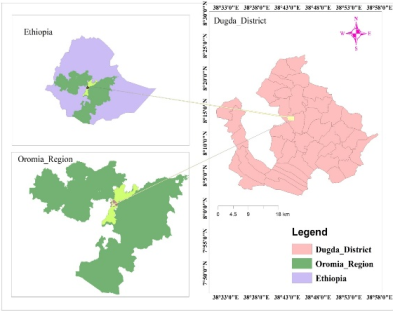
The study was carried out in Dugda district, an area within East Shewa Zone, Oromia, Ethiopia where small-scale irrigation farming is the economic cornerstone of local farming community. Despite its agricultural prominences the district faces land degradation driven by escalating soil salinity constraints. Geographically, the districts capital town Meki is located at 135km from Addis Ababa, and 100km from zonal capital, Adama. Dugda district spans a total landmass of 751 km2 representing roughly 5.2% of East shewa zone aggregate area partitioned with 18 administrative kebele’s. Climatologically, the district features a mean annual temperature of 26°C paired with mean annual rainfall of 636mm. The local agricultural landscape is divided into rainfed and irrigation productions where the rainfed production is dominated by wheat, teff and maize while the irrigation production prioritizes cash crops such as tomato, onion, pepper and head cabbage.
The study was done within selected kebele of Dugda districts of East Shewa zone, Oromia, Ethiopia. A purposively sampling approach was employed to select targeted Kebele, prioritizing onion cultivation potential and pronounced soil salinity constraints. Consequently, a Farmers Research Group (FRG) approach was used to select and organize farmers. The organized group had 15 members among which three of them were host or trial farmers who allocated required land size for the trail establishment.
2.3. Awareness Creation Sessions
Prior to implementing the demonstration trials capacity building session regarding onion production along with salt affected soil mitigation strategies were delivered. Furthermore, informative field sessions with farmers and agricultural experts to witness field performances of the crop as well as to exchange practical knowledge and skill on soil salinity reclamation technologies were conducted.
2.4. Demonstration Design
The demonstration trial was laid down on a simple plot design on a 10*10m land size per treatment replicated across trial farmers. The treatments were.
2.5. Treatments
1) Onion planted with applied gypsum at 100% GR (4ton/h) and (2.5t/ha) of compost.
2) Onion planted using farmers practice/no application gypsum and compost (Control).
2.6. Agronomic Management
The management of the demonstration were done in collaboration with researchers and the trial farmers. The trial farmers have conducted everyday activities with frequent technical and financial support. Throughout the duration of the crop, researchers provided routing and delivered technical guidance regarding optimal agronomic management practices for the onion crop.
Packaged Production technologies (spacing, fertilizer management) were used to establish the demonstration plots. Bombay red onion variety was the onion variety used. The onion plants were irrigated using furrow irrigation system with farmers’ practice of irrigation intervals. The plans were established with 20cm spacing between rows and 5-7.5cm between plants. NPS fertilizer was applied at planting time. Nitrogen application was executed using split dose of urea, with the initial 50% applied as half dressing after 15 days of transplanting and the rest was applied 45 days later. The full dose of phosphorus was applied at the time of planting. Plots were also be kept free of weeds and pant protection activities were done using agro chemicals.
2.7. Data Collected and Method of Data Collection
The following data were collected while implementing the activity:
1) Crop yield and yield components data.
2) financial data, costs incurred, and revenues gained.
3) Gender disaggregated attendance log on involvement of farmers across training and field demonstration sessions.
4) Farmers opinions/ feedbacks.
The data were collected using checklists and data collection sheets.
2.8. Data Analysis
To evaluate treatment variances onion bulb yields were subjected to SPSS v20 software. Descriptive statistics mainly mean was used to analyze the yield. Independent T-test was also used to see if there is statistical significance among treatments. To determine the financial viability of the treatments partial budget analysis was employed. Farmer feed backs/ preferences were summarized using qualitatively described using ranking.
3. Result and Discussion
3.1. Yield Performances
The following table describes the tuber yield performances across the two treatments presented as demonstrations. The findings revealed that the integrated use of gypsum (4 t/ha) and compost (2.5 t/ha) significantly enhanced crop yield compared to other treatments. Statistical analysis using the t-test confirmed these differences to be significant, and as evidenced in the figures, gypsum-treated plots achieved a yield superiority of 12.4% over the untreated plots. Thus, the results found is in line with studies made by
[13]
Kasahun Kitila and Abay Chala. Evaluation of combined and sole effect of application of gypsum and compost for soil salinity management at small scale irrigation farm in Dugda District of East. Discov Agric 2020; 6: 19–29.
[18]
Rahayu R, Syamsiyah J, Dewi L. Effects of Gypsum and Zeolite on Nutrient Uptake and Shallot (Allium ascalonium L.) Growth on Irrigated Saline Entisol. J Trop Soils 2019; 24: 73–81.
Favaretto N, Norton LD, Joern BC, Brouder SM. Gypsum Amendment and Exchangeable Calcium and Magnesium Affecting Phosphorus and Nitrogen in Runoff. Soil Sci Soc Am J 2006; 70: 1788–96.
Table 2. T-test result Onion Yield performances with /without soil salinity treatments.
t-test
Result
t-statistic
3.97
Degrees of Freedom (df)
18
P value
0.001
3.2. Yield Component Performances
The study also tried to see the performances on the onion crop in terms of its yield components performances when the land planted on is treated with integrated application of gypsum and compost or not. Hence, improved performances were observed as expected. Accordingly, the land treated with gypsum has better plant height, leaf number per plant and bulb sizes than farmers' practice. Which generally indicators of healthy plant growth and optimal growing conditions as discussed by
[18]
Rahayu R, Syamsiyah J, Dewi L. Effects of Gypsum and Zeolite on Nutrient Uptake and Shallot (Allium ascalonium L.) Growth on Irrigated Saline Entisol. J Trop Soils 2019; 24: 73–81.
Favaretto N, Norton LD, Joern BC, Brouder SM. Gypsum Amendment and Exchangeable Calcium and Magnesium Affecting Phosphorus and Nitrogen in Runoff. Soil Sci Soc Am J 2006; 70: 1788–96.
In-terms of profitability both practices were found to be profitable in their benefit cost ratio. Yet, treating land with gypsum and compost has an additional productions advantage which yielded a MRR of 1.75. A Marginal Rate of Return (MRR) of 1.75 indicates that for every additional birr invested the return generated is 1.75 birr (75% return) suggesting as the investment is profitable. Thus, the practice generates more income than it costs, which is a positive sign for decision-making. The following table describes further quantifications.
Table 4. PBA of Onion Production compared by using the two treatments.
Location: Dugda District
Parameters
Treatments
Farmers Practice
Land treated with Gypsum and compost
Tuber Yield in qt/ha
238.98
273.42
Selling Price of onion/qt
4000
4000
Total Revenue gained
955,920.00
1,093,680.00
Variable costs (TVC)
184000
234,000
Fixed costs (Land rent cost)
75000
75000
Total Cost (TVC + Fixed Cost)
259000
309,000
Gross Margin (GM) = TR-TVC
771,920.00
859,680.00
Profit= GM-TFC
696,920.00
784,680.00
Benefit Cost Ratio
2.69
2.54
Change in Profit
87,760.00
Change in costs
50,000
MRR
1.75
3.4. Farmers Feedbacks
The participant farmers were let to observe the performances of the test crop onion on the land treated with integrated gypsum and compost application and their own practices. The participant farmers then were let to provide their feedbacks and select among the practices. Thus, treating salt affected lad with integrated application of gypsum and compost at the specified rates was selected due to observable good yield, Good plant height bulb sizes, healthy plants.
Table 5. Farmers feedback regarding the practices.
Practice
Rank
Reasons
Treatment of salt affected lands with Gypsum and compost
1
Good yield, Good plant height bulb sizes, healthy plant, better profitability
Farmer’s practice
2
Lower yield, lower performances when compared
4. Conclusion and Recommendations
The study provided a practical platform for small holder farmers to directly assess the effectiveness of salt affected soil reclamation technology on onion crop. Subsequent statistical evaluations verified that; the evaluated salinity reclamation practices yielded a statistically significant differences in onion productivity. Better yield and profitability were also recorded from land treated with integrated gypsum and compost applications. The participant farmers also selected the practice given its good yield and yield component performances. Thus, integrated application of gypsum at 100% GR and (2.5t/ha) of compost is recommended to reclaim for salt affected soils in the study areas.
Abbreviations
FRG
Farmers Research Group
GR
Gypsum Requirement
MRR
Marginal Rate of Return
Acknowledgments
The authors acknowledge Oromia Agricultural Research Institute for Funding and Adami Tulu Agricultural Research center for allocation of logistics and facilities required for accomplishing the research activity.
Author Contributions
Tesfaye Gemechu: Conceptualization, Data Curation, Methodology, Investigation, Formal Analysis
Kasahun Kitila: Conceptualization, Methodology
Abay Chala: Conceptualization, Methodology
Conflicts of Interest
The authors declare no conflict of interest.
References
[1]
Tejedor M, Jiménez C, Of FD-SSS, 2003 U. Use of volcanic mulch to rehabilitate saline‐sodic soils. Wiley Online Libr 2003; 67: 1856–61.
Aly Z, Bonn F, Magagi R. Modelling the Backscattering Coefficient of Salt-Affected Soil: Application To Wadi El-Natrun Bottom, Egypt. EARSeL EProceedings 2004: 372–81.
Demo AH, Gemeda MK, Abdo DR, Guluma TN, Adugna DB. Impact of soil salinity, sodicity, and irrigation water salinity on crop production and coping mechanism in areas of dryland farming. Agrosystems, Geosci Environ 2025; 8: e70072.
Manhou K, Moussadek R, Dakak H, Zouahri A, Ghanimi A, Sanad H, Oueld Lhaj M, Hmouni D. Effect of Irrigation with Saline Water on Germination, Physiology, Growth, and Yield of Durum Wheat Varieties on Silty Clay Soil. Agric 2025, Vol 15, Page 2364 2025; 15: 2364.
Getahun M, Adgo E, Regassa Tolossa A, Getahun Z. Soil salinity sodicity and irrigation water quality in the Ethiopian Main Rift Valley and implications for sustainable management. Res Sq 2026.
Gelu G, Komai K, Dane C, Ayza A, Ayele T. Investigating the salinity distribution using field measurements in the semi-arid region of southern Ethiopia. Environ Monit Assess 2025 1972 2025; 197: 159-.
Admas H, Abbi S, Kassahun T. Assessment of salt-affected soil extent and spatial variability using GIS and remote sensing in Asaita district, Northeastern Ethiopia. Sci Rep 2025; 15: 1–17.
Ma L, Li J, Li J, Huo Y, Yang Y, Jiang C, Guo Y. Plant salt tolerance mechanisms: Classic signaling pathways, emerging frontiers, and future perspectives. Mol Plant 2025; 19: 538–70.
Hailu B, Mehari H. Impacts of Soil Salinity/Sodicity on Soil-Water Relations and Plant Growth in Dry Land Areas: A Review. J Nat Sci Res 2021; 12: 1–10.
Kitila K, Jalde A, Workina M. Evaluation and Characterization of Soil Salinity Status at Small-Scale Irrigation Farms at Bora and Lume Districts of East Showa Zone, Oromia, Ethiopia. Sci J Anal Chem 2017; 1: 31.
Kasahun Kitila and Abay Chala. Evaluation of combined and sole effect of application of gypsum and compost for soil salinity management at small scale irrigation farm in Dugda District of East. Discov Agric 2020; 6: 19–29.
[14]
Alemayehu Kiflu. Gypsum and water level effects on central rift valley sodic soils of Ethiopia. Int J Soil Sci 2021; 16: 20–5.
Gidey A, Haile M, Abrha B, Demissie B, Teka K, Atsbha Hailu T, Kahessay AR. Sodic soil amendments and reclamation to restore soil fertility and optimize grain yield and quality of sesame (Sesamum indicum L.) in Tigray, Ethiopia. Agrosystems, Geosci Environ 2026; 9: 1–19.
Kasahun Kitila, Abay Chala, Mekkonnen Workina. Effect of gypsum and compost application in reclaiming sodic soils at small scale irrigation farm in Bora district of East Shewa Zone, Oromia, Ethiopia. Agriways 2020: 28–44.
Rahayu R, Syamsiyah J, Dewi L. Effects of Gypsum and Zeolite on Nutrient Uptake and Shallot (Allium ascalonium L.) Growth on Irrigated Saline Entisol. J Trop Soils 2019; 24: 73–81.
Favaretto N, Norton LD, Joern BC, Brouder SM. Gypsum Amendment and Exchangeable Calcium and Magnesium Affecting Phosphorus and Nitrogen in Runoff. Soil Sci Soc Am J 2006; 70: 1788–96.
Gemechu, T., Kitila, K., Chala, A. (2026). Evaluation and Demonstration of Combined Application of Gypsum (CaSO4) and Compost for Soil Salinity Management in East Shewa Zone, Oromia, Ethiopia. Science Frontiers, 7(3), 59-64. https://doi.org/10.11648/j.sf.20260703.11
Gemechu, T.; Kitila, K.; Chala, A. Evaluation and Demonstration of Combined Application of Gypsum (CaSO4) and Compost for Soil Salinity Management in East Shewa Zone, Oromia, Ethiopia. Sci. Front.2026, 7(3), 59-64. doi: 10.11648/j.sf.20260703.11
Gemechu T, Kitila K, Chala A. Evaluation and Demonstration of Combined Application of Gypsum (CaSO4) and Compost for Soil Salinity Management in East Shewa Zone, Oromia, Ethiopia. Sci Front. 2026;7(3):59-64. doi: 10.11648/j.sf.20260703.11
@article{10.11648/j.sf.20260703.11,
  author = {Tesfaye Gemechu and Kasahun Kitila and Abay Chala},
  title = {Evaluation and Demonstration of Combined Application of Gypsum (CaSO4) and Compost for Soil Salinity Management in East Shewa Zone, Oromia, Ethiopia},
  journal = {Science Frontiers},
  volume = {7},
  number = {3},
  pages = {59-64},
  doi = {10.11648/j.sf.20260703.11},
  url = {https://doi.org/10.11648/j.sf.20260703.11},
  eprint = {https://article.sciencepublishinggroup.com/pdf/10.11648.j.sf.20260703.11},
  abstract = {An expansion of irrigated agriculture is greatly contributing to the build-up of and spread of salinity problems. A small-scale evaluation and demonstration of soil salinity reclamation technology was done to evaluate yield and profitability performances on onion crop under farmers management conditions at small scale irrigation farms in Dugda district, Oromia, Ethiopia. Appropriate sites were selected in collaboration with district level agricultural experts and development agents based on soil salinity problems. Plots were divided in to two treatments of gypsum applied at 100 gypsum requirement which is 4ton/ha in combination with 2.5ton/ha of compost and farmers fertilization practices with no application of gypsum and compost. The treatments were replicated across 10 trial farmers’ fields. Both quantitative and qualitative data were collected and analyzed using descriptive statistics, t-test and qualitatively. The best yield was gained from plots where gypsum (4ton/ha) and compost (2.5ton/ha) were applied together. This combined approach outperformed the other treatments, and the difference were statistically significant based on t-test results. Notably, gypsum treated plots produced a yield advantage of 12.4% higher than the untreated plots and a marginal rate of return of 1.75. The participant farmers also gave positive feedback regarding the soil salinity reclamation technology. Hence, applying gypsum at 100 gypsum requirement in combination with compost is recommended for reclaiming salt affected soils in the district and similar agro-ecologies.},
 year = {2026}
}
TY  - JOUR
T1  - Evaluation and Demonstration of Combined Application of Gypsum (CaSO4) and Compost for Soil Salinity Management in East Shewa Zone, Oromia, Ethiopia
AU  - Tesfaye Gemechu
AU  - Kasahun Kitila
AU  - Abay Chala
Y1  - 2026/07/03
PY  - 2026
N1  - https://doi.org/10.11648/j.sf.20260703.11
DO  - 10.11648/j.sf.20260703.11
T2  - Science Frontiers
JF  - Science Frontiers
JO  - Science Frontiers
SP  - 59
EP  - 64
PB  - Science Publishing Group
SN  - 2994-7030
UR  - https://doi.org/10.11648/j.sf.20260703.11
AB  - An expansion of irrigated agriculture is greatly contributing to the build-up of and spread of salinity problems. A small-scale evaluation and demonstration of soil salinity reclamation technology was done to evaluate yield and profitability performances on onion crop under farmers management conditions at small scale irrigation farms in Dugda district, Oromia, Ethiopia. Appropriate sites were selected in collaboration with district level agricultural experts and development agents based on soil salinity problems. Plots were divided in to two treatments of gypsum applied at 100 gypsum requirement which is 4ton/ha in combination with 2.5ton/ha of compost and farmers fertilization practices with no application of gypsum and compost. The treatments were replicated across 10 trial farmers’ fields. Both quantitative and qualitative data were collected and analyzed using descriptive statistics, t-test and qualitatively. The best yield was gained from plots where gypsum (4ton/ha) and compost (2.5ton/ha) were applied together. This combined approach outperformed the other treatments, and the difference were statistically significant based on t-test results. Notably, gypsum treated plots produced a yield advantage of 12.4% higher than the untreated plots and a marginal rate of return of 1.75. The participant farmers also gave positive feedback regarding the soil salinity reclamation technology. Hence, applying gypsum at 100 gypsum requirement in combination with compost is recommended for reclaiming salt affected soils in the district and similar agro-ecologies.
VL  - 7
IS  - 3
ER  -
Gemechu, T., Kitila, K., Chala, A. (2026). Evaluation and Demonstration of Combined Application of Gypsum (CaSO4) and Compost for Soil Salinity Management in East Shewa Zone, Oromia, Ethiopia. Science Frontiers, 7(3), 59-64. https://doi.org/10.11648/j.sf.20260703.11
Gemechu, T.; Kitila, K.; Chala, A. Evaluation and Demonstration of Combined Application of Gypsum (CaSO4) and Compost for Soil Salinity Management in East Shewa Zone, Oromia, Ethiopia. Sci. Front.2026, 7(3), 59-64. doi: 10.11648/j.sf.20260703.11
Gemechu T, Kitila K, Chala A. Evaluation and Demonstration of Combined Application of Gypsum (CaSO4) and Compost for Soil Salinity Management in East Shewa Zone, Oromia, Ethiopia. Sci Front. 2026;7(3):59-64. doi: 10.11648/j.sf.20260703.11
@article{10.11648/j.sf.20260703.11,
  author = {Tesfaye Gemechu and Kasahun Kitila and Abay Chala},
  title = {Evaluation and Demonstration of Combined Application of Gypsum (CaSO4) and Compost for Soil Salinity Management in East Shewa Zone, Oromia, Ethiopia},
  journal = {Science Frontiers},
  volume = {7},
  number = {3},
  pages = {59-64},
  doi = {10.11648/j.sf.20260703.11},
  url = {https://doi.org/10.11648/j.sf.20260703.11},
  eprint = {https://article.sciencepublishinggroup.com/pdf/10.11648.j.sf.20260703.11},
  abstract = {An expansion of irrigated agriculture is greatly contributing to the build-up of and spread of salinity problems. A small-scale evaluation and demonstration of soil salinity reclamation technology was done to evaluate yield and profitability performances on onion crop under farmers management conditions at small scale irrigation farms in Dugda district, Oromia, Ethiopia. Appropriate sites were selected in collaboration with district level agricultural experts and development agents based on soil salinity problems. Plots were divided in to two treatments of gypsum applied at 100 gypsum requirement which is 4ton/ha in combination with 2.5ton/ha of compost and farmers fertilization practices with no application of gypsum and compost. The treatments were replicated across 10 trial farmers’ fields. Both quantitative and qualitative data were collected and analyzed using descriptive statistics, t-test and qualitatively. The best yield was gained from plots where gypsum (4ton/ha) and compost (2.5ton/ha) were applied together. This combined approach outperformed the other treatments, and the difference were statistically significant based on t-test results. Notably, gypsum treated plots produced a yield advantage of 12.4% higher than the untreated plots and a marginal rate of return of 1.75. The participant farmers also gave positive feedback regarding the soil salinity reclamation technology. Hence, applying gypsum at 100 gypsum requirement in combination with compost is recommended for reclaiming salt affected soils in the district and similar agro-ecologies.},
 year = {2026}
}
TY  - JOUR
T1  - Evaluation and Demonstration of Combined Application of Gypsum (CaSO4) and Compost for Soil Salinity Management in East Shewa Zone, Oromia, Ethiopia
AU  - Tesfaye Gemechu
AU  - Kasahun Kitila
AU  - Abay Chala
Y1  - 2026/07/03
PY  - 2026
N1  - https://doi.org/10.11648/j.sf.20260703.11
DO  - 10.11648/j.sf.20260703.11
T2  - Science Frontiers
JF  - Science Frontiers
JO  - Science Frontiers
SP  - 59
EP  - 64
PB  - Science Publishing Group
SN  - 2994-7030
UR  - https://doi.org/10.11648/j.sf.20260703.11
AB  - An expansion of irrigated agriculture is greatly contributing to the build-up of and spread of salinity problems. A small-scale evaluation and demonstration of soil salinity reclamation technology was done to evaluate yield and profitability performances on onion crop under farmers management conditions at small scale irrigation farms in Dugda district, Oromia, Ethiopia. Appropriate sites were selected in collaboration with district level agricultural experts and development agents based on soil salinity problems. Plots were divided in to two treatments of gypsum applied at 100 gypsum requirement which is 4ton/ha in combination with 2.5ton/ha of compost and farmers fertilization practices with no application of gypsum and compost. The treatments were replicated across 10 trial farmers’ fields. Both quantitative and qualitative data were collected and analyzed using descriptive statistics, t-test and qualitatively. The best yield was gained from plots where gypsum (4ton/ha) and compost (2.5ton/ha) were applied together. This combined approach outperformed the other treatments, and the difference were statistically significant based on t-test results. Notably, gypsum treated plots produced a yield advantage of 12.4% higher than the untreated plots and a marginal rate of return of 1.75. The participant farmers also gave positive feedback regarding the soil salinity reclamation technology. Hence, applying gypsum at 100 gypsum requirement in combination with compost is recommended for reclaiming salt affected soils in the district and similar agro-ecologies.
VL  - 7
IS  - 3
ER  -





 Share This Article
 Twitter
 Linked In
 Facebook
 Copy
Copy Download