Research Article | | Peer-Reviewed

Exploring the Impact of Demographic Characteristics on Access to Basic Social Services in Ghana: A Multivariate Regression Analysis Approach

Received: 15 April 2026     Accepted: 24 April 2026     Published: 16 May 2026
Views:       Downloads:
Abstract

Most people living in the underserved rural communities in Ghana, do not have access to basic social services, such as portable water, electricity, mobile phones and internet, to promote healthy and productive living. Consequently, this research explores the influence of demographic variables on people access to basic social amenities using the Afrobarometer survey Round 10 data on Ghana. A total of 2,400 respondents were randomly sampled across all districts in the 16 regions. Structured questionnaires were the main instruments used for data collection. The data was analyzed using inferential statistics, such as correlation and multivariate regression analysis to test the hypotheses. The findings show a significant effect of socio-spatial, educational, and gender disparities in access to basic social services in the country. Individual level of education emerged as a strong predictor of access to the internet, mobile phone ownership and portable water. People's location, particularly the rural-urban divide, proved to be a major determinant of access to basic social amenities, while regional inequalities were evident across nearly all the outcome variables. The study recommends positioning education as a central instrument for socio-economic empowerment and civic engagement; targeted, context-specific development planning policies that prioritize expansion of infrastructure and social amenities to underserved communities; bridging the digital divide; and implementation of gender-sensitive digital inclusion strategies to reduce technology access gaps that constrain women's socio-political participation.

Published in Social Sciences (Volume 15, Issue 3)
DOI 10.11648/j.ss.20261503.11
Page(s) 101-117
Creative Commons

This is an Open Access article, distributed under the terms of the Creative Commons Attribution 4.0 International License (http://creativecommons.org/licenses/by/4.0/), which permits unrestricted use, distribution and reproduction in any medium or format, provided the original work is properly cited.

Copyright

Copyright © The Author(s), 2026. Published by Science Publishing Group

Keywords

Basic Social Services, Demographic Characteristics, Digital Divide, Multivariate Analysis, Statistics

1. Introduction
In this information age characterized by globalization and digitalization, citizens ought to have access to basic social services, such as internet, mobile phones, portable water and electricity, to enable them to function effectively and efficiently in society. Access to these social services is a critical determinant of socio-economic development, particularly in a developing country such as Ghana. However, availability and access to these social amenities varied from one community to another. For instance, despite widespread advancements in technology and digital infrastructure, disparities in access to these services persist, triggered by a wide range of demographic variables such as age, gender, geographical location, religion and income levels. Unpacking the level at which these demographic characteristics shape access to these vital social services is essential for policymakers planning to create inclusive and equitable developmental frameworks that meet the diverse needs of the people. A recent study by emphasizes the substantial role that demographic factors play in shaping access to technology and other social services in Ghana’s heterogeneous society. It was also found that the digital divide persists, but with the influx of mobile technology and the internet, there is an opportunity to bridge that digital divide and connectivity gaps. The digital divide not only restricts individual opportunities for education and economic advancement but also hinders general societal growth by exacerbating inequalities. Empirical studies have demonstrated that individuals from rural communities are less likely to own mobile devices or have access to reliable internet compared to their counterparts in urban contexts . As a result, evaluating how demographic variables correlate with access to these social amentias is imperative for understanding the local landscape to support design-targeted strategies to resolve those disparities. Moreover, access to portable water and electricity remains a pressing issue in most Ghanaian communities, where demographic variables, such as age, location and gender, can significantly influence access to these resources and usage. An empirical study conducted by found that women and children, who are responsible for water collection, face additional challenges related to time and physical effort, potentially limiting opportunities for education and employment. Similarly, age disparities create varied access patterns, with younger individuals in urban settings having better access to electricity due to higher infrastructural investments, while older generations in rural contexts may still rely on traditional sources. Hence, a comprehensive study into these trends is critical for fostering equitable social service distribution across all segments of the population.
Governance should be about the welfare and needs of the people. For instance, posit that social democratic governance models are vital for fulfilling social justice, reducing development disparities, empowering citizens and meeting their needs within a state. In agreement, and in their multiple cross-national surveys found that democratic institutions, good governance and citizenship well-being largely contribute to the achievement of Sustainable Development Goals (SDGs). The decentralization reforms in research in Ghana and in Bolivia demonstrate how governance reforms in democratic settings bring service delivery closer to citizens by improving infrastructure, access to quality healthcare, education and local participation. Despite these democratic gains, challenges persist. Access to social services, such as internet, mobile phones, portable water and electricity plays a vital role in promoting health, enhancing the quality of life and fostering socio-economic development. However, in Ghana, significant inequalities persist in access to these social services, raising concerns about disparities that hinder progress in various sectors . Although national data indicate considerable progress in service coverage, such as an estimated internet penetration rate of 70% as of 2025 , these figures illustrates deep demographic disparities. Evidence from the reveals that 1 in 5 Ghanaians aged 6 years and above remains digitally excluded, with women, older adults, persons with disabilities and individuals from low-income households being disproportionately affected. Similarly, access to portable water and electricity continues to show marked spatial and socio-economic differences, with 89% of urban households having access to basic water services compared to 72% in rural areas . These inequalities suggest that demographic factors significantly influence who benefits from infrastructural development and who remains excluded from these essential services.
Despite the expansion of infrastructure and ICT services, equitable access remains elusive. For example, while Ghana’s electrification rates reached almost 89% in 2024, rural access remained lower at approximately 76.7%, compared to near-universal urban coverage . Moreover, although 54% of individuals aged 5 years and above owned a functional mobile phone in 2019, only 16.8% of households had internet access, with rural households experiencing lower ownership and connectivity rates . These trends underscore the role of demographic variables such as age, gender, religion, residential location, income level, and level of education in shaping differential access to critical social services. Furthermore, the interconnections between digital inclusion and basic infrastructural access necessitate an integrated analytical approach. Access to mobile phones and the internet increasingly determines people's participation in economic, educational, political and social spheres, including digital financial services and e-learning platforms . However, when access remains stratified along demographic lines, particularly for women, children and rural populations, such exclusion exacerbates existing social inequalities in access to basic social services . Disparities in these vital social services have broader implications for health, education and livelihoods of the citizens, especially the marginalized. As a result, examining the correlation between demographic characteristics and access to these services is critical for understanding the multidimensional nature of inequalities and its implications for citizenship participation in governance processes.
2. Literature Review
This section reviewed the literature connected to the study constructs. Theoretical framework as well as empirical review of related literature are also presented.
2.1. Theoretical Framework
This study is anchored on three complementary theoretical frameworks, namely; Digital Divide Theory (DDT), Capability Theory (CT), and Resource-Conversion Theory (RCT), to examine how demographic factors influence access to essential services in Ghana. The Digital Divide Theory explains disparities in access to and use of information and communication technologies (ICTs) as outcomes of broader socio-economic, political, and demographic inequalities . Empirical research indicates that factors such as gender, geographic location, age, religion, educational attainment, and income level structure unequal opportunities to benefit from digital infrastructure . Within the Ghanaian context, rural populations, women, and individuals with lower educational attainment are disproportionately affected by limited access to internet connectivity and digital technologies due to infrastructural deficits and socio-cultural constraints . Consequently, the digital divide framework provides a useful analytical lens for interpreting how demographic inequalities shape access to modern technological and utility services. Complementing this perspective, the capability approach conceptualizes development in terms of individuals’ substantive freedoms to convert available resources into valued functioning . Access to resources such as internet services, mobile phones, electricity, and portable water can therefore enhance capabilities related to education, communication, and health. However, demographic attributes, such as age, gender, location, religion, and income, act as conversion factors that influence the extent to which these resources translate into meaningful opportunities . For instance, restrictive cultural norms may limit individuals’ effective use of digital technologies even when such services are physically available. Extending these perspectives, the Resources Conversion Framework emphasizes that equitable access depends on interrelated dimensions, including technological availability, affordability, digital skills, and socio-cultural motivation . These dimensions are mediated by demographic characteristics that can either enable or constrain access. Integrating these theoretical perspectives therefore provides a comprehensive framework for analyzing how demographic variables influence the distribution and utilization of essential social services in Ghana and underscores the need for policies that promote digital literacy, affordability, and inclusive access .
2.2. Influence of Demographic Variables on Access to the Internet and Mobile Phones
Globally, mobile internet awareness continues to grow, but in many cases a significant barrier to access to mobile internet adoption persists. The total number of people using their own smartphone to access the internet increased to almost 4.3 billion people by the end of 2023 (53% of the global population), and almost 80% of mobile internet subscribers globally are now accessing the internet on a 4G or 5G smartphone, which is an increase of about 330 million people between 2022 and 2023. While this represents a significant increase, it varies from one country to another, and one in five mobile internet subscribers worldwide are still using a 3G smartphone to access the internet . The digital divide varied from one country to another. Digital divide refers to the inequalities in access to and quality of internet connectivity between different geographic regions or demographic regions . The scope of these gaps encompasses various dimensions, including infrastructure availability, digital literacy, affordability of services, and socio-economic factors. In the United Kingdom (UK), for instance, found that while general internet access in the UK is high, individuals over 65 years face significant barriers, with only 55% reporting regular internet use compared to 95% in the 18-34-year age group. Moreover, socio-economic status was found to strongly influence access, where low-income households had limited access to high-speed broadband .
In a similar study in Kenya, discovered that an individual’s educational status significantly affects mobile phone ownership in rural Kenya. Individuals with secondary education were 30% more likely to own a mobile phone compared to those with basic education. In addition, gender disparities were evident, with men owning mobile phones at a rate of 70% compared to only 50% of women. This finding on the digital divide in Kenya was not significantly different from those found in Nigeria. Similarly, survey in Nigeria revealed that age and location of residence significantly determined internet access among Nigerians and that urban youth had an internet access rate of 85%, while rural youth had only 40%. In addition, male respondents were more likely to have access to the internet than females, reflecting persistent gender gaps . In Ghana, empirical research found that higher educational levels correlated with internet access and more frequent use of mobile phones. It was further discovered that 90% of university students owned smartphones, with usage significantly determined by gender and socio-economic background, where male students had more access to smartphones than females .
Additionally, Ghana’s 2021 Population and Housing Census (PHC) found that eight in ten (83.2%) of people who were 12 years and above owned mobile phones, and the ratio was higher for males (85.8%) than females (80.7%) . Ownership of mobile phones in urban areas (90.1%) was higher than in rural (63.3%) underserved communities. In addition, only 10% of Ghanaians 12 years and above owned only non-smart mobile phones, while a large number of people 12 years and older in rural communities (males: 12.8% and females: 16.0%) owned non-smart mobile phones . In five regions, approximately 30% of the people who were 12 years and above do not own mobile phones, and only one region has less than 10% of persons 12 years and above who do not own any mobile phone. In regions where non-ownership was high, the difference between males and females was highest in Savannah (males: 35.4% and females: 48.8%) and North East (males: 32.3% and females: 47.6%) . Interventions to address the digital divide and bridge regional inequalities in connectivity should encompass a diverse array of government projects and private sector initiatives, which should include the construction of fibre-optic networks or the deployment of wireless technology networks to connect the deprived communities.
2.3. Influence of Demographic Variables on Access to Portable Water and Electricity
A clean environment, good health, and a healthy nation requires high-quality water for domestic, agricultural, and industrial uses. However, inadequate access to clean drinking water, unimproved sanitation facilities, poor hygiene habits, and ineffective water management practices can all contribute to the development of waterborne diseases. Globally, disparities persist in access to social services such as water and electricity and vary from one country to another. In Canada, demographic variables such as age, income, and geographic location significantly determine access to portable water and electricity . Rural and indigenous communities often encounter challenges in accessing clean water due to infrastructural limitations, and older adults are more likely to report the poor quality of water supply, emphasizing the need for improved monitoring and infrastructure investment . In addition, income inequalities lead to differing access levels: lower-income households may prioritize energy cost over water quality .
More importantly, conducted a survey on access to safe drinking water in East Africa. Bivariate and multivariable multilevel logistic regression analyses were used to identify factors associated with the source of drinking water among households. In the binary model analysis, age and gender of household heads, educational level of the household head, wealth index, time to access the drinking water source, toilet facility types, type of residence, community wealth, and community-level mass media exposure were significantly associated with an improved source of drinking water (p < 0.05) . In Kenya, access to safe water and electricity is highly influenced by demographic characteristics such as level of education, ethnicity and residential location. The data highlights that households in urban settings have far better access to both electricity and water compared to those in rural contexts. Education plays a crucial role, as individuals with higher education levels are more aware of and are able to navigate available resources for clean water and electricity . Moreover, ethnic disparities affect access, with marginalized communities facing greater challenges in securing these essential social services . In Ghana, a study by discovered that rural women bear the brunt of water collection, impacting their time and opportunities . Access to electricity correlates strongly with household income, where higher-income households are more likely to have access to a reliable electricity connection . Furthermore, age determines energy consumption patterns, with younger households adopting new technologies more rapidly compared to older generations, who may depend on traditional energy sources .
2.4. Research Objectives
The main objective of the study was to investigate the impact of demographic characteristics (gender, location, region, level of education and religion) on Ghanaians access to Basic social amenities such as the internet, mobile phones, electricity and portable water.
3. Materials and Methods
This section presents the methodology employed by the study. It presents a brief profile of the study area, research hypotheses, regression and correlation analysis frameworks, and joint effect assessment.
3.1. Study Area
The study was conducted across all the districts in the 16 regions of Ghana. A structured questionnaire was adopted to collect the data from 2,400 participants across the 16 regions of Ghana who were randomly sampled for the study.
Data Source
The study used data from the Ghana Center for Democratic Development (CDD-Ghana) Afrobarometer Ghana Round 10 survey in 2024 , which was sourced from their website (https://www.afrobarometer.org/survey-resource/ghana-round-10-data-2024/). Their data covered responses from 2,400 adult citizens and was collected using a nationally representative, random, stratified, and multi-stage probability sampling procedures. The survey was conducted in August 2024 .
3.2. Research Hypotheses
The following null hypotheses formed the foundation for the study.
H01: Gender has no significant effect on Ghanaians' access to the Internet, Mobile phones, Portable Water, and Electricity
H02: Geographical location of Citizens has no statistically significant effect on their Access to basic needs such as Portable water, Mobile phones, Internet, and Electricity.
H03: Region has no statistically significant effect on Ghanaians' access to basic needs such as Portable water, Mobile phones, Internet, and Electricity
H04: Level of Education has no significant effect on Ghanaians’ access to the Internet, Mobile phones, Portable Water, and Electricity
H05: Religion has no statistically significant effect on Ghanaians' access to the Internet, Mobile phones, Portable Water, and Electricity.
4. Presentation and Discussion of Results
This section presents the results of the study and analysis of the findings.
4.1. Multivariate Regression Analysis
The null hypotheses formulated were tested with correlation and multivariate regression analysis. The multivariate regression predicts multiple outcome variables simultaneously using a single set of predictor variables. It is used to understand how predictors affect a combination of responses by analyzing relationships across outcomes at once . The model is formulated as:
If Yi=Yi1,Yi2,,YiqT denote a vector of q continuous dependent variables observed for the ith unit, i=1,2,, n, and if Xi=1, Xi1,Xi2,,XipTrepresent a vector of p independent variables including an intercept, then the multivariate regression model that corresponds with Yi and Xi is specified as:
Yi=β0+β1Xi1+β2Xi2++βpXip+εi(1)
Or the matrix equivalent
Y=+ε(2)
Where:
Y is an n×q matrix of dependent variables
X is an n+p+1 matrix of explanatory variables
β is a p+1×q matrix of coefficients, and
ε is an n×q matrix of random error terms.
The error vectors εi are assumed to satisfy:
εi~Nq0,Σ, i=1, 2,,n(3)
Where Σ is a q×q positive definite variance–covariance matrix which captures correlations among the dependent variables .
The model assumptions include linearity of the relationship between predictors and independent variables, independence of observations across units, multivariate normal distribution of error terms, constant variance-covariance matrix (homoscedasticity) across observations, and explanatory variables not perfectly correlated . Overall and individual effects of the independent variables on the dependent variables are tested using multivariate test statistics such as the Wilk’s Lambda, Pillai’s Trace, Hotelling – Lawley Trace, and Roy’s Largest Root. These assess if the explanatory variables jointly have a significant effect on the set of dependent variables . Data was stored and accessed on SPSS, whiles data analysis was performed using Stata throughout the study.
4.2. Correlation Analysis
The study used a Pearson correlation analysis to find out how strong and in what direction the linear correlations were between the research variables. We looked at the correlation coefficients (r) and their p-values and noted them in Table 1 to determine if each association was statistically significant. The study observed a moderate positive correlation between education level and internet access (r = 0.457, p < 0.001), meaning that people with higher education are more likely to have internet access. Education level showed a positive link to having power (r = 0.131, p < 0.001), owning a cell phone (r = 0.244, p < 0.001), and having access to clean water (r = 0.217, p < 0.001). These results indicate that higher levels of education are frequently linked to improved access to modern infrastructure and social amenities. There was a moderate negative correlation between location (urban–rural) and access to portable water (r = –0.455, p < 0.001). This means that families in rural areas are less likely to have access to clean drinking water. The location showed a negative correlation with education level (r = –0.259, p < 0.001) and internet access (r = –0.273, p < 0.001), which means that people in cities and towns have different levels of education and access to technology. It further revealed a positive correlation between geographical location and religion (r = 0.256, p < 0.001), indicating that religious affiliation varies across different geographical regions. Moreover, internet access demonstrated a moderate positive correlation with mobile phone ownership (r = 0.332, p < 0.001) and a weak correlation with electricity (r = 0.173, p < 0.001), highlighting the interconnectedness of technological and infrastructural components. Gender, on the other hand, had very little and statistically insignificant links to most of the variables (for example, r = 0.001 with electricity, p = 1.000), which means that male and female respondents had similar access to the basic infrastructure and socio-economic indicators that were looked at in this study. The correlation analysis shows that education, location, and access to the internet are important factors that are connected to indicators of basic infrastructure and social services, such as access to clean water, power, internet and mobile phone ownership. The results show some differences in space and socio-economics, that make it cumbersome for people to get access to important social services and technology, especially between urban and rural areas. There were insignificant statistical differences between men and women, but statistically significant differences between regions and religions.
Table 1. Correlation Matrix of Research Variables.

Variables

Gender

Location

Region

Educ3

Relig4

InterAc

Mob_Ph

Portabl_W

Electricity

Gender

1.0000

Location_U~r

0.0009

1.0000

0.9666

REGION

0.0040

0.2488

1.0000

0.8450

0.0000

Educ3

-0.1668

-0.2592

-0.2103

1.0000

0.0000

0.0000

0.0000

Relig4

-0.0447

0.0677

0.2564

-0.1287

1.0000

0.0319

0.0012

0.0000

0.0000

InternetAcc

-0.1372

-0.2729

-0.1598

0.4573

-0.0871

1.0000

0.0000

0.0000

0.0000

0.0000

0.0000

Mob_Phone1

-0.0720

-0.1407

-0.1071

0.2443

-0.0604

0.3320

1.0000

0.0004

0.0000

0.0000

0.0000

0.0038

0.0000

Portable_W

0.0009

-0.4552

-0.3369

0.2167

-0.1016

0.2105

0.1082

1.0000

0.9655

0.0000

0.0000

0.0000

0.0000

0.0000

0.0000

Electricity

0.0000

-0.2492

-0.1606

0.1311

-0.0459

0.1732

0.1190

0.2546

1.0000

1.0000

0.0000

0.0000

0.0000

0.0279

0.0000

0.0000

0.0000

Source: Afrobarometer Survey Data on Ghana Round 10 (2024)
4.3. Multivariate Regression Analysis
This section presents an explanation on how the multivariate regression analysis was used to test the hypotheses in the study. Multivariate regression analysis is used when researchers are dealing with multiple independent variables, capture complex relationships and interactions between variables, when researchers want control for confounding variables, and improve accuracy in prediction.
4.4. Joint Effects Assessment
The study used Wilks' Lambda (W), Pillai's Trace (P), Lawley–Hotelling Trace (L), and Roy's Largest Root (R) statistics to compute multivariate tests to determine how the independent factors affected the dependent variables. Table 2 shows that the total model was statistically significant across all test statistics (Wilks’ Λ = 0.414, F(23, 2272) = 24.37, p < 0.001).
This means that the predictors had a strong multivariate effect on the outcome variables. Gender (Λ = 0.991, F(4, 2269) = 5.06, p < 0.001), Location (Λ = 0.863, F(4, 2269) = 90.24, p < 0.001), Region (Λ = 0.698, F(60, 8859) = 14.27, p < 0.001), Education level (Educ3) (Λ = 0.842, F(12, 6003) = 33.72, p < 0.001), and Religion (Relig4) (Λ = 0.984, F(12, 6003) = 3.05, p < 0.001) all had statistically significant multivariate effects on the aggregated dependent variables. The fact that all of the multivariate test statistics (Wilks', Pillai's, Lawley–Hotelling, and Roy's) are always important is strong evidence that these factors together explain a large part of the variance in the dependent variables.
Table 2. Joint Effects of Independent Variables on the Set of Dependent Variables.

Source

Statistic

Df

df1

df2

F

Sign.

Model

W

0.4140

23

92

8983.5

24.37

0.0000

P

0.7312

92

9088

22.10

0.0000

L

1.0929

92

9070

26.94

0.0000

R

0.7440

23

2272

73.49

0.0000

Residual

2272

Gender

W

0.9912

1

4

2269

5.06

0.0005

P

0.0088

4

2269

5.06

0.0005

L

0.0089

4

2269

5.06

0.0005

R

0.0089

4

2269

5.06

0.0005

Location_~r

W

0.8627

1

4

2269

90.24

0.0000

P

0.1373

4

2269

90.24

0.0000

L

0.1591

4

2269

90.24

0.0000

R

0.1591

4

2269

90.24

0.0000

REGION

W

0.6976

15

60

8859.3

14.27

0.0000

P

0.3338

60

9088

13.79

0.0000

L

0.3898

60

9070

14.73

0.0000

R

0.2325

15

2272

35.21

0.0000

Educ3

W

0.8415

3

12

6003.5

33.72

0.0000

P

0.1599

12

6813

31.97

0.0000

L

0.1866

12

6803

35.27

0.0000

R

0.1769

4

2271

100.43

0.0000

Relig4

W

0.9840

3

12

6003.5

3.05

0.0003

P

0.0160

12

6813

3.04

0.0003

L

0.0162

12

6803

3.06

0.0003

R

0.0137

4

2271

7.76

0.0000

Residual

2272

Total

2295

W = Wilks' lambda

P = Pillai's trace

L = Lawley-Hotelling trace

R = Roy's largest root

Source: Afrobarometer Survey Data on Ghana Round 10 (2024)
4.5. Overall Model Fit
Table 3 shows the results of the univariate regression for each dependent variable: having an internet connection, owning a mobile phone, having access to a portable water source, and having access to electricity. All four models were statistically significant at p < 0.001, indicating that the aggregate collection of variables explained a considerable portion of the variance in each outcome. The model for portable water access had the most explanatory power (R2 = 0.33, F(23, 2272) = 48.58, p < 0.001), followed by internet access with explanatory power (R2 = 0.26, F(23, 2272) = 34.46, p < 0.001), electricity access with explanatory power (R2 = 0.21, F(23, 2272) = 26.60, p < 0.001), and mobile phone ownership with explanatory power (R2 = 0.09, F(23, 2272) = 9.90, p < 0.001), respectively. The results show that the independent variables in the model together account for a moderate amount of variation in access to important household amenities. The strongest link was found between access to clean water and internet connectivity.
Table 3. Overall Fit Statistics for the Multivariate Regression.

Equation

Obs

Parms

RMSE

R-sq

F

P>F

Internet_acc

2,296

24

0.4280

0.2586

34.4632

0.0000

Mob_Phone1

2,296

24

0.2489

0.0911

9.9027

0.0000

Portable_W~1

2,296

24

0.3871

0.3297

48.5779

0.0000

Electricity

2,296

24

0.2024

0.2121

26.5997

0.0000

Source: Afrobarometer Survey Data on Ghana Round 10 (2024)
4.6. The Multiple Regression Model
The study analysis generated the multivariate regression model output for all the dependent and independent variables. The results in this study are presented in separate output tables for each response variable because the joint output table is too long to be presented together in this study. Each output table provides the calculated coefficients, standard errors, t-values, and significance levels for each predictor.
4.7. Internet Access
From Table 4, the regression model for internet access showed that it was statistically significant (F(23, 2272) = 34.46, p < 0.001). It explained about 25.9% of the differences in Internet access (R2 = 0.26). Both gender and place of residence were significant predictors. Women had less access to the internet than men (β = –0.077, p < 0.001). This evidence provides sufficient grounds to reject the null hypothesis that gender has no significant effect on Ghanaians' access to the Internet.
In addition, those in rural communities had much less access than people who lived in cities (β = –0.120, p < 0.001). There was a strong positive relationship between education level and Internet access: people without formal education were much less likely to have internet access than people who did (β = 0.186, 0.429, and 0.650, respectively; all p < 0.001). There were also differences between regions. People from the Volta (β = –0.188, p < 0.001), Northern (β = –0.139, p = 0.008), and Savannah (β = –0.170, p = 0.019) regions said they had much less access to the internet than people from the reference region, which was probably the Western Region. The differences between other regions were not statistically significant. Religion was not a dependable predictor; coefficients for religious affiliation were generally negligible and statistically insignificant (p > 0.05). The data show a strong link between internet access and educational achievement, gender, home location, and area. This shows that there are differences in digital connection based on socioeconomic status and region.
Table 4. Output for Internet Access.

Variables

Coefficient

Std. err.

t

P>t

95% conf.

interval

Internet_acc

Gender

Woman

-0.0772

0.0183

-4.2200

0.0000

-0.1132

-0.0413

Location_Urb_Rur

Rural

-0.1202

0.0209

-5.7500

0.0000

-0.1612

-0.0793

REGION

WESTERN NORTH

-0.0094

0.0634

-0.1500

0.8820

-0.1337

0.1150

CENTRAL

-0.0100

0.0459

-0.2200

0.8280

-0.1001

0.0801

GREATER ACCRA

0.0619

0.0411

1.5000

0.1330

-0.0188

0.1425

VOLTA

-0.1877

0.0524

-3.5800

0.0000

-0.2904

-0.0850

OTI

-0.1175

0.0687

-1.7100

0.0880

-0.2523

0.0173

EASTERN

-0.0751

0.0450

-1.6700

0.0950

-0.1632

0.0131

ASHANTI

0.0421

0.0410

1.0300

0.3050

-0.0383

0.1225

AHAFO

-0.1295

0.0743

-1.7400

0.0810

-0.2752

0.0162

BONO

0.0919

0.0577

1.5900

0.1110

-0.0212

0.2050

BONO EAST

0.0291

0.0585

0.5000

0.6190

-0.0857

0.1438

NORTHERN

-0.1390

0.0525

-2.6500

0.0080

-0.2419

-0.0361

SAVANNAH

-0.1695

0.0724

-2.3400

0.0190

-0.3115

-0.0275

NORTH EAST

-0.0841

0.0803

-1.0500

0.2950

-0.2415

0.0734

UPPER EAST

-0.1129

0.0593

-1.9000

0.0570

-0.2292

0.0033

UPPER WEST

-0.1051

0.0663

-1.5800

0.1130

-0.2351

0.0250

Educ3

Low education

0.1859

0.0334

5.5600

0.0000

0.1204

0.2515

Medium education

0.4289

0.0306

14.0000

0.0000

0.3688

0.4890

High education

0.6497

0.0386

16.8400

0.0000

0.5741

0.7254

Relig4

Muslim

0.0470

0.0265

1.7800

0.0760

-0.0049

0.0989

Traditional

-0.0379

0.0581

-0.6500

0.5140

-0.1518

0.0760

Other

-0.0769

0.0671

-1.1500

0.2520

-0.2085

0.0547

_cons

0.3222

0.0481

6.7000

0.0000

0.2278

0.4165

Source: Afrobarometer Survey Data on Ghana Round 10 (2024)
The findings aligned with the recent empirical study by in rural Kenya which discovers a pronounced gender digital divide, with women significantly less likely than men to own digital devices or access the internet. This disparity is largely driven by lower educational attainment, limited income opportunities, and restrictive sociocultural norms, particularly in rural settings where infrastructure and digital literacy are weak. The study highlights how gender and rurality intersect to intensify digital exclusion. Similarly, conducted a research using binary regression models with cross-validation across West and Central Africa, to explore whether education, gender, and place of residence were key determinants of both financial and digital inclusion. Their findings show that individuals with higher levels of formal education are substantially more likely to be digitally included, while women and rural residents face persistent disadvantages. More importantly, the study underscores that structural factors rather than cultural variables were the primary drivers of digital inequality across the region. Evidence from high income contexts further reinforces these patterns. The study by in the UK reports that nearly half of experience some form of digital exclusion which was strongly associated with low income, limited digital skills, and location of residence in rural or socioeconomically deprived areas.
4.8. Mobile Phone Ownership
The regression model for mobile phone ownership, as shown in Table 5, was statistically significant (F(23, 2272) = 9.90, p < 0.001), explaining approximately 9.1% of the variance in mobile phone possession (R2 =0.09). Both gender and place of residence were significant predictors. Women were slightly less likely than men to own a mobile phone (β = –0.025, p = 0.018), and people who lived in rural areas were less likely than those who lived in cities to own a mobile phone (β = –0.036, p = 0.003). There was a positive correlation between education level and mobile phone ownership: people with low (β = 0.132, p < 0.001), medium (β = 0.160, p < 0.001), and high (β = 0.195, p < 0.001) levels of education were all much more likely to own a mobile phone than people who did not go to school. There were statistically insignificant differences between regions, and people from the Northern Region had much lower mobile phone ownership rates (β = –0.112, p < 0.001) than people from the reference region. Religion had different effects: traditionalists were much less likely to own a cell phone (β = –0.090, p = 0.008), while Muslims were a little more likely to own one (β = 0.030, p = 0.050). Mobile phone ownership was predominantly affected by education level, gender, and rural–urban location, with minor yet significant influences from area and religion. These results offered moderate evidence to reject the null hypothesis that: geographical location of citizens has no statistically significant effect on their access to basic social amenities such as portable water and mobile phones.
Table 5. Mobile Phone Ownership.

Variables

Coefficient

Std. err.

T

P>t

95% conf.

interval

Mob_Phone1

Gender

Woman

-0.0251

0.0107

-2.3600

0.0180

-0.0460

-0.0042

Location_Urb_Rur

Rural

-0.0359

0.0122

-2.9500

0.0030

-0.0597

-0.0120

REGION

WESTERN NORTH

0.0385

0.0369

1.0400

0.2970

-0.0339

0.1108

CENTRAL

-0.0311

0.0267

-1.1600

0.2450

-0.0835

0.0213

GREATER ACCRA

0.0179

0.0239

0.7500

0.4530

-0.0290

0.0648

VOLTA

0.0347

0.0305

1.1400

0.2550

-0.0250

0.0944

OTI

-0.0283

0.0400

-0.7100

0.4790

-0.1067

0.0501

EASTERN

0.0256

0.0262

0.9800

0.3270

-0.0257

0.0769

ASHANTI

-0.0130

0.0239

-0.5500

0.5860

-0.0598

0.0338

AHAFO

0.0143

0.0432

0.3300

0.7410

-0.0705

0.0990

BONO

-0.0229

0.0336

-0.6800

0.4940

-0.0887

0.0429

BONO EAST

0.0001

0.0340

0.0000

0.9970

-0.0666

0.0669

NORTHERN

-0.1123

0.0305

-3.6800

0.0000

-0.1721

-0.0524

SAVANNAH

0.0458

0.0421

1.0900

0.2770

-0.0368

0.1284

NORTH EAST

-0.0879

0.0467

-1.8800

0.0600

-0.1795

0.0037

UPPER EAST

0.0096

0.0345

0.2800

0.7800

-0.0580

0.0773

UPPER WEST

0.0366

0.0386

0.9500

0.3430

-0.0391

0.1122

Educ3

Low education

0.1315

0.0194

6.7600

0.0000

0.0934

0.1697

Medium education

0.1598

0.0178

8.9700

0.0000

0.1248

0.1947

High education

0.1948

0.0224

8.6800

0.0000

0.1508

0.2388

Relig4

Muslim

0.0302

0.0154

1.9600

0.0500

0.0000

0.0603

Traditional

-0.0896

0.0338

-2.6500

0.0080

-0.1559

-0.0234

Other

0.0151

0.0390

0.3900

0.7000

-0.0615

0.0916

_cons

0.8154

0.0280

29.1500

0.0000

0.7605

0.8703

Source: Afrobarometer Survey Data on Ghana Round 10 (2024)
4.9. Portable Water Access
In Table 6, the regression model for access to portable water was statistically significant (F(23, 2272) = 48.58, p < 0.001), accounting for approximately 33.0% of the variance in access to clean drinking water (R2 = 0.33). Gender was not a significant predictor (β = 0.010, p = 0.54); nevertheless, geographical location had a considerable impact, as respondents in rural areas were substantially less likely to have access to portable water than their urban counterparts (β = –0.313, p < 0.001). Distinct disparities exist among regions. Increased access was observed in Western North (β = 0.185, p = 0.001), Central (β = 0.259, p < 0.001), Greater Accra (β = 0.136, p < 0.001), and Bono East (β = 0.185, p < 0.001). Conversely, significantly reduced access was identified in Volta (β = –0.098, p = 0.039), Ashanti (β = –0.100, p = 0.007), Ahafo (β = –0.494, p < 0.001), Northern (β = –0.258, p < 0.001), Savannah (β = –0.263, p < 0.001), North East (β = –0.267, p < 0.001), Upper East (β = –0.258, p < 0.001), and Upper West (β = –0.228, p < 0.001). It showed that a positive correlation exists between educational attainment and access to clean water. Individuals with medium (β = 0.081, p = 0.004) and high education (β = 0.121, p = 0.001) had greater access compared to those with no education. Significant disparities were seen based on religion: Muslims exhibited more access (β = 0.081, p = 0.001), whilst Traditionalists experienced considerably reduced access (β = –0.116, p = 0.027). The primary determinants of access to portable water were one's place of residence and the specific region inhabited.
Table 6. Portable Water Access.

Variables

Coefficient

Std. err.

t

P>t

95% conf.

interval

Portable_Water1

Gender

Woman

0.0102

0.0166

0.6100

0.5400

-0.0223

0.0427

Location_Urb_Rur

Rural

-0.3126

0.0189

-16.5400

0.0000

-0.3497

-0.2756

REGION

WESTERN NORTH

0.1854

0.0574

3.2300

0.0010

0.0729

0.2978

CENTRAL

0.2594

0.0415

6.2400

0.0000

0.1779

0.3409

GREATER ACCRA

0.1356

0.0372

3.6400

0.0000

0.0626

0.2085

VOLTA

-0.0979

0.0474

-2.0700

0.0390

-0.1908

-0.0050

OTI

0.0054

0.0622

0.0900

0.9300

-0.1165

0.1273

EASTERN

0.0194

0.0407

0.4800

0.6340

-0.0604

0.0991

ASHANTI

-0.0999

0.0371

-2.6900

0.0070

-0.1727

-0.0272

AHAFO

-0.4942

0.0672

-7.3600

0.0000

-0.6260

-0.3625

BONO

-0.0080

0.0522

-0.1500

0.8790

-0.1103

0.0944

BONO EAST

0.1854

0.0529

3.5000

0.0000

0.0815

0.2892

NORTHERN

-0.2581

0.0474

-5.4400

0.0000

-0.3512

-0.1651

SAVANNAH

-0.2634

0.0655

-4.0200

0.0000

-0.3919

-0.1350

NORTH EAST

-0.2665

0.0726

-3.6700

0.0000

-0.4089

-0.1241

UPPER EAST

-0.2582

0.0536

-4.8100

0.0000

-0.3633

-0.1530

UPPER WEST

-0.2284

0.0600

-3.8100

0.0000

-0.3460

-0.1108

Educ3

Low education

0.0440

0.0302

1.4600

0.1450

-0.0153

0.1034

Medium education

0.0808

0.0277

2.9200

0.0040

0.0265

0.1352

High education

0.1207

0.0349

3.4600

0.0010

0.0523

0.1891

Relig4

Muslim

0.0814

0.0239

3.4000

0.0010

0.0345

0.1283

Traditional

-0.1162

0.0525

-2.2100

0.0270

-0.2192

-0.0132

Other

-0.0094

0.0607

-0.1600

0.8760

-0.1285

0.1096

_cons

0.7163

0.0435

16.4700

0.0000

0.6310

0.8016

Source: Afrobarometer Survey Data on Ghana Round 10 (2024)
The regression findings on access to portable water is consistent with similar studies in Ghana where rural communities significantly reduces individuals access to portable water, reflecting persistent infrastructural deficits and uneven service delivery between rural and urban areas. Similar patterns are reported in Nigeria, where rural and low-income households face substantial barriers to improved water sources due to inadequate infrastructure and socioeconomic constraints . Educational attainment, in particular, is positively associated with access to portable water, as more educated individuals are better positioned to secure improved sources through higher income, greater awareness, and improved living conditions. These findings align with broader regional evidence from South Africa, where rural water insecurity persists due to governance challenges, infrastructural weaknesses, and climate-related pressures, while individual demographic factors, such as gender, become less influential once spatial inequalities are considered . Comparable inequalities are also evident in high-income contexts. In the United States, disparities in access to portable water disproportionately affect low-income and marginalized communities, indicating that structural and regional inequalities transcend national income levels . Overall, the converging evidence suggests that access to portable water is primarily shaped by place of residence, regional inequality, and socioeconomic capacity rather than gender alone, underscoring the need for spatially targeted and equity-oriented water policies.
4.10. Electricity Access
The regression model for electricity access was statistically significant (F(23, 2272) = 26.60, p < 0.001), explaining around 21.2% of the variation in electricity availability (R2 = 0.21). From Table 7, gender did not serve as a significant predictor (β = 0.001, p = 0.93), suggesting no difference in electricity availability between males and females. There was a strong link between where people lived and how much power they had; people who lived in rural areas were much less likely to have electricity than people who lived in cities (β = –0.096, p < 0.001). There were also some high differences between places. Respondents from the Western North (β = 0.070, p = 0.02), Volta (β = 0.065, p = 0.009), and Upper West (β = 0.076, p = 0.016) regions demonstrated significantly enhanced electricity access in comparison to the reference region, likely the Western Region. Conversely, respondents from Oti (β = –0.189, p < 0.001), Ahafo (β = –0.293, p < 0.001), Northern (β = –0.093, p < 0.001), Savannah (β = –0.430, p < 0.001), and Upper East (β = –0.081, p = 0.004) indicated significantly reduced access. Educational attainment and religion were not significant predictors (p > 0.05), suggesting that regional and locational variations, rather than individual-level characteristics such as education or religion, primarily accounted for the disparities in electricity availability.
Table 7. Access to Electricity.

Variables

Coefficient

Std. err.

T

P>t

95% conf.

interval

Electricity

Gender

Woman

0.0008

0.0087

0.0900

0.9300

-0.0162

0.0178

Location_Urb_Rur

Rural

-0.0956

0.0099

-9.6700

0.0000

-0.1150

-0.0762

REGION

WESTERN NORTH

0.0700

0.0300

2.3300

0.0200

0.0112

0.1288

CENTRAL

0.0269

0.0217

1.2400

0.2160

-0.0157

0.0695

GREATER ACCRA

-0.0021

0.0195

-0.1100

0.9120

-0.0403

0.0360

VOLTA

0.0649

0.0248

2.6200

0.0090

0.0164

0.1135

OTI

-0.1887

0.0325

-5.8000

0.0000

-0.2524

-0.1249

EASTERN

0.0289

0.0213

1.3600

0.1740

-0.0128

0.0706

ASHANTI

0.0082

0.0194

0.4200

0.6730

-0.0299

0.0462

AHAFO

-0.2929

0.0351

-8.3300

0.0000

-0.3618

-0.2240

BONO

0.0488

0.0273

1.7900

0.0740

-0.0047

0.1023

BONO EAST

0.0521

0.0277

1.8800

0.0600

-0.0022

0.1064

NORTHERN

-0.0932

0.0248

-3.7600

0.0000

-0.1419

-0.0445

SAVANNAH

-0.4304

0.0343

-12.5600

0.0000

-0.4976

-0.3632

NORTH EAST

0.0623

0.0380

1.6400

0.1010

-0.0122

0.1367

UPPER EAST

-0.0812

0.0280

-2.9000

0.0040

-0.1362

-0.0262

UPPER WEST

0.0758

0.0314

2.4200

0.0160

0.0143

0.1373

Educ3

Low education

0.0120

0.0158

0.7600

0.4490

-0.0190

0.0430

Medium education

0.0104

0.0145

0.7200

0.4720

-0.0180

0.0388

High education

0.0162

0.0182

0.8900

0.3740

-0.0196

0.0520

Relig4

Muslim

0.0169

0.0125

1.3500

0.1780

-0.0077

0.0414

Traditional

0.0144

0.0275

0.5200

0.6010

-0.0395

0.0682

Other

0.0311

0.0317

0.9800

0.3270

-0.0311

0.0934

_cons

0.9770

0.0228

42.9400

0.0000

0.9323

1.0216

Source: Afrobarometer Survey Data on Ghana Round 10 (2024)
4.11. Marginal Effects by Urban-Rural Location
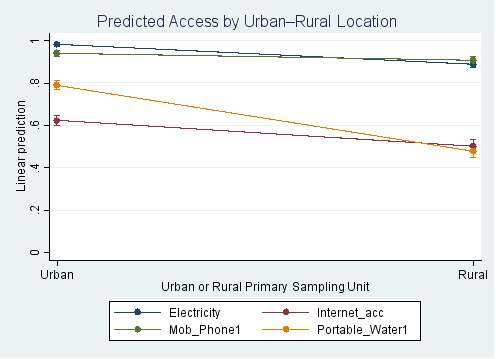
Table 8 illustrates the marginal projections about the accessibility of basic infrastructure services based on urban or rural residency, derived from the multivariate regression model. The results indicate significant disparities in access to all four infrastructure indicators between urban and rural families. Urban residences possess a 62.1% probability of having internet connectivity, whilst rural residences exhibit a 50.0% probability. This indicates a disparity of almost 12 percentage points. The majority of individuals possess a cell phone. In urban areas, 94.1% of households possess one, whereas in rural regions, 90.5% of families possess one. The primary distinctions between urban and rural communities lie in the availability of portable water and power. Urban homes possess a 98.2% probability of having electricity, whilst rural families exhibit only an 88.7% probability. This represents a significant disparity of 9.5 percentage points. The disparity is even more pronounced regarding access to drinking water: 78.9% of urban families have it, whereas only 47.7% of rural households do. This represents a disparity of about 31 percentage points. The predicted averages indicate that location significantly influences infrastructure access, with urban residents consistently enjoying superior access across all four categories. The findings indicate persistent spatial inequity in infrastructure distribution in Ghana, despite considering gender, education, region, and religion.
Table 8. Marginal Effects of Urban–Rural Location on Predicted Outcomes.

_predict#Location_Urb_Rur

Marginal Effect

Std. Err.

T

P>t

95% Conf.

Interval

1#Urban

0.6206

0.0120

51.7100

0.0000

0.5971

0.6441

1#Rural

0.5004

0.0157

31.9300

0.0000

0.4696

0.5311

2#Urban

0.9410

0.0070

134.8200

0.0000

0.9273

0.9547

2#Rural

0.9052

0.0091

99.3200

0.0000

0.8873

0.9230

3#Urban

0.7898

0.0109

72.7600

0.0000

0.7685

0.8111

3#Rural

0.4772

0.0142

33.6700

0.0000

0.4494

0.5050

4#Urban

0.9822

0.0057

173.0000

0.0000

0.9711

0.9934

4#Rural

0.8866

0.0074

119.6000

0.0000

0.8721

0.9012

Source: Afrobarometer Survey Data on Ghana Round 10
Figure 1 shows the predicted chances of having access to the internet, mobile phones, electricity, and portable water based on where you live (urban or rural), while also considering your gender, education, region, and religion. The plot shows that people who live in cities have much better access to all services than those who live in rural areas. In both cases, almost everyone has access to electricity and cell phones. In cities, the number of people with access to these things has gone up a little. There are big differences between access to the internet and access to portable water. For instance, the chance of having internet access is much higher in cities (~0.62) than in rural areas (~0.50). On the other hand, the chance of having portable water drops sharply from about 0.79 in cities to 0.48 in rural areas. The decreasing trends in the data for internet and portable water show significant differences based on location, showing that rural households lack important infrastructure more than urban households. The results confirm earlier regression findings and highlight the ongoing urban bias in infrastructure access across Ghana.
Figure 1. Predicted Access by Rural-Urban Location.
5. Conclusions
The findings of the multivariate regression and correlation analyses reveal significant socio-spatial, educational, and gendered disparities in access to essential services in Ghana. Education emerged as a powerful predictor of access to internet services, mobile phone ownership, and portable water, confirming its central role in citizens’ socio-economic empowerment. Location, particularly the urban–rural divide proved to be a major determinant of access to basic amenities, while regional disparities were evident across nearly all outcome variables. These inequalities have profound implications for social cohesion, equitable development, and democratic participation. For citizens’ participation, the results highlight how infrastructural and socio-economic inequalities restrict civic engagement, limit political efficacy, and constrain involvement in national decision-making. For governance, the findings underscore the urgent need for equity-oriented policies, targeted regional interventions, and governance reforms that recognise the central role of education and digital inclusion in national development. Finally, the study affirms that advancing Ghana’s democratic ideals and achieving sustainable development requires an integrated approach to education, governance, and social justice. By promoting inclusive access to basic services and strengthening civic competencies, Ghana can continue to uphold its constitutional mandate, foster national unity, and ensure that all citizens contribute meaningfully to national development.
6. Recommendations
From the findings, the following strategic recommendations have been advanced.
1) The persistence of regional inequalities necessitates targeted, context-sensitive development policies, prioritizing infrastructure expansion in Ghana’s most deprived northern, prei-urban and rural communities.
2) Bridging the urban–rural digital divide is imperative for inclusive governance. These requires coordinated public–private interventions to expand broadband coverage, improve affordability, and establish community ICT hubs in the underserved communities.
3) Gender-sensitive digital inclusion strategies should be institutionalized to mitigate technology access gaps that constrain women’s socio-political participation.
4) Citizenship education must be reinforced through schools and national institutions to cultivate constitutional literacy, promote social cohesion, and elevate citizens’ capacity for effective participation in governance.
Acknowledgments
The authors will like to send our profound gratitude and appreciation to Afrobarometer for making available Round 10 survey data on Ghana which was used in this study. Our second appreciation goes to the CDD-Ghana for conducting the Round 10 survey in Ghana on behalf of Afrobarometer which form the framework for this research. Finally, we thank all local and international researchers whose research works has been cited in this study.
Abbreviations

CDD

Center for Democratic Development

CP

Capability Theory

DD

Digital Divide

DDT

Digital Divide Theory

ICT

Information and Communication Technology

IFPRI

International Food Policy Research Institute

RCT

Resource Conversion Theory

SDGs

Sustainable Development Goals

Author Contributions
Iddrisu Bariham: Conceptualization, Investigation, Project administration, Resources, Supervision, Writing – original draft, Writing – review & editing
William Kofi Nkegbe: Data curation, Formal Analysis, Software, Validation, Visualization
Conflicts of Interest
The authors declare no conflict of interest.
References
[1] Achanso, A. (2020). The Efficacy of Decentralization in promoting Good Governance: A case study of Kpandai District of Northern Ghana. African Social Science and Research Journal.
[2] Abadie, F., & Badu, E. (2023). Digital Connectivity and Development in Ghana: The Role of Demographics in Access to Technology. Journal of African Development, 25(2), 132-150.
[3] Adeosun, O. T., Adebayo, A. A., & Salami, K. K. (2024). Governance quality, democratic institutions and sustainable development outcomes in Sub-Saharan Africa. Sustainable Development, 32(2), 455–468.
[4] Adom, A., & Yeboah, E. (2021). Mobile phone use and its Determinants among University Students in Ghana. Ghana Journal of Technology and Development, 8(4), 67-80.
[5] Agyemang, S., Owusu, K., & Boateng, F. (2020). Inequalities in access to basic social services in Ghana: A spatial and socio-economic analysis. GeoJournal, 85(6), 1563–1579.
[6] Ahmed, S., & Lopez, L. (2023). Bridging the global digital divide: Socioeconomic and infrastructural determinants of internet access. Telecommunications Policy, 47(5), 102537.
[7] Antwi, S., & Agyapong, G. (2022). Disparities in Mobile Phone Ownership and Internet Access in Ghana: Examining the Influence of Socioeconomic factors. Telecommunications Policy, 46(4), 102-115.
[8] Asante, J. K. (2024). Bridging the digital divide in Ghanaian education: Challenges, opportunities, and the role of technology in enhancing learning outcomes. AfricaJournal of Emerging Issues.
[9] Bardot, T. (2025). Disparities in drinking water quality across the United States. PLOS.
[10] Boadu, A., & Osei, A. (2020). The Impact of Age on Energy Consumption in Ghana. International Journal of Energy Economics and Policy, 10(3), 158-163.
[11] Boatemaa, S. (2025). Digital inequality in Ghana: Examining rural–urban disparities in access to ICT. Information Development, 41(1), 112–125.
[12] Cagler, A., & Gurler, Z. (2025). Progress towards achieving the sustainable development goals: The role of governance, democracy, and well-being. Discover Sustainability, Springer.
[13] CDD-Ghana. (2025a). Afrobarometer Round 10 survey in Ghana, 2024. Summary of results.
[14] CDD-Ghana. (2025b). Afrobarometer Round 10 Survey Manual (Number July).
[15] DataReportal. (2025). Digital 2025: Ghana. Retrieved from
[16] Electricity Monitor Ghana. (2024). Access to Electricity in Ghana. Retrieved from
[17] Faguet, J. P. (2012). Decentralization and popular democracy: Governance from below in Bolivia: University of Michigan Press.
[18] Ferguson, N., Seymour, G., & Azzarri, C. (2023). Examining the gender digital divide: A case study from rural Kenya (GCAN Policy Note No. 17). Washington, DC: International Food Policy Research Institute.
[19] Financial inclusion and improved water usage among households in Ghana. (2024). BMC Public Health, 24, 1316.
[20] Frederick, B., Abubakari, A., & Duku, M. (2021). Socio-economic factors affecting access to electricity in Ghana. Journal of Sustainable Development in Africa, 23(1), 121–135.
[21] Garcia-Guiliany, J., & De-la-Hoz-Franco, E. (2020). Multiple linear regression model applied to the projection of electricity demand in Colombia. International Journal of Energy Economics and Policy, 10(1), 419–422.
[22] Ghana Statistical Service. (2022). Ghana’s Population and Housing Census: General Report 3G. Accra: Ghana Statistical Service.
[23] Ghana Statistical Service (GSS). (2019). Household Survey on Information and Communication Technology (ICT) in Ghana. Accra: Ghana Statistical Service. Retrieved from
[24] Ghana Statistical Service. (2023). 2023 Annual household income and expenditure survey report. Accra: Ghana Statistical Service.
[25] GSMA. (2024). State of Mobile Connectivity in 2024. London: United Kingdom. The-State-of-Mobile-Internet-Connectivity-Report-2024.Pdf.
[26] International Food Policy Research Institute (IFPRI). (2024). Gender gaps in digital access and use in rural Africa. Washington, DC: IFPRI.
[27] Jacks, B. S., Ajala, O. A., Lottu, O. A., & Okafor, E. S. (2024). Theoretical frameworks for ICT for development: Impact assessment of telecommunication infrastructure projects in Africa and the USA. World Journal of Advanced Research and Review, 21(3), 394-400.
[28] Jallow, I. A., & Tajmouati, S. (2025). Determinants of financial and digital inclusion in West and Central Africa: Evidence from binary models with cross-validation (arXiv preprint).
[29] Johnson, K. (2018). Understanding inequality in access to water in Canada. International Journal of Environmental Research and Public Health, 15(9), 1873.
[30] Jr, J. F. H., Black, W. C., Babin, B. J., Anderson, R. E., Black, W. C., & Anderson, R. E. (2019). Multivariate Data Analysis (Eighth Edi). Cengage Learning EMEA.
[31] Karanja, A. (2019). Ethnic Disparities in Access to Water and Sanitation in Kenya. African Journal of Environmental Science and Technology, 13(6), 137-150.
[32] Kawano, S., Fukushima, T., Nakagawa, J., & Oshiki, M. (2025). Multivariate regression modeling in integrative analysis via sparse regularization. Japanese Journal of Statistics and Data Science.
[33] Kenya National Bureau of Statistics (2020). 2019 Kenya Population and Housing Census. Nairobi: Government of Kenya.
[34] Kyei-Arthur, F. (2024). Prevalence and determinants of Internet use among reproductive aged women in Ghana: Analysis of the 2021 Population and Housing Census. Journal of Environment and Sustainable Development, 3(1), 45-59.
[35] Mahio, L. J. (2022). Examining information and communication technology use in public primary schools in South Africa from the capability approach. Journal of Transdisciplinary Research in Southern Africa, 18(1).
[36] Martínez-Santos, P. (2025). Rural-urban inequality in drinking water accessibility as a socioeconomic outcome in Nigeria. Utilities Policy, 93, 101864.
[37] Matimolane, S., & Mathivha, F. I. (2025). Tackling rural water scarcity in South Africa: climate change, governance, and sustainability pathways. Frontiers in Environmental Science, 13, 1550738.
[38] Mwangi, L., & Njuguna, H. (2022). Demographic Influences on Mobile Phone Accessibility in Rural Kenya. African Journal of Telecommunications, 5(3), 22-34.
[39] Oduro, A. D., Boakye-Yiadom, L., & Baah-Boateng, W. (2020). Gender, time use, and access to water in rural Ghana. Feminist Economics, 26(3), 176–200.
[40] Okorie, I., & Bello, A. (2024). The Role of Socio-Demographic Factors in Internet Access among Nigerian Youth. Nigerian Journal of Communication Studies, 12(1), 101-115.
[41] Omundi, E., & Chitere, P. (2021). Education Level and Water Access: A Case study of Rural Kenya. Global Journal of Water Resource Management, 7(1), 45-58.
[42] Osei, A., Mensah, I., & Nkrumah, F. (2023). Gendered Dimensions of Water and Energy Access in Ghana: The Role of Age in Resource Distribution. Water Resources Management, 37(5), 1509-1525.
[43] PLOS ONE. (2021). Sources of individual differences in adult ICT skills: A large scale empirical test of a new guiding framework, 16(4).
[44] Recica, S., & Tosheva, E. (2023). The welfare state and social democracy: Interaction between social justice policies and democratic governance. Journal of Social Policy Studies.
[45] Sen, A. (1999). Development as freedom. Oxford University Press.
[46] Smith, J., & Thomson, R. (2023). Digital Divide: The Impact of Demographic Factors on Internet Access in the UK. Journal of Digital Inclusion, 15(2), 45-60.
[47] Statistics Canada. (2019). Potable water use in Canada. Government of Canada.
[48] The Ghana Report. (2024). Ghana makes progress in water access: GSS Survey. Retrieved from
[49] Terefe B, Jembere MM, & Assimamaw NT. (2024). Access to drinking safe water and its associated factors among households in East Africa: a mixed effect analysis using 12 East African countries recent national health survey. Journal of Health, Population and Nutrition, 43(1): 72.
[50] van Dijk, J. A. G. M. (2020). The digital divide. Polity Press.
[51] Xie, H. S., Gandla, S. R., Shi, O., & Solanki, P. (2023). Multivariate regression and variance in concrete curing methods: Strength prediction with experiments. Applied Sciences, 13(22), 12239.
[52] Yates, S., Hill, K., Blackwell, C., Davis, A., Padley, M., Stone, E., et al. (2024). A Minimum Digital Living Standard for households with children: Overall findings report (University of Liverpool; Loughborough University; Good Things Foundation). City University Research Repository.
Cite This Article
  • APA Style

    Bariham, I., Nkegbe, W. K. (2026). Exploring the Impact of Demographic Characteristics on Access to Basic Social Services in Ghana: A Multivariate Regression Analysis Approach. Social Sciences, 15(3), 101-117. https://doi.org/10.11648/j.ss.20261503.11

    Copy | Download

    ACS Style

    Bariham, I.; Nkegbe, W. K. Exploring the Impact of Demographic Characteristics on Access to Basic Social Services in Ghana: A Multivariate Regression Analysis Approach. Soc. Sci. 2026, 15(3), 101-117. doi: 10.11648/j.ss.20261503.11

    Copy | Download

    AMA Style

    Bariham I, Nkegbe WK. Exploring the Impact of Demographic Characteristics on Access to Basic Social Services in Ghana: A Multivariate Regression Analysis Approach. Soc Sci. 2026;15(3):101-117. doi: 10.11648/j.ss.20261503.11

    Copy | Download

  • @article{10.11648/j.ss.20261503.11,
      author = {Iddrisu Bariham and William Kofi Nkegbe},
      title = {Exploring the Impact of Demographic Characteristics on Access to Basic Social Services in Ghana: A Multivariate Regression Analysis Approach},
      journal = {Social Sciences},
      volume = {15},
      number = {3},
      pages = {101-117},
      doi = {10.11648/j.ss.20261503.11},
      url = {https://doi.org/10.11648/j.ss.20261503.11},
      eprint = {https://article.sciencepublishinggroup.com/pdf/10.11648.j.ss.20261503.11},
      abstract = {Most people living in the underserved rural communities in Ghana, do not have access to basic social services, such as portable water, electricity, mobile phones and internet, to promote healthy and productive living. Consequently, this research explores the influence of demographic variables on people access to basic social amenities using the Afrobarometer survey Round 10 data on Ghana. A total of 2,400 respondents were randomly sampled across all districts in the 16 regions. Structured questionnaires were the main instruments used for data collection. The data was analyzed using inferential statistics, such as correlation and multivariate regression analysis to test the hypotheses. The findings show a significant effect of socio-spatial, educational, and gender disparities in access to basic social services in the country. Individual level of education emerged as a strong predictor of access to the internet, mobile phone ownership and portable water. People's location, particularly the rural-urban divide, proved to be a major determinant of access to basic social amenities, while regional inequalities were evident across nearly all the outcome variables. The study recommends positioning education as a central instrument for socio-economic empowerment and civic engagement; targeted, context-specific development planning policies that prioritize expansion of infrastructure and social amenities to underserved communities; bridging the digital divide; and implementation of gender-sensitive digital inclusion strategies to reduce technology access gaps that constrain women's socio-political participation.},
     year = {2026}
    }
    

    Copy | Download

  • TY  - JOUR
    T1  - Exploring the Impact of Demographic Characteristics on Access to Basic Social Services in Ghana: A Multivariate Regression Analysis Approach
    AU  - Iddrisu Bariham
    AU  - William Kofi Nkegbe
    Y1  - 2026/05/16
    PY  - 2026
    N1  - https://doi.org/10.11648/j.ss.20261503.11
    DO  - 10.11648/j.ss.20261503.11
    T2  - Social Sciences
    JF  - Social Sciences
    JO  - Social Sciences
    SP  - 101
    EP  - 117
    PB  - Science Publishing Group
    SN  - 2326-988X
    UR  - https://doi.org/10.11648/j.ss.20261503.11
    AB  - Most people living in the underserved rural communities in Ghana, do not have access to basic social services, such as portable water, electricity, mobile phones and internet, to promote healthy and productive living. Consequently, this research explores the influence of demographic variables on people access to basic social amenities using the Afrobarometer survey Round 10 data on Ghana. A total of 2,400 respondents were randomly sampled across all districts in the 16 regions. Structured questionnaires were the main instruments used for data collection. The data was analyzed using inferential statistics, such as correlation and multivariate regression analysis to test the hypotheses. The findings show a significant effect of socio-spatial, educational, and gender disparities in access to basic social services in the country. Individual level of education emerged as a strong predictor of access to the internet, mobile phone ownership and portable water. People's location, particularly the rural-urban divide, proved to be a major determinant of access to basic social amenities, while regional inequalities were evident across nearly all the outcome variables. The study recommends positioning education as a central instrument for socio-economic empowerment and civic engagement; targeted, context-specific development planning policies that prioritize expansion of infrastructure and social amenities to underserved communities; bridging the digital divide; and implementation of gender-sensitive digital inclusion strategies to reduce technology access gaps that constrain women's socio-political participation.
    VL  - 15
    IS  - 3
    ER  - 

    Copy | Download

Author Information
  • Abstract
  • Keywords
  • Document Sections

    1. 1. Introduction
    2. 2. Literature Review
    3. 3. Materials and Methods
    4. 4. Presentation and Discussion of Results
    5. 5. Conclusions
    6. 6. Recommendations
    Show Full Outline
  • Acknowledgments
  • Abbreviations
  • Author Contributions
  • Conflicts of Interest
  • References
  • Cite This Article
  • Author Information