Research Article | | Peer-Reviewed

Removal of PPCPs from Water by Adsorption on Activated Carbons

Received: 3 May 2026     Accepted: 14 May 2026     Published: 26 May 2026
Views:       Downloads:
Abstract

This study demonstrated that activated carbon from waste PET bottle, could be used as an effective adsorbent for the removal of SMX and CBZ. Four adsorbents from waste PET bottle were experimented to remove SMX and CBZ from aqueous solution. The effects of various factors, such as the initial adsorbate concentration, temperature effect and contact time were investigated in series of experiments. To determine the effect of activation agent contents on SMX and CBZ adsorption, 1000 mg/l of SMX and CBZ was studied taking into account an initial concentration. The amount of each of the activated carbons used is 0.150 g and the shaking time used is 72 hours. The results of the adsorption tests showed the effectiveness of all adsorbents used for the elimination of the two PPCPS materials used. According to the removal capacity results of the 4 activated carbons used on the adsorption of SMX and CBZ, it seems that the activated carbon 1/4 with composite with (Coal=1 and KOH=4) gave the highest adsorption quantity (251.12 mg/g and 250.195 mg/g, respectively for SMX and CBZ) followed by activated carbon 2/4 with composite with (Coal=2 and KOH=4) gave (241.37 mg/g and 248.77 mg/g, respectively for SMX and CBZ). On the other side the lowest adsorption capacity of 4/4 gave (194.17 mg/g and 240.301 mg/g, respectively for SMX and CBZ) were recorded for (Coal=4 and KOH=4). The pseudo-second order model and Langmuir isotherm showed a better description of experimental adsorption data for SMX and CBZ than others models used.

Published in World Journal of Applied Chemistry (Volume 11, Issue 2)
DOI 10.11648/j.wjac.20261102.11
Page(s) 25-36
Creative Commons

This is an Open Access article, distributed under the terms of the Creative Commons Attribution 4.0 International License (http://creativecommons.org/licenses/by/4.0/), which permits unrestricted use, distribution and reproduction in any medium or format, provided the original work is properly cited.

Copyright

Copyright © The Author(s), 2026. Published by Science Publishing Group

Keywords

Sulfamethoxazole, Carbamazepine, Adsorption, Activated Carbon

1. Introduction
Pharmaceuticals and personal care products are all products produced in manufacturing processes, distributed and used in several sectors of life including hospitals, veterinary activities, households, pharmacies and agricultural activities. They are intended for human treatments, livestock treatments, aquaculture treatments, pet treatments and spreading. PPCPs are included in the family of emerging contaminants (ECs), including pharmaceutical products (PP), personal care products (PCPs), endocrine disrupting compounds (EDCs), surfactants, pesticides, flame retardants, and industrial additives . The effective management of these pharmaceutical products after having used is a real problem for municipalities. Even when treated, they can often be detected in watercourse, rivers and lake at some concentration.
Their presence in the water can have consequences on the quality of water and on aquatic life. Appropriate and effective treatments must be used in order to reduce their concentration in the receiving environment. Sulfamethoxazole is a sulfonamide bacteriostatic antibiotic used in various bacterial diseases prevention and treatment. After consumption, it is mainly excreted through urine. It is a pharmaceutical product frequently detected in domestic wastewater. It is very toxic to aquatic life and the environment . Carbamazepine is one of the most widely used pharmaceuticals in the world. It is indicated to treat epileptic seizures, bipolar disorders, nervous system damage, voice disorders and vomiting. After consumption, it is directly excreted through urine and faces. It is a pharmaceutical product that is very difficult to eliminate in wastewater . To reduce these types of pharmaceuticals in wastewater, it is imperative to use advanced techniques methods such as conventional activated sludge (CAS), Membrane bioreactor (MBRs), Advanced oxidation processes (AOPs) and adsorption, which PPCPs removed efficiency are very high compared to conventional treatment methods. All these treatments techniques mentioned above are effective in terms of pharmaceutical products elimination efficiency, but the least expensive and the easiest to perform technically is adsorption method .
Research then turned to adsorption processes using less expensive materials. Among these less expensive adsorbents, there is PET waste bottle, which can be recycled into activated carbon and be used to eliminate hazardous materials from effluents. In South Korea, these waste PET bottles are generated in large quantities each year and ends up free of charge in garbage cans. The most common way to recycle waste PET is production of activated carbon and it is one of the most environmentally friendly solutions.
2. Materials and Methods
2.1. Experimental Procedure
2.1.1. Adsorbent and Characteristics
The activated carbon used in this adsorption study was prepared in our Laboratory. It was obtained from waste PET bottle, which were cut into small fine pieces, introduced and then carbonized at 450°C for 4 hours in Electrical Tube Furnaces. The nitrogen flow and the nitrogen pressure used are 100 cc/min and 80 bars, respectively. The coal obtained was mixed with potassium hydroxide and activated again in Electrical Tube Furnaces at 800°C for 6 hours. The nitrogen flow and the nitrogen pressure used are the same like previously step. The activated carbon obtained is dissolved in 250 ml of HCl solution at 1.0 M and continually washed with distilled water. The target pH of the activated carbon found is between 6.5 to 7.5 and then dried at 110° C. in an oven for 3 nights. Different masses ratios of coal to potassium hydroxide 1/4 = 1: 4, 2/4=1: 2, 3/4 = 1: 1.33 and 4/4 = 1: 1 g/g and took to prepare composite of coal –KOH.
2.1.2. Chemical Reagents
Many reagents were purchased and used in this study including Sulfamethoxazole C10H11N3O3S, carbamazepine C15H12N2O, potassium hydroxide KOH, sodium hydroxide NaOH and hydrochloric acid HCl. Sulfamethoxazole and carbamazepine were used to prepare the stock solutions using distilled water, KOH was used to activate the coal, NaOH and HCl were used to wash the activated carbons to get final pH between 6.5 and 7.5. All solutions used in this study were prepared using distilled water.
Table 1. Chemical properties of SMX and CBZ.

Compounds

Molecular Formula

Molecular Weight

Pka

Chemical structure

SMX

C10H11N3O3S

253.279 g/mol

1.97

CBZ

C15H12N2O

236.269 g/mol

2.3

2.1.3. Preparation of SMX and CBZ Solution
Sulfamethoxazole and carbamazepine stock solutions were prepared by dissolving 2g of each of the pharmaceuticals in a 1000ml bottle and complete with distilled water. The other samples of different concentrations were prepared using stock solution and distilled water.
Impact of variable factors
Contact time
Adsorption equilibrium studies are performed with an adsorbent quantity of 0.5 g by 500 ml of PPCPs materials with 300, 500 and 700 ppm from 10 to 360 min at 25°C.
Effect of initial concentration
To study the influence of the variation of the two PPCPs materials concentrations on the adsorption efficiency, we fixed the amount of each adsorbent at 0.150 g, the initial concentration of sulfamethoxazole and carbamazepine concentration was 1000 ppm and shaking time used is 72h.
Effect of temperature
The adsorption equilibrium studies are carried out with 0.150 g of adsorbent, 40 ml of the solution volume and the initial concentrations of sulfamethoxazole and carbamazepine used was 50, 100, 200, 400, 600 and 1000 ppm at various temperatures: 15°C, 25°C and 35°C.
Determination of wavelengths
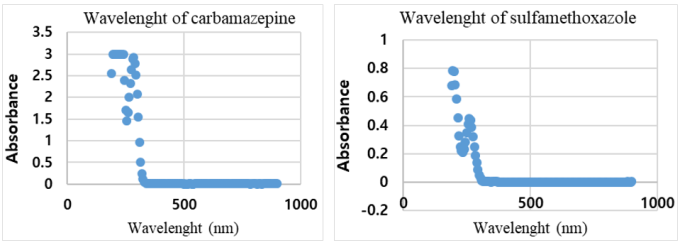
Figure 1. Wavelengths of SMX and CBZ.
Calibration Curves
UV spectrophotometer were used to quantification of pharmaceuticals concentration, maximum wavelength tested from 200-400 nm. The maximum wavelength tested, for SMX and CBZ were 264 nm and 284 nm respectively.
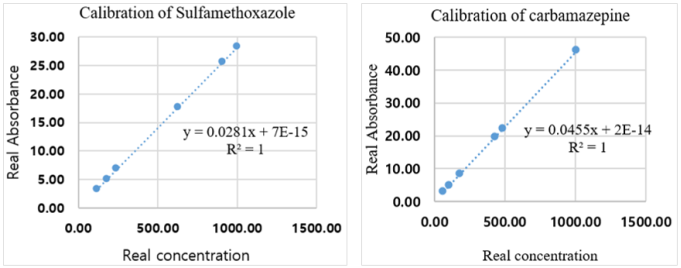
Figure 2. Calibration of SMX and CBZ.
The concentrations were plotted against the area of the sulfamethoxazole and carbamazepine absorption peak results, and the data was fitted with a linear regression. The coefficient of determination (R2) of SMX and CBZ was unity, indicating a perfect linear relationship of the line to the diluted concentrations. The calibration curves in Figure 2 were used to determine the concentrations of unknown samples. Similar results have been reported .
2.2. Experimentation
The experimental studies of sulfamethoxazole and carbamazepine on the activated carbons used in this study were carried out by studying several possible scenarios: the variation of the initial concentration, the variation of the experiment temperature and the contact time. The equilibrium quantity and the removal efficiency of the compounds used were determined by the following relationships:
qe=Co-Ce*Vm(1)
And by calculating the removal percentage
R(%)=Co-CeCo*100(2)
Where: Co - initial concentration (mg/l); Ce - equilibrium concentration (mg/l); m - mass of the adsorbent (g)
V - volume of the solution (l)
3. Results and Discussion
3.1. Activated Carbon Characteristics
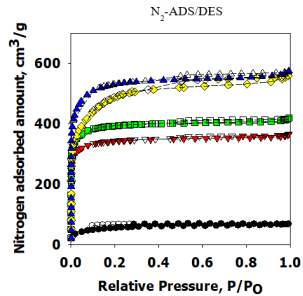
Knowledge of the textural properties of an adsorbent is a fundamental step in adsorption. They are always carried out by N2 adsorption/desorption. Its main objective is to determine the specific surface area of materials by multilayer nitrogen adsorption, the pore area and the specific pore volume. It also makes it possible to evaluate the external surface and the surface of the pores to determine the total specific surface. It also makes it possible to interpret in advance the adsorption capacity between the adsorbent and the molecules. BET analysis determines the specific surface area of materials by multi-layer nitrogen adsorption using relative pressure using an automated analyzer while the BJH and HK methods determine the surface area and specific pore volume using adsorption and desorption techniques. The experimental results show that the increase in the porosity of the adsorbent depends on the increase in the rate of interpretation .
The BET specific surface and the pore volume of 1/4 activated carbon are 2382.30 m2/g and 0.8988 cm3/g, respectively.
Figure 3. N2 adsorption-desorption isotherms of various PET Acs.
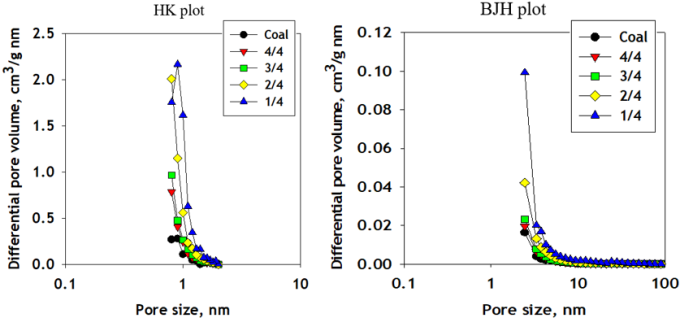
Figure 4. Pore size distributions obtained from HK methods and BJH methods.
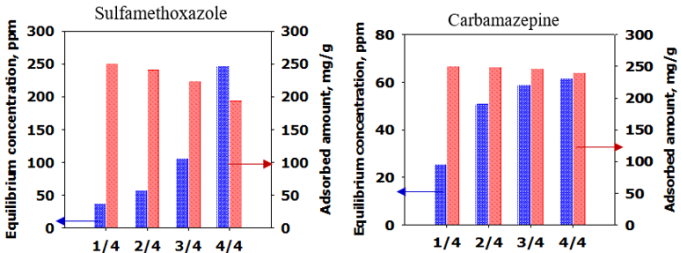
Table 2. The parameters of porous structure for the initial carbons calculated from nitrogen adsorption isotherms.

Adsorbents

BET surface area (m2/g)

Pore volume (cm3/g)

Diameter (nm)

1/4

2382.30

0.8948

1.9398

2/4

2022.50

0.8848

1.7499

3/4

1530.80

0.6454

1.6864

4/4

1348.00

0.5636

1.6724

Coal

199.33

0.1051

2.0555

3.2. Effect of Activation Agent Contents on SMX and CBZ Adsorption
The initial concentration of SMX and CBZ was studied taking into account an initial concentration of 1000 mg/l. The amount of each of the activated carbons used is 0.150 g and the shaking time used is 72 hours. The results obtained are illustrated in Figures 3, 4 and 5 Different masses ratios of coal to potassium hydroxide: activated carbon 1/4 = 1: 4, activated carbon 2/4 = 1: 2, activated carbon 3/4= 1: 1.33 and activated carbon 4/4= 1: 1 g/g and took to prepare composite of Coal –KOH.
Figure 5. Initial concentration (Co=1000 ppm), volume solution (40 ml), adsorbent amount (ACs=0.150 g), rotation speed (200 rpm), rotation time (72 hours) and temperature 25°C.
The results of the histogram representation show that the adsorption capacity of activated carbon 1/4 = 1: 4 g/g with composite of Coal and KOH (Coal=1 and KOH=4) was high than those obtained with less KOH. This result can be explained by the high amount of KOH it contains compared to other activated carbons used. From the adsorption test results of the 4 activated carbons used on SMX and CBZ, it seems that the activated carbon 1/4 with composite with (Coal=1 and KOH=4) gave the highest adsorption quantity (251.12 mg.g-1 and 250.195 mg.g-1, respectively for SMX and CBZ) followed by activated carbon 2/4 with composite with (Coal=2 and KOH=4) gave (241.37 mg.g-1 and 248.77 mg.g-1, respectively for SMX and CBZ). Unlike, the lowest adsorption capacity belongs to activated carbon 4/4 (194.17 mg.g-1 and 240.301 mg.g-1, respectively for SMX and CBZ) which were recorded for (Coal=4 and KOH=4). Our results are similar to those found .
3.3. Langmuir Isotherm of SMX and CBZ at Various System Temperature
The Langmuir isotherm describes monolayer adsorption onto a homogeneous surface of the adsorbent. The assumptions of the Langmuir model are : The adsorption energy is constant on all sites and Each site can accommodate a single molecule or an atom.
The expression of Langmuir's law is given by the following equation.
qe=qm*b*Ce1+bCe(3)
With: qe - equilibrium quantity by the adsorbent (mg. g-1), Ce - equilibrium concentration of the adsorbate (mg. L-1), qmax - maximum maximum adsorption capacity of langmuir (mg. g-1), b - Langmuir adsorption equilibrium constant (L.mg-1).
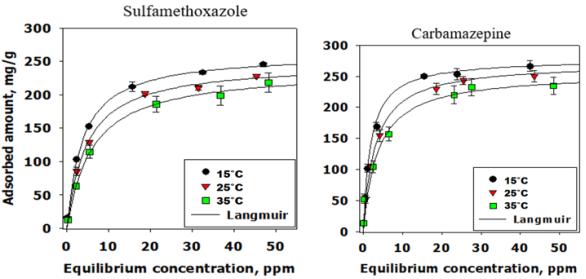
The results of experimental studies of SMX and CBZ adsorption test on activated carbon at different temperatures are shown in Figures 6. Temperature is a very important parameter in the adsorption process. The results of the experimental studies of SMX and CBZ adsorption at various temperatures revealed that SMX and CBZ adsorption capacity evolves inversely with the temperature, that is mean that when one increase, the other decrease indicates that the adsorption process is exothermic and the highest adsorption capacity was obtained at 15°C using 15°C, 25°C and 35°C. High temperature can result in an increase in the mobility of the acidic compounds but can decrease the interaction of SMX and CBZ with active sites of activated carbon, which causes a decrease in adsorption capacity . On the same Figures, we also observe that the adsorption capacity increases when the initial concentration increases. This may be explained by the presence of more SMX and CBZ in solution available for binding onto the active sites of the activated carbon. The same tendency had been obtained by . According to the isotherm study, the experimental studies data was correlated by Langmuir model. As seen in Table 3, the SMX and CBZ adsorption was well correlated with Langmuir isotherm model with high correlation coefficient values (0.998, 0.996 and 0.997) and (0.9810, 0.988 and 0.963) for sulfamethoxazole and carbamazepine, respectively. Furthermore, the values of b for the Langmuir isotherm were between 0 and 1, indicating a favorable process. Similar results have been reported have been reported by .
Figure 6. Adsorption isotherms of SMX and CBZ at various system temperature, initial concentrations used (Co=50, 100, 200, 400, 600 and 1000 ppm), volume of solution (40 ml), amount of adsorbent 0.150 g, rotation speed (200 rpm) and rotation time (72h).
3.4. Freundlich Isotherm of SMX and CBZ at Various System Temperature
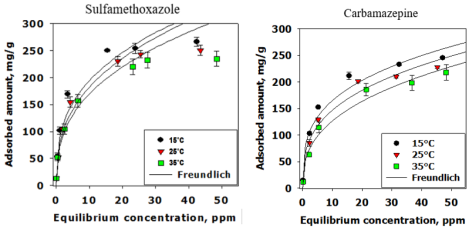
The Freundlich isotherm is frequently used to describe the adsorption on heterogeneous surfaces. The Freundlich equation is well suited to describe the aqueous phase equilibrium. Its empirical formula is:
qe = Kf*ce1n(4)
With: qe - The equilibrium concentration of the adsorbent (mg. g-1), Ce - The equilibrium concentration of the adsorbate (mg. L-1), KF and 1/n - Freundlich constants related to adsorption and affinity.
Figure 7. Adsorption isotherms of SMX and CBZ at various system temperature, initial concentrations used (Co=50, 100, 200, 400, 600 and 1000 ppm), volume of solution (40 ml), amount of adsorbent 0.150 g, agitation speed (200 rpm) and shaking time (72h).
In adsorption, temperature plays a very important role. It is one of the most important parameters in the adsorption process. So the effect of various system temperature of SMX and CBZ removal by using activated carbon 1/4 as an adsorbent was examined over a range of 15-35°C. Within this range, the maximum equilibrium quantity drug was recorded at 15°C as indicated previously for SMX and CBZ. According to the temperature results of SMX and CBZ, it can be concluding that, the adsorption capacity of SMX and CBZ increased when the temperature decrease. This is mainly due to the decreased surface activity indicating that adsorption between molecules of PPCPs molecules and adsorbent was an exothermic process. Similar results have been reported by . The Freundlich isotherm is frequently used to describe the adsorption on heterogeneous surfaces. The n parameter, known as the heterogeneity factor, can be used to indicate whether the adsorption is linear (n = 1), whether it is a chemical process (n< 1), or whether a physical process is favorable (n>1). When (n=1), the adsorption is linear; when (n<1), the adsorption process is a chemical process; when (n>1), physical process is favorable. On the other hand, values of 1/n<1 and 1/n>1 indicate a normal Langmuir isotherm and cooperative adsorption, respectively . In this study, the values (n>1) and the 1/n values are less than 1 indicate that the physical process and the normal Langmuir isotherm are favorable. The correlation coefficients obtained from Freundlich model of SMX and CBZ (R2> 0.948) indicating that the surface of the adsorbent is heterogeneous and the adsorption of SMX and CBZ on the adsorbent is multilayer. Similar results have been reported by .
Table 3. Adsorption isotherms parameters.

Adsorbates

Temperature

Langmuir isotherm model

Freundlich isotherm model

(°C)

qm

b

R2

K

1/n

R2

SMX

15

261.846

0.271

0.998

82.801

0.299

0.948

25

247.609

0.217

0.996

68.999

0.328

0.966

35

237.859

0.168

0.997

54.205

0.368

0.969

CBZ

15

278.248

0.536

0.981

88.358

0.342

0.973

25

271.921

0.332

0.988

77.881

0.369

0.977

35

255.937

0.269

0.963

72.097

0.372

0.988

3.5. Adsorption Kinetics of SMX and CBZ at Various Initial Concentration
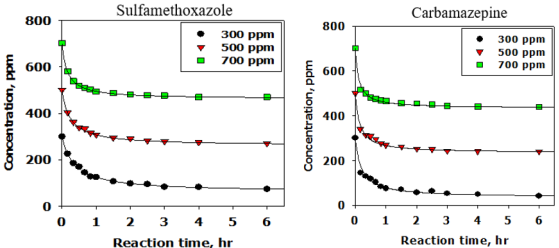
Figure 8. Effect of contact time on sulfamethoxazole and carbamazepine at various concentration, initial concentration (Co=300, 500 and 700 ppm), volume of the solution 500 ml, adsorbent quantity 0.5g, rotation time (360 min), rotation speed (200 rpm) and temperature 25°C.
This study was conducted to determine the effect of stirring time on the absorption mechanism of SMX and CBZ on activated carbon 1/4. The effect of contact time of SMX and CBZ was monitored by using 0.5 g of activated carbon 1/4 and initial concentrations used were 300, 500 and 700 ppm. The results presented in Figure 8 have shown that the adsorption kinetics of SMX and CBZ on the activated carbon used is very rapid by using 300, 500 and 700 ppm. The maximum adsorbed quantity of SMX and CBZ with 300, 500 and 700 mg/l was reached after 3 hours for SMX and 2 hours for CBZ.
The effect of contact time of SMX and CBZ adsorption is given in Figure 8 above. The Figures show the progress of adsorption on sulfamethoxazole and carbamazepine by using 300, 500 and 700 mg/l. seeing these figures, we can conclude that the initial concentrations of sulfamethoxazole and carbamazepine decrease as time progresses. In the first 10 minutes, the adsorption process was rapid then becomes slow with the evolution of contact time and reaches equilibrium after 3 hours for SMX and 2 hours for CBZ.
The experimental test results showed a decrease of the initial concentrations of SMX and CBZ at the beginning of the adsorption process with a high adsorption rate and then decrease gradually with the progress of contact time until equilibrium. This phenomenon can be explained by the fact that the first 10 minutes, the active sites of the surface of the activated carbon were empty and available to receive sulfamethoxazole and carbamazepine molecules. Then as time progresses, these active sites of the adsorbent become more and more saturated and the SMX and CBZ molecules can no longer be adsorbed by the activated carbon. Similar results have been reported by .
3.6. Adsorption Kinetics
Kinetic studies are carried out to better understand the dynamics of adsorption reactions on the studied pollutants. They are also used to determine the rate constant of the kinetics model. The most important information for the design and modeling of the adsorption process is provided by the kinetic parameters of the model. In our study, the adsorption tests for the kinetic study were carried out using 300, 500 and 700 mg/l initial concentrations for sulfamethoxazole and carbamazepine with 0.5 g of adsorbent for a contact time ranging from from 10 to 360 minutes.
3.6.1. Pseudo First Order Kinetics
Lagergren first order equation is tested to fit the experimental data obtained from the experiments test. The equation is based on the adsorption of an adsorbate from solution onto solid adsorbent, so it is usually referred as pseudo-first order kinetic model (A. S. Mestre, 2007). The pseudo-first order equation is given as follows:
Q=qe1-e-K1t(5)
Where: k1 - rate constant for pseudo first order kinetics (min1), q - adsorption capacity at time t (mg/g).
The pseudo-first order model is the earliest known equation describing the adsorption rate based on the adsorption capacity. The experimental data of the kinetic study relating to the adsorption of SMX and CBZ on activated carbon 1/4 is presented in Figures 9 by using pseudo first-order kinetic model.
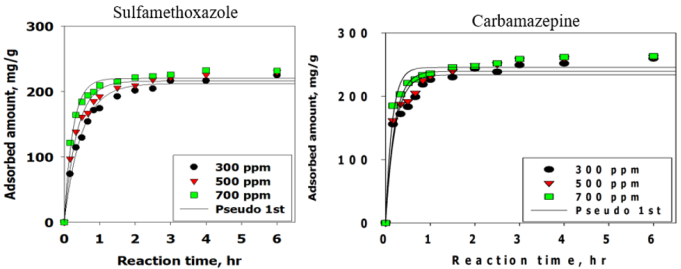
Figure 9. Pseudo-first order model of SMX and CBZ at various contact time and various initial concentration (Co=300, 500 and 700 ppm), volume of the solution 500 ml, adsorbent quantity 0.5g, rotation time (360 min), rotation speed (200 rpm) and temperature 25°C.
By observing these Figure 9, we can affirm that the adsorption capacity of SMX and CBZ increases with the evolution of contact time using the three concentrations. The obtained experimental equilibrium adsorption capacities (Qexp) are 234.988, 229.957 and 231.741mg/g of SMX and 259.642, 262.094 and 263.497 mg/g of CBZ for the initial concentrations of 300, 500, and 700mg/L, respectively. This phenomenon is ascribed to adsorbent-adsorbate interactions at various initial SMX and CBZ concentrations, allowing the mobility of PPCPs molecules to enter into the interior region of the adsorbent .
In addition, the kinetic parameters obtained from pseudo-first-order model revealed that the pseudo-first order model does not describe the experimental data of SMX and CBZ. This can generally be explained by the low values of the correlation coefficients obtained from the first-order-model equation and the disagreement between the adsorbed quantity obtained by the experimental test and those obtained by using the first order model equation. In this present study, we notice that the correlation coefficients obtained for SMX and CBZ are very low and very far from 1. Therefore, we can conclude that the pseudo-first order model does not describe the experimental test on SMX and CBZ. This can be confirmed by .
3.6.2. Pseudo Second-order Kinetics
The pseudo-second-order model is frequently used in adsorption. This model was applied in activated carbon adsorption, clays or other adsorbents. According to, this model is based on the following assumptions:
Adsorption takes place on localized sites and there is no interaction between the adsorbed molecules.
The desorption rate is negligible compared to the adsorption rate.
The adsorption maximum corresponds to the formation of a monolayer of adsorbates on the adsorbent surface.
In this case, the pseudo-second-order chemisorption kinetics can be expressed as follows :
q=K2qe2t1+K2qet(6)
Where: K2 - rate constant for pseudo-second-order kinetics (min-1).
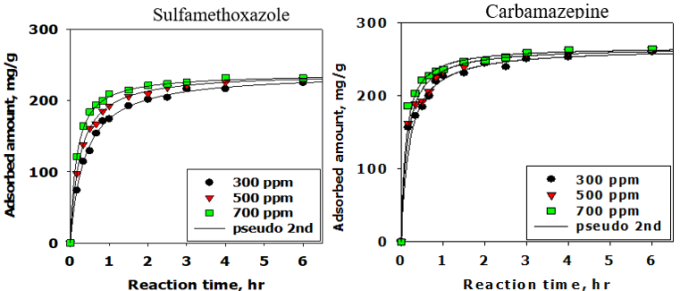
The kinetic study results of SMX and CBZ experimental adsorption tests on activated carbon was well described by pseudo-second-order kinetic model. This can be explained by the agreement between the graphical representation of the experimental test of SMX and CBZ adsorption and the second-order-model lines on the Figure 10. In addition, the kinetic parameters result of the model obtained revealed that pseudo-second-order model described well the experimental data of SMX and CBZ as seen in the rate constant adsorption which increased with the increase of SMX and CBZ initial concentrations and the correlation coefficients (R2) values. The rate constant k2 values for de pseudo second-order kinetic equation adsorption were calculated to be 0.0107, 0.0172 and 0.0263 mg.mg-1.min-1 respectively, for 300, 500 and 700 ppm for SMX adsorption and 0.0193, 0.0269 and 0.0340 mg.mg-1.min-1 respectively, for 300, 500 and 700 ppm for CBZ adsorption .
Therefore, the perfect agreement between the values of (qe, exp.) and (qe, cal.) of SMX and CBZ indicates that the pseudo-second-order kinetic model is appropriate to describe the adsorption behavior of the adsorbent selected so that the rate limiting factor could be a chemisorption process, where the interactions (chemical bonding) involved the sharing or exchange of electrons between the adsorbate and the adsorbent .
Figure 10. Pseudo-second-order model of SMX and CBZ at various contact time and various initial concentration (Co=300, 500 and 700 ppm), volume of the solution 500 ml, adsorbent quantity 0.5g, rotation time (360 min), rotation speed (200 rpm) and temperature 25°C.

Table 4. Kinetic parameters of pseudo 1st and 2nd order models.

Adsorbate

Initial concentration

qe (Exp)

pseudo 1st order

pseudo 2nd order

ppm

mg g-1

qe (Pre)

K1

R2

qe (Pre)

K2

R2

mg g-1

min-1

mg g-1

g mg-1 min-1

SMX

300

234.988

212.227

2.0613

0.983

240.957

0.0107

0.9973

500

229.957

216.107

2.7991

0.976

239.270

0.0172

0.9980

700

231.741

220.187

4.0926

0.981

239.914

0.0263

0.9986

CBZ

300

259.642

233.996

4.7226

0.931

265.173

0.0193

0.9730

500

262.094

239.722

5.0031

0.936

265.978

0.0269

0.9750

700

263.497

245.724

6.8552

0.962

266.825

0.0340

0.9867

4. Conclusion
This study demonstrated the performance of waste PET activated carbons for sulfamethoxazole and carbamazepine removal from aqueous solution. Experimental tests were carried out to evaluate the effectiveness of PET activated carbons on these two pharmaceutical products removals. The results found revealed that the activated carbons used in this study were conclusive for the elimination of sulfamethoxazole and carbamazepine.
They can be used as the excellent adsorbents for removing hazardous materials from wastewater. The following conclusions can be made:
The activated carbon 1/4 with composite with (Coal=1 and KOH=4) gave the highest adsorption quantity (251.12 mg/g and 250.195 mg/g, respectively for SMX and CBZ) by using 1000 ppm of adsorbates initial concentration.
By carrying out the experimental study with different temperatures, the obtained results showed that the adsorption capacity of SMX and CBZ evolve inversely with the temperature, i.e. when one increases, the other decreases indicates that the adsorption process is exothermic and the highest adsorption capacity was obtained at 15°C by using 15, 25 and 35°C.
The equilibrium time for adsorption of SMX and CBZ from aqueous solutions was achieved within 3 hours for SMX and 2 hours for CBZ of contact time on the activated carbon by using 300, 500 and 700 mg/l.
Langmuir’s model described well the experimental adsorption of TB and BTB than Freundlich's model.
Kinetic studies showed that the pseudo-second-order model better describes the adsorption of SMX and CBZ on activated carbon than the pseudo-first-order model.
Abbreviations

Co

Initial Concentration (mg/l)

Ce

Equilibrium Concentration (mg/l)

m

Mass of the Adsorbent (g)

V

Volume of the Solution (l)

qe

Equilibrium Quantity by the Adsorbent (mg. g-1)

q

Adsorption Capacity at Time t (mg/g)

qmax

Maximum Maximum Adsorption Capacity of Langmuir (mg. g-1)

b

Langmuir Adsorption Equilibrium Constant (L.mg-1).

KF and 1/n

Freundlich Constants Related to Adsorption and Affinity

k1

Rate Constant for Pseudo First Order Kinetics (min-1).

K2

Rate Constant for Pseudo-second-order Kinetics (min-1).

Author Contributions
Mamadou Cisse: Conceptualization, Data curation, Writing – original draft, Resources, Methodology, Writing – review & editing
Mamadou Dian Kante: Formal Analysis, Investigation, Software, Writing – review & editing, Methodology
Maimouna Drame: Formal Analysis, Investigation, Supervision, Resources, Writing – review & editing
Cellou Kante: Funding acquisition, Writing – review & editing, Supervision, Validation
Ansoumane Sakouvogui: Writing – review & editing, Supervision, Validation, Project administration
Conflicts of Interest
The authors declare no conflicts of interest.
References
[1] Anekwe Jennifer Ebele, Mohamed Abou-Elwafa Abdallah, Stuart Harrad. Pharmaceuticals and personal care products (PPCPs) in the freshwater aquatic environment. Emerging Contaminants, Volume 3, Issue 1, March 2017, Pages 1-16.
[2] Uttpal Anand, Bashir Adelodun, Carlo Cabreros, Pankaj Kumar, S. Suresh, Abhijit Dey, Florencio Ballesteros Jr., Elza Bontempi, Occurrence, transformation, bioaccumulation, risk and analysis of pharmaceutical and personal care products from wastewater: a review. Environmental Chemistry Letters (2022) 20: 3883–3904
[3] Ying Yao, Bin Gao, Hao Chen, Lijuan Jiang, Mandu Inyang, Andrew, Zimmerman, Xinde Cao, Liuyan Yang, Yingwen Xue, Hui Li. Adsorption of sulfamethoxazole on biochar and its impact on reclaimed water irrigation. Journal of Hazardous Materials Volumes 209–210, 30 March 2012, Pages 408-413
[4] Amelie Schwarz, Christian Strakos, Richard Weihrich. A Brief Review on Carbamazepine – History, Pharmacological Properties and Environmental Impact. Insi in Chem & Biochem. 1(4): 2021. ICBC. MS. ID.000519.
[5] Tanissorn Buakaew, Chavalit Ratanatamskul. A review of in-situ technologies for enhancement of the removal of pharmaceuticals and personal care products (PPCPs) and mitigation of membrane fouling in membrane bioreactors. Journal of Hazardous Materials Advances 21 (2026) 100976.
[6] Ahmed Mostafa. Spectrophotometric and Multivariate Calibration Techniques for Simultaneous Determination of Different Drugs in Pharmaceutical Formulations and Human Urine: Evaluation of Greenness Profile. Hindawi Journal of Analytical Methods in Chemistry Volume 2020, Article ID 8873003, 15 pages
[7] Mavanga, M. T., Mankulu, K. J., Mayangi, M. M., Mbenza, P. A., Mana, K. D., Tayey, M. M. J., & Mbinze, J. K. The development and validation of an UV-Vis spectrophotometric method for the determination of ciprofloxacin in raw material and dosage forms. Orapuh Journal, 6(2), e1213
[8] Xu-Dan Yang, Bo Gong, Wei Chen, Jie-Jie Chen, Chen Qian, Rui Lu, Yuan Min, Ting Jiang, Liang Li, and Han-Qing Yu. In Situ Quantitative Monitoring of Adsorption from Aqueous Phase by UV–vis Spectroscopy: Implication for Understanding of Heterogeneous Processes. Advanced Science. 2024, 11, 2402732, pp. 1-8.
[9] Apurva Belhekar, Aditya Shivankar, Prof. Kadambari Ghatpande. Comparative Evaluation of Marketed Tablet Formulations by Uv Spectroscopy. International Journal of Pharmaceutical Research and Applications Volume 10, Issue 4 July-Aug 2025, pp: 249-265.
[10] Bizi, M. Sulfamethoxazole Removal from Drinking Water by Activated Carbon: Kinetics and Diffusion Process. Molecules, 25(20) 2020, 4656.
[11] Jung, K.-W., Choi, B. H., Hwang, M.-J., Choi, J.-W., Lee, S.-H., Chang, J.-S., & Ahn, K.-H. Adsorptive removal of anionic azo dye from aqueous solution using activated carbon derived from extracted coffee residues. Journal of Cleaner Production, 166, 2017. 360 - 368.
[12] Matthias Thommes, Katsumi Kaneko, Alexander V. Neimark, James P. Olivier, Francisco Rodriguez-Reinoso, Jean Rouquerol and Kenneth S. W. Sing. Physisorption of gases, with special reference to the evaluation of surface area and pore size distribution (IUPAC Technical Report). Pure Appl. Chem. 2015; 87(9-10): 1051–1069.
[13] Shamsudin, M. S., & Ismail, S. Thin adsorbent coating for contaminant of emerging concern (CEC) removal. AIP Conference Proceedings, 2124, 020044 (2019).
[14] Khan, M. A., et al. Adsorption of heavy metals and organic pollutants using activated carbon. Environmental Research, 186, 109–120(2020).
[15] Ungureanu, G., Santos, S., Boaventura, R., & Botelho, C. Adsorption of heavy metals onto activated carbon materials. Journal of Cleaner Production, 273. 122–135.
[16] Langmuir, I. (1918). The adsorption of gases on plane surfaces of glass, mica and platinum. Journal of the American Chemical Society, 40(9), 2020, 1361–1403.
[17] Benzaoui, T., Selatnia, A., & Djebbar, M. Adsorption of copper (II) ions from aqueous solution using bottom ash of expired drugs incineration. Adsorption Science & Technology, 36, 2018, 114–129.
[18] Feng, Q., Zhan, Z., Chen, Y., Liu, L., Zhang, Z., & Chen, C. Adsorption and desorption characteristics of arsenic on soils: kinetics and equilibrium studies. Procedia Environmental Sciences, 18, 2013. 26–36,
[19] Senthil Kumar, P., Ramalingam, S., Abhinaya, R., & Kirupha, S. D. Adsorption of dye from aqueous solution using agricultural waste biomass. Journal of Hazardous Materials, 168(2–3), 2009, 1292–1299.
[20] Vargas, A. M. M., Cazetta, A. L., Kunita, M. H., Silva, T. L., & Almeida, V. C. (2011). Adsorption of methylene blue on activated carbon produced from flamboyant pods (Delonix regia). Chemical Engineering Journal, 168(2), 722–730.
[21] Lach, J., Okoniewska, E., & Włodarczyk-Makuła, M. (2018). Adsorption of pharmaceuticals from water on activated carbon. Water Science and Technology, 77(9), 2232–2242.
[22] Mestre, A. S., Pires, J., Nogueira, J. M. F., & Carvalho, A. P. (2007). Activated carbons for the adsorption of ibuprofen. Carbon, 45(10), 1979–1988.
[23] Amina Talhi, Souad Merabet, Loubna Bouhouf, Chahrazed Boukhalfa. Removal of Acid black 210 by adsorption on calcite. Desalination and Water Treatment 205 (2020) 407–411.
[24] Emmanuel D. Revellame, Dhan Lord Fortela , Wayne Sharp, Rafael Hernandez, Mark E. Zappi. Adsorption kinetic modeling using pseudo-first order and pseudo-second order rate laws: A review. Cleaner Engineering and Technology 1 (2020) 100032.
[25] Sousa, D. N. R., Insa, S., & Mozeto, A. A. Equilibrium and kinetics of antibiotics adsorption onto zeolites. Chemosphere, 205, 2018. 137–146.
[26] Xu, P., Zeng, G. M., Huang, D. L., Feng, C. L., Hu, S., Zhao, M. H., et al. Iron oxide nanomaterials in wastewater treatment. Science of the Total Environment, 424, (2012). 1–10.
[27] Boontham, P., et al. Adsorption of heavy metals using activated carbon from agricultural waste. Journal of Environmental Chemical Engineering, 4(3), (2016)? 3543–3552.
Cite This Article
  • APA Style

    Cisse, M., Kante, M. D., Drame, M., Kante, C., Sakouvogui, A. (2026). Removal of PPCPs from Water by Adsorption on Activated Carbons. World Journal of Applied Chemistry, 11(2), 25-36. https://doi.org/10.11648/j.wjac.20261102.11

    Copy | Download

    ACS Style

    Cisse, M.; Kante, M. D.; Drame, M.; Kante, C.; Sakouvogui, A. Removal of PPCPs from Water by Adsorption on Activated Carbons. World J. Appl. Chem. 2026, 11(2), 25-36. doi: 10.11648/j.wjac.20261102.11

    Copy | Download

    AMA Style

    Cisse M, Kante MD, Drame M, Kante C, Sakouvogui A. Removal of PPCPs from Water by Adsorption on Activated Carbons. World J Appl Chem. 2026;11(2):25-36. doi: 10.11648/j.wjac.20261102.11

    Copy | Download

  • @article{10.11648/j.wjac.20261102.11,
      author = {Mamadou Cisse and Mamadou Dian Kante and Maimouna Drame and Cellou Kante and Ansoumane Sakouvogui},
      title = {Removal of PPCPs from Water by Adsorption on Activated Carbons},
      journal = {World Journal of Applied Chemistry},
      volume = {11},
      number = {2},
      pages = {25-36},
      doi = {10.11648/j.wjac.20261102.11},
      url = {https://doi.org/10.11648/j.wjac.20261102.11},
      eprint = {https://article.sciencepublishinggroup.com/pdf/10.11648.j.wjac.20261102.11},
      abstract = {This study demonstrated that activated carbon from waste PET bottle, could be used as an effective adsorbent for the removal of SMX and CBZ. Four adsorbents from waste PET bottle were experimented to remove SMX and CBZ from aqueous solution. The effects of various factors, such as the initial adsorbate concentration, temperature effect and contact time were investigated in series of experiments. To determine the effect of activation agent contents on SMX and CBZ adsorption, 1000 mg/l of SMX and CBZ was studied taking into account an initial concentration. The amount of each of the activated carbons used is 0.150 g and the shaking time used is 72 hours. The results of the adsorption tests showed the effectiveness of all adsorbents used for the elimination of the two PPCPS materials used. According to the removal capacity results of the 4 activated carbons used on the adsorption of SMX and CBZ, it seems that the activated carbon 1/4 with composite with (Coal=1 and KOH=4) gave the highest adsorption quantity (251.12 mg/g and 250.195 mg/g, respectively for SMX and CBZ) followed by activated carbon 2/4 with composite with (Coal=2 and KOH=4) gave (241.37 mg/g and 248.77 mg/g, respectively for SMX and CBZ). On the other side the lowest adsorption capacity of 4/4 gave (194.17 mg/g and 240.301 mg/g, respectively for SMX and CBZ) were recorded for (Coal=4 and KOH=4). The pseudo-second order model and Langmuir isotherm showed a better description of experimental adsorption data for SMX and CBZ than others models used.},
     year = {2026}
    }
    

    Copy | Download

  • TY  - JOUR
    T1  - Removal of PPCPs from Water by Adsorption on Activated Carbons
    AU  - Mamadou Cisse
    AU  - Mamadou Dian Kante
    AU  - Maimouna Drame
    AU  - Cellou Kante
    AU  - Ansoumane Sakouvogui
    Y1  - 2026/05/26
    PY  - 2026
    N1  - https://doi.org/10.11648/j.wjac.20261102.11
    DO  - 10.11648/j.wjac.20261102.11
    T2  - World Journal of Applied Chemistry
    JF  - World Journal of Applied Chemistry
    JO  - World Journal of Applied Chemistry
    SP  - 25
    EP  - 36
    PB  - Science Publishing Group
    SN  - 2637-5982
    UR  - https://doi.org/10.11648/j.wjac.20261102.11
    AB  - This study demonstrated that activated carbon from waste PET bottle, could be used as an effective adsorbent for the removal of SMX and CBZ. Four adsorbents from waste PET bottle were experimented to remove SMX and CBZ from aqueous solution. The effects of various factors, such as the initial adsorbate concentration, temperature effect and contact time were investigated in series of experiments. To determine the effect of activation agent contents on SMX and CBZ adsorption, 1000 mg/l of SMX and CBZ was studied taking into account an initial concentration. The amount of each of the activated carbons used is 0.150 g and the shaking time used is 72 hours. The results of the adsorption tests showed the effectiveness of all adsorbents used for the elimination of the two PPCPS materials used. According to the removal capacity results of the 4 activated carbons used on the adsorption of SMX and CBZ, it seems that the activated carbon 1/4 with composite with (Coal=1 and KOH=4) gave the highest adsorption quantity (251.12 mg/g and 250.195 mg/g, respectively for SMX and CBZ) followed by activated carbon 2/4 with composite with (Coal=2 and KOH=4) gave (241.37 mg/g and 248.77 mg/g, respectively for SMX and CBZ). On the other side the lowest adsorption capacity of 4/4 gave (194.17 mg/g and 240.301 mg/g, respectively for SMX and CBZ) were recorded for (Coal=4 and KOH=4). The pseudo-second order model and Langmuir isotherm showed a better description of experimental adsorption data for SMX and CBZ than others models used.
    VL  - 11
    IS  - 2
    ER  - 

    Copy | Download

Author Information
  • Abstract
  • Keywords
  • Document Sections

    1. 1. Introduction
    2. 2. Materials and Methods
    3. 3. Results and Discussion
    4. 4. Conclusion
    Show Full Outline
  • Abbreviations
  • Author Contributions
  • Conflicts of Interest
  • References
  • Cite This Article
  • Author Information