1. Introduction
Environmental justice has developed since the 1980s as a response to the unjust distribution of environmental risks among minority and low-income communities in the United States
| [1] | Bitzer, J. M. North Carolina's Bifurcated Politics. 2025. https://doi.org/10.1007/978-3-031-92333-3_4 |
| [2] | Rhodes, S., Brown, K., Cooper, L., Muhammad, N., Hall, D. Environmental injustice in North Carolina's hog industry. In Toxic Truths. 2020.
https://doi.org/10.7765/9781526137005.00014 |
[1, 2]
. This framework is now recognized globally as an analytical tool for examining the distribution of pollution burdens, access to green space, and environmental benefits across social groups. Within the Indonesian legal context, this principle acquires a constitutional foundation through Article 28H paragraph (1) of the 1945 Constitution and Law Number 32 of 2009, which affirm the right to a good environment as well as inter- and intra-generational justice
| [3] | Ashraf, M., Harvelian, A., Kartika, T. Regulasi dan Penegakan Hukum Lingkungan dalam Menangani Kebakaran Hutan Berdasarkan Undang-Undang Nomor 32 Tahun 2009. HUMANIORUM. 2024, 1(4). https://doi.org/10.37010/hmr.v1i4.28 |
| [4] | Widjaja, G., Affandi, A. Implementasi Undang-Undang Nomor 32 Tahun 2009 Tentang Perlindungan Dan Pengelolaan Lingkungan Hidup Terhadap Pelaku Pengelolaan Limbah B3 Yang Tidak Memiliki Izin: Studi Kasus Putusan Nomor 2132 K/Pid.Sus-LH/2016. SINERGI: Jurnal Riset Ilmiah. 2024, 1(4). https://doi.org/10.62335/8kwppk45 |
[3, 4]
. However, the critical gap lies in the weak implementation of these norms at the micro level of settlements, particularly in the face of increasing urbanization pressure and population density.
In Indonesia, environmental justice issues arise in various urban contexts, especially in relation to flooding, waste management, air quality, and access to green space in densely populated areas
| [5] | Cahyani, P., Mubarak, & Zulkarnain. (2025). Kebijakan lingkungan dalam pengelolaan kualitas perairan di Indonesia: Tinjauan kebijakan (2022–2025) dan implikasinya bagi permukiman padat. Integrative Perspectives of Social and Science Journal, 2(6), 8551–8557. Available from:
https://ipssj.com/index.php/ojs/article/view/998 |
[5]
. Jakarta, as a megapolis with a population density reaching 15,900 people/km² and more than 40% of its territory classified as flood-prone, faces complex challenges in ensuring that all residents have equitable access to a healthy and livable environment
. The Malaka Jaya area in East Jakarta is one example of a dense settlement with a history of drainage problems, waterlogging, and limited green space that threaten residents' health and welfare. This condition also intersects directly with Jakarta's Sustainable Development Goals (SDGs), particularly SDG 11 (Sustainable Cities) and SDG 3 (Good Health), which require equitable distribution of basic infrastructure for all layers of society. Within the framework of environmental law, this condition potentially violates residents' constitutional right to a good and healthy environment, as well as the principle of environmental justice mandated in legislation
| [7] | Susila Wibawa, K. C. Mengembangkan Partisipasi Masyarakat Dalam Perlindungan dan Pengelolaan Lingkungan Hidup Untuk Pembangunan Berkelanjutan. Administrative Law and Governance Journal. 2019, 2(1).
https://doi.org/10.14710/alj.v2i1.79-92 |
[7]
.
RT 08/RW 04, Malaka Jaya Sub-district, Duren Sawit District, has attracted attention as a settlement-management model that has successfully transformed from a dense slum into a green and productive area through a series of community-based innovations
| [8] | Priyadevi, N. S., Nur, T., Purwanti, D. Implementasi program bantuan stimulan rumah swadaya (BSRS) di Dinas Pekerjaan Umum dan Tata Ruang Kota Sukabumi. Jurnal Inovasi Penelitian. 2022, 3(3), 5269–5276.
https://doi.org/10.47492/jip.v3i3.1854 |
[8]
. This transformation includes converting a water channel into a two-story catfish cultivation pond, processing waste through a composting system using multipurpose composter drums, building a "nutrition pond" to improve the health of the elderly and toddlers, and constructing infiltration wells and biopore holes at various points. These programs are designed through participatory mechanisms that involve residents in planning, implementation, and evaluation, so that the distribution of environmental benefits can be experienced more equitably
. The success of RT 08 in managing a dense settlement has become a learning laboratory for various parties, ranging from social foundations and universities to foreign guests who visit to study good practices in community-based environmental management. Nonetheless, there is a structural-justice issue that must be critically examined: is this success institutionally sustainable, or is it heavily dependent on the personality and commitment of the incumbent RT head? If leadership changes or resident participation declines, the risk of regression in environmental programs becomes real—a vulnerability that is generally undocumented in studies of community-based settlements in Indonesia.
This indicates that environmental justice is not merely a normative concept in environmental law, but can be operationalized through inclusive, transparent, and collaborative local governance at the most micro level of Indonesia's governmental structure, namely the Neighborhood Association (RT)
. The urgency of this research aligns with the DKI Jakarta 2023–2026 Regional Medium-Term Development Plan (RPJMD), which prioritizes equitable environmental access, as well as Jakarta's SDG targets on settlement resilience and inclusivity. Examining RT governance practices such as RT 08 is relevant as law-based empirical input for formulating fairer and more contextual urban environmental policy. Within Indonesia's institutional context, the RT is the smallest unit in the governmental system, regulated through Regulation of the Minister of Home Affairs No. 18 of 2018 on Village Community Institutions and Village Customary Institutions, as well as DKI Jakarta Governor Regulation No. 22 of 2022 on Neighborhood Associations and Community Associations. Both regulations provide a legal basis for the role of the RT in environmental management and community participation at the most basic level
.
Coolsaet emphasizes that environmental justice relates to three fundamental questions: who receives environmental burdens and benefits (what), who is recognized and respected in policy discourse (who), and who has a voice in the decision-making process (how). This perspective links spatial issues (locations of burdens and benefits), social issues (vulnerable groups, poverty), and institutional issues (policy and participation mechanisms)
. Thus, micro green spaces, drainage, and environmental innovations at the RT level can be understood as arenas of benefit distribution as well as arenas of local politics that determine who is involved and who benefits.
In the urban context, research on environmental justice increasingly focuses on the dimension of community participation in environmental governance. Studies by Anguelovski et al. show that active community participation in the planning and implementation of green infrastructure can reduce the risk of "green gentrification," in which environmental improvements paradoxically lead to the displacement of economically weaker groups. Research in various cities shows that inclusive local leadership and information-transparency mechanisms are key factors in ensuring that environmental programs do not benefit only elites or particular groups.
In Indonesia, research on community-based environmental management has shown the importance of the role of RT/RW in facilitating resident participation. Studies on waste banks in various cities show that program success is highly dependent on local leadership, residents' social networks, and policy support from the sub-district to city levels
. Research by Raharjo, Ihsan, and Yuned on developing urban waste management through community-based waste-utilization patterns affirms that a participatory approach increases the effectiveness of waste-reduction programs and creates economic value for residents. However, other research shows that limited resident participation in Jakarta is caused by the normative nature of participation, weak public institutions at the RT/RW level, insufficient support from RT and RW heads, and low environmental awareness
| [15] | Agam, M. R., Hendrayady, A., & Edison, E. (2021). Tata kelola Kijang City Walk sebagai ruang publik oleh Dinas Perumahan dan Kawasan Permukiman. Student Online Journal (SOJ) UMRAH–Ilmu Sosial dan Ilmu Politik, 2(1), 375–382. Available from:
https://soj.umrah.ac.id/index.php/SOJFISIP/article/view/863 |
[15]
. These differences in findings across studies indicate the need for more systematic comparative analysis. As a synthesis, authors are advised to add a summary table of prior research that includes the justice dimensions studied, methods, contexts, and main findings, so that the comparative position of this study becomes more explicit and verifiable.
From the perspective of Indonesian environmental law, Rahmadi affirms that legal protection of the right to a good and healthy environment is a constitutional right that must be realized through concrete policies and programs at all levels of government. Critically, the implementation of Law 32/2009 norms at the micro level of settlements reveals a real gap between the macro legal mandate and the limited institutional capacity of the RT. Article 65 paragraph (1) grants every person the right to participate in environmental management, yet its operational mechanism is not elaborated down to the RT/RW level—creating a normative vacuum that can only be filled by local initiatives such as RT 08, while simultaneously exposing the system's vulnerability to the absence of adequate implementing regulations. Samekto develops the concept of environmental justice within the perspective of Indonesian environmental law, emphasizing that environmental justice encompasses distributive dimensions (fair access to natural resources and a healthy environment), procedural dimensions (the right to participate in environmental decision-making), and corrective dimensions (the right to obtain remedy for environmental damage). Santosa emphasizes the importance of community participation in environmental management as a manifestation of the principle of environmental democracy recognized in Law Number 32 of 2009.
The legal framework in Indonesia provides a strong foundation for the implementation of environmental justice. Law Number 32 of 2009 on Environmental Protection and Management affirms every person's right to a good and healthy environment as well as the principle of inter- and intra-generational justice in environmental management
| [7] | Susila Wibawa, K. C. Mengembangkan Partisipasi Masyarakat Dalam Perlindungan dan Pengelolaan Lingkungan Hidup Untuk Pembangunan Berkelanjutan. Administrative Law and Governance Journal. 2019, 2(1).
https://doi.org/10.14710/alj.v2i1.79-92 |
| [16] | Yuliani, E., Herlina, N., & Sukarman, H. (2024). Pelaksanaan Pasal 67 Undang-Undang Nomor 32 Tahun 2009 tentang Perlindungan dan Pengelolaan Lingkungan Hidup terhadap Pembuangan Sampah oleh Wisatawan di Pantai Pangandaran. Pustaka Galuh Justisi, 2(2), 199–217.
https://doi.org/10.25157/pustaka.v2i2.4185 |
[7, 16]
. Regulation of the Minister of Home Affairs No. 18 of 2018 and DKI Jakarta Governor Regulation No. 22 of 2022 mandate participatory governance at the RT/RW level, which opens space for community involvement in strategic decision-making at the most micro level
.
Research on urban flooding and drainage also emphasizes the environmental-justice dimension. Recent studies show that flood risk in cities is not evenly distributed—poor and minority groups tend to live in areas with poor drainage and are more vulnerable to flood impacts
. Micro green infrastructure interventions such as infiltration wells, biopores, and vertical gardens have proven effective in reducing waterlogging in dense areas, but require active resident participation and institutional support for their sustainability
| [19] | Rahayu, M. I. F., Prabowo, R. G., Permana, A. H., Prawira, A. Y., Rizki, R. A. N., Sitompul, M. H. Z. Tinjauan hukum penyediaan dan pengelolaan ruang terbuka hijau berdasarkan prinsip good environmental governance di Kabupaten Karawang. UNES Law Review. 2023, 6(1), 326–336.
https://doi.org/10.31933/unesrev.v6i1.625 |
[19]
.
Although the literature on environmental justice has developed rapidly, there are several important knowledge gaps to fill. First, most environmental-justice studies have been conducted in developed countries, particularly the United States and Europe, focusing on industrial pollution and environmental racism. Urban contexts in developing countries such as Indonesia—with characteristics of very high population density, a unique local governmental structure (RT/RW), and different socio-economic dynamics—remain relatively under-researched within the environmental-justice framework. Compared with the study by Agam and Edison
| [15] | Agam, M. R., Hendrayady, A., & Edison, E. (2021). Tata kelola Kijang City Walk sebagai ruang publik oleh Dinas Perumahan dan Kawasan Permukiman. Student Online Journal (SOJ) UMRAH–Ilmu Sosial dan Ilmu Politik, 2(1), 375–382. Available from:
https://soj.umrah.ac.id/index.php/SOJFISIP/article/view/863 |
[15]
, which focuses on participation barriers, and Allvitro et al.
on greening, this study specifically examines the simultaneous operationalization of the three dimensions of environmental justice at the RT scale—a perspective that, to the best of the researchers' knowledge, has not been widely undertaken in the Indonesian environmental-law literature.
Second, research on community-based environmental management in Indonesia tends to focus on specific programs such as waste banks or greening, but rarely analyzes them comprehensively within a multi-dimensional environmental-justice framework that simultaneously encompasses distribution, recognition, and participation. Third, studies on the role of RT/RW in environmental governance often emphasize limitations and participation barriers, but insufficiently explore successful cases that can serve as best-practice learning models for other areas.
Fourth, literature on urban green infrastructure and flood mitigation in Indonesia generally focuses on technical interventions, but rarely integrates analysis of how such interventions affect distributive justice and accessibility for vulnerable groups. Fifth, although the concepts of recognition and participation have become important parts of environmental-justice theory, the operationalization of these concepts in the context of micro governance at the RT level within the Indonesian legal framework still requires deeper documentation and analysis.
Collectively, the five gaps above open space for the originality of this research: an in-depth, environmental-law-based study examining the operationalization of multi-dimensional environmental justice in a single RT governance unit in Jakarta, using a case-study approach that enables contextual analysis and specific policy implications. Thus, this study does not merely fill a descriptive gap, but contributes to the construction of an analytical model that can potentially be replicated and verified in other dense-settlement contexts.
This study provides original contributions in several aspects. First, it applies a multi-dimensional environmental-justice framework (distributive, procedural, and recognition) to the context of micro governance at the RT level in Indonesia while integrating the national environmental-law perspective, which, to the best of the researchers' knowledge, has not been widely undertaken in the academic literature. Second, it documents in detail the practice of transforming a dense slum settlement into a productive green area through community-based innovation that involves the simultaneous integration of environmental, economic, and social programs within the applicable legal framework. Third, it analyzes the role of local leadership and transparency mechanisms (the RT Online application) as instruments to prevent "elite capture" (the domination of programs and benefits by a small dominant group) and to ensure a more equitable distribution of environmental benefits among residents from diverse socio-economic backgrounds. Fourth, it identifies risk factors of structural environmental injustice (density, limited land, flood history, economic inequality) and analyzes how inclusive governance mechanisms can mitigate those risks without fully eliminating structural inequality. Fifth, it offers a practice-based analytical framework that can potentially be adapted for other dense urban settlements in Indonesia, emphasizing the importance of cross-sector collaboration and active resident participation as prerequisites for the success of fair and sustainable environmental programs within the frame of Indonesian environmental law. Theoretically, this study proposes the proposition that the effectiveness of environmental justice at the micro scale is determined by the convergence of three factors: inclusive leadership, technology-based institutional transparency, and a distributed multi-stakeholder network—a conceptual model that can be tested further in other dense-settlement contexts.
2. Materials and Methods
2.1. Research Approach
This study uses a descriptive qualitative approach with a case-study method to explore in depth the practice of community-based settlement management in RT 08/RW 04 Malaka Jaya. The three-dimensional environmental-justice framework (distributive, procedural, recognition) serves as the main analytical lens throughout all stages of the research. A qualitative approach was chosen because it enables the researchers to understand the phenomenon of environmental justice within a complex social, political, legal, and institutional context, and to explore the subjective meanings and experiences of residents and RT officials in managing their settlement environment.
2.2. Research Location and Time
The research was conducted in RT 08/RW 04, Malaka Jaya Sub-district, Duren Sawit District, East Jakarta Administrative City. This location was selected purposively (purposive sampling) because RT 08 is known as a dense settlement (kampung) that has successfully transformed into a green and productive area, and has become a learning site for environmental and social practices for various external parties. Field visits were carried out in February 2026 with an intensive full-day participatory observation session (08:00–17:00 WIB) covering direct observation of the physical environmental conditions, residents' social interactions, and environmental-management mechanisms across the three narrow alleys that constitute RT 08. Additional documentation data were obtained online through the RT Online platform and activity reports during the 2023–2026 period to broaden the temporal coverage of the analysis.
2.3. Data Collection Techniques
Primary data were collected through three main techniques. This study involved seven key informants selected purposively: the RT 08 head, two RT officials in the environmental field, three residents with diverse socio-economic backgrounds, and one foundation partner. Interview duration ranged from 30–60 minutes per informant and was recorded with the informants' written consent. Data saturation was evaluated after the seventh informant, at which point no significant new themes were found. Data validation was carried out through source triangulation (residents, RT officials, partner), method triangulation (observation, interview, documentation), and member checking with the RT head. First, participatory observation was conducted to directly observe the physical condition of the settlement, green infrastructure (catfish ponds, nutrition pond, food and ornamental plants, infiltration wells, biopores), the waste-management system, drainage conditions, and residents' social interactions in routine activities such as communal work (kerja bakti) and family gatherings. Second, in-depth interviews were conducted with key informants, namely the RT 08 head as the central figure in environmental leadership and innovation, along with several residents actively involved in environmental programs and residents representing various socio-economic backgrounds. The interviews were semi-structured, with a question guide exploring eight predetermined main themes of environmental justice.
Third, documentation was carried out to collect secondary data in the form of photographs of environmental conditions, documentation of resident activities, RT Online application data, RT activity reports, and media coverage of the RT 08 transformation. Secondary data were also obtained from scientific literature, government policy documents (the 1945 Constitution, Law No. 32 of 2009, Regulation of the Minister of Home Affairs No. 18 of 2018, DKI Jakarta Governor Regulation No. 22 of 2022), and official reports from foundations and institutions partnering with RT 08.
2.4. Data Analysis
Data analysis was carried out using the thematic-analysis technique, following these steps. First, interview transcripts, observation notes, and documents were read repeatedly to gain a comprehensive understanding of the data. Second, a coding process was conducted to identify units of meaning relevant to the multi-dimensional environmental-justice framework (distributive, procedural, recognition). Third, similar codes were grouped into broader themes, such as the distribution of environmental burdens and benefits, resident participation, inclusive leadership, institutional transparency, and structural injustice risk factors.
Fourth, the themes were analyzed within the context of environmental-justice literature and Indonesian environmental law to identify patterns, inter-theme relationships, and theoretical as well as practical implications. Fifth, data validity was strengthened through source triangulation (interviews with various informants), method triangulation (observation, interview, documentation), and theory triangulation (using the frameworks of Rhodes, Schlosberg, and Coolsaet complementarily with the Indonesian environmental-law perspective). Member checking was carried out by verifying the findings with the RT head and several residents to ensure the accuracy of the researchers' interpretation.
2.5. Research Limitations
This study has several limitations that must be explicitly acknowledged. First, field observation was limited to a single intensive visit session (February 2026), so it could not capture seasonal dynamics or changes in programs over time. Second, the limited number of informants (seven individuals) constrains the generalizability of the findings, although method triangulation was performed to strengthen validity. Third, this study has not incorporated the perspectives of residents who are critical of or dissatisfied with RT programs, which may produce a more positive picture than the actual reality. Internal validity was strengthened through member checking with the RT head, while external validity was maintained through comparison with the literature on community-based settlement governance in Indonesia.
The mapping of environmental-justice dimensions in RT 08/RW 04 Malaka Jaya against Law No. 32 of 2009 is presented in
Table 1.
Table 1. Mapping of environmental-justice dimensions in RT 08/RW 04 Malaka Jaya, East Jakarta, in the perspective of Indonesian environmental law (Law No. 32 of 2009).
Justice Dimension | Indicators | Findings in RT 08/RW 04 Malaka Jaya | Legal Basis (Law 32/2009) |
Distributive Justice | Equitable access to green space; non-discriminatory facility distribution; minimum program provision; protection of vulnerable groups | Green space across all three narrow alleys; nutrition pond for the elderly and toddlers; composting benefiting all residents; catfish ponds and plants (dual benefit) | Article 65(1): right to a good and healthy environment; Article 44: obligation to distribute environmental information |
Procedural Justice | Inclusive participation in decision-making; information and data transparency; accessible complaint mechanisms; accountability of resource management | RT Online application: resident data, cash, rules; collective communal work and resident deliberation; resident deliberation for program planning; documented activity reports (website, social media) | Article 65(3): right to participate in environmental management; Article 70(1): community role in environmental protection |
Recognition Justice | Recognition of residents' local knowledge; inclusion of marginal groups; appreciation of community contributions; representation in decision-making | RT 08 as a “learning site” for external parties; visits from foundations, corporations, and ministries; residents positioned as subjects, not objects; cross-age family-gathering activities | Article 66: protection of community rights in complaints; Article 68: obligation to provide accurate information |
Source: Researchers' analysis based on field findings at RT 08/RW 04 Malaka Jaya (2026) and Law No. 32 of 2009 on Environmental Protection and Management.
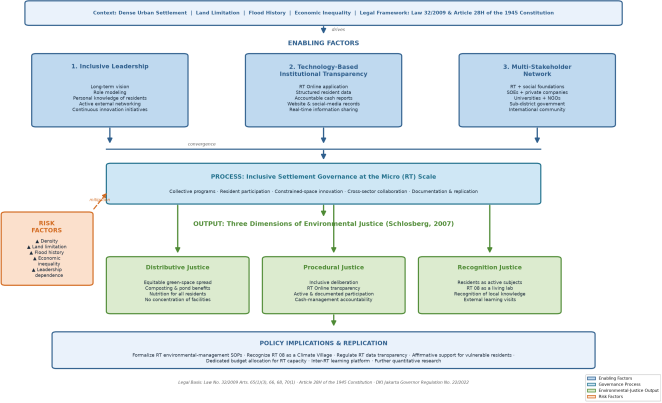
A conceptual model of the replication of community-based environmental justice at the RT level, derived from the case study, is presented in
Figure 1.
Figure 1. Replication model of community-based environmental justice at the RT governance level (Case Study of RT 08/RW 04 Malaka Jaya, East Jakarta). Source: Adaptation from field findings at RT 08/RW 04 Malaka Jaya (2026).
3. Results
3.1. Application of the Environmental-Justice Concept at the RT 08 Level
Field findings show that RT 08 translates the concept of environmental justice not merely as freedom from pollution or the availability of green space, but as the relatively equitable distribution of environmental, economic, knowledge, and network benefits among residents. This aligns with Schlosberg's framework, which emphasizes that environmental justice encompasses distributive, procedural, and recognition dimensions in an integrated manner, as well as with the Indonesian environmental-law perspective that mandates the principle of justice in Law Number 32 of 2009. Furthermore, Bullard
affirms that environmental justice requires a fair distribution of environmental benefits and burdens without discrimination based on class or social status—a condition that RT 08 pursues through the dispersal of green infrastructure across all alleys. Walker
adds that an inclusive decision-making process is an inseparable element of environmental justice, consistent with the RT-Online-based data transparency mechanism implemented in RT 08.
The implementation of distributive justice is evident in program designs that ensure environmental facilities and benefits are not concentrated in a single location or particular group. Green spaces, catfish ponds, the nutrition pond, and biota are spread across the three narrow alleys that constitute RT 08, not only in locations that are easily accessible or near the RT officials' homes. The family-gathering program themed "From Our Home, Waste Is Reduced, the RT Grows Stronger" involves all residents in the planning and implementation process, so that a sense of ownership toward environmental programs grows collectively. This equitable spatial distribution is important in the context of dense settlements, where limited land can create inequities in access to environmental benefits.
Procedural justice is realized through transparency and participation mechanisms facilitated by the RT Online application. The application contains complete data on each resident, including socio-economic profiles, which enables RT officials to design programs responsive to the diverse needs of residents. The RT head emphasizes the principle of not differentiating among residents based on social or economic status, which encourages residents' openness to share (sharing session) about issues of cleanliness, waste, drainage, and green space. This finding confirms Coolsaet's argument that procedural justice—who has a voice in decision-making—is a prerequisite for genuine distributive justice. From the perspective of Indonesian environmental law, this mechanism aligns with the principle of participation mandated in Law Number 32 of 2009 and DKI Jakarta Governor Regulation No. 22 of 2022.
The recognition dimension is manifested in the positioning of RT 08 as a "learning site for environmental and social practices" for external parties, ranging from social foundations and universities to foreign guests. Residents are not merely beneficiaries of programs but are recognized as subjects who possess local knowledge about environmental management worthy of being learned and disseminated. This recognition enhances residents' social capital and self-confidence, while also expanding the networks that can be mobilized to support subsequent programs. This aligns with Schlosberg's argument that recognition of the identity and contribution of affected groups is an important element of environmental justice.
The integration of waste management with strengthening residents' economy shows that environmental justice in RT 08 extends beyond the ecological dimension to encompass economic justice. Reuse-reduce-recycle practices not only reduce the environmental burden but are also linked to strengthening micro, small, and medium enterprises (MSMEs), such as the production of shredded catfish (abon lele) from residents' catfish cultivation supported by the Hidup Jaya Abadi Foundation. This product is not only a source of additional income for residents but is also sent as aid to disaster victims in Sumatra, demonstrating a dimension of solidarity and inter-regional justice. This finding broadens the understanding of environmental justice from the traditional focus on the distribution of pollution burdens to the distribution of sustainable economic opportunities, consistent with the economic-justice concept developed by Raharjo, Ihsan, and Yuned in the context of community-based waste management.
Within the framework of Indonesian environmental law, RT 08's practices demonstrate the concrete implementation of Article 70 paragraph (1) of Law Number 32 of 2009, which states that the community has an equal and widest opportunity to actively participate in environmental protection and management. The participatory mechanisms, data transparency, and recognition of residents' local knowledge show that the constitutional right to a good and healthy environment, as guaranteed by Article 28H paragraph (1) of the 1945 Constitution, can be realized through inclusive governance at the most micro level.
3.2. Distribution of Environmental Burdens and Benefits
Field data show that the distribution of environmental impacts in RT 08 is perceived as relatively equitable by residents. This perception is influenced by the leadership of the RT head, who prioritizes the principles of social equality and openness, as well as by program designs that ensure environmental facilities are not concentrated in a single location. Within the Rhodes framework, this equitable distribution is an indicator of the achievement of environmental justice, because no group of residents systematically bears a greater environmental-risk burden (flooding, pollution, waste) than another group.
Communal work to clean the ditches is carried out periodically together with the Babinsa (Village Guidance Non-commissioned Officer) and residents to prevent blockages and flooding
. This activity shows that the distribution of the environmental-maintenance burden is undertaken collectively, rather than being solely the responsibility of RT officials or a particular group. This reflects the principle that "all residents join the communal work, and all also enjoy reduced flooding and improved green-space quality," which is a concrete operationalization of the distributive-justice concept in urban drainage management.
The innovation of converting a water channel into a two-story catfish cultivation pond demonstrates creativity in addressing limited land while creating dual benefits: waterlogging mitigation and food production. The nutrition pond built to improve the health of the elderly and toddlers through fish cultivation reflects special attention to vulnerable groups, consistent with the environmental-justice principle emphasizing protection of the weakest groups. In the context of environmental-health law, this nutrition-pond program can be viewed as an implementation of the constitutionally guaranteed right to health, closely related to the right to a good and healthy environment.
Infiltration/artesian wells and biopores built at various points function to reduce waterlogging and their benefits can be felt by all residents, not only those living near the wells. This micro green infrastructure is a form of inclusive distribution of environmental benefits, because it reduces flood risk, which in the urban context frequently threatens economically weaker groups living in rented houses or houses along riverbanks with poor drainage conditions
| [23] | Purba, B. G. Z., Supatra, S. Penerapan tipologi baru hunian regeneratif sebagai simbiosis ekologis dalam urban renewal di kawasan bantaran Sungai Ciliwung. Jurnal Sains, Teknologi, Urban, Perancangan, Arsitektur (Stupa). 2025, 7(2), 605–620. https://doi.org/10.24912/stupa.v7i2.35565 |
[23]
. Research shows that micro green infrastructure such as infiltration wells and biopores is effective in reducing waterlogging in dense areas when supported by active resident participation.
The composting program using multipurpose composter drums produces organic fertilizer used for residents' plants, so that both economic benefits (savings on fertilizer costs) and environmental benefits (reduction of waste sent to landfills) are distributed to participating residents. Nonetheless, it should be noted that not all residents participate with the same intensity, indicating that the distribution of environmental benefits, though relatively equitable, remains influenced by the level of individual participation. This aligns with the findings of Raharjo, Ihsan, and Yuned that the success of community-based waste-management programs depends on the level of active resident participation
| [24] | Atnkut, B., Nigussie, A., Kumera, B., Tsega, A., Tiruneh, F., Minale, W. K., Anemut, F., Tazebew, E., Terefe, B., Fassil, A., Gebeyehu, G., Astatkie, T. Factors Influencing Solid Waste Management Practices and Challenges in Awi Administrative Zone, Northwestern Ethiopia. BioMed Research International. 2025, 2025(1).
https://doi.org/10.1155/bmri/1311674 |
[24]
.
These findings confirm the literature's argument that the distribution of environmental benefits does not depend solely on the availability of physical infrastructure, but also on institutional mechanisms that ensure fair access for all groups of residents. In the case of RT 08, this mechanism is realized through inclusive leadership, data transparency, and collective program design that reduces participation barriers. From the perspective of environmental law, this practice demonstrates the implementation of the justice principle in Law Number 32 of 2009, which requires the fair distribution of natural-resource and environmental benefits for the entire community.
3.3. Environmental-Injustice Risk Factors and Institutional Responses
Although relatively successful in reducing inequalities, RT 08 still faces structural environmental-injustice risk factors. These factors need to be identified to understand the limitations of the micro-governance model in addressing inequalities rooted in a broader socio-economic structure.
First, limited physical space is an inherent constraint in dense urban settlements. RT 08 is located in an area that was initially dense and tended toward slum conditions, with three narrow alleys and limited land. Without fair management, environmental facilities such as parks, ponds, or green spaces could be enjoyed only by residents living near those locations. RT 08's response to this risk is to disperse environmental facilities across various points in the three alleys and to maximize the use of vertical space (two-story catfish pond, vertical gardens) to overcome the limitation of horizontal land. This vertical-space-utilization strategy aligns with the literature on urban green infrastructure, which emphasizes the importance of spatial innovation in the context of limited land.
Second, the history of poor drainage and flooding in the Malaka Jaya area reveals a structural vulnerability that cannot be fully addressed by RT initiatives alone. High waterlogging once occurred on Jalan Nusa Indah Raya, indicating that the macro drainage system at the sub-district and district levels requires improvement. If improvement interventions are undertaken only in RT 08 while the surrounding area continues to experience waterlogging, then RT 08 residents remain at risk of being affected by flooding coming from other areas. RT 08's response is to conduct routine communal ditch-cleaning and to build infiltration wells at several points to reduce runoff, although this does not fully resolve the macro drainage problem. This limitation shows that environmental justice requires policy intervention at various levels of government, not only at the RT level.
Third, differences in economic capacity and knowledge among residents create the potential for inequality in accessing environmental benefits. Without RT intervention, economically stronger residents tend to more easily modify their homes (raising floors, installing pumps, making water filters, creating private gardens), while poorer residents are more vulnerable to pollution, flooding, and poor sanitation
| [25] | Adib, F. Rekonstruksi regulasi usaha pengembang perumahan yang berbasis nilai keadilan. [Doctoral dissertation]. Semarang: Sultan Agung Islamic University; 2022. Available from: http://repository.unissula.ac.id/30962/ |
[25]
. RT 08's response is to provide collective programs accessible to all residents regardless of economic capacity, such as the nutrition pond, infiltration wells, and communal gardens. In addition, support from foundations and corporate CSR helps close the access gap for economically weaker residents, for example in providing waste-management facilities, plant seedlings, and micro-enterprise capital based on the environment.
Fourth, inequality in access to external aid and networks can create "green islands" (a term for the phenomenon of uneven benefit distribution within a small area) in which only some residents benefit from CSR, NGOs, or international institutions. This risk is recognized in the literature as "elite capture," in which resources and opportunities meant for the community are instead controlled by a small local elite. RT 08's response is to build transparency mechanisms through the RT Online application and joint forums (family gatherings, socialization) that ensure information about aid and programs is open to all residents. The RT head also functions as a broker who distributes access to external networks more equitably, not only to particular groups.
These findings confirm the literature's argument that structural factors such as density, poverty, and limited macro infrastructure create vulnerabilities that are difficult to fully address through local intervention. However, the case of RT 08 shows that inclusive governance can mitigate the impact of those structural factors, even though it does not eliminate them entirely. This aligns with Coolsaet's argument that environmental justice requires intervention at various scales, from local to national, to address the root causes of injustice. In the Indonesian legal context, these findings affirm the importance of coordination among levels of government as regulated in Law Number 32 of 2009 and DKI Jakarta Governor Regulation No. 22 of 2022.
3.4. The Role of RT Leadership and Inclusive Governance
The leadership of RT 08 plays a central role in steering fair environmental governance. Field findings show that the RT head has personal knowledge of each of his residents, enabling a rapid response to situations of social vulnerability. For example, when a resident experienced a mental-health disturbance in Bekasi to the point of damaging a waste-collection point and being reported by the police, the RT head was able to immediately coordinate with the Social Affairs Office to pick up the resident and send him to the hospital. This personal closeness creates trust between residents and RT officials, which is important social capital in mobilizing participation.
Visionary leadership is demonstrated through the initiation of various environmental innovations that were previously uncommon at the RT level, such as converting a water channel into a two-story catfish pond, processing waste with composter drums, the nutrition pond, and biopore/artesian wells. These innovations are not merely imitations of top-down programs but creative adaptations to local conditions that integrate local knowledge with input from external partners. This aligns with the literature on transformative leadership, which emphasizes the ability of local leaders to adapt and internalize good practices according to the local context.
Participatory leadership is reflected in the way the RT head connects residents with various external partners, such as the district government, the Hidup Jaya Abadi Foundation, corporations (PT Hilon Indonesia, Indocycle), and foreign embassies. This network is not exclusively controlled by RT officials but is opened to residents through joint forums such as family gatherings, waste-management socialization, and environmental-economic activities. This ensures that environmental decisions are not elitist but are facilitated through collective deliberation involving various resident voices. From a legal perspective, this practice aligns with the participation principle in Law Number 32 of 2009 and Regulation of the Minister of Home Affairs No. 18 of 2018, which mandate community involvement in environmental decision-making.
Role modeling becomes an important instrument in normalizing environmentally friendly behavior. The RT head and his family directly practice composting, sweeping the streets after dawn, and other environmental activities that send a signal to residents that this behavior is part of daily life, not merely a slogan. The literature shows that role modeling by local leaders is a key factor in changing social norms and mobilizing resident participation.
Transparency and the use of technology, particularly the RT Online application, facilitate comprehensive resident data collection, accountable cash management, and open dissemination of environmental rules
. Residents can access information about programs, budgets, and RT officials' decisions, so that social-control mechanisms can function and unfair decisions can be corrected. This aligns with the principle of good governance, which emphasizes transparency, accountability, and participation as its main pillars. In the Indonesian legal context, transparency of environmental information is a community right guaranteed in Article 68 of Law Number 32 of 2009.
Cross-sector collaboration reduces dependence on resident contributions and expands the coverage of environmental programs. RT 08 partners with foundations, state-owned enterprises (BUMN), private companies, and the government, so that the available resources are larger and more diverse. This strategy reduces the financial burden on economically weaker residents and ensures that environmental programs can proceed even if not all residents are able to contribute financially. The literature shows that multi-stakeholder partnership is an effective strategy for overcoming resource limitations at the local level. Within the legal framework, this partnership aligns with the partnership principle in environmental management regulated in Law Number 32 of 2009.
3.5. Resident Participation and Prevention of Elite Capture
Resident participation is a key factor that reduces the possibility of "elite capture" over environmental programs. Field findings show that residents are actively involved in various routine activities such as communal work, ditch management, and arranging alleys into green and productive spaces. Participation in these physical activities reduces flood risk and improves air quality and environmental aesthetics that are felt by all parties, not only officials or particular residents.
Residents are also involved in innovative activities such as the nutrition pond, catfish cultivation, and the making of processed products (shredded catfish/abon lele) that then become a symbol of environmental-economic integration. This participation ensures that program benefits are enjoyed not only by officials but also by ordinary households involved in the production and marketing process. The shredded-catfish product was even sent as aid to disaster victims in Sumatra, demonstrating that resident participation has not only local impact but also contributes to broader social solidarity.
Residents' involvement in environmental family gatherings and receiving learning visits from external parties shows that residents are not merely objects of programs but subjects who explain, practice, and maintain environmental norms in their own living spaces. This enhances residents' sense of ownership and pride toward their environment, which is a prerequisite for the long-term sustainability of programs. From a legal perspective, this active resident participation is a concrete implementation of the right to participate in environmental protection and management as regulated in Article 70 of Law Number 32 of 2009.
The literature emphasizes that the more actively residents participate, the smaller the possibility of "elite capture," in which environmental funds or facilities are controlled by only a few people. In the case of RT 08, broad participation is reinforced by transparency mechanisms (the RT Online application) and deliberative forums (family gatherings, socialization) that open space for various resident voices to be heard and considered in decision-making.
However, it should be noted that not all residents participate with the same intensity. Residents with informal jobs that require high mobility or long working hours may have limited time to be involved in collective activities. This indicates that although inclusive participation mechanisms have been established, structural factors such as employment conditions still influence individuals' ability to participate actively. The literature suggests that participatory program design needs to consider the diversity of residents' socio-economic conditions, for example by providing various participation options (not only physical, but also contributions of ideas, documentation, or financial support).
3.6. Socio-Economic and Health Dimensions
RT 08 shows that collective and inclusive program design can close part of the gap in access to a decent environment for residents from diverse socio-economic backgrounds. Assistance from the Hidup Jaya Abadi Foundation and CSR support from various companies help provide waste-management facilities, plant seedlings, and micro-enterprise capital based on the environment for economically weaker groups. This aligns with the literature's argument that well-channeled external support can function as an affirmative intervention to reduce access gaps.
However, houses in narrow alleys, small rented dwellings, and informal-worker residents still face higher vulnerability to flooding, heat, and pollution compared with residents living in permanent houses with better building conditions. RT 08's programs reduce this vulnerability through collective governance (drainage communal work, infiltration wells), but do not entirely eliminate the structural inequality born of economic conditions. This finding confirms Rhodes's argument that poor groups usually bear a greater environmental-risk burden unless there is strong affirmative intervention.
From the health dimension, flooding and waste accumulation can potentially trigger water-based diseases (diarrhea, skin diseases, leptospirosis) and increase disease-vector populations (mosquitoes, rats), which affect increased risk of dengue fever and other diseases, especially for the elderly and children. The nutrition-pond program built to improve the health of the elderly and toddlers shows special attention to this vulnerable group, consistent with the environmental-justice principle emphasizing protection of the weakest groups. In the context of Indonesian environmental-health law, this program can be viewed as an implementation of the right to health guaranteed by Article 28H paragraph (1) of the 1945 Constitution and related to the right to a good and healthy environment.
Inequality in access to green space and air quality can create psychological and social burdens (stress, discomfort, a feeling of "environmental discrimination") for residents living in the densest and most slum-like points. However, when environmental injustice is reduced through RT 08's programs, there is an increase in subjective well-being in the form of a sense of pride, stronger social cohesion, and access to new economic opportunities (environmental MSMEs, study visits, international networks). This confirms the literature's argument that environmental justice correlates directly with the right to health and well-being, both physical and psychological.
These findings emphasize the importance of integrating health and well-being dimensions into the evaluation of environmental-justice programs. Program success is measured not only by physical indicators (reduced waterlogging, increased green space), but also by public-health indicators (reduction in the incidence of environment-based diseases) and subjective well-being (increased sense of pride, social cohesion)
| [5] | Cahyani, P., Mubarak, & Zulkarnain. (2025). Kebijakan lingkungan dalam pengelolaan kualitas perairan di Indonesia: Tinjauan kebijakan (2022–2025) dan implikasinya bagi permukiman padat. Integrative Perspectives of Social and Science Journal, 2(6), 8551–8557. Available from:
https://ipssj.com/index.php/ojs/article/view/998 |
[5]
. From the Indonesian legal perspective, integrating this health dimension aligns with the principle of environmentally sound sustainable development as regulated in Law Number 32 of 2009
| [26] | Akibu, R. S. Pembangunan berkelanjutan di Kabupaten Gorontalo: Integrasi sosial, ekonomi, dan lingkungan. In: Hajar, S., editor. Perubahan Iklim dan Pembangunan Berkelanjutan. Medan: UMSU Press; 2025. Available from: books.google.co |
[26]
.
4. Discussion
Several strategies that have been and can continue to be developed in RT 08, and that are relevant for replication in other dense settlements, encompass seven main aspects. First, a networking strategy to guarantee a sense of safety and comfort as well as environmental justice for residents. The RT 08 head builds networks with state-owned enterprises, private companies, foundations, universities, and even foreign embassies, which open access to financial, knowledge, and technological resources unavailable at the local level. This strategy can be replicated by other RTs by mapping potential partners around their areas and developing cooperation proposals that demonstrate residents' commitment to environmental management.
Second, sustained role modeling by RT officials as an instrument for changing social norms. The RT head and his family directly practice environmentally friendly behavior (composting, cleaning, plant care) that inspires other residents to do the same. This strategy can be replicated through RT leadership training that emphasizes the importance of role modeling and effective communication with residents.
Third, innovation in the use of limited space through vertical and multifunctional green infrastructure. RT 08 maximizes narrow land by creating a two-story catfish pond, vertical gardens, and combined drainage-cultivation functions. This strategy is relevant for other dense settlements facing horizontal-land limitations. The city government can support this replication by providing technical assistance and mentoring in the design of micro green infrastructure.
Fourth, institutional strengthening and documentation that make the RT a well-documented "living lab" (website, social media, activity reports), so that good practices can be replicated, while residents have a stronger bargaining position in advocacy to the sub-district, district, and CSR partners. This strategy can be strengthened through data-management and public-communication training for RT officials.
Fifth, developing micro green infrastructure by increasing infiltration wells, biopores, vertical gardens, and small ponds in narrow alleys as a response to flood risk and land limitations. This has already begun in RT 08 through the construction of infiltration wells at several points and can be expanded with support from city-government programs such as the climate village (kampung iklim).
Sixth, cross-generational environmental education by making children and adolescents the main actors in environmental activities (urban farming, small waste banks, cleanliness competitions, video documentation), so that environmental justice is sustained and does not stop when the leadership changes
| [16] | Yuliani, E., Herlina, N., & Sukarman, H. (2024). Pelaksanaan Pasal 67 Undang-Undang Nomor 32 Tahun 2009 tentang Perlindungan dan Pengelolaan Lingkungan Hidup terhadap Pembuangan Sampah oleh Wisatawan di Pantai Pangandaran. Pustaka Galuh Justisi, 2(2), 199–217.
https://doi.org/10.25157/pustaka.v2i2.4185 |
| [7] | Susila Wibawa, K. C. Mengembangkan Partisipasi Masyarakat Dalam Perlindungan dan Pengelolaan Lingkungan Hidup Untuk Pembangunan Berkelanjutan. Administrative Law and Governance Journal. 2019, 2(1).
https://doi.org/10.14710/alj.v2i1.79-92 |
[16, 7]
. This strategy can be integrated with the environmental-education curriculum in schools around the RT.
Seventh, synergy with city/provincial policy by linking RT initiatives with DKI Provincial Government programs (for example, RT/RW digital platforms, emission-reduction programs, climate village), so that access to public support is broader and not dependent on a single donor
. This strategy requires active coordination between the RT and the sub-district, district, and city governments to ensure that RT programs align with city-level environmental policy.
From the perspective of Indonesian environmental law, these strategies align with the principles of integration, participation, and biodiversity in Law Number 32 of 2009. Replicating RT 08's practices requires clear regulatory support at the sub-district and district levels, capacity training for RT officials, and the city government's commitment to providing incentives for RTs that successfully implement environmental-justice practices.




 Share This Article
 Twitter
 Linked In
 Facebook
 Copy
Copy Download