Abstract
Muscle architecture parameters, including muscle thickness (MT), fascicle length (FL), and pennation angle (PA), play a critical role in determining muscle performance. This study utilized structural equation modeling (SEM) to investigate the structural relationships between these morphological features and key performance metrics in athletes. By examining how architectural variations contribute to force production and explosive power, the research aims to bridge gaps in understanding muscle–performance dynamics. The primary objective was to evaluate the influence of muscle architecture parameters (MT, FL, and PA) on muscle performance tests, including vertical jump height, leg press power, and one-repetition maximum (1RM) squat strength, through SEM analysis. The study selected 50 male athletes aged 18–25 years, each possessing at least three years of structured training experience. Muscle architecture was assessed via B-mode ultrasonography targeting the vastus lateralis muscle. Performance evaluations encompassed vertical jump height, leg press power output, and 1RM squat strength. Data normality was verified using the Shapiro–Wilk test, which indicated normal distribution for most variables except squat strength. SEM was employed to test hypothesized pathways, with model fit assessed through χ2, RMSEA, SRMR, and CFI indices. SEM demonstrated excellent model fit (χ2 = 4.88, p = 0.770; RMSEA = 0.000; SRMR = 0.044; CFI = 1.000), confirming the validity of the proposed relationships. Muscle thickness was the strongest morphological predictor (β = 0.580), emphasizing its role in hypertrophy and force generation. Fascicle length showed a significant negative association (β = –0.410, p = 0.002), indicating potential limitations in maximal strength tasks despite benefits in speed-related activities. Pennation angle had a weak, non-significant effect (β = –0.167, p = 0.178), suggesting its influence is highly context-specific. Among performance measures, 1RM squat strength exerted the greatest impact (β = 0.963, p < 0.001), followed by vertical jump (β = 0.737) and leg press power (β = 0.630). These results highlight muscle thickness as a key driver of explosive performance, while maximal dynamic strength (1RM squat) emerges as the most reliable performance indicator. The findings offer practical implications for refining training protocols, enhancing talent scouting, and advancing theoretical frameworks of muscle–performance interactions in elite athletes.
|
Published in
|
American Journal of Sports Science (Volume 14, Issue 2)
|
|
DOI
|
10.11648/j.ajss.20261402.13
|
|
Page(s)
|
25-36 |
|
Creative Commons
|

This is an Open Access article, distributed under the terms of the Creative Commons Attribution 4.0 International License (http://creativecommons.org/licenses/by/4.0/), which permits unrestricted use, distribution and reproduction in any medium or format, provided the original work is properly cited.
|
|
Copyright
|
Copyright © The Author(s), 2026. Published by Science Publishing Group
|
Keywords
Muscle Architecture, Muscle Thickness, Fascicle Length, Pennation Angle, Muscle Performance,
Structural Equation Modeling (SEM)
1. Introduction
Muscle architecture, which describes the geometric configuration of muscle fibers, is a crucial factor influencing muscle function and performance. Key architectural features, such as fascicle length, pennation angle, and muscle thickness, are vital in determining a muscle's ability to produce force and the speed at which it contracts. In high-performance sports, these parameters are even more vital as they directly impact an athlete's ability to excel in sprinting and explosive strength activities. Understanding how these architectural traits contribute to athletic performance has significant implications for talent identification, training optimization, and injury prevention.
Running and strength activities, such as jumping, sprint starts, and Olympic weightlifting, require rapid force production and a deep understanding of muscle mechanics. Sprinting, for example, involves rapid, repetitive contractions in which muscle fibers must generate maximum force over a very short time. Explosive strength is similarly dependent on quick force production but may involve single maximal efforts (such as in a vertical jump). Muscle architecture significantly influences performance metrics by determining both the speed of muscle contraction and capacity for force production.
Many research studies have demonstrated a link between muscle structure and sports performance. For instance, the length of fascicles, which indicates the length of muscle fibers, is linked to the speed of contraction. Longer fascicles are beneficial for activities that require high contraction velocities, such as sprinting and jumping. In his research, Abe T. showed that sprinters typically have longer fascicles in muscles such as the vastus lateralis than non-athletes, likely contributing to their superior sprinting abilities. Fascicle length facilitates faster muscle shortening, which is essential for generating rapid movements in activities such as sprinting and jumping.
.
Conversely, the pennation angle, which is the angle at which muscle fibers align relative to the muscle’s force-generating axis, primarily affects the muscle's force-generating capacity. A larger pennation angle allows more fibers to be packed into a given cross-sectional area, enhancing the overall force that a muscle can produce. This is particularly important in explosive strength activities, where maximal force must be generated in a single effort to achieve optimal performance. Studies such as those by Blazevich suggest that athletes excelling in explosive strength events often have larger pennation angles, enabling them to generate more force during movements such as jumps and throws.
| [2] | Blazevich AJ, Cannavan D, Coleman DR, Horne S. Influence of concentric and eccentric resistance training on architectural adaptation in human quadriceps muscles. J Appl Physiol (1985). 2007; 103(5): 1565-75.
https://doi.org/10.1152/japplphysiol.00578.2007 |
[2]
.
Muscle thickness, another critical architectural feature, is indicative of the overall cross-sectional area (CSA) of the muscle, which correlates with its ability to generate force. A larger CSA generally equates to a greater force-producing capability, a concept supported by bodybuilders and powerlifters who exhibit thick muscle fibers. Maughan, R. J. demonstrated a strong correlation between quadriceps muscle thickness and both peak torque and maximal force output in trained athletes.
Therefore, muscle thickness is particularly relevant for both sprinting and explosive strength, where high force outputs are required to propel the body forward or upward. To investigate the intricate connections between muscle architecture and performance, this research utilized structural equation modeling (SEM). SEM is a multivariate statistical technique that allows for the analysis of both direct and indirect relationships among observed and latent variables. This approach is particularly effective for examining how different elements of muscle architecture, such as fascicle length, pennation angle, and muscle thickness, work together to impact sprint and explosive strength performance. Recently, SEM has become increasingly popular in sports science for modeling performance-related variables and providing insights that simpler statistical methods cannot offer. For instance, Wren employed SEM to evaluate how various biomechanical and anatomical factors influence sprinting mechanics, thereby offering a comprehensive understanding of sprinting performance.
| [4] | Wren TA, Bluml S, Tseng-Ong L, Gilsanz V. Three-point technique of fat quantification of muscle tissue as a marker of disease progression in Duchenne muscular dystrophy: preliminary study. AJR Am J Roentgenol. 2008; 190(1): W8-12.
https://doi.org/10.2214/AJR.07.2171 |
[4]
By applying SEM in the present study, we aimed not only to assess the direct effects of muscle architecture on performance but also to explore how these variables interact to achieve optimal results in sprinting and explosive strength activities. This study seeks to bridge the gap between muscle architecture and its application in athletic performance. Through SEM, we examined how different muscle architectural traits predict muscle performance, contributing to a deeper understanding of the underlying mechanics. This study aims to provide evidence-based insights that can enhance training programs, optimize performance, and inform talent identification strategies.
2. Material and Methods
2.1. Participants
The study included 50 male athletes, aged 18–25 years, who were actively engaged in sports requiring high levels of sprinting and explosive strength. The sprinting group included athletes specializing in the 100 m (n = 10), 200 m (n = 10), and 400 m (n = 10) events, while the explosive strength group consisted of long jump (n = 10) and high jump (n = 10) athletes. Participants were selected through purposive sampling from the undergraduate and postgraduate programmes at the Lakshmibai National Institute of Physical Education (LNIPE), Gwalior, India.
The inclusion criteria were as follows:
1) A minimum of three years of training experience.
2) No history of musculoskeletal injuries in the past six months.
3) Regular engagement in sports-specific training (at least four sessions per week).
All participants continued their regular sport-specific training routines throughout the study period. Training volume and content were not standardized or controlled by the researchers. However, a mandatory minimum 24-hour rest period from the last training session was required before all testing sessions to minimize the effect of acute fatigue on muscle architecture and performance measurements. The study received approval from the Departmental Research Committee (DRC) at Lakshmibai National Institute of Physical Education in Gwalior, M.P., India (File No: Academic/PhD/384/964). Written informed consent was obtained from all participants.
2.2. Muscle Architecture Parameter Measurement
Prior to the ultrasound examination, participants lay supine for 15 minutes to allow fluid redistribution. Muscle architecture was assessed using B-mode ultrasonography (Wipro GE Voluson E) with a 12 MHz linear probe, which was covered with a water-soluble transmission gel to maintain acoustic contact without applying pressure to the skin. All measurements were standardized and performed on the vastus lateralis muscle of the participants' dominant leg.
1) Pennation Angle (PA): This is described as the angle formed between the fascicle and the deep aponeurosis.
2) Fascicle Length (FL): It is determined as the straight-line distance from the superficial to the deep aponeurosis, with extrapolation beyond the image frame if needed.
3) Muscle Thickness (MT): This is measured as the distance from the subcutaneous fat layer to the superficial border of the femur or deep aponeurosis.
Each parameter was recorded thrice, and the average was used for analysis. The intraclass correlation coefficients (ICCs) for these measurements ranged from 0.9 to 0.996 (p < 0.001), ensuring reliability.
2.3. Muscle Performance Tests
2.3.1. Vertical Jump Test
Explosive leg power was evaluated using the vertical jump test, a widely recognized measure in sports science
. The participants engaged in a standardized 10-minute warm-up that included dynamic stretching and submaximal jumps. Positioned next to a wall-mounted measuring device, the participants executed maximal countermovement jumps without a run-up. The difference between their standing reach and maximal jump reach heights was recorded. Each participant completed three trials, and the best performance was used for further analysis
| [6] | Bosco C, Luhtanen P, Komi PV. A simple method for measurement of mechanical power in jumping. Eur J Appl Physiol Occup Physiol. 1983; 50(2): 273-82.
https://doi.org/10.1007/BF00422166 |
[6]
.
2.3.2. Leg Press Power
Peak force production of the lower limbs was evaluated using the leg press power test with a calibrated dynamometer. Participants began with a warm-up set at approximately 50% of their estimated maximum, followed by three trials of maximal effort. The highest value was considered for analysis. Throughout the testing, an experienced technician ensured proper technique to minimize compensatory movements and ensure valid results
.
2.3.3. One-repetition Maximum (1RM) Squat Test
The dynamic strength of the lower body was further evaluated using the one-repetition maximum (1RM) squat test, widely regarded as the gold standard for assessing muscular strength
| [8] | McGuigan MR, Winchester JB. The relationship between isometric and dynamic strength in college football players. J Sports Sci Med. 2008; 7(1): 101-5. |
[8]
. Following a standardized warm-up that included submaximal sets at 50–70% of the estimated maximum, the participants performed single repetitions with gradually increasing loads until they reached failure. To minimize fatigue, adequate recovery periods of 3–5 minutes were allowed between attempts. The maximum load successfully lifted with proper squat depth and technique was recorded as the participant’s 1RM value
| [9] | Nuzzo JL, McBride JM, Cormie P, McCaulley GO. Relationship between countermovement jump performance and multijoint isometric and dynamic tests of strength. J Strength Cond Res. 2008; 22(3): 699-707.
https://doi.org/10.1519/JSC.0b013e31816d5eda |
[9]
.
2.4. Statistical Analysis
Using AMOS software, Structural Equation Modeling (SEM) was conducted to examine the relationships between muscle architecture parameters (PA, FL, MT) and performance outcomes, including vertical jump height, leg press power, and 1 RM Squat.
3. Results
The descriptive results in
Table 1 provided an overview of the central tendency, variability, and distribution characteristics of the selected performance and muscle architecture variables. The 1RM squat demonstrated a median of 124.76 kg with a relatively high standard deviation (SD = 34.13), ranging from 73.53–199.43 kg. This spread reflects considerable inter-individual differences in the maximal strength capacity. However, the Shapiro–Wilk test revealed a significant deviation from normality (W = 0.920, p = 0.002), indicating that squat strength values were not normally distributed and might be skewed toward either higher or lower performers but SEM analysis is considered robust to moderate violations of normality, particularly when maximum likelihood estimation is used.
Table 1. Descriptives.
| Shapiro-Wilk |
Variables | Median | SD | Minimum | Maximum | W | p |
RM Squat | 124.76 | 34.127 | 73.53 | 199.43 | 0.920 | 0.002 |
Leg Press | 1030.79 | 202.601 | 511.05 | 1494.85 | 0.990 | 0.938 |
Vertical Jump | 50.25 | 6.583 | 35.89 | 63.87 | 0.977 | 0.438 |
Muscle Thickness | 2.49 | 0.306 | 1.93 | 3.06 | 0.967 | 0.173 |
Fascicle Length | 8.65 | 1.039 | 6.44 | 11.75 | 0.985 | 0.777 |
Pennation Angle | 20.16 | 2.551 | 14.27 | 24.98 | 0.977 | 0.441 |
In contrast, leg press performance showed a median of 1030.79 N (SD = 202.60), ranging from 511.05 to 1494.85 N. The Shapiro–Wilk test (W = 0.990, p = 0.938) confirmed the normality of the data, indicating that the leg press strength was uniformly distributed among the participants. Vertical jump height had a median of 50.25 cm (SD = 6.58), ranging from 35.89 to 63.87 cm. The Shapiro–Wilk test (W = 0.977, p = 0.438) confirmed a normal distribution, indicating a consistent capacity for explosive strength across the samples.
Regarding muscle morphology, muscle thickness averaged 2.49 cm (SD = 0.31), ranging between 1.93 and 3.06 cm, with a normal distribution (W = 0.967, p = 0.173). Fascicle length had a median of 8.65 cm (SD = 1.04), with values spanning 6.44–11.75 cm, and followed a normal distribution (W = 0.985, p = 0.777). Similarly, the median pennation angle was 20.16° (SD = 2.55), ranging from 14.27° to 24.98°, and the distribution was normal (W = 0.977, p = 0.441).
Table 2. Model Tests.
Label | X2 | df | p |
User Model | 4.88 | 8 | 0.770 |
Baseline Model | 105.96 | 15 | < .001 |
Table 2 presents the chi-square (χ
2) test outcomes, shedding light on how well the hypothesized User Model compares to the Baseline Model. The User Model yielded a chi-square value of 4.88 with 8 degrees of freedom (df), leading to a non-significant p-value of 0.770. This lack of significance implies that the User Model aligns well with the data, as there is no substantial difference between the observed and expected covariance matrices under this model. Conversely, the Baseline Model resulted in a chi-square value of 105.96 with 15 degrees of freedom and a highly significant p-value (p <.001), suggesting that the baseline structure does not adequately represent the data. Overall, this comparison strongly favors the User Model over the Baseline Model.
Table 3. Fit Indices.
| 95% Confidence Intervals | |
SRMR | RMSEA | Lower | Upper | RMSEA p |
0.044 | 0.000 | 0.000 | 0.114 | 0.827 |
The fit indices in
Table 3 further affirm the adequacy of the User Model. The Standardized Root Mean Square Residual (SRMR) value of 0.044 falls below the commonly accepted threshold of 0.08, indicating an excellent model fit. The Root Mean Square Error of Approximation (RMSEA) was 0.000, with 95% confidence intervals ranging from 0.000 to 0.114, indicating excellent fit but potentially reflecting model overfitting. The non-significant RMSEA p-value (0.827) suggests that the model does not significantly deviate from a perfect fit. Although the upper confidence interval (0.114) approaches marginal fit, the RMSEA point estimate (0.000) and the high p-value strongly indicate a good overall fit.
Results from both chi-square model testing (
Table 2) and fit indices (
Table 3) provided converging evidence that the User Model fits the data very well. The non-significant chi-square test, low SRMR, and RMSEA close to zero collectively demonstrate that the hypothesized structural relationships align with the observed data, validating the model's appropriateness for further interpretation and theoretical discussion.
Table 4. User model versus baseline model.
Model Index | Model |
Comparative Fit Index (CFI) | 1.000 |
Tucker-Lewis Index (TLI) | 1.064 |
Bentler-Bonett Non-normed Fit Index (NNFI) | 1.064 |
Relative Noncentrality Index (RNI) | 1.034 |
Bentler-Bonett Normed Fit Index (NFI) | 0.954 |
Bollen's Relative Fit Index (RFI) | 0.914 |
Bollen's Incremental Fit Index (IFI) | 1.032 |
Parsimony Normed Fit Index (PNFI) | 0.509 |
The incremental fit indices in
Table 4 further substantiate the superiority of the User Model over the baseline model, showcasing an excellent to exceptional fit across various indices. The Comparative Fit Index (CFI) was 1.000, indicating that the User Model replicated the observed data exceptionally well compared to the baseline model. Similarly, the Tucker-Lewis Index (TLI = 1.064) and Bentler-Bonett Non-Normed Fit Index (NNFI = 1.064) both surpassed the conventional cut-off value of 0.95, with values above 1.0 often reflecting an outstanding degree of fit combined with model parsimony. The Relative Noncentrality Index (RNI = 1.034) and Bollen’s Incremental Fit Index (IFI = 1.032) also exceeded the 0.95 threshold, reinforcing the robustness of the User Model. The Bentler-Bonett Normed Fit Index (NFI = 0.954) slightly surpassed the recommended cutoff of 0.90, confirming strong model adequacy. Similarly, Bollen’s Relative Fit Index (RFI = 0.914) exceeded 0.90, further supporting the model’s reliability in capturing the data structure. The only moderate value observed was the Parsimony Normed Fit Index (PNFI = 0.509), which is expected, as parsimony indices often reflect a trade-off between model complexity and fit.
The combination of very high incremental fit indices (CFI, TLI, NNFI, IFI, RNI all > 1.0) and satisfactory values of NFI and RFI strongly confirmed that the User Model provided an excellent representation of the data compared to the baseline model. Although the PNFI is moderate, this reflects the balance between parsimony and model complexity rather than a poor fit. Overall, the results aligned with the chi-square and absolute fit indices (
Tables 2 and 3), validating the User Model as a robust framework for explaining the observed relationships.
Table 5. Measurement model.
Latent Variable | Observed Variable | Estimate | SE | Lower | Upper | β | z | p |
Exogenous1 | Muscle Thickness | 1.00 | 0.000 | 1.00 | 1.00 | 1.000 | 0.580 | — |
Fascicle Length | -2.40 | 0.787 | -3.94 | -0.856 | -0.410 | -3.05 | 0.002 |
Pennation Angle | -2.40 | 1.779 | -5.88 | 1.091 | -0.167 | -1.35 | 0.178 |
Endogenous1 | Vertical Jump | 1.00 | 0.000 | 1.00 | 1.00 | 1.000 | 0.737 | — |
Leg Press | 26.31 | 5.911 | 14.72 | 37.896 | 0.630 | 4.45 | <.001 |
RM Squat | 6.78 | 1.085 | 4.65 | 8.901 | 0.963 | 6.25 | — |
The results of the model testing in
Table 5 provide additional evidence for the adequacy of the hypothesized structural model. The User Model demonstrated an excellent fit (χ
2 = 4.88, df = 8, p = 0.770), showing alignment between observed and expected covariance matrices. In contrast, the Baseline Model produced a chi-square of 105.96 (df = 15, p <.001), reflecting a poor fit. Absolute fit indices further reinforced these results, with SRMR (0.044) well below the 0.08 threshold, RMSEA (0.000) indicating near-perfect fit, and a non-significant RMSEA p-value (0.827) confirming the model adequacy.
The incremental fit indices also strongly supported the User Model. The CFI achieved a perfect score of 1.000, while the TLI and NNFI exceeded 1.0 (1.064 each), suggesting an excellent model representation. Additional indices, including IFI (1.032), RNI (1.034), NFI (0.954), and RFI (0.914), surpassed the conventional benchmarks, confirming the robust model performance. Although the PNFI value (0.509) was moderate, this is expected, as parsimony indices tend to be lower in models that prioritize fit over simplicity. Collectively, these results affirm that the User Model is substantially superior to the baseline structure and provides a valid representation of data.
The measurement model offers deeper insights into the contribution of observed indicators to their latent constructs. Within the exogenous latent factor (muscle architecture), muscle thickness emerged as the strongest indicator, serving as the reference loading (β = 0.580), whereas fascicle length contributed significantly but negatively (β = –0.410, p = 0.002), reflecting its inverse association with power-oriented adaptations. The pennation angle also loaded negatively (β = –0.167), but was not statistically significant (p = 0.178), indicating a weaker role within the model. In the endogenous latent construct (performance outcomes), all three indicators demonstrated strong contributions, with 1RM squat (β = 0.963, p <.001) emerging as the most dominant predictor, followed by vertical jump (β = 0.737) and leg press (β = 0.630, p <.001). These results highlight that maximal strength, as reflected in squat and leg press measures, is the primary determinant of performance outcomes, whereas muscle architecture factors, particularly muscle thickness, serve as key underlying morphological predictors.
Table 6. Variances and Covariances.
Variable 1 | Variable 2 | Estimate | SE | 95% C.I Lower | 95% C.I Lower | β | z | p |
Muscle Thickness | Muscle Thickness | 0.0608 | 0.0165 | 0.02839 | 0.0932 | 0.6633 | 3.676 | < .001 |
Fascicle Length | Fascicle Length | 0.8801 | 0.1866 | 0.51441 | 1.2458 | 0.8323 | 4.717 | < .001 |
Pennation Angle | Pennation Angle | 6.1980 | 1.2336 | 3.78014 | 8.6159 | 0.9722 | 5.024 | < .001 |
Vertical Jump | Vertical Jump | 19.3968 | 4.4604 | 10.65461 | 28.1390 | 0.4568 | 4.349 | < .001 |
Leg Press | Leg Press | 24256.82 | 5153.09 | 14156.94 | 34356.7 | 0.6030 | 4.707 | < .001 |
1 RM Squat | 1 RM Squat | 82.2491 | 95.6083 | -105.13970 | 269.6379 | 0.0721 | 0.860 | 0.390 |
Exogenous1 | Exogenous1 | 0.0309 | 0.0177 | -0.00386 | 0.0656 | 1.00 | 1.742 | 0.082 |
Endogenous1 | Endogenous1 | 23.0695 | 7.8697 | 7.64527 | 38.4938 | 1.00 | 2.931 | 0.003 |
Exogenous1 | Endogenous1 | 0.9880 | 0.2920 | 0.41559 | 1.5603 | 1.1708 | 3.383 | < .001 |
The variance–covariance structure in
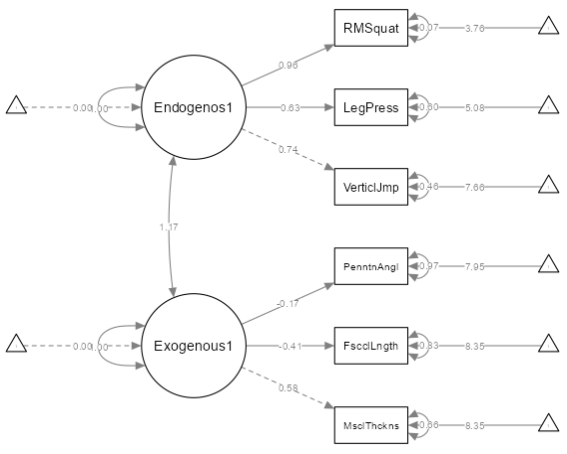
Table 6 provides insight into the reliability of the observed indicators and the strength of the associations between the latent constructs. For the measurement indicators, all variables demonstrated significant variance estimates, except for the 1RM squat. Muscle thickness demonstrated a moderate but statistically significant amount of variance (Estimate = 0.0608, β = 0.6633, z = 3.676, p <.001), suggesting that a meaningful portion of its variability was explained by the latent construct. Similarly, fascicle length (Estimate = 0.8801, β = 0.8323, z = 4.717, p <.001) and pennation angle (Estimate = 6.1980, β = 0.9722, z = 5.024, p <.001) demonstrated strong and significant variance contributions, indicating their reliability as indicators of the exogenous latent factor (muscle architecture). On the performance side, vertical jump (Estimate = 19.39, β = 0.4568, z = 4.349, p <.001) and leg press (Estimate = 24,256.82, β = 0.6030, z = 4.707, p <.001) showed significant variances, confirming their robustness as performance measures (
Figure 1). 1RM squat displayed a non-significant unique variance, likely due to its high shared variance with the latent construct. (Estimate = 82.24, β = 0.0721, z = 0.860, p = 0.390), implying a relatively lower unique variability, likely due to its near-perfect loading already captured within the measurement model.
Exogenous1 (muscle architecture) showed a variance that approached significance (Estimate = 0.0309, p = 0.082), suggesting moderate but inconclusive variability. Endogenous1 (performance outcomes), however, displayed a strong and significant variance (Estimate = 23.07, z = 2.931, p = 0.003), indicating a robust internal consistency within the performance latent factor.
Most importantly, the covariance between Exogenous1 and Endogenous1 was highly significant (Estimate = 0.9880, β = 1.1708, z = 3.383, p <.001). This strong positive relationship demonstrates that muscle architecture is closely linked to performance outcomes, confirming that differences in muscle structure (thickness, fascicle length, and pennation angle) are significantly associated with variations in strength and power performance (squat, leg press, and vertical jump).
Figure 1. SEM Path Diagram.
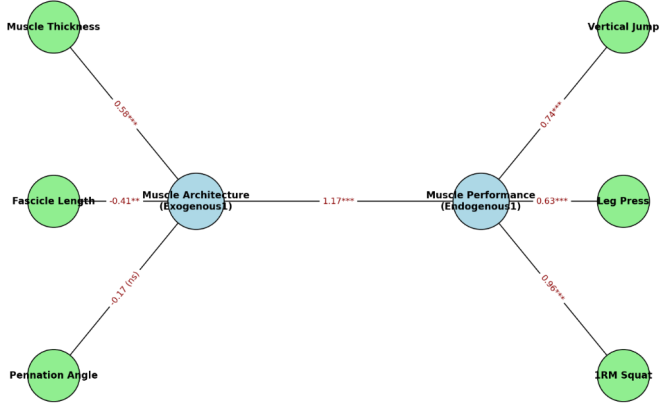
Figure 2. Simplified Path Diagram Muscle architecture → Muscle Performance.
Table 7. Intercepts.
| 95% Confidence Intervals | |
Variable | Intercept | SE | Lower | Upper | z | p |
Muscle Thickness | 2.527 | 0.043 | 2.443 | 2.611 | 59.017 | < .001 |
Fascicle Length | 8.584 | 0.145 | 8.299 | 8.869 | 59.022 | < .001 |
Pennation Angle | 20.083 | 0.357 | 19.384 | 20.783 | 56.244 | < .001 |
Vertical Jump | 49.947 | 0.922 | 48.141 | 51.753 | 54.197 | < .001 |
Leg Press | 1019.008 | 28.364 | 963.415 | 1074.600 | 35.926 | < .001 |
1 RM Squat | 126.969 | 4.778 | 117.605 | 136.333 | 26.575 | < .001 |
Exogenous1 | 0.000 | 0.000 | 0.000 | 0.000 | | |
Endogenous1 | 0.000 | 0.000 | 0.000 | 0.000 | | |
The intercepts represent the mean starting points of each observed variable when the latent constructs are centered at zero, serving as baseline values for comparison. All observed indicators demonstrated highly significant intercepts (p <.001), confirming that their means were reliably different from zero and provided meaningful contributions to the model.
Among the muscle architecture variables, the average muscle thickness was 2.527 cm (95% CI: 2.443–2.611), whereas fascicle length had a mean of 8.584 cm (95% CI: 8.299–8.869). The intercept of the pennation angle was 20.083° (95% CI: 19.384–20.783). These values align well with the typical physiological ranges reported for sprint and endurance populations, reaffirming the reliability of the measured morphological indicators. For performance outcomes, the intercepts highlighted the baseline mean performance capacities of the combined sample. Vertical jump height averaged 49.95 cm (95% CI: 48.14–51.75), leg press strength averaged 1019.01 N (95% CI: 963.41–1074.60 N), and 1RM squat performance averaged 126.97 kg (95% CI: 117.61–136.33). These values reflect solid athletic performance standards and are consistent with the differences previously observed between sprinters and long-distance runners. Notably, the latent constructs Exogenous1 (muscle architecture) and Endogenous1 (performance outcomes) were both fixed at zero (intercept = 0.000), which is the standard in structural equation modeling. Fixing the latent intercepts to zero ensures model identification and focuses interpretation on the observed variable intercepts rather than arbitrary latent means. The significant intercepts across all observed variables confirm that both muscle architecture and performance measures have stable baseline levels, which strengthens the model’s validity (
Figure 2). Muscle geometry (thickness, fascicle length, and pennation angle) establishes distinct structural baselines, whereas performance indicators (vertical jump, leg press, 1RM squat) provide robust benchmarks for strength and explosive power. Together, these intercepts support a strong and consistent relationship between muscle structure and athletic performance, providing a reliable foundation for interpreting latent relationships within the model.
4. Discussion
This study aimed to examine the structural contributions of muscle architecture parameters—muscle thickness (MT), fascicle length (FL), and pennation angle (PA)—to performance outcomes, including vertical jump, leg press power, and one-repetition maximum (1RM) squat strength, using a structural equation modeling (SEM) approach. The results demonstrated that muscle architecture significantly influenced performance, with muscle thickness emerging as the strongest predictor among morphological factors and 1RM squat as the most dominant performance indicator. These findings align with previous research while also offer nuanced insights into the structural–functional relationship underlying explosive performance.
The measurement model revealed muscle thickness as the strongest loading indicator of the exogenous latent construct (β = 0.580), suggesting that greater hypertrophy directly contributes to improved strength and explosive performance. This finding supports the study by Maughan
, who reported strong correlations between quadriceps thickness and torque output in trained athletes, emphasizing the cross-sectional area (CSA) as a determinant of maximal force production. Similarly, Akazawa et al.
| [10] | Akazawa N, Harada K, Okawa N, Tamura K, Moriyama H. Relationships between muscle thickness of knee extensors and physical activity and muscle strength in the elderly: a cross-sectional study. PLoS One. 2018; 13(8): e0201789.
https://doi.org/10.1371/journal.pone.0201789 |
[10]
confirmed that muscle thickness in the knee extensors strongly predicts functional performance outcomes, even in non-athletic populations.
Theoretically, increased muscle thickness reflects a greater CSA, which enhances the potential for parallel sarcomere arrangement, thereby boosting force production
. This structural adaptation is particularly relevant in high-load tasks, such as squatting and pressing, where maximal force must be sustained. Our findings extend these observations to a population of sprint and explosive athletes, underscoring the necessity of hypertrophy-oriented training to optimize power output.
However, contrary evidence suggests that hypertrophy alone may not fully explain the performance outcomes. Narici et al.
| [12] | Narici MV, Hoppeler H, Kayser B, Landoni L, Claassen H, Gavardi C, et al. Human quadriceps cross-sectional area, torque and neural activation during 6 months strength training. Acta Physiol Scand. 1996; 157(2): 175-86.
https://doi.org/10.1046/j.1365-201X.1996.483230000.x |
[12]
reported that neural adaptations can also substantially influence strength, independent of hypertrophy. Therefore, while our SEM results confirm the central role of muscle thickness, integration with neuromuscular coordination should be considered in future models.
Fascicle length was significantly but negatively associated with performance outcomes (β = –0.410, p =.002). This suggests that longer fascicles may not directly benefit strength-oriented tasks, such as squats or leg presses, where force rather than contraction velocity is prioritized. This finding contrasts with the sprint-specific literature, in which longer fascicles are consistently linked to superior performance. For example, Abe T. reported that sprinters exhibited significantly longer fascicles in the vastus lateralis and gastrocnemius, facilitating the greater contraction velocities required for rapid stride turnover.
.
The negative loading in our study likely reflects the specificity of the task demands. Squats and leg presses are slow-velocity, high-force movements, where shorter fascicles combined with increased pennation angle may enhance mechanical leverage for force generation. This is supported by Blazevich, who noted that resistance training emphasizing heavy loads leads to architectural adaptations toward shorter fascicles but increased pennation, favoring strength over velocity. Thus, while fascicle length is advantageous for sprinting, it may be inversely related to maximal strength outcomes, as reflected in our structural model.
.
The pennation angle showed a weak, non-significant contribution (β = –0.167, p =.178), indicating limited predictive capacity within the present sample. This result partially aligns with the literature, as pennation angle adaptations are known to be highly dependent on the task. Larger pennation angles allow greater packing of fibers within a given CSA, enhancing force but compromising contraction velocity
. Cormie reported that athletes with higher pennation angles exhibited superior explosive force in powerlifting and shot put, but this advantage was less pronounced in tasks requiring rapid velocity.
.
The non-significance in our study may reflect the mixed athletic profile of the participants, who were drawn from various sprint and explosive sports. Moreover, ultrasound-based pennation angle are highly site-specific, and regional differences may reduce their predictive accuracy
| [12] | Narici MV, Hoppeler H, Kayser B, Landoni L, Claassen H, Gavardi C, et al. Human quadriceps cross-sectional area, torque and neural activation during 6 months strength training. Acta Physiol Scand. 1996; 157(2): 175-86.
https://doi.org/10.1046/j.1365-201X.1996.483230000.x |
[12]
. Despite this limitation, the observed negative tendency aligns with sprint-related studies in which smaller pennation angles are beneficial for quick force application
| [14] | Hamza A, Khalil A, Gabr A. Is there a relationship between the pennation angle of gastrocnemius muscle and quickness in female college sprinters? J Phys Educ Sport. 2019; 19(Suppl 6): 2062-5. https://doi.org/10.7752/jpes.2019.s6306 |
[14]
. This dual role underscores the complex interplay between architectural and task demands.
Within the endogenous latent construct, 1RM squat demonstrated the highest predictive weight (β = 0.963, p <.001), followed by vertical jump (β = 0.737) and leg press power (β = 0.630) measurements. This hierarchy emphasizes maximal dynamic strength as the primary determinant of explosive performance. These findings are consistent with those of McGuigan and Winchester, who described strong associations between dynamic 1RM squat strength and athletic performance in power sports.
| [8] | McGuigan MR, Winchester JB. The relationship between isometric and dynamic strength in college football players. J Sports Sci Med. 2008; 7(1): 101-5. |
[8]
Additionally, Nuzzo also reported that squat strength strongly predicted countermovement jump performance, reinforcing its role as a key measure of lower body power.
| [9] | Nuzzo JL, McBride JM, Cormie P, McCaulley GO. Relationship between countermovement jump performance and multijoint isometric and dynamic tests of strength. J Strength Cond Res. 2008; 22(3): 699-707.
https://doi.org/10.1519/JSC.0b013e31816d5eda |
[9]
.
The robust influence of vertical jump in our model corroborates the findings of Bosco
| [6] | Bosco C, Luhtanen P, Komi PV. A simple method for measurement of mechanical power in jumping. Eur J Appl Physiol Occup Physiol. 1983; 50(2): 273-82.
https://doi.org/10.1007/BF00422166 |
[6]
, who established vertical jump as a reliable field measure of explosive power. Leg press power, although significant, ranked lower, possibly because of its more constrained biomechanics compared with squat and jump tasks. Together, these results highlight the importance of maximal strength, particularly squatting ability, in explosive performance outcomes.
The SEM results demonstrated an excellent model fit across multiple indices (χ
2 = 4.88, p = 0.770; SRMR = 0.044; RMSEA = 0.000; CFI = 1.000), validating the hypothesized structural pathways. The strong covariance between exogenous (muscle architecture) and endogenous (performance) constructs (β = 1.17, p <.001) confirmed that morphological features significantly underpin performance variability. This aligns with Wren research, who applied SEM to sprint mechanics and highlighted the interdependence between structural and functional variables.
| [4] | Wren TA, Bluml S, Tseng-Ong L, Gilsanz V. Three-point technique of fat quantification of muscle tissue as a marker of disease progression in Duchenne muscular dystrophy: preliminary study. AJR Am J Roentgenol. 2008; 190(1): W8-12.
https://doi.org/10.2214/AJR.07.2171 |
[4]
.
Notably, the non-significant variance of 1RM squat (p = 0.390) suggests limited unique variability, likely due to its near-perfect saturation in the measurement model. This underscores its dominant role, although it shares variance with other performance indicators, suggesting that it may serve as a global proxy for lower body strength.
Fast-twitch muscle fibers, particularly type IIa and IIx, play crucial roles in high-intensity sprinting and jumping performance. However, the architectural characteristics of these fibers, such as fascicle length, pennation angle, muscle thickness, and cross-sectional area, demonstrate sport-specific adaptations that differentiate weightlifters from sprinters. In weightlifters, fast-twitch fibers typically exhibit larger pennation angles and greater muscle thickness. These adaptations increase the muscle’s force-generating potential by enabling denser packing of contractile fibers
| [16] | Aagaard P, Andersen JL, Dyhre-Poulsen P, Leffers AM, Wagner A, Magnusson SP, et al. A mechanism for increased contractile strength of human pennate muscle in response to strength training: changes in muscle architecture. J Physiol. 2001; 534(Pt 2): 613-23. https://doi.org/10.1111/j.1469-7793.2001.t01-1-00613.x |
[16]
. The orientation of fibers at higher pennation angles optimizes the ability to generate maximal strength, and maximizing force production which is essential for overcoming heavy external loads during Olympic lifting and powerlifting movements
. In contrast, sprinters tend to develop longer fascicle lengths with relatively small pennation angles. Longer fascicles are associated with a higher muscle fiber shortening velocity, enabling rapid force transmission across the joint. This architectural profile enhances explosive speed and stride frequency, which are critical determinants of sprinting performance
. The divergence in architectural adaptations can be explained by the principle of specificity. Weightlifting training primarily emphasizes maximal load lifting with controlled repetitions, leading to hypertrophy and structural changes that favor increased force capacity
. In contrast, sprint training involves repeated bouts of high-velocity contractions, promoting fascicle elongation and neuromuscular adaptations that favor rapid contraction and elastic energy utilization
| [21] | Seiberl W, Hahn D, Kreuzpointner F, Schwirtz A. Force enhancement of quadriceps femoris in vivo: muscle fascicle length dependence and force-length characteristics. J Appl Biomech. 2010; 26(3): 256-64.
https://doi.org/10.1123/jab.26.3.256 |
[21]
. Thus, although both groups rely on fast-twitch fibers, their architectural adaptations reflect sport-specific demands: force-oriented in weightlifters and velocity-oriented in sprinters.
From a practical standpoint, the findings suggest that training interventions targeting muscle hypertrophy and maximal dynamic strength (particularly through squat-based protocols) may yield the greatest improvements in explosive sports performance. While fascicle length adaptation should remain a focus for sprint-dominant athletes, its contribution to maximal strength tasks may be limited or even inversely related to performance. This duality underscores the need for sport-specific programming: sprinters may benefit more from fascicle-lengthening eccentric protocols (e.g., Nordic hamstring exercise), whereas powerlifters and jump athletes may prioritize hypertrophy and pennation-enhancing training. The present findings theoretically expand our understanding of the muscle architecture–performance relationship by demonstrating the differential contributions of structural variables across performance tasks. By employing SEM, this study provides a holistic framework that integrates architecture and performance into a unified model. Despite these strong findings, certain limitations must be acknowledged. First, the study included only 50 male athletes aged 18-25 years, and this relatively small, gender specific sample may limit the statistical power, model stability (in SEM analysis), and generalizability of the findings to female athletes, other age groups, and broader population; therefore, studies should consider large and more diverse samples to external validity and examine potential sex-based differences in muscle architecture-performance relationship. Second, pennation angle was measured only in the vastus lateralis, which may not fully capture its contribution across multi-joint movements. Finally, the cross-sectional design precludes causal inference, and longitudinal interventions could better establish training-induced architectural adaptations.
5. Conclusion
The present investigation sought to elucidate the role of muscle architecture in determining sprinting and explosive strength performance using a structural equation modeling (SEM) framework. By examining muscle thickness, fascicle length, and pennation angle in relation to performance outcomes such as vertical jump, leg press power, and one-repetition maximum (1RM) squat, this study provides a robust and integrative understanding of structural–functional relationships in athletic populations. The findings demonstrated that muscle thickness emerged as the most powerful morphological predictor, highlighting the importance of hypertrophy and cross-sectional area (CSA) in force production and strength expression. This result is consistent with the established evidence that thicker muscles facilitate greater torque and maximal force generation, thereby directly enhancing explosive tasks. Fascicle length, although widely regarded as critical for sprint mechanics, showed an inverse relationship with maximal strength measures, reflecting its task-specific nature, supporting velocity-oriented adaptations in sprinting but not necessarily in slow, high-load strength tasks. In contrast, pennation angle did not significantly contribute to the performance outcomes in this model, suggesting a more nuanced and context-dependent role that may vary across sports and muscle groups. In terms of performance measures, the 1RM squat was identified as the most dominant outcome, followed by vertical jump and leg press power. This hierarchy underlines the centrality of maximal dynamic strength in underpinning explosive capacity, while also affirming the value of vertical jump as a practical and field-based indicator of lower body power. Collectively, the SEM results confirmed that muscle architecture and performance outcomes are strongly interrelated, with significant covariance between the structural and functional constructs. These results hold practical relevance for sports physiotherapists, as muscle architecture parameters—particularly muscle thickness—can support the assessment of an athlete’s load readiness, inform the planning and individualization of strength training programs, and aid in monitoring structural adaptations during rehabilitation and return-to-sport processes. In conclusion, the present study demonstrates that muscle architecture, particularly muscle thickness, is a fundamental determinant of explosive athletic performance, whereas maximal dynamic strength (1RM squat) serves as the most critical performance outcome. Fascicle length plays a nuanced, task-specific role, and pennation angle appears to be less influential in multi-joint explosive strength tasks. Together, these findings provide evidence-based insights for optimizing athlete development, advancing theoretical models of muscle–performance relationships, and refining sport-specific training strategies aimed at maximizing explosive-performance capacity.
Abbreviations
MT | Muscle Thickness |
FL | Fascicle Length |
PA | Pennation Angle |
SEM | Structural Equation Modeling |
RMSEA | Root Mean Square Error of Approximation |
SRMR | Standardized Root Mean Square Residual |
CFI | Comparative Fit Index |
1RM | One-Repetition Maximum |
Acknowledgments
Researchers extend their sincere gratitude to the Department of Physical Education at Government College Mokhra, LNIPE Gwalior, and the Sports University of Haryana for their unwavering support and facilities which greatly contributed to the research.
Author Contributions
Ajay Kumar: Conceptualization, Data Analysis
Anurodh Sisodia: Methodology
Yogesh Chander: Validation
Mayank Sharma: Data curation
Shashvat Priyam Khare: Writing – original draft
Funding
This research was self-funded by main-author.
Data Availability Statement
The data is available from the corresponding author upon reasonable request.
Conflicts of Interest
The authors declare no conflicts of interest.
References
| [1] |
Abe T, Kumagai K, Brechue WF. Fascicle length of leg muscles is greater in sprinters than distance runners. Med Sci Sports Exerc. 2000; 32(6): 1125-9.
https://doi.org/10.1097/00005768-200006000-00014
|
| [2] |
Blazevich AJ, Cannavan D, Coleman DR, Horne S. Influence of concentric and eccentric resistance training on architectural adaptation in human quadriceps muscles. J Appl Physiol (1985). 2007; 103(5): 1565-75.
https://doi.org/10.1152/japplphysiol.00578.2007
|
| [3] |
Maughan RJ, Watson JS, Weir J. Muscle strength and cross-sectional area in man: a comparison of strength-trained and untrained subjects. J Physiol. 1983; 351(1): 611-18.
https://doi.org/10.1113/jphysiol.1983.sp015266
|
| [4] |
Wren TA, Bluml S, Tseng-Ong L, Gilsanz V. Three-point technique of fat quantification of muscle tissue as a marker of disease progression in Duchenne muscular dystrophy: preliminary study. AJR Am J Roentgenol. 2008; 190(1): W8-12.
https://doi.org/10.2214/AJR.07.2171
|
| [5] |
Markovic G, Dizdar D, Jukic I, Cardinale M. Reliability and factorial validity of squat and countermovement jump tests. J Strength Cond Res. 2004; 18(3): 551-5.
https://doi.org/10.1519/1533-4287(2004)18<551:RAFVOS>2.0.CO;2
|
| [6] |
Bosco C, Luhtanen P, Komi PV. A simple method for measurement of mechanical power in jumping. Eur J Appl Physiol Occup Physiol. 1983; 50(2): 273-82.
https://doi.org/10.1007/BF00422166
|
| [7] |
Cormie P, McGuigan MR, Newton RU. Adaptations in athletic performance after ballistic power versus strength training. Med Sci Sports Exerc. 2010; 42(8): 1582-98.
https://doi.org/10.1249/MSS.0b013e3181d2013a
|
| [8] |
McGuigan MR, Winchester JB. The relationship between isometric and dynamic strength in college football players. J Sports Sci Med. 2008; 7(1): 101-5.
|
| [9] |
Nuzzo JL, McBride JM, Cormie P, McCaulley GO. Relationship between countermovement jump performance and multijoint isometric and dynamic tests of strength. J Strength Cond Res. 2008; 22(3): 699-707.
https://doi.org/10.1519/JSC.0b013e31816d5eda
|
| [10] |
Akazawa N, Harada K, Okawa N, Tamura K, Moriyama H. Relationships between muscle thickness of knee extensors and physical activity and muscle strength in the elderly: a cross-sectional study. PLoS One. 2018; 13(8): e0201789.
https://doi.org/10.1371/journal.pone.0201789
|
| [11] |
Lieber RL, Fridén J. Functional and clinical significance of skeletal muscle architecture. Muscle Nerve. 2000; 23(11): 1647-66.
https://doi.org/10.1002/1097-4598(200011)23:11<1647::aid-mus1>3.0.co;2-m
|
| [12] |
Narici MV, Hoppeler H, Kayser B, Landoni L, Claassen H, Gavardi C, et al. Human quadriceps cross-sectional area, torque and neural activation during 6 months strength training. Acta Physiol Scand. 1996; 157(2): 175-86.
https://doi.org/10.1046/j.1365-201X.1996.483230000.x
|
| [13] |
Lieber RL, Ward SR. Skeletal muscle design to meet functional demands. Philos Trans R Soc Lond B Biol Sci. 2011; 366(1570): 1466-76.
https://doi.org/10.1098/rstb.2010.0316
|
| [14] |
Hamza A, Khalil A, Gabr A. Is there a relationship between the pennation angle of gastrocnemius muscle and quickness in female college sprinters? J Phys Educ Sport. 2019; 19(Suppl 6): 2062-5.
https://doi.org/10.7752/jpes.2019.s6306
|
| [15] |
Blazevich AJ. Effects of physical training and detraining, immobilisation, growth and aging on human fascicle geometry. Sports Med. 2006; 36(12): 1003-17.
https://doi.org/10.2165/00007256-200636120-00002
|
| [16] |
Aagaard P, Andersen JL, Dyhre-Poulsen P, Leffers AM, Wagner A, Magnusson SP, et al. A mechanism for increased contractile strength of human pennate muscle in response to strength training: changes in muscle architecture. J Physiol. 2001; 534(Pt 2): 613-23.
https://doi.org/10.1111/j.1469-7793.2001.t01-1-00613.x
|
| [17] |
Kawakami Y, Abe T, Fukunaga T. Muscle-fiber pennation angles are greater in hypertrophied than in normal muscles. J Appl Physiol (1985). 1993; 74(6): 2740-4.
https://doi.org/10.1152/jappl.1993.74.6.2740
|
| [18] |
Kumar A. Relationship between quadriceps muscle fiber architecture and lunges performance. Int J Physiol Nutr Phys Educ. 2022; 7(2): 347-51.
https://doi.org/10.22271/journalofsport.2022.v7.i2f.2645
|
| [19] |
Kumar A. Non-invasive estimation of muscle fiber type using ultrasonography. Int J Phys Educ Sports Health. 2023; 10(1): 89-95.
https://doi.org/10.22271/kheljournal.2023.v10.i1b.2758
|
| [20] |
Kumar A. Muscle architecture a new dimension of talent identification: a mini review. Int J Appl Res. 2023; 9(1): 142-6.
https://doi.org/10.22271/allresearch.2023.v9.i1c.10476
|
| [21] |
Seiberl W, Hahn D, Kreuzpointner F, Schwirtz A. Force enhancement of quadriceps femoris in vivo: muscle fascicle length dependence and force-length characteristics. J Appl Biomech. 2010; 26(3): 256-64.
https://doi.org/10.1123/jab.26.3.256
|
Cite This Article
-
APA Style
Kumar, A., Sisodia, A., Chander, Y., Sharma, M., Khare, S. P. (2026). Muscle Architectural Predictors of Athlete Power: Integrating Muscle Thickness, Pennation, and Fascicle Length Using Structural Equation Modeling Approach. American Journal of Sports Science, 14(2), 25-36. https://doi.org/10.11648/j.ajss.20261402.13
 Copy
|
Copy
|
 Download
ACS Style
Kumar, A.; Sisodia, A.; Chander, Y.; Sharma, M.; Khare, S. P. Muscle Architectural Predictors of Athlete Power: Integrating Muscle Thickness, Pennation, and Fascicle Length Using Structural Equation Modeling Approach. Am. J. Sports Sci. 2026, 14(2), 25-36. doi: 10.11648/j.ajss.20261402.13
Copy
|
Download
AMA Style
Kumar A, Sisodia A, Chander Y, Sharma M, Khare SP. Muscle Architectural Predictors of Athlete Power: Integrating Muscle Thickness, Pennation, and Fascicle Length Using Structural Equation Modeling Approach. Am J Sports Sci. 2026;14(2):25-36. doi: 10.11648/j.ajss.20261402.13
Copy
|
Download
-
@article{10.11648/j.ajss.20261402.13,
  author = {Ajay Kumar and Anurodh Sisodia and Yogesh Chander and Mayank Sharma and Shashvat Priyam Khare},
  title = {Muscle Architectural Predictors of Athlete Power: Integrating Muscle Thickness, Pennation, and Fascicle Length Using Structural Equation Modeling Approach},
  journal = {American Journal of Sports Science},
  volume = {14},
  number = {2},
  pages = {25-36},
  doi = {10.11648/j.ajss.20261402.13},
  url = {https://doi.org/10.11648/j.ajss.20261402.13},
  eprint = {https://article.sciencepublishinggroup.com/pdf/10.11648.j.ajss.20261402.13},
  abstract = {Muscle architecture parameters, including muscle thickness (MT), fascicle length (FL), and pennation angle (PA), play a critical role in determining muscle performance. This study utilized structural equation modeling (SEM) to investigate the structural relationships between these morphological features and key performance metrics in athletes. By examining how architectural variations contribute to force production and explosive power, the research aims to bridge gaps in understanding muscle–performance dynamics. The primary objective was to evaluate the influence of muscle architecture parameters (MT, FL, and PA) on muscle performance tests, including vertical jump height, leg press power, and one-repetition maximum (1RM) squat strength, through SEM analysis. The study selected 50 male athletes aged 18–25 years, each possessing at least three years of structured training experience. Muscle architecture was assessed via B-mode ultrasonography targeting the vastus lateralis muscle. Performance evaluations encompassed vertical jump height, leg press power output, and 1RM squat strength. Data normality was verified using the Shapiro–Wilk test, which indicated normal distribution for most variables except squat strength. SEM was employed to test hypothesized pathways, with model fit assessed through χ2, RMSEA, SRMR, and CFI indices. SEM demonstrated excellent model fit (χ2 = 4.88, p = 0.770; RMSEA = 0.000; SRMR = 0.044; CFI = 1.000), confirming the validity of the proposed relationships. Muscle thickness was the strongest morphological predictor (β = 0.580), emphasizing its role in hypertrophy and force generation. Fascicle length showed a significant negative association (β = –0.410, p = 0.002), indicating potential limitations in maximal strength tasks despite benefits in speed-related activities. Pennation angle had a weak, non-significant effect (β = –0.167, p = 0.178), suggesting its influence is highly context-specific. Among performance measures, 1RM squat strength exerted the greatest impact (β = 0.963, p < 0.001), followed by vertical jump (β = 0.737) and leg press power (β = 0.630). These results highlight muscle thickness as a key driver of explosive performance, while maximal dynamic strength (1RM squat) emerges as the most reliable performance indicator. The findings offer practical implications for refining training protocols, enhancing talent scouting, and advancing theoretical frameworks of muscle–performance interactions in elite athletes.},
 year = {2026}
}
Copy
|
Download
-
TY  - JOUR
T1  - Muscle Architectural Predictors of Athlete Power: Integrating Muscle Thickness, Pennation, and Fascicle Length Using Structural Equation Modeling Approach
AU  - Ajay Kumar
AU  - Anurodh Sisodia
AU  - Yogesh Chander
AU  - Mayank Sharma
AU  - Shashvat Priyam Khare
Y1  - 2026/05/16
PY  - 2026
N1  - https://doi.org/10.11648/j.ajss.20261402.13
DO  - 10.11648/j.ajss.20261402.13
T2  - American Journal of Sports Science
JF  - American Journal of Sports Science
JO  - American Journal of Sports Science
SP  - 25
EP  - 36
PB  - Science Publishing Group
SN  - 2330-8540
UR  - https://doi.org/10.11648/j.ajss.20261402.13
AB  - Muscle architecture parameters, including muscle thickness (MT), fascicle length (FL), and pennation angle (PA), play a critical role in determining muscle performance. This study utilized structural equation modeling (SEM) to investigate the structural relationships between these morphological features and key performance metrics in athletes. By examining how architectural variations contribute to force production and explosive power, the research aims to bridge gaps in understanding muscle–performance dynamics. The primary objective was to evaluate the influence of muscle architecture parameters (MT, FL, and PA) on muscle performance tests, including vertical jump height, leg press power, and one-repetition maximum (1RM) squat strength, through SEM analysis. The study selected 50 male athletes aged 18–25 years, each possessing at least three years of structured training experience. Muscle architecture was assessed via B-mode ultrasonography targeting the vastus lateralis muscle. Performance evaluations encompassed vertical jump height, leg press power output, and 1RM squat strength. Data normality was verified using the Shapiro–Wilk test, which indicated normal distribution for most variables except squat strength. SEM was employed to test hypothesized pathways, with model fit assessed through χ2, RMSEA, SRMR, and CFI indices. SEM demonstrated excellent model fit (χ2 = 4.88, p = 0.770; RMSEA = 0.000; SRMR = 0.044; CFI = 1.000), confirming the validity of the proposed relationships. Muscle thickness was the strongest morphological predictor (β = 0.580), emphasizing its role in hypertrophy and force generation. Fascicle length showed a significant negative association (β = –0.410, p = 0.002), indicating potential limitations in maximal strength tasks despite benefits in speed-related activities. Pennation angle had a weak, non-significant effect (β = –0.167, p = 0.178), suggesting its influence is highly context-specific. Among performance measures, 1RM squat strength exerted the greatest impact (β = 0.963, p < 0.001), followed by vertical jump (β = 0.737) and leg press power (β = 0.630). These results highlight muscle thickness as a key driver of explosive performance, while maximal dynamic strength (1RM squat) emerges as the most reliable performance indicator. The findings offer practical implications for refining training protocols, enhancing talent scouting, and advancing theoretical frameworks of muscle–performance interactions in elite athletes.
VL  - 14
IS  - 2
ER  -
Copy
|
Download






 Share This Article
 Twitter
 Linked In
 Facebook