
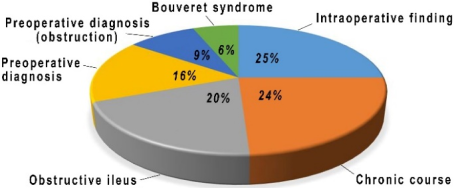
Most patients with gallstone disease undergo elective surgery. However, some patients do not undergo surgery because, despite long-term treatment, they experience only rare complications, the incidence of which does not exceed 1.4%. Rare complications of gallstone disease include external biliary fistulas, cholecystocholedocheal fistulas or Mirizzi syndrome, micro or "large" choledocholithiasis, "shrunken" gallbladder, gallbladder calcification (porcelain gallbladder), and others. Recognizing these rare complications of gallstone disease presents significant challenges, and various types of imaging are the primary methods for their detection. Development of rational surgical management to improve treatment outcomes of rare complications of cholelithiasis. A total of 5,449 patient records for cholelithiasis were reviewed. Of these, 3,332 (61%) were admitted for emergency indications and 2,117 (39%) for elective surgery. Of all patients with calculous cholecystitis, 96 had rare complications, representing a 1.74% incidence. The male-to-female ratio was 1: 4, and the average age of the patients was 70 years. A review of the anamnestic data revealed that the patients had suffered from cholelithiasis for between 5 and 57 years. Of the 96 patients operated on for rare complications of cholelithiasis, 16 (17%) were operated on for emergency indications with acute cholecystitis, 30 (32%) due to the ineffectiveness of conservative treatment, and 14 (15%) due to the failure of endoscopic papillotomy undertaken to resolve mechanical jaundice and cholangitis or due to the development of obstructive cholelithiasis. A study of clinical observations of patients with rare complications of gallstone disease revealed the absence of any pathognomonic manifestations. Only in cases of spontaneous external biliary fistulas, with bile leaking onto the anterior abdominal wall, was the diagnosis immediately apparent. The primary surgical procedure for cholecystodigestive fistulas is their dissection, cholecystectomy, and fistula closure. In cases where choledocholithiasis associated with Mirizzi syndrome cannot be resolved with endoscopic papillotomy, a biliary anastomosis is necessary. The developed surgical approach for rare complications of cholelithiasis aimed at early recognition and prompt surgical intervention led to a favorable short-term outcome in 85 of 96 patients. The overall mortality rate was 11.6% (n=11). The main cause of rare complications of cholelithiasis is a prolonged and/or asymptomatic course of the disease. The best method for preventing this disease is timely surgery during the cold period, preferably minimally invasive. Decompensation of concomitant diseases against the background of a combination of complications of cholelithiasis primarily leads to a fatal outcome.
| Published in | International Journal of Clinical and Experimental Medical Sciences (Volume 12, Issue 3) |
| DOI | 10.11648/j.ijcems.20261203.12 |
| Page(s) | 57-63 |
| Creative Commons |
This is an Open Access article, distributed under the terms of the Creative Commons Attribution 4.0 International License (http://creativecommons.org/licenses/by/4.0/), which permits unrestricted use, distribution and reproduction in any medium or format, provided the original work is properly cited. |
| Copyright |
Copyright © The Author(s), 2026. Published by Science Publishing Group |
Cholelithiasis, Mirizzti Syndrome, Bouvet Syndrome, Gallbladder Fistulas, Shrunken Gallbladder, Porcelain Gallbladder
Diagnosis | N | % |
|---|---|---|
Spontaneous external biliary fistula | 5 | 5,2 |
Internal biliary fistulas | 32 | 33,3 |
Including: | ||
Obstructive small bowel obstruction | 11 | 11,4 |
Bouveret syndrome | 3 | 3,1 |
Scleroatrophic ("shrunken") gallbladder | 11 | 11,5 |
Mirizzi syndrome | 47 | 49,0 |
Porcelain gallbladder | 1 | 1,0 |
Total | 96 | 100 |
Section (Number of Patients) | Variable | N | % |
|---|---|---|---|
Course and Management (96) | Asymptomatic course | 15 | 16 |
Refusal of surgery | 47 | 49 | |
Surgery was not proposed | 34 | 35 | |
Acute cholecystitis (emergency) | 16 | 17 | |
Indications for Surgery (96) | Failure of conservative therapy | 30 | 31 |
Failure of endoscopic papillotomy | 14 | 15 | |
Elective surgery | 36 | 37 | |
Elective Surgery (36) | Preoperative diagnosis | 17 | 46 |
Intraoperative diagnosis | 19 | 54 |
| [1] | Clavien, P. A. Baillie, J. Diseases of the Gallbladder and Bile Ducts: diagnosis and treatment. Blackwell scince. Malden, Massachusetts, 2001. 346 p. |
| [2] | Acute calculous cholecystitis. New information on cholelithiasis. A practical guide. Editors: Buriev, I. M., Melkonyan, G. G. Moscow: GEOTAR-Media, 2020. 272 с. |
| [3] | Glabay, V. P., Eldarova, Z. E. Rational Approach to Surgical Treatment of Acute Biliary Pancreatitis. Surgery Eastern Europe. 2024; 13(4): 512-521. |
| [4] |
Natroshvili, I. G. Ways to optimize treatment tactics for patients with acute calculous cholecystitis. Results of a multicenter study [dissertation]. Yekaterinburg: Ural State Medical University; 2019. 214 p.
https://elib.usma.ru/bitstream/usma/7682/1/USMU_Dis_2019_005.pdf |
| [5] |
Chinikov, M. A. Treatment of patients with calculous cholecystitis with a 24-hour hospital stay [dissertation]. Moscow: Peoples' Friendship University of Russia; 2019. 255 p.
https://www.rudn.ru/storage/u/www/files/dissertation/dissertaciya_.pdf |
| [6] | Glabay, V. P., Askerkhanov, R. G., & Matveeva, G. K. Surgical Management of Patients with Rare Complications of Cholelithiasis. Annals of Surgical Hepatology. 2009; 14(1): 57-63. |
| [7] | Galperin, E. I., Akhaladze, G. G., Kotovsky, A. E., Ungurjanu, T. V., Chevokin, A. Yu. Mirizzy Syndrome: Peculiarities of Diagnoses and Management. Annals of Surgical Hepatology. 2006; 11(3): 7-10. |
| [8] |
Аrdasenov T. B., Budzinsky S. A., Pankov А. G., Bachurin А. N., Shapovalyants S. G. Peculiarity of Surgical Management of Difficult Common Bile Duct Stones of Difficult Common Bile Duct Stones. Annals of HPB Surgery. 2013; 18(1): 23-28.
https://www.elibrary.ru/download/elibrary_20201325_72047707.pdf |
| [9] | Glabay, V. P., Tsvetkov, V. O., Gobedzhishvili, V. V., Eldarova, Z. E., Lesovik, V. S., Orlov B. B. Radical treatment of unformed intestinal fistulas. Medical News of North Caucasus. 2022; 17(2): 199-201. |
| [10] | Askerkhanov, R. G. Rare complications of cholelithiasis and their surgical treatment [dissertation]. Moscow: A. V. Vishnevsky Institute of Surgery; 2008. 103 p. |
| [11] | Vasilchenko, M. I., Ratchyk, V. M., Eldarova, Z. E. Instrumental and laboratory diagnostics of early complications in acute pancreatitis. Experimental and Clinical Gastroenterology. 2022; 8: 106-112. |
| [12] | Strasberg, S. M., Pucci, M. J., Brunt, L. M., Deziel, D. J. Subtotal Cholecystectomy - «Fenestrating» vs «Reconstituting». Journal of the American College of Surgeons. 2016; 222(1): 89-96. |
| [13] | Lunevicius, R. Review of the Literature on Partial Resections of the Gallbladder, 1898-2022: The Outline of the Conception of Subtotal Cholecystectomy and a Suggestion to Use the Terms «Subtotal Open-Tract Cholecystectomy» and «Subtotal Closed-Tract Cholecystectomy». J Clin Med. 2023 Feb 3; 12(3): 1230. |
| [14] | Ramírez-Giraldo, C., Torres-Cuellar, A., Van-Londoño, I. State of the art in subtotal cholecystectomy: An overview. Frontiers in Surgery. 2023 Apr 21; 10: 1142579. |
| [15] | Mirizzi, P. L. Sindrome del conducto hepático. Journal International de Chirurgie. 1948; 8(3): 731-777. |
APA Style
Glabay, V., Tsvetkov, V., Askerkhanov, R., Eldarova, Z., Gobedzhishvili, V. (2026). Rational Surgical Management of Rare Complications of Cholelithiasis. International Journal of Clinical and Experimental Medical Sciences, 12(3), 57-63. https://doi.org/10.11648/j.ijcems.20261203.12
ACS Style
Glabay, V.; Tsvetkov, V.; Askerkhanov, R.; Eldarova, Z.; Gobedzhishvili, V. Rational Surgical Management of Rare Complications of Cholelithiasis. Int. J. Clin. Exp. Med. Sci. 2026, 12(3), 57-63. doi: 10.11648/j.ijcems.20261203.12
AMA Style
Glabay V, Tsvetkov V, Askerkhanov R, Eldarova Z, Gobedzhishvili V. Rational Surgical Management of Rare Complications of Cholelithiasis. Int J Clin Exp Med Sci. 2026;12(3):57-63. doi: 10.11648/j.ijcems.20261203.12
@article{10.11648/j.ijcems.20261203.12,
  author = {Vladimir Glabay and Vitaliy Tsvetkov and Rashid Askerkhanov and Zaira Eldarova and Vakhtang Gobedzhishvili},
  title = {Rational Surgical Management of Rare Complications of Cholelithiasis},
  journal = {International Journal of Clinical and Experimental Medical Sciences},
  volume = {12},
  number = {3},
  pages = {57-63},
  doi = {10.11648/j.ijcems.20261203.12},
  url = {https://doi.org/10.11648/j.ijcems.20261203.12},
  eprint = {https://article.sciencepublishinggroup.com/pdf/10.11648.j.ijcems.20261203.12},
  abstract = {Most patients with gallstone disease undergo elective surgery. However, some patients do not undergo surgery because, despite long-term treatment, they experience only rare complications, the incidence of which does not exceed 1.4%. Rare complications of gallstone disease include external biliary fistulas, cholecystocholedocheal fistulas or Mirizzi syndrome, micro or "large" choledocholithiasis, "shrunken" gallbladder, gallbladder calcification (porcelain gallbladder), and others. Recognizing these rare complications of gallstone disease presents significant challenges, and various types of imaging are the primary methods for their detection. Development of rational surgical management to improve treatment outcomes of rare complications of cholelithiasis. A total of 5,449 patient records for cholelithiasis were reviewed. Of these, 3,332 (61%) were admitted for emergency indications and 2,117 (39%) for elective surgery. Of all patients with calculous cholecystitis, 96 had rare complications, representing a 1.74% incidence. The male-to-female ratio was 1: 4, and the average age of the patients was 70 years. A review of the anamnestic data revealed that the patients had suffered from cholelithiasis for between 5 and 57 years. Of the 96 patients operated on for rare complications of cholelithiasis, 16 (17%) were operated on for emergency indications with acute cholecystitis, 30 (32%) due to the ineffectiveness of conservative treatment, and 14 (15%) due to the failure of endoscopic papillotomy undertaken to resolve mechanical jaundice and cholangitis or due to the development of obstructive cholelithiasis. A study of clinical observations of patients with rare complications of gallstone disease revealed the absence of any pathognomonic manifestations. Only in cases of spontaneous external biliary fistulas, with bile leaking onto the anterior abdominal wall, was the diagnosis immediately apparent. The primary surgical procedure for cholecystodigestive fistulas is their dissection, cholecystectomy, and fistula closure. In cases where choledocholithiasis associated with Mirizzi syndrome cannot be resolved with endoscopic papillotomy, a biliary anastomosis is necessary. The developed surgical approach for rare complications of cholelithiasis aimed at early recognition and prompt surgical intervention led to a favorable short-term outcome in 85 of 96 patients. The overall mortality rate was 11.6% (n=11). The main cause of rare complications of cholelithiasis is a prolonged and/or asymptomatic course of the disease. The best method for preventing this disease is timely surgery during the cold period, preferably minimally invasive. Decompensation of concomitant diseases against the background of a combination of complications of cholelithiasis primarily leads to a fatal outcome.},
 year = {2026}
}
TY  - JOUR
T1  - Rational Surgical Management of Rare Complications of Cholelithiasis
AU  - Vladimir Glabay
AU  - Vitaliy Tsvetkov
AU  - Rashid Askerkhanov
AU  - Zaira Eldarova
AU  - Vakhtang Gobedzhishvili
Y1  - 2026/08/18
PY  - 2026
N1  - https://doi.org/10.11648/j.ijcems.20261203.12
DO  - 10.11648/j.ijcems.20261203.12
T2  - International Journal of Clinical and Experimental Medical Sciences
JF  - International Journal of Clinical and Experimental Medical Sciences
JO  - International Journal of Clinical and Experimental Medical Sciences
SP  - 57
EP  - 63
PB  - Science Publishing Group
SN  - 2469-8032
UR  - https://doi.org/10.11648/j.ijcems.20261203.12
AB  - Most patients with gallstone disease undergo elective surgery. However, some patients do not undergo surgery because, despite long-term treatment, they experience only rare complications, the incidence of which does not exceed 1.4%. Rare complications of gallstone disease include external biliary fistulas, cholecystocholedocheal fistulas or Mirizzi syndrome, micro or "large" choledocholithiasis, "shrunken" gallbladder, gallbladder calcification (porcelain gallbladder), and others. Recognizing these rare complications of gallstone disease presents significant challenges, and various types of imaging are the primary methods for their detection. Development of rational surgical management to improve treatment outcomes of rare complications of cholelithiasis. A total of 5,449 patient records for cholelithiasis were reviewed. Of these, 3,332 (61%) were admitted for emergency indications and 2,117 (39%) for elective surgery. Of all patients with calculous cholecystitis, 96 had rare complications, representing a 1.74% incidence. The male-to-female ratio was 1: 4, and the average age of the patients was 70 years. A review of the anamnestic data revealed that the patients had suffered from cholelithiasis for between 5 and 57 years. Of the 96 patients operated on for rare complications of cholelithiasis, 16 (17%) were operated on for emergency indications with acute cholecystitis, 30 (32%) due to the ineffectiveness of conservative treatment, and 14 (15%) due to the failure of endoscopic papillotomy undertaken to resolve mechanical jaundice and cholangitis or due to the development of obstructive cholelithiasis. A study of clinical observations of patients with rare complications of gallstone disease revealed the absence of any pathognomonic manifestations. Only in cases of spontaneous external biliary fistulas, with bile leaking onto the anterior abdominal wall, was the diagnosis immediately apparent. The primary surgical procedure for cholecystodigestive fistulas is their dissection, cholecystectomy, and fistula closure. In cases where choledocholithiasis associated with Mirizzi syndrome cannot be resolved with endoscopic papillotomy, a biliary anastomosis is necessary. The developed surgical approach for rare complications of cholelithiasis aimed at early recognition and prompt surgical intervention led to a favorable short-term outcome in 85 of 96 patients. The overall mortality rate was 11.6% (n=11). The main cause of rare complications of cholelithiasis is a prolonged and/or asymptomatic course of the disease. The best method for preventing this disease is timely surgery during the cold period, preferably minimally invasive. Decompensation of concomitant diseases against the background of a combination of complications of cholelithiasis primarily leads to a fatal outcome.
VL  - 12
IS  - 3
ER  -
Department of Surgery, Sechenov First Moscow State Medical University (Sechenov University), Moscow, Russia
Department of Surgery, Sechenov First Moscow State Medical University (Sechenov University), Moscow, Russia
Department of Surgery, Sechenov First Moscow State Medical University (Sechenov University), Moscow, Russia
Department of Surgery, Sechenov First Moscow State Medical University (Sechenov University), Moscow, Russia
Department of Surgery, Sechenov First Moscow State Medical University (Sechenov University), Moscow, Russia

Information



 Share This Article
 Twitter
 Linked In
 Facebook
 Copy
Copy Download